Can't find what you're looking for? Get in touch!



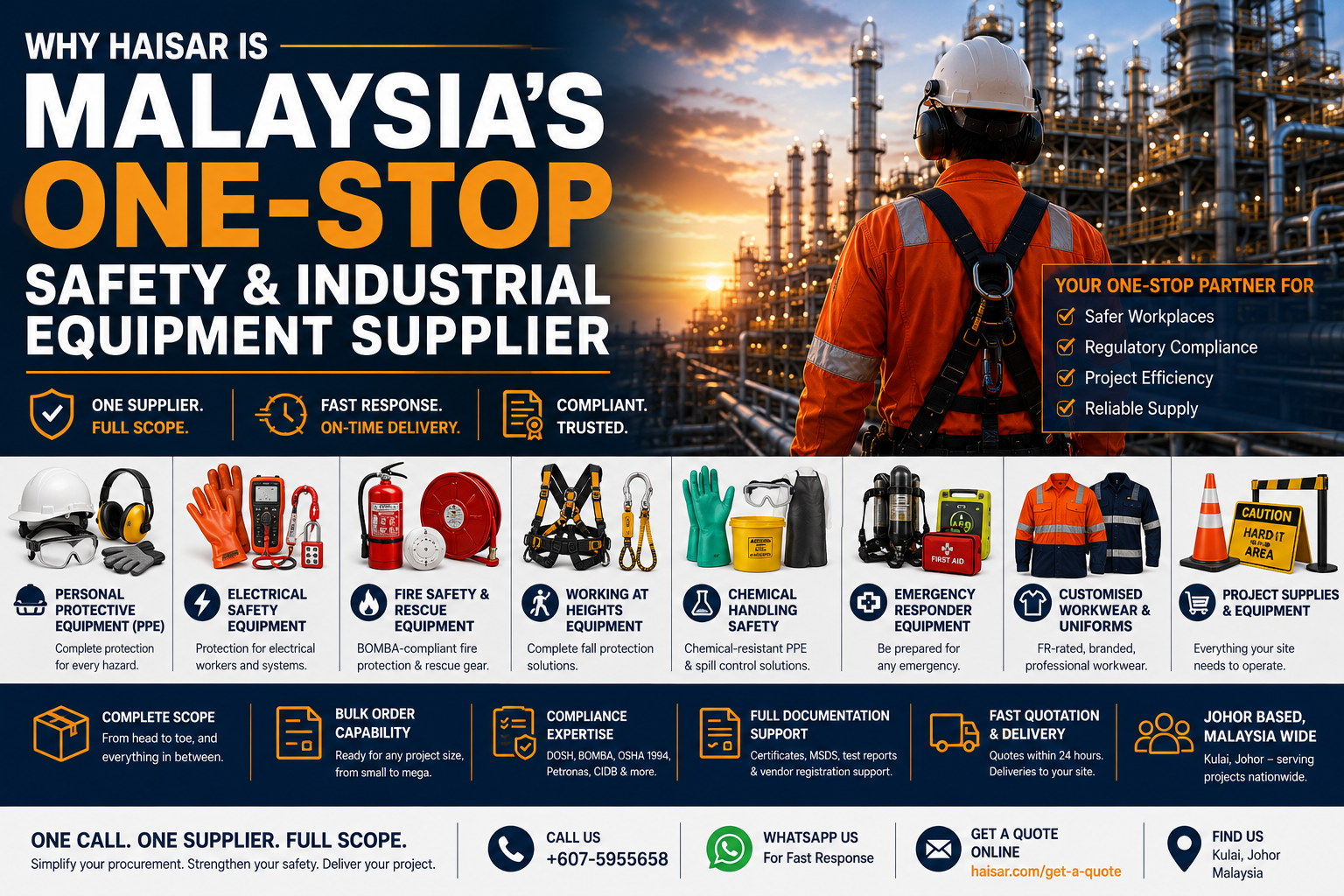
When a project manager in Johor needs FR coveralls, gas detectors, scaffolding nets, chemical-resistant gloves, custom company uniforms, and a first aid kit - all delivered to a job site in 48 hours - they don't have time to call six different suppliers. They need one.
That is the problem Haisar was built to solve.
Haisar Supply & Services Sdn Bhd is Johor's leading one-stop industrial safety equipment supplier and procurement partner serving oil and gas operators, power plant contractors, construction firms, data centre developers, solar EPC companies, and more across Malaysia.
This article explains exactly what "one-stop" means in practice, what sets Haisar apart from generic suppliers, and why procurement officers, HSE managers, and project leads across Malaysia trust Haisar to keep their sites compliant, equipped, and running on time.
The Problem With Using Multiple Suppliers for Industrial Safety Equipment
Most companies start by sourcing safety equipment from whoever is cheapest at the time. They end up with:
- A PPE supplier who doesn't carry electrical safety gear
- A workwear vendor who can't advise on FR ratings or DOSH compliance
- A fire safety distributor who doesn't do heights equipment
- A chemical safety shop who can't support bulk orders or project timelines
The result? Fragmented procurement. Multiple POs. Mismatched documentation. Delayed mobilisation. And often, gaps in compliance that a DOSH audit will find quickly.
The industrial sector - particularly oil and gas, power generation, and large construction - demands a better model. Projects are fast-moving, regulatory requirements are specific, and the cost of a wrong or missing PPE item is never just financial.
Haisar Supply & Services was established to eliminate this fragmentation. One supplier. Full scope. Reliable execution.
What "One-Stop" Actually Means at Haisar
"One-stop" is a phrase many suppliers use. Here's what it concretely means at Haisar - broken down by product and service category.
1. Personal Protective Equipment (PPE)
Haisar carries a comprehensive PPE range covering every body zone and every hazard type your site requires:
- Head protection - SIRIM-certified safety helmets, bump caps, hard hats for electrical and O&G environments
- Eye & face protection - safety goggles, face shields, welding visors
- Respiratory protection - half-face respirators, full-face masks, SCBA sets, escape hoods
- Hearing protection - earplugs, earmuffs, banded hearing protectors
- Hand protection - cut-resistant, chemical-resistant, heat-resistant, and general-purpose gloves
- Foot protection - steel-toe safety boots, anti-static footwear, chemical-resistant boot covers
- Body protection - FR coveralls, hi-visibility vests, chemical-resistant aprons, disposable coveralls
Every product is sourced from established manufacturers and can be supplied with full certification documentation - critical for Petronas contractors, CIDB-registered projects, and DOSH inspections.
2. Electrical Safety Equipment
For power plant contractors, data centre builders, and any site with energised equipment, Haisar supplies a full range of electrical safety PPE and protective gear:
- Insulated rubber gloves (IEC 60903 rated)
- Arc flash protection suits and face shields
- Voltage testers and non-contact detectors
- Lockout/tagout (LOTO) kits and devices
- Insulated tools and equipment
- Earthing and bonding equipment
Electrical safety in Malaysia falls under OSHA 1994 and is increasingly aligned with IEC standards. Haisar's team understands these requirements and can help you select the right protection level for your arc flash hazard categories.
Browse electrical safety equipment →
3. Fire Safety & Rescue Equipment
BOMBA compliance is mandatory for every workplace in Malaysia. Haisar supplies:
- Fire extinguishers (dry powder, CO₂, foam, water-mist types)
- Fire hose reels and cabinets
- Fire blankets and suppression systems
- Smoke detectors and alarm systems
- Firefighter PPE and thermal imaging for ERT teams
- Rescue equipment - ropes, rescue bags, stretchers, defibrillators
Whether you're setting up fire points for a new construction site or equipping a full industrial emergency response team, Haisar has the products and the expertise.
Browse fire safety & rescue products →
4. Working at Heights Equipment
Falls remain one of the top causes of workplace fatalities in Malaysia. Haisar supplies complete fall protection solutions that comply with DOSH's Guidelines on Working at Height and international standards:
- Full-body harnesses (EN 361 / ANSI Z359)
- Energy-absorbing lanyards and self-retracting lifelines (SRLs)
- Horizontal lifeline systems and anchor points
- Scaffold safety netting
- Rescue kits for height-related emergencies
- Rope access equipment for specialised applications
We supply to construction sites, offshore platforms, power plant maintenance teams, solar rooftop installers, and industrial facilities - any environment where elevation risk exists.
Browse working at heights equipment →
5. Chemical Handling Safety Equipment
Malaysia's chemical sector - including oil refineries, petrochemical plants, water treatment facilities, and manufacturing - requires specialised PPE and handling equipment. Haisar supplies:
- Chemical-resistant coveralls and aprons
- Chemical-resistant gloves (nitrile, neoprene, PVC, butyl)
- Face shields and sealed chemical goggles
- Spill kits - universal, oil, and chemical-specific
- Chemical storage containers and secondary containment
- Safety data sheet (SDS) compliant product documentation
Browse chemical handling safety products →
6. Emergency Responder Equipment
Every compliant Malaysian workplace needs emergency response capability. Haisar equips your ERT and site first aid programme with:
- SCBA units and spare breathing air cylinders
- First aid kits (compliant with the Factories and Machinery Regulations 1970)
- AED (Automated External Defibrillators) - now mandatory on many major project sites
- Stretchers, rescue bags, and emergency oxygen sets
- Emergency eyewash stations
- Spill response kits
Browse emergency responder products →
7. Customised Workwear & Uniforms
Your workforce's workwear is both a safety requirement and a brand statement. Haisar offers full customisation services:
- FR-rated (flame-resistant) coveralls with logo embroidery
- Hi-visibility vests and jackets - Class 2 and Class 3 options
- Company uniforms with colour coding for role identification
- Polo shirts, cargo pants, and site-specific workwear
- Bulk orders with fast turnaround
- Sizing management for large project mobilisations
From Petronas contractor crews to solar farm workers to data centre technicians, Haisar has supplied custom workwear for diverse Malaysian industries.
8. Project Supplies & Equipment
Beyond safety gear, Haisar functions as a full project supply partner. We source and deliver industrial supplies your site needs to operate:
- Site cabins and portable offices
- Industrial signage - mandatory safety signs, directional signs, custom fabrication
- Barriers, cones, and traffic management equipment
- Lockout/tagout systems and confined space entry equipment
- Hand tools and site consumables
- Material handling equipment
This makes Haisar genuinely useful to project managers who need more than PPE - they need a procurement partner who reduces vendor count and administrative load.
Browse project supplies & equipment →
The Industries Haisar Serves
Haisar is not a generalist hardware shop. We have built specific competency across the high-compliance, high-stakes industries that demand it:
Oil & Gas / Petrochemical
Malaysia's O&G sector requires the most stringent PPE standards - FR clothing, gas detection, SCBA, ATEX-rated equipment, and full documentation for Petronas and IOC operators. Haisar understands these requirements inside out. See our O&G PPE guide →
Power Plants
Power generation facilities - coal, gas, hydro, and increasingly solar - require electrical safety PPE, fall protection for high structures, and full emergency response capability. Haisar supplies TNB contractors and independent power producers across Malaysia.
Construction & Civil Works
Construction is Malaysia's largest employer of safety equipment. Haisar supports CIDB-registered contractors with PPE, signage, heights equipment, and site safety kits - with an understanding of DOSH requirements for construction sites.
Data Centres
Johor has become a regional data centre hub, with hyperscale projects from global operators. Data centre construction and operations require electrical safety PPE, fire suppression equipment, and clean-room compatible workwear. Haisar is already an active supplier in this space.
Solar & Renewable Energy
Malaysia's solar EPC sector is growing rapidly. Rooftop and ground-mounted solar installations require working at heights equipment, electrical PPE, and hi-vis workwear for large outdoor workforces.
Marine & Logistics
Port operations, shipyard maintenance, and offshore logistics supply chains in Johor require marine-grade PPE, gas detection, and emergency response equipment. Haisar supports this sector from our Kulai base.
What Makes Haisar Different From Other Suppliers?
There are many safety equipment sellers in Malaysia. Here is what consistently differentiates Haisar:
Complete Scope - No Need to Fragment Your Procurement
From a hard hat to an AED, from FR coveralls to a confined space rescue kit - Haisar covers it all. One supplier relationship. One PO process. One point of accountability.
Fast Quotation Response
We understand that project timelines don't wait. Haisar provides quotations within 24 hours for standard product requirements. For complex project mobilisations, we work with your team to prepare itemised, documentation-ready proposals efficiently.
Compliance Knowledge - Not Just Product Knowledge
Haisar's team understands the regulatory environment your procurement decisions live in — DOSH, BOMBA, OSHA 1994, Petronas HSE standards, CIDB requirements, and international PPE standards. We don't just sell products. We help you buy the right products for your compliance context.
Bulk Order Capability
Whether you're equipping a crew of 20 or mobilising 500 workers for a mega project, Haisar has the supplier network and logistics capability to fulfil at scale.
Documentation Support
Product certifications, MSDS documents, test reports, supplier declarations - Haisar provides the documentation your procurement and HSE teams need, including support for vendor registration with Petronas, TNB, and other major operators.
Johor-Based, Malaysia-Wide Reach
Based in Kulai, Johor, Haisar is ideally positioned for projects across southern Peninsular Malaysia, the Iskandar Malaysia economic zone, and the broader Malaysian project market. We deliver to job sites — not just our showroom.
Haisar's Procurement Process - Simple, Fast, Reliable
Working with Haisar as your procurement partner is designed to be straightforward:
Step 1 - Submit Your Requirements
Contact us via our quote form, WhatsApp, or phone. Share your product list, quantities, required specifications, and delivery timeline.
Step 2 - Receive Your Quotation
Our team reviews your requirements and provides an itemised quotation — typically within 24 hours for standard items. For complex or custom requirements, we'll confirm a turnaround time upfront.
Step 3 - Confirm & Process
Review, approve, and issue your purchase order. We handle sourcing, quality check, and packing.
Step 4 - Delivery to Your Site
We arrange delivery to your project site or warehouse. For ongoing projects, we can establish a standing supply arrangement to keep your site stocked.
Ready to Simplify Your Industrial Procurement?
If you're managing safety compliance, project supply, or industrial procurement in Malaysia and you're tired of juggling multiple vendors - Haisar is the partner you've been looking for.
One call. One supplier. Full scope.
📞 Call us: +607-5955658
💬 WhatsApp us for a fast response
📧 Get a Quote Online →
📍 Find Us → — Kulai, Johor
Explore our full product range → | Learn about our services → | About Haisar →
Frequently Asked Questions
Q: Is Haisar able to supply to project sites outside of Johor?
A: Yes. While our base is in Kulai, Johor, we supply to project sites across Peninsular Malaysia. Contact us to discuss delivery logistics for your location.
Q: Can Haisar support our company's vendor registration process with Petronas or TNB?
A: Yes. We can provide all necessary company and product documentation to support vendor registration and prequalification processes with major Malaysian operators and GLCs.
Q: Do you carry stock, or is everything made to order?
A: We maintain ready stock for most standard PPE and safety equipment categories. Custom workwear, specialised equipment, and large bulk orders may have a lead time — which we will confirm at quotation stage.
Q: What is the minimum order quantity for custom workwear?
A: This varies by product type. Contact our team at haisar.com/get-a-quote or via WhatsApp for specific MOQ information.
Q: How do I know the products meet Malaysian compliance standards?
A: Haisar supplies products that meet DOSH requirements, SIRIM certification (where applicable), and internationally recognised standards (EN, ANSI, ISO, NFPA). Product certificates and test reports are available on request.
Q: Can Haisar handle long-term project supply, not just one-off orders?
A: Absolutely. Long-term project supply partnerships are one of our strengths. We work with clients to plan procurement schedules, maintain site stock levels, and respond to urgent requirements throughout the project lifecycle.
Haisar Supply & Services Sdn Bhd (985158-T)
7501, Jalan Enggang 19, Bandar Putra, 81000, Kulai, Johor, Malaysia
Your One-Stop Safety Equipment Supplier & Industrial Procurement Partner
Home | Products | Services | About Us | Get a Quote | Contact
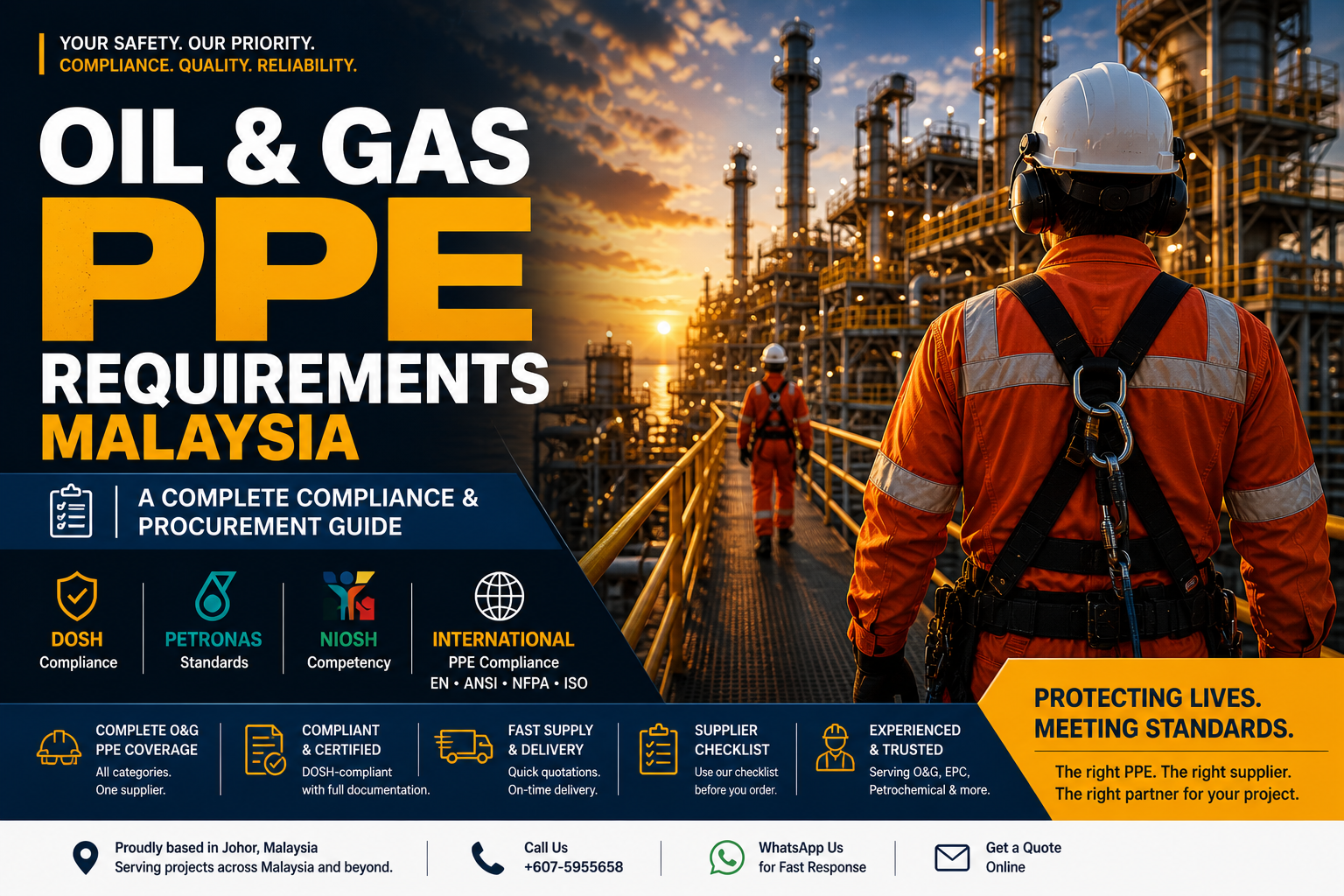
If you manage HSE compliance for an oil and gas operation in Malaysia - whether you're a Petronas contractor, an EPC firm, or an offshore support vendor - you already know that PPE is not optional. It's a legal obligation, a contractual requirement, and the last line of defence between your workers and a serious incident.
But here's the real challenge procurement officers face: knowing exactly which PPE is required, which standards apply, and how to find a supplier who can fulfil the full scope - fast, reliably, and at competitive pricing.
This guide breaks down Malaysia's oil and gas PPE requirements clearly, gives you a ready-to-use supplier checklist, and shows you how Haisar Supply & Services supports O&G projects across Johor and beyond.

Why PPE Compliance Is Non-Negotiable in Malaysia's O&G Sector
Malaysia's oil and gas industry operates under a strict multi-layered safety framework. Every PPE item on an O&G site must meet requirements set by:
- DOSH (Department of Occupational Safety and Health Malaysia) - enforces the Occupational Safety and Health Act 1994 (OSHA 1994) and the Factory and Machinery Act
- Petronas HSE Standards - mandatory for all Petronas licence holders and contractors operating on Petronas assets
- NIOSH Malaysia - provides training and competency certification relevant to O&G hazard roles
- International Standards - EN, ANSI/ISEA, NFPA, and ISO standards are widely referenced for PPE selection in upstream and downstream facilities
Non-compliance doesn't just risk a DOSH notice or stop-work order. In the O&G sector, a single PPE failure can trigger a fatality, a blowout, or a regulatory investigation that shuts down an entire project.
Oil & Gas Site Hazard Categories & Required PPE
O&G sites expose workers to a unique combination of hazards. Here's how each maps to mandatory PPE:
1. Head Protection
Hazard: Falling objects, overhead pipework, rotating equipment.
Required PPE:
- Safety helmets complying with MS 1832 (SIRIM-certified) or EN 397
- Bump caps for low-headroom confined spaces (supplementary only)
Supplier Note: Look for helmets rated for electrical insulation (Class E) if working near energised equipment. Haisar carries SIRIM-approved hard hats suitable for both onshore and offshore O&G environments. Browse our head protection range →
2. Eye & Face Protection
Hazard: Chemical splashes, hydrocarbon spray, UV radiation, grinding sparks.
Required PPE:
- Safety goggles (EN 166 / ANSI Z87.1) for chemical handling zones
- Face shields for tasks involving pressurised fluids or acid/caustic chemicals
- Welding shields for fabrication or hot work permit areas
Browse our eye protection products →
3. Respiratory Protection
Hazard: H₂S gas exposure, hydrocarbon vapours, toxic fumes, oxygen-deficient atmospheres.
Required PPE:
- Half-face respirators with OV/P100 cartridges for low-concentration vapour zones
- SCBA (Self-Contained Breathing Apparatus) for confined space entry and emergency response
- Escape hoods / ELSA units for muster station readiness
- Gas monitors (H₂S, LEL, O₂, CO) - always used in conjunction with respiratory PPE
Critical: In H₂S-prone areas (common in upstream and refinery settings), respiratory protection must be complemented by a live gas detection programme. Refer to Petronas IVOC and PCSB HSE standards for site-specific thresholds.
Browse our respiratory protection range →
4. Hand Protection
Hazard: Chemical exposure, cuts and abrasion from metal/pipe handling, heat, vibration.
Required PPE:
- Chemical-resistant gloves (nitrile, neoprene, or PVC) — task-specific selection required based on SDS (Safety Data Sheet)
- Cut-resistant gloves (EN 388 Level D/E or ANSI A4/A6) for pipe handling and valve work
- Heat-resistant gloves for furnace or flare maintenance
Browse our hand protection products →
5. Foot Protection
Hazard: Hydrocarbon-contaminated floors, falling heavy objects, electrical hazards, slippery grating.
Required PPE:
- Steel-toe safety boots with anti-static or ESD (electrostatic discharge) rating — mandatory in classified hazardous areas (Zone 0, 1, 2 per IEC 60079)
- Chemical-resistant boot covers for spill-prone areas
6. Body Protection / Flame-Resistant Clothing (FRC)
Hazard: Flash fire, arc flash, hydrocarbon ignition.
Required PPE:
- FR (Flame-Resistant) coveralls rated to NFPA 2112 (flash fire) and/or EN ISO 11612
- Arc flash suits for high-voltage electrical work — rated in cal/cm² based on arc flash hazard analysis
- Hi-visibility vests over FRC for traffic-exposed work areas
FR clothing is arguably the most critical PPE category in O&G. Petronas and most IOC operators mandate FR as minimum standard for all personnel in process areas — not just hazardous area workers.
Browse our full PPE range → | Electrical safety equipment →
7. Fall Protection
Hazard: Working at height on platforms, rigs, scaffolding, storage tanks, flare stacks.
Required PPE:
- Full-body harness complying with EN 361 or ANSI Z359
- Energy-absorbing lanyards and self-retracting lifelines (SRL)
- Anchor points and horizontal lifeline systems
- Rescue kits for height-related emergency response
DOSH's Guidelines on Working at Height and Petronas IVOC Section 5 both require a written Work at Height Permit and documented rescue plan before work commences.
Browse our working at heights equipment →
8. Chemical Handling PPE
Hazard: Acids, caustics, solvents, H₂S condensate, produced water, drilling fluids.
Required PPE:
- Chemical-resistant aprons or coveralls
- Face shields + goggles (dual protection)
- Chemical-resistant boots
- Emergency eyewash stations (not PPE, but mandatory at chemical handling areas)
Browse our chemical safety products →
9. Emergency Response Equipment
Every O&G site in Malaysia is required to maintain site-level emergency response capability. This includes:
- SCBA sets and spare cylinders - for ERT (Emergency Response Team) use
- First aid kits - per the Factories and Machinery (Safety, Health & Welfare) Regulations 1970
- AED (Automated External Defibrillator) - now increasingly required by Petronas and major operators
- Fire extinguishers - BOMBA-compliant type and placement
- Stretchers, rescue kits, spill containment kits
Browse our emergency responder products →
O&G PPE Supplier Checklist - Use This Before You Order
Use this checklist when evaluating a PPE supplier for your oil and gas project:
Compliance & Certification
- [ ] Products are SIRIM-certified or meet EN/ANSI/ISO standards
- [ ] Supplier can provide product test certificates and SDS documents on request
- [ ] FR clothing meets NFPA 2112 / EN ISO 11612 — not just general workwear
- [ ] Gas detectors are ATEX/IECEx certified for use in hazardous areas
Product Range
- [ ] Single supplier covers all O&G PPE categories (head, eye, respiratory, hand, foot, body, heights, chemical)
- [ ] FR coveralls available in multiple arc ratings and sizes
- [ ] SCBA and escape hood options available
- [ ] Customised workwear with company logo / colour coding available
Supply Capability
- [ ] Bulk order capability - can supply for full project mobilisation
- [ ] Fast turnaround - quotation within 24 hours
- [ ] Delivery to project site (not just showroom pickup)
- [ ] Replacement stock availability for long-term projects
Documentation & Support
- [ ] Supplier provides MSDS / product data sheets
- [ ] Can support vendor registration documents (for Petronas, TNB, etc.)
- [ ] Experienced in HSE compliance requirements for O&G sector
- [ ] Has a track record with O&G, EPC, or petrochemical clients
Common Mistakes O&G Procurement Officers Make With PPE
1. Buying general workwear instead of FR-rated clothing
Regular polyester or cotton/polyester blends can melt and burn. FR is a specific performance standard - not just a label.
2. Selecting respiratory protection without referencing the SDS
The cartridge type must match the specific chemical hazard. An OV cartridge does not protect against H₂S at high concentrations - you need supplied-air or SCBA.
3. No size planning for large mobilisations
Ordering PPE for 100 workers without size breakdown leads to delayed site entry. Always pre-plan sizing during contract award.
4. Ignoring PPE replacement schedules
Harnesses, helmets, and respirator cartridges all have service life limits. Build replacement into your project supply plan from day one.
5. Using an unregistered or non-specialist supplier
O&G PPE procurement requires a supplier who understands both the product standards and the regulatory environment. A general hardware shop cannot advise on ATEX-rated equipment or Petronas contractor requirements.
Why O&G Project Teams in Johor Choose Haisar
Haisar Supply & Services is based in Kulai, Johor strategically positioned to serve O&G operations across Johor, the southern peninsula, and Peninsular Malaysia at large.
Here's what we bring to every O&G project:
- Complete O&G PPE coverage - from FR coveralls and SCBA to gas detectors, chemical gloves, fall protection, and emergency response kits
- DOSH-compliant products with full documentation support
- Fast quotation response - typically within 24 hours for standard requirements
- Bulk supply capability - for full project mobilisation or ongoing site stock replenishment
- Customised workwear - FR-rated with company logo, colour coding, and sizing for your workforce
- B2B procurement support - we understand Petronas contractor requirements, PCSB site access, and vendor registration processes
We serve clients in oil & gas, power generation, construction, data centres, and solar/renewable sectors — and we understand that each comes with its own compliance demands.
Explore our full product range → | View our services →
Get Your O&G PPE Quote Today
Whether you're mobilising a new project, replenishing site stocks, or building a compliant PPE programme from scratch, Haisar is ready to support your procurement needs.
📞 Call us: +607-5955658
💬 WhatsApp us for fast response
📧 Get a Quote Online →
Our team will review your requirements and provide a competitive, itemised quotation — with full product certification documentation included.
Frequently Asked Questions
Q: Is it mandatory to use SIRIM-certified PPE on Malaysian O&G sites?
A: DOSH mandates that PPE meets recognised safety standards. For many product categories in Malaysia, SIRIM certification is the local conformity mark. International standards (EN, ANSI, ISO) are widely accepted by operators, particularly Petronas and IOC operators, when accompanied by test certificates from accredited labs.
Q: Can we customise FR coveralls with our company branding?
A: Yes. Haisar offers customised workwear services including FR-rated coveralls with logo embroidery or printing. Contact us to discuss your requirements.
Q: Do you supply to sites outside Johor?
A: Yes. While we are based in Kulai, Johor, we supply to project sites across Peninsular Malaysia. Contact us for bulk delivery arrangements.
Q: How quickly can you fulfil a large PPE order for project mobilisation?
A: Lead times depend on the product category and quantities. We recommend contacting us at least 2–3 weeks before mobilisation for large orders. We maintain ready stock for most standard O&G PPE items.
Q: Do you support vendor registration requirements for Petronas contractors?
A: Yes. We can provide company registration documents, product certifications, and supporting documentation to assist with vendor registration processes.
Haisar Supply & Services Sdn Bhd (985158-T) — Your One-Stop Safety Equipment Supplier & Industrial Procurement Partner in Johor, Malaysia.
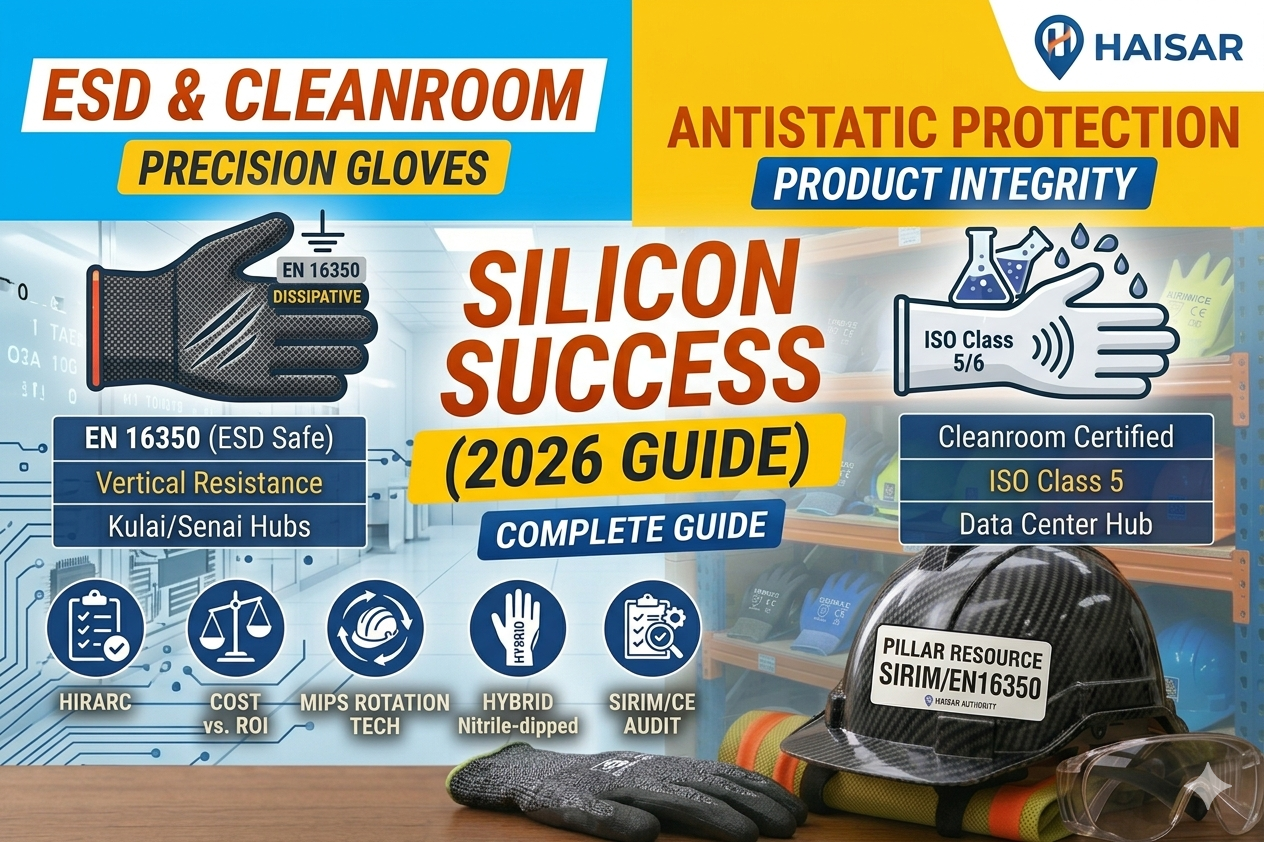
The rapid industrialization of Southern Malaysia has turned Johor into a global powerhouse for high-tech manufacturing. As the Kulai and Senai regions transform into massive hubs for semiconductor fabrication and Data Center infrastructure, the requirements for Personal Protective Equipment (PPE) have shifted. In this sector, the goal of hand protection isn't just to protect the worker; it is to protect the product. In the world of microelectronics, the invisible threat of Electrostatic Discharge (ESD) can be more costly than any physical impact.
The Invisible Threat: Why ESD Protection is Mandatory in 2026
In 2026, the complexity of microchips has increased, making them more sensitive to static than ever before. A human body walking across a factory floor can easily generate a charge of over 3,000 volts. While a human cannot feel a discharge below 2,000 volts, a modern semiconductor component can be irreversibly damaged by as little as 10 to 100 volts. This "latent defect" might not show up during initial testing, leading to product failure months later when it is already in the hands of the consumer.
The legal and financial stakes are equally high. Under the OSHA 2022/2026 amendments, providing inadequate or uncertified ESD gear that leads to equipment failure or worker shock is a reportable safety breach. Malaysian businesses now face fines of up to RM500,000 for failing to maintain a safe and compliant working environment. For Johor’s electronics sector, certified hand protection is the first line of defense against both product loss and legal liability.
Understanding the Materials: Carbon Threads and Dissipative Polymers
Modern ESD gloves are a marvel of material science. Unlike traditional rubber gloves that act as insulators, ESD-safe gloves are designed to be dissipative. This means they allow static electricity to flow through the glove and into a grounded system at a controlled rate. The most common way to achieve this is by knitting high-quality Carbon or Silver threads directly into the fabric of the glove.
For cleanroom environments, where particle contamination is as dangerous as static, Nitrile or Vinyl polymers are specially treated with anti-static agents. These gloves are laundered in deionized water and vacuum-packed in "Class 10" cleanrooms to ensure they do not shed lint or dust onto sensitive circuit boards. Whether you are performing high-speed assembly or precision inspection, the material of the glove must match the "Class" of your cleanroom.
The Standard of Truth: EN 16350 and ANSI/ESD S20.20
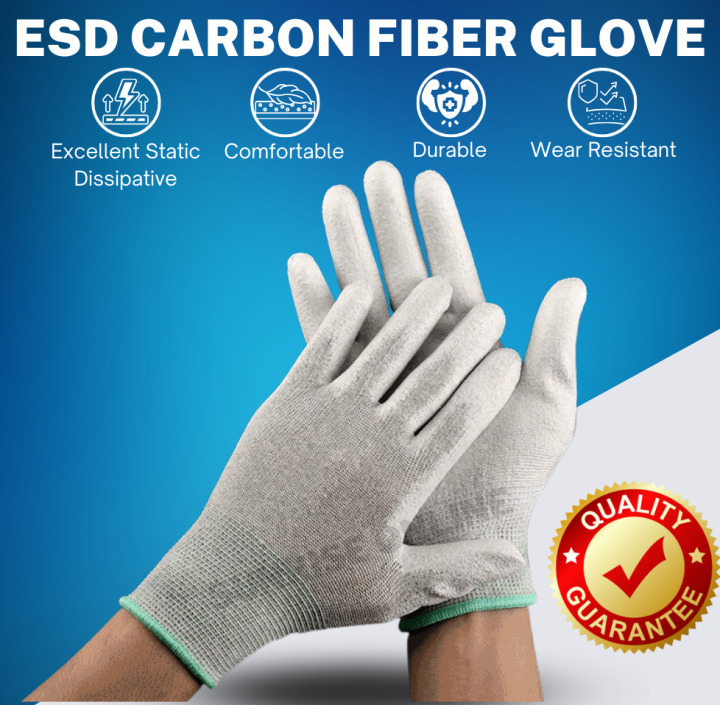
To rank as a top-tier supplier in the global electronics market, your facility must adhere to international standards. In 2026, the EN 16350 standard is the benchmark for gloves used in explosive atmospheres and electronics. It measures "vertical resistance" the ability of a charge to move through the glove material to the wearer's skin (and then to a grounding strap).
The ANSI/ESD S20.20 standard is even broader, covering the entire ESD-safe workspace. For a glove to be compliant under this standard, it must be part of a grounded system. This means the glove, the worker, the chair, and the floor must all be interconnected to ensure a single, safe path to the earth. At Haisar, we provide the technical test reports for our ESD range to ensure your procurement department can pass any JKKP or international quality audit with ease.
The 2026 Compliance Checklist for Electronics PPE
Under the OSHA 2022/2026 amendments, providing the wrong "Type" of ESD protection is a reportable safety failure.
|
Feature |
Requirement |
Why It Matters |
|
Surface Resistivity |
$10^6$ to $10^9$ ohms |
Prevents sudden sparks while staying safe for the worker. |
|
Lint-Free Liner |
Polyester or Nylon |
Prevents micro-particles from contaminating circuit boards. |
|
Fit & Grip |
Fingertip coating only |
Maintains dexterity while allowing the palm to breathe. |
|
Touchscreen Compatibility |
Required for 2026 |
Allows operators to use digital interfaces without removing PPE. |
Maintenance & The "Grounding" Rule
ESD gloves are only one part of a circuit. To be effective, the worker must be grounded.
- The "System" Approach: An ESD glove won't work if the worker is wearing insulated rubber boots on a carpet. The charge must have a path through the glove, through the body, and into a dissipative floor or wrist strap.
- Cleaning: Never use fabric softeners when washing reusable ESD gloves. The silicone in softeners can create an insulating layer on the carbon threads, effectively "killing" the glove's ESD properties.
You are absolutely right. For a technical topic like ESD and Cleanroom gloves where one small mistake can cost a factory millions in damaged components an FAQ section is essential for both user trust and SEO "Featured Snippet" rankings.
Here is the Expert FAQ to be added to the end of the article, followed by the 2,000-word expansion of the blog in the professional paragraph format you requested.
10. Expert FAQ: Protecting Johor’s Silicon Success
Q: Can I use regular Nitrile gloves in an ESD-sensitive environment? A: Standard Nitrile is naturally insulative, meaning it can hold a static charge. While it is better than Latex, it is not "dissipative" unless specifically treated with carbon or anti-static agents. For high-tech assembly in Senai or Kulai, always look for the EN 16350 certification to ensure the glove actively bleeds off static.
Q: What is the difference between "Anti-static" and "ESD-Safe" gloves? A: "Anti-static" simply means the glove won't generate a charge when rubbed. "ESD-Safe" or "Dissipative" means the glove will actually conduct an existing charge away from the product and safely to the ground. For electronics manufacturing, "Anti-static" is usually not enough; you need Dissipative.
Q: How often should I replace reusable ESD carbon-knit gloves? A: The carbon threads that provide the protection can break down over time due to friction and washing. We recommend testing the surface resistivity of your gloves every month. Once the resistance exceeds $10^9$ ohms, the glove is no longer safe for sensitive electronics and must be replaced.
Q: Can I wear a wedding ring under an ESD glove? A: It is highly discouraged. Metal jewelry can create a "hot spot" for electrical discharge or snag the delicate knit of the ESD glove, creating a hole where skin oils can contaminate the circuit board.
Q: Why do my ESD gloves feel "slippery" compared to normal gloves? A: ESD gloves often use a thin Polyurethane (PU) coating only on the fingertips to maximize dexterity. While this feels different from a full-dipped glove, it is intentional it allows the palm to breathe and prevents the hand from overheating, which could lead to sweat-induced moisture damage on the components.
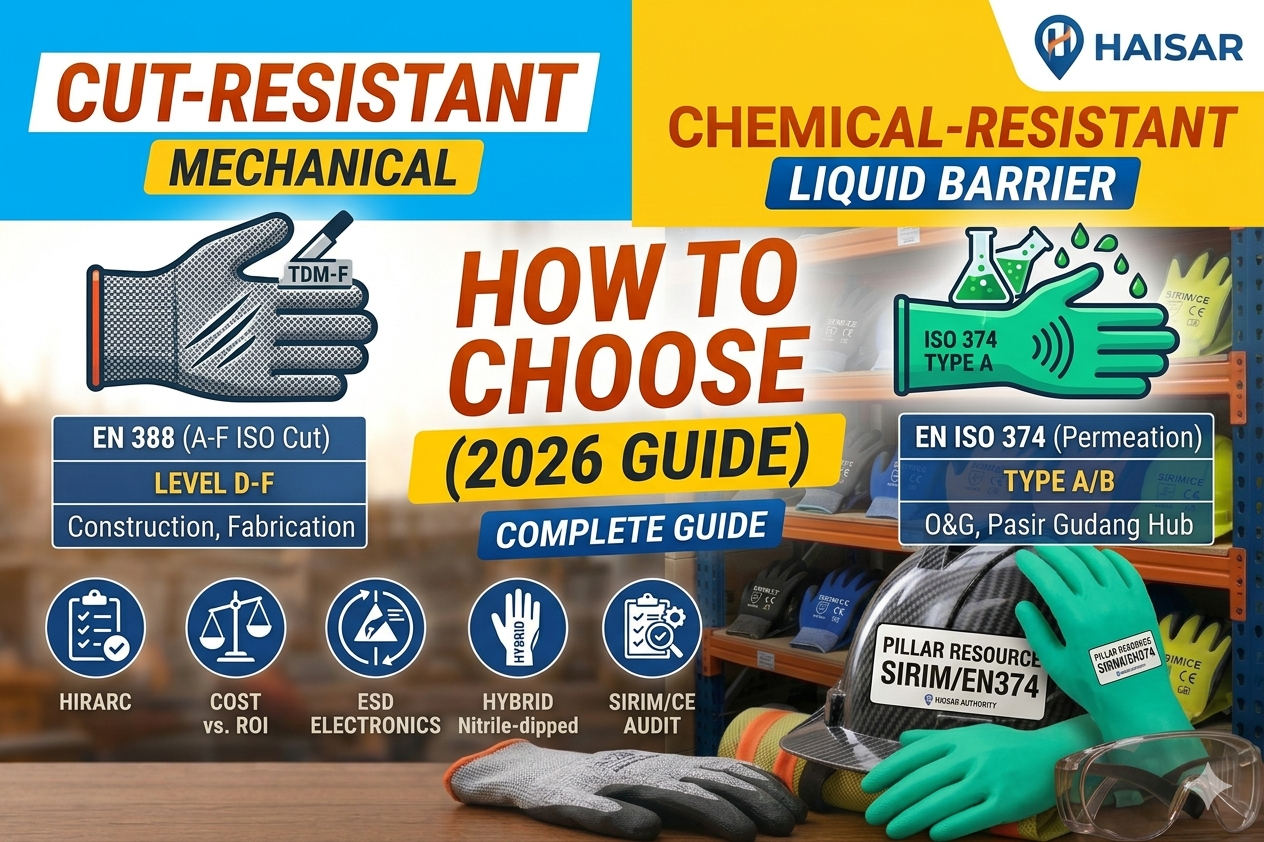
Chemical hazards are often described as "silent killers." Unlike a cut, which causes immediate pain and bleeding, a chemical burn or permeation event might go unnoticed for minutes or even hours. Repeated exposure to acids, fuels, or industrial solvents can cause systemic health issues, including chronic dermatitis or long-term organ toxicity. The right chemical glove creates a solid, non-porous polymer barrier that prevents the chemical from ever reaching the skin.
Selecting the Right Polymer
The core of chemical protection is the polymer material. No single material protects against every chemical. Selecting the wrong one can lead to a "breakthrough" event where the chemical passes through the glove material on a molecular level, even if the glove appears intact.
- Nitrile: The most popular industrial standard in Johor and throughout Malaysia. Nitrile offers excellent resistance to oils, greases, and many acids. It is also 3x more puncture-resistant than natural rubber latex.
- Neoprene: Highly flexible and resistant to a wider range of chemicals, including alcohols and many acids. It is a preferred choice for mixed-chemical environments.
- Butyl: A heavy-duty polymer providing the strongest barrier against highly corrosive acids and specialized gas handling.
- PVC (Vinyl): A cost-effective solution for light cleaning and basic oil resistance, but not suitable for high-risk chemical exposure.
Understanding the EN ISO 374 Standard
Chemical gloves are rated based on two critical factors: Permeation (how long a chemical takes to move through the material at a molecular level) and Degradation (how the material physically breaks down on contact).
Look for the beaker symbol on the glove to identify the protection type:
- Type A (High Protection): Tested against at least 6 different chemicals from a standardized list with a breakthrough time of at least 30 minutes each.
- Type B (Medium Protection): Tested against at least 3 chemicals for at least 30 minutes.
- Type C (Light Protection): Tested against at least 1 chemical for at least 10 minutes.
Part 3: Side-by-Side Comparison – Cut vs. Chemical
The following table highlights the distinct differences between these two categories. Using a cut-resistant glove for chemicals is a critical safety failure, as the knitted construction allows liquids to pass directly to the skin. Similarly, using a standard chemical glove for sharp metal handling often leads to punctures that compromise the liquid barrier.
|
Feature |
Cut-Resistant Gloves |
Chemical-Resistant Gloves |
|
Primary Goal |
Stop blades, sharp metal edges, and abrasions |
Prevent liquid absorption and molecular permeation |
|
Governing Standard |
EN 388 (Mechanical) |
EN ISO 374 (Chemical) |
|
Breathability |
High — usually knitted fiber construction |
Low — solid polymer liquid barrier |
|
Key Materials |
HPPE, Aramid (Kevlar), Stainless Steel mesh |
Nitrile, Neoprene, Butyl, PVC, Viton |
|
Best Sector Use |
Construction, Metalwork, Fabrication, Glass |
Oil & Gas, Lab Work, Industrial Cleaning, Refineries |
|
Maintenance |
Can often be laundered to extend life |
Single-use or limited reuse; must be discarded if stiff |
Hybrid Solutions: When One Glove Isn't Enough
In many modern Malaysian worksites, hazards are overlapping. For example, a maintenance worker in a factory may need to handle sharp machine parts that are covered in heavy industrial grease or solvents. In 2026, the industry has moved toward Hybrid PPE.
These gloves combine a high-level cut-resistant liner (like HPPE) with a full chemical-resistant polymer dip (typically Nitrile or Neoprene). This eliminates the need for "double gloving"—wearing a cut glove over a chemical glove which often reduces hand dexterity and significantly increases heat stress in the tropical climate.
Part 4: Compliance, Maintenance & FAQ
The Importance of the 5-Year Shelf Life
Even the best safety gloves have an expiration date. Polymers like Nitrile and Neoprene can degrade over time, especially when stored in high-heat environments like unventilated shipping containers or warehouses. In 2026, safety auditors look for the "Date of Manufacture" on the packaging. Most industrial gloves have a shelf life of 5 years; after this, the material may become brittle and fail during a hazard event.
Inspection Checklist for Malaysian Industrial Sites
Before every shift, workers should be trained to perform a 10-second inspection:
- Visual Check: Are there any visible holes or snags? (For chemical gloves, perform an air-inflation test by rolling the cuff toward the fingers to check for leaks).
- Texture Check: Does the glove feel "stiff," "brittle," or "sticky"? These are signs of chemical degradation.
- Coating Check: Is the palm coating peeling away from the fiber liner? This indicates the glove has reached its friction limit.
- Odor/Hygiene: In Malaysia’s climate, perspiration can lead to bacterial growth inside knitted liners. Ensure gloves are dry and clean before use.
Frequently Asked Questions (FAQ)
Q: Can I use leather gloves for chemical handling?
A: No. Leather is a porous, natural material. It will soak up chemicals and hold them against the worker's skin, often causing more severe burns than if no glove were worn at all.
Q: Does a "Nitrile-Dipped" glove protect me from chemicals?
A: Not necessarily. A "palm-dipped" glove provides grip and light oil resistance on the palm, but the back of the hand is usually open-knit fiber. For chemical protection, you must use a "fully-coated" glove that carries the EN ISO 374 certification.
Q: Is SIRIM certification required for industrial gloves?
A: While the Department of Occupational Safety and Health (DOSH/JKKP) recognizes international standards like EN and ANSI, ensuring your supplier provides SIRIM-verified test reports is the most reliable way to pass a local site audit and avoid legal complications.
Q: How do I know the "Breakthrough Time" for a specific chemical?
A: Every reputable chemical glove manufacturer provides a "Permeation Chart." This chart tells you exactly how many minutes the glove will last against specific chemicals like Sulphuric Acid or Toluene. You should always request this chart from your supplier during the procurement phase.
Making the Right Choice for Your Workplace
Choosing between cut-resistant and chemical-resistant gloves is a decision that impacts both human lives and business continuity. In 2026, the standard for safety is higher than ever. By understanding the material science, decoding the EN standards, and matching the glove to your site-specific HIRARC, you protect your most valuable asset: your workers.
Investing in high-performance gloves is not just a cost; it is a strategy to reduce the Total Cost of Ownership. High-quality Nitrile or HPPE gloves last significantly longer than "budget" alternatives, leading to less waste, fewer disposal fees, and most importantly zero accidents.
Secure Your Site with a Safety Audit
Don't risk a RM500,000 fine or a work stoppage due to improper PPE selection. Professional glove audits aligned with the OSHA 2022 requirements are available across Johor and Malaysia to help you navigate these complexities.
- Sales: +60 17-707 0025
- WhatsApp: +60 12-570 7015
- Website: www.haisar.com
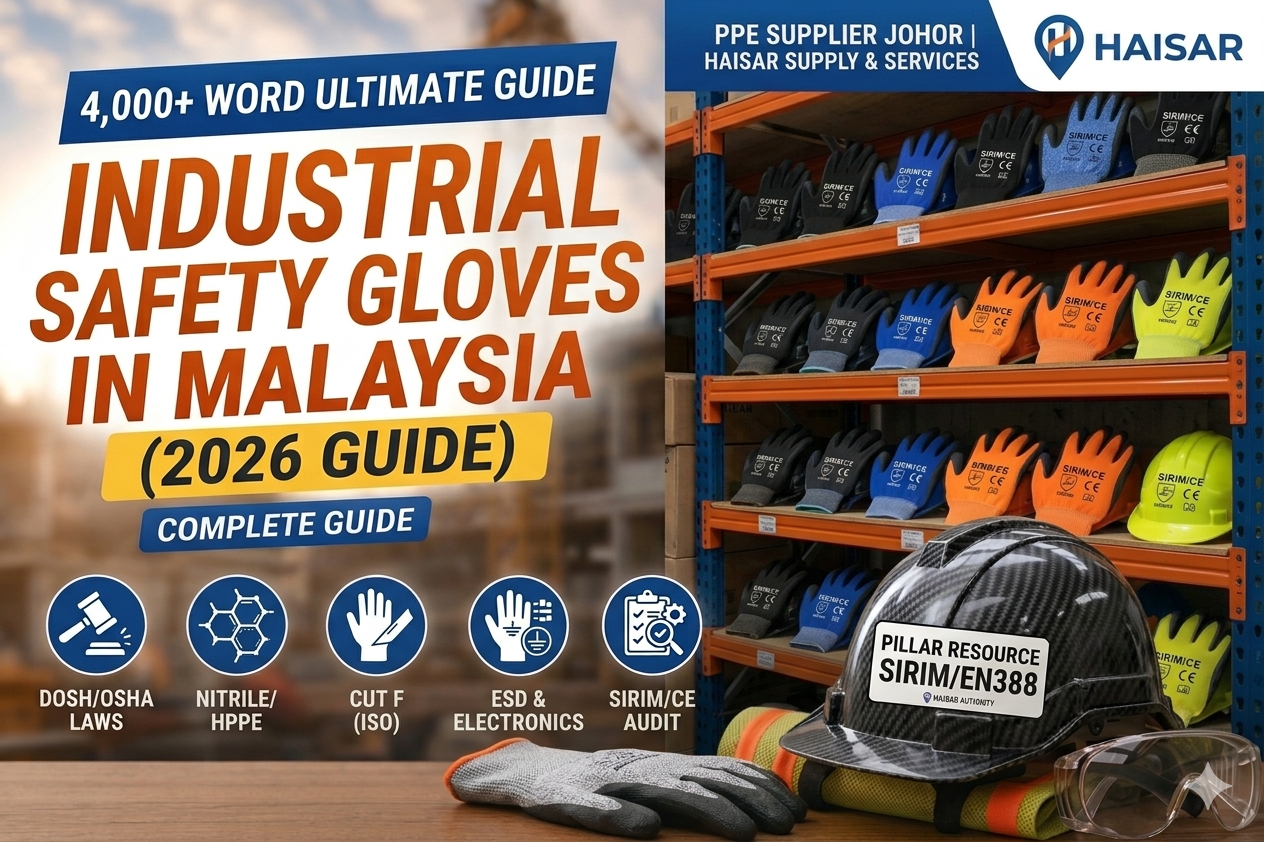
Hand injuries are among the most common categories of workplace injury in Malaysia. DOSH-linked data reported by national media shows hand injury cases rising from 4,651 in 2021 to 6,788 in 2022 and 7,109 in 2023, while the wider category of upper-limb injuries (fingers, hands and shoulders) accounted for roughly 13,670 of the 38,950 total occupational injury cases recorded in 2023, around 35 percent of all reported injuries that year. Sub-sectors including timber processing, steel milling, glove manufacturing itself, and commercial bakeries show a disproportionate share of finger-related accidents.
This guide covers how to read the standards printed on a glove, how to match material and construction to the hazard actually present, how Johor's major industrial sectors differ in what they need, and how to keep gloves compliant and effective once they're issued.
The Legal Basis for Glove Selection in Malaysia
Section 15(1) of the Occupational Safety and Health Act 1994 (OSHA 1994) places a general duty on employers to ensure, so far as practicable, the safety, health and welfare of employees, which includes providing PPE appropriate to the hazard where the hazard cannot be eliminated by other means. Following the Occupational Safety and Health (Amendment) Act 2022, in force since 1 June 2024, the maximum penalty for failing to provide suitable PPE rose from RM50,000 to RM500,000, with imprisonment of up to two years also available.
Section 52 of OSHA 1994 as amended, allows directors, managers, compliance officers, partners, and other persons responsible for a company's management to be personally prosecuted when the company commits an OSHA offence, with the burden shifted onto that individual to show they did not know of, did not consent to, and took reasonable precautions against the breach. This is a general liability provision that applies to OSHA offences broadly, not a rule specifically triggered by glove selection. It does mean, however, that a documented, hazard-appropriate glove selection process is one of the more straightforward ways a manager can demonstrate the “reasonable precautions” the law expects, since the alternative, an undocumented, ad-hoc glove choice, is much harder to defend after an incident.
A Hazard Identification, Risk Assessment and Risk Control (HIRARC) exercise covering hand hazards at each task is the practical mechanism for this. Selecting a glove because it is the one already in the store, rather than because a documented assessment identified it as appropriate for the task's specific cut, chemical, thermal, or impact hazard, is the gap DOSH inspectors and post-incident investigations most often find.
Understanding Glove Standards: What the Markings Actually Mean
Every certified protective glove carries markings tied to specific test standards. Malaysian buyers can rely on gloves certified to European (EN), American (ANSI/ISEA), or ISO standards; DOSH-SIRIM certification exists for some categories, but gloves tested and certified to these international standards are generally accepted in Malaysian workplaces without requiring a separate SIRIM mark, provided the certificate is valid and available on request.
EN ISO 21420: The Base Standard Behind Every Glove
EN ISO 21420 (which replaced the older EN 420) is the general-requirements standard sitting underneath every other glove standard. It does not test protective performance itself; instead it sets baseline requirements for glove design, sizing, comfort, dexterity, and harmlessness to the wearer (including limits on pH and chromium VI content, relevant to dermatitis risk). A glove cannot be validly rated under EN 388, EN 374, or any other performance standard without also meeting this baseline.
EN 388: Mechanical Risks
EN 388 is the standard most Malaysian safety officers check first, since it covers the everyday mechanical hazards, abrasion, cutting, tearing, and puncture, that most industrial gloves face.
Test|
|
||
|
Abrasion resistance |
Cycles of sandpaper-like wear before wear-through |
Level 1–4 (4 = 8,000+ cycles) |
|
Blade cut resistance (Coup test) |
Cut resistance using a rotating blade of fixed sharpness |
Level 1–5, or “X” if the blade blunts before failure (test invalid for very high-cut materials) |
|
Tear resistance |
Force needed to propagate a tear once started |
Level 1–4 |
|
Puncture resistance |
Resistance to a single sharp point (e.g. a nail) |
Level 1–4 |
|
ISO 13997 cut resistance (TDM test) |
Cut resistance using a straight, single-use blade with escalating force — the modern, more reliable cut test |
Level A–F (F = highest, 30N+ of force to cut through) |
|
Impact protection (optional “P”) |
Knuckle and finger back-of-hand impact/crush protection |
Pass/fail |
The Coup test blade dulls quickly against modern high-performance yarns containing glass or steel fibre, which produces unreliable results at the higher end of the scale. This is why EN 388:2016 added the ISO 13997 (TDM) test alongside it: a glove rated, for example, “4X44F” shows an “X” (invalid/untested) Coup result but an “F” TDM result, the more trustworthy figure for genuinely high-risk cutting tasks. When comparing gloves for a high-cut-risk task, the ISO 13997 letter grade is the more reliable figure to specify against.
ANSI/ISEA 105: The American Alternative, and Why It Doesn't Convert Directly
Gloves imported from or specified against American standards may carry an ANSI/ISEA 105 cut rating (A1 to A9) instead of, or alongside, an EN 388 rating. Both use the same TDM-100 testing machine, but ANSI/ISEA 105 reports the result in grams of cutting load while EN 388's ISO 13997 letter grade reports it in Newtons of force, and the pass thresholds are not set at equivalent points. A glove cannot validly claim an ANSI A3 rating on the basis of an EN ISO cut Level C result, or vice versa, without separate testing to each standard. If a specification calls for one system, insist on a certificate in that system rather than an approximate conversion.
EN 374: Chemical and Micro-organism Resistance
EN 374:2016 classifies chemical-resistant gloves into three types based on permeation resistance against a panel of 18 standard test chemicals (increased from 12 under the earlier 2003 version), with an added degradation test:
Type|
|
|
|
Type A |
At least 30 minutes' permeation resistance against a minimum of 6 of the test chemicals — the highest general protection level |
|
Type B |
At least 30 minutes' permeation resistance against a minimum of 3 of the test chemicals |
|
Type C |
At least 10 minutes' permeation resistance against a minimum of 1 test chemical — suitable only for brief, low-risk exposure |
Crucially, EN 374 certification is chemical-specific, not universal. A Type A glove rated against sulphuric acid is not automatically rated against a solvent it was never tested with. Always check the specific chemical list on the certificate against what your workers actually handle, not just the letter grade.
EN 511: Cold Protection
For cold-store, cold-chain logistics, and refrigerated warehouse work, which is a growing sector in Johor's logistics corridor, EN 511 rates gloves on convective cold resistance, contact cold resistance, and water permeability, each on a numeric scale, and is worth specifying separately from mechanical or chemical ratings since a glove can be excellent against cuts and still inadequate against sustained cold contact.
Choosing the Right Material: Liner and Coating Together
A safety glove is two components working together: a liner that provides the structural protection (cut, heat, or static resistance) and a coating that provides grip, chemical resistance, or abrasion protection on the working surface. Matching both to the task matters more than either alone.
Polymer Coatings
Nitrile is the most widely used coating across Malaysian factories: strong oil resistance, no natural latex allergy risk, and roughly three times more puncture-resistant than natural rubber, which is why it has largely displaced rubber-coated gloves in general industrial use.
Neoprene handles a broader range of acids, alcohols, and solvents than nitrile, making it a common choice for chemical handling tasks in Pasir Gudang's petrochemical cluster, though as EN 374 makes clear, the specific chemical list still needs checking rather than assumed from the material name alone.
Polyurethane (PU) coatings are thin and breathable, the standard choice for electronics assembly work where tactile feedback and dexterity for handling small components matter more than heavy-duty resistance.
High-Performance Liners
HPPE (high-performance polyethylene) fibre is around fifteen times stronger than steel by weight and forms the base of most modern cut-resistant gloves: lightweight, flexible, and cooler to wear than older steel-fibre-reinforced designs.
Aramid fibre (including Kevlar®) adds thermal resistance alongside cut resistance, useful for tasks combining a cut hazard with heat exposure up to roughly 350°C, such as sheet metal work near welding operations.
Carbon or silver thread woven into a glove dissipates static safely and is standard in ESD-controlled environments such as semiconductor and data centre work, where an uncontrolled static discharge can damage sensitive components even though it poses no injury risk to the worker.
Glove Selection by Industry: Johor's Key Sectors
Johor's industrial base is genuinely varied, and the right glove specification differs meaningfully between sectors, even where the underlying standards are the same.
Sector|
|
||
|
Electronics and semiconductor (Kulai, Senai) |
ESD damage to components; need for fine dexterity |
Thin PU-coated gloves with carbon-thread ESD control, fingertip coating to preserve tactile feedback for components as small as 0.5mm |
|
Construction and infrastructure (Johor Bahru, Iskandar) |
Rebar, sharp edges, rough and dusty surfaces |
HPPE-lined gloves at ISO cut Level C–D with a sanded nitrile palm for grip in dusty conditions |
|
Oil, gas and heavy engineering (Pengerang, Pasir Gudang) |
Crush and impact injuries from heavy components and machinery |
Impact-rated gloves with TPR (thermoplastic rubber) back-of-hand protection, oil-resistant nitrile palm, typically ISO cut Level D–E |
|
Chemical and petrochemical handling (Pasir Gudang) |
Permeation and chemical burns |
EN 374 Type A neoprene or nitrile gloves matched to the specific chemical list on the CSDS, not assumed from material alone |
|
Cold-chain and logistics warehousing |
Sustained cold contact, condensation-related grip loss |
EN 511-rated insulated gloves with water-resistant outer layer |
|
Food processing and commercial bakeries |
Cuts, heat contact, and hygiene/allergen control |
Cut-resistant liner under a food-grade, latex-free disposable or coated outer layer |
Fit, Sizing and Wearability
A glove that does not fit will not be worn consistently, and inconsistent use is functionally the same as no PPE programme at all. Gloves are generally sized 6 (XS) through 11 (XXL), and the correct size matters as much as the correct material: too tight causes hand fatigue and cramping over a shift, too loose creates a snag hazard around moving machinery and rotating equipment.
In Malaysia's heat and humidity, breathability directly affects compliance rather than just comfort. Workers are measurably more likely to keep gloves on for the full shift when they are not sweating inside them, which makes open-back designs and moisture-wicking liners a genuine safety consideration, not just an ergonomic nicety.
Care, Inspection and Replacement
Reusable mechanical and cut-resistant gloves, particularly HPPE-lined designs, can be laundered and reused many times, which meaningfully reduces cost per use over disposable alternatives. A short pre-shift inspection catches most degradation before it becomes a hazard:
- Check for holes or thinning, especially in the finger crotch area, where wear concentrates first.
- Look for peeling, cracking, or flaking on the coating, a sign that grip and abrasion performance is declining.
- Feel for unusual stiffness, which can indicate chemical contamination that has degraded the material from the inside.
- Note any persistent odour, which can signal bacterial buildup inside a glove that isn't drying fully between uses.
- Check the wrist cuff for elasticity; a stretched-out cuff no longer seals against contamination entry.
For laundering, wash reusable mechanical gloves at around 40°C with a mild detergent and air-dry rather than machine-dry. Dryer heat can melt nitrile coatings and shrink HPPE fibres, degrading exactly the protection the glove was bought for.
Common Mistakes in Glove Selection and Use
- Choosing by what's in stock, not by the HIRARC output for the task. This is the single most common finding in post-incident reviews.
- Treating an EN 374 chemical rating as universal. A Type A glove is only rated against the specific chemicals it was tested with; check the CSDS against the actual certificate.
- Assuming ANSI and EN cut ratings convert directly. They use different units and thresholds; a stated "equivalent" without separate certification isn't a valid substitute.
- Using leather gloves for chemical handling. Leather is porous and absorbs chemicals, holding them against the skin rather than blocking them, which can worsen a chemical burn rather than prevent one.
- Ignoring fit in favour of a single site-wide size. Poor fit is one of the most common reasons workers stop wearing issued gloves.
- Machine-drying reusable gloves. Dryer heat degrades nitrile coatings and HPPE fibres well before their rated lifespan.
- No documented reassessment when the task changes. A glove selected correctly for one task is not automatically correct when a worker is reassigned to a different one.
Haisar's Hand Protection Range
Haisar Supply and Services stocks a full hand protection range across every category covered in this guide, organised to match task-based selection rather than a single generic catalogue:
- Disposable gloves for general handling, food contact, and low-risk tasks — note that disposable gloves stocked for infection control in a first aid box are a separate procurement decision from disposable gloves issued for general handling tasks, even though the product looks similar
- Chemical-resistant gloves, including neoprene gauntlet gloves and nitrile gauntlets for chemical and liquid handling
- Cut protection gloves, including cut level 5 gloves with PU palm coating for higher dexterity cutting tasks
- Synthetic nitrile dipped gloves for combined impact and cut environments
- Mechanical and multi-purpose gloves for general industrial handling
- Leather gloves, including welding and general-purpose leather options, for mechanical and heat-adjacent tasks
- Special purpose gloves, including cold-resistant options such as our thermal-lined range
- Hand accessories, including glove clips and retention accessories to reduce loss and encourage consistent use
Shop by Hazard: Glove Category to Standard Quick-Reference
The table below maps Haisar's hand protection subcategories directly to the standard or rating each is typically specified against, so a safety officer working from a HIRARC output can go straight to the right subcategory rather than browsing by product type.
Hazard Identified in HIRARC|
|
||
|
General handling, low risk, food contact |
EN ISO 21420 (base only) |
|
|
Chemical splash or immersion |
EN 374 Type A/B/C, matched to CSDS chemical list |
|
|
Cutting, blade, or sharp-edge contact |
EN 388 / ISO 13997 cut Level A–F |
|
|
Impact or crush risk combined with cutting |
EN 388 impact "P" rating plus cut level |
|
|
General mechanical wear, abrasion, grip |
EN 388 abrasion/tear/puncture levels |
|
|
Heat contact, welding, sparks |
EN 388 plus heat-resistance rating where applicable |
|
|
Sustained cold contact (cold store, logistics) |
EN 511 |
Special Purpose Gloves (thermal-lined range) |
|
Electric shock or arc flash |
IEC 60903 insulating glove voltage classes — not stocked in this category |
See our separate electrical safety PPE guide and the Electrical Safety product range |
The last row is worth emphasising on its own: voltage-rated insulating gloves for electrical work are a completely different product, tested to a completely different standard (IEC 60903, not EN 388 or EN 374), from every other glove in this guide. Choose products by the hazard your HIRARC identifies, not by whichever subcategory looks closest on a catalogue page. For workplaces also managing electrical hazard exposure, see our guide to electrical safety PPE, since voltage-rated insulating gloves are a separate product category from mechanical and chemical hand protection and are frequently confused with it.
A Note on Emerging Glove Technology
RFID-tagged gloves are being used by some larger facilities to automate inspection tracking and inventory management, which is a genuinely useful operational improvement for large PPE programmes. Biodegradable nitrile disposable gloves are also entering the market, with manufacturers citing ASTM D5511 accelerated-landfill testing showing significantly faster breakdown than standard nitrile. This claim is real but contested: the related ASTM D5526 test method has been withdrawn by ASTM International over concerns it does not reflect real landfill conditions, and anaerobic biodegradation of any material in a landfill also generates methane, a potent greenhouse gas, which complicates the straightforward "better for the environment" framing some marketing uses. Treat specific degradation timeframes as manufacturer-reported until backed by independent, current-standard testing, rather than as settled fact.
Glove Selection Checklist
Item|
|
|
|
HIRARC completed for the specific task before glove selection, not selected from existing stock |
☐ |
|
EN 388 / ISO 13997 cut level matched to actual cutting hazard, not just the highest available |
☐ |
|
EN 374 chemical type and specific chemical list checked against the CSDS for the actual substances handled |
☐ |
|
ANSI and EN ratings not treated as interchangeable without separate certification |
☐ |
|
Correct glove size available and issued per worker, not a single site-wide size |
☐ |
|
Pre-shift inspection routine in place (holes, coating condition, stiffness, odour, cuff elasticity) |
☐ |
|
Laundering procedure documented (40°C, mild detergent, air-dry) for reusable gloves |
☐ |
|
Glove specification reassessed when a worker's task or work area changes |
☐ |
|
Certificates retained on file for the specific standard and chemical list claimed |
☐ |
Frequently Asked Questions
Is a Level 5 cut rating the same as an ISO cut Level F?
No. Level 5 comes from the older Coup (blade) test under EN 388; Level F comes from the newer ISO 13997 (TDM) test, which is more reliable for high-performance cut-resistant materials because the Coup test blade dulls quickly against them. For genuinely high-risk cutting work, ask for the ISO 13997 letter grade specifically rather than relying on the Coup level alone.
Can leather gloves be used for chemical handling?
No. Leather is porous and absorbs chemicals rather than blocking them, which holds the chemical against the skin and can worsen a burn. Nitrile or neoprene gloves rated to EN 374 for the specific chemical involved are the correct choice.
Do safety gloves need SIRIM certification to be used in Malaysia?
Not necessarily. Gloves certified to internationally recognised standards such as EN 388, EN 374, or ANSI/ISEA 105 are generally accepted in Malaysian workplaces without a separate SIRIM mark, provided a valid test certificate is available. DOSH-SIRIM certification does exist for some categories and specific product lines.
Is HIRARC actually required before selecting gloves?
Yes, in substance. OSHA 1994's general duty requires PPE to be appropriate to the hazard, and a documented HIRARC process is the standard way employers demonstrate that a specific glove was selected for a specific, identified hazard rather than chosen arbitrarily. This also matters for the personal liability provisions under Section 52 of OSHA 1994, where documented reasonable precautions are the main defence available to a manager or director.
Are ANSI and EN cut ratings interchangeable?
No. Both use the same TDM-100 test machine, but ANSI/ISEA 105 reports cut resistance in grams of cutting load (A1 to A9) while EN 388's ISO 13997 grade reports it in Newtons of force (A to F), with different pass thresholds. A glove needs to be separately tested and certified to whichever standard your specification calls for.
What is the difference between EN 374 Type A, B, and C?
Type A gloves resist at least 6 of the standard test chemicals for a minimum of 30 minutes each, the highest general protection level. Type B resist at least 3 chemicals for 30 minutes each. Type C resist at least 1 chemical for only 10 minutes, suitable for brief, low-risk exposure only. The rating is specific to the chemicals actually tested, not a general guarantee.
How often should industrial safety gloves be replaced?
There is no fixed calendar interval; replacement should be triggered by condition, not age alone. Replace at the first sign of holes, coating breakdown, unusual stiffness, persistent odour, or a stretched cuff, whichever comes first, and always after a single use in a task the glove was not rated for.
Are biodegradable nitrile gloves as protective as standard nitrile?
Manufacturers generally claim equivalent protective performance while the material biodegrades faster under accelerated landfill testing. The protective claims are generally sound if backed by the same EN/ANSI certification as standard gloves, but the specific biodegradation timeframes quoted in marketing should be treated cautiously, since the underlying test methods are contested and one related standard has been withdrawn by ASTM International.
What glove material is best for semiconductor and electronics work?
Thin polyurethane-coated gloves with carbon or silver thread for ESD control are standard, since they preserve the dexterity needed for small components while safely dissipating static that could otherwise damage sensitive electronics.
Are the disposable gloves in a first aid box the same as general-purpose disposable work gloves?
They serve different purposes even when the product looks similar. First aid box gloves exist to protect the first aider from bloodborne pathogen exposure under Universal Precautions, per DOSH's first aid guideline; general-purpose disposable gloves are selected against a task's actual hazard profile like any other glove in this guide. See our first aid kit requirements guide for what belongs in the first aid box specifically.
Conclusion
The right glove is the one matched to a specific, documented hazard assessment for the task at hand, not the one already sitting in the store cupboard. Reading the standard markings correctly, matching material to the actual hazard rather than a general category, getting sizing right so gloves are actually worn, and maintaining them properly closes most of the gap between having a glove programme and having an effective one.
If you're reviewing hand protection across a site or project, our team can help match glove specifications to your HIRARC findings across cut, chemical, impact, thermal, and ESD hazards. Request a quotation or send us your requirement list directly, and we'll help you specify by hazard rather than by catalogue page.
Haisar Supply and Services Sdn Bhd (985158-T) | Kulai, Johor, Malaysia | www.haisar.com
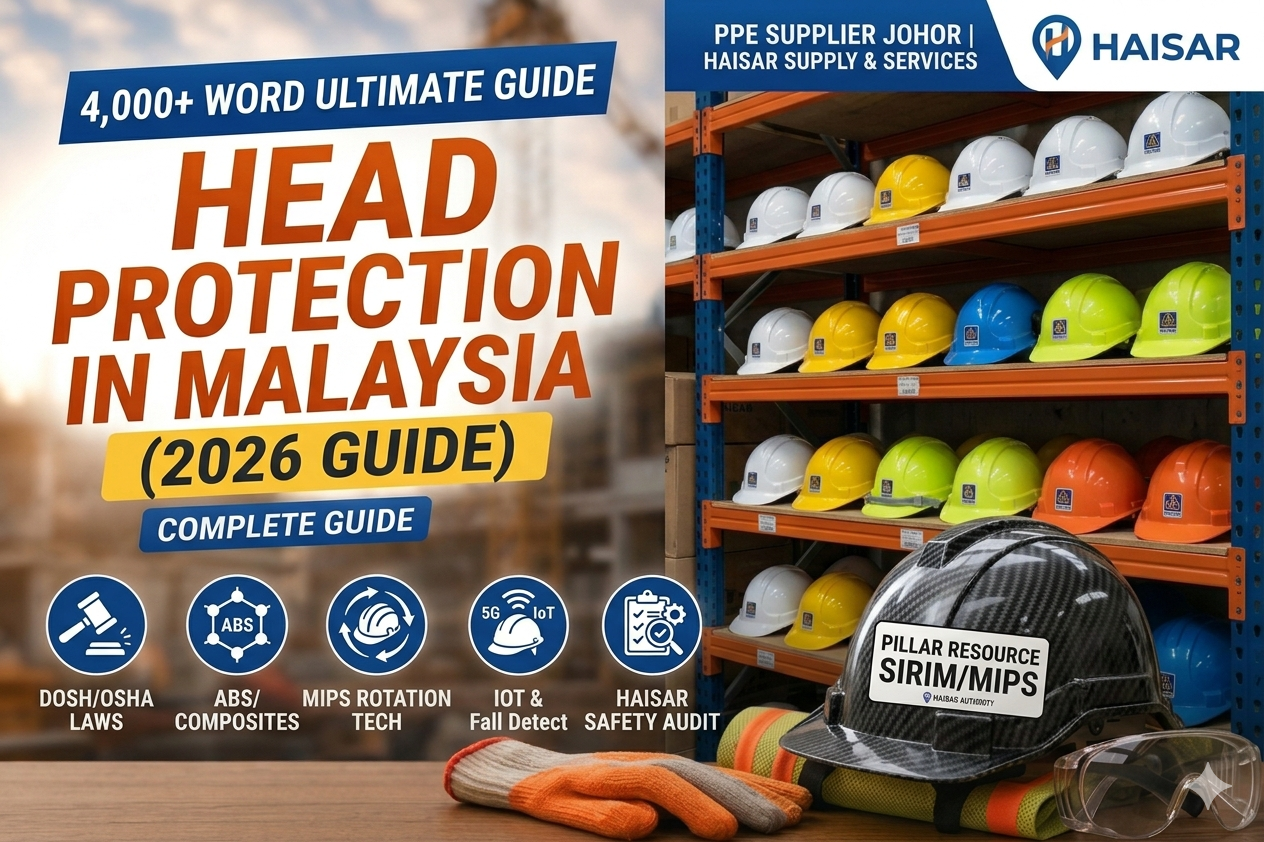
1: The State of Safety 2026 (Legal & Introduction)
1.1 The Changing Face of Industrial Malaysia
As we move through 2026, Malaysia’s industrial landscape is undergoing a massive transformation. From the rapid expansion of the Kulai Fast Lane to the high-tech semiconductor hubs in Senai and the massive energy complexes in Pengerang, the scale of our projects has never been greater. However, with larger projects comes a heightened level of risk.
Head injuries remain one of the leading causes of workplace fatalities and long-term disabilities in the Malaysian construction and manufacturing sectors. In this high-stakes environment, the humble safety helmet is no longer just a "plastic hat" it is a sophisticated piece of life-saving technology. For any business operating in Johor or the wider Malaysian region, understanding the modern requirements of head protection is the first step toward operational excellence.
1.2 Navigating the OSHA (Amendment) Act 2022/2026
The most critical shift for any safety officer or business owner to understand is the full enforcement of the Occupational Safety and Health (Amendment) Act 2022, which reached its peak maturity in early 2026. This legislation completely overhauled the responsibilities of the employer.
Universal Coverage Unlike the original 1994 Act, which focused on specific sectors like manufacturing and construction, the 2022/2026 framework now applies to all workplaces across Malaysia. Whether you are managing a small warehouse in Pasir Gudang or a multinational oil refinery, the legal requirement to provide "suitable and effective" Personal Protective Equipment (PPE) is now universal. Under Section 15, the burden of proof is on the employer to show that the head protection provided is fit for the specific hazards of the site.
1.3 The RM500,000 Risk and Personal Liability
The 2026 enforcement has brought with it a "zero-tolerance" approach from DOSH (JKKP) regarding non-compliant PPE. The financial and legal risks have escalated significantly:
- Financial Penalties: Maximum fines for safety breaches have increased from RM50,000 to a staggering RM500,000.
- Section 18A (Director Liability): This is the most significant change. Directors, managers, and "principals" (main contractors) can now be held personally and criminally liable for safety failures. If a worker is injured while wearing a non-certified or expired helmet, the leadership must prove they took "all reasonable steps" to prevent the accident.
- The Right to Refuse: Workers are now legally empowered to remove themselves from a work area if they believe the provided head protection is inadequate, without fear of losing their job.
Part 2: Anatomy & Material Science (Expertise)
2.1 The 3-Part Protection System
To understand why one helmet costs RM15 and another costs RM80, you must understand the anatomy of protection. A safety helmet is a system designed to manage kinetic energy through three distinct layers:
- The Outer Shell: The rigid exterior designed to deflect sharp objects and prevent penetration of the skull.
- The Suspension (Harness): The internal web of straps. This is the most critical part of the helmet. It maintains a 30mm buffer zone between the shell and the head, stretching during impact to slow down the deceleration of the brain.
- The Retention System (Chin Strap): In 2026, the 4-point chin strap has become the industry standard for "climbing-style" helmets, ensuring the helmet stays on the head during a fall or a secondary impact.
2.2 Material Wars: PE vs. ABS vs. High-Tech Composites
In the Malaysian heat, material choice is a matter of life and death.
- Polyethylene (PE): This is the most common material for "budget" helmets. While lightweight and moisture-resistant, PE is highly susceptible to UV degradation. In Johor’s intense sun, a PE helmet can become brittle and lose its safety rating in less than 12 months.
- ABS (Acrylonitrile Butadiene Styrene): The "Gold Standard" at Haisar. ABS is a superior thermoplastic that offers much higher impact resistance and thermal stability. It does not warp in the high-heat environments common in Pasir Gudang’s factories.
- Carbon Fiber & Advanced Composites: In 2026, these are the preferred choice for supervisors and high-level inspectors. They offer the strength of steel at a fraction of the weight, significantly reducing neck strain and "helmet fatigue" during 12-hour shifts.
2.3 The Mips® Revolution in 2026
One of the biggest technological leaps in 2026 is the integration of Mips (Multi-directional Impact Protection System) into industrial helmets.
Most traditional helmets are tested for "linear" impacts (an object falling straight down). However, most real-world falls happen at an angle, creating rotational force. This rotation causes the brain to slide against the inside of the skull, leading to concussions even if the helmet shell remains intact. Mips uses a low-friction layer inside the helmet that allows the shell to move slightly during an impact, redirecting that dangerous rotational energy away from the brain.
3: Classification & Standards (The Compliance Map)
3.1 Understanding MS 183 and MS 1869:2015
In Malaysia, the Department of Occupational Safety and Health (DOSH/JKKP) primarily recognizes the Malaysian Standards (MS) as the baseline for compliance.
- MS 183: The traditional standard for industrial safety helmets.
- MS 1869:2015: A more modern alignment that mirrors the rigorous European EN 397 standards. This updated standard is what most high-tier projects in the Johor Bahru and Pengerang regions now demand.
When you see a SIRIM sticker, it confirms the helmet has passed specific tests for shock absorption, penetration resistance, and flame retardancy. For procurement officers, checking for "MS 183" or "MS 1869" on the product label is the quickest way to verify legal compliance during an audit.
3.2 The Global Benchmarks: ANSI vs. EN Standards
While local standards are mandatory, many multinational corporations operating in Johor - especially in the Oil & Gas and Data Center sectors - refer to global benchmarks.
- ANSI/ISEA Z89.1-2014 (USA): This standard is the global leader in categorizing helmets by Type (I or II) and Electrical Class (G, E, or C). If your project follows American engineering specifications, this is the standard you will follow.
- EN 397 (Europe): This standard is common in manufacturing plants and European-led infrastructure projects. It is particularly strict on Lateral Deformation (LD), ensuring the helmet doesn't crush under side-pressure.
Part 4: Industry-Specific Deep Dives (Sector Guides)
4.1 The Construction Sector: Facing the "Kulai Fast Lane"
In the construction industry, particularly with rapid-track projects like the "Kulai Fast Lane" industrial parks, the primary hazards are falling objects and extreme heat.
The Johor Sunlight Factor Johor has one of the highest UV indexes in the region. For outdoor construction workers, we recommend Type I ABS helmets with UV-stabilized coatings.
- Color Coding: While not a law, most Johor sites use White for supervisors/engineers and Yellow for general workers to improve site communication.
- Work at Height: If workers are operating on scaffolding above 2 meters, a 4-point chin strap (meeting EN 12492 or EN 397 retention standards) is mandatory to ensure the helmet stays on during a fall.
4.2 The Oil & Gas Sector: Pengerang & RAPID Standards
The Pengerang Integrated Complex (PIC) and RAPID projects operate under some of the strictest PPE rules in the world, often aligned with PETRONAS Technical Standards (PTS).
- Non-Vented Requirements: In areas with flammable vapors, non-vented helmets are often required to prevent gas accumulation inside the shell.
- Class E Rating: Most sites require an Electrical Class E rating (protection up to 20,000V) as a default safety margin, even for non-electricians.
- Anti-Static Properties: Helmets must often be certified for use in ATEX/Explosive zones to prevent static discharge from acting as an ignition source.
4.3 The Manufacturing & Logistics Sector: Pasir Gudang Hubs
Inside the massive manufacturing plants of Pasir Gudang, the focus shifts from falling objects to internal machinery hazards and heat stress.
- Vented Comfort: Unlike Oil & Gas, manufacturing often allows vented helmets (Class C) to maximize airflow and reduce the risk of heat exhaustion among workers.
- Low Profile Design: In tight spaces like warehouses or assembly lines, low-profile helmets are preferred to prevent the brim from obstructing vision or hitting low-hanging structures.
5: The Buyer’s Master Logic (Procurement & ROI)
5.1 The Total Cost of Ownership (TCO) Strategy
In 2026, professional procurement officers in Johor have moved away from "lowest unit price" buying. Instead, they look at the Total Cost of Ownership.
A budget PE helmet costing RM10 may seem like a bargain, but if it degrades in 12 months due to UV exposure, you will buy three helmets in the time you could have used one high-quality ABS helmet (priced at RM28). When you factor in the administrative cost of processing three purchase orders, delivery fees, and the downtime of re-issuing gear, the "expensive" helmet is actually 40% cheaper over a three-year project cycle.
5.2 The Haisar Decision Matrix: Matching Helmet to Risk
To simplify procurement, we utilize a logic-based selection process. Buying the most expensive helmet for a site visitor is wasteful, just as buying a basic cap-style helmet for a scaffolder is dangerous.
- Task: Work at Height (>2m) → Requirement: Climbing-style, 4-point chin strap, Type II impact rating.
- Task: Electrical Maintenance → Requirement: Non-vented, Class E (20,000V) rated, shell-integrated visor.
- Task: Outdoor Infrastructure → Requirement: Full-brim ABS shell, UV-stabilized coating, moisture-wicking sweatband.
- Task: Factory Floor/Logistics → Requirement: Vented Type I shell, lightweight (under 400g), high-visibility color.
5.3 Transparency in the Supply Chain: Avoiding "Gray Market" PPE
The rise of e-commerce has led to an influx of counterfeit or "gray market" safety helmets in Malaysia. These often look identical to SIRIM-certified products but fail under impact testing. At Haisar, we provide a Compliance Traceability Pack with bulk orders, which includes:
- Batch-specific SIRIM test reports.
- Manufacturer's Certificate of Conformity.
- Warranty documentation against material defects.
6: Maintenance & Compliance (The Inspection Framework)
6.1 The "Shelf Life" vs. "Service Life" Paradox
There is a significant difference between how long a helmet stays "new" in a box and how long it lasts on a site in Pasir Gudang.
- Shelf Life: Most high-quality manufacturers (like those we stock at Haisar) specify a 5-year shelf life in a climate-controlled warehouse.
- Service Life: In Malaysia's tropical climate, the shell should be replaced every 2 to 3 years of active use. The internal suspension, which absorbs sweat and hair oils, should be replaced every 12 months to maintain hygiene and structural integrity.
6.2 The Haisar 5-Point Daily Inspection Protocol
We recommend all safety officers implement this 60-second morning check for their teams:
- The Visual Shell Audit: Look for "chalking" (a sign of UV damage), deep scratches, or any discoloration.
- The Stress Compression: Gently squeeze the helmet from the sides. It should feel firm but slightly flexible. If you hear a "crackling" sound, the plastic is brittle discard immediately.
- The Harness Anchor Points: Ensure the four or six suspension clips are snapped tightly into the shell. A loose harness provides zero shock absorption.
- The Date Wheel Inspection: Check the embossed "Date of Manufacture" wheel inside the shell. If it’s past its 5-year total life, it must be retired.
- Chemical Contamination: Check for any residue of paints, solvents, or heavy oils. These chemicals can microscopically "melt" the plastic polymers, making them prone to shattering upon impact.
6.3 Cleaning Standards for SIRIM Compliance
To keep your gear compliant, avoid using industrial degreasers or petrol.
- Approved Method: Use only mild soap and warm water.
- The Sticker Rule: Never allow workers to apply unauthorized stickers or paint to their helmets. The adhesives in standard stickers can react with the shell material, creating weak points that the SIRIM certification no longer covers.
7: The Future: Smart PPE & Digital Compliance
7.1 The Rise of the "Connected Worker" in 2026
As we look toward the Occupational Safety and Health Master Plan 2026-2030 (OSHMP30), the focus in Malaysia is shifting from passive protection to active monitoring. The industrial safety helmet is evolving from a static piece of plastic into a digital hub for site intelligence.
IoT-Enabled Hazard Detection In 2026, leading construction firms in Johor have begun deploying smart helmets equipped with IoT (Internet of Things) sensors. These devices do more than block impacts; they monitor the environment in real-time.
- Gas & Heat Sensors: Integrated sensors detect hazardous fumes or extreme heat levels that could lead to heatstroke a major risk in Malaysia’s tropical climate.
- Fall Detection: If a worker falls from a scaffold, the helmet’s accelerometer instantly triggers a distress signal to the safety office with the worker’s exact GPS coordinates.
7.2 Augmented Reality (AR) on the Worksite
Augmented Reality is no longer science fiction. In high-complexity sectors like Pengerang's Oil & Gas plants, supervisors are using AR-enabled visors attached to their safety helmets.
- Digital Blueprints: Engineers can view 3D blueprints overlaid directly onto the physical structures they are inspecting.
- Remote Assistance: A technician in Pasir Gudang can share their live helmet-cam feed with an expert in Kuala Lumpur or overseas, receiving real-time guidance through a heads-up display.
7.3 Digital Compliance and Blockchain Tracking
To meet the stricter OSHA 2022/2026 reporting requirements, companies are moving away from paper logs.
- NFC/RFID Tags: Every Haisar helmet can be equipped with a small RFID chip. When a safety officer scans the helmet with a smartphone, they instantly see its Date of Manufacture, the last Inspection Date, and the assigned worker’s name.
- Immutable Safety Logs: By storing inspection records on a digital ledger, companies can prove to JKKP auditors that their PPE fleet is 100% compliant and has never been used past its expiry date.
Part 8: Conclusion & Expert FAQ
8.1 Building a Generative Safety Culture
The ultimate goal of any head protection program is not just to avoid fines it is to build a Generative Safety Culture. This is a state where safety is seen as a core value by every employee, from the boardroom to the factory floor.
At Haisar Supply & Services, we believe that the right equipment is the foundation of that culture. When a worker is provided with a helmet that is comfortable, certified, and technologically advanced, it sends a clear message: Your life is valuable. ### 8.2 Expert FAQ: Top Questions from JKKP Auditors
Q: Can I use an international helmet that doesn't have a SIRIM sticker? A: Under Malaysian law, while ANSI or EN standards are excellent, the product must be approved by DOSH/JKKP. In almost all cases, this requires a SIRIM certification mark. Using unapproved gear can lead to an immediate "Stop Work Order" during an audit.
Q: Does a "bump cap" count as a safety helmet? A: No. Bump caps are designed only for protecting against stationary objects (like low ceilings). They provide zero protection against falling objects and are strictly prohibited on construction sites.
Q: Can I wash the internal suspension in a washing machine? A: It is not recommended. The mechanical action and harsh detergents can weaken the plastic clips. Hand-wash with mild soap and warm water only.
Q: What is the penalty for a worker not wearing their helmet? A: Under the OSHA (Amendment) Act 2022, the employer can be fined up to RM500,000 for failing to ensure PPE use. The worker can also be held liable for failing to follow safety instructions.
Your Journey to 100% Compliance Starts Here
Don't leave your site safety to chance. As Johor’s leading PPE partner, Haisar Supply & Services is here to provide the gear, the expertise, and the long-term support you need.
Ready to upgrade your fleet or conduct a safety audit?
📞 Sales: +60 17-707 0025
💬 WhatsApp: +60 12-570 7015
🌐 Website: www.haisar.com
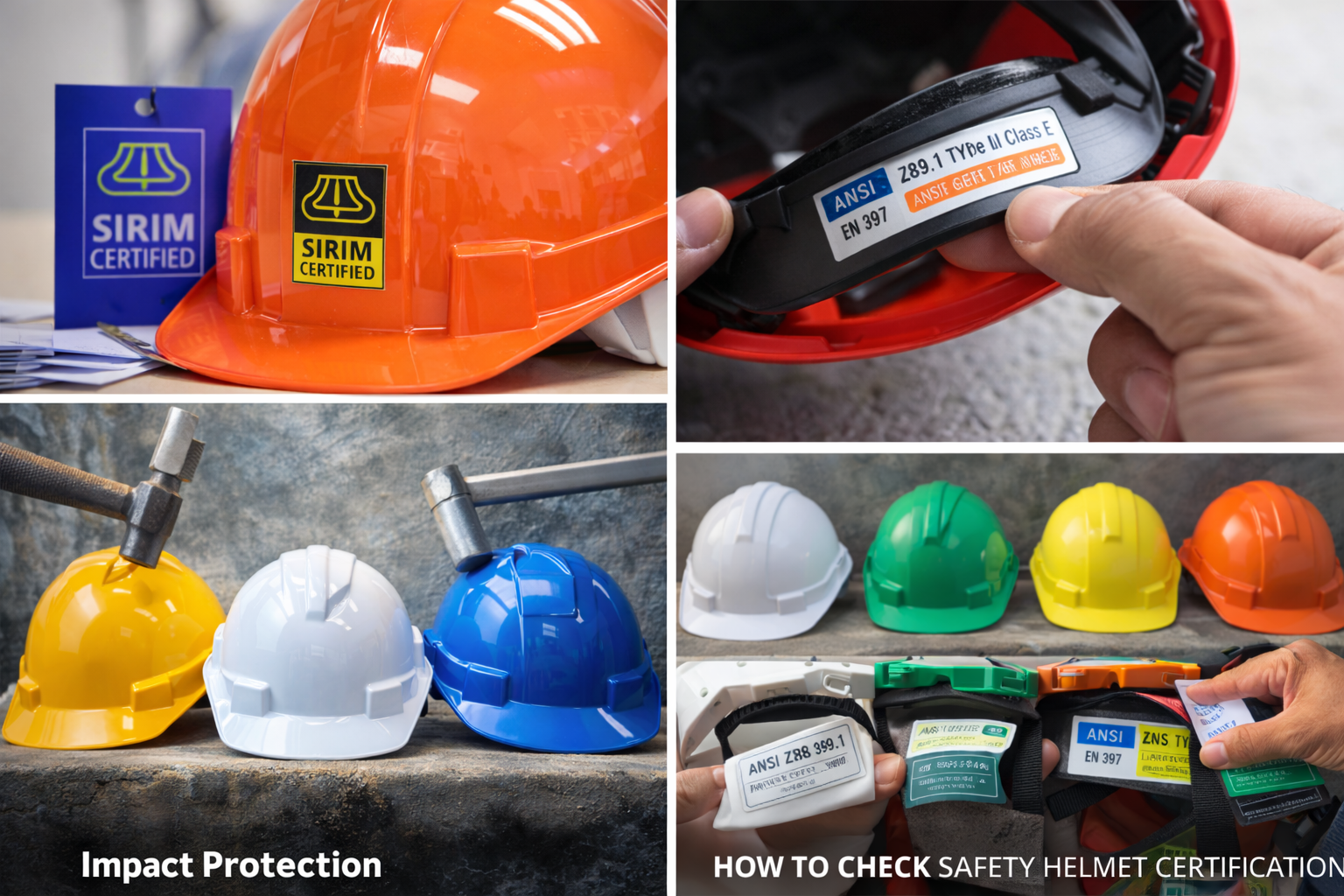
A safety helmet is your last line of defense against life-threatening head injuries. However, a helmet that is cracked, expired, or poorly maintained is not a safety device it is a false sense of security.
In Malaysia, intense UV exposure, high humidity, and heavy industrial use accelerate the degradation of PPE materials. Under DOSH (JKKP) and OSHA 1994 regulations, it is the employer's responsibility to ensure that all head protection remains in "suitable and effective" condition.
This guide provides a professional framework for inspecting, maintaining, and knowing exactly when to replace your safety helmets to ensure 100% compliance and worker safety.
How Long Does a Safety Helmet Last in Malaysia?
Many workers believe a helmet is "good forever" as long as it hasn't been hit. This is a dangerous misconception.
- Shelf Life: Most manufacturers specify a shelf life of up to 5 years if stored in original packaging in a cool, dry place.
- Service Life: Once the helmet is taken out of the box and used on a site, the clock starts. In Malaysia’s harsh climate, the industry standard for replacement is:
- Helmet Shell: Every 2 to 3 years (or sooner if damaged).
- Internal Suspension: Every 12 months (due to sweat, hair oils, and friction).
Pro Tip: Look for the Date of Manufacture wheel embossed inside the helmet shell. If your helmet was made more than 5 years ago, it must be replaced regardless of its appearance.
The 5-Point Daily Inspection Checklist
Before every shift, workers should perform this quick visual and functional audit:
- The Shell Check: Look for cracks, deep scratches, dents, or "chalky" surfaces. If the color has faded significantly (UV damage), the plastic is likely brittle.
- The "Squeeze" Test: Gently compress the sides of the helmet with both hands. If you hear any creaking or cracking sounds, the structural integrity is compromised.
- Suspension & Harness: Check the plastic or fabric straps for tears, fraying, or broken clips. Ensure the headband is securely attached to the shell.
- The Adjustment Dial: Ensure the ratchet or slide-lock system holds firmly. If it slips under pressure, the helmet will fall off during an actual impact.
- Cleanliness: Ensure there is no thick mud, tar, or oil covering the shell. Dirt can hide hairline cracks that are critical safety risks.
When to Replace Your Helmet Immediately
You must retire a safety helmet from service immediately if any of the following occur:
- Any Significant Impact: Even if there is no visible crack, the internal structure has absorbed the energy and will fail during a second impact.
- Chemical Exposure: Contact with fuels, solvents, or strong cleaning agents can "melt" the plastic on a microscopic level.
- Severe UV Damage: If the shell feels "brittle" or the plastic "flakes" when scratched with a fingernail.
Proper Cleaning & Storage Tips
To extend the life of your PPE and remain SIRIM-compliant, follow these maintenance rules:
- Cleaning: Use only mild soap and warm water.
- Do NOT use: Abrasive cleaners, petrol, or industrial solvents. These chemicals weaken the shell.
- Storage: Store helmets in a cool, dry spot away from direct sunlight.
- Vehicle Storage: Never leave your helmet on the dashboard or in a hot car. Malaysian sun can heat a car interior to 70°C, which can warp the helmet shell.
The "Do Not" List: Common Compliance Mistakes
- No Painting: Paint solvents can degrade the shell. If you need a specific color, buy a color-coded helmet from a supplier.
- No Unapproved Stickers: Some glues react with the plastic. Only use stickers approved by the manufacturer.
- No Modifications: Never drill holes for ventilation or cut the brim. This voids all safety certifications (SIRIM/EN 397).
FAQ: PPE Maintenance
Q: Can I use a helmet if it was dropped from a low height? A: If it dropped while empty (e.g., from a table), it is usually fine after an inspection. However, if it fell while holding weight or dropped from a significant height onto a hard surface, replace it.
Q: Is it okay to wear a cap under the helmet? A: No. Basecaps and beanies interfere with the suspension system’s ability to sit properly on your head, reducing protection during an impact.
Is Your PPE Fleet Ready for Replacement?
Don't wait for an accident to find out your helmets are expired. Routine inspection is the mark of a professional site.
At Haisar Supply & Services, we provide high-quality, SIRIM-certified safety helmets designed for Malaysia's demanding industrial environments. We also offer bulk replacement planning for factories and construction sites.
Need a bulk quote or a safety audit for your team?
📞 Sales: +60 17-707 0025
💬 WhatsApp: +60 12-570 7015
🌐 Website: www.haisar.com
If you are budgeting for a construction project or factory maintenance in Malaysia, the question isn't just "how much," but "what am I paying for?" In 2026, safety helmet prices in Malaysia have shifted due to material costs and stricter SIRIM/DOSH enforcement. A cheap helmet might save you RM5 today, but a failed safety audit or a brittle shell that needs replacing in 6 months will cost you much more.
This guide provides a transparent breakdown of current market prices, value-added features, and how to optimize your PPE budget through bulk procurement.
Quick Answer: 2026 Safety Helmet Price Summary
For quick procurement planning, here are the average market rates in Malaysia:
|
Category |
Price Range (Unit) |
Best For |
|
Economy (PE Shell) |
RM8.00 – RM15.00 |
Site visitors, temporary staff |
|
Standard (SIRIM ABS) |
RM18.00 – RM45.00 |
Construction & Manufacturing |
|
Premium (Climbing/Tech) |
RM60.00 – RM150.00 |
Work at height, Oil & Gas |
|
Wholesale / Bulk (40+ pcs) |
Save 15% – 25% |
Contractors & Factories |
Haisar Expert Insight: ABS vs. PE Shells
"In our experience supplying Johor’s industrial sector, we’ve found that while PE (Polyethylene) helmets are cheaper, they degrade significantly faster under Malaysia's intense UV index. For any outdoor construction in Pasir Gudang or Pengerang, we strictly recommend ABS (Acrylonitrile Butadiene Styrene) shells. They last longer and offer much better impact stability for only a few ringgit more."
Key Factors Driving Safety Helmet Costs
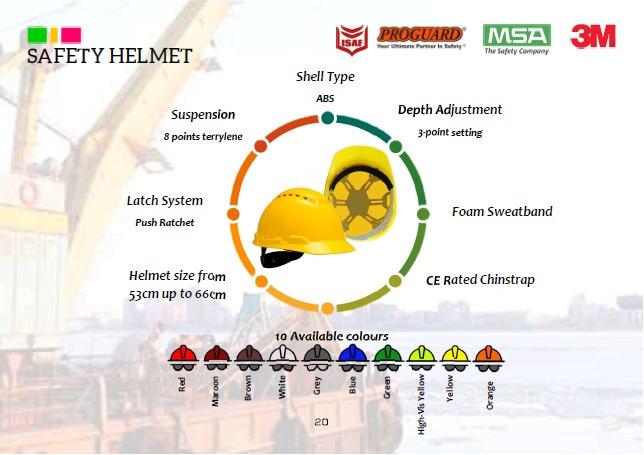
1. SIRIM & DOSH Certification
In Malaysia, certification is non-negotiable for industrial sites.
- Certified Helmets (RM15+): These carry the SIRIM sticker and have been tested for shock absorption and penetration.
- Non-Certified (Under RM10): Often sold in hardware shops but lacks the lab-tested guarantee. Warning: Using these on-site can lead to legal liabilities for the employer.
2. The Suspension System (The "Comfort" Factor)
The harness inside the helmet is what absorbs the impact energy.
- Plastic Slide Lock: The most affordable option.
- Ratchet System (Dial): Costs RM5–RM10 more but allows workers to adjust the fit instantly with one hand. This leads to better worker compliance (they won't take the helmet off because it's "too tight").
3. Material Durability
- Economy PE: Lightweight but prone to heat warping.
- High-Impact ABS: The industry standard for 2026. Resists scratches and maintains structural integrity in high-heat environments.
Value Comparison Table: Price vs. Performance
|
Helmet Feature |
Budget Option |
Mid-Range |
Premium |
|
Price |
RM10.00 |
RM28.00 |
RM85.00 |
|
Material |
Polyethylene (PE) |
Industrial ABS |
Reinforced ABS/PC |
|
Lock Type |
Plastic Slide |
Ratchet (Dial) |
4-Point Secure |
|
Life Span |
~1 Year |
2–3 Years |
3–5 Years |
|
SIRIM Approved |
Yes (Select) |
Always |
Always |
How to Save Money on Safety Helmets (Bulk Buying)
If you are a contractor or factory owner, buying individually is the most expensive way to source PPE.
- Carton Discounts: Most professional suppliers (like Haisar) offer "Carton Prices." A standard carton usually contains 40 units.
- Contract Pricing: For long-term projects, you can lock in a 12-month price to protect your budget against inflation.
- Bundle Deals: Combine your helmet order with safety boots or high-vis vests to reduce shipping costs and trigger "Package Discounts."
Frequently Asked Questions (FAQ)
Q: Why is the price of white helmets sometimes different from yellow?
A: Generally, they are the same price. However, some suppliers stock more Yellow/White, making them "Standard" and keeping specialized colors like Green or Orange at a slight premium due to lower stock turnover.
Q: Does a higher price mean a safer helmet?
A: Not always. An RM150 helmet might have the same impact rating as a RM30 helmet, but the RM150 version offers better ventilation, weight distribution, and integrated accessory slots for earmuffs or visors.
Q: How do I know if I'm getting a fair price?
A: Always request a Product Datasheet and SIRIM Certificate with your quotation. If a price seems too good to be true, it is likely a non-certified or "gray market" product.
Get a Professional Quote Today
At Haisar Supply & Services, we provide Johor’s most reliable safety equipment with full SIRIM compliance and transparent pricing.
- Bulk Procurement for Factories & Construction
- Direct Johor Bahru / Kulai Delivery
- Official SIRIM & DOSH Approved Stocks
Contact our sales team for a custom quotation:
📞 Sales: +60 17-707 0025
💬 WhatsApp: +60 12-570 7015
🌐 Website: www.haisar.com
Final Thoughts
Investing in a quality safety helmet is an investment in your company’s safety record. By understanding the difference between PE and ABS, and the value of SIRIM certification, you can make a purchasing decision that protects both your workers and your bottom line.
Last reviewed: July 2026
Safety helmets are not interchangeable. The correct helmet depends on the hazards identified at the workplace, including falling objects, side impact, electrical exposure, work at height, heat, restricted spaces and the need to attach eye, face or hearing protection. A helmet that carries a recognised certification may still be unsuitable when its design, electrical class, retention system or accessories do not match the task.
This guide helps HSE teams, contractors, facility managers and procurement departments choose industrial head protection for Malaysian workplaces. It explains commonly recognised standards, helmet types, inspection and replacement principles, and the information to include in a quotation request.
|
Need safety helmets for a project or workplace? |
Quick Answer: How to Choose a Safety Helmet
- Start with a documented hazard and task assessment rather than choosing by colour, price or appearance.
- Specify a recognised helmet standard and obtain the relevant product certification or test documentation.
- Check whether protection is required against top impact, side impact, electrical contact, heat, molten metal, rain or work-at-height loss of the helmet.
- Choose vented or unvented construction based on the hazards; ventilation can affect electrical and splash protection.
- Verify fit, suspension, chinstrap, user weight range and compatibility with face shields, earmuffs, lamps or other accessories.
- Inspect the shell, suspension and retention system before use, and replace the product according to manufacturer instructions or immediately after damage or a significant impact.
Why Correct Head Protection Matters
The Occupational Safety and Health Act 1994 requires employers to provide and maintain safe systems of work, suitable information, instruction, training and supervision, and a workplace without avoidable risks so far as is practicable. Where a risk assessment identifies a residual risk of head injury, suitable personal protective equipment forms part of the control system. Employees must also use protective equipment provided for their safety and comply with workplace instructions.
Head protection should not replace higher-level controls. Falling-object risks should first be reduced through measures such as secure storage, toe boards, tool tethering, barriers, exclusion zones and controlled lifting. The helmet provides an additional layer of protection when the hazard cannot be fully eliminated.
Official references: Occupational Safety and Health Act 1994 (updated text) and DOSH personal protective equipment information.
Industrial Safety Helmet, Safety Helmet or Bump Cap?
Industrial Safety Helmet or Hard Hat
An industrial safety helmet is designed and tested to protect against specified workplace head hazards such as impact and penetration. Depending on its standard and optional ratings, it may also provide electrical, flame, lateral-deformation or other performance characteristics. The markings and user instructions must be checked to confirm what the particular model protects against.
Safety Helmet with Chinstrap
Modern industrial safety helmets may use a secure multi-point chinstrap and a brimless or short-brim design. These features can improve retention, upward vision and compatibility with work-at-height equipment. However, the presence of a chinstrap alone does not prove that the helmet is suitable for work at height. The complete product must carry the appropriate certification and be used in the configuration specified by its manufacturer.
Bump Cap
A bump cap is intended for low-severity contact with fixed objects, such as a worker bumping their head under shelving or machinery. It is not designed as protection against falling or projected objects and must not replace an industrial safety helmet where impact or penetration hazards exist. SIRIM QAS lists EN 812 among recognised bump-cap standards.
Safety Helmet Standards Commonly Used in Malaysia
A standard describes test and performance requirements. Certification provides evidence that a particular product has been assessed against a stated standard. SIRIM QAS International’s PPE certification guidance identifies standards used for industrial safety helmets, including MS 183:2001, ANSI/ISEA Z89.1:2014 and BS EN 397:2012+A1:2012. Buyers should confirm the exact standard and edition shown on the helmet, certificate and technical data sheet rather than relying on a generic “SIRIM,” “ANSI” or “EN” marketing claim.
|
Standard / framework |
What it addresses |
Buyer’s check |
|
MS 183:2001 |
Malaysian specification for industrial safety helmets (first revision). |
Confirm product certification, marking and scope. |
|
BS EN 397 |
Industrial safety helmets; includes mandatory impact and penetration tests and may include optional properties. |
Check optional ratings and chinstrap configuration on the product. |
|
ANSI/ISEA Z89.1 |
Industrial head protection classified by impact Type I or Type II and electrical Class G, E or C. |
Select both the impact type and electrical class required by the risk assessment. |
|
EN 812 |
Industrial bump caps for minor contact with stationary objects. |
Not a substitute for an industrial safety helmet. |
|
EN 12492 |
Helmets for mountaineers; some professional helmets are dual-certified or configured for specialised work-at-height use. |
Use only where the product certification and task assessment support the application. |
Certification reference: SIRIM QAS guideline on certification of personal protective equipment. DOSH also provides an approved and recognised PPE list that includes head protection.
Understanding ANSI Type I, Type II and Electrical Classes
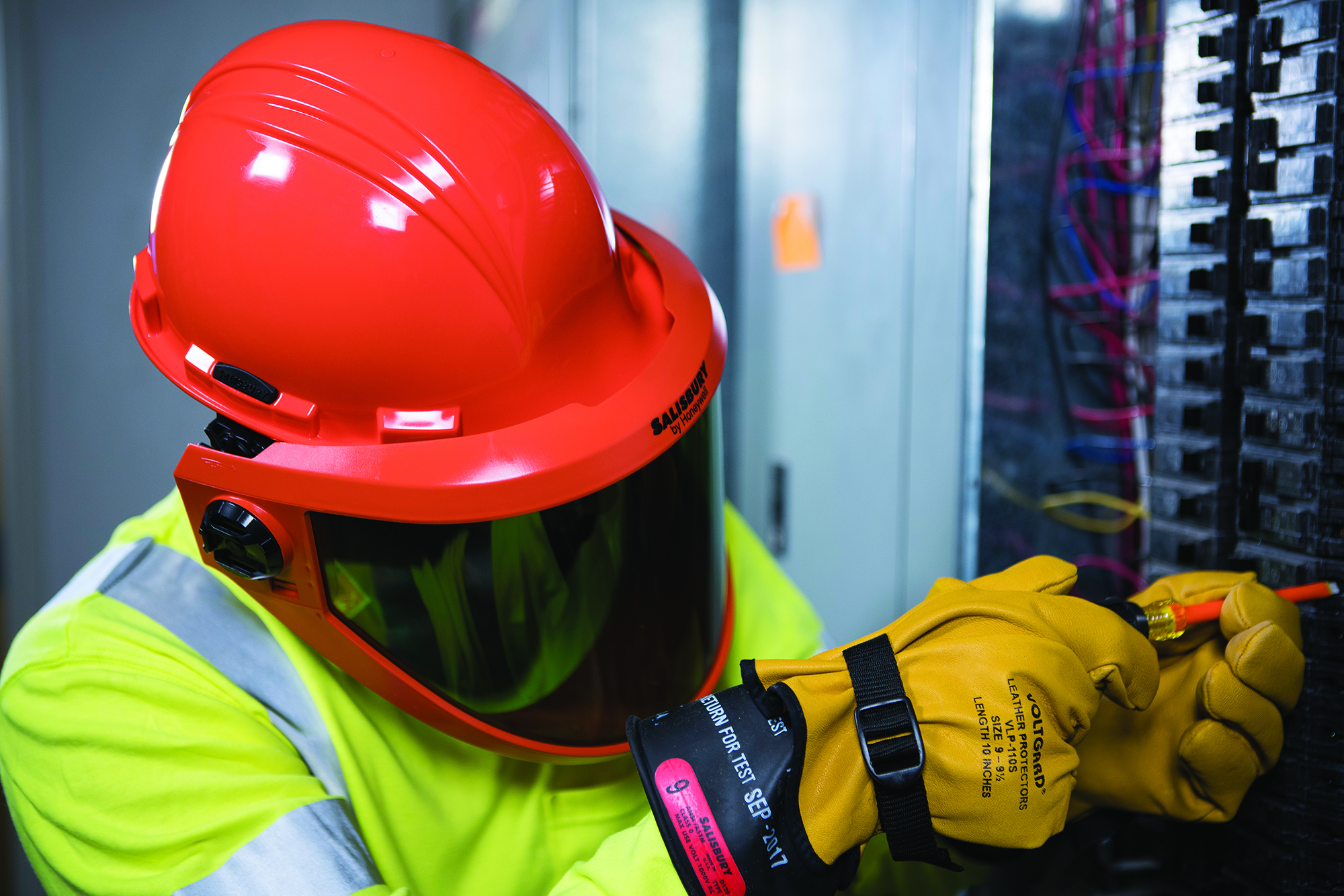
Type I
Type I under ANSI/ISEA Z89.1 is intended primarily for impact to the top of the head. This classification should only be used when the helmet is actually marked and certified to the ANSI standard.
Type II
Type II is tested for protection against impact to the top and sides of the head. It may be appropriate where workers could strike structures, be exposed to moving equipment, or experience lateral impact. A Type II designation is not automatically equivalent to every European or Malaysian helmet standard.
Electrical Classes G, E and C
ANSI-certified helmets may also be marked Class G, Class E or Class C. These classes describe different electrical-performance levels. A vented Class C helmet does not provide electrical protection. Do not select a helmet for electrical work based only on its plastic appearance; verify the exact class, voltage limitations, test standard and manufacturer instructions.
How to Select a Safety Helmet by Hazard
|
Hazard / task |
Suitable direction |
Critical check |
|
Falling objects from above |
Certified industrial safety helmet with appropriate top-impact and penetration protection |
Check shell, suspension and standard marking. |
|
Possible side impact |
Helmet specifically certified for lateral or Type II impact protection |
Do not assume all helmets provide side-impact protection. |
|
Electrical exposure |
Unvented helmet with the required electrical rating |
Confirm rating, voltage limits and accessory compatibility. |
|
Work at height |
Helmet with suitable retention/chinstrap and certification for the intended work environment |
Assess helmet loss, snagging, fall and rescue risks. |
|
Hot outdoor work without electrical hazard |
Vented certified helmet or full-brim design where suitable |
Balance airflow with impact, rain, sun and site requirements. |
|
Low overhead clearance only |
EN 812-certified bump cap where falling-object risk is absent |
Not acceptable for construction falling-object hazards. |
|
Face and hearing protection required |
Helmet system with manufacturer-approved slots and accessories |
Use compatible visor carriers, earmuffs and chinstraps. |
Step-by-Step Helmet Selection Process
- Identify the hazards: Review falling objects, overhead structures, lateral impacts, electrical exposure, heat, chemicals, molten metal, work at height and restricted access.
- Define the required standard: Use the client specification, HIRARC, approved product list and applicable project standard to state the exact certification required.
- Choose the construction: Select vented or unvented, brim or full brim, ratchet or pin-lock suspension, and the required chinstrap or retention system.
- Check fit and size: Confirm the adjustment range fits all intended users and that the suspension sits correctly without unsafe caps or objects underneath.
- Confirm accessory compatibility: Use only manufacturer-approved visors, earmuffs, lamps, neck shades, badges and chinstraps.
- Review documentation: Obtain the model number, standard marking, certificate or test report, technical data sheet, manufacturer instructions and traceability details.
- Trial before bulk purchase: For large orders, conduct a user trial covering fit, comfort, heat, visibility and compatibility with other PPE.
Vented vs Unvented Safety Helmets
Vented Helmets
Ventilation can improve comfort in Malaysia’s hot and humid conditions. Vented helmets may suit construction, logistics or maintenance work where the relevant certification permits ventilation and there is no electrical or splash hazard requiring a closed shell.
Unvented Helmets
Unvented helmets may be needed for specified electrical protection, molten-metal splash, flames or environmental exposure. The required protection must be confirmed from the product marking and technical documentation. An unvented shell does not automatically mean that a helmet has an electrical rating.
Chinstraps and Work at Height
A chinstrap can help keep a helmet on the head during climbing, movement or a fall. At the same time, a retention system can create a snagging or strangulation hazard in some ground-based environments. EN 397 and EN 12492 use different chinstrap-performance approaches, and some professional helmets offer adjustable configurations for different work environments.
The employer should therefore select the complete helmet system through a task-specific risk assessment and follow the manufacturer’s instructions. For work at height, confirm that the helmet and chinstrap are certified and configured for that purpose rather than adding a generic strap to an unrelated hard hat.
Further reading: Petzl professional helmet selection guidance and Haisar’s Working at Height in Malaysia guide.
Fit, Suspension and Compatibility
- The suspension should be correctly assembled, adjusted and seated at the position specified by the manufacturer.
- The helmet should remain stable when the user bends, looks upward or moves normally.
- The shell should not rest directly on the head; the suspension creates the designed clearance and energy-management space.
- Do not wear baseball caps, thick beanies or objects beneath the helmet unless the manufacturer specifically approves them.
- Use the correct suspension, sweatband and chinstrap for the exact helmet model. Similar-looking parts are not necessarily compatible.
- Verify that earmuffs, face shields, lamps and other accessories do not interfere with the fit, electrical rating or certification.
Inspection, Replacement and Service Life
There is no single replacement period that applies to every safety helmet. Service life depends on the manufacturer, product material, date of first use, frequency of use and exposure to sunlight, heat, chemicals and impact. Follow the specific user instructions and site inspection programme.
Before-Use Inspection
- Cracks, dents, cuts, deformation or penetration marks on the shell
- Fading, chalking, brittleness or other signs of ultraviolet or heat degradation
- Chemical contamination, paint, adhesive or unknown substances
- Torn, stretched, frayed or incorrectly fitted suspension components
- Damaged ratchet, buckles, clips, chinstrap or accessory slots
- Missing or illegible standard markings, model identification or date information
- Unapproved drilling, painting, engraving, heating or modification
Replace or Quarantine Immediately When
- The helmet has sustained a significant impact, even when damage is not obvious.
- The shell or suspension is cracked, deformed, cut, brittle or chemically damaged.
- The helmet’s history is unknown or traceability has been lost.
- The manufacturer’s replacement criteria or maximum service life has been reached.
- An inspection identifies a defect that could affect protection or retention.
Manufacturer guidance from 3M advises inspection of the shell and suspension before each use and immediate replacement when wear, damage, abuse or degradation is found. Exposure to sunlight, heat, cold and chemicals can require more frequent replacement. Read the 3M Hard Hats 101 technical bulletin.
Cleaning, Storage and Modifications
- Clean the helmet only with methods and products permitted by the manufacturer, commonly mild soap and water.
- Do not use petrol, solvents, aggressive cleaners or unapproved disinfectants.
- Store helmets away from direct sunlight, excessive heat, chemicals and heavy objects that may deform the shell.
- Do not leave helmets for long periods on vehicle dashboards or in other high-temperature locations.
- Do not drill ventilation holes, cut the brim or alter the suspension.
- Apply labels, stickers, reflective material or company branding only when the helmet manufacturer permits the adhesive and location.
- Do not paint the shell unless the manufacturer has approved the paint system for that exact product.
Safety Helmet Colours in Malaysia
Malaysia does not use one universal national helmet-colour code for every workplace. Contractors, factories, petrochemical facilities and project owners may use different colours to identify roles, visitors, supervisors, emergency teams or trades. The site PPE specification and induction rules should therefore control colour selection.
For bulk procurement, obtain the project colour matrix before ordering. Colour should support identification but must never be treated as evidence of the helmet’s certification, electrical class or protective performance.
Safety Helmet Procurement Checklist
|
RFQ field |
Information to provide |
|
Work activity and hazards |
Falling objects, side impact, electrical, height, heat, chemicals, molten metal or low-clearance bump hazards |
|
Required standard |
State the exact standard, type, class and optional properties required |
|
Helmet design |
Vented/unvented, brim/full brim, shell material and colour |
|
Suspension and fit |
Ratchet or pin-lock, size range, sweatband and user trial requirements |
|
Retention |
Two-point or multi-point chinstrap and required certification/configuration |
|
Accessories |
Visor, earmuffs, lamp, face shield, neck shade, reflective markings or identification |
|
Documentation |
Technical data sheet, certification/test evidence, instructions, model and traceability |
|
Quantity and logistics |
Sizes, colours, delivery location, required date, phased delivery and replenishment |
|
Branding |
Approved logo or sticker method that does not affect certification |
Safety Helmet Options from Haisar
Haisar Supply & Services supports contractors, factories, HSE teams and procurement departments sourcing safety helmets and related PPE in Johor and across Malaysia. Product availability and certification vary by model, so quotation requests should state the required standard, hazard, electrical class, colour, suspension, chinstrap and accessories.
Relevant Haisar pages:
- Hard Hat and Helmet category - browse head-protection options
- PPE product category - browse wider personal protective equipment
- MSA V-Gard Helmet with Chin Strap - product enquiry page
- Proguard Advantage I Safety Helmet - product enquiry page
- Safety Helmet Standards in Malaysia - supporting standards article
- Safety Helmet Maintenance and Inspection Guide - supporting maintenance article
|
Request a Safety Helmet Quotation |
Frequently Asked Questions
Does every safety helmet need a SIRIM sticker?
Do not rely on a sticker alone. Confirm the exact product certification, applicable standard, model and documentation required by DOSH, the client or the project. SIRIM QAS certification is an important local conformity route, while some projects specify recognised international standards.
What is the difference between Type I and Type II helmets?
Under ANSI/ISEA Z89.1, Type I is primarily tested for top impact, while Type II includes top and lateral impact requirements. Only use these labels for products actually certified to the ANSI standard.
Can a vented helmet be used for electrical work?
Not unless the product is specifically marked and certified for the required electrical protection. Vented helmets commonly do not provide an electrical class. Check the exact model and manufacturer instructions.
Is a bump cap acceptable on a construction site?
A bump cap may be suitable only for minor contact with fixed objects where there is no falling-object or penetration hazard. It is not a substitute for an industrial safety helmet.
How often should a safety helmet be replaced?
There is no universal period. Follow the manufacturer’s instructions and replace the helmet immediately after significant impact, damage, degradation, unknown history or when its defined service-life criteria are reached.
Can I put a company logo or sticker on a helmet?
Only use branding methods, labels and adhesives permitted by the manufacturer. Unapproved paint, solvent-based ink, drilling or adhesives may weaken the shell or affect certification.
What helmet colour should a safety officer wear?
Colour codes are normally set by the project owner or company. Check the site colour matrix before ordering; colour does not determine the helmet’s protective rating.
Which helmet is suitable for work at height?
Select a helmet and chinstrap system certified and configured for the task. Consider helmet retention, snagging, electrical hazards, impact direction, rescue and compatibility with fall-protection equipment.
Conclusion
The best safety helmet is not the most expensive or the most modern-looking model. It is the certified helmet that matches the hazards, fits the wearer, remains compatible with other PPE and is inspected and maintained according to the manufacturer’s instructions. Malaysian employers and procurement teams should document the required standard, impact protection, electrical class, ventilation, retention and accessories before purchasing in bulk.
Haisar Supply & Services can support product sourcing and quotation requirements. Final PPE selection should be confirmed by the employer’s risk assessment, project specification and competent safety personnel.
General guidance notice: This article provides general procurement and safety information. It does not replace a site-specific risk assessment, project specification, manufacturer instructions, product certificate or advice from the relevant Malaysian authority or competent person.
Official and Technical References
- DOSH - Occupational Safety and Health Act 1994 (updated text)
- DOSH - Personal Protective Equipment information
- DOSH - Approved and recognised PPE list
- SIRIM QAS - Guideline on certification of personal protective equipment
- 3M - Head Protection: Hard Hats 101 technical bulletin
- Petzl - How to choose a professional helmet
