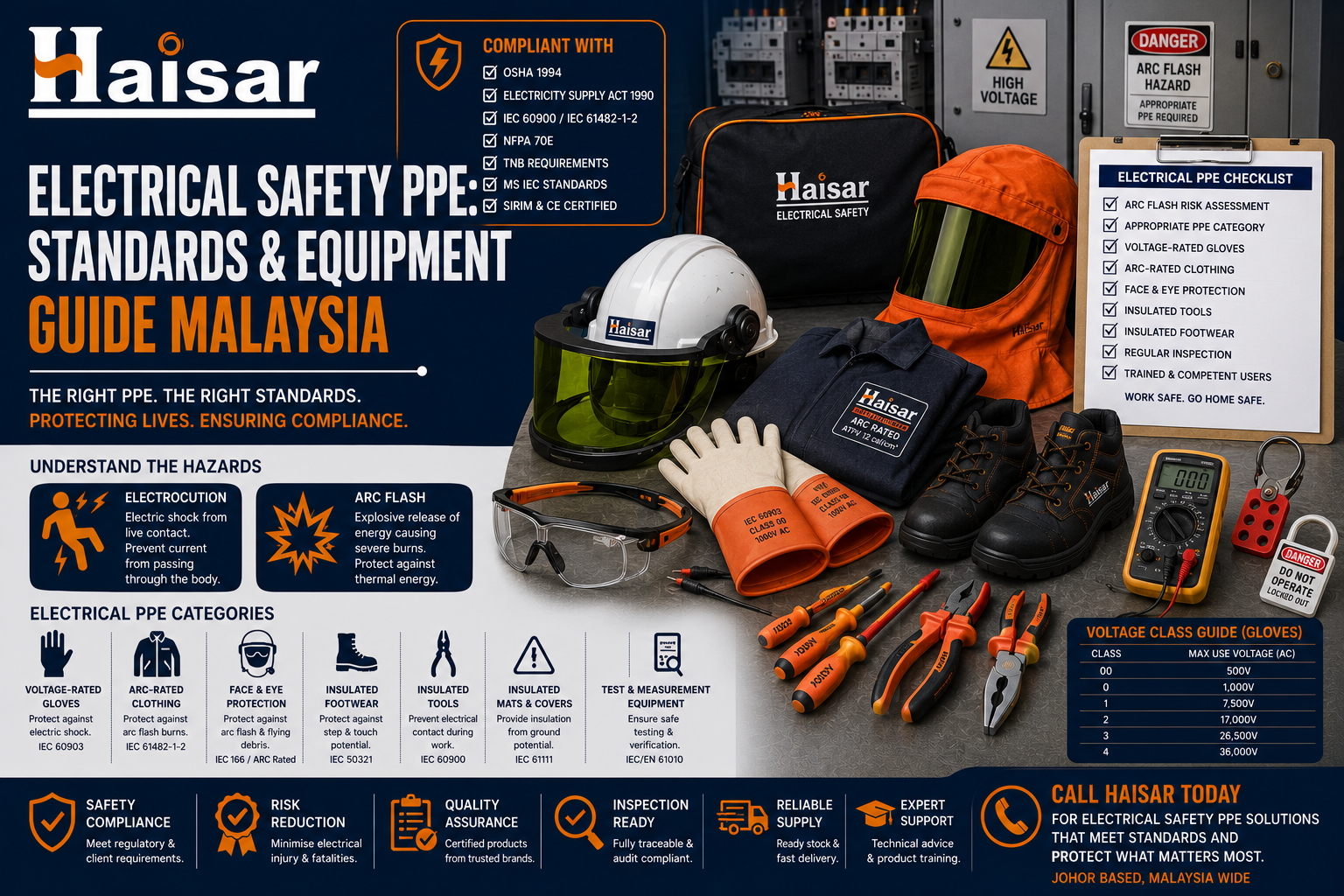
Electrical fatalities in Malaysian workplaces are disproportionately underreported relative to their actual incidence. When an electrical fatality occurs on a construction site or industrial facility, the immediate cause recorded is often the incident type, whether a fall, a fire, or a burn, rather than the underlying electrical contact that initiated it. The result is a systemic underestimation of electrical hazard risk across Malaysian industry and a corresponding underinvestment in electrical safety PPE.
The reality is that every industrial workplace in Malaysia that operates electrical systems carries arc flash, electrocution, and electrical burn risk. Manufacturing plants, data centres, oil and gas facilities, construction sites, power generation facilities, and any other workplace with switchgear, motor control centres, distribution boards, or process electrical systems exposes workers to hazards that standard workwear and standard PPE do not address.
This guide covers the standards governing electrical safety PPE in Malaysia, the equipment required for different classes of electrical work, and how to build a compliant electrical PPE programme that actually protects workers rather than just satisfying a compliance checklist.
The Malaysian Regulatory and Standards Framework for Electrical Safety
Electrical safety in Malaysian workplaces operates under a layered framework of legislation, regulations, and technical standards that procurement teams and HSE managers must navigate simultaneously.
Electricity Supply Act 1990 and Electricity Regulations 1994. These govern the supply, installation, and use of electrical equipment in Malaysia and establish the licensing requirements for electrical workers. The Electricity Regulations specify the safety requirements for electrical installations and the qualifications required to work on them.
OSHA 1994. The general duty under Section 15 of OSHA 1994 applies to electrical hazards as it does to all workplace hazards. Employers are required to provide safe systems of work and appropriate PPE for workers exposed to electrical hazards.
Factories and Machinery Act 1967 and Regulations. For factory environments, the Act and its subsidiary regulations impose specific requirements for electrical safety in factory installations.
TNB (Tenaga Nasional Berhad) Requirements. For work on or near TNB distribution networks and high-voltage infrastructure, TNB specifies minimum PPE standards and work practices for authorised contractors. These requirements reflect the specific voltages and system configurations of the TNB network and are additional to the OSHA baseline.
IEC 60900. The International Electrotechnical Commission standard for insulating hand tools used on live or near-live low-voltage electrical installations. This is the primary standard referenced in Malaysia for voltage-rated insulating tools and is widely cited in PETRONAS and international client specifications for electrical work.
IEC 61482-1-2 and NFPA 70E. The IEC and NFPA standards governing arc flash protective clothing and equipment. Both are referenced in the Malaysian oil and gas, power generation, and industrial sectors. IEC 61482-1-2 defines arc thermal performance values (ATPV) for protective clothing. NFPA 70E provides the framework for arc flash hazard analysis and PPE category selection that is most widely used by international contractors and PETRONAS-aligned operations in Malaysia.
MS IEC Standards. Malaysia adopts IEC standards as Malaysian Standards through the MS IEC series. Electrical PPE specified against IEC standards is generally accepted in Malaysia without requiring separate SIRIM certification, though documentation of the IEC standard compliance is required.
Understanding which standards apply to your specific workplace, your electrical system voltage levels, and your client or principal contractor requirements is the starting point for building a defensible electrical PPE specification.
Understanding the Two Primary Electrical Hazards
Electrical safety PPE is not a single product category. It addresses two distinct and separate electrical hazards that require different equipment and different selection methodologies.
Electrocution and electric shock result from current flowing through the human body when contact is made with a live conductor. The severity depends on the current magnitude, the path through the body, and the duration of contact. Even low voltages can cause fatal ventricular fibrillation under the right conditions. The primary PPE for electrocution protection is voltage-rated insulating equipment that prevents current flow through contact.
Arc flash is an electrical fault event in which energy is released explosively through an arc between conductors. The arc produces an intense flash of light, a pressure wave, and a thermal energy release measured in calories per square centimetre that can cause severe burn injuries at distances of several metres from the fault point. The primary PPE for arc flash protection is arc-rated clothing and face protection that limits the thermal energy transmitted to the wearer's skin.
These two hazards require different PPE and must be assessed separately. A worker wearing voltage-rated insulating gloves is protected against electrocution from the system voltage but may not be protected against the arc flash thermal energy if a fault occurs. A worker wearing an arc-rated coverall is protected against the thermal effects of an arc flash but the FR fabric provides no insulation against the voltage of the system being worked on.
Both hazards must be addressed in the electrical PPE specification for any live electrical work.
Electrical Safety PPE: The Full Equipment Range
Voltage-Rated Insulating Rubber Gloves
Insulating rubber gloves are the primary hand protection against electrocution for any live electrical work in Malaysia. They are classified by voltage class and must be matched to the system voltage being worked on.
The IEC 60903 and ASTM D120 classification system defines six voltage classes. Class 00 is rated for use up to 500V AC. Class 0 covers up to 1,000V AC. Class 1 covers up to 7,500V AC. Class 2 covers up to 17,000V AC. Class 3 covers up to 26,500V AC. Class 4 covers up to 36,000V AC.
For most Malaysian industrial workplaces operating at low voltage (up to 1,000V AC), Class 0 gloves are the minimum requirement for live electrical work. For medium voltage systems including 11kV and 33kV switchgear common in Malaysian industrial and utility installations, Class 2 or Class 3 gloves are required depending on the system voltage.
Insulating rubber gloves must be worn with leather over-gloves to protect the rubber from cuts, punctures, and abrasion during use. A glove with a pinhole failure will not protect against electric shock. Over-gloves are not optional.
Insulating rubber gloves must be pressure tested at intervals not exceeding six months to verify that the rubber dielectric integrity is maintained. Gloves that have not been tested within the required interval must not be used for live electrical work regardless of apparent condition. A credible electrical PPE supplier in Malaysia should be able to supply test certificates with new gloves and advise on testing facilities for gloves in service.
Insulating Sleeves
For work situations where the forearm and upper arm may be exposed to live conductors, insulating sleeves provide voltage-rated protection for the arm beyond the cuff of the insulating glove. They are classified on the same voltage class system as gloves and must be pressure tested at the same intervals.
Arc Flash Rated Face Protection
Standard polycarbonate face shields provide impact protection but no arc flash protection. For any work near live electrical equipment where an arc flash could occur, arc-rated face shields or arc flash hoods must be worn.
Arc flash face shields are rated in calories per square centimetre (cal/cm²) as their arc thermal performance value (ATPV). The ATPV of the face shield must equal or exceed the incident energy calculated by the arc flash risk assessment for the specific work location.
Arc flash switching hoods provide full head and face protection and are required for higher incident energy environments including work at medium voltage switchgear. They are heavier and less comfortable than face shields but provide significantly greater arc flash protection for the head and neck.
Arc Flash Rated Clothing
Arc flash clothing is rated by its ATPV in cal/cm², which represents the incident energy level at which the wearer has a 50% probability of a second-degree burn through the garment. Garments must be selected with an ATPV equal to or exceeding the incident energy at the work location.
Arc flash rated coveralls provide full-body protection in a single garment and are the standard configuration for arc flash PPE programmes across Malaysian industrial facilities. They must be made from inherently FR fabric, not from fabric that has been chemically treated for FR performance, as treatment-based FR fabrics lose their protection after repeated washing.
Arc flash rated shirts and trousers in a two-piece configuration provide equivalent protection to coveralls and may be more practical for supervisory and technical personnel who require flexibility in their workwear.
Layered arc flash systems are used at higher incident energy levels where a single garment cannot provide sufficient ATPV. A base layer of arc-rated fabric worn beneath an arc flash coverall or jacket combines the ATPV of both layers, allowing higher incident energy environments to be addressed without extremely heavy single-layer garments.
Arc flash clothing must never be worn over or combined with synthetic fabrics including polyester and nylon. Synthetic fabrics melt when exposed to arc flash heat, significantly increasing burn injury severity even when worn beneath an arc-rated outer layer.
Voltage-Rated Insulating Tools
All tools used for live electrical work must be voltage-rated to IEC 60900 or equivalent. The IEC 60900 standard requires that insulated tools be tested to 10,000V AC and rated for use at up to 1,000V AC. This provides a safety factor above the rated working voltage.
Voltage-rated tools include screwdrivers, pliers, cutters, spanners, and ratchets. The complete set of tools required for live work at a specific location must be voltage-rated. Using a single unrated tool in a live electrical environment undermines the protection provided by the rated tools used alongside it.
Voltage-rated tools must be inspected before use for damage to the insulating coating. Any tool with a cut, crack, or delamination in the insulating coating must be removed from service immediately. The insulating coating of a voltage-rated tool is not decorative. It is the primary protection against electrocution through the tool.
Non-Contact Voltage Detectors and Phase Testers
Verifying the de-energised status of a circuit or system before physical contact is a fundamental electrical safety requirement. Non-contact voltage detectors allow this verification without requiring physical contact with the conductor being tested.
Voltage detectors used in Malaysian industrial environments must be rated for the voltage range of the system being tested. A low-voltage detector will not reliably indicate the presence of medium-voltage AC. Ensure the voltage detector in use covers the voltage range of the system.
Phase testers and voltage indicating devices for medium and high voltage systems must be rated and tested to the appropriate IEC standard for the system voltage.
Lockout/Tagout Equipment
LOTO equipment is the administrative and physical system for ensuring that electrical energy sources are isolated and cannot be re-energised while work is in progress. It is a mandatory requirement for all electrical maintenance work in Malaysian industry under OSHA 1994 and applicable DOSH guidelines.
A complete LOTO programme for electrical systems requires lockout padlocks individually keyed to each authorised worker, hasp devices allowing multiple workers to lock out a single isolation point simultaneously, circuit breaker lockout devices compatible with the specific breaker designs at the facility, isolation switch lockout devices, and tagout tags that identify who performed the isolation, when, and for what purpose.
LOTO equipment must be specific to the isolation point types present at the facility. Generic LOTO kits may not include devices compatible with the specific circuit breaker models or isolation switch configurations at a Malaysian industrial facility. The procurement of LOTO equipment must be preceded by a site survey of isolation point types and a compatibility assessment of the devices being sourced.
Insulating Matting and Floor Protection
Insulating matting provides a secondary protection layer for workers standing at switchboard and distribution board locations during electrical work. It reduces the risk of a fault current finding a path to ground through the worker's body by insulating the worker from earth.
Insulating matting in Malaysia must be rated to the appropriate voltage class for the switchboard voltage. IEC 61111 specifies the performance requirements for electrical insulating matting. Matting must be inspected regularly for cuts, punctures, and contamination that would compromise its dielectric performance.
Building an Arc Flash PPE Programme in Malaysia
The selection of arc flash PPE cannot be made without an underlying arc flash risk assessment. Specifying arc flash PPE categories without knowing the incident energy at the specific work locations is not a compliant approach, regardless of what PPE is ultimately selected.
An arc flash risk assessment for a Malaysian industrial facility involves a short-circuit and protective device coordination study of the facility's electrical system, calculation of the incident energy at defined work locations throughout the system, determination of the arc flash boundary for each work location, and selection of PPE categories appropriate to the calculated incident energy levels.
This study must be carried out by a competent electrical engineer and must be reviewed whenever the electrical system is modified. The output of the study is documented at each switchboard, panel, and work location, typically on an arc flash label that specifies the incident energy, the arc flash boundary, and the required PPE category for that location.
A PPE supplier engaged to supply arc flash PPE for a Malaysian facility should be asking about the arc flash study output. If they are recommending arc flash PPE without reference to the incident energy at the work locations, they are not providing adequate technical support for the procurement decision.
Haisar Supply and Services: Electrical Safety PPE Supplier in Malaysia
Haisar Supply and Services supplies the full range of electrical safety PPE for industrial facilities and project sites across Malaysia. Our electrical safety product range covers voltage-rated insulating rubber gloves across all voltage classes with test certificates, insulating sleeves, arc flash rated face shields and switching hoods, arc flash rated coveralls and two-piece garments across multiple ATPV ratings, voltage-rated insulating tools to IEC 60900, non-contact voltage detectors and phase testers, and complete LOTO systems for electrical isolation.
We work with HSE managers and procurement officers at manufacturing facilities, data centres, power generation plants, oil and gas operations, and construction projects across Malaysia who need electrical safety PPE specified correctly for their system voltages and incident energy levels, not just selected from a catalogue.
Stay Updated on Electrical Safety Standards in Malaysia
Electrical safety standards in Malaysia are updated as IEC standards are revised and as DOSH and TNB requirements evolve. Keeping your electrical PPE programme current with these changes is an ongoing compliance obligation.
Subscribe to the Haisar newsletter for practical updates on electrical safety standards, PPE compliance changes, and HSE news relevant to industrial operations in Malaysia.
Subscribe to the Haisar Newsletter
Or visit our electrical safety product pages to explore our full range of electrical PPE and LOTO equipment.
Haisar Supply and Services Sdn Bhd (985158-T) | Kulai, Johor, Malaysia | www.haisar.com