Can't find what you're looking for? Get in touch!



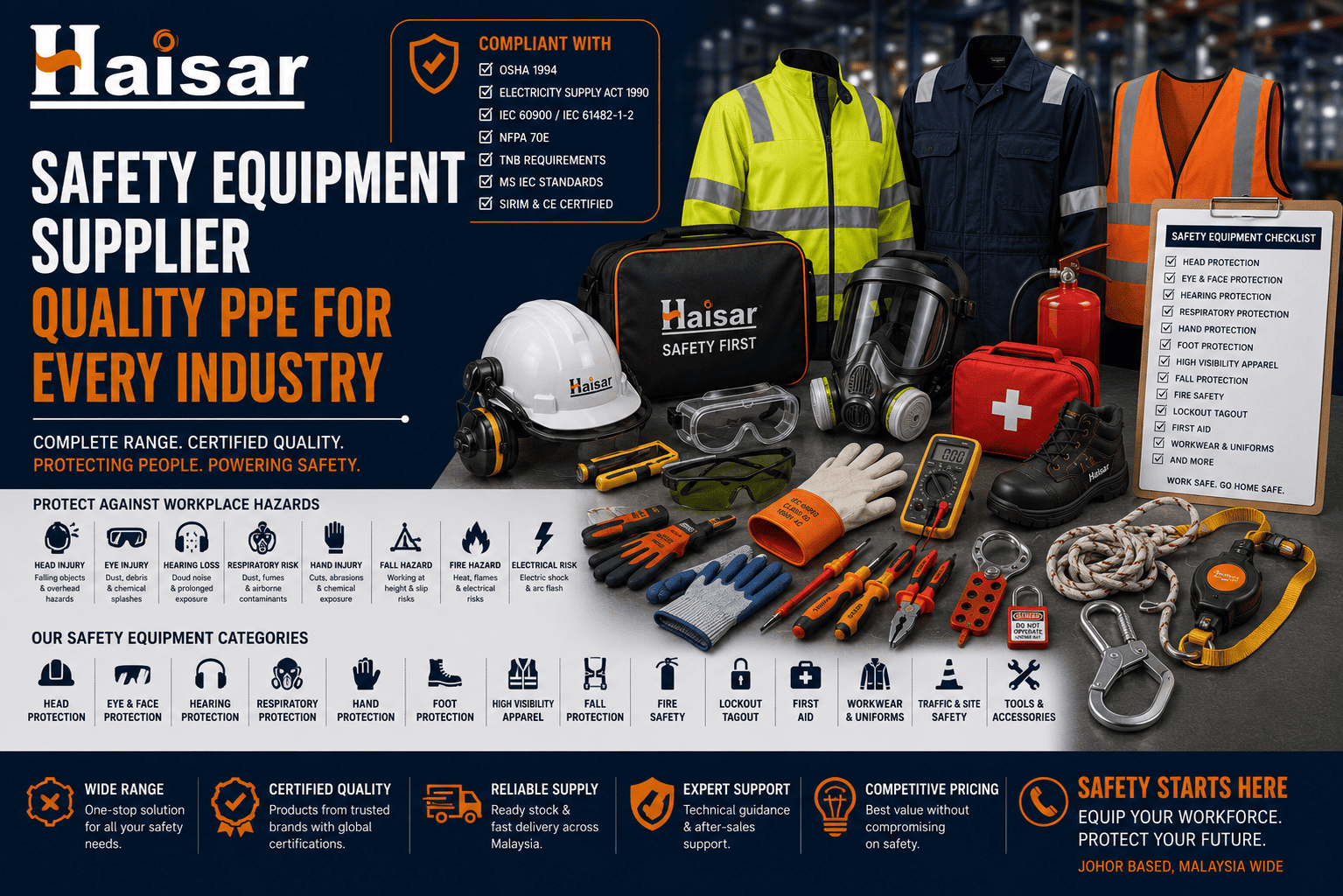
The safety helmet is the most visible piece of personal protective equipment on any construction or industrial site in Malaysia. It is also one of the most frequently misunderstood. Workers and procurement teams often treat all safety helmets as interchangeable, selecting based on price, colour, or brand familiarity rather than on whether the helmet actually matches the hazard environment it will be used in.
That misunderstanding has consequences. A helmet selected for the wrong class of hazard may provide a false sense of protection. A helmet used beyond its service life provides no reliable protection at all. A helmet that meets a certification standard from a decade ago may no longer meet the standard applicable to the site today.
This guide covers everything you need to know about safety helmets in Malaysia, from the hazard classes and certification standards that determine which helmet is right for which application, to how to select, inspect, and replace head protection correctly across the range of construction and industrial environments active in Johor and across Malaysia.
Why Safety Helmet Selection Matters
Head injuries on Malaysian construction and industrial sites range from minor lacerations to fatal traumatic brain injuries. DOSH incident records consistently show that head injuries account for a significant proportion of serious workplace injuries in the construction, manufacturing, and oil and gas sectors.
The three mechanisms of head injury that safety helmets are designed to address are impact from falling objects, impact from the wearer striking a fixed object, and electrical contact through the helmet to the skull. Different helmet types and classes protect against different combinations of these hazards with different performance levels.
A construction site in Johor where workers are exposed to falling tools and materials and where electrical cables are present overhead requires a different helmet class to a warehouse environment with low overhead impact risk and no electrical hazard. Selecting the wrong helmet for the environment is not a minor compliance gap. It is a gap in the protection provided to the worker.
Safety Helmet Standards in Malaysia
Safety helmets sold and used in Malaysia must comply with applicable certification standards. Understanding which standards apply and what they require is the foundation of a defensible head protection procurement decision.
MS EN 397. The Malaysian Standard adopting the European EN 397 standard for industrial safety helmets. This is the primary standard for industrial safety helmets in Malaysia and covers impact protection, penetration resistance, flame resistance, and electrical insulation for low-voltage applications. EN 397 is the standard most commonly referenced by DOSH, CIDB, and industry safety specifications in Malaysia.
MS EN 14052. The standard for high-performance industrial helmets providing a higher level of lateral impact protection than EN 397. Required in environments where impact from the side as well as from above is a credible hazard, including motorsport, forestry, and certain heavy industrial environments.
ANSI/ISEA Z89.1. The American National Standards Institute standard for industrial head protection. This standard is widely used in the oil and gas sector in Malaysia, particularly in PETRONAS-aligned operations and by contractors with American principal clients who specify ANSI-standard PPE. It classifies helmets by type (vertical impact only vs. lateral impact) and class (electrical insulation level).
SIRIM Certification. Safety helmets sold in Malaysia must carry SIRIM certification or equivalent international certification. SIRIM-certified helmets have been independently tested against the applicable Malaysian standard. Helmets without certification should not be used in regulated industrial and construction environments regardless of price or appearance.
MS 1): 1996 and MS 2: 1998. Earlier Malaysian standards that have been largely superseded by the MS EN series. Helmets certified only to these older standards may not meet current DOSH and industry expectations and should be treated with caution in new procurement.
Types of Safety Helmets for Construction and Industrial Use in Malaysia
Type 1 vs Type 2 (ANSI Classification)
Under the ANSI/ISEA Z89.1 standard, helmets are classified by the direction of impact they protect against.
Type 1 helmets provide impact protection only from vertical blows to the top of the helmet. They are designed for environments where the primary hazard is falling objects from above. Type 1 is the most common helmet configuration in Malaysian construction and industrial environments.
Type 2 helmets provide impact protection from both vertical blows and lateral blows from the sides. They are required in environments where workers may strike the sides of their helmet against fixed structures, in tight spaces, in elevated work environments, and in any setting where lateral impact risk is significant. Type 2 helmets are commonly required on international client projects and by operators who have adopted ANSI Z89.1 specifications.
Class A, B and C (ANSI Electrical Classification)
The ANSI/ISEA Z89.1 standard also classifies helmets by their electrical protection class.
Class A helmets provide impact protection and limited voltage protection, tested to 2,200 volts. They are appropriate for general construction and industrial environments with low electrical hazard but are not adequate for environments with significant electrical exposure.
Class B helmets provide impact protection and high-voltage protection, tested to 20,000 volts. Class B is the appropriate specification for any environment where workers may be exposed to overhead power lines, high-voltage switchgear, or significant electrical hazards. Most construction sites and industrial facilities in Malaysia with any meaningful electrical hazard should be specifying Class B helmets as the default.
Class C helmets are conductive and provide no electrical protection. They are lightweight and ventilated for comfort but must only be used in environments with absolutely no electrical hazard. Specifying Class C helmets on a site with any electrical exposure is a compliance and safety failure.
EN 397 Class Equivalents
Under the MS EN 397 standard used in Malaysia, the equivalent electrical protection classifications are expressed differently but address the same hazard.
Standard EN 397 helmets provide impact and penetration protection with basic lateral deformation resistance. Electrical insulation testing is an optional additional property under EN 397, denoted by the marking "440V AC" on the helmet label. This is roughly equivalent to Class A under ANSI.
EN 397 with 440V AC electrical insulation is the minimum electrical protection specification for most Malaysian industrial and construction sites. It is not equivalent to Class B. For environments with high-voltage exposure, a helmet rated to a higher voltage test level or meeting EN 50365 (helmets for low-voltage electrical installations) or Class B under ANSI may be required.
Hard Hats vs Safety Helmets
The terms hard hat and safety helmet are often used interchangeably in Malaysia but they refer to the same class of product. Both describe the rigid shell and internal suspension system head protection device required on construction and industrial sites. The term safety helmet is preferred in standards documentation. Hard hat is more common in everyday site language. The regulatory and protection requirements are the same regardless of which term is used.
Bump Caps
Bump caps are lightweight head protection devices designed for environments with low-headroom scrape and bump hazards but no significant impact risk. They provide no protection against falling objects and do not meet EN 397 or ANSI Z89.1 requirements.
Bump caps are appropriate for maintenance technicians working in plant rooms and equipment enclosures where the primary risk is knocking the head against a fixed structure at low speed. They must not be used as substitutes for safety helmets in any environment where falling objects, significant impact, or electrical hazards are present.
Safety Helmet Comparison Table
The table below summarises the key specifications and appropriate applications for the main helmet types used on construction and industrial sites in Malaysia.
| Helmet Type | Standard | Impact Protection | Electrical Protection | Typical Application in Malaysia |
|---|---|---|---|---|
| Class A / EN 397 (no electrical rating) | ANSI Z89.1 / MS EN 397 | Vertical impact | None or limited (2,200V) | Warehouses, low-hazard sites, no electrical exposure |
| Class B / EN 397 + 440V | ANSI Z89.1 / MS EN 397 | Vertical impact | High voltage (20,000V) / 440V AC | Construction sites, industrial facilities, oil and gas |
| Type 2 Class B | ANSI Z89.1 | Vertical and lateral impact | High voltage (20,000V) | Elevated work, tight spaces, international client projects |
| EN 14052 High Performance | MS EN 14052 | Enhanced lateral and top | Optional | Heavy industrial, specialised applications |
| Bump Cap | EN 812 | Scrape and bump only | None | Plant rooms, low-headroom maintenance |
| Class C | ANSI Z89.1 | Vertical impact | None (conductive) | No electrical hazard environments only |
Helmet Accessories and Add-Ons
A safety helmet selected for the right hazard class can be further specified with accessories that extend its protection and usability.
Chin straps are required for working at heights, for work on open vessel decks, for work in windy exposed environments, and for any application where the helmet could be dislodged. A helmet without a chin strap in these environments becomes a secondary hazard when it falls on workers below.
Visors and face shields that attach directly to the helmet brim provide integrated face protection for grinding, cutting, and forestry applications without requiring a separate face shield to be held or worn.
Ear muff attachments that mount directly to the helmet allow hearing protection to be integrated with head protection, ensuring consistent use in high-noise environments.
Sweatbands and ventilation inserts improve comfort in Malaysia's tropical climate, reducing heat build-up inside the helmet during prolonged wear. Sweatbands must be replaceable and must be replaced when visibly soiled.
Reflective stickers and helmet branding for company identification and role identification on multi-contractor sites. Stickers must not cover cracks or damage in the helmet shell.
Neck curtains for outdoor environments with high UV index, particularly relevant for workers on solar farms, civil engineering sites, and other outdoor projects in Malaysia's equatorial climate.
How to Inspect and Replace Safety Helmets
A safety helmet that is beyond its service life or that has been damaged provides no reliable protection. Inspection and replacement discipline is as important as initial product selection.
Pre-use inspection by the wearer before each shift. Check the shell for cracks, dents, gouges, and UV-related chalking or fading. Check the suspension system for cuts, fraying, and broken attachment points. Check the chin strap for damage and correct function. Any helmet with visible damage must be removed from service immediately.
Formal periodic inspection by a competent person at intervals specified in the safety management system. Formal inspection provides documented evidence of the condition of each helmet in service.
Service life limits. Safety helmets have a finite service life regardless of apparent condition. The helmet shell degrades through UV exposure, heat, chemical exposure, and impact events that may not leave visible marks. Most helmet manufacturers specify a maximum service life of five years from the date of manufacture for the shell and three years from the date of first use for the internal suspension. The manufacture date is stamped inside the shell. Any helmet beyond these limits must be replaced.
Immediate replacement triggers. A helmet that has sustained a significant impact must be replaced immediately, even if no damage is visible. The internal structure of the shell and suspension may be compromised in ways that are not visible externally but that will cause the helmet to fail in a subsequent impact. This is the most frequently ignored replacement requirement on Malaysian project sites.
Environmental degradation. Helmets used on outdoor sites in Malaysia are exposed to UV radiation and heat that accelerates shell degradation. In outdoor environments, the practical service life may be shorter than the manufacturer's standard recommendation. Visually inspect for shell chalking, fading, and increased brittleness as indicators of UV degradation.
Frequently Asked Questions About Safety Helmets in Malaysia
What is the difference between a Class A and Class B safety helmet?
Class A helmets provide limited voltage protection tested to 2,200V AC. Class B helmets provide high-voltage protection tested to 20,000V AC. For any construction or industrial site in Malaysia with overhead electrical cables, switchgear, or any other significant electrical hazard, Class B is the appropriate specification. Class A is only appropriate where there is genuinely no meaningful electrical hazard.
How long does a safety helmet last in Malaysia?
Most manufacturers specify a maximum of five years from manufacture date for the helmet shell and three years from first use for the internal suspension, whichever comes first. In outdoor environments in Malaysia with high UV exposure, the practical service life may be shorter. The manufacture date is stamped inside the shell. Check it and replace helmets accordingly.
Can I use the same helmet for construction and electrical work?
Only if the helmet is rated for both. A Class B helmet or an EN 397 helmet with appropriate electrical insulation rating provides both impact protection and electrical protection. A Class A or unrated helmet does not provide meaningful electrical protection and should not be worn in areas with significant electrical exposure.
Does a safety helmet need to be SIRIM certified in Malaysia?
Safety helmets used in regulated workplaces in Malaysia should carry SIRIM certification or equivalent international certification. SIRIM-certified helmets have been independently tested against the applicable Malaysian standard. Helmets without certification documentation should not be accepted for use on regulated construction or industrial sites.
What colour hard hat should different workers wear?
There is no single nationally mandated colour code for safety helmets in Malaysia. Many principal contractors and project operators specify their own colour systems for site identification, for example white for management and engineers, yellow for general workers, green for safety officers, and orange for visitors. Check the site-specific requirements before procuring helmets in bulk for a project.
When must a safety helmet be replaced immediately?
A helmet must be replaced immediately if it has sustained a significant impact, if it has visible cracks, dents, or shell damage, if the suspension system is cut or frayed, if it is beyond the manufacturer's service life, or if it shows signs of chemical damage or severe UV degradation. In each of these cases, the helmet should not be returned to service under any circumstances.
Does Haisar supply safety helmets in bulk for project sites in Johor?
Yes. Haisar Supply and Services supplies safety helmets across all classes and standards for project sites and facilities in Johor and across peninsular Malaysia. We supply bulk orders for project mobilisation, custom branded helmets with company stickers, and ongoing replenishment programmes. Contact our team for specifications and pricing.
Haisar Supply and Services: Safety Helmet Supplier in Malaysia
Haisar Supply and Services Sdn Bhd, based in Kulai, Johor, supplies safety helmets and head protection products for construction sites, industrial facilities, and project teams across Malaysia. Our range covers Class A and Class B helmets, Type 1 and Type 2 configurations, EN 397 certified and ANSI Z89.1 certified options, bump caps, and associated accessories including chin straps, visors, ear muff attachments, and reflective stickers.
We supply across Johor and peninsular Malaysia with fast quotation turnaround and delivery to site. For project mobilisation bulk orders and ongoing replenishment programmes, speak with our team about consolidated supply arrangements that keep your site stocked without repeated individual purchase orders.
Browse Head Protection Products at haisar.com
Haisar Supply and Services Sdn Bhd (985158-T) | Kulai, Johor, Malaysia | www.haisar.com
