Can't find what you're looking for? Get in touch!



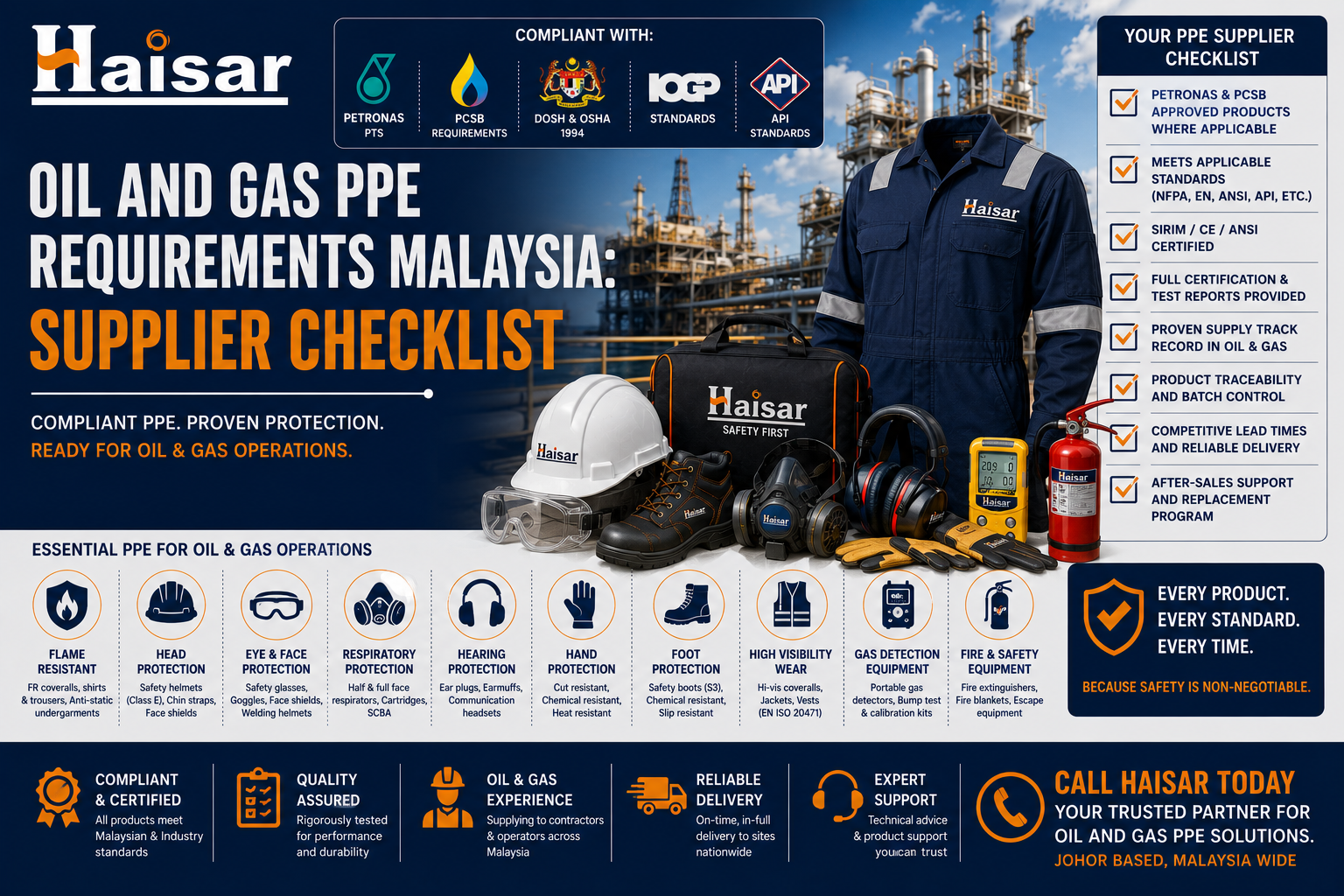
Procurement officers and HSE managers working in Malaysia's oil and gas sector operate in one of the most tightly regulated supply chain environments in the country. PETRONAS contractor requirements, PCSB safety specifications, and the overlapping obligations of DOSH, the Petroleum Safety Measures Act 1984, and international standards including IOGP and API create a compliance framework that demands more from PPE suppliers than most other industries require.
The consequence of getting PPE procurement wrong in the oil and gas sector is not just a regulatory issue. On a petrochemical plant, a refinery shutdown, or an offshore platform, inadequate PPE in the wrong hazard environment contributes directly to fatalities. The Malaysian DOSH incident record for the oil and gas sector reflects this. Falls, fire and explosion incidents, toxic gas exposure, and electrical fatalities all appear in the statistics, and all are linked to situations where the right equipment was not in place.
This checklist is written for procurement officers and HSE managers sourcing PPE for oil and gas operations in Malaysia. It covers the specific PPE requirements that apply in this sector, the compliance standards your supplier must be able to meet, and what a credible oil and gas PPE supplier in Malaysia looks like in practice.
The Regulatory Framework Governing Oil and Gas PPE in Malaysia
Before reviewing the PPE checklist, it is important to understand the layered compliance framework that governs oil and gas PPE procurement in Malaysia. This framework operates at multiple levels simultaneously and a PPE supplier working in this sector must be able to navigate all of them.
Petroleum (Safety Measures) Act 1984. The primary legislation governing safety in the Malaysian petroleum industry. It establishes the legal obligations of operators and contractors in petroleum operations and provides the framework for DOSH enforcement in the upstream sector.
OSHA 1994 and DOSH Regulations. The overarching occupational safety and health framework applying to all Malaysian workplaces including oil and gas facilities. DOSH enforcement of PPE requirements in the oil and gas sector is active and inspections are increasingly thorough.
PETRONAS Technical Standards (PTS). PETRONAS has developed a comprehensive suite of technical standards governing safety, equipment, and contractor performance at its facilities. PPE used by contractors working at PETRONAS facilities must meet PTS specifications where applicable. PETRONAS also maintains approved vendor lists and product approval requirements that affect PPE sourcing decisions.
PCSB Contractor Safety Requirements. For contractors working on PCSB-operated assets, specific contractor safety management requirements apply including PPE standards, induction requirements, and permit-to-work system obligations.
IOGP and API Standards. International Association of Oil and Gas Producers guidelines and American Petroleum Institute standards are widely referenced in the Malaysian oil and gas sector, particularly for offshore operations and for equipment specifications where PETRONAS standards reference international standards.
SIRIM Certification. Safety-critical PPE sold in Malaysia must meet SIRIM certification requirements or equivalent international standards. In the oil and gas sector, CE marking and ANSI certification are generally accepted alongside SIRIM references but documentation must be available.
A PPE supplier for oil and gas operations in Malaysia must be able to confirm the compliance status of every product against the specific standard applicable to the client's facility and operating context. This is not optional and it is not generic. The standard that applies at a PETRONAS onshore facility may differ from the standard required at an offshore platform or a downstream refinery.
The Oil and Gas PPE Checklist
The following checklist covers the PPE categories required across oil and gas operations in Malaysia. It is organised by hazard type, which is the correct starting point for PPE selection in any sector but particularly critical in oil and gas where the range and severity of hazards exceeds most other industrial environments.
Flame-Resistant and Flash Fire Protection
Flash fire risk is present wherever flammable hydrocarbons are processed, stored, or transported. The ignition of a flammable vapour cloud produces a flash fire with a duration of seconds but with sufficient thermal energy to cause fatal full-thickness burns to an unprotected worker at significant distances from the ignition source.
FR Coveralls. Flame-resistant coveralls are the primary flash fire protection garment for oil and gas workers in Malaysia. FR coveralls must be rated in calories per square centimetre against the NFPA 2112 standard or equivalent, with the calorie rating appropriate for the flash fire hazard level at the specific facility. Standard polycotton coveralls are not FR rated. They will burn when ignited and retract as they burn, increasing burn injury severity.
The FR rating of the coverall must be maintained through the customisation process if company branding is applied. Embroidery thread and reflective tape adhesives used on FR garments must be compatible with the FR fabric specification. A custom FR coverall produced by a supplier without FR garment experience may carry a brand logo but not carry the protection its rating implies.
FR Shirts and Trousers. For work environments where full coveralls are not required, FR shirts and trousers meeting NFPA 2112 or equivalent provide flash fire protection in a more practical two-piece configuration for supervisory and technical personnel.
Anti-static Undergarments. In classified hazardous areas, static electricity is an ignition risk. Anti-static undergarments reduce the risk of static discharge from clothing layers beneath the FR outer garment.
Checklist requirement: FR garments must carry a test certificate confirming the calorie rating and the standard to which they were tested. Washing instructions must be followed and FR garments must be inspected regularly for damage and contamination that could compromise the FR performance of the fabric.
Arc Flash Protection
Electrical systems at oil and gas facilities in Malaysia carry arc flash risk wherever live electrical work is performed near switchgear, motor control centres, distribution boards, and process control systems. Arc flash is a rapid release of electrical energy that produces a pressure wave, intense heat, and a flash of UV and infrared radiation that can cause fatal injuries at distances of several metres from the fault point.
Arc Flash Rated Face Shields and Hoods. Standard polycarbonate face shields are not arc flash rated. Arc flash face shields and switching hoods must be rated in calories per square centimetre against the incident energy level calculated by an arc flash risk assessment for the specific equipment being worked on.
Arc Flash Rated FR Garments. The same calorie rating requirement applies to the body protection worn during arc flash exposure. The FR garment worn as flash fire protection may or may not meet the arc flash calorie rating required for electrical work. The two requirements must be assessed separately.
Voltage-Rated Insulating Rubber Gloves. Class 00 through Class 4, matched to the system voltage. Must be pressure tested at required intervals and protected by leather over-gloves during use.
Insulated Tools and Voltage Detectors. Voltage-rated insulated tools for live work and non-contact voltage detectors for circuit status verification before any terminal or conductor contact.
Checklist requirement: An arc flash risk assessment must be conducted for the facility's electrical systems to determine incident energy levels and the required PPE category at each work location. PPE selection without an underlying arc flash study is not defensible in the event of an incident.
Gas Detection and Respiratory Protection
Toxic and flammable gas hazards are present across oil and gas operations in Malaysia. H2S is the primary toxic gas concern at upstream and refinery facilities. CO is a risk wherever combustion processes operate in confined or semi-confined spaces. Hydrocarbon vapours in confined spaces create flammable atmosphere risk. Oxygen deficiency is a risk in any enclosed space.
Personal Multi-Gas Monitors. The minimum configuration for oil and gas site work is a four-gas monitor covering O2, LEL (combustible gas), H2S, and CO. At facilities with additional specific gas hazards, extended sensor configurations may be required. Personal gas monitors must be bump tested before each shift against calibration gas and the bump test must be documented.
H2S Personal Monitors. At facilities with H2S risk, personal H2S monitors with audible and vibrating alarms are required for all workers in areas where H2S may be present. The alarm setpoints must be configured to the facility's H2S alarm levels.
Supplied Air Breathing Apparatus (SABA) and SCBA. For entry into immediately dangerous to life or health (IDLH) atmospheres including spaces with confirmed toxic gas concentrations or oxygen deficiency, supplied air or self-contained breathing apparatus is required. Air-purifying respirators provide no protection in IDLH conditions. Escape SCBA sets must be available in areas where rapid atmospheric deterioration is a risk.
Half-Face and Full-Face Respirators with Appropriate Cartridges. For non-IDLH environments with confirmed but tolerable concentrations of toxic gases or vapours, cartridge respirators with the correct cartridge type for the specific gas are required. Cartridge type must match the gas. An organic vapour cartridge provides no protection against H2S.
Checklist requirement: Gas detection equipment must be calibrated at manufacturer-specified intervals. Calibration certificates must be available for inspection. Bump test records must be maintained. All gas detection equipment used at PETRONAS facilities must be on the approved equipment list or accompanied by documentation confirming compliance with the applicable PETRONAS technical standard.
Head Protection
Safety helmets in oil and gas environments in Malaysia must meet the requirements of the specific hazard environment. Standard Class A helmets may not be adequate across all areas of an oil and gas facility.
Class B Safety Helmets. Providing impact, penetration, and electrical protection to 20,000 volts. The appropriate specification for all areas of an oil and gas facility where electrical hazards are present alongside general impact risks. This is the default specification for most oil and gas sites in Malaysia.
Class B Helmets with Chin Straps. Required for working at heights, for work on elevated structures, and for work in areas where helmet dislodgement from wind, equipment movement, or a fall is a risk.
Hard Hat Stickers and Role Identification. Many oil and gas facilities in Malaysia use hard hat colour and sticker systems to identify worker role, visitor status, and authorisation level. Custom hard hat stickers from a workwear and PPE supplier allow consistent identification across contractor teams.
Checklist requirement: Helmets must be inspected regularly and must be within the manufacturer's service life. Helmets that have sustained significant impacts must be replaced immediately even if no visible damage is apparent.
Eye and Face Protection
Oil and gas operations generate a broad range of eye and face hazards including chemical splash during process sampling and maintenance, UV radiation from outdoor work, particles and debris during mechanical maintenance, and arc flash and welding radiation during electrical and fabrication work.
Chemical Splash Goggles. For process sampling, chemical handling, and maintenance on process equipment where chemical splash risk is present. Must provide a sealed enclosure around the eye.
UV-Rated Safety Spectacles. For outdoor workers on upstream sites and pipeline projects exposed to prolonged UV radiation in Malaysia's equatorial climate.
Face Shields. For grinding, cutting, and mechanical maintenance work generating particles and debris. Must be impact-rated appropriate to the specific task.
Arc Flash Face Shields. As covered under arc flash protection above. Must be arc-rated and separate from standard impact face shields.
Welding Shields. Shaded to the appropriate number for the welding process in use. Must protect against arc radiation, UV, and infrared.
Checklist requirement: Eye protection must be appropriate to the specific eye hazard. Standard clear safety glasses do not protect against chemical splash. Chemical splash goggles do not provide arc flash protection. The hazard drives the selection.
Hand Protection
Hand hazards across oil and gas operations range from chemical exposure during process work and sampling to cut risk during mechanical maintenance, heat exposure during insulation and piping work, and electrical risk during switchgear maintenance.
Chemical Resistant Gloves. Selection must be based on chemical resistance data for the specific process chemicals at the facility. Nitrile, neoprene, butyl, and natural rubber gloves each have different chemical resistance profiles. Do not assume a single glove type covers all chemical hazards on site.
Cut-Resistant Gloves. Rated to the appropriate ANSI/ISEA 105 or EN 388 cut level for the specific mechanical maintenance task. Valve maintenance, pipe fitting, and equipment handling all generate different cut hazard profiles requiring different cut resistance levels.
Heat-Resistant Gloves. For insulation work, piping maintenance, and any task involving contact with hot surfaces or proximity to process heat.
Electrical Insulating Rubber Gloves. Voltage-rated, regularly pressure tested, and worn with leather over-gloves for all live electrical work.
Checklist requirement: Glove selection must be documented in the risk assessment for each task. A single glove type for all hand hazards across an oil and gas facility is not a credible PPE programme.
Foot Protection
Steel-Toe Safety Boots, S3 Rated. The minimum specification for general site work across oil and gas facilities in Malaysia. S3 provides toe cap protection, puncture resistance, and heel energy absorption.
Anti-Static Safety Footwear. For classified hazardous areas where electrostatic discharge is an ignition risk. Anti-static footwear must be worn without insulating insoles or socks that would break the anti-static circuit between the wearer and the ground.
Chemical Resistant Safety Boots. For process areas where chemical floor contamination or splash risk is present.
Checklist requirement: Footwear for classified hazardous areas must be anti-static rated. Standard steel-toe boots are not adequate for EX zone work without anti-static specification.
Fall Protection
Oil and gas facilities in Malaysia involve extensive working at heights on process structures, vessels, flare stacks, storage tanks, and elevated pipework. Falls from height are a consistent contributor to oil and gas sector fatalities in Malaysia.
Full-Body Harnesses. Mandatory for all fall arrest applications. Correctly fitted and inspected before each use.
Self-Retracting Lifelines (SRLs). Preferred over fixed lanyards for work on process structures where fall clearance is limited. SRLs arrest falls within centimetres.
Intrinsically Safe Attachment Hardware. In classified hazardous areas, metallic components including snap hooks and D-rings must be assessed for suitability in the area classification. Stainless steel hardware is generally specified for EX zone fall protection equipment.
Checklist requirement: A documented rescue plan must be in place before any working at heights operation begins. Suspended worker rescue from elevated structures in oil and gas facilities requires specific planning and equipment given access constraints.
What to Verify When Selecting an Oil and Gas PPE Supplier in Malaysia
A supplier working with oil and gas procurement teams in Malaysia must be able to demonstrate the following capabilities before they earn a position on your approved vendor list.
PETRONAS and PCSB product compliance knowledge. Your supplier must understand which products require PETRONAS approval, how to access approved vendor lists, and how to support the documentation process for product approval at specific facilities.
FR garment expertise. Flame-resistant workwear is a safety-critical product category where specification errors have fatal consequences. Your supplier must be able to confirm FR ratings, explain the difference between NFPA 2112 and NFPA 70E FR requirements, and advise on the correct calorie rating for your specific flash fire and arc flash hazard levels.
Gas detection calibration support. Supplying gas detection instruments without supporting the calibration programme is incomplete supply. Your supplier must be able to provide calibration gas in the correct concentration for your instruments, advise on calibration intervals, and provide calibration documentation.
Documentation at point of supply. SIRIM certificates, FR test certificates, arc flash calorie ratings, gas detection calibration certificates, and pressure test records for insulating gloves must all be available when goods are delivered, not after a request and a delay.
Approved vendor status or the capability to work through it. Many oil and gas facilities in Malaysia operate approved vendor lists for PPE supply. If your facility requires approved vendor status, your supplier must either already hold it or have a clear process for obtaining it.
Download the Haisar Oil and Gas PPE Catalogue
Haisar Supply and Services supplies the full range of oil and gas PPE for operations across Malaysia. Our range covers every category in this checklist, from PETRONAS-appropriate FR coveralls and arc flash PPE to H2S personal monitors, confined space rescue systems, voltage-rated insulating gloves, and full-body harnesses for work on process structures.
We work with procurement officers and HSE managers at PETRONAS contractor companies, upstream operators, refinery shutdown contractors, and offshore support companies across Malaysia. We understand the compliance framework, we supply with the documentation your facilities require, and we maintain the product knowledge to advise on specification rather than just fulfilling purchase orders.
Download the Haisar PPE Product Catalogue
Or contact our team directly to discuss your oil and gas PPE requirements. We respond promptly and we come prepared to talk about specifications, not just prices.
Haisar Supply and Services Sdn Bhd (985158-T) | Kulai, Johor, Malaysia | www.haisar.com
