Can't find what you're looking for? Get in touch!



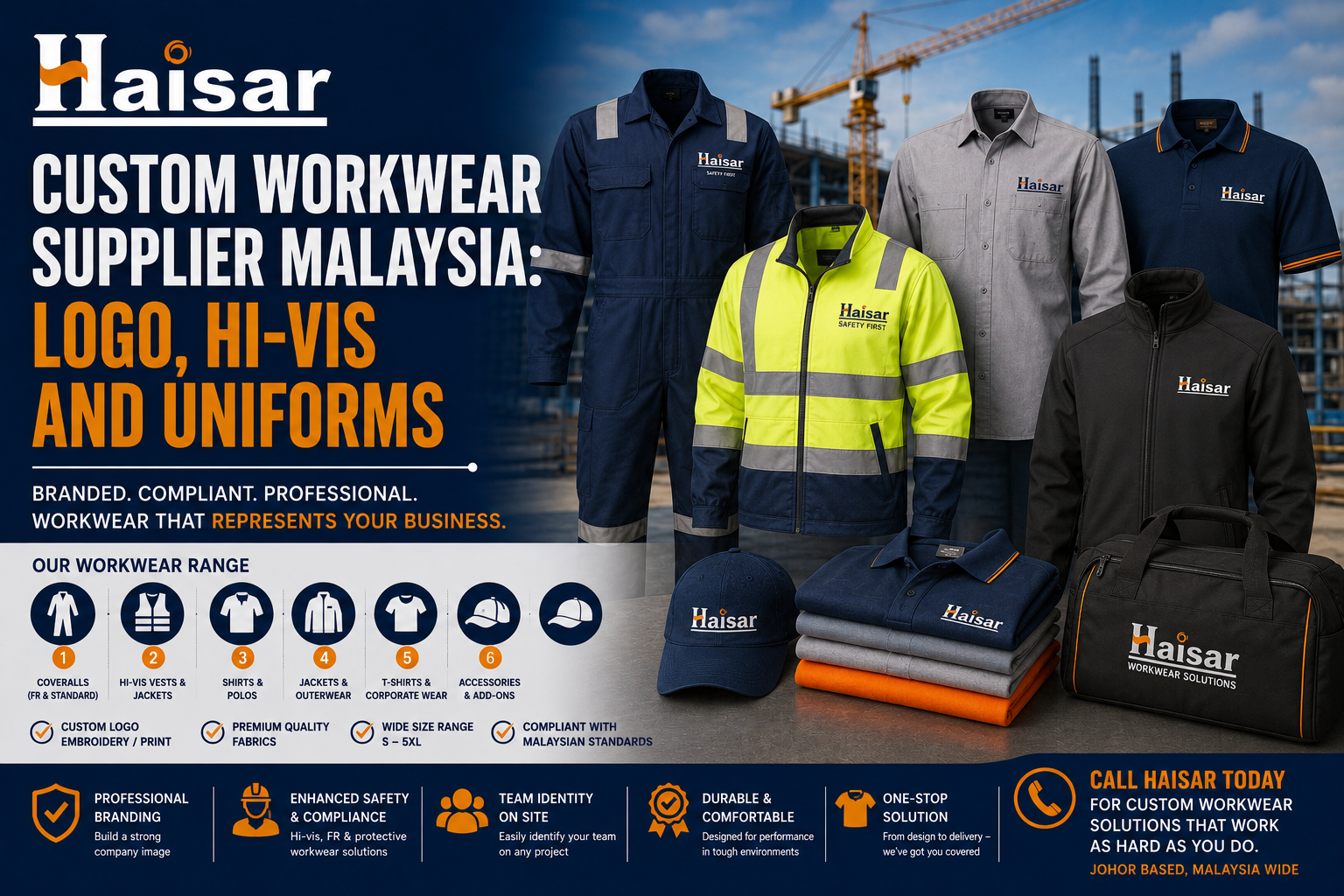
Every worker on a project site or in an industrial facility is representing an organisation. The workwear they wear communicates professionalism, safety compliance, and organisational identity to clients, regulators, and the public. Generic off-the-shelf workwear does that job passably. Custom workwear does it properly.
For companies operating in Malaysia's industrial sectors, the case for custom workwear goes beyond branding. On multi-contractor project sites, custom workwear with company identification is a practical safety tool. It allows supervisors, HSE officers, and emergency responders to instantly identify which company a worker belongs to, what their role is, and whether they have the right authorisation to be in a specific area. On client-facing sites, it projects the kind of professionalism that builds repeat business. And on sites where personal protective equipment is a regulatory requirement, custom workwear that integrates compliance and branding eliminates the friction of workers choosing comfort over safety.
This guide covers everything you need to know about custom workwear in Malaysia, from the product range and customisation options available, to how the ordering process works and what to look for in a custom workwear supplier. Whether you need branded coveralls for an oil and gas shutdown team, hi-vis jackets for a construction contractor, or a full uniform programme across a multi-site organisation, this is the reference for making informed procurement decisions.
Who Needs Custom Workwear in Malaysia
Custom workwear is relevant across virtually every sector of Malaysia's industrial and commercial economy. The specific requirements vary by industry but the underlying need is consistent: workers who look the part, are identifiable on site, and are protected by garments that meet the regulatory and practical demands of their working environment.
Oil and gas and petrochemical operations require custom workwear that integrates branding with flame-resistant (FR) protection. Workers at PETRONAS facilities, refinery shutdowns, and upstream operations wear FR coveralls as a regulatory requirement. Custom branding on FR garments allows contractors to maintain company identification without compromising the protection rating of the garment.
Construction and civil engineering contractors across Johor, the Klang Valley, and major infrastructure projects use custom hi-vis vests, jackets, and coveralls to differentiate their workers from those of other contractors on shared sites. On large projects with multiple principal and sub-contractors, colour-coded and branded workwear is the practical solution to workforce identification.
Data centre developers and fit-out contractors working in Malaysia's rapidly expanding data centre sector increasingly require clean, professional-looking custom uniforms for their on-site teams. Client operators of hyperscale data centres have high standards for contractor presentation and branded workwear is a basic expectation.
Solar EPC contractors and renewable energy project teams mobilising across Malaysia's expanding solar farm pipeline need custom workwear that handles outdoor conditions, provides UV protection, and identifies workers by company and role on sites where multiple contractors are working simultaneously.
Marine and shipyard operators in Johor's port corridor require custom workwear that is appropriate for wet, physically demanding environments and that clearly identifies workers by company and department across large, complex facility areas.
Manufacturing and industrial facilities across Johor's industrial zones use custom uniforms and workwear to create a consistent professional appearance, to differentiate between departments, and to ensure that safety-critical garment requirements are met consistently across the workforce.
Facilities management and service contractors working across commercial and industrial sites in Malaysia use custom uniforms as part of their service delivery standard. Branded, well-presented uniforms communicate professionalism and build client confidence in the service being delivered.
The Custom Workwear Range
A full custom workwear programme in Malaysia covers a broader range of garment types than most procurement teams initially consider. Understanding the full range allows organisations to build a coherent, consistent workwear system rather than procuring individual items piecemeal.
Custom Coveralls
Coveralls are the workhorse of industrial workwear across Malaysia's project and facility sectors. A well-specified custom coverall provides full-body protection, carries company branding, and can be manufactured in materials ranging from standard polycotton to flame-resistant, chemical-resistant, or anti-static fabrics depending on the hazard environment.
Custom coveralls for industrial use in Malaysia are typically specified with the following options: fabric weight and material, colour and colour-blocking options, logo embroidery or heat-transfer print placement, reflective tape configuration and rating, pocketing and closure options, and sizing range to accommodate the workforce demographic.
For flame-resistant applications, the FR rating of the base fabric must be maintained through any customisation process. Embroidery thread, reflective tape adhesives, and print materials must all be compatible with the FR specification of the garment. A custom workwear supplier working with FR garments must understand this requirement and be able to confirm that their customisation process preserves the FR rating.
Custom Hi-Vis Vests and Jackets
High-visibility garments are a legal requirement across construction sites, road works, and any environment where workers are at risk from moving vehicles and plant. Custom hi-vis garments combine the mandatory visibility requirement with company branding and site-specific identification.
Custom hi-vis options in Malaysia include single-colour vests with front and back logo, colour-blocked vests with contrasting panels for departmental identification, mesh vests for hot-climate comfort, hi-vis jackets with hood and full closure for wet season conditions, and hi-vis coveralls providing full-body visibility for high-risk environments.
The reflective tape configuration on custom hi-vis garments must maintain the MS ISO 20471 rating required for the application. Class 2 and Class 3 ratings have specific requirements for the area and placement of retroreflective material. Customisation that reduces the reflective tape area below the rated requirement produces a non-compliant garment regardless of how well-branded it is.
Custom Polo Shirts and T-Shirts
For supervisory staff, site engineers, HSE officers, and management personnel who work on site but are not in direct contact with physical hazards, custom polo shirts and T-shirts provide a professional appearance that differentiates them from the general workforce while remaining comfortable in Malaysia's climate.
Custom polos for industrial environments in Malaysia are typically specified with moisture-wicking, quick-dry fabric, UV protection rating for outdoor environments, embroidered logo on the left chest, optional back print for company or project identification, and colour choices aligned to the company's brand identity.
Custom Workpants and Shorts
Lower-body workwear is frequently overlooked in custom workwear programmes but is an important part of a complete, consistent workwear system. Custom work trousers in polycotton or ripstop fabric, with company-appropriate colour and logo options, complete the professional appearance that custom upper-body garments create.
Custom Safety Footwear
While less common than garment customisation, branded safety footwear including company-logoed safety boot tongues and custom boot bags is available and is used by organisations where a complete head-to-toe branded workwear system is the standard.
Custom Hard Hat Stickers and Helmet Branding
Safety helmets can be branded with company logos, project identification, and role identification using high-quality vinyl stickers or pad-printed directly onto the helmet shell. This is a cost-effective way to extend branding to head protection without replacing compliant helmets.
Customisation Options and Methods
The quality of customisation on workwear is as important as the quality of the garment itself. Poor embroidery, faded prints, and peeling heat-transfer logos reflect badly on the organisation wearing them and may indicate shortcuts in the production process that affect garment quality as well.
Embroidery is the premium standard for logo application on workwear. Embroidered logos are durable, professional in appearance, and resistant to washing and abrasion. They are appropriate for chest logos, sleeve badges, and name tags. The thread count, colour matching, and backing material used in embroidery all affect the quality of the finished product.
Screen printing is appropriate for larger graphic applications, particularly back prints on t-shirts, polos, and vests. Screen printing produces vibrant, detailed prints at lower cost per unit than embroidery for large logo areas. Quality screen printing maintains colour accuracy and wash durability across the working life of the garment.
Heat transfer printing allows photographic-quality image reproduction and is suitable for complex, multi-colour logos and graphics that would be prohibitively expensive to screen print. Modern heat-transfer materials are wash-durable and flexible, maintaining adhesion through repeated industrial laundering.
Reflective tape application for hi-vis garments must use tape materials that are compatible with the base fabric and maintain the retroreflective performance required for the garment's MS ISO 20471 rating. The placement of reflective tape on custom garments must meet the standard's requirements for tape area and configuration.
Colour and fabric customisation for larger orders allows complete specification of the garment from fabric to finished product, including custom colours that match exact brand specifications, fabric weights and constructions suited to the operating environment, and pocketing, closure, and fit specifications tailored to the workforce.
The Custom Workwear Ordering Process at Haisar
Understanding how a custom workwear order is managed from enquiry to delivery helps procurement teams plan timelines accurately and avoids the last-minute scrambles that are common when custom garment lead times are underestimated.
Step One: Enquiry and Requirements Brief
The process begins with a conversation. Haisar's team will gather the information needed to produce an accurate quotation and a product recommendation: the garment types required, the fabric and protection specifications, the workforce size and size distribution, the logo and branding requirements, the delivery timeline, and any site-specific requirements such as FR compatibility, anti-static specification, or client-mandated colour standards.
For large or complex programmes, we recommend a brief meeting or call to review requirements before quotation. This avoids the back-and-forth that results from quoting against an incomplete brief.
Step Two: Quotation and Sample Approval
Haisar provides a detailed quotation covering unit pricing, setup costs for embroidery or print, minimum order quantities, and lead time. For new custom programmes, we produce a sample garment with the logo applied before the full order is confirmed. Sample approval ensures that colour, placement, and embroidery quality meet expectations before production begins.
For ongoing programmes where garment and logo specifications are established, sample approval may be skipped for repeat orders.
Step Three: Production
Once the order is confirmed and the sample is approved, production begins. Production lead times for custom workwear in Malaysia typically range from two to four weeks depending on garment type, order volume, and customisation complexity. FR garments with specialised fabric requirements may carry longer lead times and this is communicated upfront at the quotation stage.
Haisar manages production communication proactively. If any production issue arises that could affect the delivery timeline, we notify the client immediately with options rather than presenting the delay as a fait accompli on the scheduled delivery date.
Step Four: Quality Check and Delivery
Completed garments are quality checked before dispatch. This includes verifying logo placement and quality, checking garment measurements against the approved specification, confirming size distribution against the order, and checking reflective tape placement and condition on hi-vis garments.
Delivery is to the client's specified address or project site across Johor and peninsular Malaysia. For large programme orders, phased delivery aligned to the client's mobilisation schedule can be arranged.
Step Five: Ongoing Replenishment
Custom workwear programmes are not one-time orders. Workforce changes, garment replacement due to wear or damage, new joiners requiring induction sets, and project extensions all generate ongoing replenishment requirements. Haisar maintains programme records for repeat clients so that replenishment orders can be processed without re-establishing specifications from scratch.
What Separates a Good Custom Workwear Supplier in Malaysia
The custom workwear market in Malaysia is broad and ranges from quality-focused suppliers with industrial experience to generic promotional merchandise vendors who can print a logo but have no understanding of the safety, compliance, and durability requirements of industrial workwear. Here is how to tell the difference.
Fabric and compliance knowledge. A custom workwear supplier working with industrial clients in Malaysia must understand the difference between standard polycotton and FR fabric, between standard and anti-static specification, between Class 2 and Class 3 hi-vis compliance. If a supplier cannot explain these distinctions and how their customisation process maintains the relevant protection rating, they are not the right partner for safety-critical workwear.
Sample before production. Any credible custom workwear supplier will produce a sample for approval before committing to full production. Suppliers who proceed to full production without sample approval are either cutting corners or have insufficient quality control to offer a meaningful sample process. Do not place a large custom workwear order without seeing and approving a physical sample.
Lead time honesty. Custom workwear takes time. A supplier who quotes two-week lead times for FR custom coveralls without qualification is either carrying stock that may not match your specification or is being optimistic in a way that will cause problems. Ask specifically about the lead time for the fabric, the garment construction, and the customisation separately. Understand where the longest lead time in the process sits.
Industrial client references. A supplier who works primarily with corporate uniform clients may not be equipped for industrial workwear procurement. Ask about experience with FR garments, hi-vis compliance, and industrial project workwear programmes. References from comparable clients in the oil and gas, construction, or manufacturing sectors are more relevant than references from retail or hospitality clients.
Minimum order quantities that match your scale. Some custom workwear suppliers in Malaysia work exclusively with high-volume orders that are not appropriate for small or mid-size project teams. Others can accommodate smaller programmes without disproportionate setup costs. Be clear about your order volume early in the enquiry process to avoid wasting time with suppliers whose model does not match your scale.
What Our Clients Say
Project teams and facility operators who have worked with Haisar on custom workwear programmes consistently highlight the same things: the speed of response at the enquiry stage, the quality of the finished garments, and the reliability of delivery against the committed timeline.
A construction contractor working on a large infrastructure project in Johor Bahru required custom hi-vis coveralls with company branding and CIDB-compliant reflective tape for a 200-person workforce. Haisar managed the programme from specification to delivery within the project's mobilisation window, including size distribution across the workforce and phased delivery aligned to site induction batches.
An oil and gas shutdown contractor needed custom FR coveralls with company logo and individual name embroidery for a 60-person team mobilising for a planned shutdown at a Johor petrochemical facility. Haisar confirmed FR fabric compatibility with the customisation process, produced samples for client approval, and delivered the complete order within the required pre-shutdown timeline.
A data centre fit-out principal contractor required a consistent workwear programme across three sub-contractor packages to create a unified professional appearance for their client. Haisar coordinated the programme across all three contractors, maintaining consistent garment specification while differentiating sub-contractor identification through colour panel and badge placement.
WhatsApp Haisar to Discuss Your Custom Workwear Requirements
Whether you are equipping a project team for mobilisation, building a full uniform programme for a facility, or replacing an existing workwear arrangement with something that better represents your organisation, Haisar Supply and Services is ready to help.
WhatsApp us now for a fast response from our team. We will discuss your requirements, advise on the right garment and customisation specification for your application, and provide a quotation with accurate lead times.
Or visit our workwear product pages to explore our standard and custom workwear range.
Browse Workwear Products at haisar.com
Haisar Supply and Services Sdn Bhd (985158-T) | Kulai, Johor, Malaysia | www.haisar.com
