Can't find what you're looking for? Get in touch!



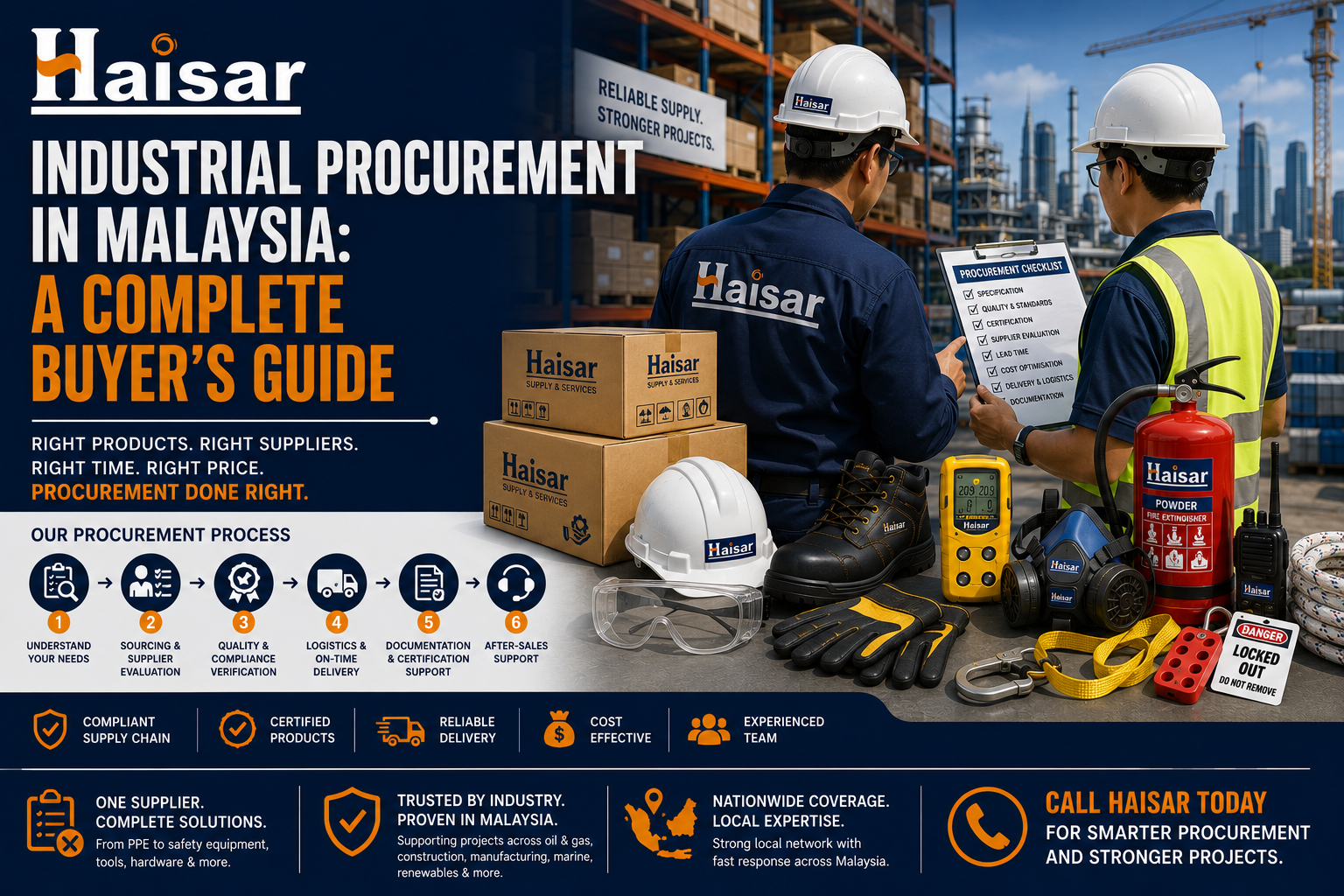
Industrial procurement in Malaysia is not getting simpler. Project timelines are tighter. Compliance requirements are broader. The number of product categories a project site needs to procure before mobilisation has expanded as regulatory enforcement has intensified. And the cost of a procurement failure, whether that is the wrong product on site, a delivery that does not arrive, or equipment that cannot be documented against the applicable standard, falls squarely on the procurement manager or HSE manager who signed off on the purchase.
This guide is written for procurement managers and HSE managers who are responsible for industrial supply in Malaysia. It covers how the procurement landscape is structured, what the most common failures look like and why they happen, how to build a procurement process that delivers compliance and operational reliability, and what to look for in a supply partner who can actually support the way industrial projects in Malaysia work.
The Industrial Procurement Landscape in Malaysia
Malaysia's industrial base spans a wide range of sectors, each with distinct procurement needs and regulatory obligations. Understanding where your organisation sits in this landscape shapes every procurement decision downstream.
Oil and gas remains one of the largest drivers of industrial procurement in Malaysia. Operations in Kertih, Bintulu, Labuan, and across the offshore blocks in Malaysian waters procure under PETRONAS contractor requirements and international standards including IOGP and API. Procurement in this sector is heavily documented, approval-listed, and subject to audit. Compliance is not aspirational. It is contractually enforced.
Construction and civil engineering across Johor, the Klang Valley, and major infrastructure corridors operates under CIDB requirements, DOSH regulations, and increasingly stringent client HSE standards as international developers and institutional investors impose their own supply chain requirements on Malaysian contractors.
Manufacturing and industrial facilities in Johor's industrial zones, Penang's manufacturing corridor, and Selangor's industrial parks procure under the Factories and Machinery Act, OSHA 1994, and sector-specific requirements depending on whether the facility handles chemicals, food products, electronics, or heavy equipment.
Renewable energy and data centres are the fastest-growing procurement segments in Malaysia. Solar EPC contractors, data centre developers, and their principal contractors are mobilising at scale and often managing procurement for project types they have not procured for before, creating gaps that experienced supply partners can close.
Marine, shipyard, and offshore support operations in Johor, Labuan, and Sarawak procure under Marine Department Malaysia requirements, SOLAS obligations, and client HSE standards from international vessel operators and charterers.
Across all of these sectors, the procurement function faces the same core challenge: sourcing the right products, at the right specification, with the right documentation, delivered to site on time and within budget.
Why Industrial Procurement in Malaysia Fails
Understanding where procurement goes wrong is more useful than a generic best-practice checklist. These are the failure modes that appear most consistently across Malaysian industrial procurement operations.
Specification drift. A purchase is raised for a product category without a sufficiently precise specification. The supplier interprets the requirement broadly and supplies a product that technically meets the description but not the application requirement. The classic example is respiratory protection: an order for "dust masks" results in FFP1 disposable respirators being delivered to a site where the hazard assessment requires half-face respirators with chemical cartridges. The product is in the correct category. It is wrong for the application.
Certification gaps. Products arrive on site without the certification documentation required by the client, the principal contractor, or the regulator. The products may be perfectly compliant but without documentation they cannot be accepted on a regulated site. Re-ordering causes delay. Expedited shipping adds cost. The procurement function carries the blame for a failure that originated in supplier selection.
Lead time optimism. Suppliers quote lead times based on their best-case assumptions. Procurement plans are built around those lead times. When actual delivery takes longer, which it frequently does for imported products and for products requiring local certification, the site mobilisation is delayed or the project proceeds without the equipment, creating both operational and compliance risk.
Vendor fragmentation. Different product categories are sourced from different suppliers. Each supplier relationship requires separate communication, separate purchase orders, separate delivery coordination, and separate invoice processing. The administrative overhead compounds with each additional vendor. Errors in one supplier relationship cascade through the others when equipment from multiple vendors must arrive simultaneously for site mobilisation.
Reactive rather than planned procurement. Equipment is ordered when the need is identified rather than when the project schedule indicates it will be needed. This is particularly common for consumable PPE. A site runs out of respirators mid-project. An urgent order is placed. Premium freight charges are incurred. The site operates without adequate respiratory protection during the gap.
Price-led vendor selection. The lowest-price supplier is selected without adequate assessment of product quality, certification status, or delivery reliability. The cost saving on the initial purchase is offset multiple times over by the downstream costs of non-compliant products, re-ordering, and delivery failures.
Each of these failure modes is avoidable. Avoiding them requires a structured procurement process and a supply partner who understands the industrial operating environment in Malaysia.
Building a Compliant Industrial Procurement Process
A procurement process that reliably delivers compliant, correctly specified products on time is not complicated. It requires discipline in five areas.
Start with the hazard and regulatory requirement, not the product.
Every industrial procurement decision should begin with a clear understanding of the hazard being controlled and the regulatory requirement that governs it. For PPE, this means a documented risk assessment that identifies the specific hazard, the exposure level, and the standard that the PPE must meet. For fire equipment, this means understanding the BOMBA requirements for the specific occupancy classification. For gas detection equipment, this means understanding the atmospheric hazards present and the instrument specifications required to detect them reliably.
Procurement that starts with the product rather than the requirement is procurement that will generate specification drift.
Write specifications that are precise enough to be audited.
A purchase specification should describe the product in sufficient detail that any competent supplier would supply the same product. For PPE, this means specifying the product standard, the protection class, and the certification requirement. For gas detection, this means specifying the sensor types, the detection ranges, and the calibration requirement. For working at heights equipment, this means specifying the load rating, the fall clearance requirement, and the anchor compatibility.
Vague specifications invite interpretation. In industrial procurement, interpretation by the supplier is not the same as judgement by the HSE manager.
Require documentation at the point of order, not on delivery.
Certification documentation, technical data sheets, and compliance declarations should be requested as part of the purchase order process, not as an afterthought when the goods arrive on site. A supplier who cannot provide documentation before delivery is unlikely to have it ready on delivery day either.
For regulated environments including PETRONAS contractor sites, offshore operations, and international client project sites, a product compliance register should be built and maintained from the first procurement event. Adding documentation to the register after the fact, under time pressure before an audit, is a risk management failure.
Align procurement timing to the project programme.
Industrial procurement should be planned against the project construction programme, not raised reactively as needs arise. Each project phase has a predictable equipment requirement. Scaffold erection requires fall protection equipment and height access gear. Confined space work requires gas detection equipment, retrieval systems, and ventilation. Electrical installation requires LOTO equipment and electrical safety PPE.
Mapping these requirements to the project programme and initiating procurement with sufficient lead time to account for delivery and documentation is the single most effective change a procurement team can make to reduce reactive ordering.
Consolidate vendor relationships where possible.
Managing fewer supplier relationships reduces administrative overhead, reduces the risk of inter-supplier coordination failures, and allows the procurement function to develop genuine working knowledge of supplier capabilities. A supplier who provides a broad range of industrial safety and project supply products from a single point of contact eliminates the coordination cost of managing multiple specialist suppliers.
This does not mean accepting inferior products to achieve consolidation. It means selecting a supply partner with sufficient breadth and depth of product range to cover the majority of your procurement requirements at the standard your projects require.
The Documentation Requirement in Malaysian Industrial Procurement
Documentation is the element of industrial procurement that is most consistently underestimated until the first audit or incident investigation makes its importance undeniable.
In Malaysian industrial procurement, documentation operates at several levels simultaneously.
Product certification documentation confirms that the product meets the applicable standard. For PPE, this is the SIRIM certification reference or equivalent international certification. For fire equipment, this is the BOMBA approval number. For gas detection equipment, this is the calibration certificate. For electrical safety PPE, this is the voltage rating test certificate.
Purchase and supply chain records demonstrate the provenance of the product and confirm that it was sourced from a legitimate distributor or manufacturer representative. In the event of a product failure or incident investigation, the ability to trace the product back through the supply chain to the manufacturer is a legal and commercial requirement.
Maintenance and inspection records confirm that equipment in service has been maintained at the required intervals. DOSH inspections, BOMBA audits, and incident investigations all examine maintenance records. Equipment that appears functional but has not been formally inspected and documented is non-compliant.
Risk assessment and PPE selection records connect the hazard identified in the risk assessment to the product specified and procured. This is the chain of evidence that demonstrates a structured approach to worker protection. Without it, the procurement decision appears arbitrary even if the product selected was correct.
A procurement function that maintains complete documentation across these four levels is in a significantly stronger position in the event of a regulatory inspection, a client audit, or an incident investigation than one that relies on institutional memory and filing systems that are not maintained.
Procurement Considerations by Product Category
Different categories of industrial procurement in Malaysia carry different compliance risks and different documentation requirements. The following covers the categories that generate the most procurement complexity.
Personal Protective Equipment. The breadth of the PPE category and the variation in applicable standards across different hazard types make PPE procurement the most complex category for most industrial procurement teams. The key discipline is maintaining the link between the hazard assessment, the standard required, and the product specified. SIRIM certification is the primary compliance marker in Malaysia and must be confirmed for safety-critical PPE categories.
Gas Detection Equipment. Gas detectors are safety-critical instruments whose function depends entirely on calibration. Procurement of gas detection equipment must include provision for calibration gas supply, calibration intervals, and bump test documentation from day one. A gas detector without a calibration programme is not compliant equipment. It is a liability.
Working at Heights Equipment. The fall clearance requirement means that harness and lanyard selection is an engineering decision, not a product catalogue exercise. Procurement teams who specify "safety harness and lanyard" without considering fall clearance, anchor compatibility, and the specific working at heights scenario will generate specification drift. The supplier must be engaged early enough to advise on system selection.
Fire Safety Equipment. BOMBA approval status must be confirmed before purchase. The type of extinguisher, the quantity, the placement, and the servicing arrangement are all regulatory requirements that must be addressed in the procurement specification. Sourcing extinguishers without confirming BOMBA approval and arranging annual servicing by a BOMBA-registered contractor is incomplete procurement.
Confined Space Equipment. The combination of gas detection, rescue retrieval, ventilation, communication, and entry signage required for compliant confined space entry means that confined space equipment is almost always best procured as a coordinated package rather than item by item. Gaps in the equipment set are not minor omissions. They are conditions that make a confined space entry non-compliant and that can result in fatal incidents.
Electrical Safety and LOTO Equipment. LOTO equipment must be compatible with the specific isolation points on the equipment being locked out. Generic procurement of LOTO equipment without reference to the valve types, circuit breaker configurations, and isolation point dimensions present on site results in equipment that cannot be used on the day it is needed.
What to Look for in an Industrial Supply Partner in Malaysia
The supply partner relationship in industrial procurement is not equivalent to the relationship with an office supplies vendor. The stakes are different and the selection criteria must reflect that.
Compliance knowledge that matches your regulatory environment. Your supply partner must understand the specific regulatory framework that governs your operations in Malaysia, whether that is OSHA and DOSH, PETRONAS contractor requirements, BOMBA standards, Marine Department regulations, or a combination. A supplier who cannot speak to these requirements is not equipped to advise on specification.
Product range that covers your procurement scope. The administrative efficiency of consolidating supply across PPE, project equipment, gas detection, fire safety, working at heights, and confined space requires a supplier with genuine depth across all of these categories, not a supplier with strength in one category and a limited range in others.
Documentation capability. Your supply partner must be able to provide complete product documentation at the point of supply, not days later when your site team is waiting. This is a process requirement as much as a product requirement. Ask prospective suppliers specifically how they manage certification documentation for each product category.
Delivery reliability. The most accurately specified product at the best price delivers no value if it arrives after the project needs it. Delivery reliability requires the supplier to hold adequate stock of fast-moving items, to be transparent about lead times for imported or specially sourced products, and to communicate proactively when delivery commitments are at risk.
A named account contact who knows your project. Industrial procurement in Malaysia involves frequent questions, changed requirements, urgent resupply needs, and documentation requests. These are handled far more effectively by a named contact who understands your project and your procurement requirements than by a general enquiries inbox.
Haisar Supply and Services: Industrial Procurement Partner in Malaysia
Haisar Supply and Services Sdn Bhd, based in Kulai, Johor, works with procurement managers and HSE managers across Malaysia's industrial sectors as a consolidated supply partner for safety equipment and project supplies.
Our supply scope covers the full range of categories that industrial project teams in Malaysia procure: PPE across all hazard categories, gas detection and calibration, working at heights equipment, confined space entry and rescue systems, LOTO and electrical safety products, fire safety and emergency response equipment, site barriers and project supplies, and customised workwear and signage.
We engage with procurement requirements at the specification stage, not just at the point of purchase order. We provide complete product documentation with every supply. We deliver across Johor and peninsular Malaysia with lead time transparency and proactive communication when supply conditions change. And we provide a named account contact for every client engagement.
For procurement managers and HSE managers who are responsible for getting industrial supply right in Malaysia, we are ready to talk about how we can support your programme.
Get a Quote from Haisar
Whether you are planning procurement for a new project mobilisation, reviewing your current supply arrangements, or looking for a more capable industrial supply partner in Malaysia, contact Haisar to discuss your requirements.
Our team will respond promptly with the information you need to make a confident procurement decision.
Haisar Supply and Services Sdn Bhd (985158-T) | Kulai, Johor, Malaysia | www.haisar.com
