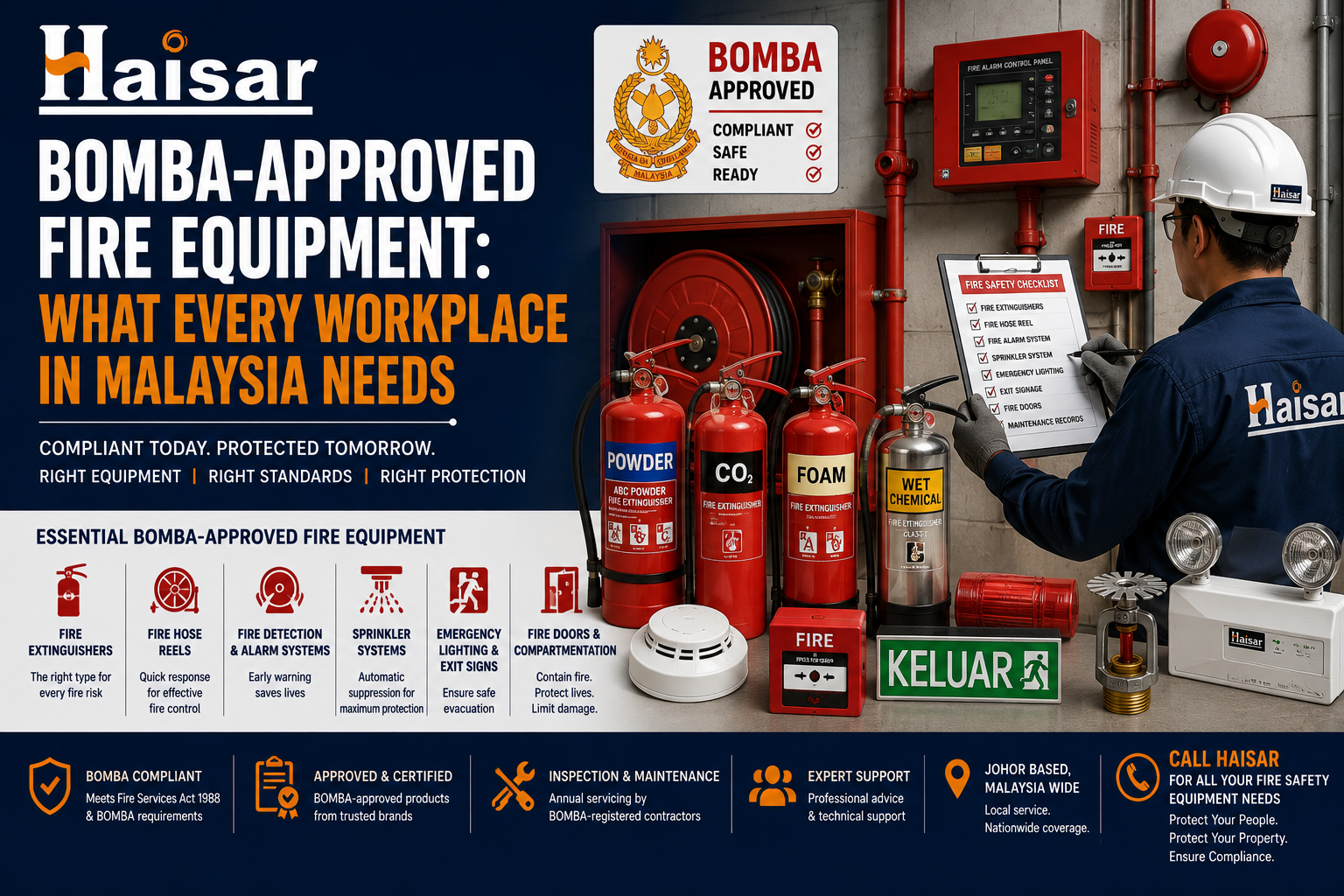
Fire safety compliance in Malaysia begins and ends with one authority: BOMBA, the Jabatan Bomba dan Penyelamat Malaysia. As the national fire and rescue department, BOMBA sets the standards for fire equipment, inspects premises, issues certificates of fitness, and enforces the Fire Services Act 1988 and its subsidiary regulations. For any workplace in Malaysia, having the right fire equipment is not optional. It is a legal requirement, and BOMBA approval is the benchmark that determines whether your equipment meets it.
This guide explains what BOMBA-approved fire equipment means in practice, what every workplace in Malaysia is required to have, and how to ensure your fire safety programme is compliant and genuinely effective rather than just documented on paper.
What BOMBA Approval Actually Means
BOMBA approval is not a single certification applied uniformly across all fire equipment. It is a framework of approvals, standards, and inspections that applies differently depending on the type of equipment, the type of premises, and the occupancy classification of the building.
For fire extinguishers, BOMBA approval means the extinguisher model has been tested and approved for sale and use in Malaysia. Approved extinguishers carry a BOMBA reference number. Using non-approved extinguishers on premises subject to BOMBA inspection is a compliance failure that will be identified during a scheduled or unannounced inspection.
For fire detection and suppression systems including sprinklers, alarm panels, and smoke detectors, BOMBA approval operates through a system of registered contractors, approved products, and installation certification. Systems must be designed, installed, and commissioned by BOMBA-registered contractors using BOMBA-approved components.
For premises, compliance is demonstrated through the Certificate of Fitness (CF) and the annual fire certificate issued by BOMBA following inspection. Premises that fail to maintain their fire equipment in working condition, that have modified their layout without BOMBA notification, or that are using non-approved equipment will not pass inspection and risk having their certificate revoked.
The practical implication for facility managers and project teams is straightforward. Specify BOMBA-approved equipment, source it from a supplier who can confirm approval status, maintain it at the required intervals, and engage only BOMBA-registered contractors for installation and servicing work.
Fire Extinguishers
Fire extinguishers are the most visible element of any workplace fire safety programme and the one most frequently inspected by BOMBA. They are also the element most often found to be non-compliant during inspections, either because the wrong type has been specified, because servicing is overdue, or because extinguishers are obstructed or incorrectly mounted.
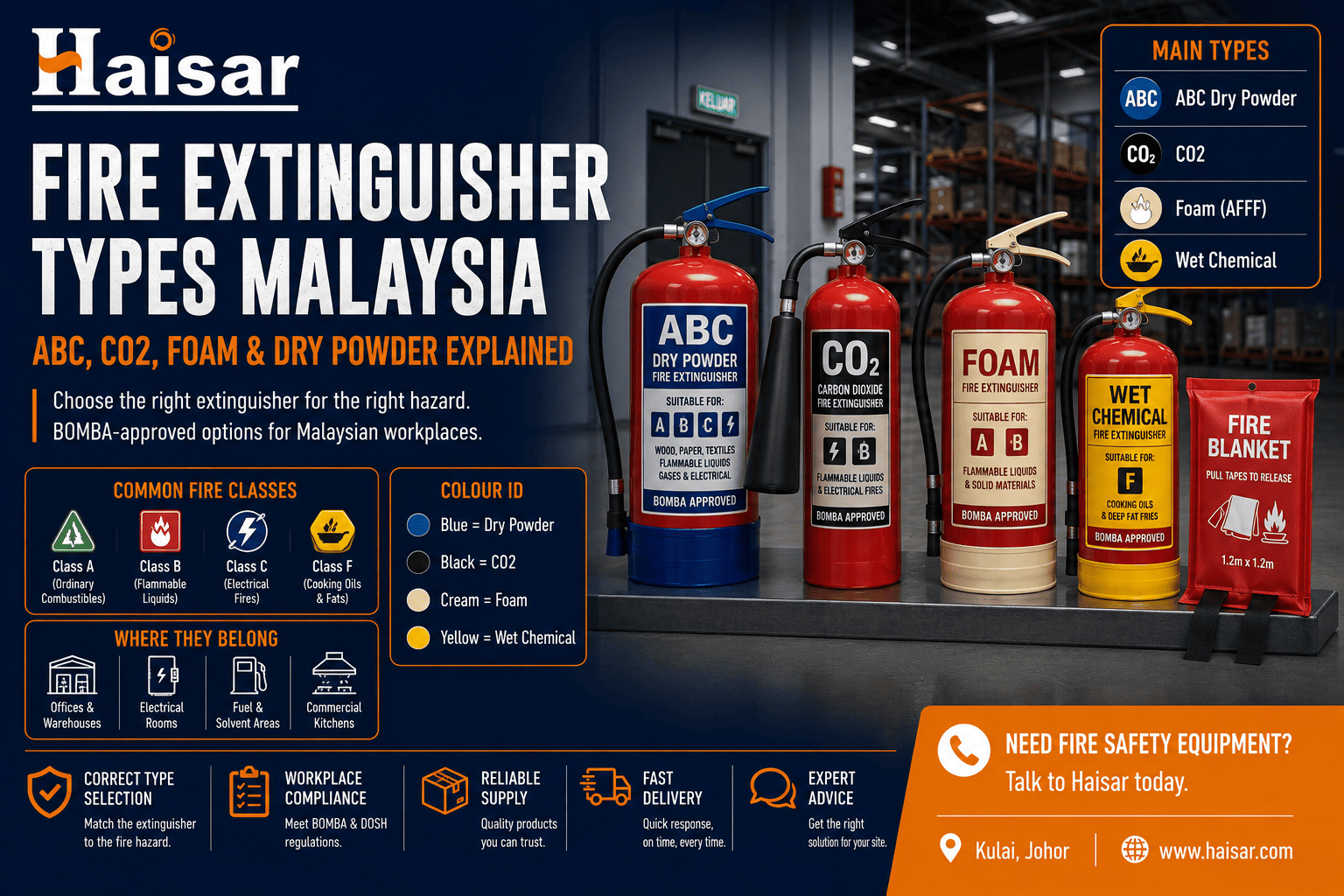
Extinguisher types and their applications:
Water extinguishers are suitable for Class A fires involving ordinary combustible materials such as wood, paper, textiles, and similar materials. They must not be used on electrical fires or on Class B fires involving flammable liquids.
Foam extinguishers (AFFF) are suitable for Class A fires and Class B fires involving flammable liquids including petrol, diesel, oils, and solvents. The foam blanket suppresses the fire by smothering the fuel surface. Foam extinguishers must not be used on live electrical equipment.
CO2 extinguishers are the primary extinguisher type for electrical fires and for environments containing sensitive electronic equipment. CO2 leaves no residue, making it appropriate for server rooms, control rooms, switchgear areas, and any environment where extinguishing agent contamination would cause secondary damage. CO2 is also effective on small Class B fires.
Dry powder extinguishers (ABC powder) are the most versatile type, rated for Class A, B, and C fires and safe for use on live electrical equipment up to a specified voltage. They are appropriate as general-purpose extinguishers across a wide range of workplaces. However, dry powder leaves a significant residue and is not appropriate for sensitive electronic environments.
Wet chemical extinguishers are specifically designed for Class F fires involving cooking oils and fats. They are the required extinguisher type in commercial kitchen environments and must not be substituted with general-purpose extinguisher types for kitchen fire suppression.
Placement and quantity requirements:
BOMBA regulations specify maximum travel distances to the nearest extinguisher. For Class A hazard areas, no point in the area should be more than 30 metres from an extinguisher. Higher hazard areas require closer spacing. Extinguishers must be mounted on wall brackets or extinguisher stands at the correct height, unobstructed, and clearly visible.
Every workplace must display a fire extinguisher location plan. Extinguishers must be identified with clear signage indicating the type, suitable fire classes, and basic operation instructions.
Servicing requirements:
BOMBA requires that fire extinguishers be serviced annually by a BOMBA-registered service contractor. This annual service includes inspection of the cylinder, valve, pressure indicator, hose, and agent condition. Extended service including hydrostatic pressure testing of the cylinder is required at longer intervals depending on the extinguisher type. An extinguisher with an overdue service tag is non-compliant regardless of whether it appears functional.
Fire Detection Systems
Automatic fire detection provides early warning that allows evacuation to begin before a fire has developed to a life-threatening stage. For all premises above a specified size and occupancy threshold, BOMBA regulations require automatic fire detection systems.
Smoke detectors are the primary device for detecting fires in the incipient stage before visible flame is present. Ionisation detectors are sensitive to fast-flaming fires. Photoelectric detectors are sensitive to slow-smouldering fires. Combined dual-sensor detectors address both fire types and are the appropriate default specification for most workplace environments.
Heat detectors are used in environments where smoke detectors would generate frequent false alarms due to dust, steam, or fumes. Typical applications include kitchens, plant rooms, and industrial production areas.
Manual call points (break glass units) allow occupants who discover a fire to manually activate the alarm system before automatic detection occurs. BOMBA requirements specify maximum travel distances to the nearest call point.
Fire alarm panels are the central control unit for the detection and alarm system. Panels must be BOMBA-approved, located in an accessible position, and monitored at all times during building occupancy. The panel must be capable of identifying the zone of origin of any alarm to support evacuation management.
Servicing requirements: Fire detection systems must be tested and maintained by a BOMBA-registered contractor at intervals specified in the system maintenance schedule. Annual inspection by a competent person is the minimum requirement. Detector sensitivity testing, battery backup testing, and panel function verification are all part of the required maintenance scope.
Emergency Lighting and Exit Signage
Emergency lighting and exit signage are legal requirements under the Uniform Building By-Laws 1984 and BOMBA fire certificate requirements. They serve a single critical function: allowing building occupants to find the exit route when normal lighting fails during a fire or power failure.
Emergency lighting must activate automatically on mains power failure and provide sufficient illumination along all escape routes, at emergency exits, at changes of direction, at stairwells, and at fire-fighting equipment locations. Emergency lighting must operate for a minimum of three hours from battery backup.
Exit signs must be installed above all fire exit doors and at all changes of direction along the escape route. Signs must be illuminated, either by an internal light source or by photoluminescent material with adequate charge from ambient lighting.
Servicing requirements: Emergency lighting and exit signage must be tested monthly for brief functional operation and annually for full rated duration discharge. Test records must be maintained and available for BOMBA inspection.
Fire Hose Reels and Hydrant Systems
For buildings above a specified size and height, BOMBA regulations require fixed fire-fighting infrastructure in addition to portable extinguishers.
Fire hose reels provide a continuous water supply for first-aid fire fighting by building occupants or trained fire wardens. They must be installed in BOMBA-specified locations throughout the building and must be accessible without obstruction. Hose reels must be tested annually and serviced by a BOMBA-registered contractor.
Wet and dry rising mains provide a connection point for BOMBA fire appliances to access water supply at upper floor levels in multi-storey buildings. Wet rising mains are kept permanently charged with water. Dry rising mains are charged by fire appliances at the time of an incident. Both systems require regular testing and maintenance by registered contractors.
Fire hydrants provide external water supply for fire brigade operations. Building owners are responsible for the maintenance of private hydrants within their property boundary. Hydrants must be accessible, clearly marked, and tested annually.
Sprinkler Systems
Automatic sprinkler systems are required in many building categories under Malaysian building regulations and BOMBA requirements, including shopping complexes, hotels, hospitals, industrial buildings above a specified size, and high-rise buildings.
Sprinklers activate automatically when the temperature at the sprinkler head reaches the rated activation temperature, discharging water directly onto the fire. They are highly effective at suppressing fires in the early stages and at controlling fire spread to allow evacuation.
Sprinkler systems must be designed, installed, and commissioned by BOMBA-registered contractors in accordance with the relevant design standard. They must be maintained under a formal maintenance contract and tested at regular intervals. The sprinkler control valve room must be accessible and the water supply to the system must be maintained at all times.
What Workplace Fire Safety Compliance Looks Like in Practice
Understanding individual equipment requirements is the starting point. A fully compliant workplace fire safety programme brings these elements together within a documented management system.
Fire risk assessment. A documented fire risk assessment identifies the fire hazards in the workplace, the people at risk, and the controls in place. It is the foundation document for the fire safety programme and must be reviewed when the workplace changes.
Fire safety plan and evacuation procedures. Every workplace must have documented fire safety procedures including evacuation routes, assembly points, and the roles of fire wardens. Procedures must be communicated to all staff and reviewed regularly.
Fire warden training. Fire wardens must be appointed for every building zone and trained in evacuation procedures, fire extinguisher use, and BOMBA notification procedures. The number of fire wardens required depends on the building size and occupancy.
Equipment maintenance records. BOMBA inspectors review maintenance records as part of the fire certificate process. All servicing of fire extinguishers, detection systems, hose reels, and other equipment must be documented with dates, service contractor details, and findings.
Regular drills. Fire evacuation drills must be conducted at least annually and the drill report must be documented.
Sourcing BOMBA-Approved Fire Equipment in Malaysia
When sourcing fire equipment in Malaysia, the critical requirement is confirming BOMBA approval status before purchase. Not all fire equipment sold in Malaysia is BOMBA-approved and using non-approved equipment on regulated premises creates compliance risk.
A reliable fire equipment supplier in Malaysia should be able to confirm the BOMBA approval status of every product they supply, provide the BOMBA reference number for approved extinguishers, and advise on the correct type and quantity of equipment for your specific premises and occupancy classification.
Haisar Supply and Services supplies BOMBA-approved fire safety equipment for workplaces and project sites across Johor and peninsular Malaysia. Our fire equipment range covers fire extinguishers across all types and sizes, fire blankets, fire safety signage, emergency response equipment, and associated first aid and spill control products.
We work with facility managers, HSE officers, and project procurement teams to ensure the right equipment is specified for each application, sourced with the correct documentation, and maintained at the compliance intervals BOMBA requires.
Stay Current on Malaysian Fire Safety Regulations
BOMBA regulations and fire safety requirements in Malaysia are updated periodically. The best way to ensure your workplace stays ahead of compliance changes is to stay informed.
Sign up for the Haisar newsletter for practical updates on fire safety regulations, equipment compliance, and HSE news relevant to workplaces and project sites in Johor and across Malaysia.
Subscribe to the Haisar Newsletter
Or visit our fire safety product pages to explore our full range of BOMBA-approved fire equipment.
Haisar Supply and Services Sdn Bhd (985158-T) | Kulai, Johor, Malaysia | www.haisar.com