Can't find what you're looking for? Get in touch!



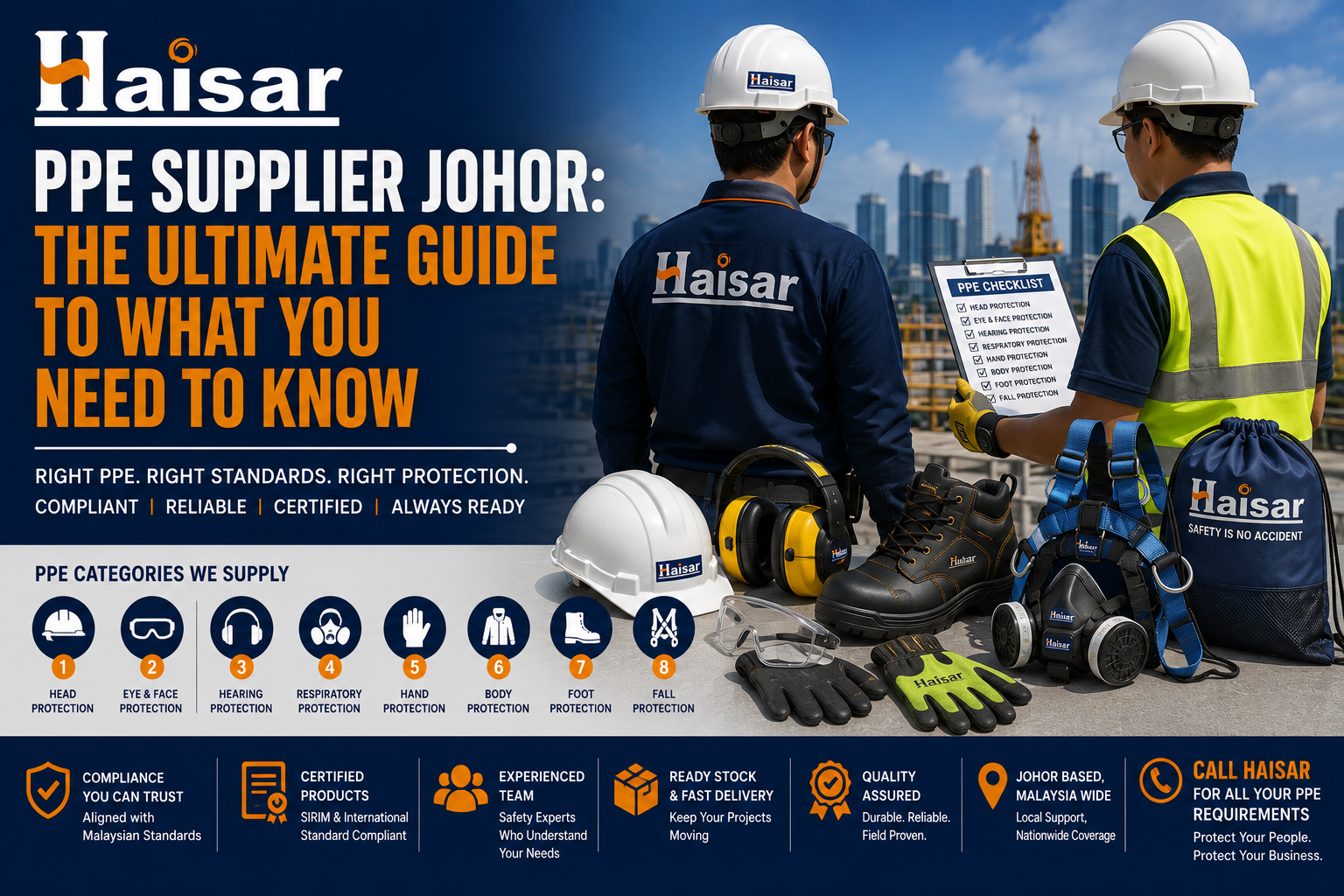
Personal protective equipment is the last line of defence between a worker and a workplace injury. Get it right and it reduces the severity of incidents that cannot be eliminated by engineering or administrative controls. Get it wrong and it fails at the moment it matters most. In a state as industrially active as Johor, where oil and gas, construction, data centres, manufacturing, marine, and renewable energy operations all run simultaneously across sites from Pasir Gudang to Iskandar Puteri, PPE procurement is not a minor administrative task. It is a safety-critical function.
This guide covers everything a project manager, HSE officer, or procurement team in Johor needs to know about sourcing PPE correctly. It explains the Malaysian regulatory framework, walks through every PPE category in practical detail, and explains what separates a reliable PPE supplier in Johor from a box-shifter with a price list. If you are building a compliant PPE programme for a project site or facility in Johor, this is the reference you need.
Why PPE Procurement in Johor Requires More Than a Price Comparison
Johor's industrial base is one of the most diverse in Malaysia. A construction project in Senai has different PPE requirements to a shipyard operation in Pasir Gudang. A data centre fit-out in Iskandar Puteri has different requirements to a solar EPC project in Kluang. A petrochemical facility in Tanjung Langsat has requirements that a general workwear supplier is not equipped to address.
This diversity creates a procurement challenge. General industrial suppliers carry broad ranges of standard PPE. What project teams in Johor's specialised industrial sectors need is a supplier who can address the full range of PPE requirements across multiple hazard categories, understands the compliance standards that apply to each, and can provide the documentation that regulated industries demand.
The consequence of getting PPE procurement wrong in Johor's industrial context is not just a compliance issue. It is a worker safety issue and a project liability issue. PPE that fails to meet the standard applicable to the hazard it is supposed to protect against provides a false sense of protection. Workers wearing inadequate PPE believe they are protected when they are not.
The Malaysian Regulatory Framework for PPE
PPE selection and provision in Malaysia is not discretionary. It is a legal obligation governed by the Occupational Safety and Health Act 1994 (OSHA 1994), its subsidiary regulations, and a framework of industry-specific requirements.
OSHA 1994. Section 15 of OSHA 1994 places a general duty on employers to ensure the safety, health, and welfare of their employees so far as is practicable. This includes the provision and maintenance of safe plant and systems of work and the provision of adequate PPE where hazards cannot be adequately controlled by other means.
Occupational Safety and Health (Use and Standards of Exposure of Chemicals Hazardous to Health) Regulations 2000 (USECHH). These regulations set specific requirements for the assessment of chemical hazards and the provision of appropriate PPE where chemical exposure is a risk. They require documented risk assessments and the selection of PPE appropriate to the specific hazard and exposure level.
Factories and Machinery Act 1967 and Subsidiary Regulations. For factory environments and construction sites, additional specific requirements apply to PPE provision, particularly in relation to head protection, eye protection, and hearing protection in high-noise environments.
DOSH Guidelines and Codes of Practice. DOSH has issued technical guidance covering PPE selection, use, and maintenance across multiple hazard categories. These guidelines provide the practical framework within which OSHA's general duty is implemented.
SIRIM Certification. Safety-critical PPE sold in Malaysia is required to meet SIRIM certification requirements or equivalent international standards. SIRIM-certified products have been tested and verified against the applicable Malaysian standard. Uncertified products may appear identical to certified ones but have not been independently verified. In the event of an incident, uncertified PPE in a situation where certified PPE was required is a liability risk for the employer.
Industry-Specific Standards. Oil and gas operations under PETRONAS requirements, offshore operations under the Petroleum Safety Measures Act, construction under CIDB requirements, and maritime operations under Marine Department Malaysia all impose additional PPE obligations beyond the OSHA baseline.
Understanding which standards apply to your specific operation in Johor is the starting point for a defensible PPE procurement programme. A knowledgeable PPE supplier in Johor should be able to advise on this, not leave it entirely to your HSE team.
Head Protection
Head protection is mandatory on all active construction and industrial project sites in Malaysia under OSHA 1994 requirements. It is also one of the PPE categories where product selection matters most, because not all safety helmets provide the same level of protection against all hazard types.
Industrial safety helmets are classified by the hazard types they are designed to protect against. Class A helmets provide general impact and penetration protection. Class B helmets provide impact, penetration, and electrical protection up to 20,000 volts, making them the appropriate choice for electrical work and for project sites where electrical hazards are present alongside general impact risks. Class C helmets are lightweight and conductive, suitable only for environments where there is no electrical hazard.
For most project sites in Johor, Class B helmets are the appropriate default specification. The additional cost compared to Class A is marginal and the protection profile is significantly broader.
Key selection considerations:
- Helmets must be SIRIM-certified or carry equivalent certification such as EN 397.
- The certification class must match the hazard profile of the site.
- Helmets must be replaced if cracked, if they have sustained a significant impact, or if they are beyond the manufacturer's recommended service life, typically three to five years from the manufacture date printed inside the shell.
- Chin straps are required for working at heights applications, for work on vessel decks, and for any environment where the helmet could be dislodged by wind, movement, or a fall.
- Bump caps are appropriate only for low-headroom maintenance situations with no impact risk. They are not substitutes for safety helmets.
Eye and Face Protection
Eye and face injuries are among the most common workplace injuries across Johor's industrial sectors, and they are among the most preventable with correctly specified protection.
The range of eye and face hazards on industrial sites is broad. Impact hazards from grinding, cutting, chipping, and nailing require different protection to chemical splash hazards from cleaning agents, acids, and solvents. UV radiation from welding arcs requires different protection to UV radiation from prolonged outdoor exposure. A single type of eye protection does not address all of these hazards adequately.
Safety spectacles provide impact protection from particles and debris. They must meet the impact rating applicable to the task. Standard fashion glasses and reading glasses do not provide adequate protection for industrial environments regardless of their lens material.
Safety goggles provide a sealed enclosure around the eye, protecting against chemical splash, fine dust, and airborne particles that would enter around the frame of safety spectacles. Anti-fog coating is important for Malaysian conditions where humidity causes rapid fogging in enclosed goggle designs.
Welding shields and face shields protect the full face. Welding shields must carry the appropriate shade number for the welding process in use. Face shields for grinding and cutting must be impact-rated. Face shields used for chemical splash protection must be manufactured from materials resistant to the specific chemicals involved.
Arc flash face shields and hoods are required for electrical work where arc flash risk is present. Standard clear polycarbonate face shields are not arc flash rated. The arc flash PPE selection must be based on an incident energy assessment for the electrical system being worked on.
UV-rated safety spectacles for outdoor workers on solar, construction, and civil engineering sites in Johor's equatorial climate. Standard clear safety glasses do not block UV radiation. Workers exposed to high UV index conditions throughout the working day require lenses with UV400 rating as a minimum.
Hearing Protection
Noise-induced hearing loss is irreversible and cumulative. It develops gradually over years of exposure and is often not noticed until significant permanent damage has occurred. Malaysian OSH law requires hearing protection in any area where noise levels exceed 85 dB(A) as an eight-hour time-weighted average, and mandatory hearing protection zones must be established and marked.
Disposable foam ear plugs are the most commonly used hearing protection in Malaysian industrial environments. When correctly inserted, they provide substantial noise reduction. Correct insertion technique is critical and is frequently not demonstrated to workers. An incorrectly inserted foam plug provides far less protection than the rated attenuation.
Reusable ear plugs with detachable cord are suitable for environments where hearing protection is worn intermittently and where the cord reduces loss. They require regular cleaning to maintain hygiene.
Earmuffs are appropriate for high-noise environments where ear plugs alone may not provide adequate attenuation, for workers who cannot insert ear plugs correctly due to ear canal anatomy, and for situations where hearing protection must be donned and doffed frequently. Earmuffs must fit correctly to the individual and must be maintained in good condition, as damaged or compressed ear cup seals significantly reduce attenuation.
Electronic hearing protection integrates noise cancellation with situational awareness capability, allowing wearers to hear speech and warning signals while attenuating damaging impulse noise. Relevant for security, supervisory, and inspection roles in high-noise environments.
Respiratory Protection
Respiratory protection is required whenever workers are exposed to airborne contaminants at levels that exceed occupational exposure limits or where there is a risk of oxygen deficiency. Selecting the wrong type of respiratory protection for a specific hazard is potentially as dangerous as wearing none at all.
Disposable dust respirators (FFP2/P2/N95) for protection against nuisance dusts and non-toxic particulates. Appropriate for general construction dust, cement, and non-hazardous particulate exposure. Not adequate for toxic dusts, chemical vapours, or oxygen-deficient atmospheres.
Half-face respirators with replaceable cartridges for protection against toxic dusts, organic vapours, acid gases, and combinations of particulate and vapour hazards. Cartridge selection must match the specific contaminant. An organic vapour cartridge provides no protection against acid gases. Fit testing is required to verify the seal between the respirator face piece and the wearer's face.
Full-face respirators provide eye and face protection in addition to respiratory protection and are appropriate for environments where the contaminant could also damage the eyes, including certain chemical vapours and irritant gases.
Powered air-purifying respirators (PAPRs) for extended duration respiratory protection in environments where wearing a tight-fitting face piece is not appropriate for medical, physiological, or beard-related seal reasons.
Supplied air and self-contained breathing apparatus (SCBA) for oxygen-deficient atmospheres and immediately dangerous to life or health (IDLH) conditions. Air-purifying respirators of any type provide no protection in oxygen-deficient atmospheres. Confined space entry into oxygen-deficient spaces requires supplied air or SCBA.
Hand Protection
Hand injuries are the most frequently reported workplace injuries in Malaysian industry. The hands are constantly in contact with work materials and equipment, and the variety of hand hazards across Johor's industrial sectors is extensive.
Cut-resistant gloves rated to the EN 388 or ANSI/ISEA 105 cut level appropriate to the specific cutting hazard. Cut resistance ratings range from A1 to A9 under ANSI standards. A glove rated A2 provides no meaningful protection against a hazard that requires A6 or above. The correct cut level must be determined by hazard assessment, not by cost.
General duty work gloves for handling materials, equipment operation, and tasks involving abrasion and grip requirements rather than cut risk.
Chemical resistant gloves for handling acids, solvents, oils, and other chemical products. Chemical resistance is highly specific. Nitrile gloves resist many organic solvents but are not appropriate for all chemicals. Neoprene, natural rubber, butyl rubber, and PVC gloves each have different chemical resistance profiles. The chemical resistance data sheet for the specific glove must be checked against the specific chemical being handled.
Electrical insulating rubber gloves for electrical work. Must be voltage-rated to the class appropriate for the system voltage being worked on. Must be pressure tested at regular intervals to verify integrity. A glove with a pinhole failure will not protect against electric shock. Must be worn with leather over-gloves to protect the rubber from physical damage during use.
Heat-resistant gloves for welding, furnace work, and handling hot materials.
Anti-vibration gloves for prolonged use of vibrating tools to reduce the risk of hand-arm vibration syndrome.
Cryogenic gloves for handling liquid nitrogen and other cryogenic materials, relevant for laboratory and specialist industrial applications in Johor.
Foot Protection
Safety footwear requirements vary significantly across Johor's industrial sectors and the correct specification must match the specific hazard environment rather than defaulting to a single standard boot for all applications.
Steel-toe safety boots (S3 rated) with steel or composite toe cap, mid-sole puncture resistance, and ankle support. S3 is the standard specification for general construction and industrial site work in Malaysia. The S3 rating indicates the boot meets requirements for impact and compression protection, penetration resistance, energy absorption in the heel, water resistance, and fuel oil resistance.
Anti-static footwear (ESD) for environments where electrostatic discharge is a risk, including electronics assembly, data centre operations, and some chemical handling scenarios. Anti-static footwear dissipates static charge gradually. It is not the same as electrical hazard rated footwear and must not be used as a substitute in live electrical environments.
Electrical hazard rated footwear providing secondary protection against incidental contact with live circuits. The electrical hazard rating provides insulation against ground fault. It is a secondary protective measure and does not replace the need for voltage-rated insulating gloves and other primary electrical PPE.
Non-slip maritime and wet deck footwear with outsoles specifically rated for traction on wet steel surfaces. Standard construction safety boots with smooth rubber outsoles can be extremely dangerous on the wet steel decks common in Johor's shipyard and port environments. Non-slip maritime footwear uses specifically designed outsole compounds and tread patterns to maintain grip on these surfaces.
Wellington boots for wet season site conditions and cable trenching, earthworks, and any operations in flooded or heavily muddy environments. Safety wellingtons with composite toe caps are available for environments requiring both waterproofing and impact protection.
Chemical resistant boots for environments involving chemical spillage and splash risk. Chemical resistance must be verified against the specific chemicals present on site.
Fall Protection and Working at Heights PPE
Falls from height are consistently among the leading causes of fatal workplace accidents in Malaysia. Working at heights PPE is the final layer of protection in situations where collective engineering controls alone are not sufficient to eliminate fall risk.
Full-body harnesses are the mandatory personal fall protection equipment for fall arrest applications in Malaysia. Body belts and waist belts are not compliant for fall arrest and have been identified as contributing factors in fatal and serious injury incidents. Full-body harnesses must be correctly fitted to the individual wearer, inspected before each use, formally inspected at six-monthly intervals, and replaced immediately following a fall arrest event regardless of apparent condition.
Energy-absorbing lanyards connect the harness to the anchor point and deploy an integrated energy absorber during a fall arrest event to limit peak arrest forces on the wearer's body. Lanyard selection must account for the available fall clearance. Standard 1.8m or 2m lanyards with energy absorbers require significantly more clearance below the worker than many Johor project sites provide.
Self-retracting lifelines (SRLs) allow freedom of movement within a defined radius while maintaining a continuously tensioned connection to the anchor. SRLs arrest falls within centimetres, making them the preferred option where fall clearance is limited. They are particularly relevant for rooftop solar installations, elevated platform maintenance, and confined structure work in Johor's industrial facilities.
Twin-leg lanyards with two independent snap hooks allow continuous connection when moving between anchor points, with one leg remaining attached throughout any transfer. The standard configuration for work on transmission towers, scaffold structures, and elevated routes.
Anchor systems and anchor points must be rated to withstand the forces generated by a fall arrest event. For a single worker, this is a minimum of 12 kilonewtons static load capacity. Attaching fall arrest equipment to scaffold tubes, pipe rails, or other structural elements not rated as anchor points is a compliance failure that has contributed to fatal incidents in Malaysia.
Full guidance on working at heights PPE selection, fall clearance calculations, and anchor point requirements is available in Haisar's Working at Heights OSH Regulations and Equipment Guide.
Fire Safety PPE
Fire risk on industrial sites in Johor ranges from the flash fire risk associated with hydrocarbon handling in oil and gas operations to the electrical arc flash risk present in any facility with high-voltage switchgear and the more general fire risk from hot work, welding, and grinding on any project site.
Flame-resistant (FR) coveralls are required for workers in environments where flash fire exposure is a risk, including petrochemical operations, offshore facilities, and any location where flammable materials are processed or stored. FR garments must be rated to the appropriate standard for the specific flash fire hazard. Standard polycotton coveralls are not FR rated and will burn when exposed to flame.
Arc flash rated PPE including face shields, hoods, and FR garments rated in calories per square centimetre must be selected based on the incident energy calculated by an arc flash risk assessment for the specific electrical equipment being worked on. Arc flash PPE that is underrated for the incident energy level provides inadequate protection.
Welding PPE including leather welding aprons, welding gauntlets, and welding shields protects against spatter, radiated heat, and UV from the welding arc. Welding shields must carry the shade number appropriate to the welding process.
Heat-resistant clothing and proximity suits for work near furnaces, kilns, and high-temperature process equipment.
Haisar supplies the full range of fire safety PPE for Johor's industrial sectors. Our fire safety product range is detailed on our fire safety equipment page.
High Visibility and Body Protection
Worker visibility in areas where mobile plant, vehicles, and cranes are operating is a basic safety requirement. Struck-by incidents involving plant and vehicles are a significant source of fatalities and serious injuries on Malaysian construction and industrial sites.
Class 2 high-visibility vests with retroreflective tape panels meet the minimum visibility requirement for most site environments in Malaysia. They are appropriate for pedestrian workers in areas with slow-moving plant.
Class 3 high-visibility garments including vests with sleeves or high-vis jackets provide greater retroreflective area and are the appropriate specification for workers in areas with faster-moving vehicles and for low-light conditions. Class 3 hi-vis is the standard specification for roadworks and for any site adjacent to public roads.
Hi-vis coveralls provide full-body high visibility and are appropriate for workers requiring both visibility and body protection simultaneously.
Hi-vis garments must comply with MS ISO 20471 or equivalent. Faded, dirty, or damaged retroreflective tape significantly reduces effectiveness. Garments must be replaced when tape reflectivity is visibly degraded.
Sun protection clothing for outdoor workers including long-sleeved, lightweight, UV-rated garments for workers on solar farms, construction sites, and civil engineering projects where prolonged outdoor exposure in Malaysia's equatorial climate creates meaningful UV radiation risk.
Chemical resistant suits for entry into areas involving chemical splash, spray, or vapour hazard at levels requiring full-body chemical protection.
Workwear and Customised PPE for Project Teams
Beyond standard catalogue PPE, many project teams and facilities in Johor require customised workwear programmes. Company-branded coveralls, customised hi-vis garments with project or contractor identification, and uniform programmes across multi-contractor project sites are all common requirements.
Haisar provides customised workwear and branded PPE programmes for project teams and facilities across Johor and peninsular Malaysia. We work with HSE managers and procurement teams to develop consistent workwear specifications across contractor packages, supply bulk orders with company or project branding, and manage ongoing replenishment across project duration.
How to Evaluate a PPE Supplier in Johor
The Johor market has no shortage of PPE suppliers. What it has a shortage of is PPE suppliers who can function as compliance partners rather than catalogue vendors. Here is how to evaluate the difference.
Product certification and documentation. A credible PPE supplier in Johor must be able to provide SIRIM certification references, manufacturer technical data sheets, and compliance declarations for every product in their range. If a supplier cannot produce this documentation when asked, do not accept their assurance that products meet the relevant standard.
Application knowledge. Can your supplier advise on the appropriate cut resistance level for your specific cutting hazard? Can they confirm that the respirator cartridge they are recommending is rated for the specific chemical your workers will be exposed to? Can they advise on the arc flash PPE category required for your electrical systems? These are not specialist questions for a PPE supplier. They are the baseline of competence your supply partner should demonstrate.
Range depth. A supplier who covers head, eye, hearing, respiratory, hand, and foot protection but cannot supply working at heights PPE, FR workwear, or electrical safety equipment is not a one-stop partner for Johor's industrial project market. Your project will have requirements across all of these categories and managing multiple suppliers for different PPE categories is an administrative burden that a capable single supplier eliminates.
Bulk and project procurement capability. Project sites in Johor mobilise rapidly and require large volumes of PPE on short notice. Your supplier must be able to handle bulk orders, provide staged delivery aligned to your programme, and manage replenishment without requiring you to resubmit detailed procurement requests for every resupply.
Delivery and response time. A PPE supplier in Johor who cannot deliver to your site within a reasonable timeframe or who consistently misses committed delivery dates is a project risk. Ask specifically about stock availability for fast-moving items and about lead times for products they do not hold in stock.
Frequently Asked Questions About PPE in Johor
What PPE is legally required on construction sites in Johor?
Under OSHA 1994 and the Factories and Machinery (Building Operations and Works of Engineering Construction) Regulations 1986, construction sites in Johor must provide as a minimum head protection (safety helmets), safety footwear, and any additional PPE required by the specific hazards on the site. Risk assessment drives the full PPE requirement and must be documented. Hi-vis garments, eye protection, hearing protection, respiratory protection, and fall protection equipment are all commonly required on construction sites in Johor in addition to the minimum legal requirements.
Does PPE in Malaysia need to be SIRIM certified?
Safety-critical PPE in Malaysia is required to meet applicable Malaysian standards, and SIRIM certification is the primary mechanism for demonstrating compliance. In practice, PPE carrying CE marking or other internationally recognised certification is generally acceptable to DOSH where a directly equivalent Malaysian standard does not exist. However, where a SIRIM standard applies, SIRIM-certified products are the safest procurement choice from a compliance and liability perspective.
Can I use the same PPE for all workers on a mixed industrial site?
No. PPE selection must be based on a risk assessment for each specific task and work area. Workers in different roles and different areas of the same site may have significantly different PPE requirements. A blanket approach to PPE specification across a mixed industrial site in Johor is both a compliance risk and a practical safety risk.
How often does PPE need to be replaced?
Replacement intervals depend on the PPE category, the specific product, and the conditions of use. Safety helmets are typically replaced every three to five years from manufacture date regardless of condition. Harnesses must be replaced immediately following a fall arrest event. Respiratory cartridges must be replaced according to breakthrough indicators or manufacturer-specified service life. Gloves showing visible damage or contamination must be replaced immediately. Your PPE supplier should be able to advise on replacement intervals for specific products.
What documentation should my PPE supplier provide?
At minimum, your PPE supplier should provide technical data sheets, SIRIM certification references or equivalent certification documentation, and manufacturer compliance declarations for each product. For electrical safety PPE including insulating gloves and arc flash garments, test certificates and arc flash ratings must be provided. For gas detection equipment, calibration certificates are required. In regulated environments including PETRONAS contractor sites and offshore operations, a product compliance register is a standard requirement.
What is the difference between fall restraint and fall arrest PPE?
Fall restraint prevents a worker from reaching the fall hazard. The lanyard length is set so the worker cannot get to the unprotected edge. No fall occurs. Fall arrest allows the worker to pass the fall hazard but arrests the fall after it has begun using energy-absorbing equipment. Fall restraint is always preferable where it is practicable because it eliminates the fall rather than managing its consequences. Both systems require full-body harnesses. The anchor, lanyard, and system design are different for each application.
Does Haisar deliver PPE outside of Johor?
Yes. Haisar supplies PPE and industrial safety equipment to project sites and facilities across peninsular Malaysia. Johor is our primary operating base but we regularly supply clients in Selangor, Kuala Lumpur, Pahang, Terengganu, and other states. Contact us to discuss delivery requirements for your specific location.
Haisar Supply and Services: Your PPE Supplier in Johor
Haisar Supply and Services Sdn Bhd, based in Kulai, Johor, is a one-stop PPE and industrial safety equipment supplier serving project teams, facility operators, and procurement teams across Johor and peninsular Malaysia.
Our PPE range covers every category in this guide: head protection, eye and face protection, hearing protection, respiratory protection, hand protection, foot protection, fall protection and working at heights equipment, fire safety PPE, high-visibility and body protection, and customised workwear and branded uniform programmes.
We work across Johor's full industrial base including oil and gas, construction, data centres, marine and shipyard, power generation, renewable energy, and manufacturing. We understand the compliance requirements that apply to each sector and we supply products with the documentation that regulated operations require.
We are not a catalogue with a delivery truck. We are a procurement partner who engages with your project requirements, advises on the right specifications, consolidates supply across PPE categories, and stays engaged through your project lifecycle.
Get a Quote from Haisar Today
Whether you are equipping a new project site, building out your facility PPE programme, or looking for a more capable PPE supplier in Johor than your current arrangements provide, Haisar is ready to help.
Contact our team with your requirements and we will respond with product recommendations, specifications, certification references, and pricing tailored to your operation and your industry.
Haisar Supply and Services Sdn Bhd (985158-T) | Kulai, Johor, Malaysia | www.haisar.com
