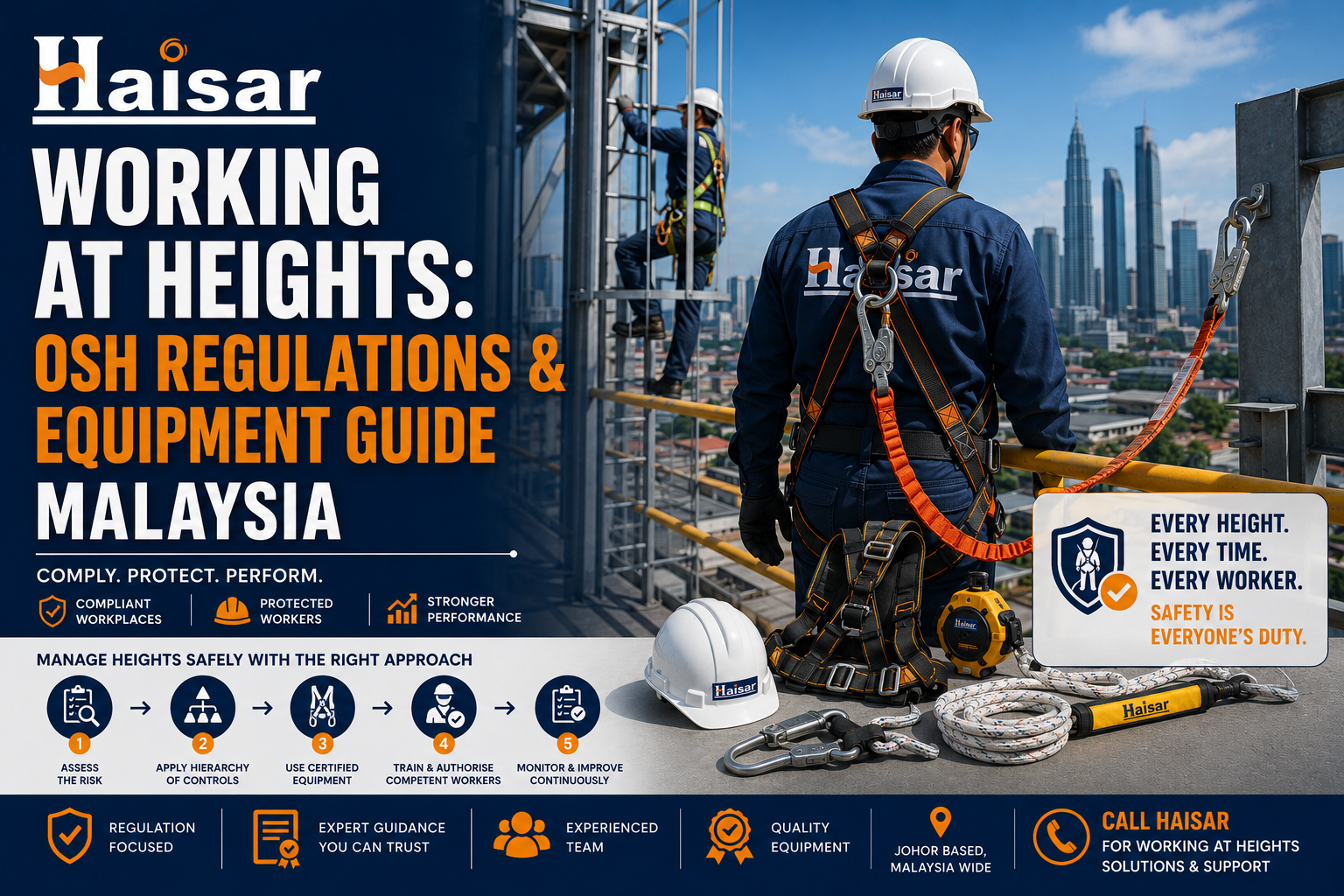
Falls from height remain one of the leading causes of fatal workplace accidents in Malaysia. Year after year, DOSH incident statistics place falls among the top three causes of occupational fatalities in the construction, oil and gas, and manufacturing sectors. Yet the majority of these incidents involve situations where the regulatory requirements for working at heights were clear, the equipment to prevent the fall existed, and the failure was in how the system was implemented.

This guide covers everything a Malaysian employer, HSE manager, or project team needs to know about working at heights under Malaysian OSH law. It explains what the regulations require, how to build a compliant working at heights programme, and what equipment is needed to protect workers operating at elevation. Whether you are managing a construction site in Johor, a rooftop solar installation in Selangor, or an offshore platform in Malaysian waters, the obligations and the practical requirements are the same.

What Counts as Working at Heights in Malaysia

Before covering regulations and equipment, it is important to establish what Malaysian OSH law means by working at heights. This is a point of frequent confusion on project sites.

Under DOSH guidelines and the OSH (Use and Standards of Exposure of Chemicals Hazardous to Health) Regulations, working at heights is generally defined as any work activity where a person could fall a distance liable to cause personal injury. There is no minimum height threshold in Malaysian law below which the requirement for fall protection disappears.

This means the obligation to assess fall risk and implement appropriate controls applies at any elevation where a fall could cause injury. In practice, this includes work on ladders, scaffolding, rooftops, elevated platforms, mezzanine floors, vessel tops, transmission towers, and any other elevated structure, regardless of whether the height involved is two metres or twenty.

The common site practice of treating heights below a certain arbitrary figure as not requiring fall protection has no legal basis and has contributed to fatal incidents in Malaysia. The regulatory position is clear: if a fall could cause injury, controls are required.

The Malaysian Regulatory Framework for Working at Heights

Working at heights in Malaysia is governed by several pieces of legislation and associated codes of practice. Understanding how they fit together is essential for building a compliant programme.

Occupational Safety and Health Act 1994 (OSHA 1994). The primary legislation governing workplace safety in Malaysia. Under Section 15 of OSHA 1994, employers have a general duty to ensure the safety, health, and welfare of their employees so far as is practicable. This duty extends explicitly to the provision and maintenance of safe systems of work and the provision of adequate information, instruction, training, and supervision. Working at heights falls squarely within this general duty.

Occupational Safety and Health (Safety and Health Officer) Regulations 1997. These regulations require certain classes of employer to appoint a qualified safety and health officer. Construction projects and industrial facilities above specified employee thresholds must have a competent person overseeing the safety management system, including working at heights controls.

Factories and Machinery Act 1967 and its Regulations. For workplaces classified as factories, the Factories and Machinery (Building Operations and Works of Engineering Construction) Regulations 1986 set specific requirements for working platforms, scaffolding, ladders, and fall protection on construction sites. These regulations specify guardrail heights, platform widths, ladder inclination angles, and inspection requirements in practical detail.

DOSH Guidelines on Working at Heights. DOSH has issued technical guidelines that supplement the legislative requirements with practical guidance on hierarchy of controls, equipment standards, and competency requirements. These guidelines are the operational reference document for working at heights safety management in Malaysia.

MS ISO 45001 and Construction Industry Standards. For organisations certified to MS ISO 45001 or operating under CIDB safety requirements, additional documented requirements apply to working at heights risk assessment and control implementation.

Industry-Specific Frameworks. Oil and gas operations must comply with PETRONAS safety requirements and relevant IOGP guidelines. Offshore operations are subject to additional requirements under the Petroleum (Safety Measures) Act 1984. Renewable energy projects under the SEDA framework carry contractor safety obligations that include working at heights.

The Hierarchy of Controls for Working at Heights

Malaysian OSH law, consistent with international best practice, requires that working at heights hazards be managed through a hierarchy of controls. Equipment is not the first line of response. It is part of a structured approach that begins with eliminating the need to work at height wherever possible.

Elimination. The most effective control is removing the need to work at height entirely. Can the task be redesigned so that it is completed at ground level before equipment is elevated? Can prefabrication reduce the amount of work done at height? Elimination should always be the first question.

Substitution. Where elimination is not possible, can a safer method be substituted? Can mobile elevated work platforms (MEWPs) replace ladder access? Can remote inspection technology reduce the frequency of physical access to elevated structures?

Engineering controls. Where work at height cannot be avoided, collective engineering controls should be the primary protection. These include edge protection systems, guardrails, scaffold platforms, and safety nets. These controls protect everyone in the area without requiring individual action from each worker.

Administrative controls. Permit-to-work systems, height work competency requirements, supervision, and inspection regimes are administrative controls that support engineering measures. They are not substitutes for them.

Personal Protective Equipment. Fall arrest and fall restraint equipment is the last line of defence. It does not prevent a fall from occurring. It limits the consequences of a fall that has already happened. PPE is required where engineering controls alone cannot adequately manage the risk, but it should never be the only control in place.

Understanding this hierarchy is important because Malaysian OSH enforcement applies it. A site that relies on harnesses as its primary working at heights control, without adequate engineering controls above, is not compliant and will not be treated as compliant in the event of an incident or an inspection.

Collective Fall Protection Systems

Collective fall protection protects all workers in an area without requiring each individual to take action. It is the preferred engineering control for working at heights and should be the primary protective measure wherever it is practicable.

Scaffold systems. Scaffold provides a stable elevated working platform with integrated edge protection. Under the Factories and Machinery (Building Operations) Regulations 1986, working platforms must be at least 500mm wide, must be fully boarded, and must have guardrails at a minimum height of 910mm with an intermediate rail and a toe board at least 200mm high. Scaffold must be erected, altered, and dismantled by a competent scaffolder and must be inspected before first use, after any alteration, and at intervals not exceeding seven days during use.

Mobile elevated work platforms (MEWPs). Scissor lifts, boom lifts, and cherry pickers provide a stable enclosed working platform that significantly reduces fall risk compared to ladder or scaffold access. Operators of MEWPs in Malaysia must be trained and assessed as competent. MEWPs must be inspected and maintained in accordance with manufacturer requirements and DOSH guidance.

Guardrail and edge protection systems. Temporary and permanent guardrail systems protect open edges on roofs, elevated platforms, and floor openings. The minimum guardrail height under Malaysian regulations is 910mm, with intermediate protection that prevents a person from passing under or through the rail.

Safety nets. Installed below a working area, safety nets provide a collective arresting system for workers who fall before reaching a lower level. Safety nets are specified and installed by competent persons and must be positioned as close as practicable to the working level to limit fall distance. They are commonly used in large-span construction, shipyard operations, and industrial maintenance.

Covers and barriers for floor openings. Openings in elevated floors and platforms must be covered or protected with guardrails. Covers must be clearly marked, secured against displacement, and capable of supporting the loads they may be subjected to.

Personal Fall Protection Equipment

Where collective controls alone are not sufficient to manage fall risk, personal fall protection equipment is required. The selection of the correct personal fall protection system for a specific task and environment is a competency requirement, not a product catalogue exercise.

Fall Restraint Systems

Fall restraint prevents a worker from reaching the fall hazard. A restraint system consists of a full-body harness connected by a lanyard to an anchor point, with the lanyard length set so that the worker cannot reach the unprotected edge. Fall restraint is the preferred personal fall protection method where it is practicable because it eliminates the fall entirely rather than arresting it after it has begun.

Fall Arrest Systems

Fall arrest allows the worker to reach and potentially pass the fall hazard but arrests the fall before the worker reaches a lower level or reaches the end of a free fall that would cause injury. Fall arrest requires more space below the worker than restraint and imposes greater forces on the harness and anchor. The fall arrest system must be designed so that the arrested fall does not result in the worker striking a lower level or obstruction.

Full-Body Harnesses

Under DOSH guidelines and the relevant product standards, all fall arrest and fall restraint systems in Malaysia must use full-body harnesses. Body belts and waist belts are not acceptable as fall arrest equipment because they concentrate arrest forces on the abdomen, causing severe internal injuries. A full-body harness distributes arrest forces across the thighs, chest, and shoulders.

Full-body harnesses must be:

  • Sized and adjusted to fit the individual wearer correctly. An incorrectly fitted harness may not provide adequate protection and may cause injury during arrest.
  • Inspected before each use by the wearer for webbing damage, stitching integrity, buckle function, and D-ring condition.
  • Formally inspected at intervals not exceeding six months by a competent person.
  • Replaced immediately if subjected to a fall arrest event, regardless of apparent condition. The internal structure of webbing and stitching may be damaged in ways not visible externally.

Lanyards and Energy Absorbers

Lanyards connect the harness to the anchor point. For fall arrest applications, lanyards must incorporate an energy absorber that limits the peak arrest force applied to the worker's body during a fall. Without an energy absorber, the arrest forces from even a short fall can cause serious internal injuries.

Key considerations for lanyard selection:

  • Fall clearance. The total fall distance in a fall arrest event is the lanyard length plus the energy absorber deployment distance plus the height of the worker. The worker must not contact any lower level or obstruction within this total fall distance. On many Malaysian project sites, the available fall clearance is insufficient for standard 1.8m or 2m lanyards with energy absorbers, making alternative equipment selection necessary.
  • Twin-leg lanyards. Where workers must move between anchor points, twin-leg lanyards with two hooks allow one leg to remain attached at all times during the transfer. This is the standard configuration for work on transmission towers, scaffold structures, and any elevated route requiring movement between fixed anchor points.
  • Retractable lanyards (SRLs). Self-retracting lifelines allow the worker to move freely within a defined radius of the anchor point while maintaining a continuously tensioned connection. SRLs activate rapidly in a fall and limit fall distance to a few centimetres before arrest. They are the preferred lanyard type where fall clearance is limited or where worker movement over a large area is required.

Anchor Points and Anchorage Systems

The anchor point is the structural element to which the fall protection system is attached. Anchor points are the critical link in the fall protection chain and their adequacy determines whether the system will function as designed in a fall arrest event.

Under Malaysian OSH requirements and the applicable product standards, anchor points for fall arrest must be capable of withstanding the forces generated by a fall arrest event. For a single worker, this is typically specified as a minimum static load capacity of 12 kilonewtons.

  • Permanent anchor points are engineered structural connections installed into buildings, roofs, and structures. They must be designed by a competent engineer and installed, inspected, and certified at required intervals.
  • Temporary anchor points are portable devices attached to structural elements for the duration of a specific task. They include beam clamps, roof anchor plates, strap anchors, and horizontal lifeline systems. Temporary anchors must be assessed for structural adequacy of the attachment point, not just the anchor device itself.
  • Horizontal lifeline systems allow a worker to move along a travel path while maintaining continuous connection. Horizontal lifelines impose complex forces on the end anchor points that are significantly greater than those generated by a single worker falling from a fixed anchor. They must be engineered and installed by a competent person.

Ladder Safety

Ladders are one of the most common working at heights scenarios on Malaysian project sites and one of the most frequently mismanaged. Key requirements under the Factories and Machinery (Building Operations) Regulations include:

  • Ladders must be of adequate length to extend at least one metre above the landing point.
  • The angle of inclination must be approximately 75 degrees or a ratio of four in height to one in horizontal distance.
  • Ladders must be secured at the top and bottom to prevent movement.
  • Ladders must be inspected before use and must not be used if damaged.
  • Ladders are not suitable as a working platform for tasks requiring two hands or sustained work at the top. Scaffold or MEWP access should be used instead.

Competency Requirements for Working at Heights

Malaysian OSH law places specific competency obligations on employers in relation to working at heights. Workers must be trained, assessed as competent, and supervised. This is not a one-time induction. It is an ongoing obligation.

Worker training. All workers who work at heights must receive training in the hazards of working at heights, the controls in place, the correct use and inspection of fall protection equipment, and the emergency procedures applicable to the site. Training must be documented.

Competent persons. Scaffold inspection, MEWP operation, horizontal lifeline installation, and fall protection system design all require persons with specific competency. A general site safety induction does not qualify a worker to inspect scaffold or install anchor systems.

Rescue planning. DOSH guidelines require that a rescue plan be in place before any work at heights begins. If a worker is suspended in a harness following a fall arrest event, they must be rescued promptly. Suspension trauma, a serious and potentially fatal condition caused by prolonged suspension in a harness, can develop within minutes. The rescue plan must be documented, resources must be in place, and workers must be trained in rescue procedures.

Common Compliance Failures on Malaysian Project Sites

Based on DOSH inspection findings and incident investigations, the following compliance failures appear most frequently on Malaysian project sites carrying out working at heights operations.

Using body belts instead of full-body harnesses. Body belts are not compliant for fall arrest. They have been identified in multiple Malaysian fatality investigations as a contributing factor in the severity of injuries.

Insufficient fall clearance for the equipment in use. Workers wearing 2m lanyards on platforms where the fall clearance below is less than the total arrest distance is one of the most common equipment selection errors. The harness and lanyard are present but they will not prevent the worker from striking the ground.

Unanchored lanyards. Personal fall protection equipment attached to non-structural elements including scaffold tubes, pipe rails, and cable trays that are not rated as anchor points. The anchor point is as important as the harness.

No rescue plan. Compliance with the equipment requirements for working at heights without a documented rescue capability is incomplete compliance. DOSH enforcement increasingly looks at rescue planning as part of working at heights assessment.

Uninspected or outdated equipment. Harnesses and lanyards that have not been formally inspected, that have been subjected to a previous fall arrest event, or that have exceeded their service life continue to be found on Malaysian project sites.

Excessive reliance on personal PPE without collective controls. Sites where edge protection, guardrails, and scaffold are absent and harnesses are the only control in place are not compliant with the hierarchy of controls requirement.

Working at Heights Equipment: What to Source and What to Look For

A compliant working at heights programme in Malaysia requires equipment across several categories. When sourcing this equipment, quality, certification, and supplier knowledge matter as much as price.

Full-body harnesses must be sourced from reputable manufacturers and must carry CE marking or equivalent certification against the relevant product standard. Lanyards and SRLs must be matched to the application in terms of fall clearance requirements and anchor compatibility. Anchor systems must be appropriate to the structural element they are attached to. Scaffold materials must meet the applicable Malaysian standard.

Documentation matters. Your supplier must be able to provide technical data sheets, certification references, and product compliance documentation. In regulated environments, this documentation is part of the compliance record.

Haisar Supply and Services supplies the complete range of working at heights equipment for industrial and construction operations across Malaysia. Our range covers full-body harnesses, twin-leg and single-leg energy-absorbing lanyards, self-retracting lifelines, temporary and permanent anchor systems, horizontal lifeline components, scaffold inspection tags and equipment registers, and associated PPE for working at heights environments.

We understand the Malaysian regulatory framework for working at heights and we work with HSE managers and project teams to ensure that the equipment we supply is appropriate to the specific application, correctly documented, and compliant with the applicable standards.

Download the Haisar Working at Heights Compliance Guide

Haisar has developed a practical compliance guide for working at heights in Malaysia, covering the regulatory requirements, equipment selection checklist, inspection frequency table, and rescue planning template.

Download the Compliance Guide or contact our team directly to discuss your working at heights equipment requirements.

We supply across Johor and peninsular Malaysia with fast quotation turnaround and delivery to site.

Haisar Supply and Services Sdn Bhd (985158-T) | Kulai, Johor, Malaysia | www.haisar.com