Can't find what you're looking for? Get in touch!



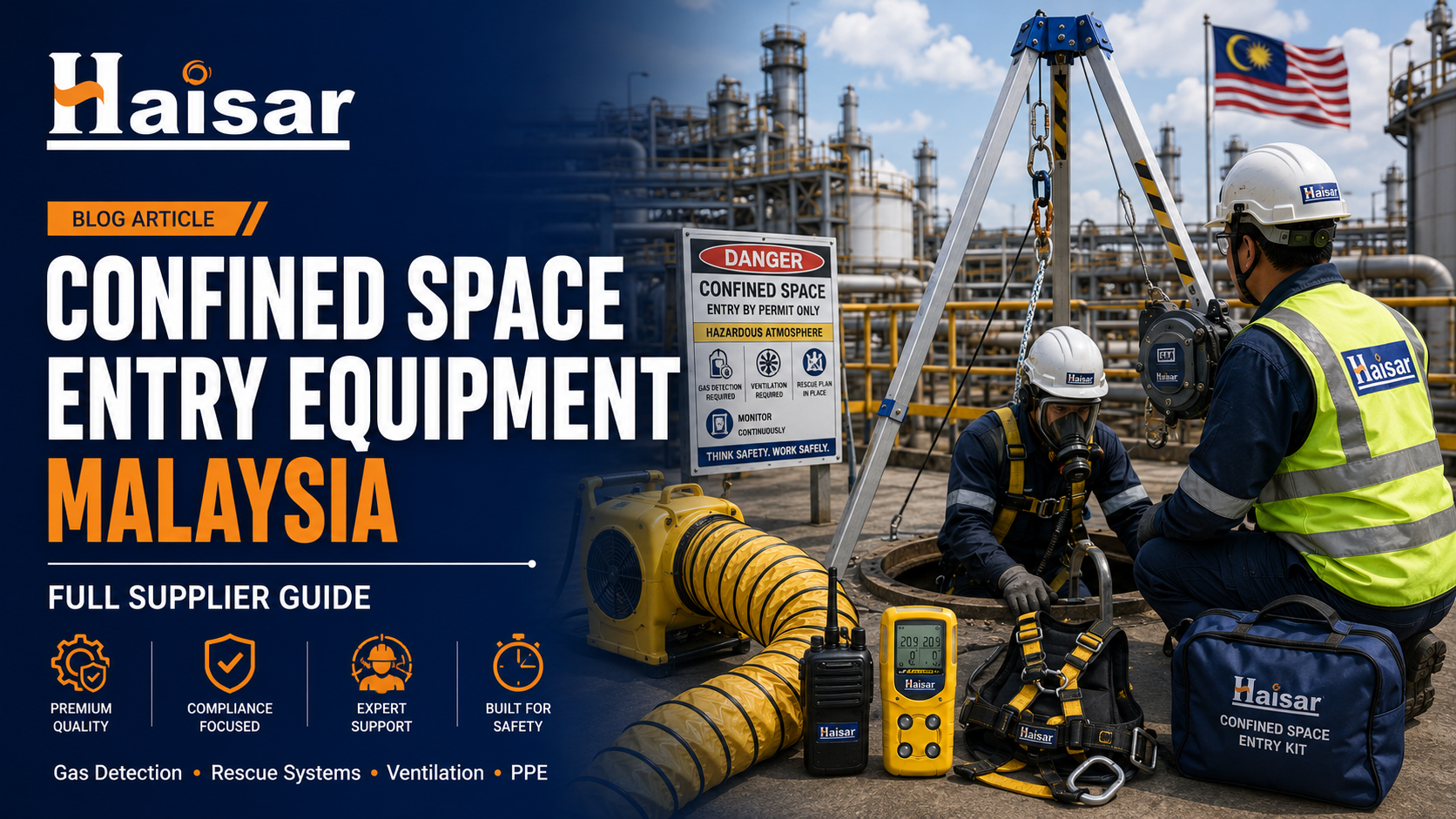
Confined space work is one of the highest-risk activities in Malaysian industry. It is also one of the most routine. Tanks, vessels, sumps, manholes, pipe tunnels, crawl spaces, silos, and ship holds are all classified confined spaces, and they appear on virtually every industrial project site in Malaysia, from oil and gas plants in Pasir Gudang to water treatment facilities in Johor Bahru, shipyards along the Johor Strait, and power generation plants across the peninsula.
What makes confined spaces so dangerous is not a single hazard but a combination. Oxygen deficiency. Toxic gas accumulation. Flammable atmospheres. Engulfment. Restricted entry and exit that slows rescue. These hazards can develop rapidly and without warning, and they can incapacitate a worker before there is any opportunity to self-rescue. The Malaysian DOSH incident record includes fatalities from confined space entries that were considered routine by the teams involved.
The right confined space entry equipment, properly maintained and used within a documented entry procedure, is what makes the difference between a controlled operation and a fatality. This guide covers the full scope of confined space entry equipment required for compliant operations in Malaysia, what to look for when sourcing it, and how Haisar Supply and Services supports operators and contractors across Johor and peninsular Malaysia.
The Regulatory Framework for Confined Space Work in Malaysia
Before covering equipment, it is important to understand the regulatory context. Confined space operations in Malaysia are governed by several overlapping frameworks that project teams and facility operators must comply with simultaneously.
OSHA 1994 and its Regulations. The Occupational Safety and Health Act 1994 sets the overarching duty of care for all Malaysian workplaces. Under OSHA, employers are required to identify confined space hazards, implement safe systems of work, and ensure that workers have the competence and equipment to carry out confined space entry safely.
DOSH Code of Practice for Work in Confined Space. This is the primary technical guidance document for confined space operations in Malaysia. It defines confined spaces, sets out the requirements for atmospheric testing, ventilation, rescue arrangements, and the permit-to-work system, and specifies the competencies required for authorised entrants, standby persons, and entry supervisors.
Factories and Machinery Act 1967. For confined spaces within factory environments, additional requirements apply under this Act and its subsidiary regulations.
Industry-specific requirements. For oil and gas operations, PETRONAS safety requirements and PCSB guidelines apply additional obligations. For offshore operations, international standards including IOGP and IACS requirements apply. For vessel entry in the maritime sector, Marine Department Malaysia and SOLAS requirements are relevant.
A confined space entry equipment supplier in Malaysia who understands this regulatory landscape is not just a product vendor. They are a compliance partner. Haisar works with clients across all of these regulatory frameworks and ensures that the equipment we supply meets the documentation and certification requirements that apply to each specific operating context.
The Essential Confined Space Entry Equipment
1. Gas Detection Equipment
Atmospheric testing is the first and most critical step before any confined space entry. The DOSH Code of Practice requires that the atmosphere within a confined space be tested for oxygen content, flammable gas concentration, and toxic gas presence before entry is permitted, and that monitoring continues throughout the operation.
What your operations need:
- Multi-gas personal monitors configured as a minimum for oxygen (O2), combustible gases (LEL), hydrogen sulphide (H2S), and carbon monoxide (CO). This four-gas configuration covers the most commonly encountered atmospheric hazards in Malaysian industrial confined spaces and is the baseline requirement for most entry operations.
- Pre-entry sampling pumps and extension probes for testing the atmosphere at depth within the space before any person enters. A competent entry supervisor must be able to test the full depth and breadth of the space remotely before authorising entry.
- Photoionisation detectors (PID) for spaces where volatile organic compounds (VOCs) are a risk, including tanks that have contained hydrocarbons, solvents, or chemical products.
- Calibration gas and certified calibration equipment to verify that each gas monitor is reading accurately before each day of use. A gas monitor that has not been bump tested against known-concentration calibration gas is not reliable protection.
- Docking stations and data management systems for operations running multiple personal gas monitors, enabling centralised bump test logging, calibration records, and instrument history.
What to check: Gas detection instruments must be calibrated at manufacturer-specified intervals and the calibration record must be documented. In regulated environments including petrochemical facilities, offshore operations, and PETRONAS contractor sites, gas detection calibration records are routinely audited. Ensure your supplier can provide calibration gas in the correct concentration for your instruments and can advise on calibration intervals appropriate to your operating conditions.
2. Rescue and Retrieval Systems
DOSH requirements and the fundamental duty of care for confined space operations require that a rescue arrangement be in place before entry is authorised. In practice, this means that mechanical retrieval equipment must be positioned at the entry point and a standby person trained in its operation must be present throughout the entry. This is not optional and it is not a box-tick. It is the mechanism that makes rescue possible without requiring another person to enter a potentially lethal atmosphere.
What your operations need:
- Tripod rescue systems for vertical entry points including manholes, tanks, and silos. A tripod provides a stable elevated anchor point above the entry allowing a worker to be retrieved vertically using an attached winch system. Tripods must be rated for the combined weight of the entrant and equipment and must be positioned correctly over the entry point to allow direct vertical retrieval.
- Davit arm systems for situations where a full tripod cannot be positioned, including low-headroom environments and ship tank entries where overhead clearance is restricted.
- Man-rated rescue winches providing mechanical advantage for retrieval of an incapacitated worker. The winch must be rated for the intended load and must allow controlled lowering as well as retrieval.
- Retrieval lines and attendant lines connecting the entrant to the rescue system at all times during the entry. The line must be routed to allow free movement within the space without creating entanglement hazards.
- Rescue stretchers and casualty handling equipment for situations where the entrant cannot be retrieved vertically through the entry point and must be manoeuvred through the space in a horizontal or angled configuration.
What to check: Tripod and winch systems must be load-rated and must be inspected before each use and at formal intervals by a competent person. Equipment must be compatible, meaning the winch, tripod, and retrieval line must be matched as a system. Do not mix components from different manufacturers without verifying compatibility and load ratings.
3. Full-Body Harnesses with Confined Space Configuration
A standard working-at-heights harness is not necessarily suitable for confined space rescue. The retrieval configuration for a vertical confined space entry requires a harness that positions the attachment point above the wearer's centre of mass to allow vertical retrieval without the casualty becoming inverted.
What your operations need:
- Full-body harnesses with a dorsal rescue D-ring as the primary retrieval attachment point. The dorsal D-ring positioned between the shoulder blades provides the correct geometry for vertical retrieval of an incapacitated worker.
- Chest D-rings and sternal attachment options for certain confined space configurations and for use with specific retrieval system geometries.
- Confined space rated harnesses with work positioning capability for entrants who need to work at a fixed position within the space in addition to being retrievable.
- Harness sizing and adjustment to ensure correct fit for each individual worker. A poorly fitted harness creates both safety risks during normal use and retrieval complications during an emergency.
What to check: Harnesses for confined space use must be inspected before each use and must be formally inspected at six-monthly intervals or more frequently if the working environment involves chemical exposure, UV exposure, or physical abrasion that could degrade the webbing. In marine and chemical environments, the inspection interval should be reduced given the accelerated degradation caused by these conditions.
4. Ventilation Equipment
Forced air ventilation is the primary means of controlling atmospheric hazards in confined spaces where toxic or flammable gases are present or where oxygen deficiency may develop. Ventilation must be established before entry and maintained continuously throughout the operation.
What your operations need:
- Axial flow ventilation blowers for forced air supply into confined spaces. Blower selection must be matched to the size of the space and the ventilation rate required to achieve and maintain a safe atmosphere.
- Flexible ventilation ducting to direct airflow to the base of the space where heavier-than-air gases accumulate. Simply placing a blower at the entry point is not sufficient ventilation for most industrial confined spaces.
- Intrinsically safe or spark-free blowers for spaces where a flammable atmosphere may be present before ventilation is established. A standard electric motor at the entry to a flammable atmosphere is an ignition source.
- Extraction ducting and fittings for situations where dilution ventilation is supplemented by direct extraction of contaminated air from the base of the space.
What to check: Ventilation must be continuous for the duration of the entry. If ventilation fails during an entry, the entrant must immediately exit the space. Gas monitoring must continue throughout regardless of ventilation status, as ventilation system failures or changes in process conditions can cause atmospheric conditions to deteriorate rapidly.
5. Communication Equipment
Communication between the entrant and the standby person outside the space is a DOSH requirement and a practical safety necessity. In spaces where visual contact cannot be maintained, which is the majority of industrial confined spaces, communication must be maintained by other means throughout the entry.
What your operations need:
- Intrinsically safe two-way radios certified for use in Zone 1 or Zone 2 hazardous areas as appropriate to the space being entered. Standard consumer radios are not suitable for use in potentially flammable atmospheres and their use in classified zones is a regulatory violation in addition to a safety risk.
- Wired communication systems as an alternative to radio in spaces where radio signal penetration is poor, such as deep underground structures or heavily shielded metal vessels.
- Signal line communication as a minimum backup system where other communication methods are not available, using agreed line-pull signals to communicate entry status and emergency conditions.
What to check: Communication systems must be tested before entry commences and must remain functional throughout the operation. Standby persons must understand the communication protocol and must be able to initiate the emergency response procedure immediately if communication is lost.
6. Emergency Escape Breathing Devices (EEBD)
In situations where atmospheric conditions in a confined space deteriorate during an entry, an emergency escape breathing device provides the entrant with a short duration air supply sufficient to exit the space before incapacitation.
What your operations need:
- Self-contained escape breathing apparatus (SCEBA) providing a minimum of 10 to 15 minutes of breathable air for emergency egress from the space.
- Compressed air escape sets for environments where the primary atmospheric risk is oxygen deficiency or toxic gas rather than flammable atmosphere.
- Storage and deployment arrangements ensuring EEBDs are immediately accessible to entrants at all times during the entry and are not stored in a location that would require the entrant to pass through the hazardous atmosphere to reach them.
What to check: EEBDs have a limited service life and a limited shelf life once activated. Ensure that your supplier can provide equipment with adequate remaining service life and that your site has a documented inspection and replacement programme for all EEBDs held in stock.
7. Confined Space Entry Signage and Permit Boards
The administrative and visual controls that surround confined space entry are as important as the physical equipment. The DOSH Code of Practice requires a documented permit-to-work system for all confined space entries, and the visual controls that support this system must be present at every entry point.
What your operations need:
- Confined space entry warning signs clearly marking every access point as a confined space with the entry requirements visible to all approaching personnel.
- Permit-to-work display boards at the entry point showing the current entry permit, the names of entrants and standby persons, atmospheric test results, and the time limits on the permit.
- Exclusion zone barriers and rope to prevent unauthorised approach to the entry point during operations.
- Do Not Enter and Confined Space Permit Required signs as permanent installations at all known confined space access points.
- Multilingual signage for facilities where the workforce includes workers whose primary language is not Bahasa Malaysia or English.
What to check: Signage in outdoor and industrial environments must be manufactured from UV-stable, weatherproof materials. Standard indoor sign materials deteriorate rapidly in the Malaysian climate and must be replaced more frequently than properly specified outdoor-rated signs.
8. Personal Protective Equipment for Confined Space Entry
In addition to the confined space-specific equipment above, entrants require appropriate personal protective equipment matched to the specific hazards of the space being entered.
What your operations need:
- Chemical resistant coveralls for entry into spaces that have contained or may contain chemical residues.
- Chemical resistant gloves and boot covers for spaces with floor contamination.
- Safety helmets with chin straps as chin straps are required in confined space environments where the helmet could be dislodged during retrieval.
- Intrinsically safe lighting including headlamps and handheld torches rated for use in classified hazardous areas.
- Knee pads for entrants working in spaces requiring crawling or kneeling on hard or contaminated surfaces.
- Appropriate respiratory protection beyond the personal gas monitor, including half-face respirators with appropriate cartridges where chemical vapour exposure is possible in a non-immediately-dangerous-to-life-or-health (IDLH) atmosphere.
What to check: PPE for confined space entry must be assessed against the specific hazards of the space. A risk assessment-based approach to PPE selection is required, and the selected PPE must be documented in the entry permit.
Sourcing Confined Space Entry Equipment in Malaysia
The confined space entry equipment market in Malaysia ranges from compliant, well-maintained equipment from reputable manufacturers to substandard products that appear adequate until they are needed. The consequences of equipment failure in a confined space rescue situation are severe enough that procurement decisions in this category require more than a price comparison.
When evaluating a confined space entry equipment supplier in Malaysia, consider the following.
Certification and documentation. Every piece of confined space equipment you purchase should come with manufacturer documentation, test certifications, and where applicable calibration certificates. A supplier who cannot provide this documentation when asked is not the right supplier for regulated industrial operations.
Product knowledge. Can your supplier advise on the correct tripod rating for your rescue scenario? Can they confirm that the gas detection instrument they are recommending has the sensor types appropriate for the hazards in your specific space? Can they advise on the compatibility of harness and retrieval system components? These are not specialist questions. They are the basic level of knowledge that a competent confined space equipment supplier should be able to answer.
Calibration gas supply. Gas detection equipment is only as reliable as the calibration process. A supplier who sells gas detectors but cannot supply calibration gas or advise on calibration intervals is leaving a gap in your compliance programme.
Stock availability and response time. Confined space work cannot wait for equipment to be sourced from overseas. Your supplier must be able to provide replacement or loan equipment promptly when instruments fail or equipment requires servicing.
Haisar Supply and Services: Confined Space Entry Equipment Supplier in Malaysia
Haisar Supply and Services Sdn Bhd, based in Kulai, Johor, supplies the complete range of confined space entry and rescue equipment for industrial operations across Malaysia. We work with oil and gas operators, shipyards, power generation facilities, construction contractors, and water and utilities operators who carry out confined space work as part of their regular operations.
Our confined space equipment supply covers the full scope outlined in this guide, from multi-gas personal monitors, calibration gas, and docking stations, to tripod and davit rescue systems, man-rated winches, confined space rated harnesses, ventilation blowers and ducting, intrinsically safe communication equipment, EEBDs, and confined space entry signage.
We supply products that meet the applicable Malaysian and international standards and we provide the documentation that regulated operations require. Our team understands the DOSH Code of Practice for Work in Confined Space and the broader regulatory framework that governs confined space operations in different industry sectors across Malaysia.
Get a Quote for Confined Space Entry Equipment
Whether you are equipping a new project site, replacing end-of-life equipment, or building out your confined space entry capability for the first time, Haisar can help.
Contact our team with your requirements and we will respond with product recommendations, specifications, and pricing tailored to your operation.
Haisar Supply and Services Sdn Bhd (985158-T) | Kulai, Johor, Malaysia | www.haisar.com
