Can't find what you're looking for? Get in touch!



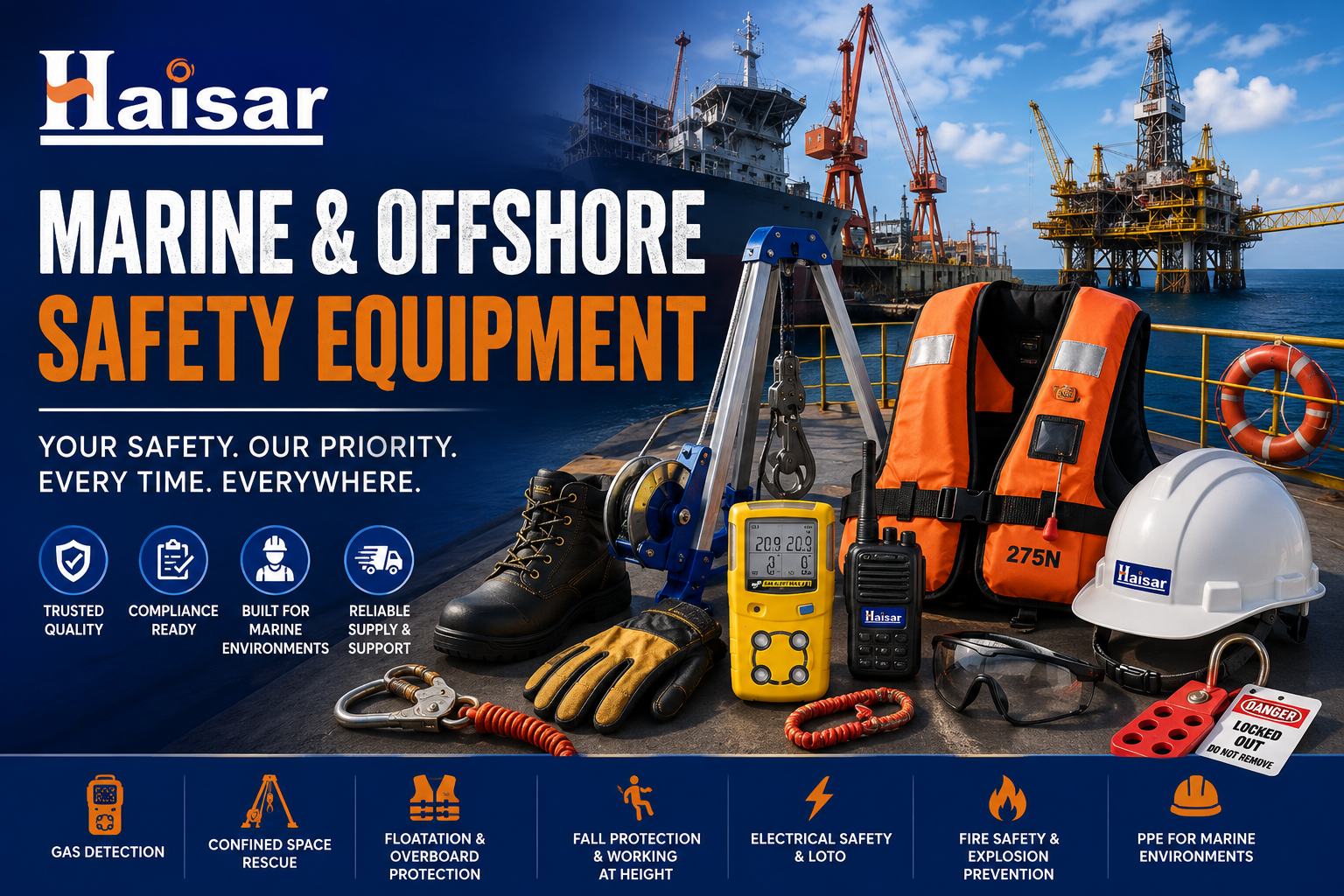
Malaysia's marine and offshore industry is one of the most demanding operating environments in the world. From the shipyards and dry docks of Johor Bahru and Pasir Gudang to the offshore platforms operating in the Malacca Strait and South China Sea, the hazards facing marine and offshore workers are numerous, often invisible, and frequently fatal when the right equipment is not in place.
Johor sits at the centre of Malaysia's maritime industrial corridor. Port of Tanjung Pelepas, Port of Johor, and the shipyards along the Johor Strait handle vessel maintenance, ship repair, new build, and offshore support operations around the clock. The workers on these sites face a combination of hazards that few other industries can match, including confined spaces with toxic atmospheres, working over water, electrical systems in corrosive environments, fire and explosion risk from flammable cargoes, and the constant physical demands of shipyard and offshore work.
This guide covers the essential safety equipment for marine and offshore operations in Malaysia, what to prioritise, and what to look for in a marine safety equipment supplier who can actually support your operations.
Why Marine and Offshore Safety Demands Specialist Equipment
Standard construction site safety equipment is not enough for marine and offshore environments. The combination of corrosive saltwater conditions, confined spaces throughout vessel structures, working at height over water, and the presence of flammable and toxic gases requires equipment that is specified, rated, and maintained for these specific conditions.
Corrosion and environmental rating. Equipment used in marine environments must be rated for saltwater exposure. Plastic components, metal fittings, and electronic instruments that perform reliably on a construction site can fail rapidly when exposed to salt air and spray. Gas detectors, rescue equipment, and harness hardware must all be selected with the marine environment in mind.
Regulatory framework. Marine and offshore operations in Malaysia are governed by the Department of Occupational Safety and Health (DOSH), the Marine Department Malaysia (Jabatan Laut), and for offshore operations, PETRONAS safety requirements and international standards including SOLAS (Safety of Life at Sea) and IOGP guidelines. Compliance across these overlapping frameworks requires equipment that meets multiple standards simultaneously.
The consequences of failure. In a shipyard or offshore environment, equipment failure does not just mean an incident on a worksite. It can mean a worker in the water, an explosion in a confined space, or a casualty in an area that emergency services cannot reach quickly. The margin for error is smaller than almost any other industry.
Getting marine and offshore safety equipment right is not a procurement convenience. It is an operational necessity.
Essential Marine and Offshore Safety Equipment
1. Gas Detection Equipment
Gas detection is the single most critical safety requirement in marine and offshore environments. Vessel tanks, bilge spaces, pump rooms, engine rooms, and cargo holds all present risk of oxygen deficiency, toxic gas accumulation, and flammable atmosphere. Entering any of these spaces without atmospheric testing is a leading cause of fatal confined space incidents in the maritime industry globally.
What your operations need:
- Multi-gas personal monitors detecting oxygen (O2), combustible gases (LEL), hydrogen sulphide (H2S), and carbon monoxide (CO) simultaneously. These are the minimum four-gas configuration for marine confined space work.
- Fixed gas detection systems for engine rooms, pump rooms, and cargo spaces where continuous monitoring is required.
- Pre-entry atmospheric testing equipment including sampling pumps and extension probes for testing spaces before entry without requiring a person to enter first.
- Photoionisation detectors (PID) for detecting volatile organic compounds (VOCs) in cargo tank cleaning and petrochemical vessel operations.
- Catalytic bead sensors for flammable gas detection in environments where methane, LPG, or other hydrocarbons may be present.
- Calibration gas and bump test equipment to ensure gas detectors are functioning correctly before each use. A gas detector that has not been bump tested is not reliable protection.
- Docking stations and data management systems for fleets of personal gas monitors, enabling centralised bump testing, calibration, and data download.
What to check: All gas detection equipment must be calibrated at manufacturer-specified intervals and bump tested before each day of use. In Malaysia, DOSH guidelines and the Code of Practice for Work in Confined Space require documented atmospheric testing as part of every confined space entry permit. Do not accept gas detection equipment from a supplier who cannot provide calibration certificates and calibration gas supply.
2. Confined Space Entry and Rescue Equipment
Confined space entry is routine in shipyard and marine operations. Tanks, voids, double bottoms, cofferdams, pipe tunnels, and pump rooms are all classified confined spaces and all require a documented entry procedure with the right equipment in place before anyone enters.
What your operations need:
- Tripod and davit rescue systems for vertical entry rescue from tanks and manholes without requiring a rescuer to enter the space.
- Winch and retrieval systems rated for the weight of a fully equipped worker, providing mechanical rescue capability at every entry point.
- Full-body harnesses with rescue attachments for all confined space entrants. The harness must include a designated rescue lifting point, typically a dorsal D-ring, compatible with the retrieval system in use.
- Ventilation equipment including axial flow blowers, duct, and fittings for forced air ventilation of confined spaces before and during entry.
- Intrinsically safe communication equipment for communication between entrants and the standby person outside the space. Standard radios are not safe for use in potentially flammable atmospheres.
- Confined space entry signage and barriers to clearly mark entry points and exclude unauthorised personnel during permit operations.
- Emergency escape breathing devices (EEBD) for workers in spaces where rapid evacuation may be required in the event of atmospheric deterioration.
What to check: Every confined space entry in a marine environment requires a permit to work signed by a competent person, documented atmospheric testing results, and a standby person stationed at the entry point for the duration of the operation. Equipment alone is not enough without the procedural framework to support it.
3. Personal Flotation Devices and Overboard Protection
Working over water, alongside vessels, on jetties, and on offshore platforms presents a drowning risk that shore-based sites do not face. Falls overboard in the Johor Strait or offshore waters are serious incidents with a narrow survival window.
What your operations need:
- Automatic inflatable lifejackets (150N and 275N rated) for workers operating in areas where a fall overboard is possible. Automatic inflation lifejackets activate on water immersion without requiring the wearer to pull a cord, which is critical for an incapacitated casualty.
- Buoyancy aids for lower-risk near-water work where full lifejacket protection is not required but some buoyancy support is appropriate.
- Lifebuoys and rescue throw lines positioned at all water-edge working locations, jetties, and gangways. These must be SOLAS-rated for offshore and port operations.
- Man-overboard poles and lights for offshore and vessel operations where rapid marking of a person in the water is critical to recovery.
- Safety harnesses with tethers for work on vessel decks and gangways where a tether to a fixed point provides primary fall prevention before a lifejacket becomes relevant.
- Personal locator beacons (PLBs) for offshore workers operating in remote locations or working away from the main platform.
What to check: Inflatable lifejackets must be serviced and re-armed at manufacturer-specified intervals. An unserviced inflatable lifejacket may not inflate when needed. Ensure your supplier can provide or direct you to service facilities for the brands they supply.
4. Fall Protection and Working at Height Equipment
Shipyard and offshore environments involve extensive working at height on vessel structures, scaffolding over water, offshore platform decks, and crane operations. The consequence of a fall in many of these environments is not just injury from the fall itself but drowning risk if the fall is into water.
What your operations need:
- Full-body safety harnesses rated to EN 361, correctly fitted to each worker. In marine environments, harnesses should be inspected more frequently due to the accelerated degradation caused by salt air and UV exposure.
- Self-retracting lifelines (SRLs) for freedom of movement on decks and elevated structures where a standard lanyard would create trip hazards.
- Energy-absorbing lanyards for single-point anchorage where fall clearance is sufficient.
- Temporary and permanent anchor points for vessel repair and shipyard work where structures may not have built-in anchorage provisions.
- Scaffold systems for vessel hull repair, painting, and maintenance work. Scaffold systems used in shipyards must be erected and inspected by a competent scaffolder.
- Rope access equipment for confined hull sections and locations where conventional scaffold is not practical.
What to check: Salt air and UV radiation degrade synthetic rope and webbing significantly faster than in indoor or sheltered environments. Harness and lanyard inspection in marine settings must be more frequent than the standard intervals applicable to general construction sites.
5. Electrical Safety PPE
Shipyards and offshore facilities involve extensive electrical work in environments that combine the hazards of water, humidity, and salt with live electrical systems. Electrical fatalities in marine environments are disproportionately high compared to land-based industries.
What your operations need:
- Voltage-rated insulated rubber gloves matched to the voltage class of the systems being worked on. Regular pressure testing is required to verify integrity.
- Arc flash rated PPE including face shields, hoods, and FR coveralls rated to the incident energy level determined by an arc flash risk assessment.
- Voltage detectors and non-contact testers for verifying circuit status before any contact with terminals or conductors.
- Lockout/tagout (LOTO) equipment for isolating electrical systems during maintenance and repair. This includes padlocks, hasps, multi-lock devices, circuit breaker lockouts, and tagout tags.
- Insulated tools for live work and work near live conductors.
- Insulated matting for switchboard and distribution board locations.
What to check: Insulating gloves must be pressure tested at intervals and before any use where integrity is in question. A glove with a pinhole failure will not protect against electric shock. Source gloves from a supplier who can also supply testing equipment or provide test certification.
6. Fire Safety and Explosion Prevention
Fire risk in marine and offshore environments comes from flammable cargo residues in tanks, fuel systems, welding and hot work operations, and electrical faults in areas exposed to flammable atmospheres. Explosion risk is present wherever tanks that have contained flammable products are being cleaned, repaired, or modified.
What your operations need:
- BOMBA-approved fire extinguishers of the correct class for the fire risks present, including CO2 for electrical fires and dry powder or foam for hydrocarbon fires.
- Fire blankets for small fire suppression and for protection of casualties with burn injuries.
- Hot work permits and associated equipment including fire watches, fire extinguishers at the point of work, and fire-resistant blankets to protect adjacent structures during welding and grinding operations.
- Intrinsically safe equipment for use in classified hazardous areas where flammable atmospheres may be present. This includes torches, communication devices, and gas detectors.
- Flame-resistant (FR) workwear for workers in areas where flash fire risk exists, including tank cleaning, hot work, and operations on vessels carrying or having carried flammable cargoes.
What to check: Fire extinguishers in marine environments must be inspected and serviced at the required intervals. Salt air corrodes extinguisher bodies and activating mechanisms. A corroded extinguisher may fail to operate when needed.
7. Personal Protective Equipment for Marine Environments
Standard site PPE is a starting point, but marine environments require additional consideration for each PPE category due to the corrosive, wet, and physically demanding nature of the work.
What your operations need:
- SIRIM-certified safety helmets with chin straps, as a helmet without a chin strap on a vessel deck or scaffold over water can become a secondary hazard.
- Safety footwear with non-slip soles rated for wet deck surfaces. Standard construction safety boots with smooth soles can be dangerous on wet steel decks. Look for footwear with oil and water-resistant outsoles designed for maritime environments.
- Waterproof and chemical-resistant gloves for wet working conditions and chemical handling during vessel cleaning operations.
- Eye protection including anti-fog goggles for grinding, cutting, and work in spray conditions.
- Hearing protection for engine room work and areas with high noise levels from machinery and fabrication operations.
- Coveralls and waterproof outerwear for working in exposed conditions. FR coveralls are required for workers in hot work and hydrocarbon-exposed environments.
- Knee pads for workers involved in hull cleaning, blasting, and close-contact work on vessel surfaces.
What to check: PPE in marine environments degrades faster than on standard construction sites. Inspection frequency should be increased, and replacement thresholds should be applied more conservatively given the additional environmental stressors.
8. Signage and Site Communication
Marine and offshore facilities operate across large areas with multiple simultaneous operations, shift workers, and contractors from multiple organisations working alongside each other. Clear signage and communication systems are essential for maintaining safe site conditions.
What your operations need:
- Confined space entry signage clearly marking every access point to a confined space with entry requirements and permit information.
- Hazardous area classification signage marking zones where flammable atmospheres may be present and where intrinsically safe equipment is required.
- Emergency muster point signage visible from all areas of the facility and vessel.
- Hot work zone signage marking areas where welding, grinding, and cutting is in progress.
- Safety instruction signage in multiple languages as Malaysian shipyards and offshore facilities typically employ workers from multiple countries.
- Custom facility signage for permit-to-work boards, equipment storage locations, and safety notice boards.
What to check: Signage in marine environments must be resistant to UV degradation, moisture, and salt air. Standard indoor signage will deteriorate rapidly in these conditions. Specify outdoor-rated, UV-stable materials for all external and exposed signage.
What to Look for in a Marine Safety Equipment Supplier in Malaysia
The demands of marine and offshore operations mean that your safety equipment supplier needs to be more than a catalogue. They need to understand the regulatory environment, the specific hazards of marine work, and the operational realities of shipyard and offshore procurement.
Product range that covers the marine environment. You need a supplier who can provide gas detection equipment and calibration gas, confined space rescue systems, lifejackets and overboard protection, electrical safety PPE, FR workwear, LOTO equipment, and fire safety products from a single point of contact. Managing multiple specialist suppliers for a marine project is a procurement burden that slows down mobilisation.
Compliance knowledge. Your supplier should understand the intersection of DOSH requirements, Marine Department Malaysia regulations, PETRONAS safety requirements where applicable, and international standards like SOLAS. A supplier who cannot explain why a particular product meets the relevant standard is not the right partner for a regulated marine operation.
Reliability and response time. Offshore and shipyard operations do not wait. If a gas detector fails calibration before a confined space entry, you need a replacement or a loan unit the same day, not in a week. Supplier responsiveness is an operational requirement, not a nice to have.
Documentation and traceability. Marine and offshore operations require documented evidence that safety equipment meets specified standards. Your supplier must be able to provide calibration certificates, test reports, SIRIM certification references, and manufacturer documentation on request.
Haisar Supply and Services: Marine Safety Equipment Supplier in Johor and Malaysia
Haisar Supply and Services Sdn Bhd, based in Kulai, Johor, supplies the full range of safety equipment required for marine, shipyard, and offshore operations across Malaysia. We serve operators and contractors working in Johor's port and shipyard corridor, and across peninsular Malaysia.
Our marine and offshore safety equipment supply covers gas detection and calibration, confined space entry and rescue systems, personal flotation and overboard protection, fall protection and working at heights gear, electrical safety PPE and LOTO equipment, fire safety products, and the full range of marine-rated personal protective equipment.
We understand the compliance requirements that govern marine and offshore operations in Malaysia and we work with HSE managers and procurement teams to ensure the right products reach site on time and with the documentation your operations require.
Get a Quote for Marine Safety Equipment
Whether you are equipping a shipyard operation in Pasir Gudang, supporting an offshore project out of Johor, or sourcing safety equipment for a port facility, Haisar Supply and Services can help.
Contact us directly and our team will respond promptly with product availability, specifications, and pricing for your marine safety equipment requirements.
Haisar Supply and Services Sdn Bhd (985158-T) | Kulai, Johor, Malaysia | www.haisar.com
