Can't find what you're looking for? Get in touch!



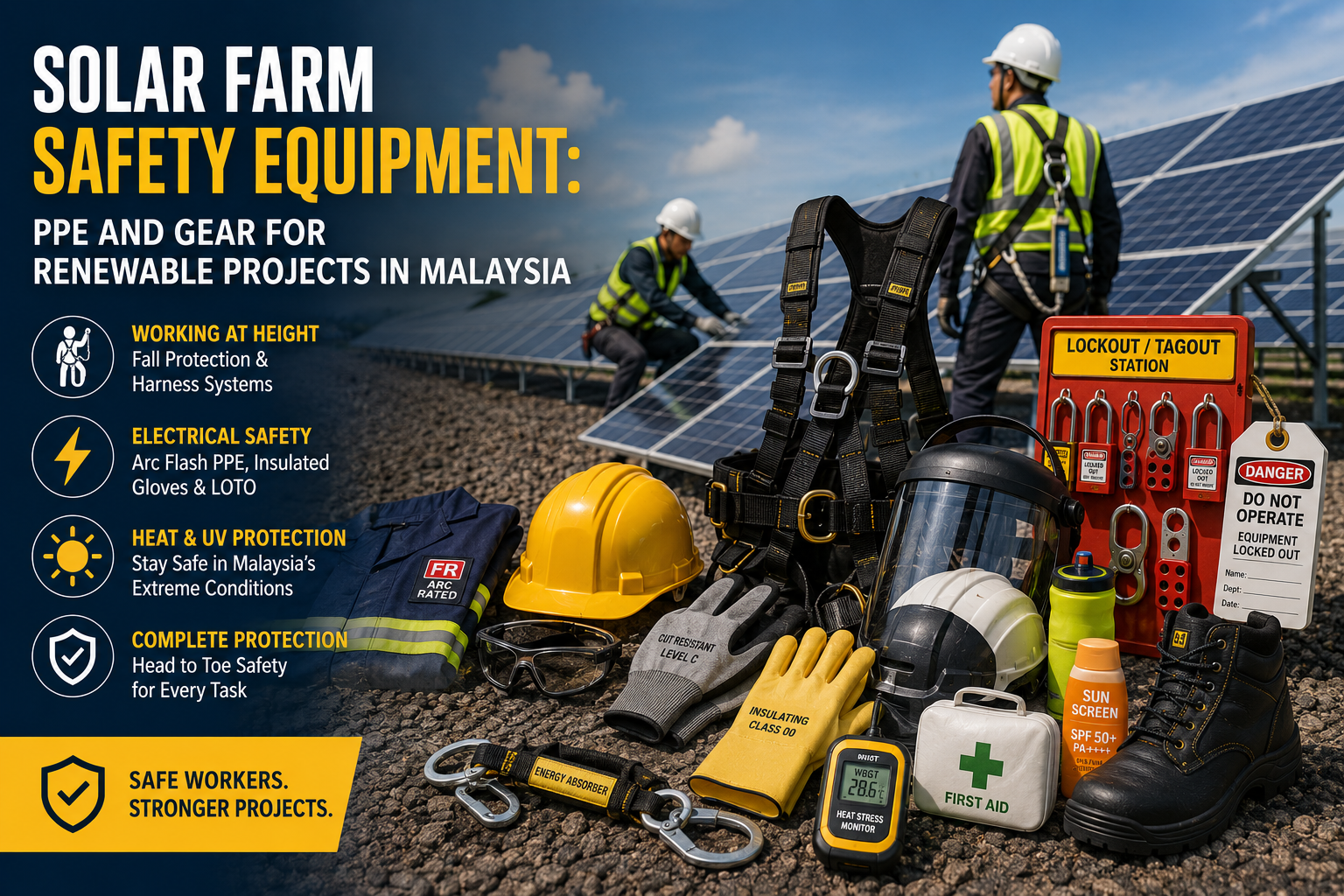
Malaysia's solar energy sector is growing fast. With the government's target to reach 70% renewable energy capacity by 2050 and a surge in large-scale solar (LSS) projects across Johor, Selangor, Kedah, and Sabah, EPC contractors and project developers are mobilising site teams at a pace the industry has not seen before. Behind every megawatt commissioned is a workforce operating in demanding outdoor environments, working at height on rooftops and ground-mounted structures, handling electrical systems, and exposed to heat, UV radiation, and the very real risk of electric shock.
Solar farm safety equipment is not a tick-box exercise. It is what keeps your workers alive and your project on schedule. This guide covers the essential PPE and safety gear for solar farm and renewable energy projects in Malaysia, with practical guidance on what to prioritise and why.
The Unique Safety Risks of Solar Farm Projects in Malaysia
Solar installations in Malaysia present a specific combination of hazards that differ from conventional construction sites. Understanding them is the starting point for building the right safety equipment programme.
Working at height. Whether your team is installing panels on pitched rooftops, elevated mounting structures, or carrying out maintenance on utility-scale ground-mounted arrays, fall risk is constant. Malaysia's DOSH statistics regularly list falls from height among the top causes of fatal workplace accidents in construction and installation work.
Electrical hazards. Solar panels generate DC electricity the moment they are exposed to light. There is no way to fully de-energise a panel in the field without covering it, and even covered panels can carry residual charge. Workers involved in cabling, inverter installation, and electrical testing face real arc flash and electrocution risk.
Heat stress and UV exposure. Solar farm work happens outdoors, often in open fields with no shade and ambient temperatures exceeding 35 degrees Celsius. Malaysia's equatorial climate means UV index levels are consistently in the extreme range. Heat exhaustion and heatstroke are genuine risks on any outdoor solar project.
Manual handling and repetitive strain. Panels are heavier than they look, typically between 20 and 25 kilograms each, and installation involves repetitive lifting, carrying, and positioning across large site areas. Cumulative strain injuries and acute manual handling accidents are common on poorly managed solar sites.
Slip, trip, and fall hazards at ground level. Even on ground-mounted projects, uneven terrain, cable runs, mounting rails, and muddy conditions during wet season create constant slip and trip hazards.
A well-specified safety equipment package for a solar project in Malaysia needs to address all of these hazards systematically.
Essential Solar Farm Safety Equipment for Malaysian Projects
1. Fall Protection and Working at Heights Gear
Fall protection is the highest-priority safety requirement on any solar installation. Whether your workers are on a rooftop system or an elevated racking structure, DOSH regulations require appropriate fall protection systems to be in place before work begins.
What your team needs:
- Full-body safety harnesses rated to EN 361 or equivalent, correctly fitted to each worker. A harness that does not fit is not protection.
- Lanyards and energy-absorbing lanyards for single-point anchorage on structures where fall clearance allows.
- Self-retracting lifelines (SRLs) for situations where movement across the work area requires a retractable connection rather than a fixed lanyard.
- Roof anchor points and temporary anchor systems providing rated anchorage for rooftop installations. Anchor points must be engineered and load-rated.
- Safety nets for large rooftop or elevated installations where collective fall protection is required below the work area.
- Scaffold edge protection and guardrails as the primary collective fall protection measure wherever scaffold access is used.
- Ladder safety systems for access to elevated working positions.
What to check: Under Malaysia's OSH (Use and Standards of Exposure of Chemicals Hazardous to Health) Regulations and the DOSH Working at Heights guidelines, a documented fall protection plan is required before any work at height begins. All equipment must be inspected before each use and formally inspected at intervals by a competent person.
2. Electrical Safety PPE
Solar panel strings, combiner boxes, inverters, and grid connection points all present electrical hazards. Electrical safety PPE on a solar site must address both AC and DC electrical risks, including arc flash.
What your team needs:
- Insulated rubber gloves (Class 00 to Class 4) rated for the voltages your team will encounter. DC string voltages on utility-scale solar can exceed 1,000V. Gloves must be tested regularly and protected with leather over-gloves during use.
- Arc flash rated face shields and hoods for work near inverters, switchboards, and combiner boxes where arc flash energy is a risk.
- Arc flash rated clothing (FR coveralls) providing appropriate calorie-rated protection for the tasks and equipment involved.
- Voltage-rated insulated tools for all live electrical work.
- Voltage detectors and non-contact testers so workers can verify circuit status before touching any terminal or conductor.
- Lockout/tagout (LOTO) equipment for isolating inverters, switchboards, and string combiner boxes during maintenance. This includes padlocks, hasps, circuit breaker lockout devices, and tagout tags.
- Insulated matting for work at switchboard and inverter locations.
What to check: An arc flash risk assessment should be carried out for the project's electrical system to determine the incident energy levels and the appropriate arc flash PPE category. Do not assume standard workwear is adequate near electrical equipment on a solar site.
3. Head Protection
Head protection is mandatory on all active project sites in Malaysia under OSHA 1994 requirements. On solar farm sites, overhead hazards include panels being lifted and positioned, tools dropped from elevated work areas, and movement of materials by crane or telehandler.
What your team needs:
- SIRIM-certified safety helmets appropriate to the site hazard class. Standard Class B helmets provide both impact and electrical protection, making them the preferred choice for solar sites where both hazards are present.
- Chin straps particularly important for work at height where a falling helmet becomes a secondary hazard to workers below.
- Bump caps for low-headroom maintenance situations inside plant rooms and inverter enclosures, where impact risk is low but scrape and abrasion hazards exist.
What to check: Helmets must be inspected regularly and replaced if cracked, faded excessively, or past the manufacturer's recommended service life, typically three to five years from the date of manufacture.
4. Eye and Face Protection
Solar sites expose workers to multiple eye hazards including UV radiation, dust and particulates during ground preparation, sparks during electrical termination work, and chemical splash risk during battery storage maintenance.
What your team needs:
- UV-rated safety spectacles for outdoor workers exposed to high UV index conditions throughout the working day.
- Anti-fog safety goggles for dust-intensive tasks during ground clearance and earthworks.
- Face shields for grinding, cutting, and any work involving chemical splash risk.
- Welding shades and grinding visors for metalwork on racking and mounting structure fabrication.
What to check: Standard clear safety glasses do not provide UV protection. Outdoor workers on solar sites need lenses with UV400 rating or equivalent. This is often overlooked during equipment procurement.
5. Respiratory Protection
Ground preparation, earthworks, and concrete work on solar farm sites generate significant dust. Workers involved in battery storage installation may also encounter gases and chemical vapours during commissioning and maintenance.
What your team needs:
- P2 disposable respirators (FFP2/N95) for general dust protection during ground clearing, earthworks, and panel handling.
- P3 half-face respirators with particulate filters for higher dust concentrations during prolonged earth-moving phases.
- Gas and vapour cartridge respirators for battery room work involving hydrogen gas risk or chemical maintenance tasks.
What to check: Respirator selection must be based on the specific contaminant and concentration. A P2 dust mask is not appropriate for gas or vapour exposure. Fit testing is recommended for half-face and full-face respirators.
6. Hand Protection
Hand injuries are among the most common on construction and installation sites. Solar farm work involves sharp panel frames, metal racking components, electrical conductors, and heavy panel handling, all of which present different hand injury risks requiring different gloves.
What your team needs:
- Cut-resistant gloves (Level C or higher) for handling panel frames, racking components, and metal structure fabrication.
- General duty work gloves for routine panel handling, cabling, and site operations.
- Electrical insulating rubber gloves for all electrical work, matched to the voltage class required.
- Chemical resistant gloves for battery maintenance and any chemical handling on site.
What to check: Never wear standard fabric or leather gloves near live electrical equipment. Only properly rated and regularly tested insulating rubber gloves provide electrical protection.
7. Foot Protection
Solar farm terrain ranges from cleared agricultural land to rocky hillsides, and site conditions change significantly between dry and wet season. Foot protection must handle both the physical hazards of the site and the electrical hazards of the work.
What your team needs:
- Steel-toe safety boots (S3 rated) providing toe cap protection, puncture resistance, and ankle support for general site work.
- Anti-static or ESD footwear for work in areas where electrostatic discharge is a risk, including battery storage and inverter rooms.
- Electrical hazard rated footwear providing secondary protection against incidental contact with live circuits.
- Wellington boots for wet season site conditions during ground preparation and cable trenching works.
What to check: Footwear must be appropriate to the specific task and location. Anti-static boots are not the same as electrical hazard boots and should not be used interchangeably in live electrical areas.
8. High Visibility and Body Protection
Solar farm sites involve the movement of heavy equipment including module delivery trucks, forklifts, telehandlers, and cranes. Ensuring workers are visible to plant operators is a basic site safety requirement.
What your team needs:
- Class 2 or Class 3 high-visibility vests for all workers in areas where mobile plant is operating. Class 3 hi-vis (full vest with sleeves or jacket) is recommended for sites with vehicles operating at higher speeds.
- Hi-vis coveralls for workers requiring full-body high visibility, particularly those working in or near active roadways adjacent to the site.
- Sun protection clothing including long-sleeved lightweight shirts and UV-rated garments for outdoor workers exposed to prolonged sun throughout the working day.
- FR (flame-resistant) coveralls for electrical workers and those involved in inverter and switchboard commissioning.
What to check: Hi-vis garments must comply with MS ISO 20471 or equivalent. Faded, dirty, or damaged reflective tape significantly reduces visibility and garments should be replaced when tape reflectivity is visibly degraded.
9. Heat Stress Management Equipment
Malaysia's climate makes heat stress a genuine medical risk on outdoor solar projects. Unlike many occupational hazards, heat illness can progress from mild symptoms to life-threatening heatstroke rapidly and without sufficient warning.
What your team needs:
- Cooling towels and neck wraps for immediate cooling during rest breaks.
- Electrolyte replenishment available at all rest stations throughout the working day.
- Portable shaded rest areas positioned strategically across large site areas so workers can take shade breaks without long walks.
- Heat stress monitoring including wet bulb globe temperature (WBGT) measurement to guide work-rest ratios during the hottest parts of the day.
- Personal cooling vests (phase change or evaporative) for workers performing high-exertion tasks during peak heat hours.
What to check: A heat stress management plan should be part of your project's HSE plan. DOSH guidelines on thermal environment and the Code of Practice for Prevention of Heat Stress at Work provide the framework for Malaysian project sites.
10. Emergency Response Equipment
Solar farms are often located in remote or semi-rural areas where emergency services may take significant time to respond. On-site emergency response capability is not optional.
What your team needs:
- First aid kits stocked and sized for the workforce on site, as required under the Factory and Machinery Regulations 1970.
- AED (Automated External Defibrillator) given the electrical hazards on solar sites, cardiac arrest from electric shock is a genuine risk and response time is critical.
- Eye wash stations for sites where chemical handling occurs, particularly battery storage maintenance.
- Burns treatment kits for electrical flash and arc incidents.
- Emergency communication equipment particularly important on remote sites where mobile coverage may be limited.
- Stretcher and casualty evacuation equipment for sites where vehicle access to all areas of the site cannot be guaranteed.
What to check: All first aiders on site must hold a valid first aid certificate. On a solar site with electrical hazards, first aiders should also be trained in the management of electric shock casualties, including the procedure for safely approaching a casualty who may still be in contact with a live circuit.
Sourcing Solar Farm Safety Equipment in Malaysia
For EPC contractors and project developers working on solar projects in Johor and across peninsular Malaysia, the challenge is not knowing what equipment you need. It is finding a supplier who can provide it all, reliably, at the pace your project demands.
Solar project timelines are tight. Mobilisation windows are short. The last thing your HSE team needs is to be chasing three different suppliers for fall protection, electrical PPE, and hi-vis garments while your crew is ready to start work.
A one-stop industrial safety equipment supplier who understands the renewable energy sector can make a material difference to your project setup process.
Why Solar EPC Contractors in Johor Choose Haisar Supply and Services
Haisar Supply and Services Sdn Bhd, based in Kulai, Johor, supplies the full range of safety equipment required for solar farm and renewable energy projects across Malaysia. We work with EPC contractors, project developers, and HSE managers who need reliable procurement support from a supplier who understands the site environment.
We supply everything covered in this guide, from full-body harnesses and SRLs for working at height, to arc flash PPE, insulated gloves, FR coveralls, LOTO equipment, heat stress management products, and on-site emergency response gear.
Our team can support your project from initial mobilisation through to ongoing maintenance phase requirements, with fast quotation turnaround, bulk procurement capability, and delivery across Johor and peninsular Malaysia.
Enquire About Solar Farm Safety Equipment Today
Setting up a solar project in Johor or elsewhere in Malaysia? Haisar Supply and Services can help you specify and procure the right safety equipment for your site, efficiently and in line with Malaysian regulatory requirements.
WhatsApp us now for a fast response from our team.
Or visit our website to browse our full range of PPE, working at heights equipment, and electrical safety products.
Browse Our Products at haisar.com
Haisar Supply and Services Sdn Bhd (985158-T) | Kulai, Johor, Malaysia | www.haisar.com
