Can't find what you're looking for? Get in touch!



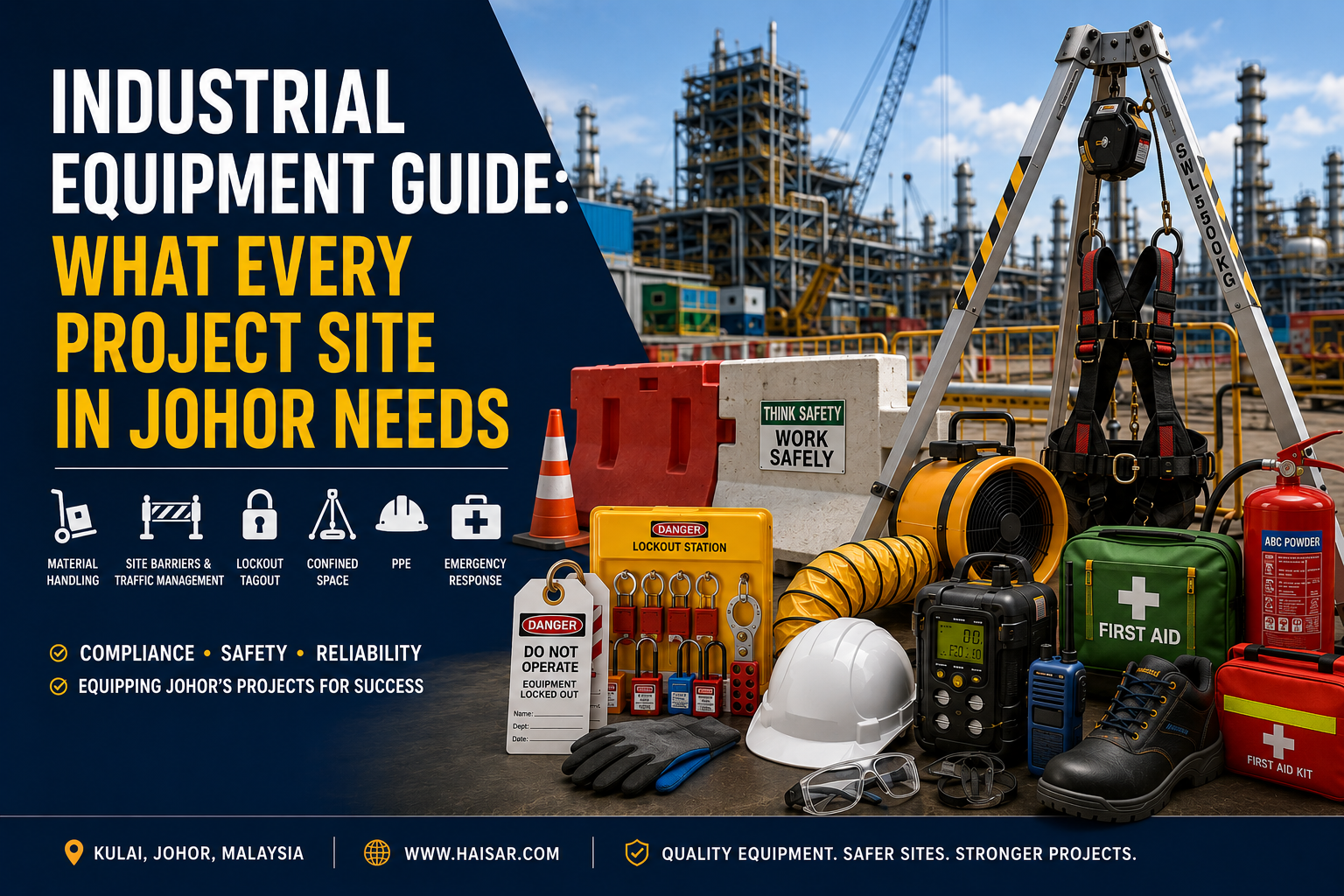
If you're running a project site in Johor, whether it's an oil and gas plant in Pasir Gudang, a data centre in Iskandar Puteri, or a construction site along the Senai corridor, you already know how much rides on having the right industrial equipment on hand. Delays caused by missing tools, wrong specifications, or unreliable suppliers are not just costly. In industries where safety and compliance are non-negotiable, they can be dangerous.
This guide breaks down the essential industrial equipment every project site in Johor needs, from material handling and confined space gear to lockout/tagout systems and site barriers. More importantly, it explains what to look for in an industrial equipment supplier in Johor and why procurement decisions matter as much as the products themselves.
Why Equipment Selection Matters More Than Most Teams Realise
Equipment on a project site is not just a logistics issue. Every piece of industrial equipment your workers use is tied to three critical areas.
Regulatory compliance. Malaysia's Occupational Safety and Health Act (OSHA 1994), DOSH regulations, and industry-specific codes like BOMBA and CIDB standards set clear requirements for what equipment must be present on site. Non-compliance can result in stop-work orders, fines, or worse.
Worker safety. Inadequate or substandard equipment contributes directly to workplace accidents. Malaysia's DOSH statistics consistently show that construction and industrial sectors account for the highest number of reported workplace incidents.
Project continuity. A site that runs out of barriers, lockout devices, or respiratory protection mid-project faces downtime. Procurement delays ripple outward, affecting timelines, subcontractors, and client relationships.
Getting your industrial equipment procurement right from the start is not just good practice. It is a competitive advantage.
The Essential Industrial Equipment Checklist for Johor Project Sites
Below is a practical breakdown of industrial equipment categories your project site likely needs, with guidance on what to look for in each area.
1. Material Handling Equipment
Material handling is the backbone of any active project site. From moving heavy components to organising storage areas, the right equipment prevents injuries and accelerates workflow.
What your site needs:
- Hand trucks and platform trolleys for moving equipment and materials over short distances without forklift dependency.
- Pallet jacks (manual and electric) essential for warehouse-adjacent operations and laydown yards.
- Lifting slings and shackles for overhead lifts. Must be rated and certified.
- Drum handling equipment particularly relevant for chemical, oil and gas, and manufacturing sites where drums of lubricants or chemicals are routinely moved.
- Storage racking and shelving systems to reduce loss, improve traceability, and speed up daily operations.
What to check: All lifting accessories including slings, shackles, and chains must carry a Safe Working Load (SWL) rating and should be inspected regularly. In Malaysia, DOSH guidelines under the Factories and Machinery Act require that lifting gear be tested and certified.
2. Site Barriers and Traffic Management
A well-managed project site separates work zones, protects workers from mobile plant, and keeps unauthorised personnel away from hazardous areas.
What your site needs:
- Plastic water-filled barriers for road and heavy-traffic zone separation. Interlocking designs are easy to deploy and reconfigure.
- Jersey barriers (concrete) for permanent or semi-permanent separation in high-risk areas.
- Crowd control barriers and pedestrian fencing for access control around active work zones.
- Safety cones and delineators for temporary traffic management during works.
- Warning tape and barrier tape for low-cost, flexible demarcation of exclusion zones.
- Site entrance gates and boom barriers for controlled site access on larger projects.
What to check: Barrier specifications must match the risk level of the area. High-speed vehicular environments require rated barriers, not just plastic tape. Ensure your supplier can provide products that meet relevant MS and SIRIM standards.
3. Lockout/Tagout (LOTO) Equipment
Lockout/tagout procedures protect workers from the unexpected energisation of machinery during maintenance, repair, or service activities. This is one of the most frequently cited compliance gaps on Malaysian industrial sites.
What your site needs:
- Lockout padlocks individually keyed, durable, and clearly identifiable per worker.
- Hasp lockouts allowing multiple workers to lock out the same energy isolation point simultaneously.
- Circuit breaker lockout devices for electrical panels and switchboards.
- Valve lockout devices for ball valves, gate valves, and butterfly valves in piping systems.
- Lockout stations and shadow boards for centralised LOTO equipment storage, prominently placed near plant areas.
- Tagout tags durable and weatherproof, identifying who performed the isolation and when.
- Cable lockouts for flexible systems covering non-standard or multi-point energy sources.
What to check: LOTO equipment must be compatible with your specific machinery and isolation points. A good industrial equipment supplier in Johor will help you assess your site's energy control needs and recommend the right combination of devices, not just sell you a generic kit.
4. Confined Space Entry Equipment
Confined space work is one of the highest-risk activities on any project site. In Johor's oil and gas, utilities, and construction sectors, confined space entry is routine and the equipment requirements are specific and non-negotiable.
What your site needs:
- Gas detectors and multi-gas monitors for testing oxygen levels, combustible gases, CO, and H2S before and during entry. Must be calibrated regularly.
- Ventilation blowers and ducting to maintain a breathable atmosphere inside confined spaces.
- Tripod rescue systems for vertical entry rescue without requiring rescuers to enter the space.
- Fall arrest systems for confined space including retrieval lines and winch systems.
- Harnesses with rescue attachments as workers entering confined spaces must wear full-body harnesses with a designated retrieval point.
- Communication equipment such as intrinsically safe two-way radios for communication between entrants and attendants.
- Atmospheric testing equipment including calibration gas, bump test kits, and docking stations.
What to check: Under DOSH's Guidelines on Occupational Safety and Health in Confined Space, every confined space entry must follow a documented permit-to-work system, with equipment checks as part of the entry protocol. Ensure all gas detection equipment is calibrated and all rescue equipment is in-date and functional.
5. Signage and Site Communication
Effective industrial signage is not optional. It is a legal requirement under Malaysia's OSHA 1994 and its subsidiary regulations. Beyond compliance, clear signage reduces accident rates by communicating hazards, procedures, and site rules at the point of need.
What your site needs:
- Mandatory signs covering hard hat areas, safety boot zones, eye protection requirements, and high visibility vest requirements.
- Prohibition signs for no entry, no smoking, and no mobile phones in EX zones.
- Warning signs for high voltage, slippery surfaces, moving machinery, and overhead loads.
- Emergency information signs marking assembly points, first aid locations, fire extinguisher positions, and emergency exits.
- Custom site signage for project-specific safety messages, site rules, visitor instructions, and multilingual signage where required.
- Banner stands and display boards for HSE noticeboards, induction areas, and toolbox talk stations.
What to check: Signs must comply with MS ISO 7010 (Graphical symbols, Safety colours and safety signs) or relevant DOSH and BOMBA requirements depending on the hazard type. A reputable supplier should be able to advise on the correct sign standard for each application.
6. Personal Protective Equipment (PPE)
No industrial equipment guide would be complete without addressing PPE. Project sites in Johor serve multiple industries with varying PPE requirements. What is adequate for general construction may fall short for oil and gas or data centre work.
Core PPE for project sites:
- Head protection with SIRIM-certified safety helmets appropriate to the task class.
- Eye and face protection including safety spectacles, goggles, and face shields for grinding, chemical handling, and welding.
- Hearing protection such as ear plugs and earmuffs for high-noise areas.
- Respiratory protection covering dust masks (P2/P3), half-face respirators, and supplied air respirators for hazardous atmospheres.
- Hand protection including general duty, cut-resistant, chemical-resistant, and electrical insulating gloves as required.
- Foot protection with steel-toe boots, anti-static footwear, and electrical hazard rated footwear.
- Body protection including hi-vis vests, coveralls, chemical resistant suits, and arc flash rated garments.
- Fall protection with full-body harnesses, lanyards, self-retracting lifelines (SRLs), and anchor devices.
What to check: PPE selection should be based on a documented risk assessment, not habit or lowest cost. DOSH-compliant suppliers should be able to provide product documentation, SIRIM certification references, and technical data sheets on request.
7. Emergency Response Equipment
Project sites must be prepared for incidents. Whether it is a chemical spill, a medical emergency, or a fire, having the right emergency response equipment on-site and ensuring workers know how to use it is a basic legal and moral obligation.
What your site needs:
- First aid kits sized and stocked per the number of workers on site, as specified under the Factory and Machinery (Safety, Health and Welfare) Regulations 1970.
- AED (Automated External Defibrillator) increasingly required on larger sites and critical for high-risk environments.
- Eye wash stations including fixed and portable units for chemical and particulate exposure.
- Emergency eyewash and shower units for sites handling corrosive chemicals.
- Fire extinguishers that are BOMBA-approved and correctly rated for the fire risks present on site.
- Chemical spill kits in oil-only, chemical, or universal absorbent configurations depending on site chemicals.
- Stretchers and first aid equipment for transport and initial treatment of injured workers.
What to check: Emergency equipment placement must follow specific requirements. Extinguishers must be within a maximum travel distance, and eye wash stations must be within 10 seconds of chemical hazard areas per ANSI Z358.1. A knowledgeable supplier will help you map placement, not just supply the product.
How to Choose the Right Industrial Equipment Supplier in Johor
With the product landscape covered, the next question is who to buy from. Not all industrial equipment suppliers in Johor offer the same level of service, and for project sites, service matters as much as price.
Product Range and Availability. A one-stop industrial equipment supplier in Johor eliminates the need to manage multiple vendors across different categories. Look for suppliers who can cover material handling, barriers, LOTO, confined space, PPE, and emergency response from a single point of contact.
Compliance Knowledge. Can your supplier tell you which gas detector is appropriate for an oxygen-deficient space versus a flammable gas environment? Can they advise on LOTO compatibility or BOMBA-compliant fire equipment? Technical knowledge separates a real procurement partner from a box-shifter.
Speed of Response. Project sites run on timelines. Your supplier needs to provide quotations quickly, fulfil orders reliably, and communicate proactively about lead times. A supplier who goes silent after you place an order is a risk to your project schedule.
Custom and Bulk Procurement Capability. Many project sites have specialised requirements, from custom signage to bulk PPE orders with company branding or project-specific equipment packages. Look for suppliers with the flexibility to handle these without bureaucratic delays.
After-Sales Support. Who do you call if a gas detector fails calibration on a Monday morning? Good suppliers maintain relationships, not just transactions.
Why Haisar Supply & Services is Johor's Go-To Industrial Equipment Supplier
Haisar Supply & Services Sdn Bhd, based in Kulai, Johor, is built specifically to serve the industrial project market in Johor and across Malaysia. Our clients include companies in oil and gas, power generation, construction, data centres, and renewable energy, industries where equipment quality and procurement reliability directly affect project outcomes.
We supply across all the categories covered in this guide, including material handling and project supplies, site barriers and traffic management, lockout/tagout systems, confined space entry and rescue equipment, safety signage, a full head-to-toe PPE range, and emergency response equipment.
Our team understands the compliance landscape across OSHA, DOSH, BOMBA, CIDB, and industry-specific requirements, and we are here to help you procure correctly, not just cheaply. We offer fast quotation turnaround typically within 24 hours, bulk and project procurement support, custom workwear and signage, and delivery across Johor and peninsular Malaysia.
Ready to Equip Your Johor Project Site?
Whether you're setting up a new site or restocking for an ongoing project, Haisar Supply & Services can help you procure the right industrial equipment efficiently and in compliance with Malaysian regulations.
Or WhatsApp us directly for a faster response. Our team is ready to assist with your project supply and procurement needs across Johor and beyond.
Haisar Supply & Services Sdn Bhd (985158-T) | Kulai, Johor, Malaysia | www.haisar.com
