Can't find what you're looking for? Get in touch!




The rapid industrialization of Southern Malaysia has turned Johor into a global powerhouse for high-tech manufacturing. As the Kulai and Senai regions transform into massive hubs for semiconductor fabrication and Data Center infrastructure, the requirements for Personal Protective Equipment (PPE) have shifted. In this sector, the goal of hand protection isn't just to protect the worker; it is to protect the product. In the world of microelectronics, the invisible threat of Electrostatic Discharge (ESD) can be more costly than any physical impact.
The Invisible Threat: Why ESD Protection is Mandatory in 2026
In 2026, the complexity of microchips has increased, making them more sensitive to static than ever before. A human body walking across a factory floor can easily generate a charge of over 3,000 volts. While a human cannot feel a discharge below 2,000 volts, a modern semiconductor component can be irreversibly damaged by as little as 10 to 100 volts. This "latent defect" might not show up during initial testing, leading to product failure months later when it is already in the hands of the consumer.
The legal and financial stakes are equally high. Under the OSHA 2022/2026 amendments, providing inadequate or uncertified ESD gear that leads to equipment failure or worker shock is a reportable safety breach. Malaysian businesses now face fines of up to RM500,000 for failing to maintain a safe and compliant working environment. For Johor’s electronics sector, certified hand protection is the first line of defense against both product loss and legal liability.
Understanding the Materials: Carbon Threads and Dissipative Polymers
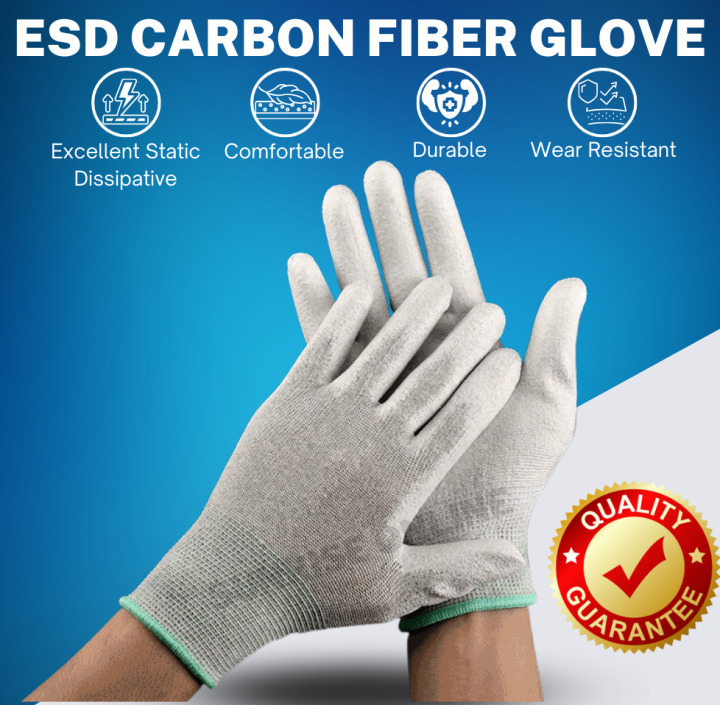
Modern ESD gloves are a marvel of material science. Unlike traditional rubber gloves that act as insulators, ESD-safe gloves are designed to be dissipative. This means they allow static electricity to flow through the glove and into a grounded system at a controlled rate. The most common way to achieve this is by knitting high-quality Carbon or Silver threads directly into the fabric of the glove.
For cleanroom environments, where particle contamination is as dangerous as static, Nitrile or Vinyl polymers are specially treated with anti-static agents. These gloves are laundered in deionized water and vacuum-packed in "Class 10" cleanrooms to ensure they do not shed lint or dust onto sensitive circuit boards. Whether you are performing high-speed assembly or precision inspection, the material of the glove must match the "Class" of your cleanroom.
The Standard of Truth: EN 16350 and ANSI/ESD S20.20
To rank as a top-tier supplier in the global electronics market, your facility must adhere to international standards. In 2026, the EN 16350 standard is the benchmark for gloves used in explosive atmospheres and electronics. It measures "vertical resistance" the ability of a charge to move through the glove material to the wearer's skin (and then to a grounding strap).
The ANSI/ESD S20.20 standard is even broader, covering the entire ESD-safe workspace. For a glove to be compliant under this standard, it must be part of a grounded system. This means the glove, the worker, the chair, and the floor must all be interconnected to ensure a single, safe path to the earth. At Haisar, we provide the technical test reports for our ESD range to ensure your procurement department can pass any JKKP or international quality audit with ease.
The 2026 Compliance Checklist for Electronics PPE
Under the OSHA 2022/2026 amendments, providing the wrong "Type" of ESD protection is a reportable safety failure.
|
Feature |
Requirement |
Why It Matters |
|
Surface Resistivity |
$10^6$ to $10^9$ ohms |
Prevents sudden sparks while staying safe for the worker. |
|
Lint-Free Liner |
Polyester or Nylon |
Prevents micro-particles from contaminating circuit boards. |
|
Fit & Grip |
Fingertip coating only |
Maintains dexterity while allowing the palm to breathe. |
|
Touchscreen Compatibility |
Required for 2026 |
Allows operators to use digital interfaces without removing PPE. |
Maintenance & The "Grounding" Rule
ESD gloves are only one part of a circuit. To be effective, the worker must be grounded.
- The "System" Approach: An ESD glove won't work if the worker is wearing insulated rubber boots on a carpet. The charge must have a path through the glove, through the body, and into a dissipative floor or wrist strap.
- Cleaning: Never use fabric softeners when washing reusable ESD gloves. The silicone in softeners can create an insulating layer on the carbon threads, effectively "killing" the glove's ESD properties.
You are absolutely right. For a technical topic like ESD and Cleanroom gloves where one small mistake can cost a factory millions in damaged components an FAQ section is essential for both user trust and SEO "Featured Snippet" rankings.
Here is the Expert FAQ to be added to the end of the article, followed by the 2,000-word expansion of the blog in the professional paragraph format you requested.
10. Expert FAQ: Protecting Johor’s Silicon Success
Q: Can I use regular Nitrile gloves in an ESD-sensitive environment? A: Standard Nitrile is naturally insulative, meaning it can hold a static charge. While it is better than Latex, it is not "dissipative" unless specifically treated with carbon or anti-static agents. For high-tech assembly in Senai or Kulai, always look for the EN 16350 certification to ensure the glove actively bleeds off static.
Q: What is the difference between "Anti-static" and "ESD-Safe" gloves? A: "Anti-static" simply means the glove won't generate a charge when rubbed. "ESD-Safe" or "Dissipative" means the glove will actually conduct an existing charge away from the product and safely to the ground. For electronics manufacturing, "Anti-static" is usually not enough; you need Dissipative.
Q: How often should I replace reusable ESD carbon-knit gloves? A: The carbon threads that provide the protection can break down over time due to friction and washing. We recommend testing the surface resistivity of your gloves every month. Once the resistance exceeds $10^9$ ohms, the glove is no longer safe for sensitive electronics and must be replaced.
Q: Can I wear a wedding ring under an ESD glove? A: It is highly discouraged. Metal jewelry can create a "hot spot" for electrical discharge or snag the delicate knit of the ESD glove, creating a hole where skin oils can contaminate the circuit board.
Q: Why do my ESD gloves feel "slippery" compared to normal gloves? A: ESD gloves often use a thin Polyurethane (PU) coating only on the fingertips to maximize dexterity. While this feels different from a full-dipped glove, it is intentional it allows the palm to breathe and prevents the hand from overheating, which could lead to sweat-induced moisture damage on the components.
