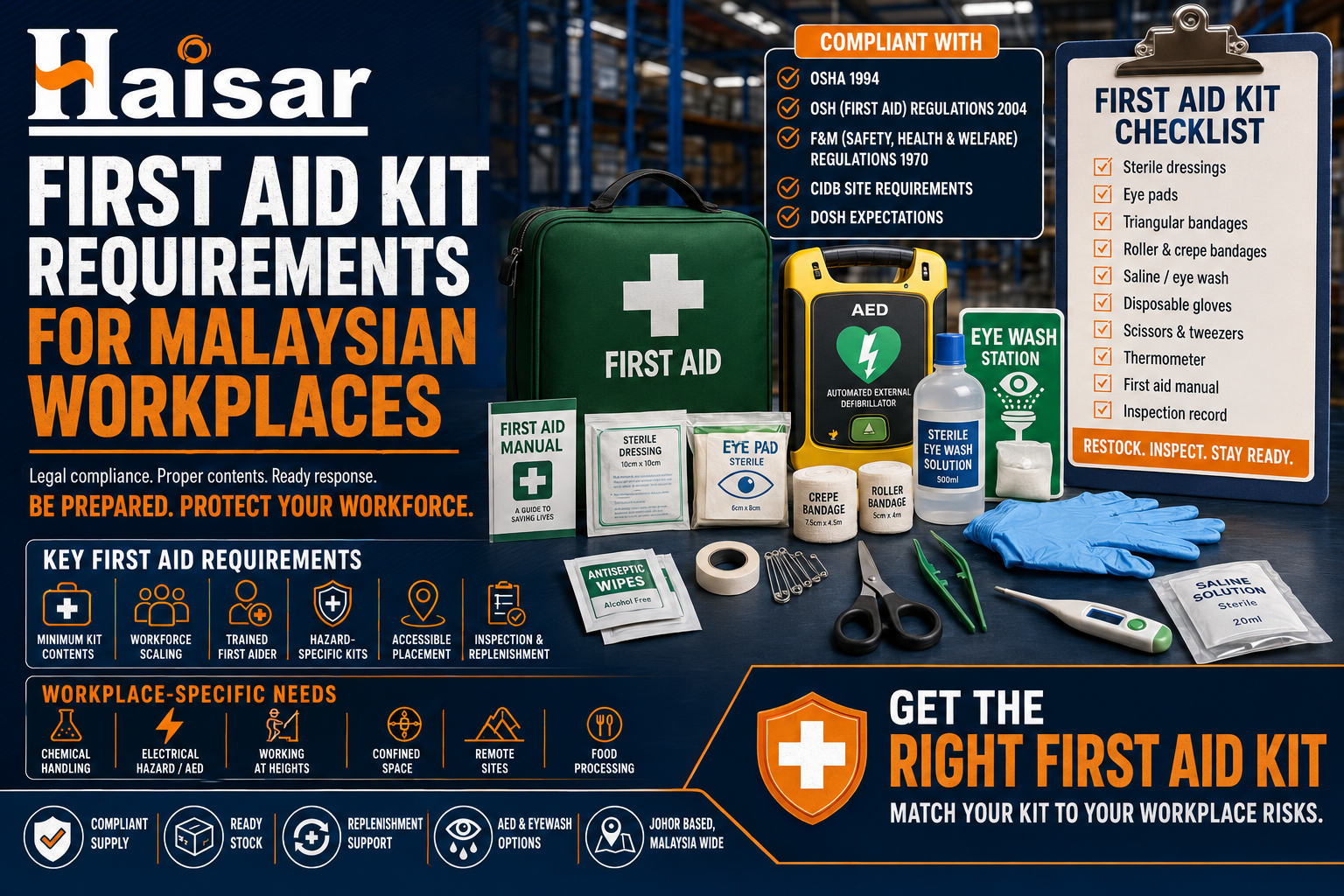
First aid kits are the most universally present piece of safety equipment in Malaysian workplaces and, paradoxically, among the most frequently non-compliant. A first aid kit that is present on site but stocked with the wrong contents, that has not been replenished after use, or that workers do not know how to locate does not meet the legal requirement and does not provide the protection it is intended to deliver.
Malaysian law is unambiguous about the first aid obligation. The Factories and Machinery (Safety, Health and Welfare) Regulations 1970, the Occupational Safety and Health Act 1994, and the specific minimum contents requirements prescribed in subsidiary regulations all impose documented obligations on employers. Compliance requires more than purchasing a kit and placing it on a shelf. It requires the right kit for the workforce size, the correct contents for the hazard environment, a trained first aider on site, and a maintenance process that keeps the kit stocked and ready at all times.
This guide covers the legal requirements for first aid kits in Malaysian workplaces, the minimum contents mandated by regulation, how to scale first aid provision to your workforce size and hazard environment, and where to source compliant first aid equipment in Malaysia.
The Legal Framework for Workplace First Aid in Malaysia
Factories and Machinery (Safety, Health and Welfare) Regulations 1970. These regulations set the primary legal requirements for first aid provision in factory and industrial workplaces in Malaysia. Regulation 23 requires that every factory must be equipped with a first aid box or cupboard containing the prescribed first aid materials. The number of boxes required scales with the number of workers on site.
Occupational Safety and Health Act 1994 (OSHA 1994). Section 15 imposes a general duty on employers to ensure the safety, health, and welfare of employees. First aid provision is explicitly a welfare obligation under this duty. For non-factory workplaces including offices, construction sites, and service environments, OSHA's general duty is the primary legal basis for the first aid requirement.
Occupational Safety and Health (First Aid) Regulations 2004. These regulations establish the requirements for first aid provision across all Malaysian workplaces, including the requirement to appoint a first aider, the training standards for first aiders, and the equipment that must be available. They apply across a broader range of workplaces than the 1970 factory regulations.
Construction Industry Development Board (CIDB) Requirements. Construction sites registered with CIDB must comply with safety requirements including first aid provision. CIDB inspections examine first aid equipment as part of site safety assessments.
DOSH Enforcement. DOSH inspectors examine first aid provision during workplace inspections across all sectors. An inadequately stocked first aid kit, the absence of a trained first aider, or the inability to locate the first aid kit during an inspection are findings that generate compliance notices and contribute to adverse DOSH safety ratings.
Understanding which regulations apply to your specific workplace type is the starting point for building a compliant first aid programme. For most Malaysian industrial and commercial workplaces, the OSH (First Aid) Regulations 2004 and the general duty under OSHA 1994 set the baseline, with the 1970 factory regulations providing additional specificity for factory environments.
Minimum First Aid Kit Contents Under Malaysian Regulations
The Factories and Machinery (Safety, Health and Welfare) Regulations 1970 specify minimum contents for workplace first aid boxes in Malaysia. The following is the prescribed minimum for a first aid box for a workplace with up to fifty workers.
Wound care. Individually wrapped sterile adhesive dressings in assorted sizes, sterile eye pads with bandage attached, triangular bandages, sterile wound dressings in two sizes, and safety pins.
Bandaging and strapping. Roller bandages in multiple widths and crepe bandages for support dressing.
Cleansing. Sterile normal saline solution or sterile water for wound and eye irrigation, antiseptic wipes for wound cleansing.
Protective equipment. Disposable gloves for the first aider to use during treatment, to prevent cross-contamination.
Instruments. Scissors, tweezers or forceps for splinter and foreign body removal, and a clinical thermometer.
Instructions. A first aid manual or guidance card appropriate for the hazard environment.
In addition to these minimum contents, the OSH (First Aid) Regulations 2004 require that the first aid box be clearly marked, readily accessible, and in the charge of a responsible person who holds a current first aid certificate.
The minimum contents prescribed in the 1970 Regulations represent the regulatory floor, not the practical standard for workplaces with significant hazard exposure. Factories, construction sites, and industrial facilities handling chemicals, working at heights, or operating machinery should carry additional contents beyond the regulatory minimum to address the specific injury types their hazard environment can produce.
Scaling First Aid Provision to Workforce Size
The Factories and Machinery Regulations specify the number of first aid boxes required based on the number of workers on site. A single first aid box is required for workplaces with up to fifty workers. An additional box is required for each additional fifty workers or part thereof. A workplace with 120 workers requires three first aid boxes, one for the first fifty, one for the next fifty, and one for the final twenty.
Beyond the number of boxes, the number of trained first aiders required also scales with workforce size. The OSH (First Aid) Regulations 2004 require that at least one trained first aider be present whenever workers are on site. For larger workplaces, the ratio of trained first aiders to workers must be sufficient to ensure a first aider can reach any injured worker within a reasonable time. DOSH guidance suggests a minimum of one trained first aider per fifty workers as a practical standard for most industrial environments.
For multi-shift operations, the first aider requirement applies to every shift, not just the day shift. A workplace that has a trained first aider on the day shift but not on the night shift is non-compliant during night shift operations.
Workplace-Specific First Aid Requirements
The regulatory minimum is not always adequate for the specific hazard environment of every Malaysian workplace. The following guidance covers additional first aid provisions required in specific working environments common across Johor's industrial sectors.
Chemical handling environments. Workplaces where workers handle corrosive chemicals including acids, alkalis, and solvents require specific first aid provisions beyond the standard kit. Emergency eye wash stations providing continuous clean water flow must be within ten seconds of travel from any location where corrosive chemicals are handled. Portable eye wash bottles are an interim provision only and do not substitute for a plumbed or large-volume gravity-fed eye wash station where regular chemical handling occurs. Chemical burns require large-volume irrigation as the immediate first aid response and the kit must include adequate irrigation fluid.
Electrical hazard environments. Workplaces where electric shock is a risk, including manufacturing plants, data centres, oil and gas facilities, and construction sites with live electrical work, should carry an AED (Automated External Defibrillator) and ensure that at least one first aider is trained in its use. Cardiac arrest from ventricular fibrillation following electric shock is a survival-dependent emergency where time to defibrillation is the critical variable. A well-stocked first aid kit without an AED does not address the primary life-threatening outcome of electrical contact.
Working at heights environments. Falls from height produce injury types including fractures, spinal injuries, and head injuries that require specific first aid responses. First aid kits for construction sites and industrial facilities with working at heights operations should include a cervical collar for spinal precautions, additional dressing materials for larger wound areas, and a trauma dressing or haemostatic gauze for severe bleeding control.
Confined space operations. Confined space rescue casualties may present with asphyxiation, toxic gas exposure, or traumatic injuries depending on the incident type. First aid provision for confined space operations should include oxygen administration equipment where available, resuscitation pocket masks for CPR, and the ability to manage a recumbent casualty until ambulance arrival. Ensure first aiders assigned to confined space operations are trained in oxygen administration and confined space first aid.
Remote and rural project sites. Project sites in remote areas of Johor and across Malaysia where emergency ambulance response time may exceed twenty to thirty minutes require enhanced first aid provision including a broader trauma kit, oxygen administration, IV fluid capability where first aiders are appropriately trained, and communication equipment for coordinating emergency services to the site location. A standard workplace first aid kit is not adequate first aid provision for a remote site with extended emergency service response times.
Food processing and manufacturing. These environments require additional provision for heat-related illness including oral rehydration sachets, cooling equipment, and first aid guidance specific to heat exhaustion and heatstroke, which are genuine risks in Malaysian food processing and manufacturing environments.
First Aid Box Placement and Management
A compliant first aid kit in the correct location with the correct contents is non-compliant if workers cannot find it when it is needed. Placement and management are as important as the kit contents themselves.
Placement. First aid boxes must be in accessible locations throughout the workplace. For large facilities, the maximum travel time from any work location to the nearest first aid kit should be considered when positioning kits. DOSH guidance and practical best practice suggests that no worker should have to travel more than a minute to reach a first aid kit. For multi-floor buildings and large site areas, this requires multiple kits at distributed locations rather than a single kit in the welfare room.
Signage. First aid kit locations must be marked with compliant signage visible from the approach to the location. MS ISO 7010 specifies the standard green first aid cross symbol used in Malaysian workplaces. Signage must be illuminated or photoluminescent where lighting may be inadequate during an emergency.
Responsible person. Each first aid box must be assigned to a responsible person who ensures it is adequately stocked at all times. The responsible person checks the kit at regular intervals, replaces used or expired items, and ensures the kit is secured against casual use while remaining accessible for genuine emergencies.
Inspection record. A documented inspection record for each first aid kit showing the date of each inspection, the name of the responsible person, and any items replaced provides the evidence that maintenance is being carried out. DOSH inspectors may request this record during workplace inspections.
Expiry management. First aid consumables including sterile dressings, medications where permitted, and saline solutions all carry expiry dates. Expired items must be replaced before they expire, not after the kit is next inspected. Tracking expiry dates for each item in the kit is the responsible person's ongoing obligation.
Choosing a First Aid Kit Supplier in Malaysia
For procurement teams sourcing first aid kits for workplaces and project sites in Malaysia, the following criteria help distinguish a compliant supply from a low-cost catalogue purchase.
Regulatory compliance. First aid kit contents must meet the minimum requirements prescribed in the Factories and Machinery Regulations 1970 and the OSH (First Aid) Regulations 2004 as applicable to the workplace type. A supplier who cannot confirm that their kit contents meet the regulatory requirements is not an adequate source of workplace first aid equipment.
Hazard-specific configurations. A standard office first aid kit is not appropriate for an oil and gas facility, a chemical handling environment, or a construction site. A good first aid supplier should offer configurations tailored to specific hazard environments or be able to advise on supplementary items for standard kits.
Replenishment capability. First aid kits require regular replenishment of consumed and expired items. A supplier who can provide individual item replenishment as well as complete kit replacements reduces the administrative burden of maintaining compliant kits across a large facility or multi-site programme.
AED supply and support. For workplaces requiring AED provision, your first aid supplier should be able to supply the AED unit, replacement pads and batteries, and the wall-mounted cabinet or stand required for compliant installation.
Haisar Supply and Services: First Aid Kit Supplier in Malaysia
Haisar Supply and Services supplies first aid kits, AED units, eye wash stations, and emergency response equipment for workplaces and project sites across Johor and peninsular Malaysia. Our first aid product range covers standard workplace first aid kits configured to Malaysian regulatory requirements, site first aid kits for construction and industrial environments, chemical handling first aid provision including eye wash stations and burn treatment kits, AED units with wall mounting and cabinet options, and individual item replenishment for ongoing kit maintenance programmes.
We work with HSE managers and facility operators to ensure first aid provision matches the hazard profile of the workplace, not just the minimum regulatory requirement.
Browse First Aid and Emergency Products at haisar.com
Contact our team for specifications and pricing for first aid kits and emergency response equipment for your workplace or project site in Johor and across Malaysia.
Haisar Supply and Services Sdn Bhd (985158-T) | Kulai, Johor, Malaysia | www.haisar.com