Can't find what you're looking for? Get in touch!



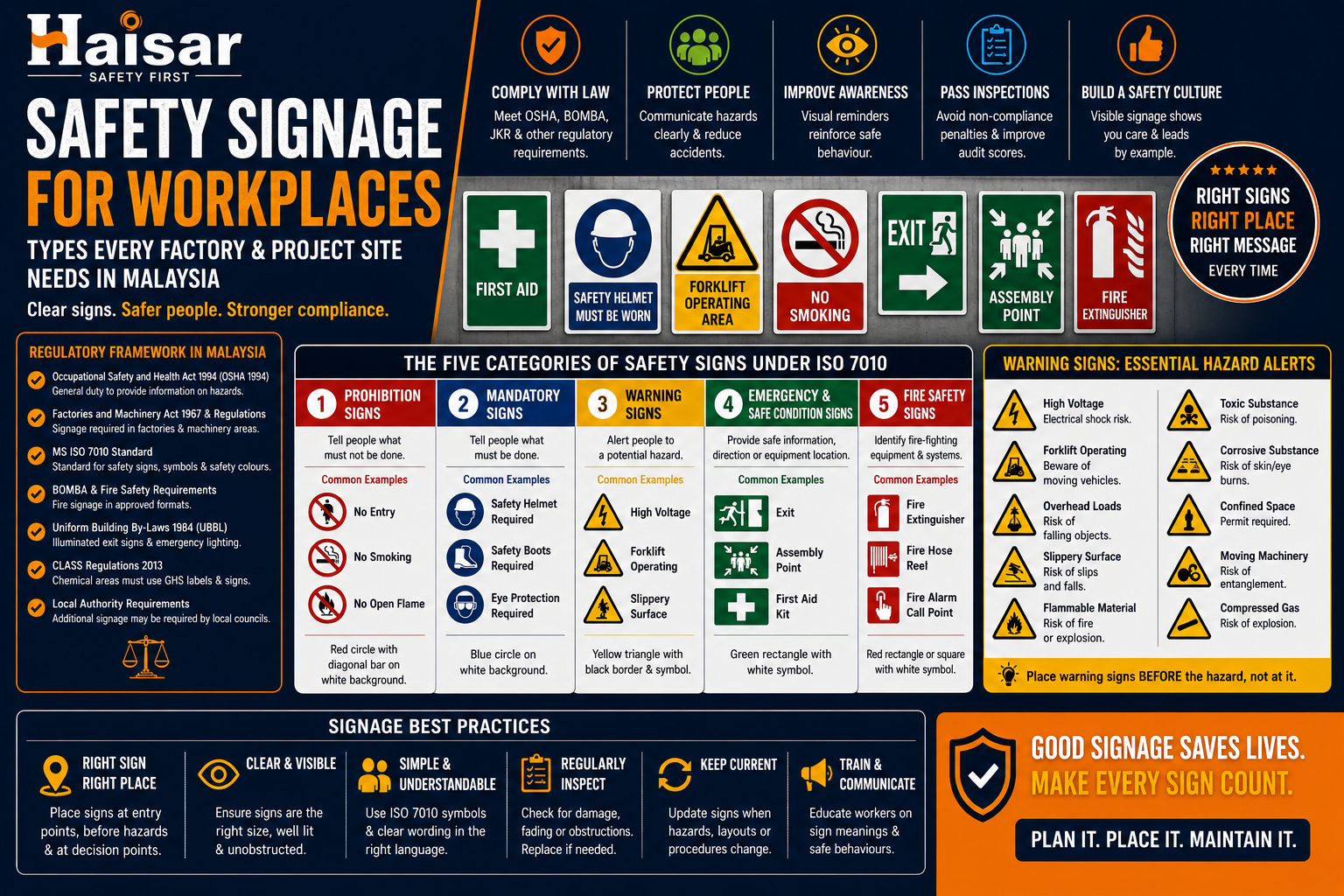
Safety signage is the silent safety system that runs continuously in the background of every compliant Malaysian workplace. When a worker approaches a confined space entry point, a sign tells them to stop and check the permit. When a visitor walks toward the active forklift zone, a sign warns them before they enter. When a fire breaks out at two in the morning and the building is unfamiliar to the night shift team, illuminated exit signs guide them to safety.
When the signage is correct, current, and in the right locations, it works without anyone noticing. When it is missing, faded, incorrect, or in the wrong language for the workforce, the consequences range from compliance failures during DOSH and BOMBA inspections to workers entering hazardous areas without the information they needed to protect themselves.
This guide covers every category of safety signage required in Malaysian factories and project sites, the regulatory standards that govern them, and a practical checklist for site managers and HSE officers to verify that their signage programme is complete.
The Regulatory Framework for Safety Signage in Malaysia
Occupational Safety and Health Act 1994 (OSHA 1994). The general duty under Section 15 requires employers to provide adequate information about hazards in the workplace. Safety signage is a primary means of communicating hazard information and the OSH Act underpins the signage obligation for all Malaysian workplaces.
Factories and Machinery Act 1967 and Regulations. The Act and subsidiary regulations specify signage requirements for factory environments including hazardous machine guarding signs, electrical warning signs, and chemical storage identification. DOSH inspectors examining factory premises check signage as part of the standard inspection protocol.
MS ISO 7010. The Malaysian Standard adopting the international ISO 7010 standard for graphical symbols, safety colours, and safety signs. ISO 7010 is the definitive reference for sign formats in Malaysia and specifies the exact symbols, colours, and shapes that must be used for each safety sign category. Signs that deviate from ISO 7010 formats may not be acceptable to DOSH inspectors and may not be understood by a multilingual workforce.
BOMBA and fire safety requirements. BOMBA specifies the signage required for fire safety compliance including fire exit signs, fire extinguisher location signs, fire assembly point signs, and fire safety instruction notices. These must be in BOMBA-approved formats where specific formats are prescribed.
Uniform Building By-Laws 1984 (UBBL 1984). The UBBLs specify emergency exit signage and emergency lighting requirements for buildings. Exit signs must be illuminated and must be visible from the approach to each fire exit.
Occupational Safety and Health (Classification, Labelling and Safety Data Sheet of Hazardous Chemicals) Regulations 2013 (CLASS Regulations). Chemical storage areas must be labelled with GHS hazard pictograms and associated hazard communication information.
Local authority requirements. Local authorities in Johor including MPJOHOR and MBJB may impose additional signage requirements as conditions of premises approvals and occupancy permits.
The Five Categories of Safety Signs Under ISO 7010
ISO 7010 organises safety signs into five categories, each with a distinctive colour and shape combination. Understanding the category system is the foundation of a compliant and visually coherent signage programme.
Prohibition Signs — Red circle with diagonal bar on white background. Prohibition signs tell people what they must not do. The red colour and circle-with-bar symbol universally communicates "not permitted" regardless of language. Common prohibition signs in Malaysian workplaces include No Entry, No Smoking, No Mobile Phones in Hazardous Areas, No Unauthorised Entry, and No Open Flame. Prohibition signs must be posted at the point where the prohibited action might otherwise occur.
Mandatory Signs — Blue circle on white background. Mandatory signs tell people what they must do. Blue communicates a positive requirement. Common mandatory signs include Safety Helmet Required, Safety Boots Required, High Visibility Vest Required, Eye Protection Required, Hearing Protection Required, and Hand Protection Required. These signs must be posted at every entry point to the area where the mandatory PPE is required.
Warning Signs — Yellow or amber triangle with black border and symbol. Warning signs alert people to a hazard. The yellow triangle is the universal visual language for caution and danger. Common warning signs for Malaysian workplaces include Caution Forklift Operating, High Voltage, Slippery Surface, Overhead Loads, Flammable Material, Toxic Substance, Corrosive Substance, and Moving Machinery. Warning signs must be placed before the hazard, not at it.
Emergency and Safe Condition Signs — Green rectangle with white symbol. Green signs indicate safe conditions, emergency routes, and the location of safety equipment. They communicate reassurance and positive direction rather than hazard. Common green signs include Exit, Emergency Exit, Fire Exit Direction Arrow, Assembly Point, First Aid Kit Location, Emergency Eye Wash, and AED Location. Green exit signs above fire exit doors and at every change of direction along the escape route are a BOMBA and UBBL requirement.
Fire Safety Signs — Red rectangle or square with white symbol. Fire safety signs identify fire-fighting equipment and fire safety systems. Common fire safety signs include Fire Extinguisher, Fire Hose Reel, Fire Alarm Call Point, and Sprinkler Valve. These signs must be in BOMBA-approved formats where prescribed.
Warning Signs: What Every Malaysian Workplace Needs
Warning signs are the most task-specific category. The hazards in a petrochemical facility are different from those in a garment factory, but certain warning signs appear across virtually every industrial and construction workplace in Malaysia.
Electrical hazards. High Voltage warning signs at all electrical switchboards, distribution boards, motor control centres, and exposed electrical infrastructure. Electrical Arc Flash Hazard warning signs at locations where arc flash risk is present, specifying the incident energy and required PPE where an arc flash study has been conducted. Do Not Isolate signs at equipment subject to specific LOTO procedures.
Mechanical and moving equipment hazards. Moving Parts warning signs at machine guarding interfaces. Crush Hazard and Pinch Point warning signs at press tools, conveyors, and equipment with accessible nip points. Forklift Operating warning signs at all pedestrian entry points to vehicle operation zones.
Overhead hazards. Overhead Load warning signs in crane and hoist operating areas. Falling Objects warning signs at the perimeter of elevated work areas. Hard Hat Required mandatory signs in the same locations.
Slip and trip hazards. Wet Floor warning signs for use during cleaning operations and in areas prone to water contamination. Uneven Surface and Watch Your Step signs at floor transitions, ramps, and threshold hazards.
Chemical hazards. Flammable Substances warning signs in chemical storage and handling areas. Toxic or Corrosive warning signs matched to the specific hazard class of the chemicals stored, consistent with GHS classification. Hazardous Area Do Not Enter signs for classified zones on oil and gas and petrochemical sites.
Biological and environmental hazards. Biohazard warning signs for medical, laboratory, and waste management facilities. Radiation warning signs for facilities with radiological equipment or radioactive material storage.
Mandatory Signs: PPE Requirements by Zone
Mandatory signage communicates PPE requirements to workers and visitors entering specific areas of the workplace. Every zone with a PPE requirement must have the relevant mandatory signs posted at every entry point.
A standard industrial facility in Johor requires mandatory signs across the following zones as a minimum.
The main production and factory floor requires Safety Helmet Required, Safety Boots Required, and High Visibility Vest Required signs at every entrance from the office, welfare, and access areas.
Grinding, cutting, and fabrication areas require Eye Protection Required and Hearing Protection Required signs in addition to the general floor requirements.
Chemical handling and storage areas require Hand Protection Required, Eye Protection Required, and Respiratory Protection Required signs with the specific PPE type indicated in supplementary text where the respiratory hazard requires a specific cartridge type.
Electrical switchroom and battery room areas require Authorised Personnel Only as a restriction alongside electrical safety PPE requirement signs.
Confined space entry points require Confined Space Permit Required and Do Not Enter Without Permit signs as mandatory notices at every access point.
Noise-controlled areas require Hearing Protection Required with the noise level indicated where available to allow workers to verify they are using adequate attenuation.
Emergency and Evacuation Signage
Emergency signage is the category with the most direct link to life safety outcomes. In a fire or emergency, correctly placed, illuminated, and maintained emergency signage guides building occupants to safety. Missing or non-illuminated emergency signage can contribute to fatalities.
Fire exit signs above every fire exit door in the building. Signs must be illuminated by internal lamp or by photoluminescent material charged by adequate ambient lighting. BOMBA requires illuminated exit signs.
Directional exit signs at every change of direction along the escape route from all areas of the building to the nearest fire exit. Where the escape route branches, a directional sign at each branch indicates the direction to the nearest exit.
Assembly point signs at the designated assembly point location and at the exits leading toward it. Workers must be able to identify the assembly point location from the signs without prior knowledge of the facility layout.
First aid signs. First Aid Kit location signs at every first aid kit position throughout the facility. First Aider signs identifying the designated first aider for the area or shift.
AED location signs at all AED installation positions with directional signs pointing to the nearest AED from key locations throughout larger facilities.
Emergency eye wash and shower signs at all eye wash station and emergency shower positions.
Muster point and emergency contact signs combining assembly point information with emergency telephone numbers displayed at key locations throughout the facility.
Photoluminescent versus LED illuminated signs. Photoluminescent signs glow in the dark after being charged by ambient light. They are appropriate for environments with adequate ambient lighting during normal operations. For environments with variable or low ambient lighting, LED-illuminated signs that remain lit during power failure from battery backup are the more reliable choice. BOMBA requirements for fire exit signs typically require illumination rather than purely photoluminescent signs.
Fire Safety Signage
Fire safety signs identify the location of fire-fighting equipment and fire safety systems. BOMBA inspectors check fire safety signage as part of the annual fire certificate inspection. Missing or incorrectly positioned fire safety signs are a common inspection finding.
Fire extinguisher location signs above every fire extinguisher position, clearly visible from the approach to the extinguisher. Where extinguishers are positioned in recesses or behind equipment, directional signs pointing to the extinguisher position are required.
Fire extinguisher type identification. In facilities with multiple extinguisher types, signage identifying the class of fire each extinguisher is rated for helps workers select the correct extinguisher in an emergency. CO2 extinguishers must not be used on flammable liquid fires. Dry powder extinguishers must not be used in server rooms and electrical equipment areas where residue contamination would cause secondary damage.
Fire hose reel signs at each fire hose reel position. Hose reel signs must include the operating instructions where space permits.
Fire alarm call point signs at each manual call point position. Where the call point is not immediately visible from the approach, directional signs are required.
Sprinkler control valve room signs at the entrance to the sprinkler control valve room and on the valve itself.
Fire action notices posted at key locations throughout the facility, summarising the action to take on discovering a fire and on hearing the fire alarm. BOMBA requires fire action notices in the prescribed format.
Chemical and GHS Signage
For workplaces storing or handling hazardous chemicals, the CLASS Regulations 2013 require GHS-compliant chemical identification signage throughout storage and handling areas.
GHS hazard pictograms on all chemical storage areas, clearly indicating the hazard class of the stored chemicals. The nine GHS pictograms cover flammable, oxidising, corrosive, toxic, harmful, environmental hazard, gas under pressure, explosive, and health hazard categories.
COSHH and USECHH hazard communication signs indicating the health risk assessment requirements, PPE requirements, and emergency procedures for the chemical hazards present in the area.
Secondary container labelling. Under the CLASS Regulations, chemicals transferred from original containers to secondary containers must have GHS-compliant labels on the secondary container. Pre-printed GHS label sheets or direct-print label systems allow this requirement to be met efficiently in facilities with high chemical transfer volumes.
Flammable storage signs. BOMBA requires specific signage on flammable liquid storage rooms and cabinets including the No Smoking, No Open Flame prohibition signs and the Flammable warning sign.
Multilingual Signage for Malaysian Workplaces
The Malaysian industrial workforce is diverse. Project sites and factories in Johor regularly employ workers from multiple nationalities, including Malaysian workers from different ethnic and linguistic backgrounds, Indonesian workers, Bangladeshi workers, and workers from other countries. ISO 7010 graphical symbols are designed to communicate across language barriers, which is why the international symbol format is the required standard rather than text-only signs.
However, for complex safety messages, permit requirements, and emergency procedures that cannot be fully communicated by a symbol alone, multilingual signage in Bahasa Malaysia, English, and where appropriate Bahasa Indonesia or Bengali, ensures that the safety message reaches every worker on site.
The practical approach. Use ISO 7010 compliant symbols as the primary communication on all standard safety signs. Add bilingual or multilingual text in supplementary panels below the symbol where complex instructions need to be communicated. For emergency action notices and evacuation procedures, produce multilingual versions and display them at the key locations throughout the facility.
Haisar Supply and Services produces custom multilingual safety signage for project sites and facilities across Johor and Malaysia. Our signage production capability covers standard ISO 7010 signs, custom-format signs for specific facility requirements, and multilingual versions in the languages relevant to the workforce composition.
The Safety Signage Checklist
Use this checklist for new site sign-off, periodic safety audits, and BOMBA or DOSH inspection preparation.
Prohibition signs present and correctly positioned. No entry, no smoking, and other relevant prohibitions posted at every point where the prohibited action could occur.
Mandatory PPE signs at all zone entry points. Every area with a PPE requirement has the relevant mandatory signs at every entry point from adjacent areas.
Warning signs before the hazard. Every significant hazard has the appropriate warning sign positioned before the hazard, not at it.
Emergency exit signs above all fire exits. All signs illuminated and legible. No sign obscured by equipment, storage, or decoration.
Directional exit signs at every change of direction. Every escape route has directional signs guiding to the nearest exit at every branch and turn.
Assembly point clearly signed. Assembly point sign visible from all exits leading toward it.
First aid, AED, and emergency equipment locations signed. Every first aid kit, AED, and emergency eye wash station has a location sign. Directional signs to nearest AED from key locations.
Fire extinguisher location signs above all extinguishers. All signs current, legible, and visible from the approach.
Fire action notices at required locations. BOMBA-format fire action notices at the required locations throughout the facility.
GHS hazard pictograms on all chemical storage areas. All chemical storage labelled per CLASS Regulations 2013.
Confined space entry signs at all access points. Permit Required and Do Not Enter signs at every confined space access.
Signage in good physical condition. No faded, damaged, or obscured signs. All photoluminescent signs adequately charged. All illuminated signs functional.
Multilingual signs where required. Complex safety messages in languages appropriate for the workforce composition.
Haisar Supply and Services: Safety Signage Supplier in Malaysia
Haisar Supply and Services supplies the complete range of safety signage for factories, construction sites, industrial facilities, and logistics operations across Johor and peninsular Malaysia. Our signage range covers the full ISO 7010 suite of prohibition, mandatory, warning, emergency, and fire safety signs in standard and custom sizes, GHS chemical hazard signs and labels, custom-format facility-specific signs, multilingual signage in Bahasa Malaysia, English, and other languages, outdoor-rated signs in UV-stable materials for Malaysian climate conditions, and illuminated and photoluminescent emergency exit signs.
We produce custom signs for specific facility requirements including confined space entry signs, arc flash warning labels, LOTO station identification signs, and project-specific safety message boards.
Request a Quotation for Safety Signage
Contact our team with your facility type, the sign categories required, and any custom sign requirements and we will respond with product options and pricing for your signage programme in Johor and across Malaysia.
Browse Safety Signage and Project Supply Products at haisar.com
Haisar Supply and Services Sdn Bhd (985158-T) | Kulai, Johor, Malaysia | www.haisar.com
