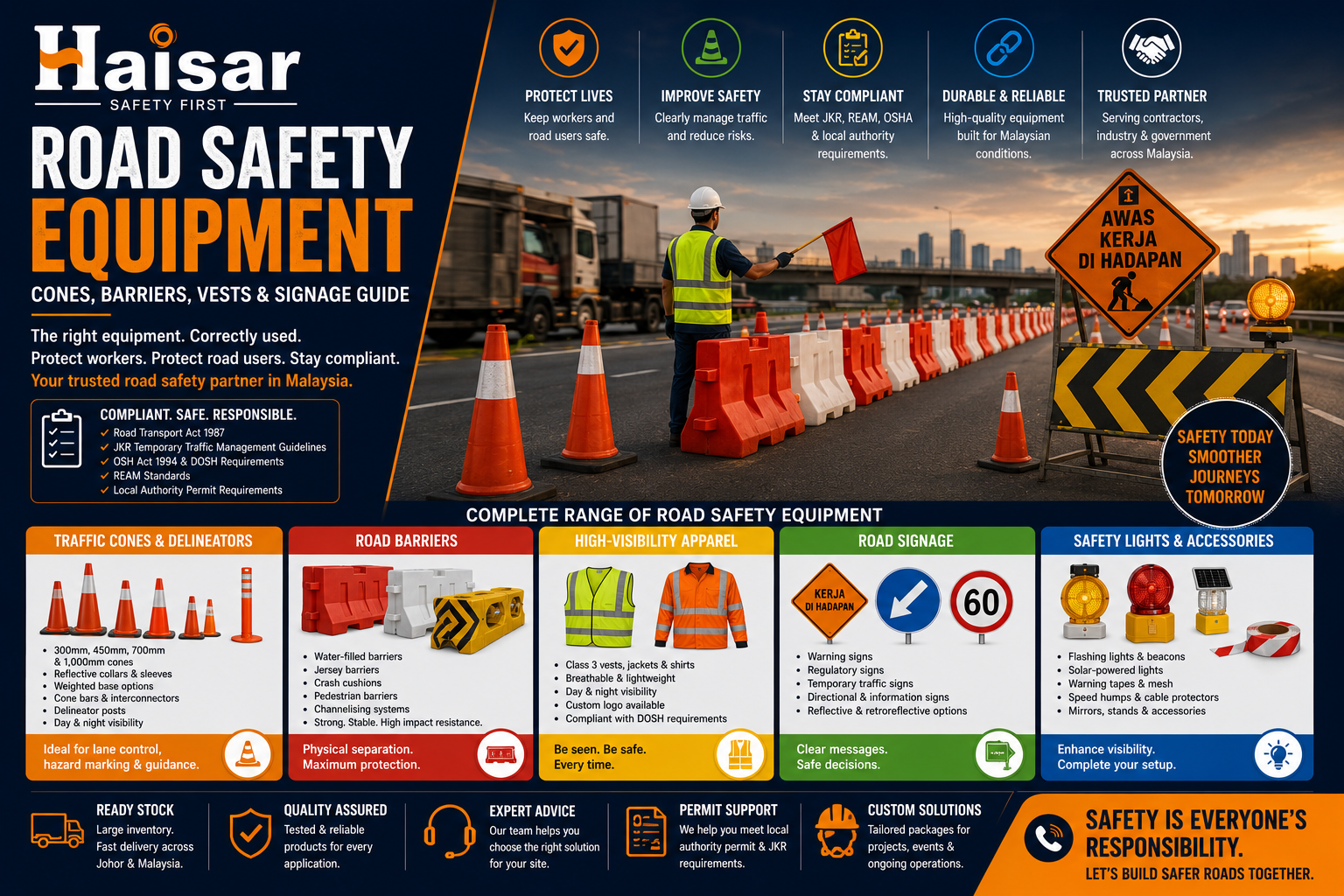
Every day across Malaysia, road safety equipment is deployed on hundreds of sites simultaneously. A highway contractor in Johor setting up a lane closure for overnight resurfacing. A utility company in Iskandar Puteri excavating a footpath to lay new infrastructure. A property developer managing traffic around a new building entrance in Johor Bahru. A logistics park in Kulai marking out a new loading bay layout. An event management company setting up crowd control for a weekend event at a commercial centre in Skudai.

Each of these scenarios requires specific road safety equipment configured correctly for the hazard, the vehicle speeds involved, and the regulatory requirements that apply. Getting it right protects workers, protects the public, and keeps the organisation compliant with Malaysian road authority requirements. Getting it wrong puts workers in the path of moving vehicles and exposes organisations to enforcement action and liability.

This guide covers the full range of road safety equipment available in Malaysia, what each product does, how to select the right product for the application, and where to source compliant road safety equipment for projects across Johor and the peninsula.

 WhatsApp us for a quick quote 

The Regulatory Framework for Road Safety Equipment in Malaysia

Road Transport Act 1987. The primary legislation governing road use in Malaysia. Temporary traffic management on public roads, including lane closures, contraflow arrangements, and road works zones, must be implemented in accordance with the requirements of the Road Transport Act and the guidelines issued by Jabatan Kerja Raya (JKR) and the relevant state public works departments.

JKR Guidelines for Temporary Traffic Management. JKR issues technical guidelines covering the specification and deployment of temporary traffic management equipment on Malaysian public roads. These guidelines specify the types of equipment required for different road works scenarios, the placement distances and sequences for warning and guidance devices, and the signing requirements for different road classifications.

REAM (Road Engineering Association of Malaysia) Standards. REAM publishes technical references for road works safety that supplement JKR guidelines, covering signing, delineation, and temporary traffic management on Malaysian roads.

OSHA 1994 and DOSH requirements. Workers involved in road works operations are covered by OSHA's general duty requirements. Personal protective equipment including Class 3 high-visibility garments, safety helmets, and appropriate safety footwear is required for all workers in road works zones.

Local authority requirements. Road works and temporary traffic management on roads under the jurisdiction of local authorities including MPJOHOR, MBJB, and other local councils in Johor require permits and must comply with the conditions imposed by the local authority as part of the permit.

For off-road applications including logistics parks, private industrial roads, construction site internal roads, and private property, JKR and road authority requirements do not apply directly. However, the design principles for vehicle and pedestrian separation, warning distance, and delineation that apply on public roads are also best practice for private road and site traffic management.

Traffic Cones and Delineators

Traffic cones are the most versatile and most widely used road safety delineation device in Malaysia. They are the first line of traffic management deployed at any temporary hazard on a road or site.

Standard orange traffic cones in 300mm, 450mm, 700mm, and 1,000mm heights are used for lane delineation, hazard marking, parking control, and event crowd management. The height selected should match the speed and scale of the traffic environment. On high-speed roads and major highways in Johor, 700mm or 1,000mm cones are required for adequate visibility to approaching drivers. Shorter cones are appropriate for low-speed environments including car parks, site access roads, and pedestrian areas.

Reflective collars and sleeves on cones provide retroreflective visibility to approaching vehicle headlights during night works and low-light conditions. Cones without reflective elements are not adequate for night-time road works on public roads. JKR guidelines specify retroreflective requirements for temporary traffic management devices on Malaysian public roads.

Weighted base cones resist wind and vehicle wash from passing traffic. On Malaysian highways and arterial roads with high traffic volumes and vehicle speeds, lightweight cones without weighted bases are displaced by passing vehicles, compromising the delineation.

Cone bars and interconnectors link cones into a continuous delineation line, increasing the visual impression of the barrier and reducing the likelihood of vehicles crossing the delineation. Used in lane narrowing, taper runs, and separation of opposing traffic streams.

Traffic delineators and channelling devices for more permanent temporary marking. Delineator posts with retroreflective panels provide a more robust delineation than cones for extended-duration works where the equipment must remain in place across multiple shifts or days.

Application examples for Johor. Highway resurfacing works on the North-South Expressway require 1,000mm reflective cones at specified spacing for the taper and transition zones. Utility works on Johor Bahru city roads use 700mm cones for lane delineation. Logistics park internal road modifications and parking layout changes use standard 300mm to 450mm cones for low-speed delineation.

Road Barriers and Separation Systems

Barriers provide physical separation between the work zone and live traffic, or between vehicle and pedestrian areas. Unlike cones and delineators, which guide and channel, barriers physically prevent vehicle intrusion into the protected zone.

Water-filled plastic barriers (Jersey-type) are the standard portable barrier system for road works in Malaysia. They are filled with water on site, providing a high mass-to-volume ratio that resists vehicle impact. They interlock end to end to create a continuous barrier run and are available in standard lengths of one metre and two metres. Water-filled barriers are specified for any works on high-speed roads where vehicle intrusion into the work zone would have fatal consequences.

For works on lower-speed roads and in site environments, lighter plastic barriers filled with sand or water provide separation without the complexity of full-weight jersey barrier deployment.

Concrete barriers for permanent or semi-permanent separation on highway construction projects, elevated structures, and locations where the duration of works justifies the additional cost of concrete over plastic. Concrete barriers provide the highest level of vehicle impact resistance and are the standard separation device for long-duration highway works in Malaysia.

Modular plastic barriers for event management and pedestrian control. Crowd control barriers in galvanised steel or heavy plastic are used for event perimeter management, queue management at commercial venues, and pedestrian separation at public events. Interlocking designs allow rapid configuration and reconfiguration.

Flood barriers and temporary flood defence. In Johor's low-lying areas prone to monsoonal flooding, deployable flood barriers provide temporary flood protection for logistics facilities, site stores, and critical infrastructure. Sand-free alternatives to traditional sandbags using water-activated expanding barriers are available for rapid deployment.

Application examples for Johor. Major road works on the Tebrau Highway and Pasir Gudang Highway use water-filled jersey barriers for lane separation and work zone protection. Data centre construction sites in Iskandar Puteri use plastic barriers for controlled vehicle access to the site. Events at Johor Premium Outlets and commercial developments in Johor Bahru use crowd control barriers for visitor management.

High-Visibility Workwear for Road Works

Workers on road works sites in Malaysia face the highest vehicle proximity hazard of any outdoor working environment. High-visibility workwear for road works must meet a higher standard than for general site use.

Class 3 high-visibility garments are mandatory for all workers on public road works sites in Malaysia. Class 3 provides the greatest retroreflective tape area and requires sleeve coverage in addition to the body panel coverage of Class 2. Class 2 vests are not adequate for workers in live traffic environments.

MS ISO 20471 compliance for all hi-vis garments used on road works. The retroreflective tape must meet the standard's minimum area and placement requirements. Faded, damaged, or low-quality tape that does not maintain retroreflectivity does not provide the protection the standard requires.

Fluorescent orange-red is the traditional and most commonly used colour for road safety workers in Malaysia. It provides strong contrast against grey road surfaces and concrete backgrounds.

All-weather hi-vis garments for the Malaysian wet season. Standard mesh vests become ineffective in heavy rain because the transparent vest with wet retroreflective tape provides significantly reduced visibility. Hi-vis waterproof jackets with sealed reflective tape maintain visibility in wet conditions.

Traffic controllers and flaggers require the highest-specification hi-vis garments because they stand at the boundary between live traffic and the work zone. Full Class 3 hi-vis jackets or coveralls, not vests, are the appropriate specification for traffic controllers.

Traffic Signs and Signage Systems

Temporary traffic signs warn road users of the hazard ahead, indicate the speed and lane restrictions in force, and guide road users through the temporary traffic management arrangement.

Temporary road works signs following Malaysian road sign standards (ARAHAN TEKNIK JALAN) for warning, regulatory, and guidance signs applicable to road works. Common signs for Malaysian road works include road works ahead warning signs, lane closure signs, speed reduction signs, and keep left or right guidance signs. Sign dimensions and retroreflective sheeting specifications must comply with JKR requirements for the road classification.

Variable message signs (VMS) and portable changeable message signs for highway works where the traffic management arrangement changes between day and night configurations, or where real-time traffic information needs to be communicated to approaching drivers.

Temporary speed limit signs for enforcing reduced speed limits in works zones. Speed limit signs must be removed or covered immediately when the works are not in progress. A reduced speed limit sign in place when no works are active is a road safety hazard because drivers who encounter speed enforcement after a period of non-enforcement of the limit lose confidence in the sign.

Arrow boards and directional signs for lane merges, contraflow arrangements, and complex traffic management layouts where the standard sign sequence alone may not adequately communicate the required driver action.

Portable sign stands and mounts that hold temporary signs at the correct height and position without requiring fixed mounting. Weighted bases prevent sign displacement in wind from passing vehicles.

Road Marking and Delineation

Temporary road markings supplement signs and delineation devices to communicate lane positions, give-way arrangements, and pedestrian crossing points in temporary traffic management schemes.

Temporary road marking tape for creating temporary lane lines, stop lines, and pedestrian crossing markings that can be removed cleanly at the end of the works without damaging the permanent road surface. Available in standard yellow and white for Malaysian road marking conventions.

Road studs and cats eyes for temporary delineation of lane boundaries, particularly on night works where retroreflective road studs provide positive delineation even when the road surface has been disturbed by works.

Line marking spray paint for temporary markings on construction site internal roads, logistics park layouts, and site access road configurations that require clear lane markings for vehicle management.

Application Examples Across Malaysian Industry

Construction site access management. Large construction sites in Johor including data centre developments, industrial facility construction, and mixed-use developments require temporary traffic management at the site access from the public road. Cones and delineators mark the entry and exit route. Barriers protect the guard post and site office. Temporary signs indicate speed limits and vehicle routing. Hi-vis vests for security and traffic management personnel.

Highway and road works contractors. Resurfacing, maintenance, and upgrade works on Johor's arterial road network require full temporary traffic management packages. Water-filled jersey barriers for work zone separation. 1,000mm reflective cones for taper zones and transition delineation. Class 3 hi-vis for all site workers. Temporary signs for speed reduction and lane guidance.

Utility and service works on public roads. Telecom, utility, and service contractors excavating on or near public roads in Johor require portable temporary traffic management equipment for short-duration and recurring works. Lightweight portable barrier systems. Portable sign stands with appropriate warning signs. Hi-vis vests and safety helmets for all workers.

Logistics parks and industrial area management. Logistics parks in Johor's industrial zones require ongoing traffic management for vehicle routing, pedestrian protection, and loading bay control. Cones for bay marking. Barriers for pedestrian separation at loading docks. Road markings for vehicle circulation routes. Speed limit signs for internal roads.

Events and public gatherings. Events at commercial developments, exhibition venues, and public spaces in Johor require crowd control barriers, pedestrian management cones, and temporary signs for access management. Hi-vis vests for event safety stewards and traffic marshals.

What to Look for in a Road Safety Equipment Supplier in Malaysia

Product compliance. Road safety equipment used on public roads in Malaysia must meet JKR specification requirements for retroreflectivity, dimensions, and materials. A supplier who cannot confirm that their traffic cones and signs meet JKR specifications is not an adequate source of road works equipment.

Range breadth. A complete road works or site traffic management setup requires cones, barriers, signs, hi-vis workwear, road marking, and lighting. Sourcing these from multiple suppliers adds procurement complexity and delivery coordination risk. A supplier with a broad product range covering all temporary traffic management categories simplifies procurement.

Stock availability for urgent requirements. Road works and site traffic management requirements often arise quickly. A road authority permit may be received at short notice. A supplier with adequate stock of standard items can fulfil urgent requirements without extended lead times.

Documentation for JKR and local authority compliance. Where road works permits require evidence that specified equipment has been used, product compliance documentation from the supplier may be required. Confirm that your supplier can provide relevant certification and specifications for the equipment supplied.

Haisar Supply and Services: Road Safety Equipment Supplier in Malaysia

Haisar Supply and Services supplies the complete range of road safety and temporary traffic management equipment for road works contractors, construction projects, logistics operations, and event management across Johor and peninsular Malaysia. Our road safety product range covers traffic cones in all heights with reflective collars, water-filled plastic barriers and crowd control barriers, Class 2 and Class 3 hi-vis vests and jackets, temporary traffic signs and portable sign stands, road marking tape and spray paint, and delineator posts and channelling devices.

We supply in bulk for project and road works programmes and hold stock of fast-moving road safety items for urgent requirements across Johor.

Get a Quote for Road Safety Equipment

Contact our team with your project or works requirements and we will respond with product options, specifications, and pricing for your road safety equipment needs in Johor and across Malaysia.

Browse Road Safety and Project Supply Products at haisar.com

Haisar Supply and Services Sdn Bhd (985158-T) | Kulai, Johor, Malaysia | www.haisar.com