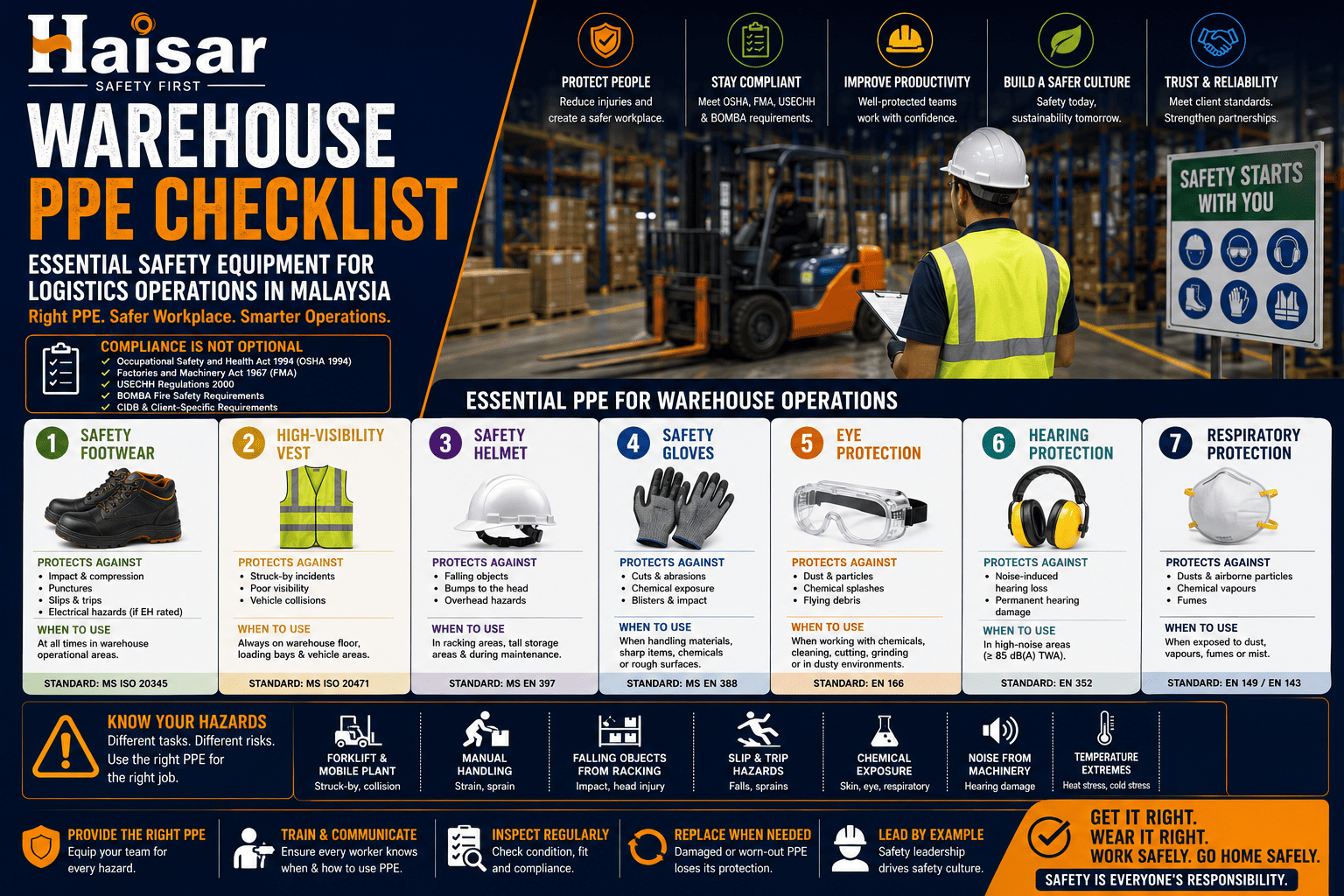
Malaysia's logistics sector is expanding rapidly. E-commerce fulfilment centres, cold chain warehouses, bonded logistics zones, and industrial stores serving Johor's manufacturing and project site base all operate environments where the physical hazards are real and the workforce turnover is high. In logistics operations, a new picker on their first week and a forklift driver in their third year are sharing the same floor space, often without the clear separation that a well-managed warehouse requires.
The PPE programme for a warehouse or logistics facility is not the same as the PPE programme for a construction site or an oil and gas plant. The hazards are different. The workforce profile is different. And the compliance challenge is different because warehouse workers are often less familiar with PPE requirements than workers in traditionally regulated industrial sectors, and because the pace of operations creates pressure to cut corners on safety that is harder to manage than on a formally safety-managed project site.
This guide and checklist is written for warehouse managers, logistics operations managers, and HSE officers responsible for PPE compliance in Malaysian warehouse and distribution environments. It covers the essential PPE categories for warehouse operations, the regulatory basis for each, and the practical checklist that keeps your facility compliant and your workers protected.
The Regulatory Basis for Warehouse PPE in Malaysia
Occupational Safety and Health Act 1994 (OSHA 1994). The general duty under Section 15 applies to all Malaysian workplaces including warehouses and distribution centres. Employers are required to provide safe systems of work, safe places of work, and adequate PPE for the hazards present.
Factories and Machinery Act 1967. Warehouses operating forklift trucks, pallet jacks, and other material handling machinery are classified as factories under the Act. The Factory and Machinery regulations impose specific safety requirements including operator licensing for forklift drivers, equipment inspection, and safety measures for material handling operations.
Occupational Safety and Health (Use and Standards of Exposure of Chemicals Hazardous to Health) Regulations 2000 (USECHH). For warehouses storing chemicals, cleaning agents, or other hazardous substances, USECHH requirements for chemical risk assessment and chemical PPE provision apply.
BOMBA and fire safety requirements. Warehouse facilities must comply with BOMBA fire safety requirements including fire extinguisher provision, fire exit maintenance, emergency lighting, and evacuation procedures.
CIDB requirements. For warehouses associated with construction project sites or operating within construction site boundaries, CIDB safety requirements may apply.
Industry-specific client requirements. Warehouses operating within the supply chains of international clients including hyperscale data centre developers, FMCG companies, and industrial operators may face additional PPE and safety equipment requirements imposed by the client as a condition of the warehouse service agreement.
Warehouse Hazard Profile
Before working through the PPE checklist, understanding the specific hazard profile of warehouse and logistics operations provides the context for why each PPE category is required.
Forklift and mobile plant movement. Forklifts, reach trucks, order pickers, and pallet jacks moving through the same space as pedestrian workers is the primary safety risk in most Malaysian warehouses. Struck-by incidents involving forklifts are a leading cause of serious injuries in the logistics sector. Visibility of pedestrian workers to forklift operators, and clear separation between vehicle and pedestrian zones, is the primary control. PPE including high-visibility vests supports the visibility control.
Manual handling and musculoskeletal risk. Repeated lifting, carrying, and positioning of packages and materials creates cumulative musculoskeletal strain. Appropriate footwear with support and appropriate gloves for the materials being handled are the PPE contributions to manual handling risk management.
Falling objects from racking. Racking systems loaded with pallets and packages present overhead object hazard when handling at height. Safety helmets are required in areas where overhead working at racking height occurs and where objects could fall from elevated storage positions.
Slip and trip hazards. Wet floors from cleaning, spills, and loading bay conditions. Uneven surfaces at loading docks. Package material and wrapping debris on the floor. Appropriate safety footwear with slip-resistant outsoles is the primary PPE control.
Chemical storage and handling. Warehouses storing cleaning chemicals, battery acid for forklift batteries, aerosol products, or other hazardous substances require chemical PPE for the handling tasks involving those substances.
Noise from machinery. Continuous forklift operation, conveyor systems, packaging machinery, and dock loading equipment can generate noise levels approaching or exceeding 85 dB(A) in production warehouses and fulfilment centres. Hearing protection is required where measured noise levels exceed the regulatory threshold.
Temperature extremes. Cold chain warehouses operating at sub-zero temperatures require cold-rated PPE and workwear. Outdoor loading bay work in Malaysia's heat requires heat stress management provision.
The Warehouse PPE Checklist
1. Safety Footwear
Safety footwear is the foundation of warehouse PPE. Every worker on the warehouse floor must wear safety footwear appropriate for the specific hazards of their role and work area.
S3 rated safety boots or safety shoes with steel or composite toecap, mid-sole penetration resistance, and energy-absorbing heel for general warehouse floor operations. The S3 rating covers impact protection, penetration resistance, ankle energy absorption, water resistance, and anti-static properties. This is the appropriate default for most Malaysian warehouse environments.
Slip-resistant outsoles are critical for warehouse environments with smooth concrete floors, wet loading bay areas, and polished cold storage floors. Confirm that the outsole slip resistance rating on the selected footwear is appropriate for the specific floor surfaces in your facility. SRC is the highest slip resistance classification under EN ISO 20345 and is the recommended specification for smooth concrete and wet surface environments.
Anti-static or ESD rated footwear for warehouses handling electronics, sensitive equipment, or operating in environments where static discharge could damage products or create ignition risk.
Cold-rated insulated safety boots for cold chain and frozen goods warehouses. Standard S3 boots are not rated for sustained use in sub-zero environments. Insulated footwear with a CI (cold insulation) rating maintains foot warmth at the storage temperatures your workers are exposed to.
Checklist item: Verify that all workers on the warehouse floor are wearing appropriate safety footwear at the start of every shift. Footwear inspection should be included in the induction process for new workers and in periodic PPE audits.
2. High-Visibility Vests and Workwear
High-visibility garments are mandatory for all workers in areas shared with forklift and mobile plant traffic. They are the PPE component most directly linked to the primary safety risk in warehouse environments.
Class 2 hi-vis vests as the minimum for all workers in active vehicle movement areas. Under MS ISO 20471, Class 2 vests carry a minimum of 0.50 square metres of fluorescent material and 0.13 square metres of retroreflective tape. The retroreflective tape must be in a 360-degree configuration visible from any angle of approach, which is critical in a warehouse environment where a forklift may approach a pedestrian worker from behind or from the side.
Class 3 hi-vis garments for workers in loading dock areas, yard movements, and any area with higher-speed vehicle movement or low-light conditions. Class 3 requires sleeve coverage in addition to the body panel requirements of Class 2.
Colour-coded vests for site identification. Many Malaysian warehouse operators use colour-coded hi-vis vests to differentiate workers by role, contractor, or access authorisation. This helps supervisors and forklift operators quickly identify who belongs in which area, improving both safety management and accountability.
Hi-vis workwear for cold chain environments. Standard fluorescent mesh vests are not appropriate for sub-zero cold storage environments. Hi-vis insulated jackets meeting both the MS ISO 20471 visibility requirement and the thermal protection requirement for the storage temperature are the correct specification for cold store workers.
Checklist item: No worker enters the active vehicle movement area without a compliant hi-vis garment. Post the hi-vis requirement at all entry points to vehicle movement zones.
3. Safety Helmets
Not every area of a warehouse requires safety helmets, but they are mandatory in any area where overhead hazards exist.
Mandatory helmet zones include: Areas where reach trucks and order pickers are operating at elevated racking heights. Loading and unloading areas where overhead crane or hoist operations are in progress. Areas where workers are loading or unloading vehicles from the top or sides where falling package risk exists. Any racking inspection or maintenance activity at height.
Class B safety helmets are the appropriate specification for warehouse environments where any electrical infrastructure, overhead lighting systems, or elevated electrical equipment is present alongside the impact hazard. Class A is adequate for pure impact-only environments with no electrical overhead hazard.
Bump caps for areas with low headroom and minor head bump risk but no falling object hazard, such as maintenance areas under conveyors and in service corridors with low infrastructure.
Checklist item: Helmet zones must be clearly marked with mandatory signage at the zone boundaries. Helmets must be available at zone entry points for visitors and contractors who enter without their own.
4. Protective Gloves
Hand protection in warehouse operations addresses a range of hazards depending on the materials handled, the equipment used, and the chemicals present in the facility.
General purpose cut-resistant work gloves at EN 388 TDM Level A to B for picking, packing, and general material handling. Protects against incidental contact with sharp box edges, staples, strapping, and packaging materials.
Higher cut-resistant gloves EN 388 TDM Level C to D for workers handling sheet metal components, machine parts with sharp edges, or industrial materials with significant cutting hazard.
Chemical resistant gloves matched to the specific chemicals present for battery maintenance (sulphuric acid exposure), cleaning chemical handling, and any chemical product receiving or storage tasks.
Cold-rated gloves for cold chain and frozen goods handling. Cold contact from frozen packaging materials can rapidly cause cold burns. Insulated gloves rated for the temperature range of the storage environment are required for workers regularly handling frozen goods.
Grip gloves with coated palms for carton handling and general distribution tasks where improved grip reduces drop-and-crush incidents and reduces hand fatigue during high-volume picking operations.
Checklist item: Match the glove specification to the task. One glove type for all warehouse tasks is inadequate. Provide the appropriate glove type at each workstation and ensure workers know which glove to use for each task category.
5. Safety Signage
Safety signage is not the most visible category of PPE but it is a regulatory requirement and a critical component of the warehouse safety system. Signage communicates hazards, rules, and emergency information at the point of need.
Mandatory PPE zone signs at the entry to every area requiring specific PPE. Hard hat required, safety footwear required, hi-vis required, and hearing protection required signs must be posted at the zone boundaries.
Forklift and pedestrian zone separation signs. Clearly marked pedestrian walkways with contrasting floor marking and signage. Forklift operating area signs at the entry to vehicle-priority zones. Pedestrian crossing point signs where the pedestrian route crosses a vehicle route.
Speed limit signs for forklift operating areas. Forklifts in Malaysian warehouse environments should be limited to 10 km/h in areas where pedestrians may be present. Speed limit signs must be posted at the entrance to the facility and at appropriate intervals throughout the vehicle movement areas.
Emergency information signs covering fire exit locations, fire assembly point, fire extinguisher positions, first aid kit location, AED location where installed, and emergency contact numbers.
Racking load capacity signs on every racking bay identifying the maximum load capacity per bay and per level. Overloaded racking is a significant collapse risk in Malaysian warehouses.
Hazardous substance storage signs including GHS hazard pictograms on storage areas holding chemicals, BOMBA flammable storage signs for flammable goods, and COSHH warning signs for chemical storage rooms.
Checklist item: Walk the facility and verify that all required signs are present, legible, correctly positioned, and in good physical condition. Replace faded, damaged, or incorrectly positioned signs immediately.
6. Hearing Protection
Hearing protection is required in any warehouse area where measured noise levels exceed 85 dB(A) as an eight-hour time-weighted average.
High-noise areas in Malaysian warehouses include packaging machinery halls where continuous packaging equipment produces sustained noise above 85 dB(A), loading dock areas with continuous vehicle reversing alarms and loading equipment, cold store machinery rooms with compressor and refrigeration equipment, and conveyor-intensive fulfilment centres where the combined noise of multiple conveyor lines approaches the threshold.
Pre-formed reusable earplugs for warehouse workers in areas with intermittent noise exposure who need to remove and replace hearing protection as they move between areas. Easier to use correctly than foam disposables in a fast-paced logistics environment.
Foam disposable earplugs for continuous high-noise environments where workers remain in the noisy zone for extended periods.
Checklist item: Measure noise levels in potential high-noise areas before designating hearing protection zones. Post hearing protection zone signs at the entry to every measured area above 85 dB(A). Provide appropriate hearing protection dispensers at zone entry points.
7. Emergency Response Equipment
Emergency response capability is a regulatory requirement and an operational necessity for any Malaysian warehouse facility.
First aid kits sized and stocked per the workforce on each shift under the Factories and Machinery (Safety, Health and Welfare) Regulations 1970. One kit for the first 50 workers, one additional kit per additional 50 workers or part thereof. Position kits at accessible locations throughout the facility, not just in the office.
AED (Automated External Defibrillator) for larger warehouse facilities where the distance from any location to the nearest emergency service access could result in extended cardiac arrest survival time before ambulance arrival. Increasingly expected in facilities above 100 workers.
Eye wash stations at any location where chemical handling occurs including battery maintenance areas, cleaning chemical storage and dispensing, and chemical goods receiving.
Chemical spill kits at all chemical storage locations and at forklift battery charging and maintenance areas.
BOMBA-approved fire extinguishers of the correct type for the fire risks present, positioned per BOMBA placement requirements throughout the facility, with annual service documentation current.
Checklist item: Assign a responsible person to each emergency equipment location. Inspect all emergency equipment on a documented schedule. Ensure all first aiders hold current certificates and that their certificates are renewed before expiry.
8. Personal Protective Equipment for Forklift and Plant Operators
Forklift and mobile plant operators have specific PPE requirements beyond the general warehouse floor requirements.
Safety boots as per the general requirement above, with emphasis on ankle support for operators mounting and dismounting equipment repeatedly throughout the shift.
Hi-vis vest or jacket for all plant operators so they are visible to pedestrians when dismounted from the equipment.
Safety helmet for operators in loading dock and outdoor yard environments where overhead hazards are present.
Seatbelts on all forklifts and mobile plant must be worn at all times during operation. This is not PPE in the traditional sense but it is a personal safety requirement that warehouse managers must enforce consistently. A forklift tip-over with the operator wearing a seatbelt is survivable. The same incident without a seatbelt often is not.
Checklist item: Include PPE compliance for forklift operators in the pre-shift inspection checklist for every machine. Any operator observed operating without seatbelt fastened or without required PPE must stop the machine and correct immediately.
The Complete Warehouse PPE Checklist Summary
Use this summary checklist for shift-start inspections, new worker inductions, and periodic PPE audits.
Safety footwear: All workers in S3 rated footwear with SRC slip-resistant outsoles. Cold-rated boots for cold store workers. Anti-static for electronics handling.
High-visibility vests: All workers in vehicle movement areas wearing Class 2 minimum. Class 3 at loading docks and outdoor yards. Insulated hi-vis for cold store workers.
Safety helmets: All workers in elevated racking areas, crane zones, and loading operations wearing Class B helmets. Helmet zones clearly marked.
Protective gloves: General cut-resistant gloves for picking and packing. Chemical gloves for battery and chemical handling. Cold gloves for frozen goods handling.
Safety signage: PPE zone signs current and correctly positioned. Forklift and pedestrian separation marked. Emergency information signs complete and legible.
Hearing protection: Hearing protection zones identified by noise measurement. Pre-formed earplugs or foam disposables available at zone entry points.
Emergency equipment: First aid kits stocked and inspected. Eye wash stations at chemical locations. Spill kits at chemical storage. Fire extinguishers serviced.
Forklift operators: Seatbelts worn. PPE compliant per above. Pre-shift equipment inspection completed.
Download the Haisar Warehouse PPE Checklist
Haisar Supply and Services supplies the complete range of warehouse and logistics safety equipment for distribution centres, fulfilment facilities, and industrial warehouses across Johor and peninsular Malaysia. Our warehouse PPE supply covers S3 safety footwear with SRC-rated outsoles, Class 2 and Class 3 hi-vis vests and jackets, safety helmets, cut-resistant and chemical resistant gloves, safety signage across all mandatory and warning categories, hearing protection, first aid kits, eye wash stations, spill kits, and BOMBA-approved fire extinguishers.
We supply in bulk for facility-wide PPE programmes and maintain stock of fast-moving warehouse PPE items for rapid resupply.
Download the Warehouse PPE Checklist
Contact our team to discuss your warehouse safety equipment requirements across Johor and Malaysia.
Browse PPE and Safety Products at haisar.com
Haisar Supply and Services Sdn Bhd (985158-T) | Kulai, Johor, Malaysia | www.haisar.com