Can't find what you're looking for? Get in touch!



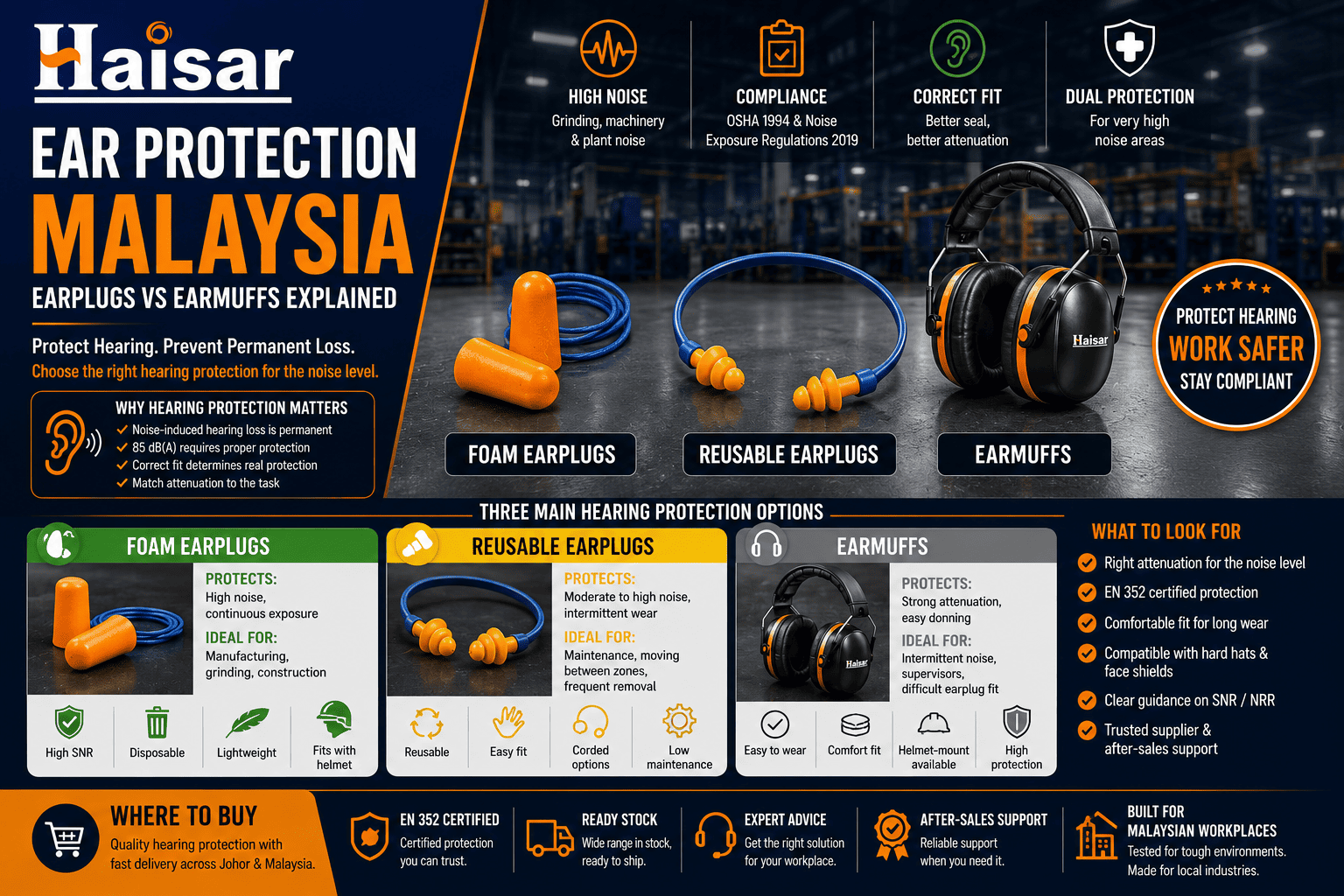
Noise-induced hearing loss is permanent. Unlike a laceration that heals or a chemical burn that can be treated, the damage that loud noise does to the hair cells of the inner ear does not repair itself. Once those cells are destroyed, the hearing loss they cause is irreversible. There is no surgical correction and no medical treatment that restores the lost sensitivity. Workers who develop occupational hearing loss from years of inadequate noise protection carry that loss for the rest of their lives.
Malaysian industrial workplaces generate noise levels that create genuine risk of hearing damage across a wide range of sectors. Manufacturing plants, fabrication workshops, power generation facilities, oil and gas compressor modules, data centre plant rooms, and construction sites all regularly expose workers to noise levels above the 85 dB(A) threshold at which Malaysian OSH regulations require hearing protection.
The two primary devices for hearing protection in industrial environments are earplugs and earmuffs. Both are effective when correctly specified and correctly used. Neither is universally superior. Choosing between them, or combining them, requires understanding how noise is measured, what level of attenuation each device provides, and which device suits the specific working environment and task requirements. This guide covers all of it.
The Regulatory Basis for Hearing Protection in Malaysia
Occupational Safety and Health (Noise Exposure) Regulations 2019. These regulations set the current framework for noise management in Malaysian workplaces. They establish an action level of 80 dB(A) as an eight-hour time-weighted average (TWA), at which employers must assess noise exposure and take steps to reduce it. The limit value is 85 dB(A) TWA, above which engineering and administrative controls must be implemented and hearing protection must be provided. Peak noise levels above 140 dB(C) require immediate hearing protection regardless of duration.
OSHA 1994. The general duty under OSHA provides the overarching framework within which the Noise Exposure Regulations operate. Employers are required to provide and maintain safe working conditions including protection from hazardous noise.
Hearing conservation programme requirements. Workplaces where workers are regularly exposed at or above the 80 dB(A) action level must implement a hearing conservation programme. This includes noise measurement to establish exposure levels, engineering and administrative controls to reduce noise at source, provision of suitable hearing protection, audiometric testing to monitor worker hearing over time, and training workers in the hazards of noise and the correct use of hearing protection.
In practice, DOSH enforcement focuses on whether hearing protection zones are marked, whether appropriate hearing protection is available, and whether workers are wearing it consistently. Unmarked high-noise areas and workers in noisy environments without hearing protection are among the findings most commonly cited in DOSH inspection reports across Malaysian manufacturing and industrial facilities.
How Noise Levels Are Measured and What They Mean
Understanding noise levels helps connect the regulations to the real-world environments on Malaysian industrial sites.
Noise is measured in decibels (dB), a logarithmic scale. The logarithmic nature of the scale means that a 3 dB increase represents a doubling of sound energy, and a 10 dB increase represents a tenfold increase in sound energy. Small differences in dB level represent large differences in exposure intensity.
The 85 dB(A) regulatory limit is the eight-hour time-weighted average. The permissible exposure time halves with every 3 dB increase above 85 dB(A). At 88 dB(A), the permissible unprotected exposure is four hours. At 91 dB(A), it is two hours. At 97 dB(A), it is thirty minutes.
Typical noise levels at Malaysian industrial workplaces:
Normal conversation is approximately 60 dB(A). A busy office or light manufacturing environment is approximately 70 to 75 dB(A), below the action level.
Heavy vehicle traffic on a construction site is typically 80 to 85 dB(A), at or near the action level.
Angle grinding and disc cutting typically produce 90 to 100 dB(A) at the operator position. A worker grinding continuously without hearing protection for one shift is receiving a noise dose many times the permissible limit.
Pneumatic chipping and jackhammer operation typically produces 100 to 110 dB(A). Even brief exposures at these levels without hearing protection accumulate significant noise dose.
Turbine halls and compressor buildings in power generation and oil and gas facilities typically operate at 90 to 105 dB(A). Workers conducting maintenance in these areas require hearing protection rated for the actual noise level, not the minimum available protection.
Engine test beds, generator halls, and jet blast environments can exceed 120 dB(A), requiring the highest available attenuation and potentially dual protection combining earplugs and earmuffs.
Understanding Attenuation Ratings: SNR, HML and NRR
Hearing protection devices carry attenuation ratings that indicate how much noise reduction they provide. Understanding these ratings is essential for selecting a device that provides adequate protection at the actual noise level in your workplace.
SNR (Single Number Rating) — European Standard EN 352.
The SNR is a single number expressing the average noise attenuation provided by the device across the relevant frequency range, in decibels. A higher SNR means more attenuation. To estimate the noise level at the ear when wearing the device, subtract half the SNR value from the measured workplace noise level. This conservative approach accounts for real-world fitting variability.
Example: Workplace noise level is 98 dB(A). Earmuffs with SNR 30. Estimated noise at ear: 98 − (30 ÷ 2) = 83 dB(A). This is below the 85 dB(A) limit, so the earmuffs provide adequate protection at this noise level.
HML (High, Medium, Low) — European Standard EN 352.
The HML system provides three attenuation values for high, medium, and low frequency noise components separately. It is more accurate than the SNR for environments with predominantly high or low frequency noise, as workplace noise is not always evenly distributed across the frequency spectrum. Heavy industrial machinery and compressors typically produce significant low-frequency noise components where the L value is the relevant rating.
NRR (Noise Reduction Rating) — NIOSH/US Standard.
The American rating system used by international contractors and oil and gas operators referencing American standards in Malaysia. To estimate protected noise level using NRR, subtract half the NRR value from the C-weighted noise level, or subtract the NRR value with a 7 dB adjustment from the A-weighted level. NRR values are numerically different from SNR values and cannot be directly compared.
Earplugs: Types, Performance and When to Use Them
Earplugs are inserted into the ear canal and provide attenuation by blocking the direct path of noise into the ear. They are lightweight, compact, and compatible with other PPE including hard hats, face shields, and welding helmets. They do not interfere with head-mounted equipment.
Foam disposable earplugs are the most widely used hearing protection in Malaysian industrial environments. Made from slow-recovery polyurethane foam, they are rolled into a narrow cylinder, inserted into the ear canal, and allowed to expand to fill the canal. When correctly inserted, foam earplugs provide the highest attenuation of any earplug type, with SNR values typically ranging from 30 to 38 dB.
The critical factor with foam earplugs is correct insertion technique. A foam earplug that is not inserted deeply enough into the ear canal provides significantly less attenuation than its rated SNR. The rolled plug must be held in the ear canal for several seconds while the foam expands to form the seal. Many workers in Malaysian factories and construction sites insert foam earplugs only partially, receiving a fraction of the rated attenuation without knowing it. Training in correct insertion technique is as important as providing the earplugs.
Pre-formed reusable earplugs with flanged or banded designs provide consistent attenuation without requiring the rolling and insertion technique of foam earplugs. They are easier to insert correctly and are appropriate for environments where hearing protection is put on and removed frequently throughout the shift. SNR values for pre-formed earplugs are typically 20 to 28 dB, lower than foam disposables but more consistently achieved in practice.
Corded earplugs with a connecting cord between the two plugs prevent loss and allow the earplugs to be draped around the neck when not in use. Practical for environments where hearing protection is worn intermittently, such as moving between noisy and quiet areas during a shift.
When earplugs are the right choice. Hot environments where earmuff ear cups cause excessive heat and sweating. Environments where workers must wear hard hats, face shields, or other head-mounted PPE that is incompatible with earmuff headbands. Tasks requiring frequent entry and exit from high-noise areas where the hearing protection must be removed and replaced regularly. Workers who find earmuffs uncomfortable for extended wear.
Earmuffs: Types, Performance and When to Use Them
Earmuffs consist of two rigid ear cups lined with sound-absorbing material, connected by a headband and sealed against the head by soft cushioned ear seals. They are worn over the ears rather than inside the ear canal.
Standard over-head earmuffs are the most common format and provide attenuation across the full frequency range. SNR values for standard industrial earmuffs typically range from 25 to 35 dB, with variation depending on the cup size, seal quality, and headband tension. Earmuffs are generally easier to use correctly than foam earplugs because the correct wearing position is visually obvious and does not require insertion technique.
Helmet-mounted earmuffs attach directly to the brim of a safety helmet. They fold flat against the helmet when not in use and swing into position over the ears when required. Practical for construction sites and industrial environments where workers alternate between quiet and noisy areas frequently and wear hard hats continuously. The attenuation of helmet-mounted earmuffs is typically slightly lower than equivalent over-head earmuffs because the mounting attachment is less rigid than a full headband.
Electronic hearing protection incorporates microphones and speakers that amplify ambient sound at safe levels while electronically limiting impulsive noise peaks above a set threshold. Workers wearing electronic earmuffs can hear speech and warning signals clearly at normal ambient conditions but are protected against sudden loud impacts such as hammering, gunfire, and blast events. Relevant for supervisory and coordination roles in intermittently noisy environments, for workers who need to maintain situational awareness and communication capability, and for security and defence applications.
When earmuffs are the right choice. Workers who cannot achieve a good earplug fit due to ear canal anatomy or sensitivity. Environments with intermittent high-noise events where the earmuffs can be quickly positioned and removed. Workers who find earplug insertion uncomfortable or who have difficulty with the insertion technique. Environments where earmuff hygiene is easier to maintain than earplug hygiene, such as food processing facilities.
Side-by-Side Comparison
| Property | Foam Earplugs | Pre-formed Earplugs | Standard Earmuffs | Electronic Earmuffs |
|---|---|---|---|---|
| Typical SNR range | 30 to 38 dB | 20 to 28 dB | 25 to 35 dB | 25 to 33 dB |
| Ease of correct fitting | Requires technique | Easy | Easy | Easy |
| Compatibility with hard hat | Yes | Yes | Reduced with helmet-mount | Reduced with helmet-mount |
| Compatibility with welding visor | Yes | Yes | Difficult | Difficult |
| Hot climate comfort | Good | Good | Can cause sweating | Can cause sweating |
| Maintenance | Disposable | Clean regularly | Clean ear seals regularly | Clean ear seals, battery |
| Communication capability | Reduced | Reduced | Reduced | Enhanced (electronic type) |
| Cost per unit | Very low | Low | Medium | High |
| Best for | High noise, continuous wear | Intermittent wear | Easy donning, anatomy issues | Communication needed |
Dual Protection: When One Device Is Not Enough
At noise levels above approximately 105 dB(A), a single hearing protection device may not provide sufficient attenuation to reduce exposure below the regulatory limit. Dual protection combines earplugs and earmuffs simultaneously, with the combined attenuation exceeding what either device provides alone.
The combined attenuation of dual protection is not the sum of both SNR values. In practice, the combined protection adds approximately 5 to 10 dB to the higher of the two individual device ratings. If the best earmuff provides SNR 33 and the earplug provides SNR 37, the combined protection is approximately SNR 40 to 45, not SNR 70.
Dual protection is appropriate for turbine halls and compressor modules at the highest noise levels, generator test environments, pneumatic breaking and rock drilling operations, and any environment consistently above 105 dB(A).
Hearing Protection by Malaysian Industry Application
Manufacturing plants and production facilities in Johor. Noise levels vary by production line but stamping, pressing, pneumatic tools, and conveyor systems commonly exceed 90 dB(A). Foam disposable earplugs SNR 33 or above for continuous production workers. Pre-formed earplugs for workers moving between noisy and quieter areas.
Oil and gas compressor and turbine areas. Typically 95 to 110 dB(A). Earmuffs SNR 30 or above, or foam earplugs SNR 35 or above. Dual protection for the highest-level compressor areas. Helmet-mounted earmuffs for workers wearing hard hats who need to move in and out of noisy areas.
Power generation turbine halls and generator buildings. 90 to 105 dB(A) typically. Standard earmuffs or high-SNR foam earplugs as primary protection. Electronic earmuffs for maintenance supervisors and shift engineers who need communication capability during plant rounds.
Construction sites with heavy plant. Variable noise levels by task. Angle grinding and disc cutting typically 95 to 100 dB(A), requiring earplugs or earmuffs with SNR 25 or above. Jackhammer and pneumatic breaking at 100 to 110 dB(A), requiring SNR 30 or above. Hard hat compatibility favours foam earplugs for workers wearing head protection.
Shipyards and fabrication workshops in Johor. Continuous grinding, chipping, and welding typically produces 90 to 100 dB(A). Foam disposable earplugs for general fabrication workers. Earmuffs for workers who need to hear communication signals from supervisors while working in the yard.
Data centre plant rooms and generator halls. Generator testing and mechanical plant areas typically 85 to 100 dB(A). Standard earmuffs or foam earplugs for maintenance access. Electronic earmuffs for technicians who need to communicate while conducting maintenance in plant rooms.
Haisar Supply and Services: Hearing Protection Supplier in Malaysia
Haisar Supply and Services supplies the full range of hearing protection for industrial workplaces across Johor and peninsular Malaysia. Our hearing protection range covers disposable foam earplugs in standard and high-attenuation SNR ratings, pre-formed reusable earplugs with corded options, over-head earmuffs across multiple SNR levels, helmet-mounted earmuffs for hard hat compatibility, electronic hearing protection for communication-dependent environments, and dual protection combinations for the highest noise level applications.
We supply with EN 352 certification documentation and SNR ratings for all hearing protection products and can advise on the correct attenuation level for your measured workplace noise levels.
Browse Hearing Protection and PPE Products at haisar.com
Contact our team for product specifications, certification documentation, and pricing for hearing protection procurement for your facility or project site in Johor and across Malaysia.
Haisar Supply and Services Sdn Bhd (985158-T) | Kulai, Johor, Malaysia | www.haisar.com
