Can't find what you're looking for? Get in touch!



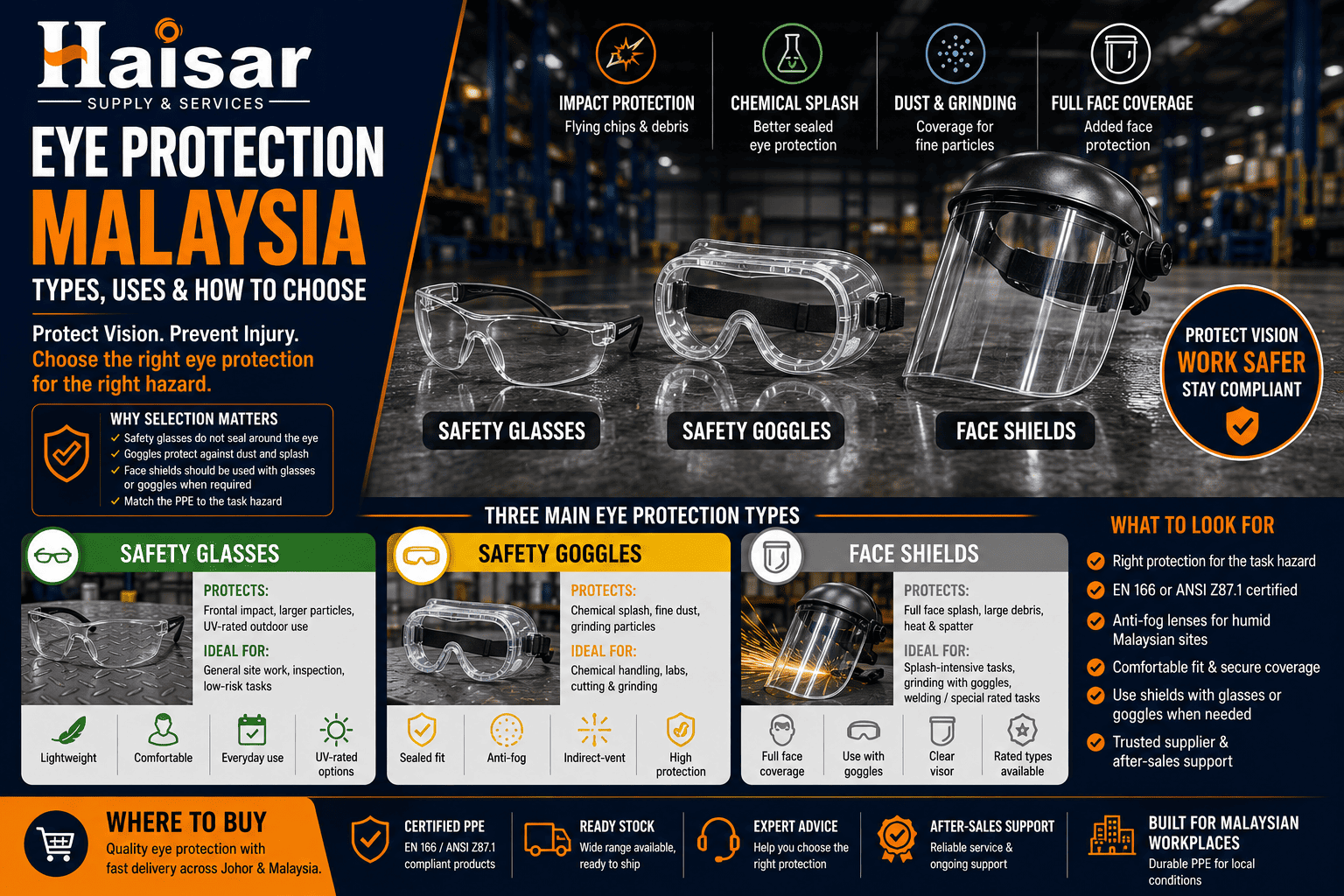
Eye injuries are among the most preventable workplace injuries in Malaysian industry, and among the most consequential when they occur. A foreign body embedded in the cornea, a chemical splash causing corneal burns, or an arc flash causing photokeratitis are all injuries that could have been prevented by the correct eye protection worn correctly. The challenge is that the three main categories of eye protection, safety glasses, safety goggles, and face shields, are not interchangeable. Each is designed for a specific range of hazards and using the wrong one for a given task either provides no protection or inadequate protection for the hazard present.
This guide cuts through the confusion. It explains what each type of eye protection does and does not protect against, provides a clear comparison, covers the standards applicable in Malaysia, and gives safety officers and procurement teams a task-by-task reference for making the correct specification decision.
Why Eye Protection Selection Matters
Eye injuries on Malaysian industrial sites range from minor, grit and dust particles that can be flushed out, to severe and permanently sight-affecting, chemical burns, arc flash damage, and penetrating objects that require surgical intervention. The severity of the injury depends partly on the hazard and partly on whether the eye protection worn was the right type for that hazard.
The most common eye protection specification failure in Malaysian workplaces is using safety glasses in situations that require goggles or face shields. Safety glasses protect the eye from frontal impact and particles travelling in a direct line toward the eye. They do not seal around the eye. Chemical splash, fine dust, and vapours can enter from the sides, top, or bottom of the frame. In a chemical splash situation, safety glasses provide meaningfully less protection than properly sealed goggles and may result in a chemical burn injury that sealed goggles would have prevented.
Understanding exactly what each device does and does not protect against is the foundation of correct eye protection selection.
Safety Glasses: What They Protect Against and When to Use Them
Safety glasses are the most commonly worn form of eye protection in Malaysian workplaces and they are appropriate for a narrower range of hazards than most sites apply them to.
What they protect against. Safety glasses provide frontal impact protection against particles, chips, and debris travelling in the line of sight. They protect against dust particles large enough to be stopped by the lens and frame. They provide UV protection when the lens carries a UV rating, important for outdoor workers on Malaysian sites. They provide a basic level of splash protection against large droplets in situations where splash velocity and quantity are low.
What they do not protect against. Safety glasses do not seal around the eye. Any hazard that can reach the eye from the side, below, or above the frame, including chemical splash, fine airborne dust, and vapours, is not adequately controlled by safety glasses alone. They are not rated for protection against chemical splash. They are not rated for arc flash. They are not adequate protection for grinding, where fine particles are propelled in all directions.
When safety glasses are the right choice. General site work with low particulate levels and no chemical splash risk. Inspection and supervisory roles where the primary risk is incidental debris. Indoor technical work in clean environments. Situations where the primary hazard is UV radiation from outdoor work, requiring UV400-rated lenses. Safety glasses are also commonly worn as a comfort layer under other eye protection, but this does not replace the need for the primary protection device appropriate to the task.
Standards. EN 166 is the European standard for individual eye protection covering impact resistance, optical quality, and additional properties. ANSI Z87.1 is the American standard, referenced by international contractors and oil and gas operators in Malaysia. Both specify impact resistance, optical quality, and where applicable additional properties including UV protection, anti-fog coating, and anti-scratch performance.
Safety Goggles: What They Protect Against and When to Use Them
Safety goggles form a sealed or semi-sealed enclosure around the eye, preventing hazards from reaching the eye from any direction. This makes them the appropriate specification for a significantly wider range of hazards than safety glasses.
What they protect against. Safety goggles protect against chemical splash from any direction, including splash that would enter around the frame of safety glasses. They protect against fine dust and airborne particulates that would enter around the frame of safety glasses. They protect against vapours when the ventilation design is indirect-ventilation or non-ventilated. They provide impact protection equivalent to or exceeding safety glasses depending on the lens and frame specification.
Direct-ventilated vs indirect-ventilated vs non-ventilated goggles.
Direct-ventilated goggles have open ventilation ports that allow air to circulate freely. They prevent fogging and are comfortable to wear for extended periods. They protect against impact and large particles but the open vents allow chemical splash and fine dusts to enter. Appropriate for dusty environments where chemical splash is not a risk.
Indirect-ventilated goggles have hooded or baffled ventilation ports that allow air exchange but prevent liquid from entering through the vents. They provide protection against chemical splash from any direction while maintaining adequate ventilation to reduce fogging. This is the standard chemical splash goggle specification for Malaysian industrial workplaces.
Non-ventilated goggles have no ventilation ports. They provide the highest protection against chemical splash, fine mists, and vapours but are the least comfortable for extended wear due to fogging. Required where vapour hazards or very fine aerosols could enter through vented goggles.
Anti-fog coating is particularly important for goggles used in Malaysian industrial conditions. High ambient temperature and humidity combined with the sealed enclosure of goggles creates rapid fogging that leads workers to remove the goggles during the task. Anti-fog coated lenses or anti-fog inserts maintain visibility and improve compliance.
When safety goggles are the right choice. Chemical handling and dispensing operations involving splash risk. Laboratory work. Grinding and cutting operations where fine particles are propelled in all directions. Dust-intensive construction activities including concrete cutting, demolition, and earthworks. Any situation where the hazard can approach the eye from directions other than directly in front. Battery maintenance operations where sulphuric acid splash risk is present.
Face Shields: What They Protect Against and When to Use Them
Face shields protect the entire face including the forehead, chin, and neck from hazards. They do not seal against the face and therefore do not provide adequate protection against fine dust, chemical vapours, or any hazard that can enter the gap between the shield and the face. They must always be worn in combination with safety glasses or goggles for tasks where fine particles or chemical vapour are present alongside the face-level hazard.
What they protect against. Face shields provide protection against chemical splash, molten metal splash, and large flying debris that threatens the entire face area, not just the eyes. They protect against radiated heat and UV from welding and cutting arcs when fitted with the appropriate shade lens. They protect against arc flash when rated to the applicable incident energy level.
What they do not protect against by themselves. Fine airborne particles that enter around the gap between the shield and the face. Chemical vapours. Fine mists. Any hazard that can travel upward under the lower edge of the shield or around the sides.
Face shield types for Malaysian industrial applications.
Clear polycarbonate face shields for grinding, cutting, machining, and chemical splash protection. The polycarbonate lens must meet the impact rating appropriate for the debris hazard. Standard face shields rated for grinding and cutting are not arc flash rated.
Arc flash rated face shields in cal/cm² ratings matched to the incident energy at the work location. Standard polycarbonate shields are not arc flash rated regardless of thickness. Arc flash shields are visually distinct, typically amber-tinted, and carry their ATPV rating on the label. Using a standard clear face shield for live electrical work where an arc flash rated shield is required provides no arc flash protection.
Welding shields with variable or fixed shade lenses for protection against arc radiation, UV, and infrared during welding operations. Shade number must match the welding process and amperage in use.
The Comparison: Which Provides What Protection
| Hazard | Safety Glasses | Direct-Vent Goggles | Indirect-Vent Goggles | Face Shield (with goggles) |
|---|---|---|---|---|
| Flying debris, large particles | Yes | Yes | Yes | Yes |
| Fine airborne dust | Partial | Yes | Yes | No (use with goggles) |
| Chemical splash | No | No | Yes | Partial (use with goggles) |
| Chemical vapour | No | No | Non-vent only | No |
| Grinding particles (all directions) | No | Yes | Yes | No (use with goggles) |
| Arc flash (rated shield) | No | No | No | Yes (rated shield only) |
| Welding arc radiation | No | No | No | Yes (shaded lens) |
| Radiated heat and spatter | No | No | No | Yes |
| UV radiation (outdoor) | UV-rated lenses | Some | Some | No |
| Molten metal splash | No | No | No | Yes |
Eye Protection Standards in Malaysia
EN 166 (Individual Eye Protection). The European standard covering the performance requirements for safety glasses, goggles, and face shields. EN 166 specifies impact resistance, optical quality, and additional properties indicated by marking codes on the lens and frame. This is the primary standard referenced in Malaysia's industrial sector.
ANSI Z87.1. The American standard for occupational and educational eye and face protection. Widely referenced by international clients, oil and gas operators, and PETRONAS contractor specifications in Malaysia. ANSI Z87.1 uses a similar performance category approach to EN 166 with different marking conventions.
EN 175 (Welding Protection). The European standard for eye and face protection during welding and allied processes. Welding shields must meet EN 175 in addition to EN 166 for the mechanical protection properties.
Arc flash ratings (IEC 61482-1-2 / NFPA 70E). Arc flash face shields are rated in cal/cm² under IEC 61482-1-2 or NFPA 70E. The rating must match or exceed the incident energy at the work location as determined by an arc flash risk assessment.
Task-by-Task Eye Protection Guide for Malaysian Workplaces
Angle grinding, disc cutting, and abrasive operations. Indirect-ventilated goggles as the primary eye protection. Fine abrasive particles are propelled in all directions and will enter around safety glasses. Face shield optional as secondary protection for larger debris and face coverage. Safety glasses alone are inadequate for grinding.
Welding and hot work. Welding shield with correct shade number for the welding process. Safety glasses or goggles under the welding shield for protection when the shield is lifted. The shade number requirements by process are: oxy-gas welding typically Shade 5 to 8, MIG and TIG welding typically Shade 10 to 13 depending on amperage, and stick welding typically Shade 9 to 12.
Chemical handling and dispensing. Indirect-ventilated safety goggles as the minimum. Face shield as secondary protection for splash-intensive operations including drum dispensing and chemical transfer. Safety glasses alone are not adequate for any chemical with splash hazard.
Battery maintenance. Indirect-ventilated safety goggles as the minimum for handling batteries with sulphuric acid electrolyte. Face shield as secondary protection for battery watering and maintenance involving open electrolyte.
Live electrical work (LV and MV switchgear). Arc flash rated face shield or switching hood at the appropriate cal/cm² rating based on the arc flash risk assessment for the specific location. Safety glasses under the arc flash face shield as standard eye protection when the face shield is not down. Standard clear face shields are not acceptable for live electrical work where arc flash risk is present.
Concrete cutting and demolition. Indirect-ventilated or direct-ventilated goggles for fine concrete dust protection. Face shield as secondary protection for larger debris during demolition. Safety glasses alone are not adequate for concrete cutting dust.
General site work and inspection. Safety glasses with impact-rated lenses and UV400 protection for outdoor work. Adequate for general incidental debris hazard in environments without grinding, chemicals, or welding.
Spray painting and coating. Indirect-ventilated or non-ventilated goggles for protection against paint mist. Full-face respirator as an integrated eye and respiratory protection solution where the coating material presents both inhalation and eye contact hazard.
Laboratory and chemical analysis. Indirect-ventilated chemical splash goggles as the standard. Non-ventilated for volatile chemical applications.
Haisar Supply and Services: Eye Protection Supplier in Malaysia
Haisar Supply and Services supplies the full range of eye and face protection for workplaces and project sites across Johor and peninsular Malaysia. Our eye protection range covers EN 166 and ANSI Z87.1 certified safety glasses in standard and prescription-ready frames, direct and indirect-ventilated chemical splash goggles with anti-fog coating, arc flash rated face shields across multiple ATPV ratings, welding shields and auto-darkening welding helmets, and full-face respirators providing integrated eye and respiratory protection.
We supply with EN 166 and ANSI Z87.1 certification documentation and can advise on the correct eye protection type for your specific hazard and task requirements.
Browse Eye Protection Products at haisar.com
Contact our team for product specifications, certification references, and pricing for eye protection procurement for your site in Johor and across Malaysia.
Haisar Supply and Services Sdn Bhd (985158-T) | Kulai, Johor, Malaysia | www.haisar.com
