Can't find what you're looking for? Get in touch!



Respiratory protection is the PPE category where getting the selection wrong carries the most invisible consequences. A worker wearing the wrong glove for a chemical task may notice skin irritation quickly. A worker wearing the wrong respirator for a toxic dust or vapour exposure may not notice anything at all, while cumulative damage to the lungs, airways, and bloodstream accumulates over months or years.
Occupational lung disease from inadequate respiratory protection is one of the leading occupational health problems in Malaysian industry. Silicosis from construction and quarrying dust. Occupational asthma from chemical sensitisers in manufacturing and painting. Chronic obstructive pulmonary disease from welding fumes. These are irreversible conditions that develop when the wrong respirator is worn, when a respirator is worn incorrectly, or when no respirator is worn at all because the hazard was not recognised or the right equipment was not available.
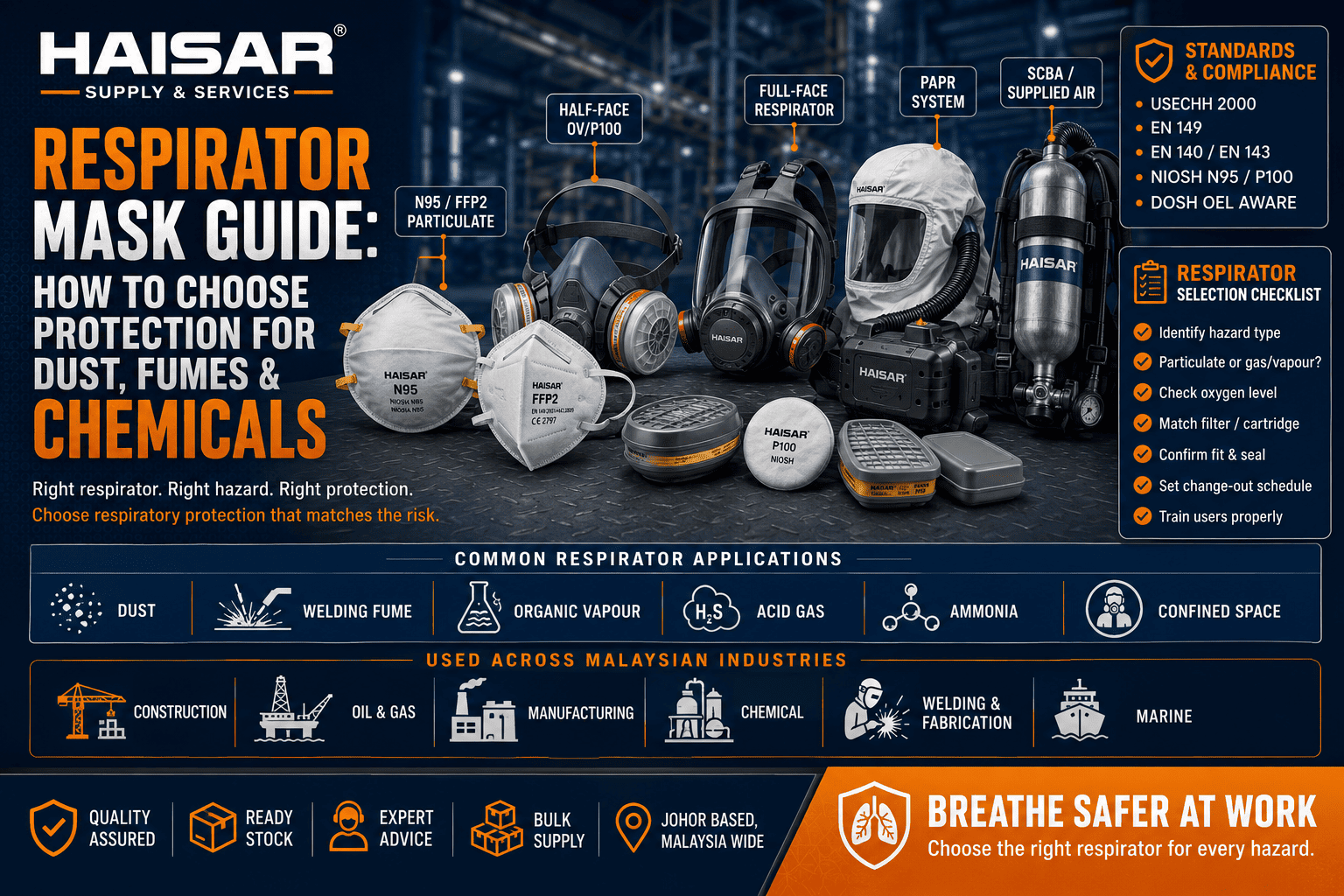
This guide covers the full respirator selection process for Malaysian workplaces, from understanding the hazard types that require different respirator classes, through the N95, FFP, and cartridge-based systems, to the fit basics that determine whether a respirator actually works for the individual wearing it. Whether you are an HSE manager building a respiratory protection programme, a procurement officer sourcing respirators for a construction project, or a site supervisor trying to understand what your team should be wearing, this is the reference you need.
Step One: Identify the Respiratory Hazard Type
Respirator selection begins with the hazard, not the product catalogue. Respiratory hazards fall into two categories and the distinction is fundamental to getting the selection right.
Particulate hazards are solid or liquid particles suspended in air. They include dusts from construction activities, grinding, and earthworks, metallic fumes from welding and cutting, biological aerosols, mists from spray painting and chemical spraying, and fibres including asbestos and man-made mineral fibres. Particulate hazards are removed from the inhaled air by filtration.
Gas and vapour hazards are molecular-level contaminants that cannot be removed by particle filtration. Organic vapours from solvents, adhesives, and paints. Acid gases including hydrochloric acid and sulphur dioxide. Ammonia from agricultural chemicals and refrigeration systems. Formaldehyde from resins and adhesives. CO and H2S from process and confined space environments. Gas and vapour hazards require chemical adsorption cartridges that bind the contaminant molecule to an active medium.
Many Malaysian industrial environments present both particulate and gas or vapour hazards simultaneously. A spray painting operation creates both solvent vapour and paint mist. Welding in a confined space creates both metallic fume and CO. For combined hazards, a combination cartridge addressing both contaminant types is required.
Oxygen deficiency is a third category that requires entirely different protection. Where oxygen concentration falls below 19.5 percent, no air-purifying respirator provides protection. Air-purifying respirators filter or adsorb contaminants from the ambient air. In an oxygen-deficient atmosphere, the ambient air itself is the hazard. Supplied air or self-contained breathing apparatus is required. This is the most critical respiratory protection decision because the worker wearing an air-purifying respirator in an oxygen-deficient space has no protection at all.
The Malaysian Regulatory Framework for Respiratory Protection
USECHH Regulations 2000. The primary regulations governing respiratory protection in Malaysian workplaces. They require employers to assess respiratory hazards, implement controls in the hierarchy order of elimination, substitution, and engineering controls before relying on PPE, and where respiratory protection is required as a control measure, to provide appropriate respirators and ensure they are correctly used and maintained. Respirator selection under USECHH must be based on the results of a documented Chemical Health Risk Assessment (CHRA) for chemical hazard environments.
DOSH Occupational Exposure Limits (OELs). DOSH publishes occupational exposure limits for substances hazardous to health in Malaysia, referenced in the USECHH Regulations. Respiratory protection must be capable of reducing worker exposure to below the applicable OEL for the specific substance. Selecting a respirator without reference to the OEL and the actual concentration of the contaminant is not a defensible specification.
OSHA 1994 general duty. Where USECHH does not specifically apply, OSHA's general duty to provide safe working conditions and adequate PPE covers respiratory hazards including construction dust, welding fume, and other non-chemical respiratory hazards.
SIRIM acceptance. Respirators with CE marking against EN 149 (disposable filtering face pieces) and EN 140/EN 143 (half-face respirators and filters) are generally accepted in Malaysian regulated workplaces. For oil and gas and PETRONAS contractor sites, additional approval requirements may apply.
Disposable Filtering Face Pieces: N95, FFP2 and FFP3
Disposable filtering face pieces are the most commonly used respiratory protection in Malaysian industrial environments. They are single-use or limited-reuse devices that filter particulate hazards from inhaled air. Understanding the rating systems for disposable respirators is the starting point for correct specification.
The FFP System (European Standard EN 149)
European standard EN 149 classifies disposable filtering face pieces across three levels based on the percentage of airborne particles the device filters when correctly fitted.
FFP1 provides a minimum of 80 percent filtration efficiency and is intended for low toxicity nuisance dusts. FFP1 is rarely adequate for Malaysian industrial applications where the dust has occupational health significance.
FFP2 provides a minimum of 94 percent filtration efficiency and is the standard specification for most industrial dust hazards in Malaysia including construction dust, cement dust, non-fibrous mineral dusts, and general wood dust. The assigned protection factor of FFP2 means that when correctly fitted, it should reduce exposure by a factor of 10 relative to the ambient concentration. This is broadly equivalent in filtration performance to the N95 standard.
FFP3 provides a minimum of 99 percent filtration efficiency and the highest assigned protection factor among disposable filtering face pieces. Required for high-toxicity dusts including asbestos fibres, highly respirable silica at elevated concentrations, and biological aerosols with significant infection risk. FFP3 is also specified for environments where the contaminant concentration is high enough that FFP2 filtration efficiency is insufficient to reduce exposure below the OEL.
The N Series System (NIOSH Standard, US)
The NIOSH N-P-R series is the American filtration classification system widely used in Malaysia's oil and gas sector and by international contractors. The letter indicates resistance to oil (N = not oil resistant, R = oil resistant, P = oil proof). The number indicates filtration efficiency as a percentage.
N95 filters a minimum of 95 percent of airborne particles and is the most widely specified disposable respirator standard in Malaysia across both construction and industrial environments. It is broadly equivalent in filtration performance to FFP2. N99 and N100 provide 99 and 99.97 percent filtration respectively, equivalent to FFP3 in filtration performance.
P100 is the highest NIOSH filtration standard at 99.97 percent efficiency with oil-proof filter medium. Used in environments with oil-based aerosols including metalworking fluids and oil mists, and in combination cartridge respirators where both vapour and oil aerosol hazards are present.
Disposable Respirator Selection Table
| Hazard Type | Minimum Disposable Respirator Standard | Notes |
|---|---|---|
| General nuisance dust, low hazard | FFP1 | Rarely adequate for industrial applications |
| Construction dust, cement, wood dust | FFP2 / N95 | Standard minimum for most Malaysian construction sites |
| Mineral dust with silica content | FFP2 / N95 minimum, FFP3 for high concentrations | Silicosis risk — err toward higher protection |
| Welding fume (general) | FFP2 / N95 | Consider P2 or P100 for oily fume environments |
| Asbestos fibres | FFP3 / P100 | FFP2 is inadequate for asbestos. Confirm with CHRA |
| Biological aerosols | FFP2 minimum, FFP3 recommended | Healthcare and waste handling environments |
| Gas or vapour hazards | Not applicable | Disposable filtering face pieces provide NO gas protection |
| Oxygen deficiency | Not applicable | Supplied air or SCBA required — no filtering device |
Half-Face Respirators with Replaceable Cartridges
Half-face respirators provide a higher assigned protection factor than disposable filtering face pieces, cover the nose and mouth with a reusable face piece, and accept replaceable filter cartridges that can be selected for the specific hazard being controlled. They are the correct specification for environments where the contaminant type, concentration, or duration of exposure makes disposable respirators inadequate.
How half-face respirators work. The elastomeric face piece forms a seal against the face. Inhaled air passes through the cartridges before entering the face piece. The cartridges contain the filter medium, activated carbon for vapour adsorption, or both. Exhaled air exits through a one-way exhalation valve, reducing heat and moisture build-up inside the face piece.
The assigned protection factor of a half-face respirator is typically 10, meaning that when correctly fitted and sealed, the wearer's exposure to the contaminant should be one-tenth of the ambient concentration. This is the same APF as FFP2, but the half-face respirator's advantage is the replaceable cartridge system that allows the protection type to be matched to the specific hazard.
Cartridge selection. This is where respiratory protection specification gets hazard-specific. The wrong cartridge provides no protection against the hazard it does not address.
Organic vapour (OV) cartridges adsorb organic solvents and petroleum vapours through activated carbon. Appropriate for painting, degreasing, solvent handling, and petroleum product maintenance. Common applications across Johor's manufacturing, construction, and oil and gas sectors.
Acid gas cartridges for inorganic acid gases including hydrochloric acid, sulphur dioxide, chlorine, and hydrogen fluoride. Required for chemical handling, laboratory work, and industrial processes involving these gases.
P100 particulate filters provide 99.97 percent particle filtration for use alone against high-concentration dusts or in combination with gas/vapour cartridges where both hazard types are present.
OV/P100 combination cartridges address both organic vapour and high-efficiency particulate hazards simultaneously. The standard specification for spray painting, chemical application operations, and many petrochemical maintenance activities in Johor.
Ammonia/methylamine cartridges for refrigeration system maintenance and agricultural chemical applications.
Multi-gas combination cartridges covering organic vapour, acid gas, and particulate for broad-spectrum protection in environments with complex chemical mixtures.
Cartridge service life and change-out schedule. Activated carbon cartridges do not have an indicator that shows when they are exhausted. Workers do not always detect cartridge breakthrough because many vapours are not perceptible at low concentrations. A documented cartridge change-out schedule based on the contaminant type, concentration, temperature, humidity, and work duration must be established and followed. In Malaysia's humid tropical climate, activated carbon cartridges should be replaced more frequently than in cooler, drier environments because humidity accelerates the reduction of adsorptive capacity.
Full-Face Respirators
Full-face respirators extend the face piece to cover the eyes and face in addition to the nose and mouth. They accept the same cartridge range as half-face respirators and provide the additional benefit of protecting the eyes from chemical vapour, irritant gases, and splash hazard simultaneously with the respiratory protection.
Full-face respirators are the appropriate specification for environments where the contaminant is both a respiratory and an ocular hazard, including environments with irritant and corrosive gas exposure, high-concentration vapour environments where chemical eye exposure is a risk, and environments where separate eye protection and respiratory protection would be impractical or create a seal compatibility problem.
The assigned protection factor of a full-face respirator is typically 50, significantly higher than a half-face respirator. For environments where the contaminant concentration is too high for a half-face respirator to reduce exposure below the OEL, a full-face respirator may allow compliant exposure management where a half-face respirator cannot.
Powered Air-Purifying Respirators (PAPRs)
Powered air-purifying respirators use a battery-powered blower to draw air through filters or cartridges and deliver filtered air to a loose-fitting hood or face piece. The key advantage of a PAPR over a negative pressure half-face or full-face respirator is that the loose-fitting hood does not require a face seal and is therefore suitable for workers who cannot achieve a tight face seal due to facial hair, facial features, or certain medical conditions.
PAPRs are the appropriate specification for extended duration respiratory protection tasks where the tight face piece of a negative pressure respirator creates discomfort or breathing resistance that would reduce compliance. They are used in pharmaceutical manufacturing, specialist chemical operations, and certain confined space applications in Malaysia where the extended wear period makes tight-fitting respirators impractical.
Supplied Air Respirators and SCBA
Air-purifying respirators of all types, from disposable FFP2 through to full-face PAPR, provide no protection in oxygen-deficient atmospheres and limited protection in immediately dangerous to life or health (IDLH) concentrations of toxic contaminants. Where either condition exists, supplied air or self-contained breathing apparatus is required.
Supplied air respirators (SARs) provide breathable air from an external compressed air source through a hose to the wearer's face piece. They allow unlimited duration use at the air supply location but restrict movement to the length of the air hose.
Self-contained breathing apparatus (SCBA) provides a self-contained compressed air supply carried by the wearer. The standard for confined space rescue, emergency response, and entry into IDLH atmospheres in Malaysian oil and gas, petrochemical, and marine environments. Air supply duration is limited by cylinder capacity, typically 30 to 45 minutes at moderate work rate.
Confined space entry into any space that may be oxygen-deficient, including nitrogen-blanketed tanks, poorly ventilated sumps, and spaces with residual process gas contamination, must use supplied air or SCBA. The most common fatal confined space entry scenario in Malaysian industry involves a worker wearing an air-purifying respirator entering an oxygen-deficient space, which provides no protection.
Fit: Why the Best Respirator in the Wrong Face Does Not Work
Filtration efficiency ratings assume that the respirator is correctly fitted and sealing against the face. A respirator that leaks around the seal provides dramatically less protection than its rating implies, regardless of the filter efficiency of the cartridge or media.
Fit testing is the process of verifying that a specific respirator model and size achieves an adequate seal on a specific individual wearer. There are two types. Qualitative fit testing uses the wearer's sense of taste or smell to detect test agent leakage around the face seal. Quantitative fit testing uses instruments to measure the actual leakage around the face seal, producing a fit factor number. Quantitative testing is more reliable and is required for high-protection respirators including full-face devices.
For Malaysian industrial workplaces using half-face and full-face respirators, fit testing is required under DOSH guidance to verify that the respirator selected provides the claimed protection for each individual worker. Fit testing must be repeated when the worker's face shape changes due to weight gain or loss, dental work, or significant scarring.
Practical seal factors. Facial hair along the seal line of any tight-fitting respirator, including disposable filtering face pieces and half-face respirators, prevents an adequate seal. A worker with a beard wearing a disposable N95 is not achieving N95 protection. The only tight-fitting respirators that work with facial hair are those that seal above the hairline, and these are not standard industrial respirators. For workers with facial hair who require respiratory protection against hazards requiring tight-fitting face pieces, a PAPR with a loose-fitting hood is the appropriate specification.
Correct donning procedure is critical for disposable filtering face pieces. The most common cause of inadequate protection from a disposable N95 or FFP2 in Malaysian workplaces is incorrect fitting. The nose wire must be moulded to the nose bridge. The straps must be positioned above and below the ears, not both around the neck. A seal check should be performed after donning by covering the exhalation valve and exhaling to check for leaks around the seal.
Respirator Selection by Malaysian Industry and Application
Construction sites in Johor. FFP2/N95 for general construction dust from concrete cutting, grinding, and earthworks. FFP3 for tasks involving silica-containing materials at elevated dust concentrations including dry cutting of concrete, brick, and stone. OV/P100 combination half-face respirator for spray painting, adhesive application, and waterproofing membrane work.
Oil and gas and petrochemical maintenance (Pasir Gudang and offshore). Half-face respirator with OV/P100 combination cartridge for hydrocarbon maintenance tasks. SCBA or supplied air for confined space entry into potentially oxygen-deficient spaces. FFP2/P2 for general dust and particulate exposure in plant maintenance areas. Full-face respirator with multi-gas combination cartridge for high-vapour concentration maintenance tasks.
Welding and fabrication. P2 or FFP2 minimum for welding fume. P100 or FFP3 for high-intensity welding operations in confined or poorly ventilated areas. Half-face respirator with OV/P100 for welding activities producing both metallic fume and associated solvent vapours.
Chemical manufacturing and handling. Half-face or full-face respirator with cartridges selected to match the specific chemicals based on the CHRA. Combination cartridges for multi-hazard environments. SCBA for IDLH concentrations and oxygen-deficient spaces.
Solar and renewable energy construction. FFP2/N95 for ground preparation dust during site clearing. Half-face with OV cartridge for adhesive and sealant application in module installation.
Data centres and electrical fit-out. P2 or FFP2 for construction dust during fit-out phase. Minimal vapour exposure in typical data centre construction unless adhesives and sealants are being applied in confined areas.
Haisar Supply and Services: Respirator Supplier in Malaysia
Haisar Supply and Services supplies the complete range of respiratory protection for industrial workplaces across Johor and peninsular Malaysia. Our respirator range covers FFP2 and FFP3 disposable filtering face pieces, N95 and P100 rated disposable respirators, half-face and full-face elastomeric respirators with the full range of replacement cartridge types, powered air-purifying respirators for extended duration and facial hair applications, and supplied air and SCBA equipment for confined space and IDLH applications.
We work with HSE managers and procurement teams to select the correct respirator for each hazard and task, and we supply with EN 149, EN 140, and NIOSH certification documentation for regulated industrial operations.
WhatsApp us now to discuss your respiratory protection requirements. Our team will advise on the correct specification for your specific hazard environment and supply the equipment with the documentation your site needs.
Browse Respirator and PPE Products at haisar.com
Haisar Supply and Services Sdn Bhd (985158-T) | Kulai, Johor, Malaysia | www.haisar.com
