Can't find what you're looking for? Get in touch!



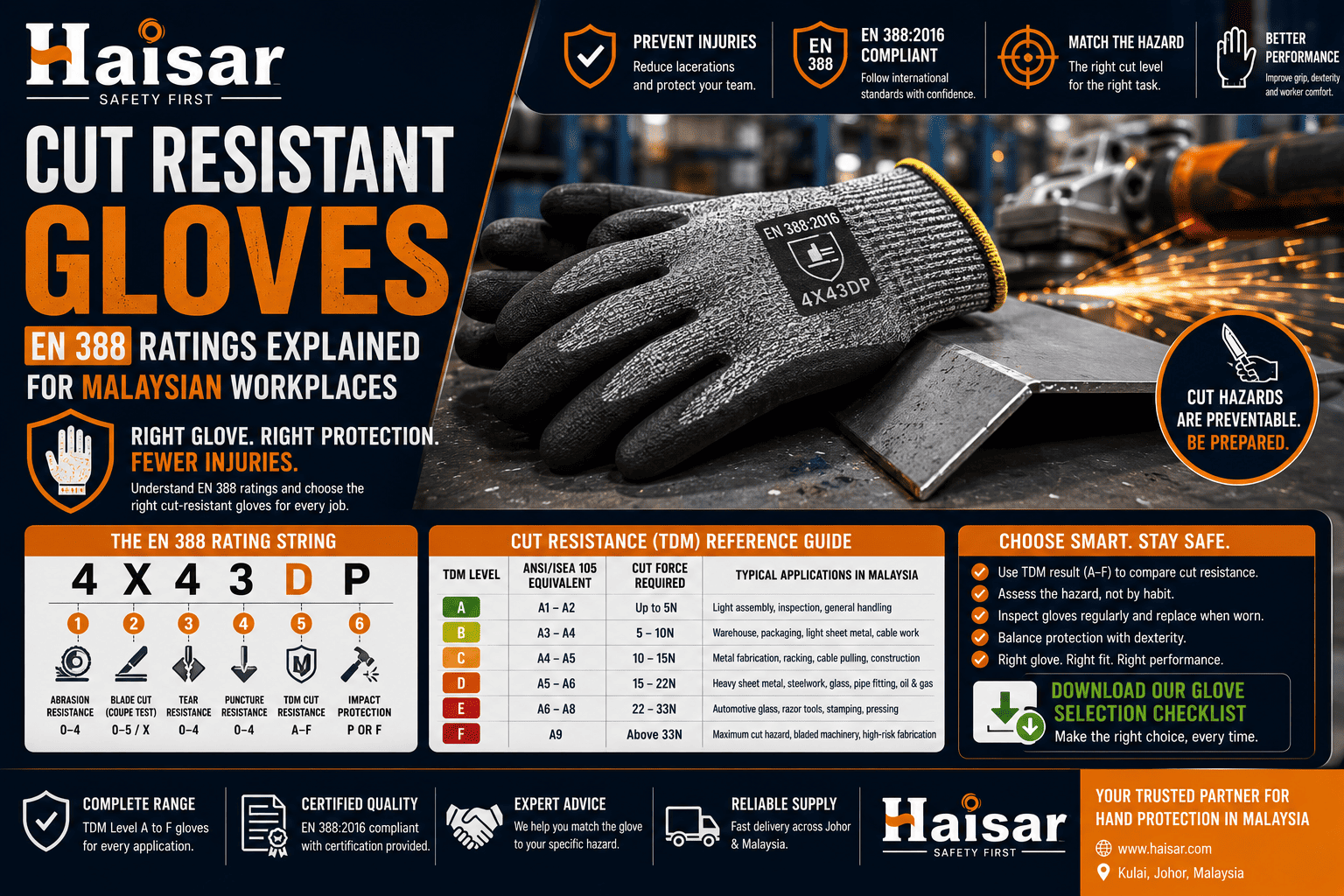
Cut injuries are the most frequently reported hand injury type on Malaysian industrial and construction sites. Most of them are preventable. The right cut-resistant glove, matched to the specific cutting hazard present at the task, reduces the severity of lacerations when contact with a sharp edge occurs and eliminates many cut injuries entirely.
The challenge procurement managers and HSE officers face is not finding cut-resistant gloves. The Malaysian market has dozens of options at every price point. The challenge is understanding the EN 388 rating system well enough to match the glove to the hazard rather than picking based on price or the most familiar brand.
This guide explains the EN 388 standard and its cut resistance ratings in plain terms, gives a clear reference table for Malaysian workplace applications, and covers the most common specification mistakes so your team avoids them.
What EN 388 Is and Why It Matters in Malaysia
EN 388 is the European standard for protective gloves against mechanical hazards. It is the primary glove standard referenced in Malaysia's industrial sector and is the standard most commonly required by principal contractors, PETRONAS contractor specifications, and international client safety requirements operating in Johor and across Malaysia.
When you see a glove label with a shield icon followed by a string of numbers and letters, that is the EN 388 rating. Every number and letter in the sequence tells you something specific about how the glove performs against a different mechanical hazard. Understanding what each position in the rating means is what makes glove selection a defensible specification decision rather than a guess.
The EN 388 standard was updated in 2016. The update added a new blade cut test, the TDM test, alongside the original Coupe cut test. This means gloves certified to EN 388:2016 carry a longer rating string than older gloves tested under EN 388:2003. Both are still in the market in Malaysia. Knowing which version applies to the gloves you are buying matters for cut resistance specifically.
The EN 388 Rating String: Position by Position
A typical EN 388:2016 glove label looks like this: 4X43BP
Each character in the string corresponds to a specific test result. Here is what each position means.
Position 1 — Abrasion resistance (0 to 4)
How many cycles of sandpaper abrasion the glove material withstands before being worn through. Level 1 is the lowest, Level 4 is the highest. A higher abrasion number means the glove lasts longer under friction from rough surfaces and rough handling. Relevant for any task involving sustained contact with abrasive materials, rough concrete, or unfinished metal surfaces.
Position 2 — Blade cut resistance, Coupe test (0 to 5 or X)
The original blade cut test from EN 388:2003. A rotating blade passes over the glove material under a set load until it cuts through. The number reflects the number of cycles before cut-through relative to a reference material. Level 5 is the highest protection. X means the test could not be conducted because the glove material blunted the blade, which typically indicates very high cut resistance materials including steel wire blends and HPPE constructions. For gloves tested under EN 388:2016, the TDM test result in the fifth position is the more reliable cut resistance indicator when both results are available.
Position 3 — Tear resistance (0 to 4)
The force required to tear the glove material once a cut is started. Higher levels mean the material resists tearing propagation. Relevant for environments with snagging hazards where a small cut or nick in the glove could propagate into a larger tear under tension.
Position 4 — Puncture resistance (0 to 4)
Resistance to penetration by a pointed object under a static load. Level 4 is the highest protection. Important for environments with nail, needle, wire, or thorn hazards. Note that EN 388 puncture resistance does not cover needlestick injuries from hypodermic needles, which is covered by a separate standard.
Position 5 — TDM blade cut resistance (A to F)
The new cut resistance test introduced in EN 388:2016. A straight blade is drawn across the glove material under a defined load. The result is expressed as a letter from A (lowest) through F (highest). This test produces more reliable cut resistance rankings than the Coupe test because the rotating blade in the Coupe test can be blunted by high-cut-resistance materials, producing artificially high results. The TDM letter is the most useful cut resistance indicator for specifying the correct glove for a cutting hazard.
Position 6 — Impact protection (P or F)
Pass or fail result for dorsal impact protection. P means the glove has met the EN 388 impact protection test requirement. F means it has not been tested or has failed. Relevant for gloves with knuckle and back-of-hand impact protection panels, increasingly specified in oil and gas, heavy construction, and pipe fitting environments in Johor.
The Cut Resistance Reference Table
| EN 388 TDM Level | ANSI/ISEA 105 Equivalent | Cut Force Required | Typical Applications in Malaysia |
|---|---|---|---|
| A | A1 to A2 | Up to 5N | Light assembly, inspection, general handling with occasional sharp surface contact |
| B | A3 to A4 | 5 to 10N | Warehouse picking, packaging, light sheet metal, cable work with mild cut exposure |
| C | A4 to A5 | 10 to 15N | Metal fabrication, sheet metal handling, racking installation, cable pulling, general construction |
| D | A5 to A6 | 15 to 22N | Heavy sheet metal, structural steelwork, glass handling, pipe fitting, oil and gas maintenance |
| E | A6 to A8 | 22 to 33N | Automotive glass, razor sharp cutting tools, stamping and pressing operations |
| F | A9 | Above 33N | Maximum cut hazard: bladed machinery, slash-resistant applications, highest-risk fabrication |
How to Read a Glove Label: Worked Examples
Example 1: Label reads 4543BP
Position 1 (4): Excellent abrasion resistance. Position 2 (5): High Coupe cut resistance. Position 3 (4): Excellent tear resistance. Position 4 (3): Good puncture resistance. Position 5 (B): TDM cut level B, suitable for moderate cut hazard. Position 6 (P): Impact protection passes.
This is a robust general-purpose work glove with impact protection, suitable for construction site use and general industrial maintenance. The TDM Level B means it is appropriate for tasks with moderate incidental cut exposure but not for sustained high-cut-hazard work like sheet metal handling.
Example 2: Label reads 4X43F
Position 1 (4): Excellent abrasion resistance. Position 2 (X): Coupe test not valid, material blunted the blade. Position 3 (4): Excellent tear resistance. Position 4 (3): Good puncture resistance. Position 5 (F): TDM cut level F, maximum cut protection. No Position 6: No impact protection claim.
This is a high cut-resistance glove suitable for sheet metal, structural steel, glass handling, and any application with severe cutting hazard. The X in Position 2 confirms very high cut-resistance material. No impact protection feature.
Example 3: Label reads 2213A
Position 1 (2): Moderate abrasion resistance. Position 2 (2): Moderate Coupe cut resistance. Position 3 (1): Low tear resistance. Position 4 (3): Good puncture resistance. Position 5 (A): TDM cut level A, minimal cut protection. No Position 6: No impact protection.
This is a light handling glove with good puncture resistance but minimal cut protection. Appropriate for needle stick risk protection or light assembly tasks but not for any environment with meaningful cutting hazard.
Selecting the Right Cut Level for Malaysian Work Environments
Light assembly, inspection, and picking operations. TDM Level A. Light, dexterous gloves that protect against minor incidental contact with sharp surfaces without restricting fine motor tasks. Common in electronics manufacturing, warehouse operations, and inspection roles.
Cable installation and tray work. TDM Level B to C. Cable armour and sharp conduit edges create moderate cut risk. A Level B or C glove balances cut protection with the grip and dexterity needed for pulling and routing cable.
Metal fabrication, racking, and structural steel. TDM Level C to D. Regular contact with sharp metal edges during fabrication, assembly, and installation. Level C provides meaningful protection for general fabrication work. Level D for sustained heavy sheet metal handling.
Oil and gas maintenance and pipe fitting. TDM Level C to D with impact protection (P). Pipe fitting and valve operations combine cut risk from metal edges with pinch-point and struck-by risk for the back of the hand. Specify a glove with both TDM Level C or D and a P impact protection rating.
Glass handling and razor-edge cutting tools. TDM Level E to F. These are the highest cut hazard applications on any Malaysian industrial site. Laminated glass, precision cutting blades, and stamping dies all require maximum cut protection.
Shipyard and marine fabrication in Johor. TDM Level C to D for structural steel and marine fabrication. Consider additional chemical resistance in the palm coating for environments where cutting oils and lubricants are present alongside the cutting hazard.
What EN 388 Does Not Cover
Understanding the limitations of EN 388 is as important as understanding what it measures.
EN 388 does not cover needle-stick injuries. Hypodermic needles and fine wires are not addressed by EN 388 puncture resistance. Healthcare and waste management applications with hypodermic needle risk require gloves tested to EN 388 with ISO 13997 needle-stick resistance.
EN 388 does not cover chemical resistance. A cut-resistant nitrile-coated glove is not a chemically resistant glove unless it also carries EN 374 certification for the specific chemicals present. Cut protection and chemical protection are separate requirements and may require separate gloves for different tasks.
EN 388 does not cover thermal hazards. Heat and cold protection are covered by EN 407 and EN 511 respectively. A cut-resistant glove is not a welding glove and must not be used as one.
EN 388 cut resistance applies to the palm. The TDM and Coupe cut tests are conducted on the palm area of the glove. The back of the hand and finger tips may have lower cut resistance than the palm. For applications where the back of the hand or fingertips are exposed to cutting hazard, confirm the protection coverage extends to those areas.
Common Specification Mistakes in Malaysian Workplaces
Using Coupe test results only to compare cut resistance. The original Coupe test result in Position 2 of the EN 388 string is unreliable for high cut-resistance materials because the rotating blade blunts on materials above a certain hardness, producing a maximum result that does not reflect true cut resistance. Always compare gloves using the TDM result in Position 5 for meaningful cut resistance ranking.
Specifying cut level by habit rather than hazard assessment. Many Malaysian sites specify the same cut level across all glove users regardless of the specific tasks performed. A warehouse picker and a sheet metal fabricator have very different cut hazard profiles. The same glove specification does not serve both correctly.
Treating anti-cut coating as a permanent feature. The cut-resistant coating or liner of a glove degrades through use, washing, and abrasion. A glove that tested at TDM Level D when new may perform at a lower level after extended use or repeated washing. Inspect gloves regularly and replace when visible wear reduces the cut-resistant material.
Choosing cut level without considering dexterity. A TDM Level F glove provides maximum cut protection but is heavy and relatively inflexible. Specifying the highest available cut level for tasks that require fine dexterity results in gloves that workers remove because they cannot complete the task while wearing them. Match the cut level to the hazard, not to the maximum available.
Haisar Supply and Services: Cut Resistant Gloves in Malaysia
Haisar Supply and Services supplies cut-resistant gloves across all EN 388 TDM levels for industrial workplaces across Johor and peninsular Malaysia. Our cut-resistant glove range covers TDM Level A lightweight assembly gloves through to TDM Level F maximum cut protection gloves for high-hazard fabrication and glass handling applications, with options for added impact protection, chemical resistant coatings, and anti-static properties for classified area use.
We provide EN 388:2016 certification documentation with every glove order and can advise on the correct TDM level and glove construction for your specific cutting hazard and task requirements.
Get a Quote for Cut Resistant Gloves
Contact our team with your application, workforce size, and required specification and we will respond with product options, certification references, and pricing tailored to your site in Johor and across Malaysia.
Browse Hand Protection Products at haisar.com
Haisar Supply and Services Sdn Bhd (985158-T) | Kulai, Johor, Malaysia | www.haisar.com
