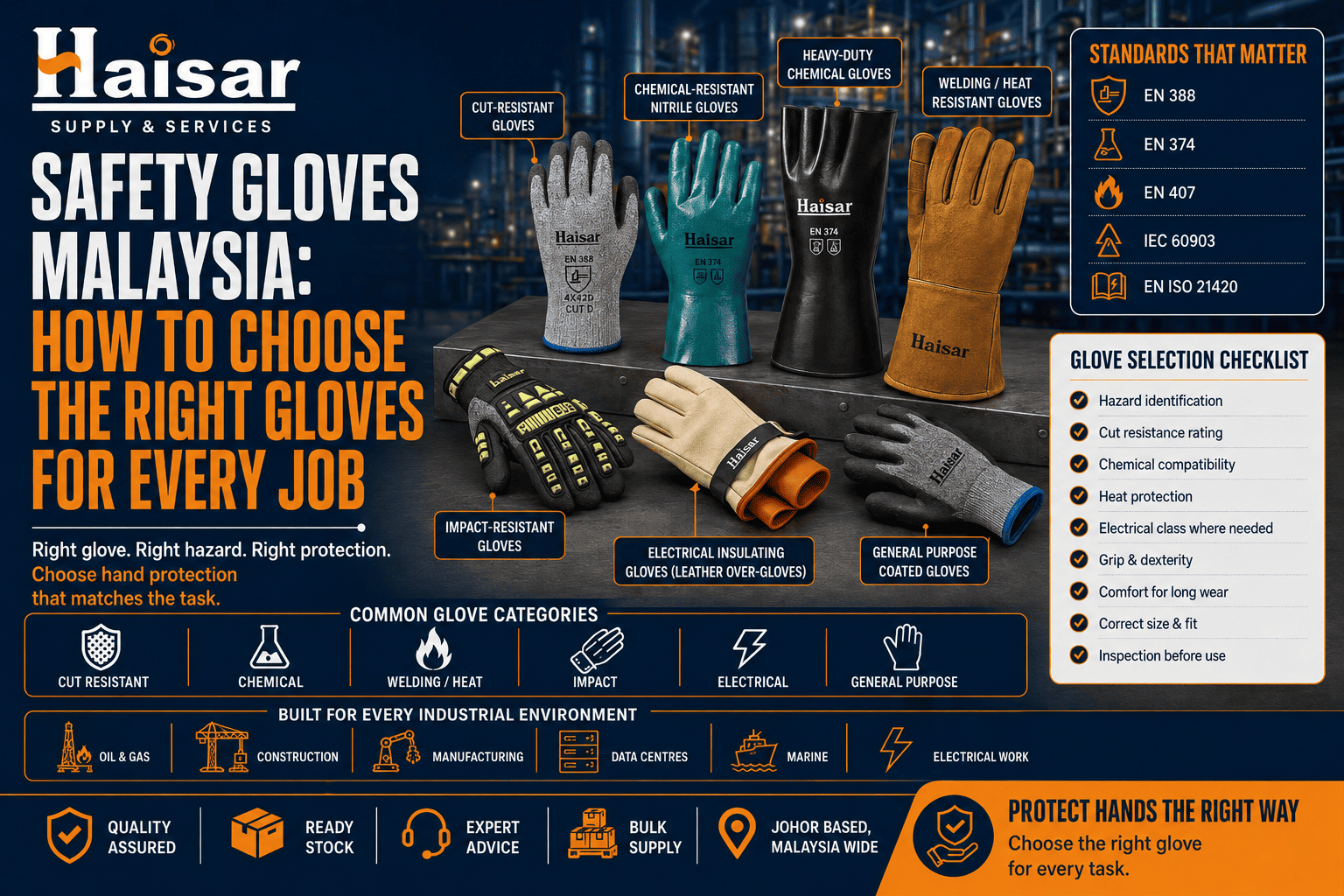
Hand injuries are the most frequently reported workplace injuries in Malaysian industry. They are also among the most preventable. The hand is in contact with work materials, tools, and equipment throughout every task, and the variety of hand hazards across Johor's industrial sectors, from the cut risk of metal fabrication to the chemical exposure of process plant maintenance, from the thermal hazard of welding to the electrical risk of live electrical work, is broader than almost any other body part a worker needs to protect.
The challenge is not finding safety gloves. The Malaysian market has hundreds of glove options across dozens of categories. The challenge is selecting the right glove for the specific hazard present at the specific task. A glove that is wrong for the application does not protect. Worse, it can create false confidence that causes workers to take risks they would not take with unprotected hands.
This pillar guide covers every major safety glove category relevant to Malaysian industrial workplaces, the standards and ratings that matter, and a structured approach to glove selection that HSE managers and procurement teams can apply across the full range of tasks on their sites. At the end, a downloadable glove selection checklist is available to support consistent specification decisions across your workplace PPE programme.
Why Glove Selection Is More Complex Than It Looks
There is a persistent misconception in Malaysian industrial procurement that gloves are a commodity. One box of nitrile gloves for general purpose use, one pair of leather gloves for heavy work. Done.
This approach fails in two ways. It provides inadequate protection in situations where the hazard requires a specific glove type. And it provides excessive restriction in situations where a lighter, more dexterous glove would maintain grip and task performance while still protecting the hand.
Both failures have consequences. The first is an injury waiting to happen. The second is a worker who removes the glove because it prevents them doing their job, and then injures themselves with an unprotected hand.
Correct glove selection requires understanding the hazard, reading the rating system, and matching the glove to both the protection requirement and the task demands simultaneously. This guide makes that process straightforward.
Understanding the Glove Standards Framework
Before reviewing glove categories, understanding the standards framework that governs glove selection in Malaysia provides the foundation for defensible procurement decisions.
EN 388 (Mechanical Risks). The European standard for protective gloves against mechanical hazards including abrasion, cut resistance, tear resistance, and puncture resistance. EN 388 is the most widely referenced glove standard in Malaysia's industrial market. Under the 2016 revision of EN 388, gloves are rated across five performance levels indicated by the marking sequence on the glove label. Cut resistance is now assessed using both the original Coupe test and the ISO 13997 TDM blade cut test, with the TDM result expressed as a letter from A to F.
ANSI/ISEA 105. The American standard for hand protection, used by international contractors and oil and gas operators in Malaysia who specify American standards. ANSI 105 uses a nine-level cut resistance scale from A1 to A9 and separate ratings for puncture resistance, abrasion, and other mechanical hazards.
EN 374 (Chemical and Micro-Organism Risks). The standard governing chemical resistant gloves. It assesses gloves against penetration, permeation, and degradation by chemicals. The key output is the breakthrough time for listed chemicals, expressed as a performance level from 1 to 6. Glove selection for chemical applications must reference the EN 374 chemical resistance data for the specific chemicals being handled.
EN 407 (Thermal Risks). The standard for protective gloves against thermal hazards including contact heat, convective heat, radiant heat, and resistance to small splashes of molten metal. Each property is rated on a scale of 0 to 4 or 0 to 5 depending on the sub-test.
IEC 60903 (Electrical Risks). The international standard for voltage-rated insulating rubber gloves. Classifies gloves by voltage class from Class 00 (500V AC maximum) through Class 4 (36,000V AC maximum).
EN ISO 21420 (General Glove Requirements). The baseline standard covering general glove requirements including ergonomics, sizing, comfort, and the minimum performance level for gloves claiming protective function.
Malaysian industrial sites generally accept EN standard certification for safety gloves, with ANSI standards also accepted in oil and gas and international client environments. SIRIM certification for safety gloves is less universally mandated than for PPE categories such as hard hats, but compliance documentation should be available for any gloves used in regulated industrial environments.
Cut-Resistant Gloves
Cut injuries are among the most common hand injuries on Malaysian construction, manufacturing, oil and gas, and maintenance sites. Metal edges, cable armour, sheet materials, glass, and cutting tool contact all produce lacerations ranging from superficial to tendon-severing.
Cut-resistant gloves are the primary control for cut hazard. They do not make hands indestructible. They reduce the severity of lacerations when contact with a sharp edge occurs, and they protect against incidental contact during handling tasks where the worker does not anticipate direct contact with a sharp surface.
Cut resistance ratings. Under the updated EN 388 standard, cut resistance is expressed as a letter from A to F on the TDM blade test, where A represents the lowest cut resistance and F represents the highest. Under ANSI/ISEA 105, cut resistance levels run from A1 (lowest) through A9 (highest). The ratings are not directly interchangeable between the two systems, but broadly:
EN 388 Level A corresponds to ANSI A1 to A2. EN 388 Level B to ANSI A3 to A4. EN 388 Level C to ANSI A4 to A5. EN 388 Level D to ANSI A5 to A6. EN 388 Level E to ANSI A6 to A7. EN 388 Level F to ANSI A8 to A9.
Selecting the right cut level. The correct cut level is determined by the specific cutting hazard, not by a general assumption of what is adequate. Common applications on Malaysian industrial sites and the appropriate cut level guidance:
General material handling and assembly with occasional sharp surface contact requires EN 388 Level A or B, ANSI A2 to A3. Light cut resistance in a dexterous, comfortable glove that does not compromise grip or tactile feedback.
Metal fabrication, sheet metal handling, and racking installation with regular contact with sharp metal edges requires EN 388 Level C to D, ANSI A4 to A6. Moderate to high cut resistance in a glove that maintains enough dexterity for precise handling.
Cable pulling and cable management installation with armoured cable and sharp conduit edges requires EN 388 Level C to D minimum. The combination of cut resistance and grip on large-diameter cable is the key performance requirement.
Glass handling, ceramic materials, and very sharp cutting tools require EN 388 Level E to F, ANSI A7 to A9. Maximum cut resistance for the highest severity cut hazard applications.
Glove materials for cut resistance. High-performance cut-resistant gloves use engineered fibres including HPPE (high-performance polyethylene), Kevlar, steel wire blended yarns, and glass fibre blends to achieve higher cut resistance ratings in lighter constructions. The heavier and less dexterous the cut-resistant glove, the harder it is for workers to use it effectively. Always balance cut protection with the dexterity needed for the task.
Chemical Resistant Gloves
Chemical resistance is the most technically demanding category of glove selection because the protection provided is entirely specific to the relationship between the glove material and the chemical being handled. A glove that is highly resistant to one chemical may be degraded by another within minutes.
The fundamental rule is that glove material selection for chemical applications must be verified against the manufacturer's chemical resistance data for each specific chemical. Do not assume. Do not generalise. Check the data.
Nitrile rubber gloves. The most widely used chemical resistant glove in Malaysian industrial environments. Nitrile provides good resistance to oils, fuels, greases, and many non-polar organic solvents. It is the appropriate general-purpose chemical resistant glove for maintenance work involving hydraulic fluid, lubricants, and petroleum products. Nitrile does not provide adequate resistance to ketones, strong oxidising acids, or chlorinated solvents.
Natural rubber latex gloves. Good resistance to water-based chemicals, dilute acids, and dilute alkalis. Not resistant to petroleum products or organic solvents. Latex allergy is a significant occupational health consideration. Latex gloves must not be used in environments where latex-sensitive workers are present or where workers have a known latex allergy.
Neoprene gloves. Broader chemical resistance than nitrile or latex, covering a range of acids, alkalis, petroleum products, and certain organic solvents. A practical choice for environments handling a variety of different chemicals where a single glove type must address multiple hazards.
Butyl rubber gloves. Highest resistance to polar solvents including ketones, esters, and aldehydes. Also appropriate for concentrated acids, alkalis, and certain toxic materials. Butyl rubber is the correct specification for handling chemicals where nitrile and neoprene do not provide adequate resistance. Used in PETRONAS petrochemical facilities and specialist chemical handling operations across Johor.
PVC (polyvinyl chloride) gloves. Resistant to water-based chemicals, dilute acids, and alkalis. Less flexible than rubber gloves and typically used in wet work environments including food processing, cleaning operations, and water-based chemical handling.
Laminate film gloves (Silver Shield, 4H). The highest chemical resistance of any glove material, providing broad resistance to a very wide range of chemicals. Used for handling highly toxic materials where breakthrough from other materials would present unacceptable exposure risk. Less dexterous than rubber gloves and typically used for short-duration high-hazard tasks rather than continuous wear.
Breakthrough time and service life. Chemical resistant gloves are not permanently protective. The EN 374 breakthrough time indicates how long the glove material will resist permeation by a specific chemical at the conditions tested. When the task duration or glove exposure approaches the breakthrough time, the gloves must be changed. Gloves showing visible degradation, softening, or discolouration from chemical contact must be replaced immediately regardless of elapsed time.
Heat and Thermal Protection Gloves
Thermal hazards to hands on Malaysian industrial sites include contact with hot pipe surfaces and process equipment, convective heat from furnace and boiler openings, radiant heat from welding and cutting operations, and molten metal splash in foundry and fabrication environments.
Welding gloves. Leather welding gauntlets are the standard hand protection for TIG, MIG, and stick welding operations. Welding gloves protect against spatter, UV radiation from the arc, and contact with hot metal during and after welding. For TIG welding where dexterity is critical for precise electrode control, lighter goatskin TIG gloves provide better tactile feedback than heavy cowhide gauntlets.
Heat-resistant gloves (EN 407 rated). For handling hot components, working near process heat, and contact with surfaces at elevated temperatures. EN 407 contact heat resistance is rated from Level 1 (100 degrees Celsius) to Level 4 (500 degrees Celsius). Select the contact heat level appropriate for the surface temperatures encountered. Common applications in Malaysian power generation, oil and gas, and food processing environments.
Aluminised and proximity gloves. For work near furnaces, molten metal, and high radiant heat sources. Aluminised construction reflects radiant heat rather than absorbing it.
Anti-vibration gloves. For prolonged use of vibrating tools including impact wrenches, grinders, and jackhammers. Anti-vibration gloves reduce the transmission of vibration to the hand and arm, reducing the risk of hand-arm vibration syndrome (HAVS) from long-term vibration exposure. Relevant for maintenance and construction teams in Johor using vibrating tools for extended periods.
Impact Protection Gloves
Struck-by and pinch-point injuries to the back of the hand are common in heavy industry, oil and gas, and construction. Impact-resistant gloves with rigid or semi-rigid dorsal protection reduce the severity of injuries when the back of the hand is struck or caught in a pinch point.
EN 388 impact resistance is rated as P (pass) or F (fail) rather than a numeric scale. A glove with a P rating for impact resistance has met the standard's requirement for dorsal impact protection.
Impact-resistant gloves are particularly relevant for oil and gas and petrochemical maintenance in Johor, where pipe fitting, valve operations, and equipment handling in confined spaces create regular pinch-point and struck-by hazards for the hands. They are also specified for structural steelwork, racking installation, and heavy material handling in manufacturing and construction environments.
Electrical Insulating Rubber Gloves
Voltage-rated insulating rubber gloves are a safety-critical product whose failure mode is electrocution. They must be selected, maintained, and inspected with a rigour that does not apply to mechanical or chemical gloves.
Under IEC 60903, insulating gloves are classified by maximum working voltage. Class 00 for 500V AC, Class 0 for 1,000V AC, Class 1 for 7,500V AC, Class 2 for 17,000V AC, Class 3 for 26,500V AC, and Class 4 for 36,000V AC.
For most Malaysian industrial facilities operating at low voltage (up to 1,000V AC), Class 0 gloves are the minimum requirement for live electrical work. For medium voltage systems at 11kV and 33kV, Class 2 or Class 3 gloves are required.
Insulating rubber gloves must always be worn with leather over-gloves to protect the rubber from physical damage during use. A glove with a pinhole defect provides no electrical insulation. Pressure testing at intervals not exceeding six months verifies that the rubber dielectric integrity is intact. Gloves that have not been pressure tested within the required interval must not be used for live electrical work.
General Purpose and Handling Gloves
Not every task on a Malaysian industrial site involves a specific cut, chemical, thermal, or electrical hazard. General material handling, equipment operation, and routine maintenance tasks require a baseline level of hand protection against abrasion, grip enhancement, and minor cut and impact risk.
General purpose work gloves for Malaysian industrial environments should provide good grip on tools and equipment in both dry and wet conditions, adequate abrasion resistance for the tasks involved, basic cut resistance (EN 388 Level A to B) for incidental contact with sharp surfaces, and sufficient dexterity for the manual tasks being performed.
Synthetic leather palm gloves with back-of-hand breathability are the most practical general purpose glove for outdoor site work in Malaysia's climate. Coated work gloves with nitrile or polyurethane palm coatings provide excellent grip and abrasion resistance for general handling. Cotton-jersey lined gloves are the baseline option for very light work and assembly tasks.
The selection criteria for general purpose gloves in Malaysia should also account for the heat of extended wear. A heavy, unventilated work glove in Johor's outdoor industrial environment will be removed and stuffed in a pocket within the first hour. A lightweight, breathable glove that provides basic protection will actually be worn throughout the shift.
Glove Selection by Industry in Johor
Oil and gas (Pasir Gudang, offshore, PETRONAS facilities). Cut-resistant gloves at minimum EN 388 Level C for mechanical maintenance. Chemical resistant gloves matched to process chemicals and hydrocarbons. Insulating rubber gloves Class 0 to Class 3 for electrical work matched to system voltage. Impact-resistant gloves for pipe fitting and valve operations.
Construction and civil engineering. Cut-resistant gloves EN 388 Level C to D for rebar tying, metal formwork, and cable installation. General purpose handling gloves for concrete work and material handling. Leather welding gauntlets for any welding and hot work activities.
Data centres and electrical fit-out. Insulating rubber gloves matched to system voltage for electrical termination work. Light cut-resistant gloves for cable management and tray installation. ESD-compatible gloves for work in live data hall environments.
Manufacturing and industrial facilities. Cut-resistant gloves appropriate to the specific cutting hazard of the production process. Chemical resistant gloves matched to the specific process chemicals used. General purpose handling gloves for assembly and material handling.
Marine and shipyard operations. Heavy-duty cut-resistant gloves for rope handling and metal fabrication. Chemical resistant gloves for deck treatment chemicals and lubricants. Wet grip gloves with waterproof or water-resistant palm construction for work in marine conditions.
Solar and renewable energy projects. Cut-resistant gloves for panel frame handling and racking installation. Insulating rubber gloves for electrical termination work at inverter and combiner box locations.
Building a Glove Management Programme
Selecting the right gloves is the first step. Managing them correctly is what determines whether the protection remains in place throughout the working day.
Risk assessment-based selection. Every glove specification must trace back to a documented risk assessment for the specific task and hazard. The risk assessment drives the standard requirement, the standard drives the specification, and the specification drives the procurement decision. This chain of documentation is what a DOSH inspector or PETRONAS contractor audit examines.
Training in correct use. Workers must be trained in the purpose of the specific gloves they are issued, the limitations of those gloves, how to inspect them before use, and the procedure for replacing damaged or contaminated gloves. A worker who does not understand why nitrile gloves should not be used for ketone handling will use them anyway when no other option is visible.
Inspection before each use. All gloves must be visually inspected before each use for cuts, tears, chemical degradation, and in the case of insulating rubber gloves, any evidence of damage or defect. Damaged gloves must be replaced before the task begins.
Regular replenishment. Gloves are consumables. They degrade through use, washing, and exposure to the hazards they are protecting against. Procurement must include provision for regular replenishment and a management process that prevents sites from operating with degraded gloves because the replacement order has not yet been placed.
Download the Haisar Glove Selection Checklist
Haisar has developed a practical glove selection checklist covering the hazard assessment questions, the standard requirements for each glove category, and the key specifications to confirm before purchase.
Download the Glove Selection Checklist
Haisar Supply and Services supplies the complete range of safety gloves for industrial workplaces across Johor and peninsular Malaysia. Our glove range covers cut-resistant gloves from EN 388 Level A through Level F, chemical resistant gloves in nitrile, latex, neoprene, butyl, PVC, and laminate film materials, heat-resistant and welding gloves across EN 407 contact heat levels, impact-resistant gloves for heavy industry and oil and gas, insulating rubber gloves from Class 00 through Class 4 with pressure test certificates, anti-vibration gloves, and general purpose handling gloves for all site environments.
We supply with chemical resistance documentation, EN 388 and EN 374 certification references, and IEC 60903 test certificates for insulating rubber gloves. Our team can advise on the correct specification for your specific hazard environment and task requirements.
Browse Hand Protection Products at haisar.com
Haisar Supply and Services Sdn Bhd (985158-T) | Kulai, Johor, Malaysia | www.haisar.com