Can't find what you're looking for? Get in touch!



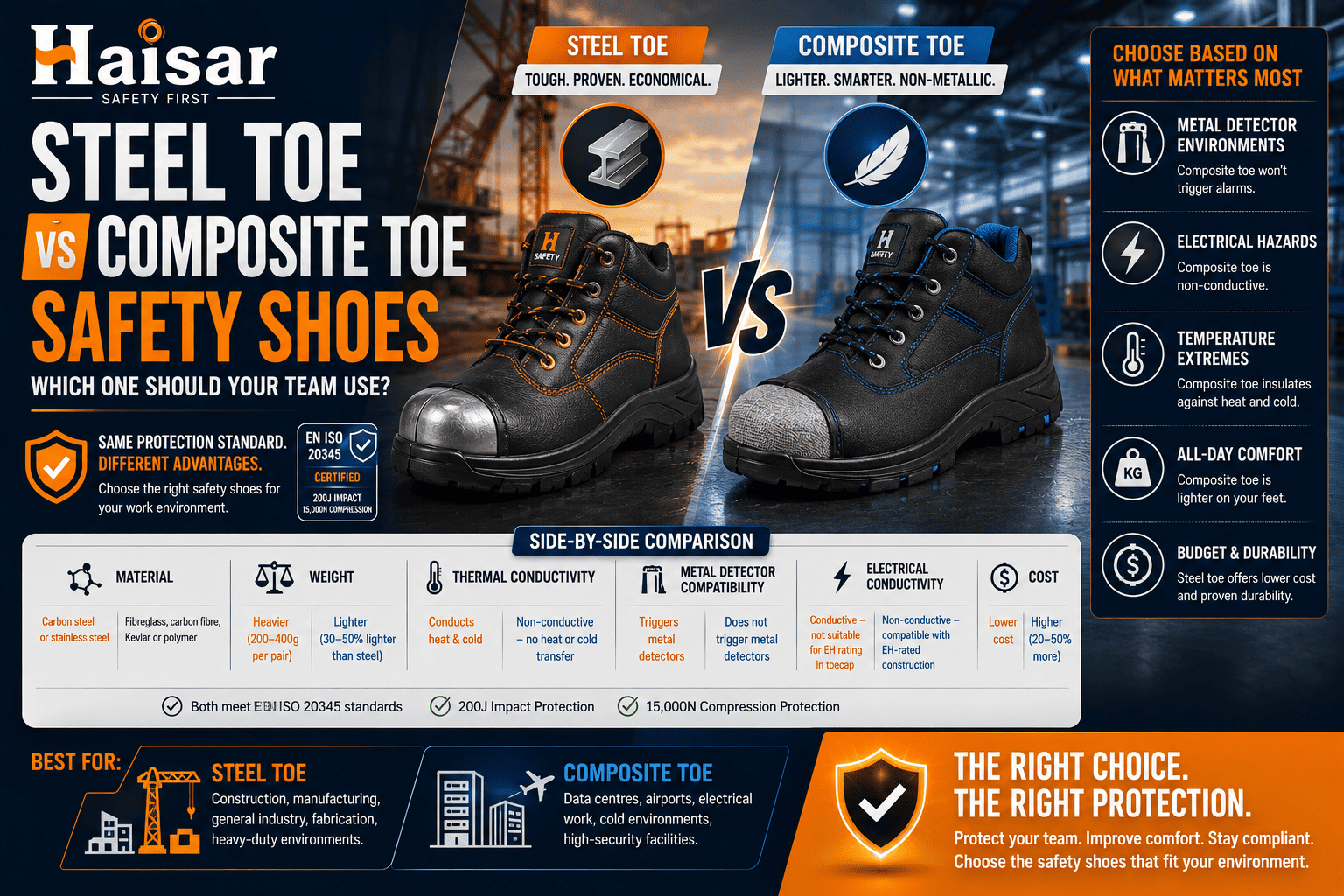
Walk into any safety equipment supplier in Johor and you will find both steel toe and composite toe safety shoes sitting side by side, often at very different price points, often with minimal explanation of why one might be right for your team over the other. Most procurement teams default to steel toe because it is familiar. Some default to composite because it sounds more advanced. Neither is the right approach.
The choice between steel toe and composite toe safety shoes is a specification decision that should be driven by the specific hazard environment, the working conditions, the regulatory requirements of the site, and the physical demands on the worker. Both meet the same fundamental impact and compression protection standard. The differences between them determine which one serves your team better in practice.
This guide breaks down the comparison clearly, covers the key differences in plain terms, and gives industrial buyers in Johor the information needed to make the right call for each site environment.
The Common Ground: What Both Toe Cap Types Must Deliver
Before comparing the differences, it is worth being clear about what steel toe and composite toe safety shoes have in common. Both are required to meet the same protection performance under EN ISO 20345, the international safety footwear standard adopted by Malaysia.
Under EN ISO 20345, all safety footwear regardless of toe cap material must withstand a 200-joule impact test and a 15,000-newton compression test. These tests simulate a heavy object falling onto the foot and a heavy object rolling across the toe respectively. Both steel and composite toe caps are independently tested and certified to these requirements before they can be sold as safety footwear.
This means the baseline protection is equivalent. A composite toe cap does not provide less impact or compression protection than a steel toe cap when both carry EN ISO 20345 certification. The differences between them lie elsewhere.
Side-by-Side Comparison
| Property | Steel Toe | Composite Toe |
|---|---|---|
| Material | Carbon steel or stainless steel | Fibreglass, carbon fibre, Kevlar, or plastic polymer |
| Weight | Heavier (adds 200–400g per pair) | Lighter (30–50% lighter than steel) |
| Impact protection (EN ISO 20345) | Meets 200J standard | Meets 200J standard |
| Compression protection | Meets 15,000N standard | Meets 15,000N standard |
| Thermal conductivity | Conducts heat and cold | Non-conductive — no heat or cold transfer |
| Electrical conductivity | Conductive — not suitable for EH rating in toecap | Non-conductive — compatible with EH-rated construction |
| Metal detector compatibility | Triggers metal detectors | Does not trigger metal detectors |
| Electrostatic discharge | Requires separate ESD outsole; toecap is neutral | Fully non-conductive construction possible |
| Durability under repeated impact | Deforms on severe impact but resists crushing | Can crack under extreme impact; less deformation |
| Unit cost | Lower | Higher (typically 20–50% more) |
| Typical environments | Construction, manufacturing, general industry | Data centres, airports, electrical work, cold environments |
Where Steel Toe Wins
Cost. Steel toe safety shoes cost less to manufacture and less to buy. For large project site mobilisations in Johor where hundreds of workers need to be equipped quickly and the hazard environment is general construction or industrial, the cost differential across the full workforce is meaningful. If the application does not require composite, there is no advantage in paying the premium.
Durability under sustained heavy use. On active construction sites and in heavy industrial environments where tools and materials are dropped regularly, steel toe caps take repeated minor impacts without structural change. A steel cap that has absorbed an impact remains functionally protective until it deforms severely enough to compress against the toe. Composite toe caps can develop micro-cracks from repeated minor impacts that are not visible externally but that reduce the structural integrity of the cap over time.
Proven track record. Steel toe safety footwear has been the standard for Malaysian industrial sites for decades. HSE managers, DOSH inspectors, and principal contractors are familiar with it. It does not generate questions about certification or capability on site.
General construction and industrial work. For the majority of Johor's construction sites, civil engineering projects, fabrication yards, and general industrial facilities, steel toe S3 boots are the correct specification. The working environment does not generate conditions where composite toe's specific advantages are relevant.
Where Composite Toe Wins
Metal detector environments. This is the clearest and most unambiguous advantage of composite toe footwear. Data centres, airports, government buildings, and secure facilities often require workers to pass through metal detectors during access. Steel toe boots fail metal detectors every time. Composite toe boots do not. For fit-out contractors at Johor's expanding hyperscale data centre facilities in Iskandar Puteri and Nusajaya, composite toe footwear is frequently the only practical option for maintaining site access procedures.
Electrical hazard environments. Electrical hazard rated safety footwear is built to provide insulation between the wearer's foot and the ground, protecting against incidental contact with live circuits. Steel toe caps are conductive metal components within the footwear construction. Composite toe caps are non-conductive throughout. For EH-rated footwear where the entire construction including the toe cap must contribute to the insulating system, composite construction is the technically correct choice. Electrical maintenance workers, data centre technicians, and power generation personnel working in live electrical areas benefit from the fully non-conductive construction.
Extreme cold environments. Steel is a good thermal conductor. In cold storage facilities, refrigerated warehouses, and cold chain logistics environments, steel toe caps draw heat away from the toes, accelerating heat loss and increasing cold injury risk. Composite toe caps do not conduct cold in the same way. For workers in cold chain and refrigerated environments, composite toe footwear is the more appropriate specification.
Lightweight applications. Where workers are on their feet for extended shifts in environments with lighter physical impact hazard, the weight reduction from composite toe footwear reduces fatigue. For supervisory, inspection, and technical roles on large sites, lighter footwear worn for ten to twelve hours at a stretch makes a genuine difference to comfort and end-of-shift fatigue levels.
High UV outdoor environments. A minor but real consideration in Malaysia's equatorial climate. Steel toe caps heat up when exposed to prolonged direct sunlight in a way that composite materials do not. For outdoor workers in open sites without shade cover, including solar farm installation teams and highway construction crews, composite toe caps remain more comfortable at the toe during peak heat hours.
The Anti-Static and ESD Question
This is one of the most frequently confused aspects of safety footwear specification in Johor's industrial market, and it is worth addressing directly because the confusion creates real compliance gaps.
Anti-static and ESD footwear is specified for environments where electrostatic discharge is a hazard, either to sensitive electronic equipment in data centres and electronics manufacturing, or as an ignition source in classified hazardous areas on oil and gas and petrochemical sites.
Anti-static and ESD footwear works through the outsole. The outsole is manufactured with a controlled level of electrical resistance that allows static charge to dissipate from the body to earth. The toe cap material is largely irrelevant to the anti-static function because the charge dissipation path runs through the outsole and upper, not through the toe cap.
Both steel toe and composite toe safety shoes can be manufactured with anti-static or ESD outsoles. Both can carry the A or ESD marking under EN ISO 20345. The toe cap material does not determine whether the footwear provides anti-static protection. The outsole and construction specification does.
However, for fully classified hazardous area applications where the entire footwear construction should ideally be non-metallic, composite toe construction is often the preferred specification because it eliminates any risk of the metallic toe cap creating an unexpected conductive pathway in the footwear system.
Which Is Right for Johor's Key Industries
Oil and gas sites in Pasir Gudang. Steel toe S3 with anti-static outsole for general site workers in non-classified areas. Composite toe with ESD construction for workers in classified zones where full non-metallic construction is preferred by the site HSE specification.
Construction and civil engineering sites. Steel toe S3 for the majority of workers. No specific advantage to composite on standard Johor construction sites unless the site operates metal detector access control.
Data centre construction and fit-out in Iskandar Puteri. Composite toe as the standard specification to avoid metal detector issues during access. ESD outsole for work in live data hall environments.
Shipyard and marine operations. Steel toe maritime deck footwear for most applications. The maritime outsole compound and tread pattern is the critical specification for wet steel deck environments, not the toe cap material.
Manufacturing and warehousing. Steel toe for general production and warehousing. Composite or steel with anti-static/ESD outsole for cleanroom, electronics, and sensitive equipment environments.
Power generation facilities. Steel toe for general maintenance and construction. Composite toe with EH rating or ESD construction for electrical maintenance personnel in live electrical areas.
Cold chain and refrigerated logistics. Composite toe to eliminate the cold transfer issue that steel toe caps create in sustained cold environments.
Frequently Asked Questions
Do composite toe safety shoes provide less protection than steel toe?
No. Both must meet the same 200-joule impact and 15,000-newton compression requirements under EN ISO 20345. Composite toe shoes certified to this standard provide equivalent protection to steel toe shoes. The material is different. The protection level is the same.
Can I use steel toe safety shoes in a data centre in Johor?
Only if the facility does not operate metal detector access control. Most hyperscale and enterprise data centre facilities in Johor's Iskandar Puteri corridor use metal detector or security screening at facility access points. Steel toe boots trigger these detectors and prevent access. Composite toe footwear is the practical specification for data centre environments.
Are composite toe safety shoes more expensive?
Generally yes, by approximately 20 to 50 percent more than equivalent steel toe specifications. The premium reflects the higher cost of composite materials and more complex manufacturing. For large workforce orders, the cost differential is meaningful and should be factored into the procurement budget for the applications that genuinely require composite construction.
Can the same pair of shoes be used for both anti-static and general construction requirements?
Many anti-static or ESD rated safety shoes also meet general S3 construction site requirements. Check that the footwear carries both the S3 or appropriate S-rating and the A or ESD marking, and that the physical construction is robust enough for the construction environment. Not all anti-static footwear is built for rough construction site conditions.
How do I know if my site requires composite toe footwear?
Ask four questions. Does the site use metal detector access control? Are workers performing electrical work in live electrical areas where full non-metallic construction is specified? Is the environment a classified hazardous area where the site HSE specification requires non-metallic footwear? Is the environment cold storage or refrigerated? If any of these apply, composite toe is the correct specification.
Haisar Supply and Services: Safety Footwear Supplier in Johor
Haisar Supply and Services supplies both steel toe and composite toe safety footwear across the full S-rating range for industrial project sites, facilities, and organisations across Johor and peninsular Malaysia. We carry stock of fast-moving specifications and can source specific brands and protection configurations for project mobilisation requirements.
Our footwear range covers S1P, S3, S4, and S5 rated steel toe and composite toe options, anti-static and ESD rated footwear for classified areas and data centre environments, electrical hazard rated composite toe footwear for live electrical work, maritime deck footwear for shipyard and port operations in Johor, and chemical resistant safety wellingtons for process and chemical handling environments.
Browse Foot Protection Products at haisar.com
Contact our team for product specifications, certification documentation, bulk order pricing, and delivery to your project site or facility in Johor and across Malaysia.
Haisar Supply and Services Sdn Bhd (985158-T) | Kulai, Johor, Malaysia | www.haisar.com
