Can't find what you're looking for? Get in touch!



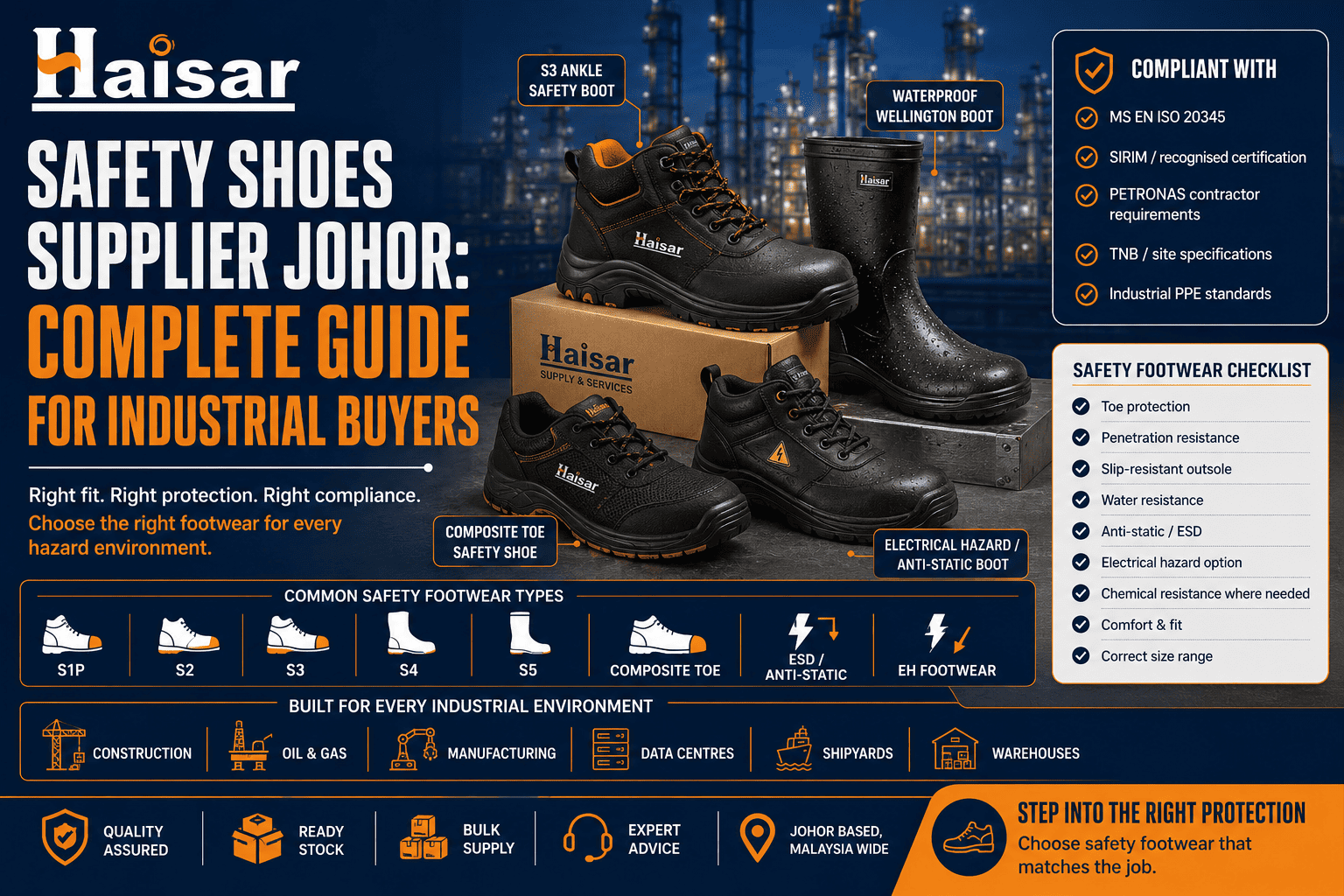
Safety footwear is one of the most personal items of PPE your workers will wear. Unlike a hard hat or a hi-vis vest that sits on top of the body, safety shoes are worn for an entire shift, walked in across uneven terrain, stood in on concrete for hours at a time, and subjected to the full range of Malaysian weather from monsoon mud to sun-baked tarmac. When the footwear is right, workers wear it without complaint. When it is wrong, the PPE programme starts to unravel because workers find ways to avoid wearing it.
For industrial buyers in Johor sourcing safety shoes for construction sites, oil and gas facilities, manufacturing plants, data centres, shipyards, and warehouses, this guide covers everything you need to make the right procurement decision. From the safety shoe types and protection standards that apply in different hazard environments to the practical selection checklist that procurement managers and HSE officers use to specify correctly, this is the complete reference for safety footwear sourcing in Johor.
Why Safety Shoe Selection Matters More Than Most Buyers Realise
Foot injuries are among the most frequently reported workplace injuries in Malaysia. Crushed toes from falling objects, puncture wounds from nails and sharp debris, slips and falls on wet or contaminated surfaces, chemical burns from spilled process fluids, and electrical contact through poorly specified footwear all appear in DOSH incident records across Johor's active industrial sectors.
The safety shoe is the control for all of these hazards simultaneously, but only if the right shoe is selected for the specific hazard combination present at the work location. A steel-toe boot that meets S3 requirements on a general construction site does not meet the anti-static requirement for a classified hazardous area. Anti-static footwear does not provide electrical hazard protection in live electrical environments. Maritime deck footwear is not the same as chemical resistant footwear. And none of these specialised shoes should be bought based on price alone without confirming they meet the required standard for the application.
The cost of selecting the wrong safety footwear is not the purchase price. It is the injury, the downtime, the compliance failure, and in serious cases the regulatory and legal consequences that follow.
The Safety Footwear Standards Applicable in Malaysia
Safety footwear sold and used in Malaysian industrial workplaces must comply with applicable certification standards. Understanding the standards in use across Malaysian industry helps buyers specify correctly and verify compliance claims.
MS EN ISO 20345. The Malaysian Standard adopting the international EN ISO 20345 standard for safety footwear. This is the primary standard for industrial safety footwear in Malaysia and defines the S-rating system used to classify safety shoes by their protection features. Safety footwear certified to EN ISO 20345 and marked with an S rating is the standard specification for industrial sites across Johor.
ANSI/ASTM F2413. The American standard for protective footwear, referenced in Malaysia's oil and gas sector and by international contractors and operators who specify American standards in their contractor safety requirements. ASTM-rated footwear uses a different classification notation to the EN system but addresses similar protection categories.
SIRIM Certification. Safety footwear sold in Malaysia for use in regulated workplaces should carry SIRIM certification or equivalent international certification. SIRIM-certified footwear has been tested and verified against the applicable Malaysian standard.
TNB and PETRONAS specifications. For electrical safety applications and for contractors working at TNB and PETRONAS facilities, footwear specifications may reference TNB or PETRONAS technical standard requirements that go beyond the general EN ISO 20345 baseline. Confirm the applicable specification before purchasing for these environments.
The S-Rating System: What Each Rating Means
The EN ISO 20345 S-rating system is the most important thing industrial buyers in Johor need to understand about safety footwear. Each S rating indicates the combination of basic and additional protection features the shoe provides.
SB (Safety Basic) is the minimum safety footwear classification. It includes a 200-joule toecap and a basic construction. SB footwear is rarely the right specification for active industrial environments in Malaysia. It is the regulatory floor, not a practical procurement target.
S1 adds antistatic properties, energy absorption in the heel, and fuel oil resistance to the SB baseline. Suitable for light industrial environments where basic hazard protection is required.
S1P adds a mid-sole penetration resistance to S1. The P suffix means the sole cannot be penetrated by a 4.5mm nail under a 1,100 newton load. Required for any environment where sharp objects on the floor are a hazard, including construction sites, fabrication workshops, and maintenance environments.
S2 adds water resistance to the S1 specification. The upper material resists water penetration for at least 60 minutes of flexing in water. Suitable for wet environments where the foot may be in contact with surface water.
S3 is the most commonly specified safety footwear standard across Malaysian construction and industrial sites. It combines the S2 water resistance specification with the S1P mid-sole penetration resistance. S3 is the appropriate default specification for general construction, manufacturing, oil and gas, and most industrial project environments in Johor. If in doubt, specify S3.
S4 is equivalent to S1 protection in a rubber or polymer construction, typically a Wellington boot or similar fully moulded design. No upper material water resistance standard applies because the construction is fully waterproof by nature. Appropriate for agricultural, food processing, and wet operations environments.
S5 adds mid-sole penetration resistance to S4, the rubber or polymer construction equivalent of S3. Appropriate for food processing, wet industrial environments, and outdoor operations in monsoon conditions where both waterproofing and penetration resistance are required.
Additional protection suffixes. Beyond the S rating, EN ISO 20345 footwear may carry additional protection code suffixes indicating properties beyond the base rating. The most important for Malaysian industrial procurement are:
HRO (heat resistant outsole) for contact with hot surfaces up to 300 degrees Celsius. Relevant for foundry work, boiler maintenance, and any environment where floor surfaces are at elevated temperatures.
WR (water resistant) indicating the complete shoe meets water penetration resistance requirements.
AN (ankle protection) for footwear with reinforced ankle impact protection.
ESD or A (antistatic and electrostatic dissipative) for environments where electrostatic discharge is a hazard to sensitive equipment or processes. Important for data centre environments, electronics manufacturing, and classified hazardous areas.
HI (heat insulation) and CI (cold insulation) for insulated footwear in extreme temperature environments.
Safety Shoe Types for Industrial Use in Johor
Understanding the different physical formats of safety footwear helps match the right shoe type to the specific working environment and task requirements.
Safety Boots (Ankle Height)
The most common safety footwear format on Malaysian construction and industrial sites. Safety boots provide ankle support that is important for uneven terrain, outdoor project sites, and environments with trip hazards. S3-rated safety boots are the default specification for construction sites, manufacturing facilities, oil and gas operations, and general industrial use across Johor.
Safety boots are available in full-grain leather uppers for durability and water resistance, synthetic and PU leather uppers for lighter weight and lower cost, and composite construction with non-metallic toecaps and penetration-resistant mid-soles for applications where metal detectors are in use or where electrical insulation is required throughout the footwear construction.
Safety Shoes (Low Cut)
Low-cut safety shoes provide toecap and sole protection without ankle coverage. They are lighter and more comfortable than boots and are appropriate for environments with smooth, flat floors, lighter workloads, and lower trip and ankle hazard profiles. Common in manufacturing, warehousing, and light industrial environments. Not appropriate for construction sites with uneven terrain or for outdoor sites in wet season conditions.
Safety Wellington Boots
Fully waterproof moulded boots appropriate for wet season site conditions, cable trenching and earthworks, food processing, chemical environments where the foot and lower leg may be exposed to chemical splash, and any outdoor environment where standing water is present. Safety wellingtons are available in standard S4 and S5 configurations with steel toecaps moulded into the boot construction.
Composite Toe Safety Footwear
Safety footwear with composite, plastic, or fibreglass toecaps rather than steel. Composite toe footwear is lighter than steel toe, does not conduct heat or cold from the toecap, and is appropriate for environments where metal detectors are in use, such as airport construction projects and secure facilities. Composite toe footwear is also preferred in very cold environments where steel toecaps become uncomfortably cold against the foot.
Electrical Hazard (EH) Rated Safety Footwear
Safety footwear specifically rated for electrical hazard protection, providing insulation against incidental contact with live circuits up to a specified voltage level. EH-rated footwear is required for electrical maintenance work in live electrical areas and for any work environment where inadvertent contact with live conductors is a risk. EH-rated footwear is a secondary protective measure alongside primary electrical PPE including voltage-rated gloves. It is not a substitute for primary electrical PPE.
Anti-Static and ESD Safety Footwear
Anti-static and ESD footwear dissipates static electrical charge from the wearer's body to earth, preventing the build-up of static electricity that could ignite flammable atmospheres or damage sensitive electronic equipment. Required in classified hazardous areas on oil and gas and petrochemical sites, in data centre environments, and in electronics manufacturing. Anti-static footwear must be worn without insulating insoles, thick socks, or other footwear modifications that break the anti-static circuit between the wearer and the floor.
Maritime and Deck Safety Footwear
Safety footwear with outsoles specifically compounded and treaded for traction on wet steel deck surfaces. Standard construction safety boots with smooth-profile rubber outsoles are a slip hazard on wet steel decks in Johor's shipyards and port facilities. Maritime deck footwear uses specialised outsole formulations that maintain grip on oiled and wet steel in a way that standard industrial outsoles do not.
Chemical Resistant Safety Footwear
Safety footwear with uppers and outsoles resistant to specific classes of chemical. Chemical resistance is material-specific and must be verified against the chemicals present in the work environment. Nitrile rubber outsoles provide resistance to oils and petroleum products. PVC and rubber constructions offer resistance to a range of acids, alkalis, and water-based chemicals. Specific chemical resistance data must be checked against the chemicals actually handled at the work location.
Safety Shoe Selection Checklist for Industrial Buyers in Johor
Use this checklist when specifying and procuring safety footwear for any industrial project site or facility in Johor.
Step 1: Identify the primary hazards at the work location.
Does the environment present falling or rolling object risk? Toecap protection is required. What is the toecap impact rating needed for the objects present?
Is there a floor penetration hazard from nails, metal debris, or sharp material? Mid-sole penetration resistance is required. Specify S1P or S3 minimum.
Is the environment wet, muddy, or flooded? Water resistance or full waterproof construction is required. Specify S2, S3, S4, or S5 depending on the level of wetness exposure.
Is the floor surface slippery due to oil, water, or wet steel? Confirm the outsole slip resistance rating and the outsole compound for the specific surface type.
Is the environment a classified hazardous area where flammable atmospheres may be present? Anti-static footwear is required.
Is there a risk of incidental contact with live electrical conductors? Electrical hazard rated footwear is required.
Is chemical splash or immersion a risk? Chemical resistant footwear is required. Identify the specific chemicals and verify the chemical resistance of the footwear material against them.
Is the environment very hot, with elevated floor surface temperatures? HRO heat-resistant outsoles are required.
Step 2: Confirm the applicable standard for the site or facility.
Is the site a PETRONAS contractor site with specific footwear specification requirements? Confirm the PTS or contractor safety requirement before purchasing.
Does the principal contractor specify a particular standard, brand, or model? Comply with the specification.
Does the client's approved vendor list apply to footwear? Confirm.
Is SIRIM certification required for the site? Confirm SIRIM status for the footwear being considered.
Step 3: Assess comfort and fit requirements for the workforce.
Safety footwear that is not worn because it is uncomfortable is not providing protection. Consider the following comfort factors for the specific workforce and working environment: footwear weight relative to the physical demands of the task, insole and footbed quality for workers standing for extended periods, toe box width for workers with wider foot profiles, fastening system security and ease of use during the working day, breathability for outdoor workers in Malaysia's heat and humidity.
Step 4: Confirm supply capability and documentation.
Does the supplier carry the required specification in stock in the size range needed for the workforce? What is the lead time for bulk orders? Can the supplier provide EN ISO 20345 certification documentation, SIRIM certification references, and manufacturer technical data sheets for the footwear being supplied?
Step 5: Plan for ongoing replenishment.
Safety footwear has a finite service life. Plan for replacement intervals based on the intensity of use and the environmental conditions. Footwear used in chemical environments, on abrasive surfaces, or in high-temperature conditions will have a shorter service life than footwear in lighter industrial applications. Include replenishment quantities in the project PPE budget from the outset.
Common Safety Footwear Procurement Mistakes in Malaysian Industrial Sites
Specifying S3 without considering the specific hazard environment. S3 is the right default for general construction and industrial use, but it does not cover anti-static requirements for classified hazardous areas, chemical resistance for chemical handling environments, or electrical hazard protection for live electrical work. S3 is the floor, not the ceiling.
Treating anti-static and electrical hazard footwear as interchangeable. Anti-static footwear dissipates static charge gradually to prevent electrostatic ignition. Electrical hazard footwear provides insulation against fault current. They serve different purposes and must not be used interchangeably. Anti-static footwear in a live electrical work area is not providing electrical protection.
Purchasing standard construction boots for maritime deck environments. Smooth-profile rubber outsoles that perform adequately on dry concrete are extremely dangerous on wet steel decks in Johor's shipyard and port environments. Maritime deck footwear is not a premium option. It is the correct specification for the surface.
Not checking size availability before mobilisation. Safety footwear in Malaysian industrial size ranges, particularly at the larger end of the scale, may not always be available off-the-shelf. Confirming size availability and placing orders with sufficient lead time for mobilisation is a procurement discipline that prevents last-minute procurement gaps.
Ignoring replacement intervals. Safety footwear worn beyond its service life provides degraded protection. Toecap impact resistance reduces as the boot absorbs repeated impacts. Outsole slip resistance reduces as the tread wears. Anti-static and chemical resistance properties degrade with time and exposure. Include routine footwear inspection and replacement in the PPE management programme.
Frequently Asked Questions About Safety Shoes in Johor
What is the difference between S1, S2 and S3 safety shoes?
S1 provides antistatic, energy absorption in the heel, and fuel oil resistance with a basic water-resistant upper. S2 adds water resistance to the S1 specification. S3 adds mid-sole penetration resistance to S2. For most construction and industrial sites in Johor, S3 is the appropriate minimum specification because it covers both water resistance and penetration protection alongside the S1 base requirements.
Are steel toecaps or composite toecaps better for Malaysian sites?
Both meet the 200-joule impact protection requirement of EN ISO 20345. Steel toecaps are heavier but generally more durable and lower cost. Composite toecaps are lighter, do not conduct heat or cold through the cap, and are appropriate where metal detectors are in use. For most Malaysian construction and industrial sites, steel toecap S3 boots are the standard practical choice. Composite toe is preferred for specific applications requiring metal-free construction.
Can the same safety shoes be used in a classified hazardous area and on a regular construction site?
Only if the footwear carries both S3 and anti-static or ESD certification. Anti-static footwear can often be used on general construction sites as well as in classified areas. Confirm that the anti-static footwear also meets the physical protection requirements of the construction site specification.
How often should safety footwear be replaced?
There is no single universal replacement interval. Replacement is driven by the condition of the footwear. Footwear must be replaced when the toecap is visibly deformed from an impact, when the outsole is worn to the point where tread depth no longer provides slip resistance, when the upper is cracked or degraded to the point where water resistance or chemical resistance is compromised, or when the footwear reaches the manufacturer's recommended service life. For most moderate-use industrial environments, twelve to twenty-four months is a typical practical service life.
Does safety footwear need to be SIRIM certified in Malaysia?
For regulated workplaces and sites where compliance documentation is inspected, SIRIM certification or equivalent international certification documentation should be available. EN ISO 20345 certified footwear with CE marking is generally accepted on Malaysian industrial sites. Confirm the specific documentation requirement of your principal contractor or client before purchasing.
Can Haisar supply safety footwear in bulk for a project site mobilisation in Johor?
Yes. Haisar Supply and Services supplies safety footwear across all S-ratings and specialised types for project mobilisation and ongoing site replenishment across Johor and peninsular Malaysia. We carry stock of fast-moving specifications and can source specific brands and models with confirmed lead times for larger orders. WhatsApp or contact our team to confirm availability and pricing for your specific requirements.
Haisar Supply and Services: Safety Shoes Supplier in Johor
Haisar Supply and Services Sdn Bhd, based in Kulai, Johor, supplies the full range of industrial safety footwear for project sites, facilities, and organisations across Johor and peninsular Malaysia. Our safety footwear range covers S1P, S2, S3, S4, and S5 rated safety boots and shoes, composite toecap options, anti-static and ESD rated footwear, electrical hazard rated footwear, maritime and deck footwear for shipyard and port environments, chemical resistant safety wellingtons, and specialised footwear for high-temperature and cold environment applications.
We supply to construction contractors, oil and gas operators and their contractors, manufacturing facilities, data centre projects, marine and shipyard operators, and any industrial organisation in Johor that needs reliable safety footwear procurement with accurate compliance documentation.
Our team can advise on the correct S-rating, toecap type, and additional protection properties for your specific hazard environment, provide EN ISO 20345 certification references and technical data sheets, and fulfil bulk orders for project mobilisation with delivery across Johor and Malaysia.
Get a Quote for Safety Footwear from Haisar
Contact our team with your workforce size, size distribution, required specification, and delivery timeline and we will respond with product options, availability confirmation, and pricing.
Browse Foot Protection and PPE Products at haisar.com
Haisar Supply and Services Sdn Bhd (985158-T) | Kulai, Johor, Malaysia | www.haisar.com
