Can't find what you're looking for? Get in touch!



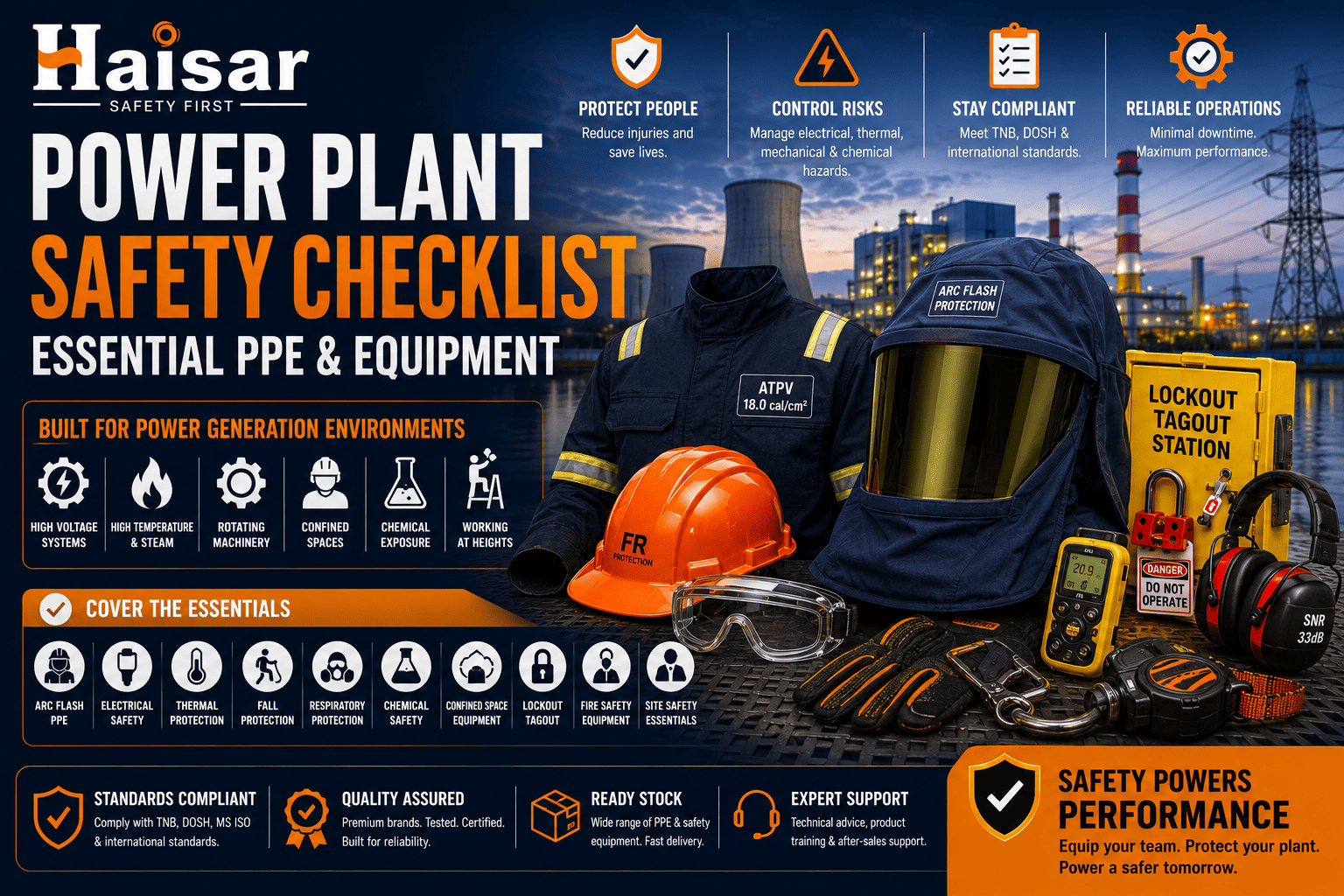
Power generation facilities in Malaysia operate some of the most hazardous working environments in the country. Whether it is a combined cycle gas turbine plant in Johor's southern energy corridor, a coal-fired facility on the peninsula, a hydroelectric station in Pahang or Sarawak, or a solar farm being commissioned in Kedah, the combination of high-voltage electrical systems, high-temperature steam and process equipment, rotating machinery, confined spaces, and the perpetual pressure of maintaining generation output creates a safety environment that demands more from PPE and site safety equipment than most industrial settings.
TNB contractors, independent power producer (IPP) maintenance teams, EPC contractors on generation projects, and the operations and maintenance companies serving Malaysia's expanding power generation portfolio all face the same fundamental procurement challenge: sourcing PPE and safety equipment that meets the specific hazard profile of power generation environments, complies with TNB and DOSH requirements, and can be supplied reliably to facilities that often operate on tight maintenance windows where equipment gaps create both compliance and generation risk.
This checklist covers the essential PPE and safety equipment categories for power plant operations in Malaysia, the standards applicable to each, and what procurement teams and HSE managers at power generation facilities and contractor organisations need to have in place.
The Power Plant Hazard Environment
Before reviewing the equipment checklist, understanding the specific combination of hazards present in power generation environments clarifies why standard industrial PPE is often inadequate and why power plant-specific specification is required.
High-voltage electrical systems. Power stations operate at transmission voltages of 132kV, 275kV, and 500kV at the grid connection, with generation voltage typically at 11kV or 22kV and medium voltage distribution throughout the facility. The incident energy levels at main switchgear and transformer locations in power stations can be significantly higher than in typical industrial facilities. Arc flash risk is a primary hazard for all electrical maintenance personnel.
High-temperature steam and thermal systems. Conventional power plants operate steam systems at temperatures and pressures that produce severe burn injuries on contact. Turbine halls, boiler houses, heat recovery steam generator (HRSG) areas, and steam piping systems all present burn and scald risk requiring appropriate thermal protection.
Rotating machinery. Turbines, generators, pumps, compressors, and fan systems create entanglement and impact hazards. Energy isolation through lockout/tagout is the primary administrative control, but PPE appropriate for the mechanical hazard environment is required throughout plant areas.
Confined spaces. Condenser water boxes, boiler drums, storage tanks, sumps, cable tunnels, and ductwork all qualify as confined spaces with atmospheric hazard potential including oxygen deficiency from nitrogen blanketing, CO from combustion residues, and toxic gas from chemical treatment systems.
Chemical hazards. Power plants use a range of process chemicals including boiler water treatment chemicals, cooling water biocides, transformer oils, lubricants, battery electrolytes, and in some facilities, anhydrous ammonia for SCR emission control. Each presents specific PPE requirements.
Working at heights. Boiler structures, cooling towers, flue gas desulphurisation systems, turbine hall crane beams, and elevated pipework all involve working at heights on structures where fall protection must be carefully specified for the available anchor arrangements.
Noise. Turbine halls, compressor buildings, and cooling tower fan areas routinely exceed 85 dB(A) and in some locations approach 100 dB(A). Hearing protection selection must be matched to the attenuation required at the specific noise levels encountered.
Heat stress. Boiler houses, turbine halls, and outdoor work in Malaysia's equatorial climate create genuine heat stress risk, particularly during planned maintenance when additional workers are on site in areas with elevated ambient temperatures.
Power Plant Safety Equipment Checklist
1. Arc Flash PPE
Arc flash is the primary electrical fatality risk in power generation environments. The fault current levels at power station switchgear and transformer locations produce incident energy values that can be significantly higher than in typical industrial facilities, and the electrical work performed during planned maintenance, commissioning, and emergency response frequently involves proximity to live or recently live systems.
Arc flash risk assessment. The checklist starts here because without an arc flash risk assessment for the specific facility, all other arc flash PPE selections lack the technical foundation they require. The assessment must be site-specific, conducted by a competent electrical engineer, and must produce incident energy values and arc flash boundary distances at every switchboard, motor control centre, and panel in the facility. For TNB contractor operations, the assessment must account for TNB network fault levels at the grid connection.
Arc flash face shields and switching hoods rated in cal/cm² to the incident energy level at the specific work location. For medium voltage switchgear and main LV switchboards in power stations, switching hoods providing full head and neck protection are typically required rather than face shields alone.
Arc flash rated coveralls with ATPV in cal/cm² equal to or exceeding the incident energy at the work location, manufactured from inherently FR fabric. Layered systems for higher incident energy locations.
Voltage-rated insulating rubber gloves across voltage classes from Class 0 for LV work through Class 2 and above for MV switchgear. Pressure tested at required intervals with valid test certificates.
Arc flash rated balaclava and liner for neck and ear protection when face shields are used without a full switching hood.
Voltage-rated insulated tools to IEC 60900 for all live or near-live electrical work.
Insulating matting at all switchboard and distribution board locations.
2. Thermal and Burn Protection
Steam and thermal hazards in conventional power plants require specific protection beyond standard FR workwear. Contact with high-pressure steam, hot pipe insulation, and process surfaces at elevated temperatures produces scalds and burns with injury severity that standard polycotton workwear does not adequately mitigate.
FR coveralls rated to NFPA 2112 or equivalent for all workers in boiler houses, turbine halls, and process areas where thermal hazard and flash fire risk are present. The calorie rating must be appropriate for the hazard level. This is the base garment requirement for most power plant working areas.
Heat-resistant gloves for handling hot components, insulation removal, and work on surfaces at elevated temperatures. Selection must match the specific temperature range encountered.
Thermal insulating boot covers for work on hot surfaces and in high-temperature floor environments near boiler bases and steam piping.
Proximity suits and aluminised garments for emergency response teams dealing with steam releases and high-temperature incidents.
3. Lockout/Tagout Equipment
LOTO is the primary control for preventing unexpected energisation of electrical, mechanical, pneumatic, and hydraulic systems during maintenance. Power plants have extensive and complex energy isolation requirements across all three energy types simultaneously. A turbine undergoing maintenance may require electrical isolation of the generator and associated switchgear, mechanical isolation of the turbine itself, and thermal isolation of steam inlet and exhaust valves, all requiring coordinated multi-lock isolation with documented permit-to-work control.
Lockout padlocks individually keyed, one per authorised worker. Sufficient quantity for the workforce size performing simultaneous maintenance activities.
Multi-hasp lockout devices allowing multiple workers to lock out a single isolation point simultaneously. In a power plant, a single turbine outage may involve mechanical, electrical, I&C, and civil teams all applying locks to shared isolation points.
Circuit breaker lockout devices compatible with the specific breaker configurations used at the facility. Power station switchgear includes a range of racking-type, bolt-on, and handle-type circuit breakers requiring different lockout device configurations.
Valve lockout devices across all valve types present in the facility including gate valves, ball valves, butterfly valves, and globe valves. The valve lockout device range must cover all isolation valve sizes and types present on the maintenance scope.
Pneumatic and hydraulic energy isolation lockouts for compressed air and hydraulic systems on plant auxiliary equipment.
Cable lockouts for non-standard and multi-point energy sources where standard devices do not fit.
Lockout stations and shadow boards positioned at key maintenance areas throughout the plant for organised storage and rapid access to LOTO equipment during outage mobilisation.
Tagout tags weatherproof and UV-resistant for outdoor and high-humidity applications in power plant environments.
4. Confined Space Equipment
Power plants contain numerous confined spaces that are routinely entered during maintenance. Condenser water boxes, boiler drums, deaerators, storage tanks, underground cable tunnels, sumps, and control room cable floors all require formal confined space entry procedures with appropriate equipment.
The atmospheric hazards in power plant confined spaces are specific to each space type. Condenser water boxes may contain oxygen-depleted atmospheres. Boiler drums and feedwater systems may carry CO from combustion residues. Nitrogen-blanketed systems create immediate oxygen deficiency on entry. Chemical treatment storage areas may carry toxic vapours from process chemicals.
Multi-gas monitors covering O2, LEL, CO, and H2S as the baseline four-gas configuration. For nitrogen-blanketed spaces, an oxygen monitor with a fast-responding sensor is the primary detection requirement. For ammonia-related applications at SCR facilities, an NH3 sensor must be added.
Pre-entry sampling pump and probe for remote atmosphere testing before approach to the entry point.
Tripod and davit rescue systems with man-rated winches at every confined space entry point for the duration of entry operations.
Ventilation blowers and ducting for forced air supply before and during entry. Must be spark-free for spaces where flammable atmosphere may be present before ventilation is established.
Full-body harnesses with dorsal rescue D-ring for all confined space entrants.
Intrinsically safe communication equipment for classified area confined spaces.
EEBD or escape sets for spaces where rapid atmospheric deterioration is a risk during entry.
5. Working at Heights Equipment
Power plant structures present a range of working at heights scenarios from the straightforward, maintenance platforms with fixed guardrails, to the technically demanding, elevated work on boiler superstructure, cooling tower fill replacement, and flue stack inspection where conventional scaffold and standard fall protection equipment may not be the right solution.
Full-body harnesses with dorsal D-ring for fall arrest and frontal D-ring for restraint applications, selected based on the specific task geometry and fall clearance available.
Self-retracting lifelines for work on elevated structures where fall clearance below the anchor is limited. SRLs are the preferred choice for most power plant elevated maintenance scenarios where the available clearance is insufficient for standard energy-absorbing lanyards.
Twin-leg energy-absorbing lanyards for movement across elevated work areas requiring transfer between anchor points.
Temporary anchor points and horizontal lifeline systems for locations without built-in anchorage, including boiler casing surfaces, turbine hall roof structures, and cooling tower access.
Rope access equipment for inspection and maintenance of boiler external structures, flue stacks, cooling tower shells, and elevated pipework where conventional scaffold is not practicable. Rope access contractors on power plant sites must be IRATA or equivalent certified.
Scaffold systems for planned maintenance access to elevated areas. Scaffold in power plant environments must account for the loads and access requirements of the specific maintenance scope, including component removal weights and personnel access for multiple simultaneous trades.
6. Respiratory Protection
Power plants present a range of respiratory hazards across different areas and activities. General maintenance activities in dusty plant areas require basic dust protection. Chemical handling requires appropriate cartridge selection. Confined space entry into oxygen-deficient spaces requires supplied air.
P2 or P3 disposable respirators for general maintenance dusty environments and insulation removal activities.
Half-face respirators with appropriate cartridges for chemical handling activities including boiler water treatment chemical dosing, cooling water biocide application, and lubricant and transformer oil handling. Cartridge selection must match the specific chemical being handled.
Full-face respirators for activities with both respiratory and eye hazard, including chemical transfer and spill response.
Supplied air or SCBA for oxygen-deficient confined space entry. Air-purifying respirators provide no protection in oxygen-deficient atmospheres and must not be used in nitrogen-blanketed or other oxygen-deficient spaces.
Asbestos-rated RPE for maintenance on older power plant equipment that may contain asbestos insulation. Legacy power plant equipment in Malaysia from the 1970s through the 1990s may contain asbestos and this must be assessed before insulation removal or disturbance.
7. Hearing Protection
Power plant noise levels vary significantly by area. Control rooms and offices may be below 70 dB(A). Turbine halls and generator decks typically operate in the 85 to 95 dB(A) range. Compressor buildings, induced and forced draft fan areas, and some pump rooms may exceed 100 dB(A). Hearing protection selection must be matched to the attenuation required in each specific area.
Foam ear plugs correctly inserted for general turbine hall and plant area use. Pre-formed ear plugs with cord for environments requiring frequent removal and reinsertion.
Earmuffs for areas above 95 dB(A) where ear plug attenuation alone may be insufficient, and for workers who cannot achieve an adequate ear canal seal with ear plugs.
Combined ear plug and earmuff protection for areas at or above 100 dB(A) where dual protection is required to achieve adequate combined attenuation.
Electronic hearing protection for supervisory and coordination roles in high-noise environments where situational awareness and communication capability must be maintained alongside noise protection.
8. Head Protection and Eye Protection
Class B safety helmets with electrical insulation rating for all workers in plant areas. The prevalence of overhead electrical hazards in power plant environments makes Class B the mandatory default specification. Chin straps required for elevated work.
Chemical splash goggles for chemical handling activities. Anti-fog coating for the humid heat of boiler houses and turbine halls.
Arc flash face shields and switching hoods as covered under arc flash PPE above.
Welding shields for welding and hot work activities during maintenance outages.
UV-rated safety spectacles for outdoor workers on solar and civil areas of the facility.
Procurement for Power Plant Planned Outages
The planned maintenance outage, or planned preventive maintenance (PPM) shutdown, is the most intensive procurement event in the power plant safety equipment calendar. An outage may mobilise several hundred additional workers onto a facility over a period of days to weeks, all requiring PPE, and the outage window is typically too short to tolerate procurement delays.
The key procurement discipline for outage safety equipment is mobilisation lead time. PPE orders for a planned outage must be placed with sufficient lead time for delivery before the outage start date, not on the day that mobilisation begins. For FR coveralls with custom embroidery, arc flash PPE requiring specific ATPV ratings, and LOTO equipment requiring compatibility assessment with the facility's specific isolation point configurations, the procurement lead time may be three to four weeks for first-time orders.
Haisar Supply and Services works with power generation operators and maintenance contractors to plan outage safety equipment procurement against the outage schedule, ensuring that the right PPE and equipment is on site before the workforce arrives, not after the outage has started.
Haisar Supply and Services: Power Plant PPE Supplier in Malaysia
Haisar Supply and Services, based in Kulai, Johor, supplies the complete range of PPE and safety equipment for power generation operations across Malaysia. We work with TNB contractors, IPP maintenance teams, and EPC contractors on generation projects who need PPE specified and documented to the standards that power plant operations demand.
Our power plant supply range covers arc flash rated PPE across all ATPV levels, voltage-rated insulating gloves with test certificates, FR coveralls for thermal and flash fire protection, complete LOTO systems for multi-energy outage isolation, confined space entry and rescue equipment, working at heights gear for elevated power plant structures, respiratory protection across all hazard types, and full head, eye, and hearing protection programmes.
We understand TNB contractor requirements, DOSH regulations for generation facilities, and the outage procurement timeline pressures that power plant teams operate under.
Get a Quote for Power Plant Safety Equipment
Whether you are equipping a planned outage team, building out your O&M contractor's PPE programme, or sourcing safety equipment for a new generation project in Johor or across Malaysia, contact Haisar to discuss your requirements.
Our team responds promptly with product recommendations, ATPV specifications, compliance documentation, and pricing tailored to your facility's specific requirements.
Haisar Supply and Services Sdn Bhd (985158-T) | Kulai, Johor, Malaysia | www.haisar.com
