Can't find what you're looking for? Get in touch!



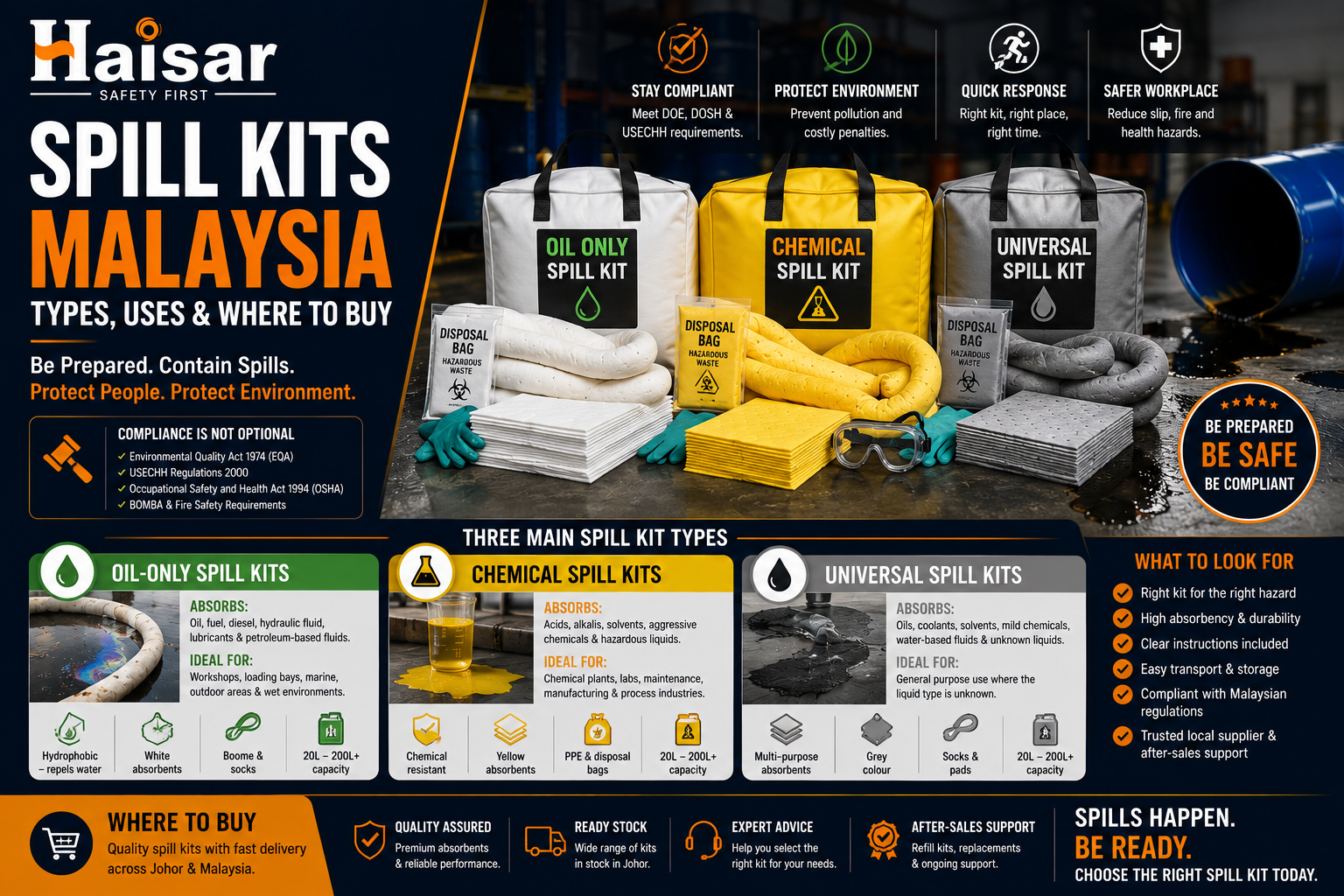
Chemical and oil spills happen on project sites and in industrial facilities across Malaysia every day. Most of them are small. A drum overflows during transfer. A hose fitting fails on a hydraulic system. A solvent container is knocked over in a maintenance area. A vehicle leaks engine oil onto a concrete floor in a loading bay.
Small spills are not minor incidents. Left uncontained, they become slip hazards, environmental liabilities, fire risks, and DOSH or DOE compliance failures. Responded to quickly with the right spill kit, they are cleaned up in minutes without escalating into anything more serious.
The spill kit is the first response tool for liquid spill containment in any Malaysian workplace that handles oils, chemicals, fuels, or water-based industrial fluids. Getting the right kit for the right spill type is what determines whether it actually works when needed. This guide covers the three main spill kit types, their applications, what to look for when buying, and where to source spill kits in Malaysia.
Why Spill Kits Are a Compliance Requirement in Malaysia
Spill response equipment is not optional for Malaysian workplaces that handle hazardous or polluting liquids. The obligation comes from several directions simultaneously.
Environmental Quality Act 1974 (EQA). The EQA and its subsidiary regulations prohibit the discharge of polluting substances into Malaysian waterways, drains, and land. Oil and chemical spills that reach floor drains, monsoon drains, or soil without adequate containment and cleanup constitute a pollution offence under the EQA. The Department of Environment (DOE) enforces the EQA and has the authority to issue compound fines and prosecution notices for pollution incidents.
USECHH Regulations 2000. For workplaces handling chemicals hazardous to health, the USECHH Regulations require that control measures include provision for spill containment and response. A chemical spill for which no response equipment is available is a control measure failure under these regulations.
OSHA 1994. The general duty under OSHA requires employers to maintain safe workplaces. Liquid spills that create slip hazards and exposure risks are workplace safety failures. Spill kits are part of the control infrastructure required to maintain safe conditions.
BOMBA and fire safety requirements. For workplaces storing or handling flammable liquids, spill containment is a fire safety requirement. A flammable solvent spill in an area with ignition sources is a fire and explosion risk. Rapid containment using appropriate absorbent materials reduces the ignition risk.
The practical implication is straightforward. Any Malaysian workplace that handles oils, fuels, solvents, chemicals, or other industrial fluids needs spill kits appropriate for those fluids, positioned close to the areas where spills are most likely, and maintained in a ready-to-use condition.
The Three Main Spill Kit Types
Spill kits are not interchangeable across all liquid types. The absorbent materials in a spill kit are selected for specific liquid categories and using the wrong kit for a specific spill either produces inadequate absorption or, in the case of oil-only kits used on chemical spills, fails to address the hazard adequately. Understanding the three main kit types is the starting point for correct spill kit selection.
Oil-Only Spill Kits
Oil-only spill kits contain white absorbent materials that are hydrophobic, meaning they absorb oil and petroleum-based fluids while repelling water. This property makes them highly effective for oil spills on water surfaces and on wet floors where a universal absorbent would become saturated with water before absorbing the oil.
What they absorb: Petroleum-based fluids including engine oil, hydraulic fluid, diesel, petrol, transformer oil, gear oil, cutting fluids, and lubricants. They do not absorb water-based fluids adequately.
Where they are used: Marine and port environments where oil spills occur on water. Vehicle maintenance workshops and loading bays where engine oil, hydraulic fluid, and diesel are handled. Industrial facilities with hydraulic machinery and lubrication systems. Outdoor areas where rainfall means the floor surface is wet when a spill occurs.
Standard kit contents: White absorbent pads and pillows for initial containment and surface absorption, white absorbent socks or booms for perimeter containment to prevent the spill spreading, and disposal bags and ties for waste containment after absorption.
Kit sizes range from small portable kits absorbing 20 to 30 litres for vehicle workshops and light industrial use, through to large wheelie bin kits absorbing 200 litres or more for facilities with significant hydraulic systems or fuel storage.
Key advantage: The hydrophobic property means oil-only kits perform in wet conditions where general purpose absorbents would be rendered ineffective by water uptake. This makes them the correct choice for marine environments, outdoor spill response, and any situation where the floor surface may be wet.
Chemical Spill Kits
Chemical spill kits contain yellow or orange absorbent materials made from chemically resistant compounds that can absorb a broad range of aggressive chemical fluids without reacting with them. They are designed for use with acids, alkalis, solvents, and other hazardous chemicals that would degrade standard polypropylene absorbents.
What they absorb: Acids including hydrochloric acid, sulphuric acid, and nitric acid. Alkalis including sodium hydroxide and ammonia solutions. Solvents including acetone, MEK, and IPA. Aggressive industrial chemicals used in manufacturing, laboratory, and chemical processing environments.
Where they are used: Chemical manufacturing and processing facilities. Laboratory environments handling corrosive reagents. Oil and gas and petrochemical facilities handling process chemicals and chemical injection products. Agricultural operations handling fertiliser solutions and pesticides. Cleaning contractor operations using concentrated cleaning agents.
Standard kit contents: Chemically resistant absorbent pads for surface absorption, chemical absorbent socks for perimeter containment, and heavy-duty disposal bags rated for chemical waste. Some chemical kits also include a pair of chemical resistant gloves and eye protection for the responder, a neutralising agent for acid or alkali spills, and pH indicator paper for identifying unknown spills.
Key advantage: Chemical resistance in the absorbent material means the kit is safe to use with aggressive chemicals that would degrade standard absorbents. Using a general purpose polypropylene absorbent on a concentrated acid spill risks degradation of the absorbent and inadequate containment.
Important distinction: Chemical spill kits absorb the liquid but do not neutralise aggressive chemicals. Neutralisation is a separate step for acid and alkali spills and must be carried out using the correct neutralising agent before the absorbed material is disposed of.
Universal or General Purpose Spill Kits
Universal spill kits contain grey absorbent materials made from polypropylene that absorb a wide range of water-based and petroleum-based fluids. They are the most commonly used spill kit type in Malaysian workplaces because of their versatility across the range of fluids present on most general industrial sites.
What they absorb: Water-based fluids including coolants, aqueous cleaning solutions, water-based paints, and process water. Petroleum-based fluids including oils and fuels. Mild chemical solutions at lower concentrations. Blood and biological fluids in first aid and healthcare applications.
Where they are used: Construction sites handling a mix of fuels, lubricants, and water-based process fluids. Manufacturing facilities with diverse fluid types across different production processes. Food processing environments where both water-based and oil-based fluids are present. General industrial and commercial workshops.
What they do not do well: Universal kits are not hydrophobic. On wet surfaces, the absorbent will absorb water as well as the spilled fluid, reducing its effective capacity for the target liquid. For outdoor or marine environments where water is present, an oil-only kit is the more effective choice for petroleum spills. For aggressive chemicals at high concentrations, a dedicated chemical kit with chemically resistant absorbents is the safer choice.
Standard kit contents: Grey absorbent pads for surface absorption, grey absorbent socks for perimeter containment, and disposal bags. Larger kits may include pillows or loose granular absorbent for heavier spills.
Choosing the Right Kit Size
Spill kit capacity is measured by the volume of liquid the kit can absorb, typically expressed in litres. Matching kit capacity to the largest credible spill at the location where the kit is positioned is the correct selection methodology.
For a vehicle workshop with individual oil containers and a sump drain, a 20 to 40 litre kit is adequate for routine spills. For a chemical store with drum storage of process chemicals, a 100 litre or larger kit positioned at the store entrance addresses the capacity needed for a full drum spill. For a facility with bulk storage tanks, multiple large-capacity kits or a dedicated spill response trolley with large-volume absorbents may be required.
The most common spill kit procurement error in Malaysian workplaces is selecting a kit that is adequate for small everyday spills but that cannot contain the largest credible spill at the location. A 20 litre kit next to a 200 litre chemical drum provides false reassurance without adequate protection.
Spill Kit Placement and Maintenance
Correct placement and ongoing maintenance are as important as selecting the right kit type and size.
Positioning. Spill kits must be positioned close to the area where the spill risk exists. A kit that is stored in a central warehouse and must be retrieved during a spill response will arrive too late to prevent the spill from spreading. For chemical handling areas, the kit should be within arm's reach of the dispensing or handling location. For vehicle and plant maintenance areas, a kit should be present in each bay where fuel and oil are routinely handled.
Signage. Spill kit locations must be marked with clear signage visible from the approach to the location. Workers must know where the nearest kit is before a spill occurs, not during one.
Inspection. Spill kits must be inspected at regular intervals to confirm they are complete and have not been partially used without replacement. A kit that has had absorbent pads removed for casual use and not replaced is not a functional spill kit. Assign a responsible person to each kit location and document inspection records.
Replacement after use. After any spill response, all used absorbent materials must be disposed of as chemical or contaminated waste in accordance with the type of liquid absorbed. The kit must be fully restocked before it is returned to its position. A partially depleted kit at a spill location provides less protection than specified and must not be left in that condition.
What to Look for in a Spill Kit Supplier in Malaysia
Kit type clarity. A credible supplier should be able to clearly explain the difference between oil-only, chemical, and universal kits and advise on the correct type for the specific fluids present at your facility. A supplier who treats all spill kits as interchangeable does not have adequate product knowledge for industrial procurement.
Capacity range. Your supplier should stock spill kits across a range of capacities from small portable kits to large drum and wheelie bin kits. The right capacity for every location in a facility will vary and a single kit size is rarely adequate across all spill risk points.
Replenishment supply. Individual absorbent components including pads, socks, and disposal bags should be available for purchase separately to allow kit replenishment after use without replacing the entire kit.
Chemical specific advice. For workplaces handling specific aggressive chemicals, the supplier should be able to confirm that the absorbent materials in the chemical kit are compatible with those specific substances.
Haisar Supply and Services: Spill Kit Supplier in Malaysia
Haisar Supply and Services supplies oil-only, chemical, and universal spill kits for workplaces and project sites across Johor and peninsular Malaysia. Our spill kit range covers small portable kits for light industrial and vehicle maintenance applications, medium and large kits for chemical stores and process areas, and heavy-duty drum and wheelie bin kits for facilities with bulk storage and significant spill risk.
We supply individual absorbent components for kit replenishment and stock fast-moving items for quick resupply when kits are used. Our team can advise on the correct kit type and capacity for your specific fluid types and spill risk locations.
WhatsApp Haisar to Order Spill Kits
Whether you are sourcing spill kits for a new facility, replacing depleted kits on an active project site, or reviewing your spill response provision for compliance with DOE and DOSH requirements, our team is ready to help.
WhatsApp us now for a fast response and to place your order.
We deliver across Johor and peninsular Malaysia with competitive lead times on all spill kit types and sizes.
Browse Spill Kit and Chemical Safety Products at haisar.com
Haisar Supply and Services Sdn Bhd (985158-T) | Kulai, Johor, Malaysia | www.haisar.com
