Can't find what you're looking for? Get in touch!



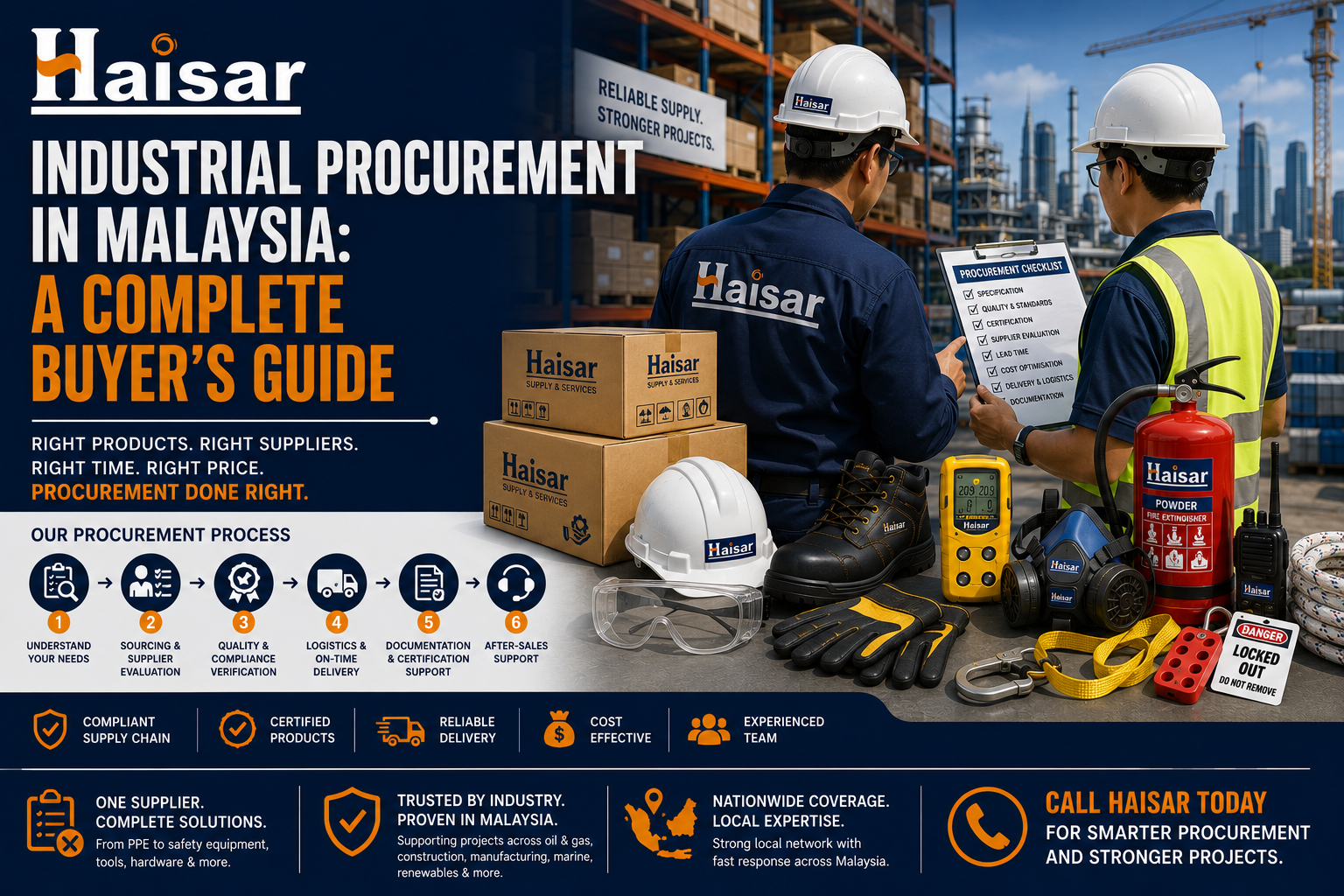
Industrial procurement in Malaysia is not getting simpler. Project timelines are tighter. Compliance requirements are broader. The number of product categories a project site needs to procure before mobilisation has expanded as regulatory enforcement has intensified. And the cost of a procurement failure, whether that is the wrong product on site, a delivery that does not arrive, or equipment that cannot be documented against the applicable standard, falls squarely on the procurement manager or HSE manager who signed off on the purchase.
This guide is written for procurement managers and HSE managers who are responsible for industrial supply in Malaysia. It covers how the procurement landscape is structured, what the most common failures look like and why they happen, how to build a procurement process that delivers compliance and operational reliability, and what to look for in a supply partner who can actually support the way industrial projects in Malaysia work.
The Industrial Procurement Landscape in Malaysia
Malaysia's industrial base spans a wide range of sectors, each with distinct procurement needs and regulatory obligations. Understanding where your organisation sits in this landscape shapes every procurement decision downstream.
Oil and gas remains one of the largest drivers of industrial procurement in Malaysia. Operations in Kertih, Bintulu, Labuan, and across the offshore blocks in Malaysian waters procure under PETRONAS contractor requirements and international standards including IOGP and API. Procurement in this sector is heavily documented, approval-listed, and subject to audit. Compliance is not aspirational. It is contractually enforced.
Construction and civil engineering across Johor, the Klang Valley, and major infrastructure corridors operates under CIDB requirements, DOSH regulations, and increasingly stringent client HSE standards as international developers and institutional investors impose their own supply chain requirements on Malaysian contractors.
Manufacturing and industrial facilities in Johor's industrial zones, Penang's manufacturing corridor, and Selangor's industrial parks procure under the Factories and Machinery Act, OSHA 1994, and sector-specific requirements depending on whether the facility handles chemicals, food products, electronics, or heavy equipment.
Renewable energy and data centres are the fastest-growing procurement segments in Malaysia. Solar EPC contractors, data centre developers, and their principal contractors are mobilising at scale and often managing procurement for project types they have not procured for before, creating gaps that experienced supply partners can close.
Marine, shipyard, and offshore support operations in Johor, Labuan, and Sarawak procure under Marine Department Malaysia requirements, SOLAS obligations, and client HSE standards from international vessel operators and charterers.
Across all of these sectors, the procurement function faces the same core challenge: sourcing the right products, at the right specification, with the right documentation, delivered to site on time and within budget.
Why Industrial Procurement in Malaysia Fails
Understanding where procurement goes wrong is more useful than a generic best-practice checklist. These are the failure modes that appear most consistently across Malaysian industrial procurement operations.
Specification drift. A purchase is raised for a product category without a sufficiently precise specification. The supplier interprets the requirement broadly and supplies a product that technically meets the description but not the application requirement. The classic example is respiratory protection: an order for "dust masks" results in FFP1 disposable respirators being delivered to a site where the hazard assessment requires half-face respirators with chemical cartridges. The product is in the correct category. It is wrong for the application.
Certification gaps. Products arrive on site without the certification documentation required by the client, the principal contractor, or the regulator. The products may be perfectly compliant but without documentation they cannot be accepted on a regulated site. Re-ordering causes delay. Expedited shipping adds cost. The procurement function carries the blame for a failure that originated in supplier selection.
Lead time optimism. Suppliers quote lead times based on their best-case assumptions. Procurement plans are built around those lead times. When actual delivery takes longer, which it frequently does for imported products and for products requiring local certification, the site mobilisation is delayed or the project proceeds without the equipment, creating both operational and compliance risk.
Vendor fragmentation. Different product categories are sourced from different suppliers. Each supplier relationship requires separate communication, separate purchase orders, separate delivery coordination, and separate invoice processing. The administrative overhead compounds with each additional vendor. Errors in one supplier relationship cascade through the others when equipment from multiple vendors must arrive simultaneously for site mobilisation.
Reactive rather than planned procurement. Equipment is ordered when the need is identified rather than when the project schedule indicates it will be needed. This is particularly common for consumable PPE. A site runs out of respirators mid-project. An urgent order is placed. Premium freight charges are incurred. The site operates without adequate respiratory protection during the gap.
Price-led vendor selection. The lowest-price supplier is selected without adequate assessment of product quality, certification status, or delivery reliability. The cost saving on the initial purchase is offset multiple times over by the downstream costs of non-compliant products, re-ordering, and delivery failures.
Each of these failure modes is avoidable. Avoiding them requires a structured procurement process and a supply partner who understands the industrial operating environment in Malaysia.
Building a Compliant Industrial Procurement Process
A procurement process that reliably delivers compliant, correctly specified products on time is not complicated. It requires discipline in five areas.
Start with the hazard and regulatory requirement, not the product.
Every industrial procurement decision should begin with a clear understanding of the hazard being controlled and the regulatory requirement that governs it. For PPE, this means a documented risk assessment that identifies the specific hazard, the exposure level, and the standard that the PPE must meet. For fire equipment, this means understanding the BOMBA requirements for the specific occupancy classification. For gas detection equipment, this means understanding the atmospheric hazards present and the instrument specifications required to detect them reliably.
Procurement that starts with the product rather than the requirement is procurement that will generate specification drift.
Write specifications that are precise enough to be audited.
A purchase specification should describe the product in sufficient detail that any competent supplier would supply the same product. For PPE, this means specifying the product standard, the protection class, and the certification requirement. For gas detection, this means specifying the sensor types, the detection ranges, and the calibration requirement. For working at heights equipment, this means specifying the load rating, the fall clearance requirement, and the anchor compatibility.
Vague specifications invite interpretation. In industrial procurement, interpretation by the supplier is not the same as judgement by the HSE manager.
Require documentation at the point of order, not on delivery.
Certification documentation, technical data sheets, and compliance declarations should be requested as part of the purchase order process, not as an afterthought when the goods arrive on site. A supplier who cannot provide documentation before delivery is unlikely to have it ready on delivery day either.
For regulated environments including PETRONAS contractor sites, offshore operations, and international client project sites, a product compliance register should be built and maintained from the first procurement event. Adding documentation to the register after the fact, under time pressure before an audit, is a risk management failure.
Align procurement timing to the project programme.
Industrial procurement should be planned against the project construction programme, not raised reactively as needs arise. Each project phase has a predictable equipment requirement. Scaffold erection requires fall protection equipment and height access gear. Confined space work requires gas detection equipment, retrieval systems, and ventilation. Electrical installation requires LOTO equipment and electrical safety PPE.
Mapping these requirements to the project programme and initiating procurement with sufficient lead time to account for delivery and documentation is the single most effective change a procurement team can make to reduce reactive ordering.
Consolidate vendor relationships where possible.
Managing fewer supplier relationships reduces administrative overhead, reduces the risk of inter-supplier coordination failures, and allows the procurement function to develop genuine working knowledge of supplier capabilities. A supplier who provides a broad range of industrial safety and project supply products from a single point of contact eliminates the coordination cost of managing multiple specialist suppliers.
This does not mean accepting inferior products to achieve consolidation. It means selecting a supply partner with sufficient breadth and depth of product range to cover the majority of your procurement requirements at the standard your projects require.
The Documentation Requirement in Malaysian Industrial Procurement
Documentation is the element of industrial procurement that is most consistently underestimated until the first audit or incident investigation makes its importance undeniable.
In Malaysian industrial procurement, documentation operates at several levels simultaneously.
Product certification documentation confirms that the product meets the applicable standard. For PPE, this is the SIRIM certification reference or equivalent international certification. For fire equipment, this is the BOMBA approval number. For gas detection equipment, this is the calibration certificate. For electrical safety PPE, this is the voltage rating test certificate.
Purchase and supply chain records demonstrate the provenance of the product and confirm that it was sourced from a legitimate distributor or manufacturer representative. In the event of a product failure or incident investigation, the ability to trace the product back through the supply chain to the manufacturer is a legal and commercial requirement.
Maintenance and inspection records confirm that equipment in service has been maintained at the required intervals. DOSH inspections, BOMBA audits, and incident investigations all examine maintenance records. Equipment that appears functional but has not been formally inspected and documented is non-compliant.
Risk assessment and PPE selection records connect the hazard identified in the risk assessment to the product specified and procured. This is the chain of evidence that demonstrates a structured approach to worker protection. Without it, the procurement decision appears arbitrary even if the product selected was correct.
A procurement function that maintains complete documentation across these four levels is in a significantly stronger position in the event of a regulatory inspection, a client audit, or an incident investigation than one that relies on institutional memory and filing systems that are not maintained.
Procurement Considerations by Product Category
Different categories of industrial procurement in Malaysia carry different compliance risks and different documentation requirements. The following covers the categories that generate the most procurement complexity.
Personal Protective Equipment. The breadth of the PPE category and the variation in applicable standards across different hazard types make PPE procurement the most complex category for most industrial procurement teams. The key discipline is maintaining the link between the hazard assessment, the standard required, and the product specified. SIRIM certification is the primary compliance marker in Malaysia and must be confirmed for safety-critical PPE categories.
Gas Detection Equipment. Gas detectors are safety-critical instruments whose function depends entirely on calibration. Procurement of gas detection equipment must include provision for calibration gas supply, calibration intervals, and bump test documentation from day one. A gas detector without a calibration programme is not compliant equipment. It is a liability.
Working at Heights Equipment. The fall clearance requirement means that harness and lanyard selection is an engineering decision, not a product catalogue exercise. Procurement teams who specify "safety harness and lanyard" without considering fall clearance, anchor compatibility, and the specific working at heights scenario will generate specification drift. The supplier must be engaged early enough to advise on system selection.
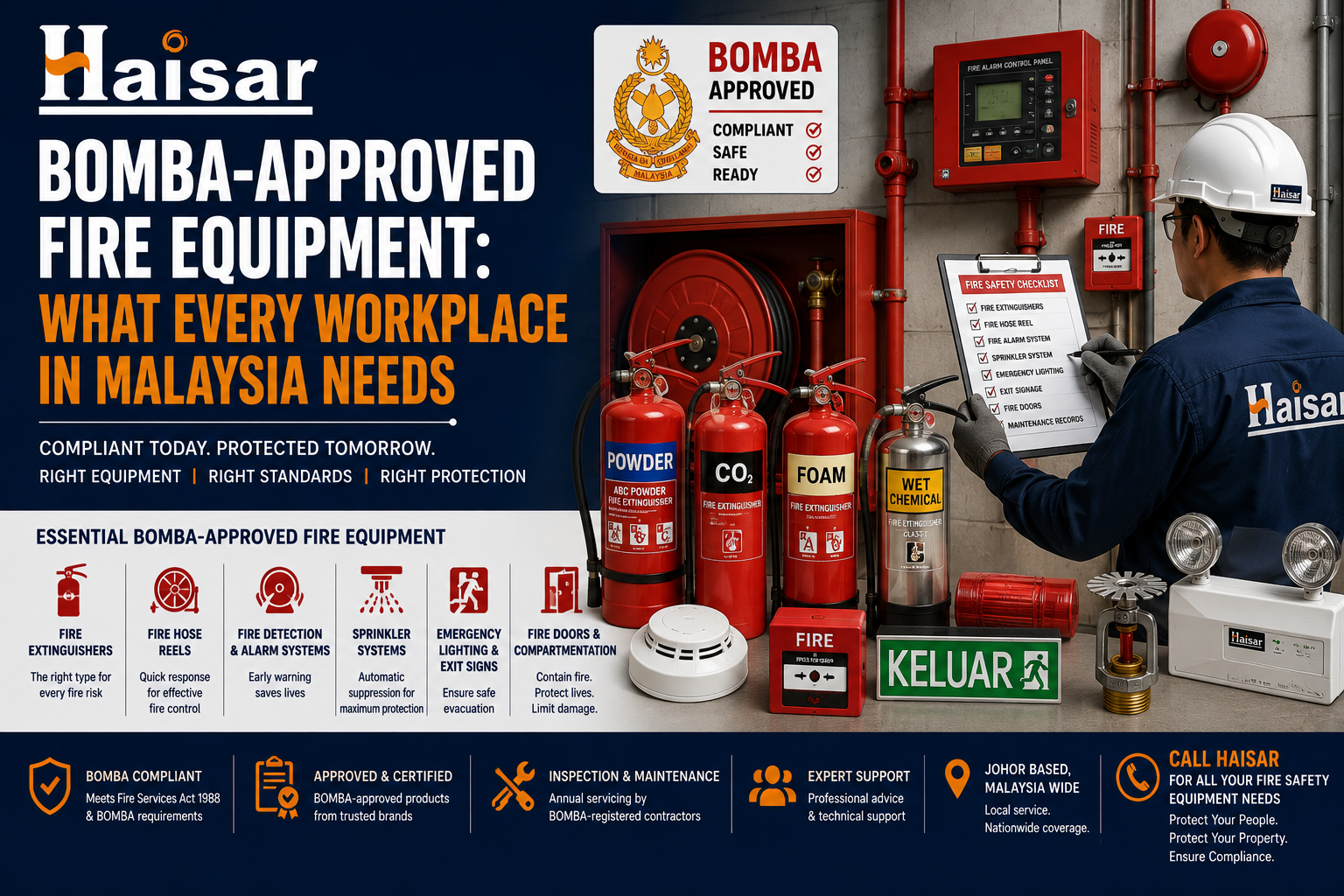
Fire Safety Equipment. BOMBA approval status must be confirmed before purchase. The type of extinguisher, the quantity, the placement, and the servicing arrangement are all regulatory requirements that must be addressed in the procurement specification. Sourcing extinguishers without confirming BOMBA approval and arranging annual servicing by a BOMBA-registered contractor is incomplete procurement.
Confined Space Equipment. The combination of gas detection, rescue retrieval, ventilation, communication, and entry signage required for compliant confined space entry means that confined space equipment is almost always best procured as a coordinated package rather than item by item. Gaps in the equipment set are not minor omissions. They are conditions that make a confined space entry non-compliant and that can result in fatal incidents.
Electrical Safety and LOTO Equipment. LOTO equipment must be compatible with the specific isolation points on the equipment being locked out. Generic procurement of LOTO equipment without reference to the valve types, circuit breaker configurations, and isolation point dimensions present on site results in equipment that cannot be used on the day it is needed.
What to Look for in an Industrial Supply Partner in Malaysia
The supply partner relationship in industrial procurement is not equivalent to the relationship with an office supplies vendor. The stakes are different and the selection criteria must reflect that.
Compliance knowledge that matches your regulatory environment. Your supply partner must understand the specific regulatory framework that governs your operations in Malaysia, whether that is OSHA and DOSH, PETRONAS contractor requirements, BOMBA standards, Marine Department regulations, or a combination. A supplier who cannot speak to these requirements is not equipped to advise on specification.
Product range that covers your procurement scope. The administrative efficiency of consolidating supply across PPE, project equipment, gas detection, fire safety, working at heights, and confined space requires a supplier with genuine depth across all of these categories, not a supplier with strength in one category and a limited range in others.
Documentation capability. Your supply partner must be able to provide complete product documentation at the point of supply, not days later when your site team is waiting. This is a process requirement as much as a product requirement. Ask prospective suppliers specifically how they manage certification documentation for each product category.
Delivery reliability. The most accurately specified product at the best price delivers no value if it arrives after the project needs it. Delivery reliability requires the supplier to hold adequate stock of fast-moving items, to be transparent about lead times for imported or specially sourced products, and to communicate proactively when delivery commitments are at risk.
A named account contact who knows your project. Industrial procurement in Malaysia involves frequent questions, changed requirements, urgent resupply needs, and documentation requests. These are handled far more effectively by a named contact who understands your project and your procurement requirements than by a general enquiries inbox.
Haisar Supply and Services: Industrial Procurement Partner in Malaysia
Haisar Supply and Services Sdn Bhd, based in Kulai, Johor, works with procurement managers and HSE managers across Malaysia's industrial sectors as a consolidated supply partner for safety equipment and project supplies.
Our supply scope covers the full range of categories that industrial project teams in Malaysia procure: PPE across all hazard categories, gas detection and calibration, working at heights equipment, confined space entry and rescue systems, LOTO and electrical safety products, fire safety and emergency response equipment, site barriers and project supplies, and customised workwear and signage.
We engage with procurement requirements at the specification stage, not just at the point of purchase order. We provide complete product documentation with every supply. We deliver across Johor and peninsular Malaysia with lead time transparency and proactive communication when supply conditions change. And we provide a named account contact for every client engagement.
For procurement managers and HSE managers who are responsible for getting industrial supply right in Malaysia, we are ready to talk about how we can support your programme.
Get a Quote from Haisar
Whether you are planning procurement for a new project mobilisation, reviewing your current supply arrangements, or looking for a more capable industrial supply partner in Malaysia, contact Haisar to discuss your requirements.
Our team will respond promptly with the information you need to make a confident procurement decision.
Haisar Supply and Services Sdn Bhd (985158-T) | Kulai, Johor, Malaysia | www.haisar.com
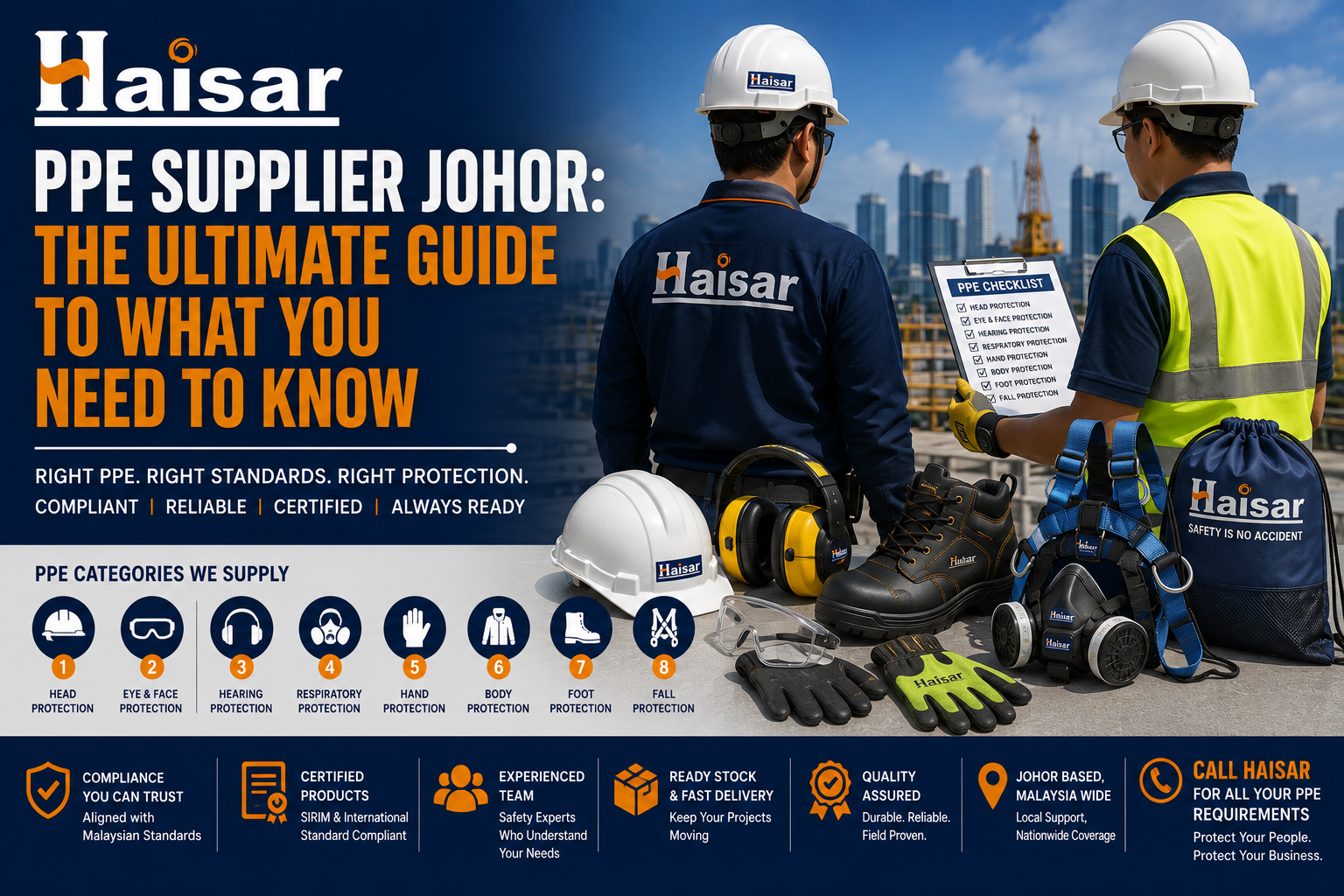
Personal protective equipment is the last line of defence between a worker and a workplace injury. Get it right and it reduces the severity of incidents that cannot be eliminated by engineering or administrative controls. Get it wrong and it fails at the moment it matters most. In a state as industrially active as Johor, where oil and gas, construction, data centres, manufacturing, marine, and renewable energy operations all run simultaneously across sites from Pasir Gudang to Iskandar Puteri, PPE procurement is not a minor administrative task. It is a safety-critical function.
This guide covers everything a project manager, HSE officer, or procurement team in Johor needs to know about sourcing PPE correctly. It explains the Malaysian regulatory framework, walks through every PPE category in practical detail, and explains what separates a reliable PPE supplier in Johor from a box-shifter with a price list. If you are building a compliant PPE programme for a project site or facility in Johor, this is the reference you need.
Why PPE Procurement in Johor Requires More Than a Price Comparison
Johor's industrial base is one of the most diverse in Malaysia. A construction project in Senai has different PPE requirements to a shipyard operation in Pasir Gudang. A data centre fit-out in Iskandar Puteri has different requirements to a solar EPC project in Kluang. A petrochemical facility in Tanjung Langsat has requirements that a general workwear supplier is not equipped to address.
This diversity creates a procurement challenge. General industrial suppliers carry broad ranges of standard PPE. What project teams in Johor's specialised industrial sectors need is a supplier who can address the full range of PPE requirements across multiple hazard categories, understands the compliance standards that apply to each, and can provide the documentation that regulated industries demand.
The consequence of getting PPE procurement wrong in Johor's industrial context is not just a compliance issue. It is a worker safety issue and a project liability issue. PPE that fails to meet the standard applicable to the hazard it is supposed to protect against provides a false sense of protection. Workers wearing inadequate PPE believe they are protected when they are not.
The Malaysian Regulatory Framework for PPE
PPE selection and provision in Malaysia is not discretionary. It is a legal obligation governed by the Occupational Safety and Health Act 1994 (OSHA 1994), its subsidiary regulations, and a framework of industry-specific requirements.
OSHA 1994. Section 15 of OSHA 1994 places a general duty on employers to ensure the safety, health, and welfare of their employees so far as is practicable. This includes the provision and maintenance of safe plant and systems of work and the provision of adequate PPE where hazards cannot be adequately controlled by other means.
Occupational Safety and Health (Use and Standards of Exposure of Chemicals Hazardous to Health) Regulations 2000 (USECHH). These regulations set specific requirements for the assessment of chemical hazards and the provision of appropriate PPE where chemical exposure is a risk. They require documented risk assessments and the selection of PPE appropriate to the specific hazard and exposure level.
Factories and Machinery Act 1967 and Subsidiary Regulations. For factory environments and construction sites, additional specific requirements apply to PPE provision, particularly in relation to head protection, eye protection, and hearing protection in high-noise environments.
DOSH Guidelines and Codes of Practice. DOSH has issued technical guidance covering PPE selection, use, and maintenance across multiple hazard categories. These guidelines provide the practical framework within which OSHA's general duty is implemented.
SIRIM Certification. Safety-critical PPE sold in Malaysia is required to meet SIRIM certification requirements or equivalent international standards. SIRIM-certified products have been tested and verified against the applicable Malaysian standard. Uncertified products may appear identical to certified ones but have not been independently verified. In the event of an incident, uncertified PPE in a situation where certified PPE was required is a liability risk for the employer.
Industry-Specific Standards. Oil and gas operations under PETRONAS requirements, offshore operations under the Petroleum Safety Measures Act, construction under CIDB requirements, and maritime operations under Marine Department Malaysia all impose additional PPE obligations beyond the OSHA baseline.
Understanding which standards apply to your specific operation in Johor is the starting point for a defensible PPE procurement programme. A knowledgeable PPE supplier in Johor should be able to advise on this, not leave it entirely to your HSE team.
Head Protection
Head protection is mandatory on all active construction and industrial project sites in Malaysia under OSHA 1994 requirements. It is also one of the PPE categories where product selection matters most, because not all safety helmets provide the same level of protection against all hazard types.
Industrial safety helmets are classified by the hazard types they are designed to protect against. Class A helmets provide general impact and penetration protection. Class B helmets provide impact, penetration, and electrical protection up to 20,000 volts, making them the appropriate choice for electrical work and for project sites where electrical hazards are present alongside general impact risks. Class C helmets are lightweight and conductive, suitable only for environments where there is no electrical hazard.
For most project sites in Johor, Class B helmets are the appropriate default specification. The additional cost compared to Class A is marginal and the protection profile is significantly broader.
Key selection considerations:
- Helmets must be SIRIM-certified or carry equivalent certification such as EN 397.
- The certification class must match the hazard profile of the site.
- Helmets must be replaced if cracked, if they have sustained a significant impact, or if they are beyond the manufacturer's recommended service life, typically three to five years from the manufacture date printed inside the shell.
- Chin straps are required for working at heights applications, for work on vessel decks, and for any environment where the helmet could be dislodged by wind, movement, or a fall.
- Bump caps are appropriate only for low-headroom maintenance situations with no impact risk. They are not substitutes for safety helmets.
Eye and Face Protection
Eye and face injuries are among the most common workplace injuries across Johor's industrial sectors, and they are among the most preventable with correctly specified protection.
The range of eye and face hazards on industrial sites is broad. Impact hazards from grinding, cutting, chipping, and nailing require different protection to chemical splash hazards from cleaning agents, acids, and solvents. UV radiation from welding arcs requires different protection to UV radiation from prolonged outdoor exposure. A single type of eye protection does not address all of these hazards adequately.
Safety spectacles provide impact protection from particles and debris. They must meet the impact rating applicable to the task. Standard fashion glasses and reading glasses do not provide adequate protection for industrial environments regardless of their lens material.
Safety goggles provide a sealed enclosure around the eye, protecting against chemical splash, fine dust, and airborne particles that would enter around the frame of safety spectacles. Anti-fog coating is important for Malaysian conditions where humidity causes rapid fogging in enclosed goggle designs.
Welding shields and face shields protect the full face. Welding shields must carry the appropriate shade number for the welding process in use. Face shields for grinding and cutting must be impact-rated. Face shields used for chemical splash protection must be manufactured from materials resistant to the specific chemicals involved.
Arc flash face shields and hoods are required for electrical work where arc flash risk is present. Standard clear polycarbonate face shields are not arc flash rated. The arc flash PPE selection must be based on an incident energy assessment for the electrical system being worked on.
UV-rated safety spectacles for outdoor workers on solar, construction, and civil engineering sites in Johor's equatorial climate. Standard clear safety glasses do not block UV radiation. Workers exposed to high UV index conditions throughout the working day require lenses with UV400 rating as a minimum.
Hearing Protection
Noise-induced hearing loss is irreversible and cumulative. It develops gradually over years of exposure and is often not noticed until significant permanent damage has occurred. Malaysian OSH law requires hearing protection in any area where noise levels exceed 85 dB(A) as an eight-hour time-weighted average, and mandatory hearing protection zones must be established and marked.
Disposable foam ear plugs are the most commonly used hearing protection in Malaysian industrial environments. When correctly inserted, they provide substantial noise reduction. Correct insertion technique is critical and is frequently not demonstrated to workers. An incorrectly inserted foam plug provides far less protection than the rated attenuation.
Reusable ear plugs with detachable cord are suitable for environments where hearing protection is worn intermittently and where the cord reduces loss. They require regular cleaning to maintain hygiene.
Earmuffs are appropriate for high-noise environments where ear plugs alone may not provide adequate attenuation, for workers who cannot insert ear plugs correctly due to ear canal anatomy, and for situations where hearing protection must be donned and doffed frequently. Earmuffs must fit correctly to the individual and must be maintained in good condition, as damaged or compressed ear cup seals significantly reduce attenuation.
Electronic hearing protection integrates noise cancellation with situational awareness capability, allowing wearers to hear speech and warning signals while attenuating damaging impulse noise. Relevant for security, supervisory, and inspection roles in high-noise environments.
Respiratory Protection
Respiratory protection is required whenever workers are exposed to airborne contaminants at levels that exceed occupational exposure limits or where there is a risk of oxygen deficiency. Selecting the wrong type of respiratory protection for a specific hazard is potentially as dangerous as wearing none at all.
Disposable dust respirators (FFP2/P2/N95) for protection against nuisance dusts and non-toxic particulates. Appropriate for general construction dust, cement, and non-hazardous particulate exposure. Not adequate for toxic dusts, chemical vapours, or oxygen-deficient atmospheres.
Half-face respirators with replaceable cartridges for protection against toxic dusts, organic vapours, acid gases, and combinations of particulate and vapour hazards. Cartridge selection must match the specific contaminant. An organic vapour cartridge provides no protection against acid gases. Fit testing is required to verify the seal between the respirator face piece and the wearer's face.
Full-face respirators provide eye and face protection in addition to respiratory protection and are appropriate for environments where the contaminant could also damage the eyes, including certain chemical vapours and irritant gases.
Powered air-purifying respirators (PAPRs) for extended duration respiratory protection in environments where wearing a tight-fitting face piece is not appropriate for medical, physiological, or beard-related seal reasons.
Supplied air and self-contained breathing apparatus (SCBA) for oxygen-deficient atmospheres and immediately dangerous to life or health (IDLH) conditions. Air-purifying respirators of any type provide no protection in oxygen-deficient atmospheres. Confined space entry into oxygen-deficient spaces requires supplied air or SCBA.
Hand Protection
Hand injuries are the most frequently reported workplace injuries in Malaysian industry. The hands are constantly in contact with work materials and equipment, and the variety of hand hazards across Johor's industrial sectors is extensive.
Cut-resistant gloves rated to the EN 388 or ANSI/ISEA 105 cut level appropriate to the specific cutting hazard. Cut resistance ratings range from A1 to A9 under ANSI standards. A glove rated A2 provides no meaningful protection against a hazard that requires A6 or above. The correct cut level must be determined by hazard assessment, not by cost.
General duty work gloves for handling materials, equipment operation, and tasks involving abrasion and grip requirements rather than cut risk.
Chemical resistant gloves for handling acids, solvents, oils, and other chemical products. Chemical resistance is highly specific. Nitrile gloves resist many organic solvents but are not appropriate for all chemicals. Neoprene, natural rubber, butyl rubber, and PVC gloves each have different chemical resistance profiles. The chemical resistance data sheet for the specific glove must be checked against the specific chemical being handled.
Electrical insulating rubber gloves for electrical work. Must be voltage-rated to the class appropriate for the system voltage being worked on. Must be pressure tested at regular intervals to verify integrity. A glove with a pinhole failure will not protect against electric shock. Must be worn with leather over-gloves to protect the rubber from physical damage during use.
Heat-resistant gloves for welding, furnace work, and handling hot materials.
Anti-vibration gloves for prolonged use of vibrating tools to reduce the risk of hand-arm vibration syndrome.
Cryogenic gloves for handling liquid nitrogen and other cryogenic materials, relevant for laboratory and specialist industrial applications in Johor.
Foot Protection
Safety footwear requirements vary significantly across Johor's industrial sectors and the correct specification must match the specific hazard environment rather than defaulting to a single standard boot for all applications.
Steel-toe safety boots (S3 rated) with steel or composite toe cap, mid-sole puncture resistance, and ankle support. S3 is the standard specification for general construction and industrial site work in Malaysia. The S3 rating indicates the boot meets requirements for impact and compression protection, penetration resistance, energy absorption in the heel, water resistance, and fuel oil resistance.
Anti-static footwear (ESD) for environments where electrostatic discharge is a risk, including electronics assembly, data centre operations, and some chemical handling scenarios. Anti-static footwear dissipates static charge gradually. It is not the same as electrical hazard rated footwear and must not be used as a substitute in live electrical environments.
Electrical hazard rated footwear providing secondary protection against incidental contact with live circuits. The electrical hazard rating provides insulation against ground fault. It is a secondary protective measure and does not replace the need for voltage-rated insulating gloves and other primary electrical PPE.
Non-slip maritime and wet deck footwear with outsoles specifically rated for traction on wet steel surfaces. Standard construction safety boots with smooth rubber outsoles can be extremely dangerous on the wet steel decks common in Johor's shipyard and port environments. Non-slip maritime footwear uses specifically designed outsole compounds and tread patterns to maintain grip on these surfaces.
Wellington boots for wet season site conditions and cable trenching, earthworks, and any operations in flooded or heavily muddy environments. Safety wellingtons with composite toe caps are available for environments requiring both waterproofing and impact protection.
Chemical resistant boots for environments involving chemical spillage and splash risk. Chemical resistance must be verified against the specific chemicals present on site.
Fall Protection and Working at Heights PPE
Falls from height are consistently among the leading causes of fatal workplace accidents in Malaysia. Working at heights PPE is the final layer of protection in situations where collective engineering controls alone are not sufficient to eliminate fall risk.
Full-body harnesses are the mandatory personal fall protection equipment for fall arrest applications in Malaysia. Body belts and waist belts are not compliant for fall arrest and have been identified as contributing factors in fatal and serious injury incidents. Full-body harnesses must be correctly fitted to the individual wearer, inspected before each use, formally inspected at six-monthly intervals, and replaced immediately following a fall arrest event regardless of apparent condition.
Energy-absorbing lanyards connect the harness to the anchor point and deploy an integrated energy absorber during a fall arrest event to limit peak arrest forces on the wearer's body. Lanyard selection must account for the available fall clearance. Standard 1.8m or 2m lanyards with energy absorbers require significantly more clearance below the worker than many Johor project sites provide.
Self-retracting lifelines (SRLs) allow freedom of movement within a defined radius while maintaining a continuously tensioned connection to the anchor. SRLs arrest falls within centimetres, making them the preferred option where fall clearance is limited. They are particularly relevant for rooftop solar installations, elevated platform maintenance, and confined structure work in Johor's industrial facilities.
Twin-leg lanyards with two independent snap hooks allow continuous connection when moving between anchor points, with one leg remaining attached throughout any transfer. The standard configuration for work on transmission towers, scaffold structures, and elevated routes.
Anchor systems and anchor points must be rated to withstand the forces generated by a fall arrest event. For a single worker, this is a minimum of 12 kilonewtons static load capacity. Attaching fall arrest equipment to scaffold tubes, pipe rails, or other structural elements not rated as anchor points is a compliance failure that has contributed to fatal incidents in Malaysia.
Full guidance on working at heights PPE selection, fall clearance calculations, and anchor point requirements is available in Haisar's Working at Heights OSH Regulations and Equipment Guide.
Fire Safety PPE
Fire risk on industrial sites in Johor ranges from the flash fire risk associated with hydrocarbon handling in oil and gas operations to the electrical arc flash risk present in any facility with high-voltage switchgear and the more general fire risk from hot work, welding, and grinding on any project site.
Flame-resistant (FR) coveralls are required for workers in environments where flash fire exposure is a risk, including petrochemical operations, offshore facilities, and any location where flammable materials are processed or stored. FR garments must be rated to the appropriate standard for the specific flash fire hazard. Standard polycotton coveralls are not FR rated and will burn when exposed to flame.
Arc flash rated PPE including face shields, hoods, and FR garments rated in calories per square centimetre must be selected based on the incident energy calculated by an arc flash risk assessment for the specific electrical equipment being worked on. Arc flash PPE that is underrated for the incident energy level provides inadequate protection.
Welding PPE including leather welding aprons, welding gauntlets, and welding shields protects against spatter, radiated heat, and UV from the welding arc. Welding shields must carry the shade number appropriate to the welding process.
Heat-resistant clothing and proximity suits for work near furnaces, kilns, and high-temperature process equipment.
Haisar supplies the full range of fire safety PPE for Johor's industrial sectors. Our fire safety product range is detailed on our fire safety equipment page.
High Visibility and Body Protection
Worker visibility in areas where mobile plant, vehicles, and cranes are operating is a basic safety requirement. Struck-by incidents involving plant and vehicles are a significant source of fatalities and serious injuries on Malaysian construction and industrial sites.
Class 2 high-visibility vests with retroreflective tape panels meet the minimum visibility requirement for most site environments in Malaysia. They are appropriate for pedestrian workers in areas with slow-moving plant.
Class 3 high-visibility garments including vests with sleeves or high-vis jackets provide greater retroreflective area and are the appropriate specification for workers in areas with faster-moving vehicles and for low-light conditions. Class 3 hi-vis is the standard specification for roadworks and for any site adjacent to public roads.
Hi-vis coveralls provide full-body high visibility and are appropriate for workers requiring both visibility and body protection simultaneously.
Hi-vis garments must comply with MS ISO 20471 or equivalent. Faded, dirty, or damaged retroreflective tape significantly reduces effectiveness. Garments must be replaced when tape reflectivity is visibly degraded.
Sun protection clothing for outdoor workers including long-sleeved, lightweight, UV-rated garments for workers on solar farms, construction sites, and civil engineering projects where prolonged outdoor exposure in Malaysia's equatorial climate creates meaningful UV radiation risk.
Chemical resistant suits for entry into areas involving chemical splash, spray, or vapour hazard at levels requiring full-body chemical protection.
Workwear and Customised PPE for Project Teams
Beyond standard catalogue PPE, many project teams and facilities in Johor require customised workwear programmes. Company-branded coveralls, customised hi-vis garments with project or contractor identification, and uniform programmes across multi-contractor project sites are all common requirements.
Haisar provides customised workwear and branded PPE programmes for project teams and facilities across Johor and peninsular Malaysia. We work with HSE managers and procurement teams to develop consistent workwear specifications across contractor packages, supply bulk orders with company or project branding, and manage ongoing replenishment across project duration.
How to Evaluate a PPE Supplier in Johor
The Johor market has no shortage of PPE suppliers. What it has a shortage of is PPE suppliers who can function as compliance partners rather than catalogue vendors. Here is how to evaluate the difference.
Product certification and documentation. A credible PPE supplier in Johor must be able to provide SIRIM certification references, manufacturer technical data sheets, and compliance declarations for every product in their range. If a supplier cannot produce this documentation when asked, do not accept their assurance that products meet the relevant standard.
Application knowledge. Can your supplier advise on the appropriate cut resistance level for your specific cutting hazard? Can they confirm that the respirator cartridge they are recommending is rated for the specific chemical your workers will be exposed to? Can they advise on the arc flash PPE category required for your electrical systems? These are not specialist questions for a PPE supplier. They are the baseline of competence your supply partner should demonstrate.
Range depth. A supplier who covers head, eye, hearing, respiratory, hand, and foot protection but cannot supply working at heights PPE, FR workwear, or electrical safety equipment is not a one-stop partner for Johor's industrial project market. Your project will have requirements across all of these categories and managing multiple suppliers for different PPE categories is an administrative burden that a capable single supplier eliminates.
Bulk and project procurement capability. Project sites in Johor mobilise rapidly and require large volumes of PPE on short notice. Your supplier must be able to handle bulk orders, provide staged delivery aligned to your programme, and manage replenishment without requiring you to resubmit detailed procurement requests for every resupply.
Delivery and response time. A PPE supplier in Johor who cannot deliver to your site within a reasonable timeframe or who consistently misses committed delivery dates is a project risk. Ask specifically about stock availability for fast-moving items and about lead times for products they do not hold in stock.
Frequently Asked Questions About PPE in Johor
What PPE is legally required on construction sites in Johor?
Under OSHA 1994 and the Factories and Machinery (Building Operations and Works of Engineering Construction) Regulations 1986, construction sites in Johor must provide as a minimum head protection (safety helmets), safety footwear, and any additional PPE required by the specific hazards on the site. Risk assessment drives the full PPE requirement and must be documented. Hi-vis garments, eye protection, hearing protection, respiratory protection, and fall protection equipment are all commonly required on construction sites in Johor in addition to the minimum legal requirements.
Does PPE in Malaysia need to be SIRIM certified?
Safety-critical PPE in Malaysia is required to meet applicable Malaysian standards, and SIRIM certification is the primary mechanism for demonstrating compliance. In practice, PPE carrying CE marking or other internationally recognised certification is generally acceptable to DOSH where a directly equivalent Malaysian standard does not exist. However, where a SIRIM standard applies, SIRIM-certified products are the safest procurement choice from a compliance and liability perspective.
Can I use the same PPE for all workers on a mixed industrial site?
No. PPE selection must be based on a risk assessment for each specific task and work area. Workers in different roles and different areas of the same site may have significantly different PPE requirements. A blanket approach to PPE specification across a mixed industrial site in Johor is both a compliance risk and a practical safety risk.
How often does PPE need to be replaced?
Replacement intervals depend on the PPE category, the specific product, and the conditions of use. Safety helmets are typically replaced every three to five years from manufacture date regardless of condition. Harnesses must be replaced immediately following a fall arrest event. Respiratory cartridges must be replaced according to breakthrough indicators or manufacturer-specified service life. Gloves showing visible damage or contamination must be replaced immediately. Your PPE supplier should be able to advise on replacement intervals for specific products.
What documentation should my PPE supplier provide?
At minimum, your PPE supplier should provide technical data sheets, SIRIM certification references or equivalent certification documentation, and manufacturer compliance declarations for each product. For electrical safety PPE including insulating gloves and arc flash garments, test certificates and arc flash ratings must be provided. For gas detection equipment, calibration certificates are required. In regulated environments including PETRONAS contractor sites and offshore operations, a product compliance register is a standard requirement.
What is the difference between fall restraint and fall arrest PPE?
Fall restraint prevents a worker from reaching the fall hazard. The lanyard length is set so the worker cannot get to the unprotected edge. No fall occurs. Fall arrest allows the worker to pass the fall hazard but arrests the fall after it has begun using energy-absorbing equipment. Fall restraint is always preferable where it is practicable because it eliminates the fall rather than managing its consequences. Both systems require full-body harnesses. The anchor, lanyard, and system design are different for each application.
Does Haisar deliver PPE outside of Johor?
Yes. Haisar supplies PPE and industrial safety equipment to project sites and facilities across peninsular Malaysia. Johor is our primary operating base but we regularly supply clients in Selangor, Kuala Lumpur, Pahang, Terengganu, and other states. Contact us to discuss delivery requirements for your specific location.
Haisar Supply and Services: Your PPE Supplier in Johor
Haisar Supply and Services Sdn Bhd, based in Kulai, Johor, is a one-stop PPE and industrial safety equipment supplier serving project teams, facility operators, and procurement teams across Johor and peninsular Malaysia.
Our PPE range covers every category in this guide: head protection, eye and face protection, hearing protection, respiratory protection, hand protection, foot protection, fall protection and working at heights equipment, fire safety PPE, high-visibility and body protection, and customised workwear and branded uniform programmes.
We work across Johor's full industrial base including oil and gas, construction, data centres, marine and shipyard, power generation, renewable energy, and manufacturing. We understand the compliance requirements that apply to each sector and we supply products with the documentation that regulated operations require.
We are not a catalogue with a delivery truck. We are a procurement partner who engages with your project requirements, advises on the right specifications, consolidates supply across PPE categories, and stays engaged through your project lifecycle.
Get a Quote from Haisar Today
Whether you are equipping a new project site, building out your facility PPE programme, or looking for a more capable PPE supplier in Johor than your current arrangements provide, Haisar is ready to help.
Contact our team with your requirements and we will respond with product recommendations, specifications, certification references, and pricing tailored to your operation and your industry.
Haisar Supply and Services Sdn Bhd (985158-T) | Kulai, Johor, Malaysia | www.haisar.com
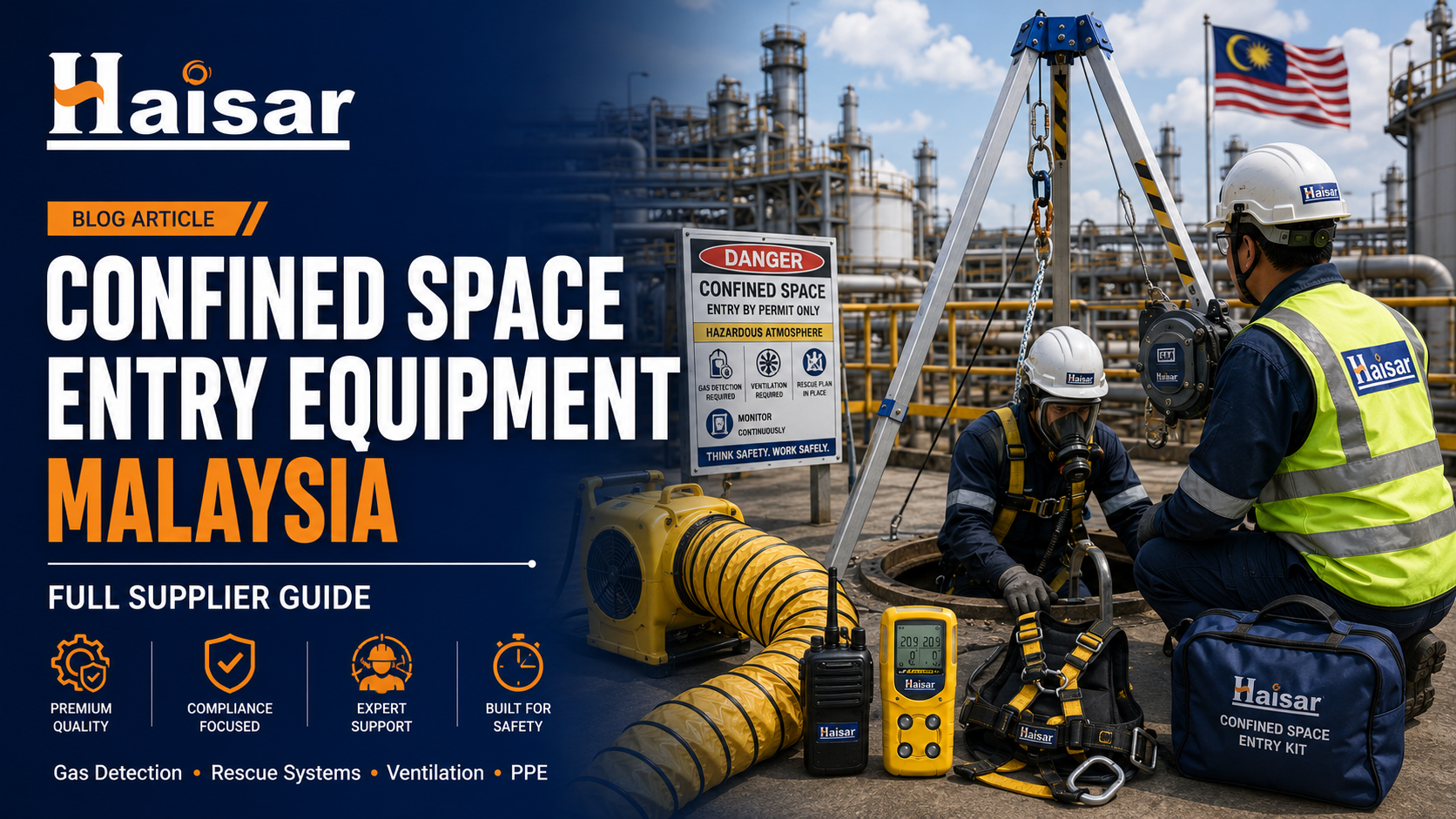
Confined space work is one of the highest-risk activities in Malaysian industry. It is also one of the most routine. Tanks, vessels, sumps, manholes, pipe tunnels, crawl spaces, silos, and ship holds are all classified confined spaces, and they appear on virtually every industrial project site in Malaysia, from oil and gas plants in Pasir Gudang to water treatment facilities in Johor Bahru, shipyards along the Johor Strait, and power generation plants across the peninsula.
What makes confined spaces so dangerous is not a single hazard but a combination. Oxygen deficiency. Toxic gas accumulation. Flammable atmospheres. Engulfment. Restricted entry and exit that slows rescue. These hazards can develop rapidly and without warning, and they can incapacitate a worker before there is any opportunity to self-rescue. The Malaysian DOSH incident record includes fatalities from confined space entries that were considered routine by the teams involved.
The right confined space entry equipment, properly maintained and used within a documented entry procedure, is what makes the difference between a controlled operation and a fatality. This guide covers the full scope of confined space entry equipment required for compliant operations in Malaysia, what to look for when sourcing it, and how Haisar Supply and Services supports operators and contractors across Johor and peninsular Malaysia.
The Regulatory Framework for Confined Space Work in Malaysia
Before covering equipment, it is important to understand the regulatory context. Confined space operations in Malaysia are governed by several overlapping frameworks that project teams and facility operators must comply with simultaneously.
OSHA 1994 and its Regulations. The Occupational Safety and Health Act 1994 sets the overarching duty of care for all Malaysian workplaces. Under OSHA, employers are required to identify confined space hazards, implement safe systems of work, and ensure that workers have the competence and equipment to carry out confined space entry safely.
DOSH Code of Practice for Work in Confined Space. This is the primary technical guidance document for confined space operations in Malaysia. It defines confined spaces, sets out the requirements for atmospheric testing, ventilation, rescue arrangements, and the permit-to-work system, and specifies the competencies required for authorised entrants, standby persons, and entry supervisors.
Factories and Machinery Act 1967. For confined spaces within factory environments, additional requirements apply under this Act and its subsidiary regulations.
Industry-specific requirements. For oil and gas operations, PETRONAS safety requirements and PCSB guidelines apply additional obligations. For offshore operations, international standards including IOGP and IACS requirements apply. For vessel entry in the maritime sector, Marine Department Malaysia and SOLAS requirements are relevant.
A confined space entry equipment supplier in Malaysia who understands this regulatory landscape is not just a product vendor. They are a compliance partner. Haisar works with clients across all of these regulatory frameworks and ensures that the equipment we supply meets the documentation and certification requirements that apply to each specific operating context.
The Essential Confined Space Entry Equipment
1. Gas Detection Equipment
Atmospheric testing is the first and most critical step before any confined space entry. The DOSH Code of Practice requires that the atmosphere within a confined space be tested for oxygen content, flammable gas concentration, and toxic gas presence before entry is permitted, and that monitoring continues throughout the operation.
What your operations need:
- Multi-gas personal monitors configured as a minimum for oxygen (O2), combustible gases (LEL), hydrogen sulphide (H2S), and carbon monoxide (CO). This four-gas configuration covers the most commonly encountered atmospheric hazards in Malaysian industrial confined spaces and is the baseline requirement for most entry operations.
- Pre-entry sampling pumps and extension probes for testing the atmosphere at depth within the space before any person enters. A competent entry supervisor must be able to test the full depth and breadth of the space remotely before authorising entry.
- Photoionisation detectors (PID) for spaces where volatile organic compounds (VOCs) are a risk, including tanks that have contained hydrocarbons, solvents, or chemical products.
- Calibration gas and certified calibration equipment to verify that each gas monitor is reading accurately before each day of use. A gas monitor that has not been bump tested against known-concentration calibration gas is not reliable protection.
- Docking stations and data management systems for operations running multiple personal gas monitors, enabling centralised bump test logging, calibration records, and instrument history.
What to check: Gas detection instruments must be calibrated at manufacturer-specified intervals and the calibration record must be documented. In regulated environments including petrochemical facilities, offshore operations, and PETRONAS contractor sites, gas detection calibration records are routinely audited. Ensure your supplier can provide calibration gas in the correct concentration for your instruments and can advise on calibration intervals appropriate to your operating conditions.
2. Rescue and Retrieval Systems
DOSH requirements and the fundamental duty of care for confined space operations require that a rescue arrangement be in place before entry is authorised. In practice, this means that mechanical retrieval equipment must be positioned at the entry point and a standby person trained in its operation must be present throughout the entry. This is not optional and it is not a box-tick. It is the mechanism that makes rescue possible without requiring another person to enter a potentially lethal atmosphere.
What your operations need:
- Tripod rescue systems for vertical entry points including manholes, tanks, and silos. A tripod provides a stable elevated anchor point above the entry allowing a worker to be retrieved vertically using an attached winch system. Tripods must be rated for the combined weight of the entrant and equipment and must be positioned correctly over the entry point to allow direct vertical retrieval.
- Davit arm systems for situations where a full tripod cannot be positioned, including low-headroom environments and ship tank entries where overhead clearance is restricted.
- Man-rated rescue winches providing mechanical advantage for retrieval of an incapacitated worker. The winch must be rated for the intended load and must allow controlled lowering as well as retrieval.
- Retrieval lines and attendant lines connecting the entrant to the rescue system at all times during the entry. The line must be routed to allow free movement within the space without creating entanglement hazards.
- Rescue stretchers and casualty handling equipment for situations where the entrant cannot be retrieved vertically through the entry point and must be manoeuvred through the space in a horizontal or angled configuration.
What to check: Tripod and winch systems must be load-rated and must be inspected before each use and at formal intervals by a competent person. Equipment must be compatible, meaning the winch, tripod, and retrieval line must be matched as a system. Do not mix components from different manufacturers without verifying compatibility and load ratings.
3. Full-Body Harnesses with Confined Space Configuration
A standard working-at-heights harness is not necessarily suitable for confined space rescue. The retrieval configuration for a vertical confined space entry requires a harness that positions the attachment point above the wearer's centre of mass to allow vertical retrieval without the casualty becoming inverted.
What your operations need:
- Full-body harnesses with a dorsal rescue D-ring as the primary retrieval attachment point. The dorsal D-ring positioned between the shoulder blades provides the correct geometry for vertical retrieval of an incapacitated worker.
- Chest D-rings and sternal attachment options for certain confined space configurations and for use with specific retrieval system geometries.
- Confined space rated harnesses with work positioning capability for entrants who need to work at a fixed position within the space in addition to being retrievable.
- Harness sizing and adjustment to ensure correct fit for each individual worker. A poorly fitted harness creates both safety risks during normal use and retrieval complications during an emergency.
What to check: Harnesses for confined space use must be inspected before each use and must be formally inspected at six-monthly intervals or more frequently if the working environment involves chemical exposure, UV exposure, or physical abrasion that could degrade the webbing. In marine and chemical environments, the inspection interval should be reduced given the accelerated degradation caused by these conditions.
4. Ventilation Equipment
Forced air ventilation is the primary means of controlling atmospheric hazards in confined spaces where toxic or flammable gases are present or where oxygen deficiency may develop. Ventilation must be established before entry and maintained continuously throughout the operation.
What your operations need:
- Axial flow ventilation blowers for forced air supply into confined spaces. Blower selection must be matched to the size of the space and the ventilation rate required to achieve and maintain a safe atmosphere.
- Flexible ventilation ducting to direct airflow to the base of the space where heavier-than-air gases accumulate. Simply placing a blower at the entry point is not sufficient ventilation for most industrial confined spaces.
- Intrinsically safe or spark-free blowers for spaces where a flammable atmosphere may be present before ventilation is established. A standard electric motor at the entry to a flammable atmosphere is an ignition source.
- Extraction ducting and fittings for situations where dilution ventilation is supplemented by direct extraction of contaminated air from the base of the space.
What to check: Ventilation must be continuous for the duration of the entry. If ventilation fails during an entry, the entrant must immediately exit the space. Gas monitoring must continue throughout regardless of ventilation status, as ventilation system failures or changes in process conditions can cause atmospheric conditions to deteriorate rapidly.
5. Communication Equipment
Communication between the entrant and the standby person outside the space is a DOSH requirement and a practical safety necessity. In spaces where visual contact cannot be maintained, which is the majority of industrial confined spaces, communication must be maintained by other means throughout the entry.
What your operations need:
- Intrinsically safe two-way radios certified for use in Zone 1 or Zone 2 hazardous areas as appropriate to the space being entered. Standard consumer radios are not suitable for use in potentially flammable atmospheres and their use in classified zones is a regulatory violation in addition to a safety risk.
- Wired communication systems as an alternative to radio in spaces where radio signal penetration is poor, such as deep underground structures or heavily shielded metal vessels.
- Signal line communication as a minimum backup system where other communication methods are not available, using agreed line-pull signals to communicate entry status and emergency conditions.
What to check: Communication systems must be tested before entry commences and must remain functional throughout the operation. Standby persons must understand the communication protocol and must be able to initiate the emergency response procedure immediately if communication is lost.
6. Emergency Escape Breathing Devices (EEBD)
In situations where atmospheric conditions in a confined space deteriorate during an entry, an emergency escape breathing device provides the entrant with a short duration air supply sufficient to exit the space before incapacitation.
What your operations need:
- Self-contained escape breathing apparatus (SCEBA) providing a minimum of 10 to 15 minutes of breathable air for emergency egress from the space.
- Compressed air escape sets for environments where the primary atmospheric risk is oxygen deficiency or toxic gas rather than flammable atmosphere.
- Storage and deployment arrangements ensuring EEBDs are immediately accessible to entrants at all times during the entry and are not stored in a location that would require the entrant to pass through the hazardous atmosphere to reach them.
What to check: EEBDs have a limited service life and a limited shelf life once activated. Ensure that your supplier can provide equipment with adequate remaining service life and that your site has a documented inspection and replacement programme for all EEBDs held in stock.
7. Confined Space Entry Signage and Permit Boards
The administrative and visual controls that surround confined space entry are as important as the physical equipment. The DOSH Code of Practice requires a documented permit-to-work system for all confined space entries, and the visual controls that support this system must be present at every entry point.
What your operations need:
- Confined space entry warning signs clearly marking every access point as a confined space with the entry requirements visible to all approaching personnel.
- Permit-to-work display boards at the entry point showing the current entry permit, the names of entrants and standby persons, atmospheric test results, and the time limits on the permit.
- Exclusion zone barriers and rope to prevent unauthorised approach to the entry point during operations.
- Do Not Enter and Confined Space Permit Required signs as permanent installations at all known confined space access points.
- Multilingual signage for facilities where the workforce includes workers whose primary language is not Bahasa Malaysia or English.
What to check: Signage in outdoor and industrial environments must be manufactured from UV-stable, weatherproof materials. Standard indoor sign materials deteriorate rapidly in the Malaysian climate and must be replaced more frequently than properly specified outdoor-rated signs.
8. Personal Protective Equipment for Confined Space Entry
In addition to the confined space-specific equipment above, entrants require appropriate personal protective equipment matched to the specific hazards of the space being entered.
What your operations need:
- Chemical resistant coveralls for entry into spaces that have contained or may contain chemical residues.
- Chemical resistant gloves and boot covers for spaces with floor contamination.
- Safety helmets with chin straps as chin straps are required in confined space environments where the helmet could be dislodged during retrieval.
- Intrinsically safe lighting including headlamps and handheld torches rated for use in classified hazardous areas.
- Knee pads for entrants working in spaces requiring crawling or kneeling on hard or contaminated surfaces.
- Appropriate respiratory protection beyond the personal gas monitor, including half-face respirators with appropriate cartridges where chemical vapour exposure is possible in a non-immediately-dangerous-to-life-or-health (IDLH) atmosphere.
What to check: PPE for confined space entry must be assessed against the specific hazards of the space. A risk assessment-based approach to PPE selection is required, and the selected PPE must be documented in the entry permit.
Sourcing Confined Space Entry Equipment in Malaysia
The confined space entry equipment market in Malaysia ranges from compliant, well-maintained equipment from reputable manufacturers to substandard products that appear adequate until they are needed. The consequences of equipment failure in a confined space rescue situation are severe enough that procurement decisions in this category require more than a price comparison.
When evaluating a confined space entry equipment supplier in Malaysia, consider the following.
Certification and documentation. Every piece of confined space equipment you purchase should come with manufacturer documentation, test certifications, and where applicable calibration certificates. A supplier who cannot provide this documentation when asked is not the right supplier for regulated industrial operations.
Product knowledge. Can your supplier advise on the correct tripod rating for your rescue scenario? Can they confirm that the gas detection instrument they are recommending has the sensor types appropriate for the hazards in your specific space? Can they advise on the compatibility of harness and retrieval system components? These are not specialist questions. They are the basic level of knowledge that a competent confined space equipment supplier should be able to answer.
Calibration gas supply. Gas detection equipment is only as reliable as the calibration process. A supplier who sells gas detectors but cannot supply calibration gas or advise on calibration intervals is leaving a gap in your compliance programme.
Stock availability and response time. Confined space work cannot wait for equipment to be sourced from overseas. Your supplier must be able to provide replacement or loan equipment promptly when instruments fail or equipment requires servicing.
Haisar Supply and Services: Confined Space Entry Equipment Supplier in Malaysia
Haisar Supply and Services Sdn Bhd, based in Kulai, Johor, supplies the complete range of confined space entry and rescue equipment for industrial operations across Malaysia. We work with oil and gas operators, shipyards, power generation facilities, construction contractors, and water and utilities operators who carry out confined space work as part of their regular operations.
Our confined space equipment supply covers the full scope outlined in this guide, from multi-gas personal monitors, calibration gas, and docking stations, to tripod and davit rescue systems, man-rated winches, confined space rated harnesses, ventilation blowers and ducting, intrinsically safe communication equipment, EEBDs, and confined space entry signage.
We supply products that meet the applicable Malaysian and international standards and we provide the documentation that regulated operations require. Our team understands the DOSH Code of Practice for Work in Confined Space and the broader regulatory framework that governs confined space operations in different industry sectors across Malaysia.
Get a Quote for Confined Space Entry Equipment
Whether you are equipping a new project site, replacing end-of-life equipment, or building out your confined space entry capability for the first time, Haisar can help.
Contact our team with your requirements and we will respond with product recommendations, specifications, and pricing tailored to your operation.
Haisar Supply and Services Sdn Bhd (985158-T) | Kulai, Johor, Malaysia | www.haisar.com
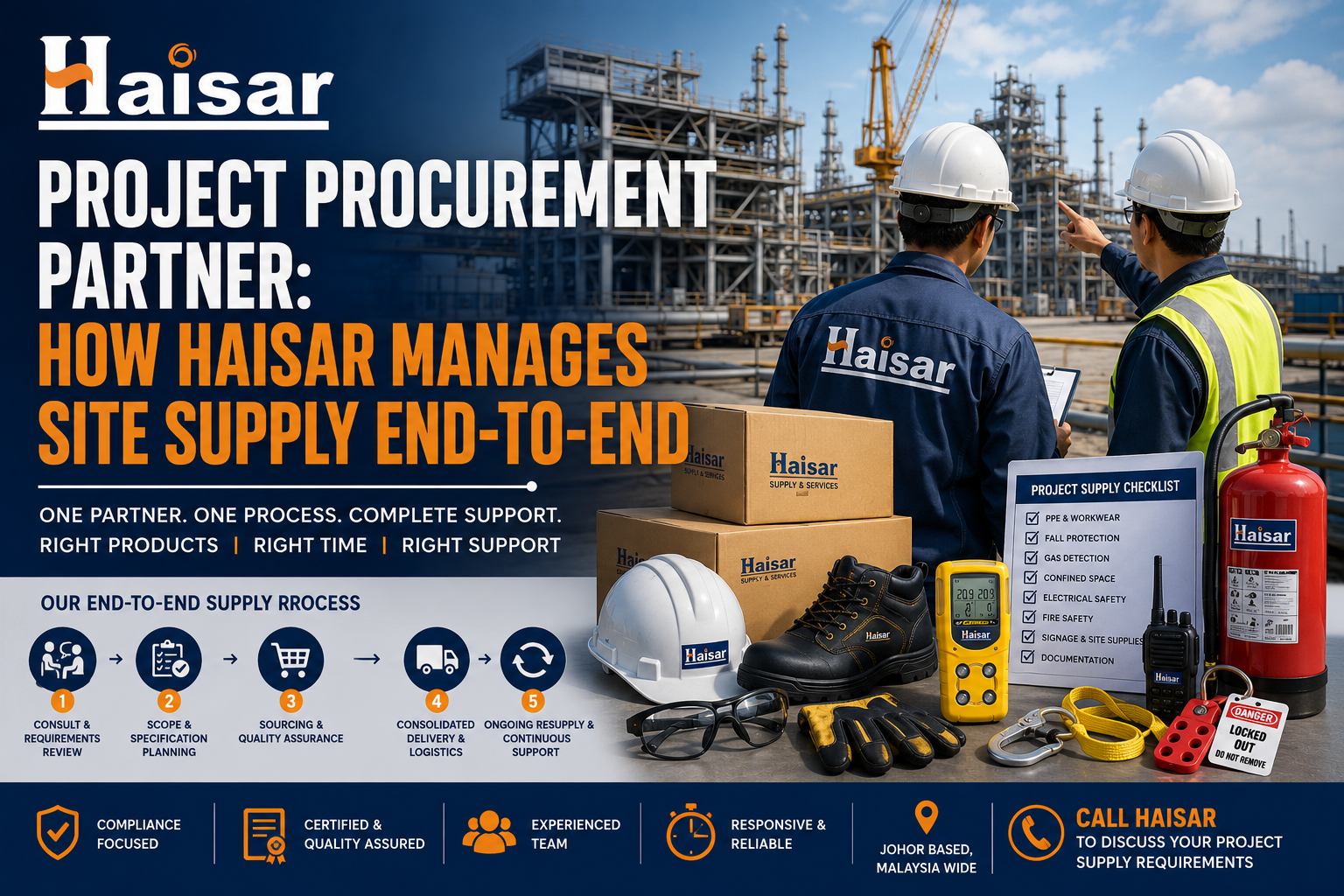
Most industrial project teams do not struggle to find safety equipment. What they struggle with is everything around it. The back-and-forth quotations. The suppliers who go quiet after you place an order. The wrong items arriving on site. The paperwork that does not match what procurement needs. The last-minute scramble when something is missing on day one of mobilisation.
These are not product problems. They are procurement problems. And they are far more common on project sites in Johor than they should be.
At Haisar Supply and Services, we have built our business around solving exactly these problems. This page explains how we manage site supply end-to-end, what that means in practice, and why it matters for project teams who need more than a catalogue and a delivery truck.
The Difference Between a Supplier and a Procurement Partner
The distinction sounds subtle but the operational reality is significant.
A product supplier responds to purchase orders. You know what you need, you raise a PO, they fulfil it. That model works when your procurement process is mature, your specifications are finalised, and your supply chain has no surprises. On a live project site, those conditions rarely all exist at the same time.
A procurement partner does something different. They engage with your project requirements before the purchase order exists. They help you identify what you need, flag what you may have missed, advise on the right specification for your application, and structure supply in a way that keeps pace with your project schedule rather than reacting to it.
For project teams operating in Johor's industrial sectors, oil and gas, power generation, construction, data centres, marine, and renewable energy, the procurement partner model is not a premium option. It is a practical necessity given the pace and complexity of these projects.
Haisar operates as a procurement partner. Here is what that looks like across the stages of a typical project engagement.
Stage One: Project Mobilisation Support
The mobilisation phase is where procurement errors have the greatest downstream impact. Equipment that is incorrectly specified at mobilisation creates compliance problems later. Items that are forgotten at the planning stage become urgent orders mid-project. Quantities that are underestimated result in resupply delays at the worst possible moments.
Haisar's involvement at the mobilisation stage means we work with your HSE manager, project manager, or procurement team before the site is active. We review your scope of work, the hazard environment your teams will be operating in, and the regulatory requirements applicable to your project, whether that is DOSH compliance, PETRONAS safety requirements, CIDB standards, or BOMBA specifications.
From that review, we produce a consolidated project supply list covering the full scope of what your site needs. This is not a generic equipment checklist. It is a project-specific document that accounts for your workforce size, the phases of your project, the specific tasks being carried out, and the standards that apply to your industry and site type.
For a project team that has previously managed procurement reactively, this stage alone changes the dynamic entirely. Instead of raising purchase orders item by item as needs arise, you have a consolidated view of your supply requirements from day one.
Stage Two: Product Sourcing and Specification
Once the supply scope is established, Haisar manages the sourcing process. This matters because the industrial safety equipment market in Malaysia includes a wide range of product quality and a significant variation in what suppliers claim versus what products actually deliver.
Our sourcing process is built around three criteria.
Compliance first. Every product we supply is assessed against the regulatory standard applicable to its use. SIRIM certification for PPE. BOMBA approval for fire safety products. Voltage ratings and test certifications for electrical safety equipment. Calibration documentation for gas detection equipment. We do not supply products that cannot be documented against the relevant standard, because our clients operate in regulated environments where documentation is part of the compliance requirement, not an afterthought.
Application appropriateness. The correct product for a confined space entry operation in a petrochemical tank is not the same as the correct product for a rooftop solar installation. The correct safety footwear for a wet steel deck in a shipyard is not the same as the correct footwear for a data centre fit-out. We match products to the specific application, not to the broadest possible category.
Delivery reality. Lead times in industrial procurement are often longer than catalogue listings suggest. We maintain relationships with a broad supplier network and carry stock of fast-moving items to ensure that what we commit to deliver is what we actually deliver, on the date we commit to.
For project teams who have experienced the gap between a supplier's quoted lead time and the actual delivery date, this is where a procurement partner earns its position in the supply chain.
Stage Three: Consolidated Supply and Delivery
One of the most significant operational advantages of working with Haisar as a procurement partner is the consolidation of supply. Rather than managing separate vendor relationships for PPE, project equipment, signage, workwear, gas detection, confined space gear, and fall protection, your team manages one.
This has practical implications that are easy to underestimate until you have experienced them.
A single point of contact for all product queries means your team spends less time chasing suppliers and more time running the project. A single delivery consolidation means your goods receiving team is not processing multiple part-shipments from different vendors across different days. A single invoice means your finance team has one document to process rather than a stack of purchase orders matched against receipts from five different suppliers.
On a large project site in Johor, these efficiencies are not marginal. The administrative overhead of managing multiple safety equipment suppliers across a project lifecycle is a real cost, both in staff time and in the coordination errors that arise when multiple supplier relationships are running simultaneously.
Haisar's delivery capability covers Johor and peninsular Malaysia. For projects requiring staged delivery aligned to project phases, we structure our supply schedule around your construction programme rather than our convenience.
Stage Four: Ongoing Resupply and Replenishment
Projects evolve. Workforce numbers change. Scope extensions add new work areas with new hazard profiles. Consumable PPE is used up. Equipment is damaged or lost on site. Signage needs to be updated when site conditions change.
A supplier who only engages at the point of a purchase order leaves your site team to identify these needs themselves, raise new orders, and wait for fulfilment. A procurement partner stays engaged with the project and anticipates resupply needs before they become urgent.
For clients on ongoing project engagements, Haisar operates a scheduled resupply model. We work with your site HSE team to review consumption rates, identify upcoming requirements based on the project programme, and pre-position stock for delivery before the need becomes critical.
For consumable items like disposable respirators, safety glasses, gloves, and barrier tape, this means your site store does not run empty mid-shift. For equipment items like gas detection instruments requiring calibration, this means replacements are available before calibration due dates create compliance gaps.
Stage Five: Documentation and Compliance Support
Regulated project environments require documentation at every stage of the supply chain. Your procurement team needs purchase records. Your HSE team needs product compliance certificates. Your client or regulator may require evidence that the PPE on site meets the specified standard.
Haisar maintains a documentation management process that runs alongside every supply engagement. For each product category, we can provide SIRIM certification references, manufacturer technical data sheets, compliance declarations, calibration certificates for gas detection equipment, and test reports for electrical safety PPE where required.
For clients operating under PETRONAS contractor safety requirements, data centre operator HSE standards, or client-specified approved product lists, we work within your framework rather than asking you to adapt to ours. If your project requires products from a specific approved brand list, we source within that list. If your client requires a product compliance register, we supply the documentation to populate it.
This level of procurement support is what separates a transactional supplier relationship from a procurement partnership. The product is the same. The support around it is where the value is created.
What Haisar Supplies for Project Sites in Johor
Our project supply capability covers every category of safety equipment and site supply that an industrial project team in Johor is likely to need.
Personal Protective Equipment covers the full head-to-toe range including head protection, eye and face protection, hearing protection, respiratory protection across dust masks, half-face and full-face respirators and supplied air systems, hand protection across multiple glove types, safety footwear, and body protection including hi-vis garments, coveralls, and FR rated workwear.
Working at Heights Equipment covers full-body harnesses, lanyards, self-retracting lifelines, anchor systems, roof anchor points, and associated inspection and training documentation support.
Electrical Safety Products cover insulated rubber gloves and testing equipment, arc flash PPE, voltage detectors, lockout/tagout systems including padlocks, hasps, valve lockouts, circuit breaker lockouts, and cable lockout devices, insulated tools, and insulated matting.
Gas Detection Equipment covers personal four-gas monitors, fixed gas detection systems, sampling pumps, calibration gas, bump test equipment, and docking stations.
Confined Space Equipment covers tripod and davit rescue systems, winch and retrieval systems, ventilation blowers and ducting, emergency escape breathing devices, and confined space entry signage.
Project Supplies and Site Equipment covers material handling equipment, site barriers and traffic management systems, storage and racking solutions, site cabins, and temporary site infrastructure.
Signage and Site Communication covers mandatory, prohibition, warning, and emergency signage, custom site signage, multilingual signage, and HSE noticeboards and display systems.
Customised Workwear covers company-branded coveralls, hi-vis vests and jackets, FR rated garments, and uniform programmes for project teams and contractors.
Fire Safety and Emergency Response covers BOMBA-approved fire extinguishers, fire blankets, first aid kits, AED units, eye wash stations, spill kits, and emergency response equipment.
Who We Work With
Haisar's project procurement clients span the industrial sectors active in Johor and across peninsular Malaysia.
Oil and gas operators and contractors working in Pasir Gudang, Kertih, and offshore locations rely on us for the full scope of site safety supply from initial mobilisation through to maintenance phase operations.
Power generation project teams, including conventional and renewable energy EPC contractors, work with us to manage safety equipment procurement aligned to their construction programme.
Data centre developers and fit-out contractors operating in Iskandar Puteri and Greater Johor Bahru use our consolidated supply model to manage the complexity of procurement across multiple contractor packages simultaneously.
Construction and civil engineering companies active across Johor's infrastructure pipeline work with us as their safety supply partner across project durations of months to years.
Marine and shipyard operators in Johor's port corridor rely on us for marine-rated safety equipment including gas detection, confined space rescue systems, personal flotation, and electrical safety PPE.
Working with Haisar: What to Expect
Every engagement with Haisar begins the same way. We understand your project before we recommend products. We ask about your scope of work, your timeline, your workforce size, the industries and regulatory frameworks that apply to your site, and your previous procurement experience. That context shapes everything that follows.
From your first enquiry, you will have a named contact at Haisar who manages your account. That person knows your project, knows your requirements, and is reachable when you need them. You will not be passed between departments or asked to repeat your project details every time you raise a new order.
Quotation turnaround is a priority. For standard project supply requirements, we aim to provide a detailed quotation within 24 hours of enquiry. For complex or multi-category project supply scopes, we will give you a realistic timeframe upfront and meet it.
Delivery across Johor and peninsular Malaysia is part of our standard service. For urgent requirements, we will tell you clearly what is possible and what is not, rather than committing to timelines we cannot meet.
Call Haisar to Discuss Your Project Supply Requirements
If your project in Johor needs a procurement partner who manages site supply end-to-end rather than just fulfilling purchase orders, we are ready to talk.
Call us now to speak with our project supply team.
We will listen to your requirements, give you a clear view of what we can provide, and start the process of building a supply solution that works for your project from mobilisation to completion.
Get a Quote or visit our services page to learn more about how Haisar works with project teams across Johor and Malaysia.
Haisar Supply and Services Sdn Bhd (985158-T) | Kulai, Johor, Malaysia | www.haisar.com
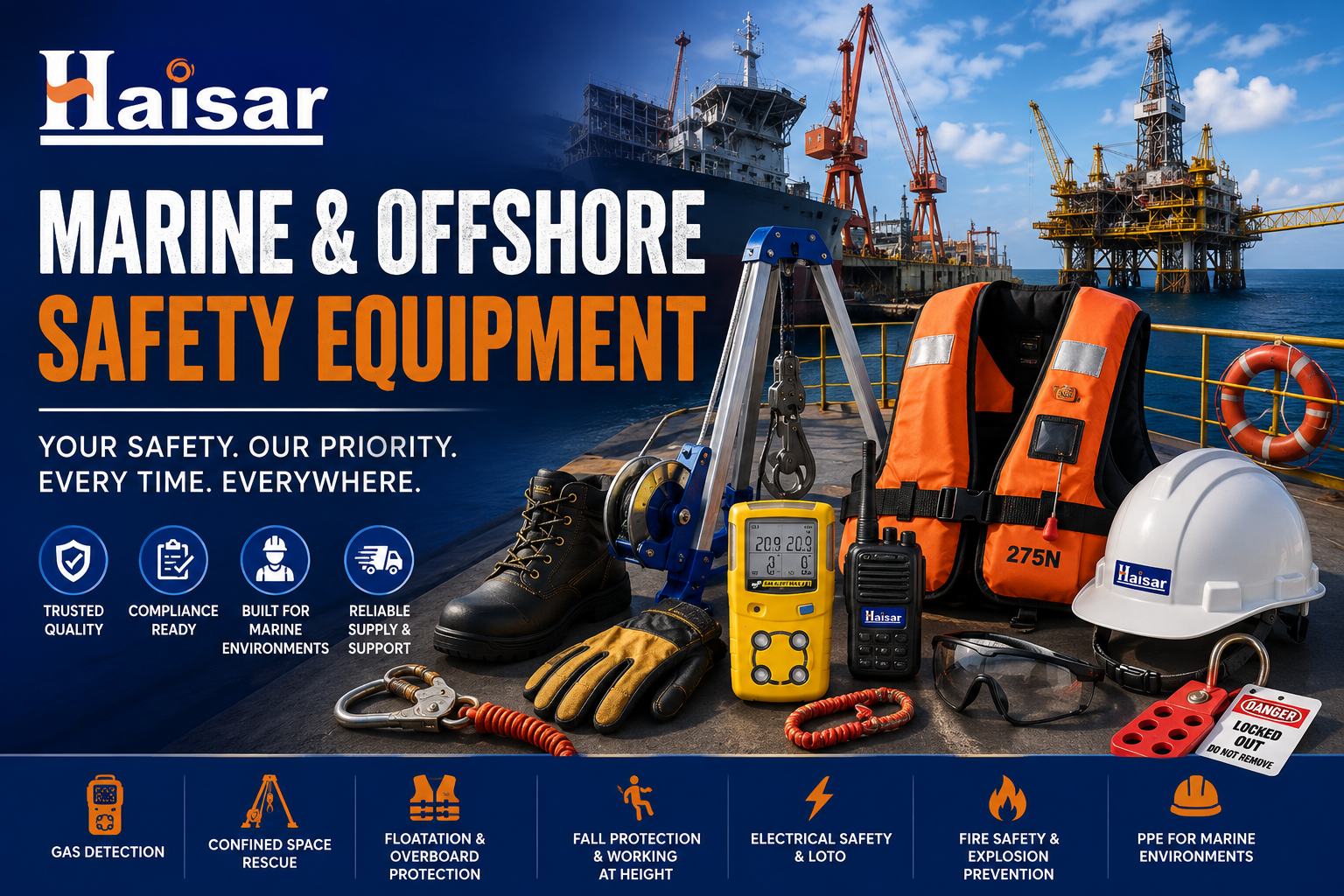
Malaysia's marine and offshore industry is one of the most demanding operating environments in the world. From the shipyards and dry docks of Johor Bahru and Pasir Gudang to the offshore platforms operating in the Malacca Strait and South China Sea, the hazards facing marine and offshore workers are numerous, often invisible, and frequently fatal when the right equipment is not in place.
Johor sits at the centre of Malaysia's maritime industrial corridor. Port of Tanjung Pelepas, Port of Johor, and the shipyards along the Johor Strait handle vessel maintenance, ship repair, new build, and offshore support operations around the clock. The workers on these sites face a combination of hazards that few other industries can match, including confined spaces with toxic atmospheres, working over water, electrical systems in corrosive environments, fire and explosion risk from flammable cargoes, and the constant physical demands of shipyard and offshore work.
This guide covers the essential safety equipment for marine and offshore operations in Malaysia, what to prioritise, and what to look for in a marine safety equipment supplier who can actually support your operations.
Why Marine and Offshore Safety Demands Specialist Equipment
Standard construction site safety equipment is not enough for marine and offshore environments. The combination of corrosive saltwater conditions, confined spaces throughout vessel structures, working at height over water, and the presence of flammable and toxic gases requires equipment that is specified, rated, and maintained for these specific conditions.
Corrosion and environmental rating. Equipment used in marine environments must be rated for saltwater exposure. Plastic components, metal fittings, and electronic instruments that perform reliably on a construction site can fail rapidly when exposed to salt air and spray. Gas detectors, rescue equipment, and harness hardware must all be selected with the marine environment in mind.
Regulatory framework. Marine and offshore operations in Malaysia are governed by the Department of Occupational Safety and Health (DOSH), the Marine Department Malaysia (Jabatan Laut), and for offshore operations, PETRONAS safety requirements and international standards including SOLAS (Safety of Life at Sea) and IOGP guidelines. Compliance across these overlapping frameworks requires equipment that meets multiple standards simultaneously.
The consequences of failure. In a shipyard or offshore environment, equipment failure does not just mean an incident on a worksite. It can mean a worker in the water, an explosion in a confined space, or a casualty in an area that emergency services cannot reach quickly. The margin for error is smaller than almost any other industry.
Getting marine and offshore safety equipment right is not a procurement convenience. It is an operational necessity.
Essential Marine and Offshore Safety Equipment
1. Gas Detection Equipment
Gas detection is the single most critical safety requirement in marine and offshore environments. Vessel tanks, bilge spaces, pump rooms, engine rooms, and cargo holds all present risk of oxygen deficiency, toxic gas accumulation, and flammable atmosphere. Entering any of these spaces without atmospheric testing is a leading cause of fatal confined space incidents in the maritime industry globally.
What your operations need:
- Multi-gas personal monitors detecting oxygen (O2), combustible gases (LEL), hydrogen sulphide (H2S), and carbon monoxide (CO) simultaneously. These are the minimum four-gas configuration for marine confined space work.
- Fixed gas detection systems for engine rooms, pump rooms, and cargo spaces where continuous monitoring is required.
- Pre-entry atmospheric testing equipment including sampling pumps and extension probes for testing spaces before entry without requiring a person to enter first.
- Photoionisation detectors (PID) for detecting volatile organic compounds (VOCs) in cargo tank cleaning and petrochemical vessel operations.
- Catalytic bead sensors for flammable gas detection in environments where methane, LPG, or other hydrocarbons may be present.
- Calibration gas and bump test equipment to ensure gas detectors are functioning correctly before each use. A gas detector that has not been bump tested is not reliable protection.
- Docking stations and data management systems for fleets of personal gas monitors, enabling centralised bump testing, calibration, and data download.
What to check: All gas detection equipment must be calibrated at manufacturer-specified intervals and bump tested before each day of use. In Malaysia, DOSH guidelines and the Code of Practice for Work in Confined Space require documented atmospheric testing as part of every confined space entry permit. Do not accept gas detection equipment from a supplier who cannot provide calibration certificates and calibration gas supply.
2. Confined Space Entry and Rescue Equipment
Confined space entry is routine in shipyard and marine operations. Tanks, voids, double bottoms, cofferdams, pipe tunnels, and pump rooms are all classified confined spaces and all require a documented entry procedure with the right equipment in place before anyone enters.
What your operations need:
- Tripod and davit rescue systems for vertical entry rescue from tanks and manholes without requiring a rescuer to enter the space.
- Winch and retrieval systems rated for the weight of a fully equipped worker, providing mechanical rescue capability at every entry point.
- Full-body harnesses with rescue attachments for all confined space entrants. The harness must include a designated rescue lifting point, typically a dorsal D-ring, compatible with the retrieval system in use.
- Ventilation equipment including axial flow blowers, duct, and fittings for forced air ventilation of confined spaces before and during entry.
- Intrinsically safe communication equipment for communication between entrants and the standby person outside the space. Standard radios are not safe for use in potentially flammable atmospheres.
- Confined space entry signage and barriers to clearly mark entry points and exclude unauthorised personnel during permit operations.
- Emergency escape breathing devices (EEBD) for workers in spaces where rapid evacuation may be required in the event of atmospheric deterioration.
What to check: Every confined space entry in a marine environment requires a permit to work signed by a competent person, documented atmospheric testing results, and a standby person stationed at the entry point for the duration of the operation. Equipment alone is not enough without the procedural framework to support it.
3. Personal Flotation Devices and Overboard Protection
Working over water, alongside vessels, on jetties, and on offshore platforms presents a drowning risk that shore-based sites do not face. Falls overboard in the Johor Strait or offshore waters are serious incidents with a narrow survival window.
What your operations need:
- Automatic inflatable lifejackets (150N and 275N rated) for workers operating in areas where a fall overboard is possible. Automatic inflation lifejackets activate on water immersion without requiring the wearer to pull a cord, which is critical for an incapacitated casualty.
- Buoyancy aids for lower-risk near-water work where full lifejacket protection is not required but some buoyancy support is appropriate.
- Lifebuoys and rescue throw lines positioned at all water-edge working locations, jetties, and gangways. These must be SOLAS-rated for offshore and port operations.
- Man-overboard poles and lights for offshore and vessel operations where rapid marking of a person in the water is critical to recovery.
- Safety harnesses with tethers for work on vessel decks and gangways where a tether to a fixed point provides primary fall prevention before a lifejacket becomes relevant.
- Personal locator beacons (PLBs) for offshore workers operating in remote locations or working away from the main platform.
What to check: Inflatable lifejackets must be serviced and re-armed at manufacturer-specified intervals. An unserviced inflatable lifejacket may not inflate when needed. Ensure your supplier can provide or direct you to service facilities for the brands they supply.
4. Fall Protection and Working at Height Equipment
Shipyard and offshore environments involve extensive working at height on vessel structures, scaffolding over water, offshore platform decks, and crane operations. The consequence of a fall in many of these environments is not just injury from the fall itself but drowning risk if the fall is into water.
What your operations need:
- Full-body safety harnesses rated to EN 361, correctly fitted to each worker. In marine environments, harnesses should be inspected more frequently due to the accelerated degradation caused by salt air and UV exposure.
- Self-retracting lifelines (SRLs) for freedom of movement on decks and elevated structures where a standard lanyard would create trip hazards.
- Energy-absorbing lanyards for single-point anchorage where fall clearance is sufficient.
- Temporary and permanent anchor points for vessel repair and shipyard work where structures may not have built-in anchorage provisions.
- Scaffold systems for vessel hull repair, painting, and maintenance work. Scaffold systems used in shipyards must be erected and inspected by a competent scaffolder.
- Rope access equipment for confined hull sections and locations where conventional scaffold is not practical.
What to check: Salt air and UV radiation degrade synthetic rope and webbing significantly faster than in indoor or sheltered environments. Harness and lanyard inspection in marine settings must be more frequent than the standard intervals applicable to general construction sites.
5. Electrical Safety PPE
Shipyards and offshore facilities involve extensive electrical work in environments that combine the hazards of water, humidity, and salt with live electrical systems. Electrical fatalities in marine environments are disproportionately high compared to land-based industries.
What your operations need:
- Voltage-rated insulated rubber gloves matched to the voltage class of the systems being worked on. Regular pressure testing is required to verify integrity.
- Arc flash rated PPE including face shields, hoods, and FR coveralls rated to the incident energy level determined by an arc flash risk assessment.
- Voltage detectors and non-contact testers for verifying circuit status before any contact with terminals or conductors.
- Lockout/tagout (LOTO) equipment for isolating electrical systems during maintenance and repair. This includes padlocks, hasps, multi-lock devices, circuit breaker lockouts, and tagout tags.
- Insulated tools for live work and work near live conductors.
- Insulated matting for switchboard and distribution board locations.
What to check: Insulating gloves must be pressure tested at intervals and before any use where integrity is in question. A glove with a pinhole failure will not protect against electric shock. Source gloves from a supplier who can also supply testing equipment or provide test certification.
6. Fire Safety and Explosion Prevention
Fire risk in marine and offshore environments comes from flammable cargo residues in tanks, fuel systems, welding and hot work operations, and electrical faults in areas exposed to flammable atmospheres. Explosion risk is present wherever tanks that have contained flammable products are being cleaned, repaired, or modified.
What your operations need:
- BOMBA-approved fire extinguishers of the correct class for the fire risks present, including CO2 for electrical fires and dry powder or foam for hydrocarbon fires.
- Fire blankets for small fire suppression and for protection of casualties with burn injuries.
- Hot work permits and associated equipment including fire watches, fire extinguishers at the point of work, and fire-resistant blankets to protect adjacent structures during welding and grinding operations.
- Intrinsically safe equipment for use in classified hazardous areas where flammable atmospheres may be present. This includes torches, communication devices, and gas detectors.
- Flame-resistant (FR) workwear for workers in areas where flash fire risk exists, including tank cleaning, hot work, and operations on vessels carrying or having carried flammable cargoes.
What to check: Fire extinguishers in marine environments must be inspected and serviced at the required intervals. Salt air corrodes extinguisher bodies and activating mechanisms. A corroded extinguisher may fail to operate when needed.
7. Personal Protective Equipment for Marine Environments
Standard site PPE is a starting point, but marine environments require additional consideration for each PPE category due to the corrosive, wet, and physically demanding nature of the work.
What your operations need:
- SIRIM-certified safety helmets with chin straps, as a helmet without a chin strap on a vessel deck or scaffold over water can become a secondary hazard.
- Safety footwear with non-slip soles rated for wet deck surfaces. Standard construction safety boots with smooth soles can be dangerous on wet steel decks. Look for footwear with oil and water-resistant outsoles designed for maritime environments.
- Waterproof and chemical-resistant gloves for wet working conditions and chemical handling during vessel cleaning operations.
- Eye protection including anti-fog goggles for grinding, cutting, and work in spray conditions.
- Hearing protection for engine room work and areas with high noise levels from machinery and fabrication operations.
- Coveralls and waterproof outerwear for working in exposed conditions. FR coveralls are required for workers in hot work and hydrocarbon-exposed environments.
- Knee pads for workers involved in hull cleaning, blasting, and close-contact work on vessel surfaces.
What to check: PPE in marine environments degrades faster than on standard construction sites. Inspection frequency should be increased, and replacement thresholds should be applied more conservatively given the additional environmental stressors.
8. Signage and Site Communication
Marine and offshore facilities operate across large areas with multiple simultaneous operations, shift workers, and contractors from multiple organisations working alongside each other. Clear signage and communication systems are essential for maintaining safe site conditions.
What your operations need:
- Confined space entry signage clearly marking every access point to a confined space with entry requirements and permit information.
- Hazardous area classification signage marking zones where flammable atmospheres may be present and where intrinsically safe equipment is required.
- Emergency muster point signage visible from all areas of the facility and vessel.
- Hot work zone signage marking areas where welding, grinding, and cutting is in progress.
- Safety instruction signage in multiple languages as Malaysian shipyards and offshore facilities typically employ workers from multiple countries.
- Custom facility signage for permit-to-work boards, equipment storage locations, and safety notice boards.
What to check: Signage in marine environments must be resistant to UV degradation, moisture, and salt air. Standard indoor signage will deteriorate rapidly in these conditions. Specify outdoor-rated, UV-stable materials for all external and exposed signage.
What to Look for in a Marine Safety Equipment Supplier in Malaysia
The demands of marine and offshore operations mean that your safety equipment supplier needs to be more than a catalogue. They need to understand the regulatory environment, the specific hazards of marine work, and the operational realities of shipyard and offshore procurement.
Product range that covers the marine environment. You need a supplier who can provide gas detection equipment and calibration gas, confined space rescue systems, lifejackets and overboard protection, electrical safety PPE, FR workwear, LOTO equipment, and fire safety products from a single point of contact. Managing multiple specialist suppliers for a marine project is a procurement burden that slows down mobilisation.
Compliance knowledge. Your supplier should understand the intersection of DOSH requirements, Marine Department Malaysia regulations, PETRONAS safety requirements where applicable, and international standards like SOLAS. A supplier who cannot explain why a particular product meets the relevant standard is not the right partner for a regulated marine operation.
Reliability and response time. Offshore and shipyard operations do not wait. If a gas detector fails calibration before a confined space entry, you need a replacement or a loan unit the same day, not in a week. Supplier responsiveness is an operational requirement, not a nice to have.
Documentation and traceability. Marine and offshore operations require documented evidence that safety equipment meets specified standards. Your supplier must be able to provide calibration certificates, test reports, SIRIM certification references, and manufacturer documentation on request.
Haisar Supply and Services: Marine Safety Equipment Supplier in Johor and Malaysia
Haisar Supply and Services Sdn Bhd, based in Kulai, Johor, supplies the full range of safety equipment required for marine, shipyard, and offshore operations across Malaysia. We serve operators and contractors working in Johor's port and shipyard corridor, and across peninsular Malaysia.
Our marine and offshore safety equipment supply covers gas detection and calibration, confined space entry and rescue systems, personal flotation and overboard protection, fall protection and working at heights gear, electrical safety PPE and LOTO equipment, fire safety products, and the full range of marine-rated personal protective equipment.
We understand the compliance requirements that govern marine and offshore operations in Malaysia and we work with HSE managers and procurement teams to ensure the right products reach site on time and with the documentation your operations require.
Get a Quote for Marine Safety Equipment
Whether you are equipping a shipyard operation in Pasir Gudang, supporting an offshore project out of Johor, or sourcing safety equipment for a port facility, Haisar Supply and Services can help.
Contact us directly and our team will respond promptly with product availability, specifications, and pricing for your marine safety equipment requirements.
Haisar Supply and Services Sdn Bhd (985158-T) | Kulai, Johor, Malaysia | www.haisar.com
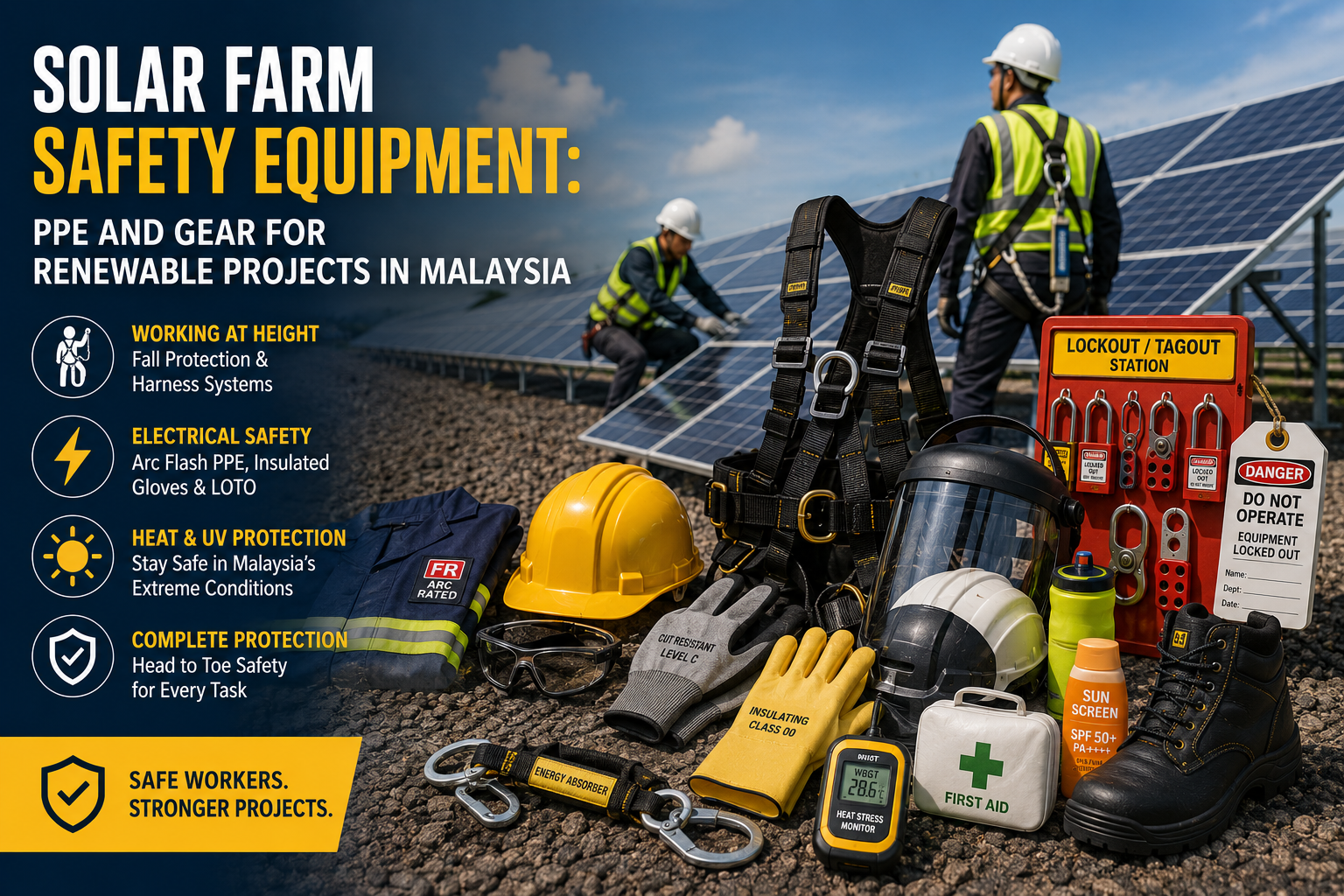
Malaysia's solar energy sector is growing fast. With the government's target to reach 70% renewable energy capacity by 2050 and a surge in large-scale solar (LSS) projects across Johor, Selangor, Kedah, and Sabah, EPC contractors and project developers are mobilising site teams at a pace the industry has not seen before. Behind every megawatt commissioned is a workforce operating in demanding outdoor environments, working at height on rooftops and ground-mounted structures, handling electrical systems, and exposed to heat, UV radiation, and the very real risk of electric shock.
Solar farm safety equipment is not a tick-box exercise. It is what keeps your workers alive and your project on schedule. This guide covers the essential PPE and safety gear for solar farm and renewable energy projects in Malaysia, with practical guidance on what to prioritise and why.
The Unique Safety Risks of Solar Farm Projects in Malaysia
Solar installations in Malaysia present a specific combination of hazards that differ from conventional construction sites. Understanding them is the starting point for building the right safety equipment programme.
Working at height. Whether your team is installing panels on pitched rooftops, elevated mounting structures, or carrying out maintenance on utility-scale ground-mounted arrays, fall risk is constant. Malaysia's DOSH statistics regularly list falls from height among the top causes of fatal workplace accidents in construction and installation work.
Electrical hazards. Solar panels generate DC electricity the moment they are exposed to light. There is no way to fully de-energise a panel in the field without covering it, and even covered panels can carry residual charge. Workers involved in cabling, inverter installation, and electrical testing face real arc flash and electrocution risk.
Heat stress and UV exposure. Solar farm work happens outdoors, often in open fields with no shade and ambient temperatures exceeding 35 degrees Celsius. Malaysia's equatorial climate means UV index levels are consistently in the extreme range. Heat exhaustion and heatstroke are genuine risks on any outdoor solar project.
Manual handling and repetitive strain. Panels are heavier than they look, typically between 20 and 25 kilograms each, and installation involves repetitive lifting, carrying, and positioning across large site areas. Cumulative strain injuries and acute manual handling accidents are common on poorly managed solar sites.
Slip, trip, and fall hazards at ground level. Even on ground-mounted projects, uneven terrain, cable runs, mounting rails, and muddy conditions during wet season create constant slip and trip hazards.
A well-specified safety equipment package for a solar project in Malaysia needs to address all of these hazards systematically.
Essential Solar Farm Safety Equipment for Malaysian Projects
1. Fall Protection and Working at Heights Gear
Fall protection is the highest-priority safety requirement on any solar installation. Whether your workers are on a rooftop system or an elevated racking structure, DOSH regulations require appropriate fall protection systems to be in place before work begins.
What your team needs:
- Full-body safety harnesses rated to EN 361 or equivalent, correctly fitted to each worker. A harness that does not fit is not protection.
- Lanyards and energy-absorbing lanyards for single-point anchorage on structures where fall clearance allows.
- Self-retracting lifelines (SRLs) for situations where movement across the work area requires a retractable connection rather than a fixed lanyard.
- Roof anchor points and temporary anchor systems providing rated anchorage for rooftop installations. Anchor points must be engineered and load-rated.
- Safety nets for large rooftop or elevated installations where collective fall protection is required below the work area.
- Scaffold edge protection and guardrails as the primary collective fall protection measure wherever scaffold access is used.
- Ladder safety systems for access to elevated working positions.
What to check: Under Malaysia's OSH (Use and Standards of Exposure of Chemicals Hazardous to Health) Regulations and the DOSH Working at Heights guidelines, a documented fall protection plan is required before any work at height begins. All equipment must be inspected before each use and formally inspected at intervals by a competent person.
2. Electrical Safety PPE
Solar panel strings, combiner boxes, inverters, and grid connection points all present electrical hazards. Electrical safety PPE on a solar site must address both AC and DC electrical risks, including arc flash.
What your team needs:
- Insulated rubber gloves (Class 00 to Class 4) rated for the voltages your team will encounter. DC string voltages on utility-scale solar can exceed 1,000V. Gloves must be tested regularly and protected with leather over-gloves during use.
- Arc flash rated face shields and hoods for work near inverters, switchboards, and combiner boxes where arc flash energy is a risk.
- Arc flash rated clothing (FR coveralls) providing appropriate calorie-rated protection for the tasks and equipment involved.
- Voltage-rated insulated tools for all live electrical work.
- Voltage detectors and non-contact testers so workers can verify circuit status before touching any terminal or conductor.
- Lockout/tagout (LOTO) equipment for isolating inverters, switchboards, and string combiner boxes during maintenance. This includes padlocks, hasps, circuit breaker lockout devices, and tagout tags.
- Insulated matting for work at switchboard and inverter locations.
What to check: An arc flash risk assessment should be carried out for the project's electrical system to determine the incident energy levels and the appropriate arc flash PPE category. Do not assume standard workwear is adequate near electrical equipment on a solar site.
3. Head Protection
Head protection is mandatory on all active project sites in Malaysia under OSHA 1994 requirements. On solar farm sites, overhead hazards include panels being lifted and positioned, tools dropped from elevated work areas, and movement of materials by crane or telehandler.
What your team needs:
- SIRIM-certified safety helmets appropriate to the site hazard class. Standard Class B helmets provide both impact and electrical protection, making them the preferred choice for solar sites where both hazards are present.
- Chin straps particularly important for work at height where a falling helmet becomes a secondary hazard to workers below.
- Bump caps for low-headroom maintenance situations inside plant rooms and inverter enclosures, where impact risk is low but scrape and abrasion hazards exist.
What to check: Helmets must be inspected regularly and replaced if cracked, faded excessively, or past the manufacturer's recommended service life, typically three to five years from the date of manufacture.
4. Eye and Face Protection
Solar sites expose workers to multiple eye hazards including UV radiation, dust and particulates during ground preparation, sparks during electrical termination work, and chemical splash risk during battery storage maintenance.
What your team needs:
- UV-rated safety spectacles for outdoor workers exposed to high UV index conditions throughout the working day.
- Anti-fog safety goggles for dust-intensive tasks during ground clearance and earthworks.
- Face shields for grinding, cutting, and any work involving chemical splash risk.
- Welding shades and grinding visors for metalwork on racking and mounting structure fabrication.
What to check: Standard clear safety glasses do not provide UV protection. Outdoor workers on solar sites need lenses with UV400 rating or equivalent. This is often overlooked during equipment procurement.
5. Respiratory Protection
Ground preparation, earthworks, and concrete work on solar farm sites generate significant dust. Workers involved in battery storage installation may also encounter gases and chemical vapours during commissioning and maintenance.
What your team needs:
- P2 disposable respirators (FFP2/N95) for general dust protection during ground clearing, earthworks, and panel handling.
- P3 half-face respirators with particulate filters for higher dust concentrations during prolonged earth-moving phases.
- Gas and vapour cartridge respirators for battery room work involving hydrogen gas risk or chemical maintenance tasks.
What to check: Respirator selection must be based on the specific contaminant and concentration. A P2 dust mask is not appropriate for gas or vapour exposure. Fit testing is recommended for half-face and full-face respirators.
6. Hand Protection
Hand injuries are among the most common on construction and installation sites. Solar farm work involves sharp panel frames, metal racking components, electrical conductors, and heavy panel handling, all of which present different hand injury risks requiring different gloves.
What your team needs:
- Cut-resistant gloves (Level C or higher) for handling panel frames, racking components, and metal structure fabrication.
- General duty work gloves for routine panel handling, cabling, and site operations.
- Electrical insulating rubber gloves for all electrical work, matched to the voltage class required.
- Chemical resistant gloves for battery maintenance and any chemical handling on site.
What to check: Never wear standard fabric or leather gloves near live electrical equipment. Only properly rated and regularly tested insulating rubber gloves provide electrical protection.
7. Foot Protection
Solar farm terrain ranges from cleared agricultural land to rocky hillsides, and site conditions change significantly between dry and wet season. Foot protection must handle both the physical hazards of the site and the electrical hazards of the work.
What your team needs:
- Steel-toe safety boots (S3 rated) providing toe cap protection, puncture resistance, and ankle support for general site work.
- Anti-static or ESD footwear for work in areas where electrostatic discharge is a risk, including battery storage and inverter rooms.
- Electrical hazard rated footwear providing secondary protection against incidental contact with live circuits.
- Wellington boots for wet season site conditions during ground preparation and cable trenching works.
What to check: Footwear must be appropriate to the specific task and location. Anti-static boots are not the same as electrical hazard boots and should not be used interchangeably in live electrical areas.
8. High Visibility and Body Protection
Solar farm sites involve the movement of heavy equipment including module delivery trucks, forklifts, telehandlers, and cranes. Ensuring workers are visible to plant operators is a basic site safety requirement.
What your team needs:
- Class 2 or Class 3 high-visibility vests for all workers in areas where mobile plant is operating. Class 3 hi-vis (full vest with sleeves or jacket) is recommended for sites with vehicles operating at higher speeds.
- Hi-vis coveralls for workers requiring full-body high visibility, particularly those working in or near active roadways adjacent to the site.
- Sun protection clothing including long-sleeved lightweight shirts and UV-rated garments for outdoor workers exposed to prolonged sun throughout the working day.
- FR (flame-resistant) coveralls for electrical workers and those involved in inverter and switchboard commissioning.
What to check: Hi-vis garments must comply with MS ISO 20471 or equivalent. Faded, dirty, or damaged reflective tape significantly reduces visibility and garments should be replaced when tape reflectivity is visibly degraded.
9. Heat Stress Management Equipment
Malaysia's climate makes heat stress a genuine medical risk on outdoor solar projects. Unlike many occupational hazards, heat illness can progress from mild symptoms to life-threatening heatstroke rapidly and without sufficient warning.
What your team needs:
- Cooling towels and neck wraps for immediate cooling during rest breaks.
- Electrolyte replenishment available at all rest stations throughout the working day.
- Portable shaded rest areas positioned strategically across large site areas so workers can take shade breaks without long walks.
- Heat stress monitoring including wet bulb globe temperature (WBGT) measurement to guide work-rest ratios during the hottest parts of the day.
- Personal cooling vests (phase change or evaporative) for workers performing high-exertion tasks during peak heat hours.
What to check: A heat stress management plan should be part of your project's HSE plan. DOSH guidelines on thermal environment and the Code of Practice for Prevention of Heat Stress at Work provide the framework for Malaysian project sites.
10. Emergency Response Equipment
Solar farms are often located in remote or semi-rural areas where emergency services may take significant time to respond. On-site emergency response capability is not optional.
What your team needs:
- First aid kits stocked and sized for the workforce on site, as required under the Factory and Machinery Regulations 1970.
- AED (Automated External Defibrillator) given the electrical hazards on solar sites, cardiac arrest from electric shock is a genuine risk and response time is critical.
- Eye wash stations for sites where chemical handling occurs, particularly battery storage maintenance.
- Burns treatment kits for electrical flash and arc incidents.
- Emergency communication equipment particularly important on remote sites where mobile coverage may be limited.
- Stretcher and casualty evacuation equipment for sites where vehicle access to all areas of the site cannot be guaranteed.
What to check: All first aiders on site must hold a valid first aid certificate. On a solar site with electrical hazards, first aiders should also be trained in the management of electric shock casualties, including the procedure for safely approaching a casualty who may still be in contact with a live circuit.
Sourcing Solar Farm Safety Equipment in Malaysia
For EPC contractors and project developers working on solar projects in Johor and across peninsular Malaysia, the challenge is not knowing what equipment you need. It is finding a supplier who can provide it all, reliably, at the pace your project demands.
Solar project timelines are tight. Mobilisation windows are short. The last thing your HSE team needs is to be chasing three different suppliers for fall protection, electrical PPE, and hi-vis garments while your crew is ready to start work.
A one-stop industrial safety equipment supplier who understands the renewable energy sector can make a material difference to your project setup process.
Why Solar EPC Contractors in Johor Choose Haisar Supply and Services
Haisar Supply and Services Sdn Bhd, based in Kulai, Johor, supplies the full range of safety equipment required for solar farm and renewable energy projects across Malaysia. We work with EPC contractors, project developers, and HSE managers who need reliable procurement support from a supplier who understands the site environment.
We supply everything covered in this guide, from full-body harnesses and SRLs for working at height, to arc flash PPE, insulated gloves, FR coveralls, LOTO equipment, heat stress management products, and on-site emergency response gear.
Our team can support your project from initial mobilisation through to ongoing maintenance phase requirements, with fast quotation turnaround, bulk procurement capability, and delivery across Johor and peninsular Malaysia.
Enquire About Solar Farm Safety Equipment Today
Setting up a solar project in Johor or elsewhere in Malaysia? Haisar Supply and Services can help you specify and procure the right safety equipment for your site, efficiently and in line with Malaysian regulatory requirements.
WhatsApp us now for a fast response from our team.
Or visit our website to browse our full range of PPE, working at heights equipment, and electrical safety products.
Browse Our Products at haisar.com
Haisar Supply and Services Sdn Bhd (985158-T) | Kulai, Johor, Malaysia | www.haisar.com
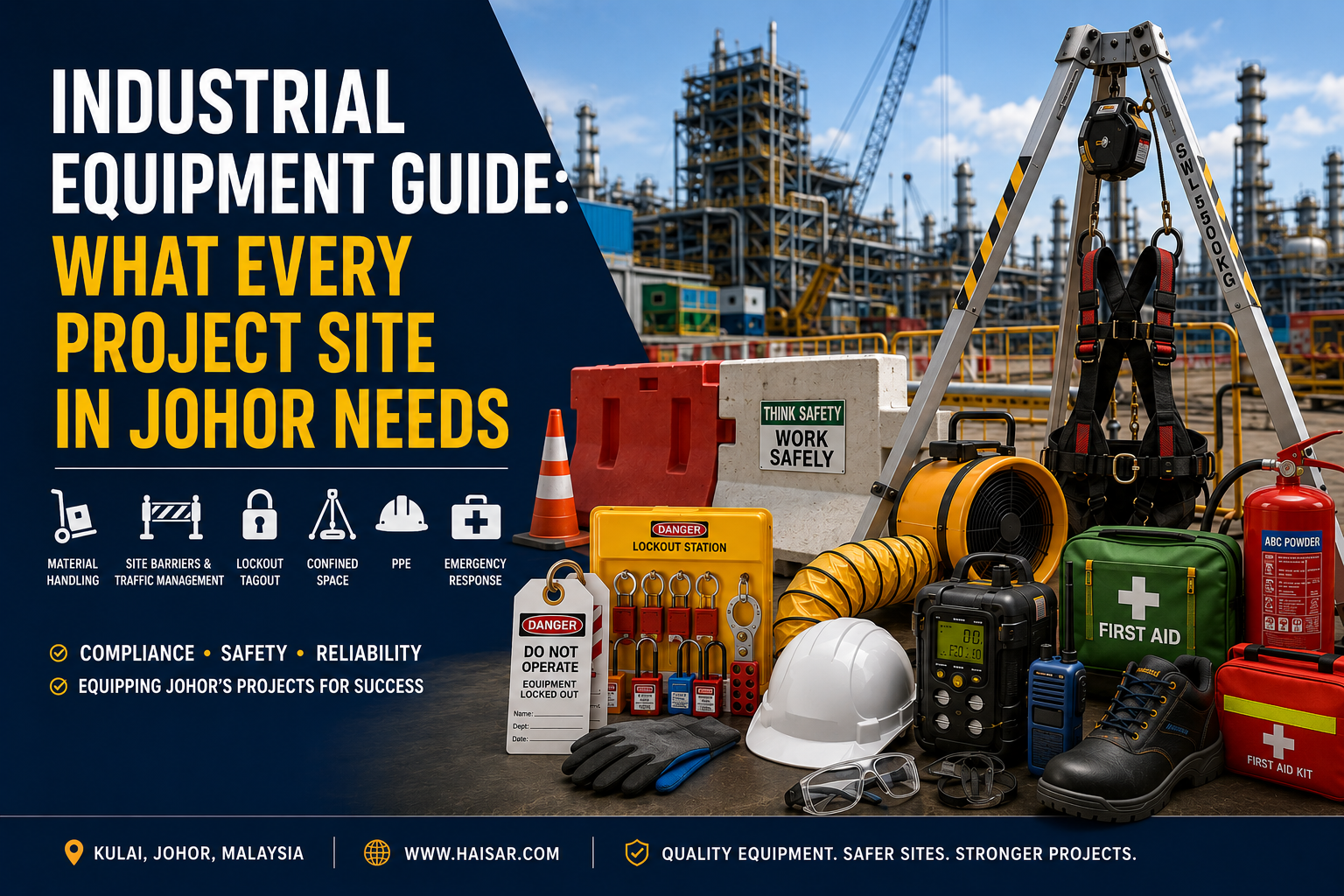
If you're running a project site in Johor, whether it's an oil and gas plant in Pasir Gudang, a data centre in Iskandar Puteri, or a construction site along the Senai corridor, you already know how much rides on having the right industrial equipment on hand. Delays caused by missing tools, wrong specifications, or unreliable suppliers are not just costly. In industries where safety and compliance are non-negotiable, they can be dangerous.
This guide breaks down the essential industrial equipment every project site in Johor needs, from material handling and confined space gear to lockout/tagout systems and site barriers. More importantly, it explains what to look for in an industrial equipment supplier in Johor and why procurement decisions matter as much as the products themselves.
Why Equipment Selection Matters More Than Most Teams Realise
Equipment on a project site is not just a logistics issue. Every piece of industrial equipment your workers use is tied to three critical areas.
Regulatory compliance. Malaysia's Occupational Safety and Health Act (OSHA 1994), DOSH regulations, and industry-specific codes like BOMBA and CIDB standards set clear requirements for what equipment must be present on site. Non-compliance can result in stop-work orders, fines, or worse.
Worker safety. Inadequate or substandard equipment contributes directly to workplace accidents. Malaysia's DOSH statistics consistently show that construction and industrial sectors account for the highest number of reported workplace incidents.
Project continuity. A site that runs out of barriers, lockout devices, or respiratory protection mid-project faces downtime. Procurement delays ripple outward, affecting timelines, subcontractors, and client relationships.
Getting your industrial equipment procurement right from the start is not just good practice. It is a competitive advantage.
The Essential Industrial Equipment Checklist for Johor Project Sites
Below is a practical breakdown of industrial equipment categories your project site likely needs, with guidance on what to look for in each area.
1. Material Handling Equipment
Material handling is the backbone of any active project site. From moving heavy components to organising storage areas, the right equipment prevents injuries and accelerates workflow.
What your site needs:
- Hand trucks and platform trolleys for moving equipment and materials over short distances without forklift dependency.
- Pallet jacks (manual and electric) essential for warehouse-adjacent operations and laydown yards.
- Lifting slings and shackles for overhead lifts. Must be rated and certified.
- Drum handling equipment particularly relevant for chemical, oil and gas, and manufacturing sites where drums of lubricants or chemicals are routinely moved.
- Storage racking and shelving systems to reduce loss, improve traceability, and speed up daily operations.
What to check: All lifting accessories including slings, shackles, and chains must carry a Safe Working Load (SWL) rating and should be inspected regularly. In Malaysia, DOSH guidelines under the Factories and Machinery Act require that lifting gear be tested and certified.
2. Site Barriers and Traffic Management
A well-managed project site separates work zones, protects workers from mobile plant, and keeps unauthorised personnel away from hazardous areas.
What your site needs:
- Plastic water-filled barriers for road and heavy-traffic zone separation. Interlocking designs are easy to deploy and reconfigure.
- Jersey barriers (concrete) for permanent or semi-permanent separation in high-risk areas.
- Crowd control barriers and pedestrian fencing for access control around active work zones.
- Safety cones and delineators for temporary traffic management during works.
- Warning tape and barrier tape for low-cost, flexible demarcation of exclusion zones.
- Site entrance gates and boom barriers for controlled site access on larger projects.
What to check: Barrier specifications must match the risk level of the area. High-speed vehicular environments require rated barriers, not just plastic tape. Ensure your supplier can provide products that meet relevant MS and SIRIM standards.
3. Lockout/Tagout (LOTO) Equipment
Lockout/tagout procedures protect workers from the unexpected energisation of machinery during maintenance, repair, or service activities. This is one of the most frequently cited compliance gaps on Malaysian industrial sites.
What your site needs:
- Lockout padlocks individually keyed, durable, and clearly identifiable per worker.
- Hasp lockouts allowing multiple workers to lock out the same energy isolation point simultaneously.
- Circuit breaker lockout devices for electrical panels and switchboards.
- Valve lockout devices for ball valves, gate valves, and butterfly valves in piping systems.
- Lockout stations and shadow boards for centralised LOTO equipment storage, prominently placed near plant areas.
- Tagout tags durable and weatherproof, identifying who performed the isolation and when.
- Cable lockouts for flexible systems covering non-standard or multi-point energy sources.
What to check: LOTO equipment must be compatible with your specific machinery and isolation points. A good industrial equipment supplier in Johor will help you assess your site's energy control needs and recommend the right combination of devices, not just sell you a generic kit.
4. Confined Space Entry Equipment
Confined space work is one of the highest-risk activities on any project site. In Johor's oil and gas, utilities, and construction sectors, confined space entry is routine and the equipment requirements are specific and non-negotiable.
What your site needs:
- Gas detectors and multi-gas monitors for testing oxygen levels, combustible gases, CO, and H2S before and during entry. Must be calibrated regularly.
- Ventilation blowers and ducting to maintain a breathable atmosphere inside confined spaces.
- Tripod rescue systems for vertical entry rescue without requiring rescuers to enter the space.
- Fall arrest systems for confined space including retrieval lines and winch systems.
- Harnesses with rescue attachments as workers entering confined spaces must wear full-body harnesses with a designated retrieval point.
- Communication equipment such as intrinsically safe two-way radios for communication between entrants and attendants.
- Atmospheric testing equipment including calibration gas, bump test kits, and docking stations.
What to check: Under DOSH's Guidelines on Occupational Safety and Health in Confined Space, every confined space entry must follow a documented permit-to-work system, with equipment checks as part of the entry protocol. Ensure all gas detection equipment is calibrated and all rescue equipment is in-date and functional.
5. Signage and Site Communication
Effective industrial signage is not optional. It is a legal requirement under Malaysia's OSHA 1994 and its subsidiary regulations. Beyond compliance, clear signage reduces accident rates by communicating hazards, procedures, and site rules at the point of need.
What your site needs:
- Mandatory signs covering hard hat areas, safety boot zones, eye protection requirements, and high visibility vest requirements.
- Prohibition signs for no entry, no smoking, and no mobile phones in EX zones.
- Warning signs for high voltage, slippery surfaces, moving machinery, and overhead loads.
- Emergency information signs marking assembly points, first aid locations, fire extinguisher positions, and emergency exits.
- Custom site signage for project-specific safety messages, site rules, visitor instructions, and multilingual signage where required.
- Banner stands and display boards for HSE noticeboards, induction areas, and toolbox talk stations.
What to check: Signs must comply with MS ISO 7010 (Graphical symbols, Safety colours and safety signs) or relevant DOSH and BOMBA requirements depending on the hazard type. A reputable supplier should be able to advise on the correct sign standard for each application.
6. Personal Protective Equipment (PPE)
No industrial equipment guide would be complete without addressing PPE. Project sites in Johor serve multiple industries with varying PPE requirements. What is adequate for general construction may fall short for oil and gas or data centre work.
Core PPE for project sites:
- Head protection with SIRIM-certified safety helmets appropriate to the task class.
- Eye and face protection including safety spectacles, goggles, and face shields for grinding, chemical handling, and welding.
- Hearing protection such as ear plugs and earmuffs for high-noise areas.
- Respiratory protection covering dust masks (P2/P3), half-face respirators, and supplied air respirators for hazardous atmospheres.
- Hand protection including general duty, cut-resistant, chemical-resistant, and electrical insulating gloves as required.
- Foot protection with steel-toe boots, anti-static footwear, and electrical hazard rated footwear.
- Body protection including hi-vis vests, coveralls, chemical resistant suits, and arc flash rated garments.
- Fall protection with full-body harnesses, lanyards, self-retracting lifelines (SRLs), and anchor devices.
What to check: PPE selection should be based on a documented risk assessment, not habit or lowest cost. DOSH-compliant suppliers should be able to provide product documentation, SIRIM certification references, and technical data sheets on request.
7. Emergency Response Equipment
Project sites must be prepared for incidents. Whether it is a chemical spill, a medical emergency, or a fire, having the right emergency response equipment on-site and ensuring workers know how to use it is a basic legal and moral obligation.
What your site needs:
- First aid kits sized and stocked per the number of workers on site, as specified under the Factory and Machinery (Safety, Health and Welfare) Regulations 1970.
- AED (Automated External Defibrillator) increasingly required on larger sites and critical for high-risk environments.
- Eye wash stations including fixed and portable units for chemical and particulate exposure.
- Emergency eyewash and shower units for sites handling corrosive chemicals.
- Fire extinguishers that are BOMBA-approved and correctly rated for the fire risks present on site.
- Chemical spill kits in oil-only, chemical, or universal absorbent configurations depending on site chemicals.
- Stretchers and first aid equipment for transport and initial treatment of injured workers.
What to check: Emergency equipment placement must follow specific requirements. Extinguishers must be within a maximum travel distance, and eye wash stations must be within 10 seconds of chemical hazard areas per ANSI Z358.1. A knowledgeable supplier will help you map placement, not just supply the product.
How to Choose the Right Industrial Equipment Supplier in Johor
With the product landscape covered, the next question is who to buy from. Not all industrial equipment suppliers in Johor offer the same level of service, and for project sites, service matters as much as price.
Product Range and Availability. A one-stop industrial equipment supplier in Johor eliminates the need to manage multiple vendors across different categories. Look for suppliers who can cover material handling, barriers, LOTO, confined space, PPE, and emergency response from a single point of contact.
Compliance Knowledge. Can your supplier tell you which gas detector is appropriate for an oxygen-deficient space versus a flammable gas environment? Can they advise on LOTO compatibility or BOMBA-compliant fire equipment? Technical knowledge separates a real procurement partner from a box-shifter.
Speed of Response. Project sites run on timelines. Your supplier needs to provide quotations quickly, fulfil orders reliably, and communicate proactively about lead times. A supplier who goes silent after you place an order is a risk to your project schedule.
Custom and Bulk Procurement Capability. Many project sites have specialised requirements, from custom signage to bulk PPE orders with company branding or project-specific equipment packages. Look for suppliers with the flexibility to handle these without bureaucratic delays.
After-Sales Support. Who do you call if a gas detector fails calibration on a Monday morning? Good suppliers maintain relationships, not just transactions.
Why Haisar Supply & Services is Johor's Go-To Industrial Equipment Supplier
Haisar Supply & Services Sdn Bhd, based in Kulai, Johor, is built specifically to serve the industrial project market in Johor and across Malaysia. Our clients include companies in oil and gas, power generation, construction, data centres, and renewable energy, industries where equipment quality and procurement reliability directly affect project outcomes.
We supply across all the categories covered in this guide, including material handling and project supplies, site barriers and traffic management, lockout/tagout systems, confined space entry and rescue equipment, safety signage, a full head-to-toe PPE range, and emergency response equipment.
Our team understands the compliance landscape across OSHA, DOSH, BOMBA, CIDB, and industry-specific requirements, and we are here to help you procure correctly, not just cheaply. We offer fast quotation turnaround typically within 24 hours, bulk and project procurement support, custom workwear and signage, and delivery across Johor and peninsular Malaysia.
Ready to Equip Your Johor Project Site?
Whether you're setting up a new site or restocking for an ongoing project, Haisar Supply & Services can help you procure the right industrial equipment efficiently and in compliance with Malaysian regulations.
Or WhatsApp us directly for a faster response. Our team is ready to assist with your project supply and procurement needs across Johor and beyond.
Haisar Supply & Services Sdn Bhd (985158-T) | Kulai, Johor, Malaysia | www.haisar.com
