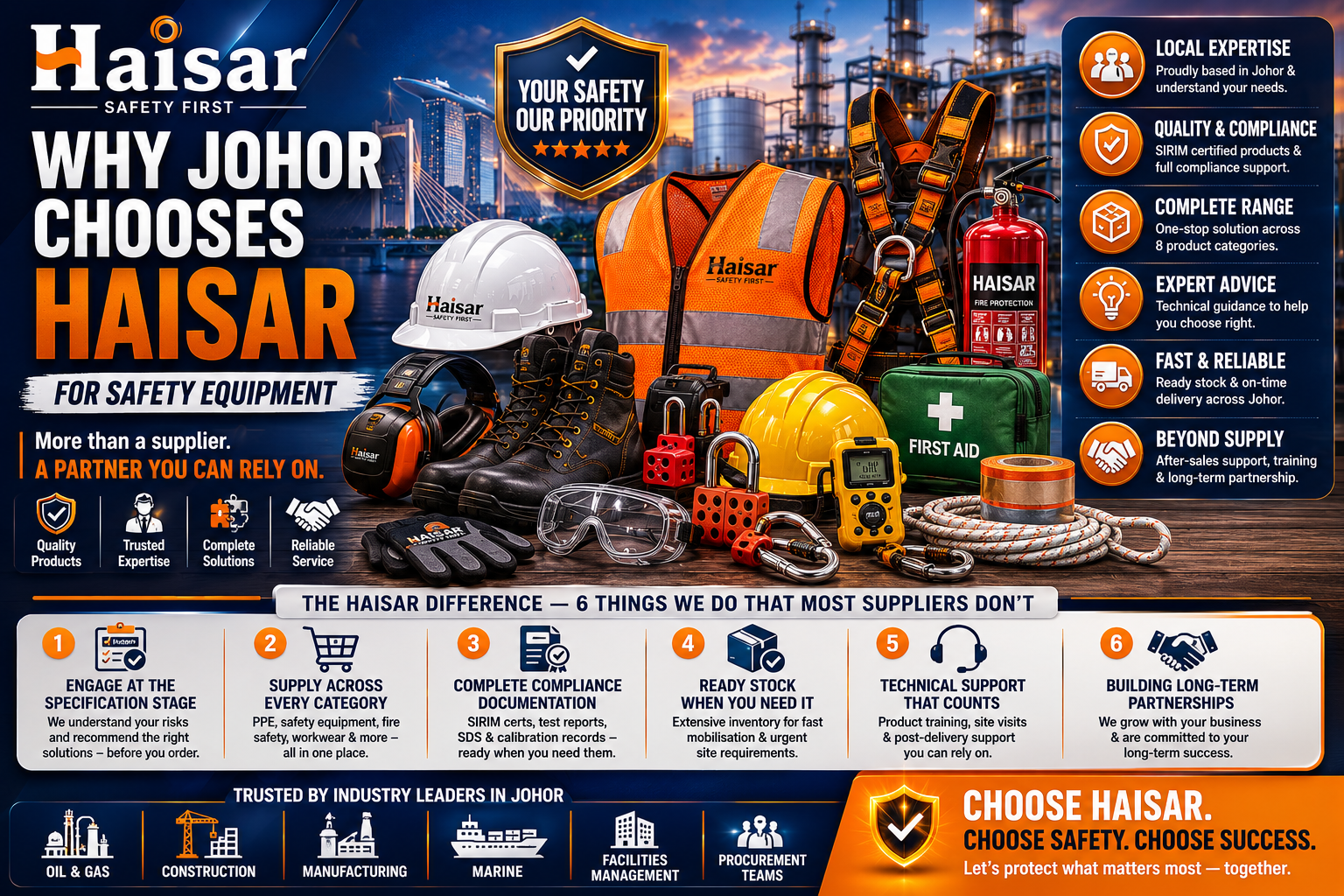
Choosing a safety equipment brand is rarely just a product decision - it's a decision about worker protection, compliance exposure, and how much time your procurement team will spend chasing replacement parts, certificates, and warranty claims two years from now. In Johor's industrial corridor, from the refineries and petrochemical terminals of Pengerang to the semiconductor plants of Kulai and Senai and the logistics hubs of Pasir Gudang, HSE managers and procurement officers are rarely short of options. What they're short of is a clear, unbiased way to compare the brands actually worth specifying.
This guide is built for that job. It's not a listicle ranking brands by hype - it's a working reference for procurement managers, HSE officers, contractors, and factory owners who need to build or review an approved brand list, respond to a client's PPE specification, or simply make a defensible purchasing decision. It covers ten globally recognised safety equipment brands available through Haisar Supply & Services, what each one does best, where each one has limits, and how to match a brand to your specific hazard profile, industry, and budget.
Haisar has supplied PPE, safety equipment, and project supplies to industrial buyers across Johor and Malaysia since 2012. This guide reflects that experience - brands that consistently perform, pass audits, and hold up in Malaysia's climate and industrial conditions, not brands chosen because they pay for placement.
An emergency evacuation plan is not a document that lives in a filing cabinet. It is an operational system that must work under pressure, in the dark, with noise and confusion, and with workers who may never have rehearsed what to do. When an emergency occurs at a workplace in Malaysia, whether it is a fire, a chemical release, a structural collapse, or a medical emergency, the evacuation plan is what stands between a controlled response and a chaotic one.
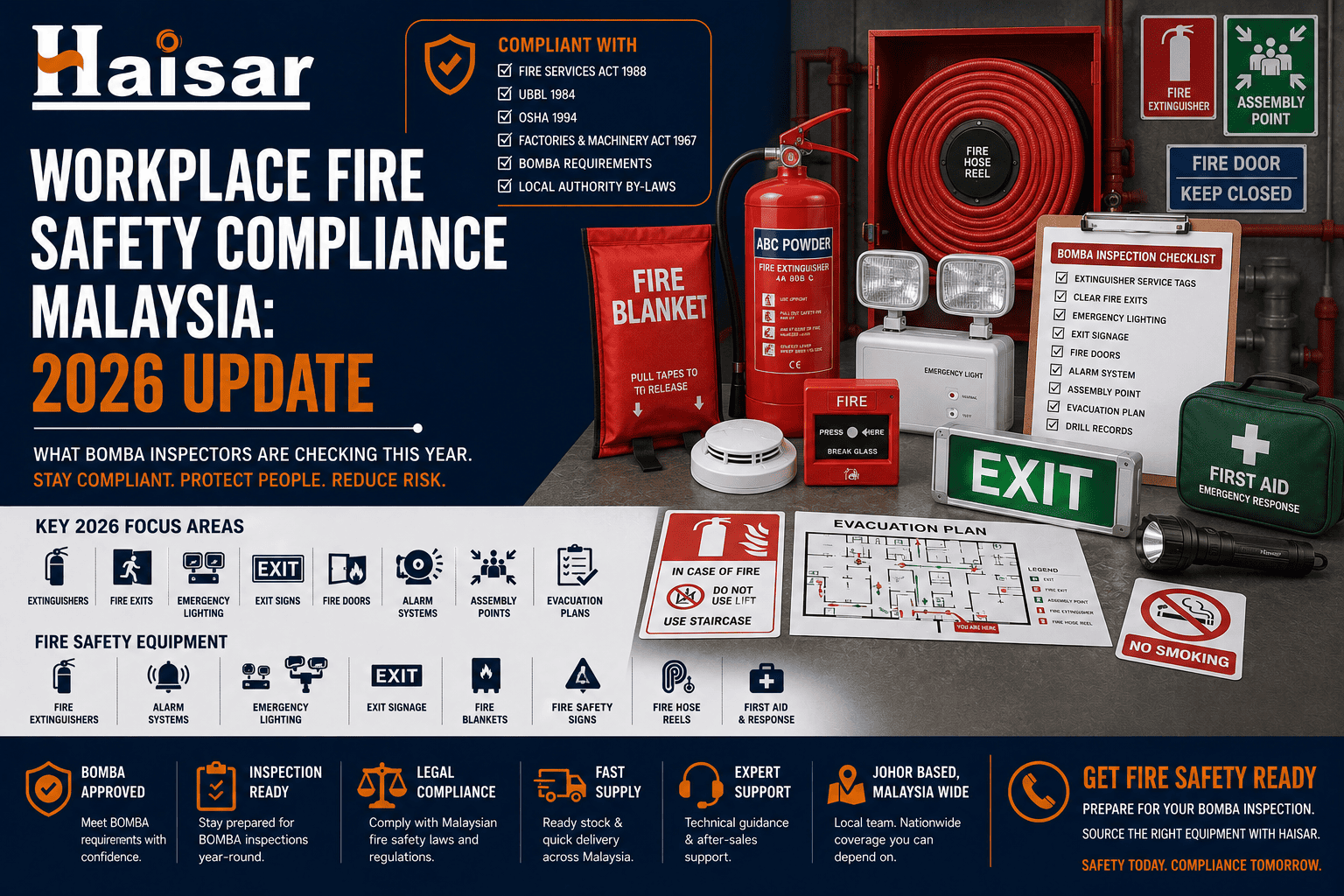
Malaysian law is clear on the obligation. OSHA 1994, the Fire Services Act 1988, BOMBA requirements for certificate of fitness premises, and the Factories and Machinery Act all impose obligations on employers to have documented emergency procedures, to communicate them to workers, and to test them through regular drills. Despite this, emergency evacuation plans in Malaysian workplaces range from genuinely effective operational documents to paper compliance exercises that would not survive first contact with a real emergency.
This guide explains what a legally compliant and operationally effective emergency evacuation plan in Malaysia must contain, walks through a step-by-step template you can adapt for your workplace or project site, and covers the equipment and signage required to support plan implementation.
At the end of this guide, a downloadable template is available. Use it as the starting point for your site-specific plan, not as a finished document. Every effective emergency evacuation plan is specific to the facility, the workforce, and the hazards it addresses.
Last reviewed: July 2026
Chemical hazards are not limited to large petrochemical plants or laboratories. Many Malaysian workplaces handle chemicals every day, including manufacturing plants, construction sites, workshops, cleaning operations, food-processing facilities, warehouses, agricultural operations and maintenance teams.
The risk may come from vapours, gases, mists, dusts, corrosive splashes, contaminated surfaces, flammable liquids, reactive chemicals or chemical waste. Because of this, chemical safety cannot be managed by simply buying gloves or placing one spill kit in the store room. The correct equipment must be selected from the chemical inventory, Safety Data Sheets, exposure route, task method and site-specific risk assessment.
In Malaysia, the main workplace framework for chemicals hazardous to health is the Occupational Safety and Health (Use and Standards of Exposure of Chemicals Hazardous to Health) Regulations 2000, commonly known as the USECHH Regulations. These are supported by the Occupational Safety and Health Act 1994, the CLASS Regulations 2013 and DOSH guidance on Chemical Health Risk Assessment.
Johor is becoming one of Southeast Asia's most significant data centre corridors. The combination of land availability, competitive power tariffs, proximity to Singapore's hyperscale demand, and strong fibre connectivity has attracted investment from some of the world's largest cloud and colocation operators. Iskandar Puteri, Nusajaya, and the broader Greater Johor Bahru area now host a growing number of hyperscale and enterprise data centre facilities, with further development in the pipeline across multiple sites.
Behind every commissioned data centre rack is a construction and fit-out programme employing hundreds of workers across civil, structural, mechanical, electrical, and low-voltage trades. And behind every operational data centre is an ongoing maintenance and facilities management operation employing engineers, technicians, and service contractors who work in an environment that carries specific and significant safety hazards.
Data centres are not conventional office buildings. They house high-density electrical systems operating at voltages from 230V to 33kV or higher at the grid connection point. They run critical cooling infrastructure including refrigerants under pressure. They contain battery backup systems with chemical and electrical hazards. And they operate under client safety standards that often exceed the Malaysian regulatory baseline in specificity and enforcement rigour.
This guide covers the essential PPE and safety equipment for data centre construction, fit-out, and operations in Malaysia, with particular focus on the electrical safety requirements that define the risk environment.
The safety helmet is the most visible piece of personal protective equipment on any construction or industrial site in Malaysia. It is also one of the most frequently misunderstood. Workers and procurement teams often treat all safety helmets as interchangeable, selecting based on price, colour, or brand familiarity rather than on whether the helmet actually matches the hazard environment it will be used in.
That misunderstanding has consequences. A helmet selected for the wrong class of hazard may provide a false sense of protection. A helmet used beyond its service life provides no reliable protection at all. A helmet that meets a certification standard from a decade ago may no longer meet the standard applicable to the site today.
This guide covers everything you need to know about safety helmets in Malaysia, from the hazard classes and certification standards that determine which helmet is right for which application, to how to select, inspect, and replace head protection correctly across the range of construction and industrial environments active in Johor and across Malaysia.
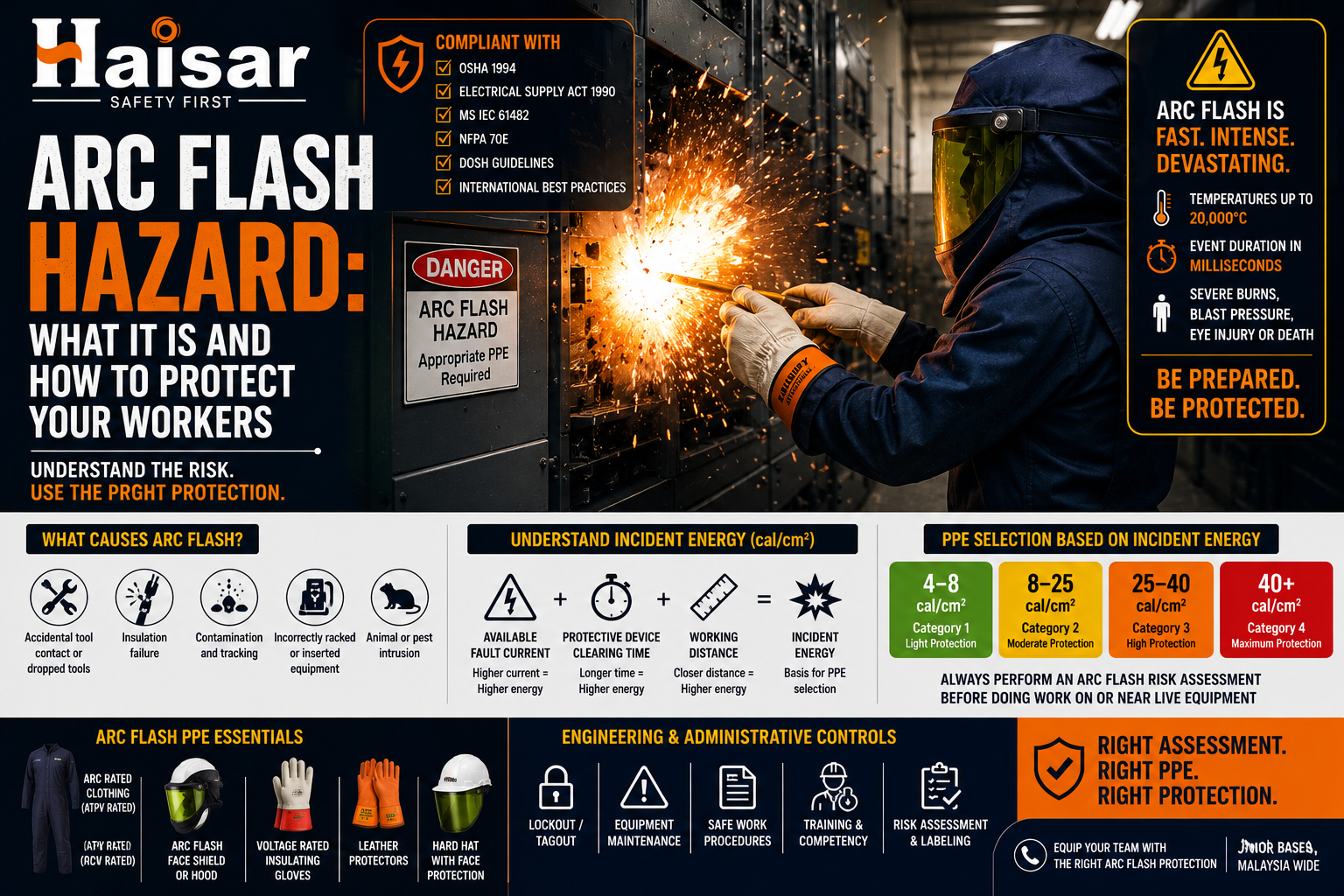
Between 2002 and 2021, Suruhanjaya Tenaga (the Energy Commission) recorded more than 1,100 electrical accidents in Peninsular Malaysia and Sabah, with roughly half resulting in a fatality. Poor maintenance and faulty electrical installations were identified as the single largest contributing factor, accounting for over a third of all cases investigated. Electrical work carries one of the highest fatality-to-incident ratios of any workplace hazard in Malaysia, and yet electrical safety PPE is still frequently treated as a lower priority than helmets, gloves, or footwear when facilities plan their safety budgets.
Every Malaysian workplace that operates switchgear, motor control centres, distribution boards, or process electrical systems carries some level of electric shock or arc flash risk. This includes manufacturing plants, data centres, oil and gas facilities, power generation stations, solar farms, and construction sites at the point where temporary power is energised.
This guide sets out the regulatory framework that governs electrical safety PPE in Malaysia, how electrical accidents actually happen, the equipment required for different classes of electrical work, how to size an arc flash PPE programme correctly, how to train and authorise the people who use that equipment, and how to keep it compliant through its working life. It is written for facility managers, safety officers, procurement teams, and HSE coordinators who need to specify electrical PPE correctly rather than select it from a catalogue.
Because electrical PPE selection depends on technical variables (system voltage, fault current, incident energy) that vary from site to site, this guide leans on tables, checklists and a glossary of terms wherever possible, so you can use it as a working reference rather than a one-time read.
Procurement officers and HSE managers working in Malaysia's oil and gas sector operate in one of the most tightly regulated supply chain environments in the country. PETRONAS contractor requirements, PCSB safety specifications, and the overlapping obligations of DOSH, the Petroleum Safety Measures Act 1984, and international standards including IOGP and API create a compliance framework that demands more from PPE suppliers than most other industries require.
The consequence of getting PPE procurement wrong in the oil and gas sector is not just a regulatory issue. On a petrochemical plant, a refinery shutdown, or an offshore platform, inadequate PPE in the wrong hazard environment contributes directly to fatalities. The Malaysian DOSH incident record for the oil and gas sector reflects this. Falls, fire and explosion incidents, toxic gas exposure, and electrical fatalities all appear in the statistics, and all are linked to situations where the right equipment was not in place.
This checklist is written for procurement officers and HSE managers sourcing PPE for oil and gas operations in Malaysia. It covers the specific PPE requirements that apply in this sector, the compliance standards your supplier must be able to meet, and what a credible oil and gas PPE supplier in Malaysia looks like in practice.
The Regulatory Framework Governing Oil and Gas PPE in Malaysia
Before reviewing the PPE checklist, it is important to understand the layered compliance framework that governs oil and gas PPE procurement in Malaysia. This framework operates at multiple levels simultaneously and a PPE supplier working in this sector must be able to navigate all of them.
Petroleum (Safety Measures) Act 1984. The primary legislation governing safety in the Malaysian petroleum industry. It establishes the legal obligations of operators and contractors in petroleum operations and provides the framework for DOSH enforcement in the upstream sector.
OSHA 1994 and DOSH Regulations. The overarching occupational safety and health framework applying to all Malaysian workplaces including oil and gas facilities. DOSH enforcement of PPE requirements in the oil and gas sector is active and inspections are increasingly thorough.
PETRONAS Technical Standards (PTS). PETRONAS has developed a comprehensive suite of technical standards governing safety, equipment, and contractor performance at its facilities. PPE used by contractors working at PETRONAS facilities must meet PTS specifications where applicable. PETRONAS also maintains approved vendor lists and product approval requirements that affect PPE sourcing decisions.
PCSB Contractor Safety Requirements. For contractors working on PCSB-operated assets, specific contractor safety management requirements apply including PPE standards, induction requirements, and permit-to-work system obligations.
IOGP and API Standards. International Association of Oil and Gas Producers guidelines and American Petroleum Institute standards are widely referenced in the Malaysian oil and gas sector, particularly for offshore operations and for equipment specifications where PETRONAS standards reference international standards.
SIRIM Certification. Safety-critical PPE sold in Malaysia must meet SIRIM certification requirements or equivalent international standards. In the oil and gas sector, CE marking and ANSI certification are generally accepted alongside SIRIM references but documentation must be available.
A PPE supplier for oil and gas operations in Malaysia must be able to confirm the compliance status of every product against the specific standard applicable to the client's facility and operating context. This is not optional and it is not generic. The standard that applies at a PETRONAS onshore facility may differ from the standard required at an offshore platform or a downstream refinery.
The Oil and Gas PPE Checklist
The following checklist covers the PPE categories required across oil and gas operations in Malaysia. It is organised by hazard type, which is the correct starting point for PPE selection in any sector but particularly critical in oil and gas where the range and severity of hazards exceeds most other industrial environments.
Flame-Resistant and Flash Fire Protection
Flash fire risk is present wherever flammable hydrocarbons are processed, stored, or transported. The ignition of a flammable vapour cloud produces a flash fire with a duration of seconds but with sufficient thermal energy to cause fatal full-thickness burns to an unprotected worker at significant distances from the ignition source.
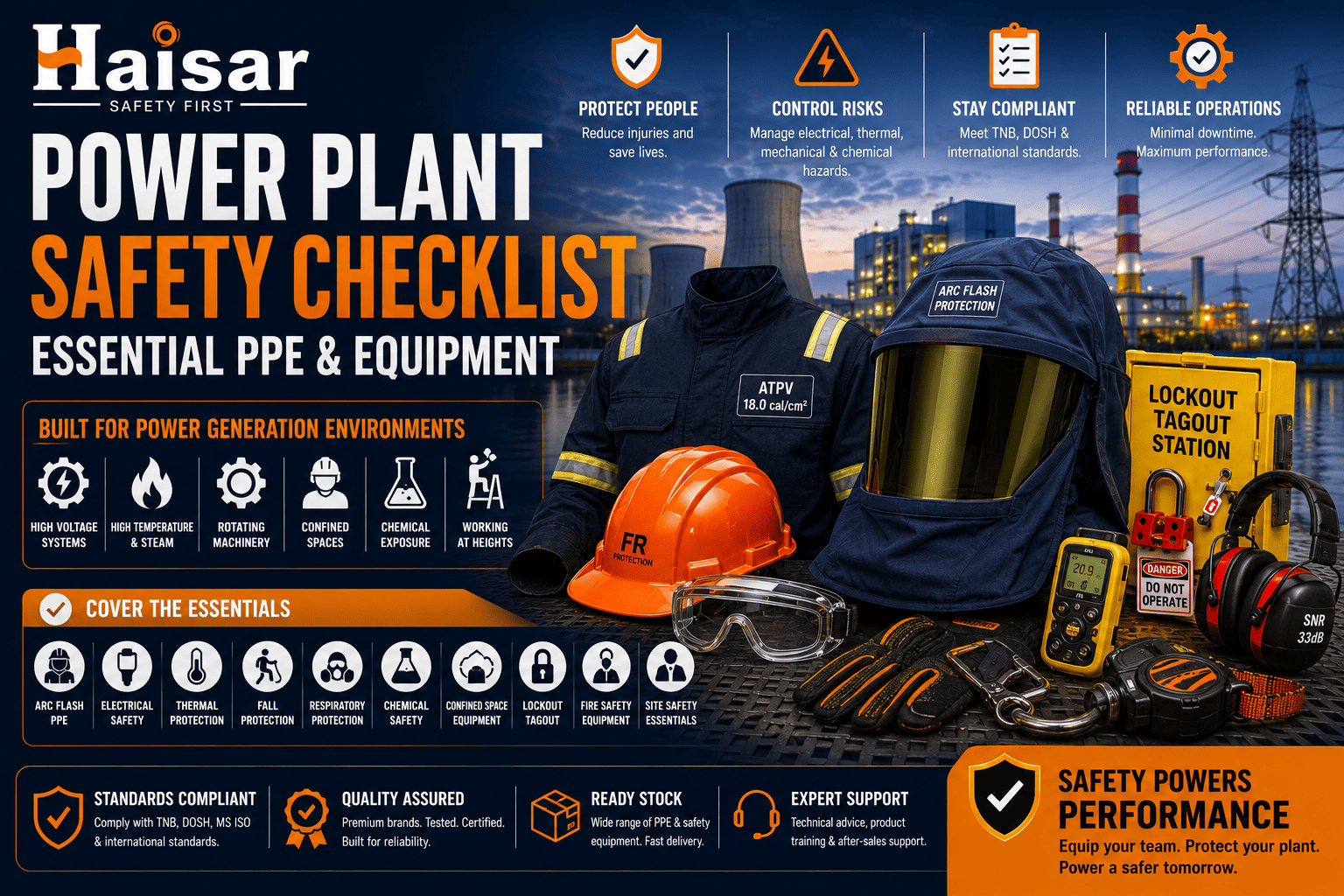
FR Coveralls. Flame-resistant coveralls are the primary flash fire protection garment for oil and gas workers in Malaysia. FR coveralls must be rated in calories per square centimetre against the NFPA 2112 standard or equivalent, with the calorie rating appropriate for the flash fire hazard level at the specific facility. Standard polycotton coveralls are not FR rated. They will burn when ignited and retract as they burn, increasing burn injury severity.
The FR rating of the coverall must be maintained through the customisation process if company branding is applied. Embroidery thread and reflective tape adhesives used on FR garments must be compatible with the FR fabric specification. A custom FR coverall produced by a supplier without FR garment experience may carry a brand logo but not carry the protection its rating implies.
FR Shirts and Trousers. For work environments where full coveralls are not required, FR shirts and trousers meeting NFPA 2112 or equivalent provide flash fire protection in a more practical two-piece configuration for supervisory and technical personnel.
Anti-static Undergarments. In classified hazardous areas, static electricity is an ignition risk. Anti-static undergarments reduce the risk of static discharge from clothing layers beneath the FR outer garment.
Checklist requirement: FR garments must carry a test certificate confirming the calorie rating and the standard to which they were tested. Washing instructions must be followed and FR garments must be inspected regularly for damage and contamination that could compromise the FR performance of the fabric.
Arc Flash Protection
Electrical systems at oil and gas facilities in Malaysia carry arc flash risk wherever live electrical work is performed near switchgear, motor control centres, distribution boards, and process control systems. Arc flash is a rapid release of electrical energy that produces a pressure wave, intense heat, and a flash of UV and infrared radiation that can cause fatal injuries at distances of several metres from the fault point.
Arc Flash Rated Face Shields and Hoods. Standard polycarbonate face shields are not arc flash rated. Arc flash face shields and switching hoods must be rated in calories per square centimetre against the incident energy level calculated by an arc flash risk assessment for the specific equipment being worked on.
Arc Flash Rated FR Garments. The same calorie rating requirement applies to the body protection worn during arc flash exposure. The FR garment worn as flash fire protection may or may not meet the arc flash calorie rating required for electrical work. The two requirements must be assessed separately.
Voltage-Rated Insulating Rubber Gloves. Class 00 through Class 4, matched to the system voltage. Must be pressure tested at required intervals and protected by leather over-gloves during use.
Insulated Tools and Voltage Detectors. Voltage-rated insulated tools for live work and non-contact voltage detectors for circuit status verification before any terminal or conductor contact.
Checklist requirement: An arc flash risk assessment must be conducted for the facility's electrical systems to determine incident energy levels and the required PPE category at each work location. PPE selection without an underlying arc flash study is not defensible in the event of an incident.
Gas Detection and Respiratory Protection
Toxic and flammable gas hazards are present across oil and gas operations in Malaysia. H2S is the primary toxic gas concern at upstream and refinery facilities. CO is a risk wherever combustion processes operate in confined or semi-confined spaces. Hydrocarbon vapours in confined spaces create flammable atmosphere risk. Oxygen deficiency is a risk in any enclosed space.
Personal Multi-Gas Monitors. The minimum configuration for oil and gas site work is a four-gas monitor covering O2, LEL (combustible gas), H2S, and CO. At facilities with additional specific gas hazards, extended sensor configurations may be required. Personal gas monitors must be bump tested before each shift against calibration gas and the bump test must be documented.
H2S Personal Monitors. At facilities with H2S risk, personal H2S monitors with audible and vibrating alarms are required for all workers in areas where H2S may be present. The alarm setpoints must be configured to the facility's H2S alarm levels.
Supplied Air Breathing Apparatus (SABA) and SCBA. For entry into immediately dangerous to life or health (IDLH) atmospheres including spaces with confirmed toxic gas concentrations or oxygen deficiency, supplied air or self-contained breathing apparatus is required. Air-purifying respirators provide no protection in IDLH conditions. Escape SCBA sets must be available in areas where rapid atmospheric deterioration is a risk.
Half-Face and Full-Face Respirators with Appropriate Cartridges. For non-IDLH environments with confirmed but tolerable concentrations of toxic gases or vapours, cartridge respirators with the correct cartridge type for the specific gas are required. Cartridge type must match the gas. An organic vapour cartridge provides no protection against H2S.
Checklist requirement: Gas detection equipment must be calibrated at manufacturer-specified intervals. Calibration certificates must be available for inspection. Bump test records must be maintained. All gas detection equipment used at PETRONAS facilities must be on the approved equipment list or accompanied by documentation confirming compliance with the applicable PETRONAS technical standard.
Head Protection
Safety helmets in oil and gas environments in Malaysia must meet the requirements of the specific hazard environment. Standard Class A helmets may not be adequate across all areas of an oil and gas facility.
Class B Safety Helmets. Providing impact, penetration, and electrical protection to 20,000 volts. The appropriate specification for all areas of an oil and gas facility where electrical hazards are present alongside general impact risks. This is the default specification for most oil and gas sites in Malaysia.
Class B Helmets with Chin Straps. Required for working at heights, for work on elevated structures, and for work in areas where helmet dislodgement from wind, equipment movement, or a fall is a risk.
Hard Hat Stickers and Role Identification. Many oil and gas facilities in Malaysia use hard hat colour and sticker systems to identify worker role, visitor status, and authorisation level. Custom hard hat stickers from a workwear and PPE supplier allow consistent identification across contractor teams.
Checklist requirement: Helmets must be inspected regularly and must be within the manufacturer's service life. Helmets that have sustained significant impacts must be replaced immediately even if no visible damage is apparent.
Eye and Face Protection
Oil and gas operations generate a broad range of eye and face hazards including chemical splash during process sampling and maintenance, UV radiation from outdoor work, particles and debris during mechanical maintenance, and arc flash and welding radiation during electrical and fabrication work.
Chemical Splash Goggles. For process sampling, chemical handling, and maintenance on process equipment where chemical splash risk is present. Must provide a sealed enclosure around the eye.
UV-Rated Safety Spectacles. For outdoor workers on upstream sites and pipeline projects exposed to prolonged UV radiation in Malaysia's equatorial climate.
Face Shields. For grinding, cutting, and mechanical maintenance work generating particles and debris. Must be impact-rated appropriate to the specific task.
Arc Flash Face Shields. As covered under arc flash protection above. Must be arc-rated and separate from standard impact face shields.
Welding Shields. Shaded to the appropriate number for the welding process in use. Must protect against arc radiation, UV, and infrared.
Checklist requirement: Eye protection must be appropriate to the specific eye hazard. Standard clear safety glasses do not protect against chemical splash. Chemical splash goggles do not provide arc flash protection. The hazard drives the selection.
Hand Protection
Hand hazards across oil and gas operations range from chemical exposure during process work and sampling to cut risk during mechanical maintenance, heat exposure during insulation and piping work, and electrical risk during switchgear maintenance.
Chemical Resistant Gloves. Selection must be based on chemical resistance data for the specific process chemicals at the facility. Nitrile, neoprene, butyl, and natural rubber gloves each have different chemical resistance profiles. Do not assume a single glove type covers all chemical hazards on site.
Cut-Resistant Gloves. Rated to the appropriate ANSI/ISEA 105 or EN 388 cut level for the specific mechanical maintenance task. Valve maintenance, pipe fitting, and equipment handling all generate different cut hazard profiles requiring different cut resistance levels.
Heat-Resistant Gloves. For insulation work, piping maintenance, and any task involving contact with hot surfaces or proximity to process heat.
Electrical Insulating Rubber Gloves. Voltage-rated, regularly pressure tested, and worn with leather over-gloves for all live electrical work.
Checklist requirement: Glove selection must be documented in the risk assessment for each task. A single glove type for all hand hazards across an oil and gas facility is not a credible PPE programme.
Foot Protection
Steel-Toe Safety Boots, S3 Rated. The minimum specification for general site work across oil and gas facilities in Malaysia. S3 provides toe cap protection, puncture resistance, and heel energy absorption.
Anti-Static Safety Footwear. For classified hazardous areas where electrostatic discharge is an ignition risk. Anti-static footwear must be worn without insulating insoles or socks that would break the anti-static circuit between the wearer and the ground.
Chemical Resistant Safety Boots. For process areas where chemical floor contamination or splash risk is present.
Checklist requirement: Footwear for classified hazardous areas must be anti-static rated. Standard steel-toe boots are not adequate for EX zone work without anti-static specification.
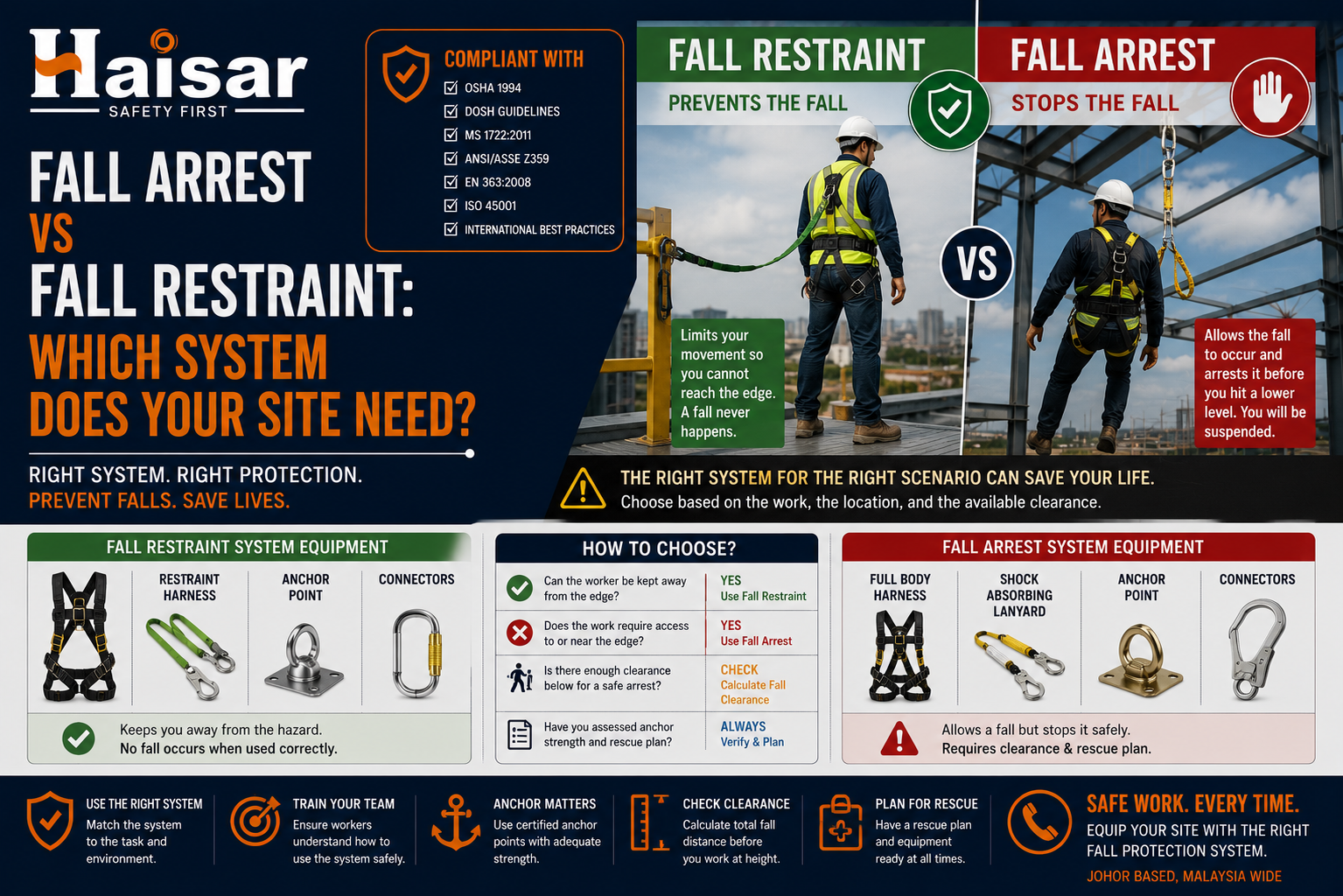
Fall Protection
Oil and gas facilities in Malaysia involve extensive working at heights on process structures, vessels, flare stacks, storage tanks, and elevated pipework. Falls from height are a consistent contributor to oil and gas sector fatalities in Malaysia.
Full-Body Harnesses. Mandatory for all fall arrest applications. Correctly fitted and inspected before each use.
Self-Retracting Lifelines (SRLs). Preferred over fixed lanyards for work on process structures where fall clearance is limited. SRLs arrest falls within centimetres.
Intrinsically Safe Attachment Hardware. In classified hazardous areas, metallic components including snap hooks and D-rings must be assessed for suitability in the area classification. Stainless steel hardware is generally specified for EX zone fall protection equipment.
Checklist requirement: A documented rescue plan must be in place before any working at heights operation begins. Suspended worker rescue from elevated structures in oil and gas facilities requires specific planning and equipment given access constraints.
What to Verify When Selecting an Oil and Gas PPE Supplier in Malaysia
A supplier working with oil and gas procurement teams in Malaysia must be able to demonstrate the following capabilities before they earn a position on your approved vendor list.
PETRONAS and PCSB product compliance knowledge. Your supplier must understand which products require PETRONAS approval, how to access approved vendor lists, and how to support the documentation process for product approval at specific facilities.
FR garment expertise. Flame-resistant workwear is a safety-critical product category where specification errors have fatal consequences. Your supplier must be able to confirm FR ratings, explain the difference between NFPA 2112 and NFPA 70E FR requirements, and advise on the correct calorie rating for your specific flash fire and arc flash hazard levels.
Gas detection calibration support. Supplying gas detection instruments without supporting the calibration programme is incomplete supply. Your supplier must be able to provide calibration gas in the correct concentration for your instruments, advise on calibration intervals, and provide calibration documentation.
Documentation at point of supply. SIRIM certificates, FR test certificates, arc flash calorie ratings, gas detection calibration certificates, and pressure test records for insulating gloves must all be available when goods are delivered, not after a request and a delay.
Approved vendor status or the capability to work through it. Many oil and gas facilities in Malaysia operate approved vendor lists for PPE supply. If your facility requires approved vendor status, your supplier must either already hold it or have a clear process for obtaining it.
Download the Haisar Oil and Gas PPE Catalogue
Haisar Supply and Services supplies the full range of oil and gas PPE for operations across Malaysia. Our range covers every category in this checklist, from PETRONAS-appropriate FR coveralls and arc flash PPE to H2S personal monitors, confined space rescue systems, voltage-rated insulating gloves, and full-body harnesses for work on process structures.
We work with procurement officers and HSE managers at PETRONAS contractor companies, upstream operators, refinery shutdown contractors, and offshore support companies across Malaysia. We understand the compliance framework, we supply with the documentation your facilities require, and we maintain the product knowledge to advise on specification rather than just fulfilling purchase orders.
Download the Haisar PPE Product Catalogue
Or contact our team directly to discuss your oil and gas PPE requirements. We respond promptly and we come prepared to talk about specifications, not just prices.
Haisar Supply and Services Sdn Bhd (985158-T) | Kulai, Johor, Malaysia | www.haisar.com
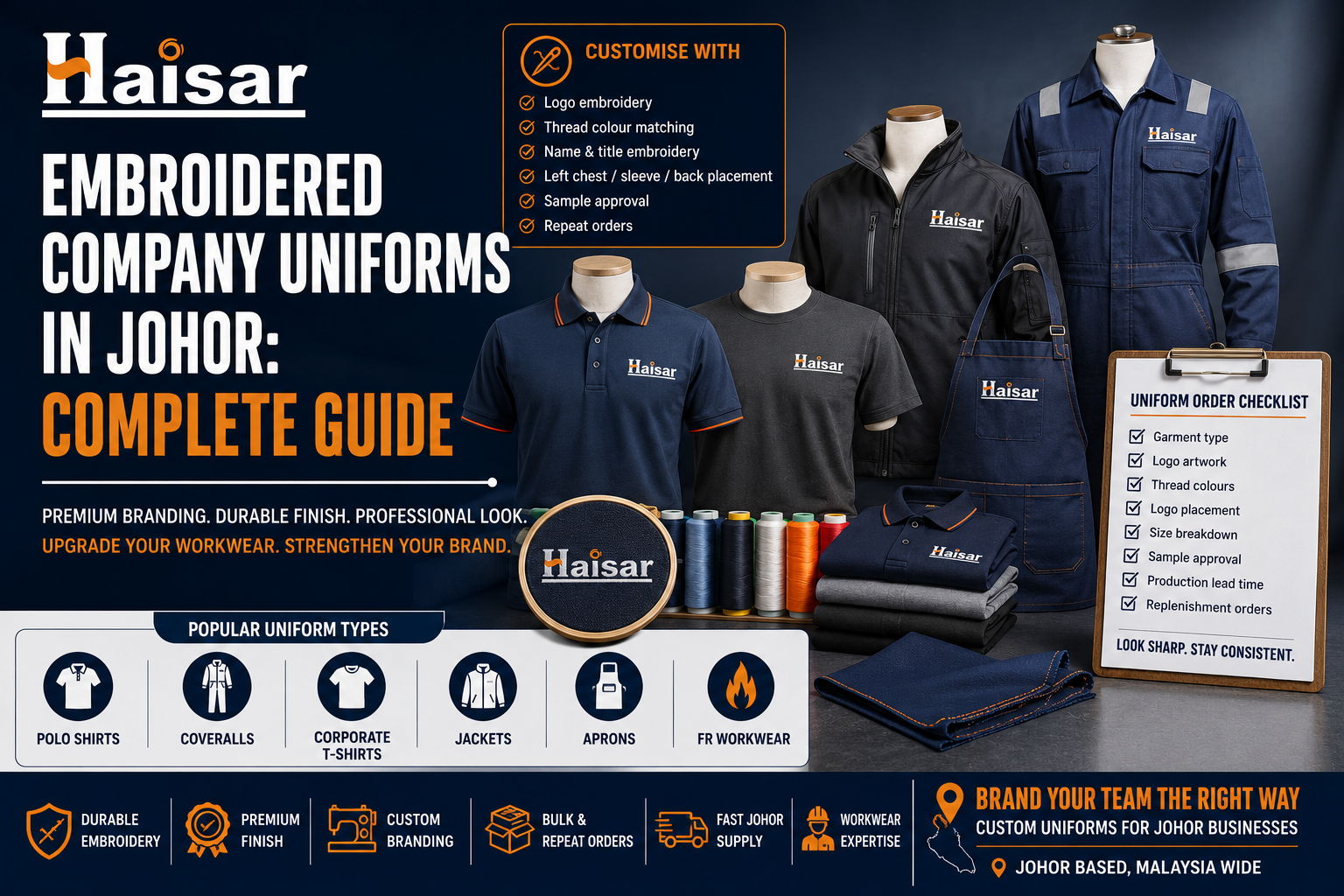
Every worker on a project site or in an industrial facility is representing an organisation. The workwear they wear communicates professionalism, safety compliance, and organisational identity to clients, regulators, and the public. Generic off-the-shelf workwear does that job passably. Custom workwear does it properly.
For companies operating in Malaysia's industrial sectors, the case for custom workwear goes beyond branding. On multi-contractor project sites, custom workwear with company identification is a practical safety tool. It allows supervisors, HSE officers, and emergency responders to instantly identify which company a worker belongs to, what their role is, and whether they have the right authorisation to be in a specific area. On client-facing sites, it projects the kind of professionalism that builds repeat business. And on sites where personal protective equipment is a regulatory requirement, custom workwear that integrates compliance and branding eliminates the friction of workers choosing comfort over safety.
This guide covers everything you need to know about custom workwear in Malaysia, from the product range and customisation options available, to how the ordering process works and what to look for in a custom workwear supplier. Whether you need branded coveralls for an oil and gas shutdown team, hi-vis jackets for a construction contractor, or a full uniform programme across a multi-site organisation, this is the reference for making informed procurement decisions.
Who Needs Custom Workwear in Malaysia
Custom workwear is relevant across virtually every sector of Malaysia's industrial and commercial economy. The specific requirements vary by industry but the underlying need is consistent: workers who look the part, are identifiable on site, and are protected by garments that meet the regulatory and practical demands of their working environment.
Oil and gas and petrochemical operations require custom workwear that integrates branding with flame-resistant (FR) protection. Workers at PETRONAS facilities, refinery shutdowns, and upstream operations wear FR coveralls as a regulatory requirement. Custom branding on FR garments allows contractors to maintain company identification without compromising the protection rating of the garment.
Construction and civil engineering contractors across Johor, the Klang Valley, and major infrastructure projects use custom hi-vis vests, jackets, and coveralls to differentiate their workers from those of other contractors on shared sites. On large projects with multiple principal and sub-contractors, colour-coded and branded workwear is the practical solution to workforce identification.
Data centre developers and fit-out contractors working in Malaysia's rapidly expanding data centre sector increasingly require clean, professional-looking custom uniforms for their on-site teams. Client operators of hyperscale data centres have high standards for contractor presentation and branded workwear is a basic expectation.
Solar EPC contractors and renewable energy project teams mobilising across Malaysia's expanding solar farm pipeline need custom workwear that handles outdoor conditions, provides UV protection, and identifies workers by company and role on sites where multiple contractors are working simultaneously.
Marine and shipyard operators in Johor's port corridor require custom workwear that is appropriate for wet, physically demanding environments and that clearly identifies workers by company and department across large, complex facility areas.
Manufacturing and industrial facilities across Johor's industrial zones use custom uniforms and workwear to create a consistent professional appearance, to differentiate between departments, and to ensure that safety-critical garment requirements are met consistently across the workforce.
Facilities management and service contractors working across commercial and industrial sites in Malaysia use custom uniforms as part of their service delivery standard. Branded, well-presented uniforms communicate professionalism and build client confidence in the service being delivered.
The Custom Workwear Range
A full custom workwear programme in Malaysia covers a broader range of garment types than most procurement teams initially consider. Understanding the full range allows organisations to build a coherent, consistent workwear system rather than procuring individual items piecemeal.
Custom Coveralls
Coveralls are the workhorse of industrial workwear across Malaysia's project and facility sectors. A well-specified custom coverall provides full-body protection, carries company branding, and can be manufactured in materials ranging from standard polycotton to flame-resistant, chemical-resistant, or anti-static fabrics depending on the hazard environment.
Custom coveralls for industrial use in Malaysia are typically specified with the following options: fabric weight and material, colour and colour-blocking options, logo embroidery or heat-transfer print placement, reflective tape configuration and rating, pocketing and closure options, and sizing range to accommodate the workforce demographic.
For flame-resistant applications, the FR rating of the base fabric must be maintained through any customisation process. Embroidery thread, reflective tape adhesives, and print materials must all be compatible with the FR specification of the garment. A custom workwear supplier working with FR garments must understand this requirement and be able to confirm that their customisation process preserves the FR rating.
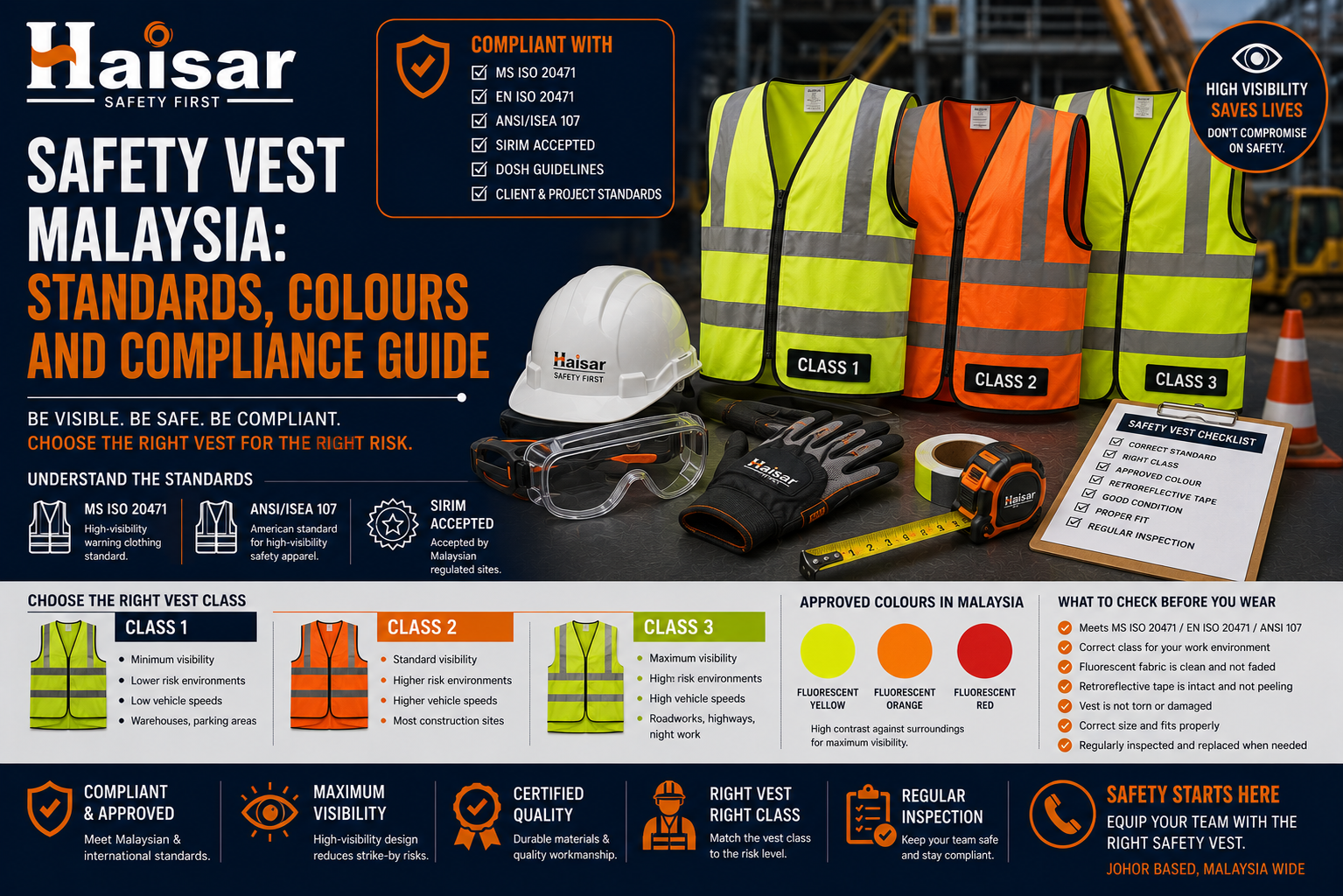
Custom Hi-Vis Vests and Jackets
High-visibility garments are a legal requirement across construction sites, road works, and any environment where workers are at risk from moving vehicles and plant. Custom hi-vis garments combine the mandatory visibility requirement with company branding and site-specific identification.
Custom hi-vis options in Malaysia include single-colour vests with front and back logo, colour-blocked vests with contrasting panels for departmental identification, mesh vests for hot-climate comfort, hi-vis jackets with hood and full closure for wet season conditions, and hi-vis coveralls providing full-body visibility for high-risk environments.
The reflective tape configuration on custom hi-vis garments must maintain the MS ISO 20471 rating required for the application. Class 2 and Class 3 ratings have specific requirements for the area and placement of retroreflective material. Customisation that reduces the reflective tape area below the rated requirement produces a non-compliant garment regardless of how well-branded it is.
Custom Polo Shirts and T-Shirts
For supervisory staff, site engineers, HSE officers, and management personnel who work on site but are not in direct contact with physical hazards, custom polo shirts and T-shirts provide a professional appearance that differentiates them from the general workforce while remaining comfortable in Malaysia's climate.
Custom polos for industrial environments in Malaysia are typically specified with moisture-wicking, quick-dry fabric, UV protection rating for outdoor environments, embroidered logo on the left chest, optional back print for company or project identification, and colour choices aligned to the company's brand identity.
Custom Workpants and Shorts
Lower-body workwear is frequently overlooked in custom workwear programmes but is an important part of a complete, consistent workwear system. Custom work trousers in polycotton or ripstop fabric, with company-appropriate colour and logo options, complete the professional appearance that custom upper-body garments create.
Custom Safety Footwear
While less common than garment customisation, branded safety footwear including company-logoed safety boot tongues and custom boot bags is available and is used by organisations where a complete head-to-toe branded workwear system is the standard.
Custom Hard Hat Stickers and Helmet Branding
Safety helmets can be branded with company logos, project identification, and role identification using high-quality vinyl stickers or pad-printed directly onto the helmet shell. This is a cost-effective way to extend branding to head protection without replacing compliant helmets.
Customisation Options and Methods
The quality of customisation on workwear is as important as the quality of the garment itself. Poor embroidery, faded prints, and peeling heat-transfer logos reflect badly on the organisation wearing them and may indicate shortcuts in the production process that affect garment quality as well.
Embroidery is the premium standard for logo application on workwear. Embroidered logos are durable, professional in appearance, and resistant to washing and abrasion. They are appropriate for chest logos, sleeve badges, and name tags. The thread count, colour matching, and backing material used in embroidery all affect the quality of the finished product.
Screen printing is appropriate for larger graphic applications, particularly back prints on t-shirts, polos, and vests. Screen printing produces vibrant, detailed prints at lower cost per unit than embroidery for large logo areas. Quality screen printing maintains colour accuracy and wash durability across the working life of the garment.
Heat transfer printing allows photographic-quality image reproduction and is suitable for complex, multi-colour logos and graphics that would be prohibitively expensive to screen print. Modern heat-transfer materials are wash-durable and flexible, maintaining adhesion through repeated industrial laundering.
Reflective tape application for hi-vis garments must use tape materials that are compatible with the base fabric and maintain the retroreflective performance required for the garment's MS ISO 20471 rating. The placement of reflective tape on custom garments must meet the standard's requirements for tape area and configuration.
Colour and fabric customisation for larger orders allows complete specification of the garment from fabric to finished product, including custom colours that match exact brand specifications, fabric weights and constructions suited to the operating environment, and pocketing, closure, and fit specifications tailored to the workforce.
The Custom Workwear Ordering Process at Haisar
Understanding how a custom workwear order is managed from enquiry to delivery helps procurement teams plan timelines accurately and avoids the last-minute scrambles that are common when custom garment lead times are underestimated.
Step One: Enquiry and Requirements Brief
The process begins with a conversation. Haisar's team will gather the information needed to produce an accurate quotation and a product recommendation: the garment types required, the fabric and protection specifications, the workforce size and size distribution, the logo and branding requirements, the delivery timeline, and any site-specific requirements such as FR compatibility, anti-static specification, or client-mandated colour standards.
For large or complex programmes, we recommend a brief meeting or call to review requirements before quotation. This avoids the back-and-forth that results from quoting against an incomplete brief.
Step Two: Quotation and Sample Approval
Haisar provides a detailed quotation covering unit pricing, setup costs for embroidery or print, minimum order quantities, and lead time. For new custom programmes, we produce a sample garment with the logo applied before the full order is confirmed. Sample approval ensures that colour, placement, and embroidery quality meet expectations before production begins.
For ongoing programmes where garment and logo specifications are established, sample approval may be skipped for repeat orders.
Step Three: Production
Once the order is confirmed and the sample is approved, production begins. Production lead times for custom workwear in Malaysia typically range from two to four weeks depending on garment type, order volume, and customisation complexity. FR garments with specialised fabric requirements may carry longer lead times and this is communicated upfront at the quotation stage.
Haisar manages production communication proactively. If any production issue arises that could affect the delivery timeline, we notify the client immediately with options rather than presenting the delay as a fait accompli on the scheduled delivery date.
Step Four: Quality Check and Delivery
Completed garments are quality checked before dispatch. This includes verifying logo placement and quality, checking garment measurements against the approved specification, confirming size distribution against the order, and checking reflective tape placement and condition on hi-vis garments.
Delivery is to the client's specified address or project site across Johor and peninsular Malaysia. For large programme orders, phased delivery aligned to the client's mobilisation schedule can be arranged.
Step Five: Ongoing Replenishment
Custom workwear programmes are not one-time orders. Workforce changes, garment replacement due to wear or damage, new joiners requiring induction sets, and project extensions all generate ongoing replenishment requirements. Haisar maintains programme records for repeat clients so that replenishment orders can be processed without re-establishing specifications from scratch.
What Separates a Good Custom Workwear Supplier in Malaysia
The custom workwear market in Malaysia is broad and ranges from quality-focused suppliers with industrial experience to generic promotional merchandise vendors who can print a logo but have no understanding of the safety, compliance, and durability requirements of industrial workwear. Here is how to tell the difference.
Fabric and compliance knowledge. A custom workwear supplier working with industrial clients in Malaysia must understand the difference between standard polycotton and FR fabric, between standard and anti-static specification, between Class 2 and Class 3 hi-vis compliance. If a supplier cannot explain these distinctions and how their customisation process maintains the relevant protection rating, they are not the right partner for safety-critical workwear.
Sample before production. Any credible custom workwear supplier will produce a sample for approval before committing to full production. Suppliers who proceed to full production without sample approval are either cutting corners or have insufficient quality control to offer a meaningful sample process. Do not place a large custom workwear order without seeing and approving a physical sample.
Lead time honesty. Custom workwear takes time. A supplier who quotes two-week lead times for FR custom coveralls without qualification is either carrying stock that may not match your specification or is being optimistic in a way that will cause problems. Ask specifically about the lead time for the fabric, the garment construction, and the customisation separately. Understand where the longest lead time in the process sits.
Industrial client references. A supplier who works primarily with corporate uniform clients may not be equipped for industrial workwear procurement. Ask about experience with FR garments, hi-vis compliance, and industrial project workwear programmes. References from comparable clients in the oil and gas, construction, or manufacturing sectors are more relevant than references from retail or hospitality clients.
Minimum order quantities that match your scale. Some custom workwear suppliers in Malaysia work exclusively with high-volume orders that are not appropriate for small or mid-size project teams. Others can accommodate smaller programmes without disproportionate setup costs. Be clear about your order volume early in the enquiry process to avoid wasting time with suppliers whose model does not match your scale.
What Our Clients Say
Project teams and facility operators who have worked with Haisar on custom workwear programmes consistently highlight the same things: the speed of response at the enquiry stage, the quality of the finished garments, and the reliability of delivery against the committed timeline.
A construction contractor working on a large infrastructure project in Johor Bahru required custom hi-vis coveralls with company branding and CIDB-compliant reflective tape for a 200-person workforce. Haisar managed the programme from specification to delivery within the project's mobilisation window, including size distribution across the workforce and phased delivery aligned to site induction batches.
An oil and gas shutdown contractor needed custom FR coveralls with company logo and individual name embroidery for a 60-person team mobilising for a planned shutdown at a Johor petrochemical facility. Haisar confirmed FR fabric compatibility with the customisation process, produced samples for client approval, and delivered the complete order within the required pre-shutdown timeline.
A data centre fit-out principal contractor required a consistent workwear programme across three sub-contractor packages to create a unified professional appearance for their client. Haisar coordinated the programme across all three contractors, maintaining consistent garment specification while differentiating sub-contractor identification through colour panel and badge placement.
WhatsApp Haisar to Discuss Your Custom Workwear Requirements
Whether you are equipping a project team for mobilisation, building a full uniform programme for a facility, or replacing an existing workwear arrangement with something that better represents your organisation, Haisar Supply and Services is ready to help.
WhatsApp us now for a fast response from our team. We will discuss your requirements, advise on the right garment and customisation specification for your application, and provide a quotation with accurate lead times.
Or visit our workwear product pages to explore our standard and custom workwear range.
Browse Workwear Products at haisar.com
Haisar Supply and Services Sdn Bhd (985158-T) | Kulai, Johor, Malaysia | www.haisar.com
Industrial procurement in Malaysia is not getting simpler. Project timelines are tighter. Compliance requirements are broader. The number of product categories a project site needs to procure before mobilisation has expanded as regulatory enforcement has intensified. And the cost of a procurement failure, whether that is the wrong product on site, a delivery that does not arrive, or equipment that cannot be documented against the applicable standard, falls squarely on the procurement manager or HSE manager who signed off on the purchase.
This guide is written for procurement managers and HSE managers who are responsible for industrial supply in Malaysia. It covers how the procurement landscape is structured, what the most common failures look like and why they happen, how to build a procurement process that delivers compliance and operational reliability, and what to look for in a supply partner who can actually support the way industrial projects in Malaysia work.
The Industrial Procurement Landscape in Malaysia
Malaysia's industrial base spans a wide range of sectors, each with distinct procurement needs and regulatory obligations. Understanding where your organisation sits in this landscape shapes every procurement decision downstream.
Oil and gas remains one of the largest drivers of industrial procurement in Malaysia. Operations in Kertih, Bintulu, Labuan, and across the offshore blocks in Malaysian waters procure under PETRONAS contractor requirements and international standards including IOGP and API. Procurement in this sector is heavily documented, approval-listed, and subject to audit. Compliance is not aspirational. It is contractually enforced.
Construction and civil engineering across Johor, the Klang Valley, and major infrastructure corridors operates under CIDB requirements, DOSH regulations, and increasingly stringent client HSE standards as international developers and institutional investors impose their own supply chain requirements on Malaysian contractors.
Manufacturing and industrial facilities in Johor's industrial zones, Penang's manufacturing corridor, and Selangor's industrial parks procure under the Factories and Machinery Act, OSHA 1994, and sector-specific requirements depending on whether the facility handles chemicals, food products, electronics, or heavy equipment.
Renewable energy and data centres are the fastest-growing procurement segments in Malaysia. Solar EPC contractors, data centre developers, and their principal contractors are mobilising at scale and often managing procurement for project types they have not procured for before, creating gaps that experienced supply partners can close.
Marine, shipyard, and offshore support operations in Johor, Labuan, and Sarawak procure under Marine Department Malaysia requirements, SOLAS obligations, and client HSE standards from international vessel operators and charterers.
Across all of these sectors, the procurement function faces the same core challenge: sourcing the right products, at the right specification, with the right documentation, delivered to site on time and within budget.
Why Industrial Procurement in Malaysia Fails
Understanding where procurement goes wrong is more useful than a generic best-practice checklist. These are the failure modes that appear most consistently across Malaysian industrial procurement operations.
Specification drift. A purchase is raised for a product category without a sufficiently precise specification. The supplier interprets the requirement broadly and supplies a product that technically meets the description but not the application requirement. The classic example is respiratory protection: an order for "dust masks" results in FFP1 disposable respirators being delivered to a site where the hazard assessment requires half-face respirators with chemical cartridges. The product is in the correct category. It is wrong for the application.
Certification gaps. Products arrive on site without the certification documentation required by the client, the principal contractor, or the regulator. The products may be perfectly compliant but without documentation they cannot be accepted on a regulated site. Re-ordering causes delay. Expedited shipping adds cost. The procurement function carries the blame for a failure that originated in supplier selection.
Lead time optimism. Suppliers quote lead times based on their best-case assumptions. Procurement plans are built around those lead times. When actual delivery takes longer, which it frequently does for imported products and for products requiring local certification, the site mobilisation is delayed or the project proceeds without the equipment, creating both operational and compliance risk.
Vendor fragmentation. Different product categories are sourced from different suppliers. Each supplier relationship requires separate communication, separate purchase orders, separate delivery coordination, and separate invoice processing. The administrative overhead compounds with each additional vendor. Errors in one supplier relationship cascade through the others when equipment from multiple vendors must arrive simultaneously for site mobilisation.
Reactive rather than planned procurement. Equipment is ordered when the need is identified rather than when the project schedule indicates it will be needed. This is particularly common for consumable PPE. A site runs out of respirators mid-project. An urgent order is placed. Premium freight charges are incurred. The site operates without adequate respiratory protection during the gap.
Price-led vendor selection. The lowest-price supplier is selected without adequate assessment of product quality, certification status, or delivery reliability. The cost saving on the initial purchase is offset multiple times over by the downstream costs of non-compliant products, re-ordering, and delivery failures.
Each of these failure modes is avoidable. Avoiding them requires a structured procurement process and a supply partner who understands the industrial operating environment in Malaysia.
Building a Compliant Industrial Procurement Process
A procurement process that reliably delivers compliant, correctly specified products on time is not complicated. It requires discipline in five areas.
Start with the hazard and regulatory requirement, not the product.
Every industrial procurement decision should begin with a clear understanding of the hazard being controlled and the regulatory requirement that governs it. For PPE, this means a documented risk assessment that identifies the specific hazard, the exposure level, and the standard that the PPE must meet. For fire equipment, this means understanding the BOMBA requirements for the specific occupancy classification. For gas detection equipment, this means understanding the atmospheric hazards present and the instrument specifications required to detect them reliably.
Procurement that starts with the product rather than the requirement is procurement that will generate specification drift.
Write specifications that are precise enough to be audited.
A purchase specification should describe the product in sufficient detail that any competent supplier would supply the same product. For PPE, this means specifying the product standard, the protection class, and the certification requirement. For gas detection, this means specifying the sensor types, the detection ranges, and the calibration requirement. For working at heights equipment, this means specifying the load rating, the fall clearance requirement, and the anchor compatibility.
Vague specifications invite interpretation. In industrial procurement, interpretation by the supplier is not the same as judgement by the HSE manager.
Require documentation at the point of order, not on delivery.
Certification documentation, technical data sheets, and compliance declarations should be requested as part of the purchase order process, not as an afterthought when the goods arrive on site. A supplier who cannot provide documentation before delivery is unlikely to have it ready on delivery day either.
For regulated environments including PETRONAS contractor sites, offshore operations, and international client project sites, a product compliance register should be built and maintained from the first procurement event. Adding documentation to the register after the fact, under time pressure before an audit, is a risk management failure.
Align procurement timing to the project programme.
Industrial procurement should be planned against the project construction programme, not raised reactively as needs arise. Each project phase has a predictable equipment requirement. Scaffold erection requires fall protection equipment and height access gear. Confined space work requires gas detection equipment, retrieval systems, and ventilation. Electrical installation requires LOTO equipment and electrical safety PPE.
Mapping these requirements to the project programme and initiating procurement with sufficient lead time to account for delivery and documentation is the single most effective change a procurement team can make to reduce reactive ordering.
Consolidate vendor relationships where possible.
Managing fewer supplier relationships reduces administrative overhead, reduces the risk of inter-supplier coordination failures, and allows the procurement function to develop genuine working knowledge of supplier capabilities. A supplier who provides a broad range of industrial safety and project supply products from a single point of contact eliminates the coordination cost of managing multiple specialist suppliers.
This does not mean accepting inferior products to achieve consolidation. It means selecting a supply partner with sufficient breadth and depth of product range to cover the majority of your procurement requirements at the standard your projects require.
The Documentation Requirement in Malaysian Industrial Procurement
Documentation is the element of industrial procurement that is most consistently underestimated until the first audit or incident investigation makes its importance undeniable.
In Malaysian industrial procurement, documentation operates at several levels simultaneously.
Product certification documentation confirms that the product meets the applicable standard. For PPE, this is the SIRIM certification reference or equivalent international certification. For fire equipment, this is the BOMBA approval number. For gas detection equipment, this is the calibration certificate. For electrical safety PPE, this is the voltage rating test certificate.
Purchase and supply chain records demonstrate the provenance of the product and confirm that it was sourced from a legitimate distributor or manufacturer representative. In the event of a product failure or incident investigation, the ability to trace the product back through the supply chain to the manufacturer is a legal and commercial requirement.
Maintenance and inspection records confirm that equipment in service has been maintained at the required intervals. DOSH inspections, BOMBA audits, and incident investigations all examine maintenance records. Equipment that appears functional but has not been formally inspected and documented is non-compliant.
Risk assessment and PPE selection records connect the hazard identified in the risk assessment to the product specified and procured. This is the chain of evidence that demonstrates a structured approach to worker protection. Without it, the procurement decision appears arbitrary even if the product selected was correct.
A procurement function that maintains complete documentation across these four levels is in a significantly stronger position in the event of a regulatory inspection, a client audit, or an incident investigation than one that relies on institutional memory and filing systems that are not maintained.
Procurement Considerations by Product Category
Different categories of industrial procurement in Malaysia carry different compliance risks and different documentation requirements. The following covers the categories that generate the most procurement complexity.
Personal Protective Equipment. The breadth of the PPE category and the variation in applicable standards across different hazard types make PPE procurement the most complex category for most industrial procurement teams. The key discipline is maintaining the link between the hazard assessment, the standard required, and the product specified. SIRIM certification is the primary compliance marker in Malaysia and must be confirmed for safety-critical PPE categories.
Gas Detection Equipment. Gas detectors are safety-critical instruments whose function depends entirely on calibration. Procurement of gas detection equipment must include provision for calibration gas supply, calibration intervals, and bump test documentation from day one. A gas detector without a calibration programme is not compliant equipment. It is a liability.
Working at Heights Equipment. The fall clearance requirement means that harness and lanyard selection is an engineering decision, not a product catalogue exercise. Procurement teams who specify "safety harness and lanyard" without considering fall clearance, anchor compatibility, and the specific working at heights scenario will generate specification drift. The supplier must be engaged early enough to advise on system selection.
Fire Safety Equipment. BOMBA approval status must be confirmed before purchase. The type of extinguisher, the quantity, the placement, and the servicing arrangement are all regulatory requirements that must be addressed in the procurement specification. Sourcing extinguishers without confirming BOMBA approval and arranging annual servicing by a BOMBA-registered contractor is incomplete procurement.
Confined Space Equipment. The combination of gas detection, rescue retrieval, ventilation, communication, and entry signage required for compliant confined space entry means that confined space equipment is almost always best procured as a coordinated package rather than item by item. Gaps in the equipment set are not minor omissions. They are conditions that make a confined space entry non-compliant and that can result in fatal incidents.
Electrical Safety and LOTO Equipment. LOTO equipment must be compatible with the specific isolation points on the equipment being locked out. Generic procurement of LOTO equipment without reference to the valve types, circuit breaker configurations, and isolation point dimensions present on site results in equipment that cannot be used on the day it is needed.
What to Look for in an Industrial Supply Partner in Malaysia
The supply partner relationship in industrial procurement is not equivalent to the relationship with an office supplies vendor. The stakes are different and the selection criteria must reflect that.
Compliance knowledge that matches your regulatory environment. Your supply partner must understand the specific regulatory framework that governs your operations in Malaysia, whether that is OSHA and DOSH, PETRONAS contractor requirements, BOMBA standards, Marine Department regulations, or a combination. A supplier who cannot speak to these requirements is not equipped to advise on specification.
Product range that covers your procurement scope. The administrative efficiency of consolidating supply across PPE, project equipment, gas detection, fire safety, working at heights, and confined space requires a supplier with genuine depth across all of these categories, not a supplier with strength in one category and a limited range in others.
Documentation capability. Your supply partner must be able to provide complete product documentation at the point of supply, not days later when your site team is waiting. This is a process requirement as much as a product requirement. Ask prospective suppliers specifically how they manage certification documentation for each product category.
Delivery reliability. The most accurately specified product at the best price delivers no value if it arrives after the project needs it. Delivery reliability requires the supplier to hold adequate stock of fast-moving items, to be transparent about lead times for imported or specially sourced products, and to communicate proactively when delivery commitments are at risk.
A named account contact who knows your project. Industrial procurement in Malaysia involves frequent questions, changed requirements, urgent resupply needs, and documentation requests. These are handled far more effectively by a named contact who understands your project and your procurement requirements than by a general enquiries inbox.
Haisar Supply and Services: Industrial Procurement Partner in Malaysia
Haisar Supply and Services Sdn Bhd, based in Kulai, Johor, works with procurement managers and HSE managers across Malaysia's industrial sectors as a consolidated supply partner for safety equipment and project supplies.
Our supply scope covers the full range of categories that industrial project teams in Malaysia procure: PPE across all hazard categories, gas detection and calibration, working at heights equipment, confined space entry and rescue systems, LOTO and electrical safety products, fire safety and emergency response equipment, site barriers and project supplies, and customised workwear and signage.
We engage with procurement requirements at the specification stage, not just at the point of purchase order. We provide complete product documentation with every supply. We deliver across Johor and peninsular Malaysia with lead time transparency and proactive communication when supply conditions change. And we provide a named account contact for every client engagement.
For procurement managers and HSE managers who are responsible for getting industrial supply right in Malaysia, we are ready to talk about how we can support your programme.
Get a Quote from Haisar
Whether you are planning procurement for a new project mobilisation, reviewing your current supply arrangements, or looking for a more capable industrial supply partner in Malaysia, contact Haisar to discuss your requirements.
Our team will respond promptly with the information you need to make a confident procurement decision.
Haisar Supply and Services Sdn Bhd (985158-T) | Kulai, Johor, Malaysia | www.haisar.com