Can't find what you're looking for? Get in touch!



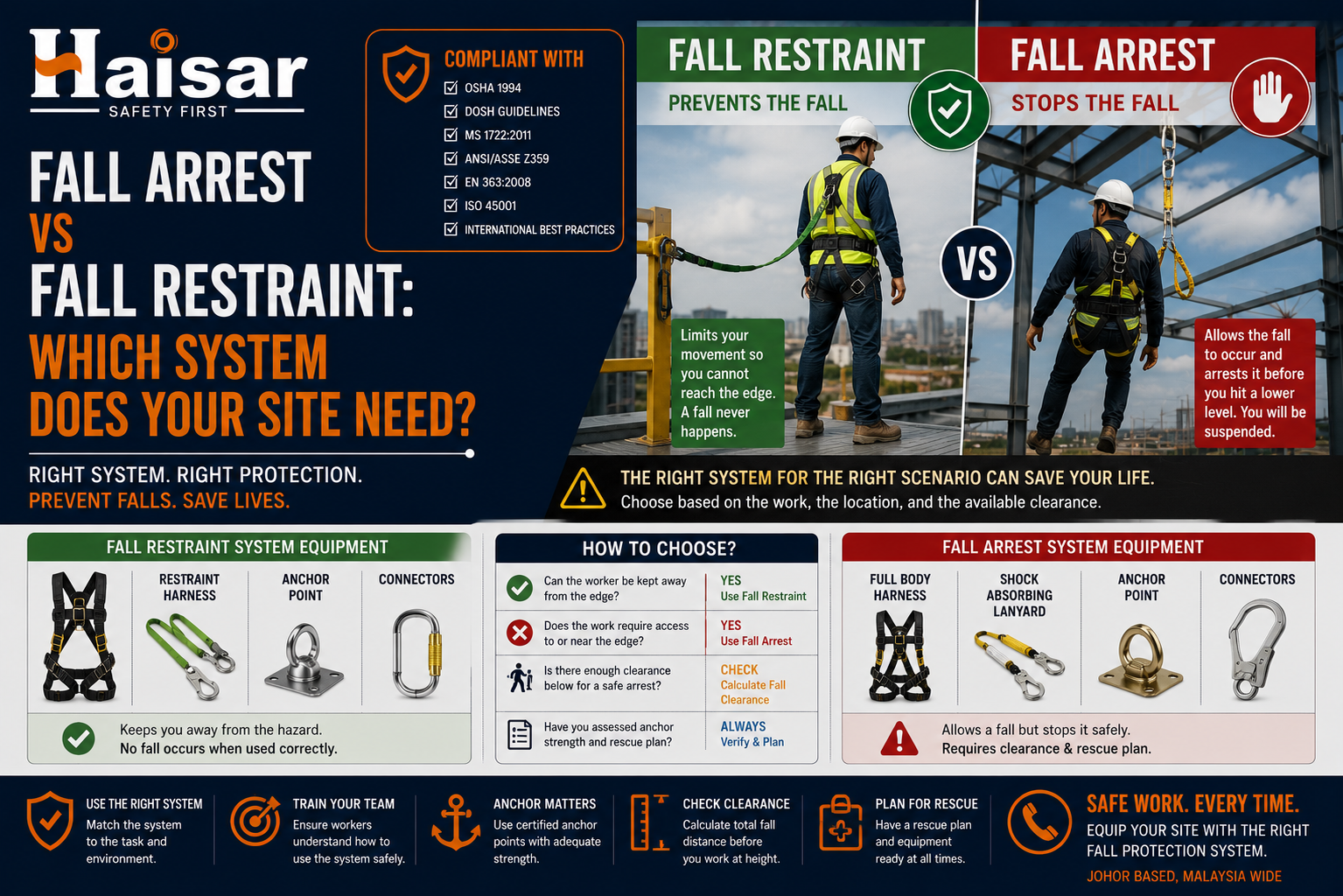
Falls from height are consistently among the leading causes of fatal workplace accidents in Malaysia. Yet the conversation on most project sites about fall protection is limited to whether the worker is wearing a harness. The more important question, one that is far less often asked, is whether the system the harness is connected to is the right system for the specific working scenario.
Fall protection in Malaysia is not a single solution. It is a family of systems, each designed for different scenarios, each with different equipment, different anchor requirements, and different consequences if specified incorrectly. The two primary personal fall protection systems are fall arrest and fall restraint. They address the same broad hazard, a worker falling from height, but they do so in fundamentally different ways and they are not interchangeable.
This guide explains the difference between fall arrest and fall restraint in plain terms, walks through the decision factors that determine which system is right for which working scenario, and covers the equipment required for each. Whether you are an HSE officer reviewing a working at heights programme, a project manager specifying fall protection for a new site, or a procurement manager sourcing equipment, this is the reference that clarifies the decision.
The Fundamental Difference: Preventing a Fall vs Arresting One
The distinction between fall arrest and fall restraint is not about the harness. Both systems use a full-body harness. The distinction is about what the system does in relation to the fall itself.
Fall restraint prevents the fall from occurring. A restraint system physically limits the worker's movement so that they cannot reach the unprotected edge or the fall hazard. The lanyard is set short enough that the worker, when wearing the harness and connected to the anchor, cannot physically reach the point from which a fall would occur. If the restraint system is correctly configured, a fall never happens. The worker reaches the end of the lanyard before reaching the edge.
Fall arrest allows the fall to begin but stops it before the worker hits a lower level. An arrest system does not prevent the worker from reaching or passing the edge. It allows the fall to occur and then arrests it, limiting the fall distance and the arrest forces to survivable levels. The worker falls, the system activates, the fall is stopped. The worker is suspended in the harness until rescued.
This is not a subtle distinction. It changes the entire basis of system design, the equipment required, and the consequences of getting it wrong.
With a restraint system, the failure mode is the worker reaching the edge because the lanyard was too long or the anchor was incorrectly positioned. With an arrest system, the failure modes include the fall distance exceeding the available clearance, meaning the worker hits the lower level before the system fully arrests the fall, and the arrest forces exceeding what the anchor or the worker's body can withstand.
Understanding this distinction is the starting point for every fall protection decision.
When to Use Fall Restraint
Fall restraint is always the preferred personal fall protection system where it is practicable. The reason is straightforward: a system that prevents the fall entirely is safer than a system that arrests it after it has begun. If the fall never happens, there is no arrest force on the worker's body, no suspension trauma risk, and no rescue required.
Fall restraint is appropriate when all of the following conditions are met.
The fall hazard is a defined edge or opening that the worker must work near but not reach. A worker installing roofing materials near a roof edge, a worker inspecting a raised platform adjacent to an unguarded edge, and a worker on a flat roof near a perimeter are all scenarios where the fall hazard is at a defined location that the restraint system can keep the worker away from.
The anchor point can be positioned so that the lanyard length prevents the worker from reaching the edge. The effectiveness of a restraint system depends entirely on the geometry of the anchor position and the lanyard length. The anchor must be positioned and the lanyard must be cut to a length that physically prevents the worker from reaching the unprotected edge even if they lean, stretch, or lose their footing. If the anchor position and lanyard length cannot be configured to achieve this, restraint is not workable for the scenario.
The work task can be completed within the restricted movement area. If the worker needs to move to or near the edge to complete the task, restraint is not appropriate. A restraint system that workers consistently bypass because the lanyard prevents them from reaching the work area will be disregarded and provides no protection.
There is no overhead anchor required. Restraint systems typically use waist-level or chest-level anchor points because the system is preventing movement rather than arresting a vertical fall. An anchor below shoulder height is acceptable for a restraint system in a way that it would not be for a fall arrest system.
When restraint is correctly configured and the geometry works, it is the cleanest fall protection solution: simple, low equipment overhead, and no fall clearance calculation required.
When Fall Restraint Does Not Work
Fall restraint is not universally applicable. There are many common working at heights scenarios in Malaysia where restraint cannot be achieved and fall arrest is the required approach.
When the worker must work at or near the edge. Scaffold dismantling, edge beam installation, rooftop membrane installation right at the perimeter, and any task that requires the worker to be at the fall hazard location cannot be managed by restraint. The task requires the worker to be at the edge. Restraint prevents them from being there.
When the anchor cannot be positioned to prevent edge access. On many Malaysian project sites, the available anchor points are fixed. If the only available anchor is at the same level as the work and at a distance that does not create adequate restraint geometry, a restraint system cannot be achieved with those anchors.
When the worker must move across a large elevated area with unguarded edges on multiple sides. Restraint requires that the movement radius be limited to an area away from the hazard. On a large elevated work area with multiple unguarded edges, a single restraint anchor may not cover the full work area and the worker may have unprotected access to edges outside the restrained radius.
When working at height on structures that require movement between anchor points. Tower climbing, scaffold erection and dismantling, and structural steelwork installation all require workers to move continuously through the elevated environment in ways that cannot be managed by a restraint system tethered to a single anchor.
In all of these scenarios, fall arrest is required.
Fall Arrest System Design: The Critical Variables
Fall arrest system design requires working through a set of calculations and decisions that do not apply to restraint. The most important of these is fall clearance.
Fall clearance is the minimum vertical distance between the worker's feet and any lower level or obstruction that must be available below the anchor point for the fall arrest system to stop the worker before they make contact. If the available fall clearance is less than the total arrest distance, the worker will hit the lower level before the system has fully arrested the fall.
The total arrest distance for a fall arrest system using an energy-absorbing lanyard is calculated as follows:
The lanyard length, typically 1.75m to 2m for a standard energy-absorbing lanyard, plus the energy absorber deployment distance, typically 1.0m to 1.75m when fully deployed, plus the height of the worker from feet to the dorsal D-ring where the lanyard connects, typically 1.5m, plus a safety factor of typically 1.0m. This produces a total minimum clearance requirement of approximately 5.5m to 6.5m below the anchor point for a standard energy-absorbing lanyard.
On a significant proportion of working at heights scenarios on Malaysian project sites, this clearance is not available. Workers are working at heights of three to five metres, not fifteen. The standard 2m energy-absorbing lanyard is the wrong equipment for these scenarios because the arrest distance exceeds the available clearance.
This is where self-retracting lifelines become the correct equipment choice.
Self-retracting lifelines (SRLs) arrest falls in a fraction of the distance required by a fixed-length energy-absorbing lanyard. A standard SRL arrests a fall within 0.6m to 1.2m of movement, compared to the 1.0m to 1.75m absorber deployment distance of a standard lanyard. Combined with the shorter effective free-fall distance in an SRL system, the total clearance requirement for an SRL is typically 2.0m to 3.0m below the anchor point, making them the appropriate choice for the three-to-five metre height range common on Malaysian construction and industrial sites.
Anchor point adequacy is the second critical variable in fall arrest system design. An anchor point for a fall arrest system must be capable of withstanding the forces generated by an arrested fall. For a single worker, this is typically specified as a minimum static load capacity of 12 kilonewtons, roughly equivalent to the force generated by a 100kg mass dropped 2 metres. Attaching a fall arrest system to a scaffold tube, a pipe handrail, or any other structural element not designed and rated as an anchor point is a failure that has contributed to multiple fatalities in Malaysia and globally.
The direction of arrest force must also be considered when selecting and positioning anchor points. Fall arrest forces are primarily vertical, directed downward through the system to the anchor. An anchor that is rated for vertical loading may not be rated for the same load in a different direction. System design must account for the direction of force at the anchor point.
Equipment for Fall Restraint Systems
A compliant fall restraint system in Malaysia requires the following equipment.
Full-body harness with a frontal or sternal D-ring as the connection point for the restraint lanyard. A dorsal D-ring is used for fall arrest applications. A frontal or sternal connection positions the lanyard in front of the worker where it is more comfortable for movement within the restrained work area and less likely to create a trip hazard.
Fixed-length restraint lanyard set to the length that prevents the worker from reaching the fall hazard. Unlike fall arrest lanyards, restraint lanyards do not require an energy absorber because the system is not designed to arrest a fall. A restraint lanyard with an energy absorber will deploy the absorber if the worker falls while restrained, but the system design must ensure this cannot happen by keeping the worker away from the edge.
Rated anchor point positioned to achieve the required restraint geometry. Even for restraint applications, the anchor must be capable of withstanding the forces that could be generated if the restraint system is tested by a worker reaching the end of the lanyard forcefully.
Snap hooks and connectors compatible with both the harness D-ring and the anchor point. Connectors must be self-closing and self-locking. Non-locking snap hooks must not be used in fall protection applications.
Equipment for Fall Arrest Systems
A compliant fall arrest system in Malaysia requires the following equipment in addition to the full-body harness.
Full-body harness with dorsal D-ring as the primary arrest connection point. The dorsal D-ring is positioned between the shoulder blades and provides the correct geometry for arresting a fall vertically and for rescuing a suspended worker. A harness without a dorsal D-ring is not a fall arrest harness.
Energy-absorbing lanyard or self-retracting lifeline selected based on the available fall clearance at the specific work location. As covered above, standard 2m energy-absorbing lanyards require significantly more clearance than SRLs and are inappropriate for many Malaysian site scenarios where clearance is limited.
Twin-leg lanyards for scenarios where workers must move between anchor points and maintain continuous connection. One leg remains connected at all times during the transfer from one anchor to the next.
Rated anchor point capable of 12kN minimum static load positioned above the worker. For fall arrest systems, the anchor must be at or above the level of the dorsal D-ring to limit free fall distance. An anchor below the dorsal D-ring means the worker falls further before the system activates, increasing both the fall distance and the arrest forces.
Rescue capability must be in place before any fall arrest work begins. A worker suspended in a harness following an arrested fall is at risk of suspension trauma, a serious and potentially fatal condition caused by the harness leg straps restricting blood flow from the lower body. Rescue from suspension must be achieved within minutes. A documented rescue plan, rescue equipment, and trained personnel capable of implementing the rescue plan are not optional additions to a fall arrest programme. They are mandatory prerequisites.
The Decision Framework: Which System for Which Scenario
Use the following decision framework to determine the appropriate fall protection system for a specific working at heights scenario on your Malaysian project site or facility.
Can the worker complete the task without reaching the fall hazard?
If yes, fall restraint may be achievable. Assess whether the anchor position and lanyard length can be configured to prevent edge access while allowing the task to be completed.
If no, the task requires the worker to be at or near the fall hazard. Fall arrest is required.
Can the anchor be positioned and the lanyard length set to prevent the worker reaching the edge?
If yes, fall restraint is the preferred system. Confirm the geometry works in practice before relying on it.
If no, fall restraint is not achievable with the available anchors. Fall arrest is required.
What is the available fall clearance below the anchor point?
If greater than approximately 6m, a standard energy-absorbing lanyard may be appropriate. Confirm the calculation for the specific lanyard in use.
If less than approximately 6m, an SRL is required. Calculate the minimum clearance requirement for the specific SRL being used, as it varies by model and manufacturer.
If less than approximately 2m, personal fall arrest may not be achievable. Collective controls including guardrails and edge protection must be the primary protection.
Is a rescue plan in place?
If yes, fall arrest work may proceed subject to all other conditions being met.
If no, fall arrest work must not commence until a documented rescue plan with trained personnel and equipment is in place.
Haisar Supply and Services: Fall Protection Equipment in Johor and Malaysia
Haisar Supply and Services supplies the complete range of fall protection equipment for construction sites, industrial facilities, and project teams across Johor and peninsular Malaysia. Our heights product range covers full-body harnesses for both fall arrest and fall restraint applications, standard and twin-leg energy-absorbing lanyards in multiple lengths, self-retracting lifelines across standard and confined space configurations, temporary and permanent anchor systems, horizontal lifeline components, and associated heights equipment.
We work with HSE officers and project procurement teams to select the right system for the specific scenario rather than defaulting to the most commonly specified product regardless of fit.
WhatsApp us now to discuss your working at heights equipment requirements. Our team will respond promptly with product recommendations, specifications, and pricing for your site.
Browse Heights and Fall Protection Products at haisar.com
Haisar Supply and Services Sdn Bhd (985158-T) | Kulai, Johor, Malaysia | www.haisar.com
