Can't find what you're looking for? Get in touch!



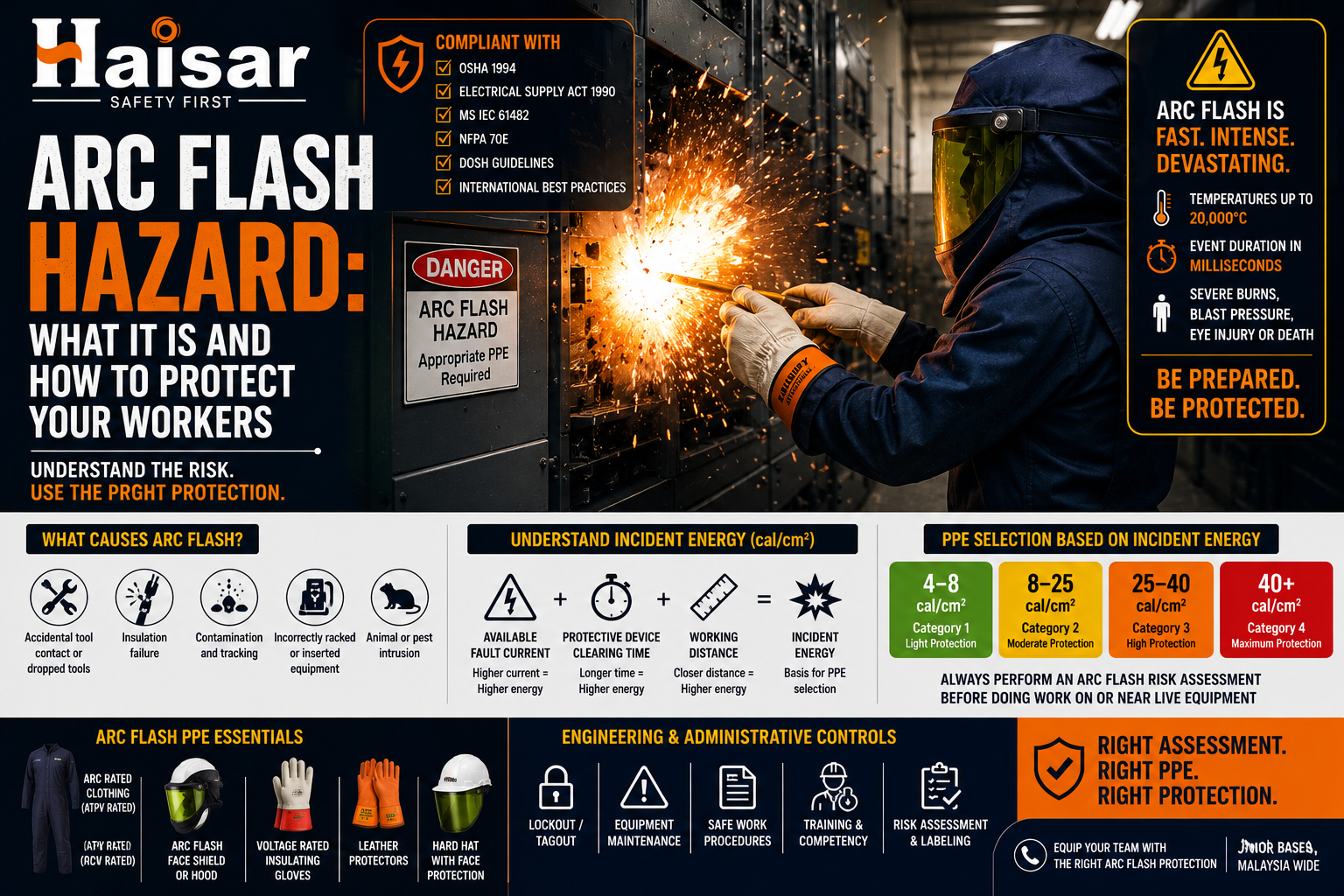
Arc flash is one of the most severe electrical hazards in industrial and commercial facilities in Malaysia, and one of the least understood. Unlike electrocution, which most plant engineers and HSE managers have a conceptual model for, arc flash is a phenomenon that many people cannot describe accurately until they have either witnessed an incident or been trained specifically in its recognition and management.
The consequences of an arc flash event are immediate and severe. The thermal energy released in a fraction of a second can cause fatal full-thickness burns at distances of several metres from the fault point. The pressure wave from the arc blast can throw a worker across a room. The intense UV and infrared radiation causes retinal damage. The molten metal expelled from the fault point penetrates skin and clothing. And all of this happens faster than a human being can react. From the onset of the arc to the thermal damage occurring is measured in milliseconds.
In Malaysian industrial facilities, data centres, manufacturing plants, oil and gas operations, and power infrastructure, arc flash risk is present wherever workers open, inspect, or work near live electrical equipment. Managing it requires understanding what causes it, how to quantify the risk, and how to select and maintain the right protective equipment for the specific incident energy levels workers are exposed to. This guide covers all of it.
What Arc Flash Is and What Causes It
An arc flash is the sudden release of electrical energy through the air when a conductive path is created between two conductors at different electrical potentials. The arc produces a plasma channel with temperatures that can reach 20,000 degrees Celsius, approximately four times the surface temperature of the sun. The energy release is not gradual. It is explosive.
Arc flash events are initiated by several different mechanisms, all of which are present in normal maintenance and operational activities on Malaysian industrial sites.
Accidental tool contact or dropped tools. A screwdriver or wrench that slips and bridges two conductors at different potentials in a live switchboard will initiate an arc. This is among the most common arc flash initiating events in industrial environments globally and in Malaysia specifically.
Insulation failure. Degraded or damaged insulation on cables, bus bars, or switchgear components can fail in a way that allows current to arc between conductors. Insulation degradation is accelerated by Malaysia's high ambient temperatures and humidity levels.
Contamination and tracking. Conductive contamination including metal dust, moisture ingress, and carbon tracking from previous partial discharges can create a conductive path between conductors that initiates an arc. Industrial environments in Johor's manufacturing and oil and gas sectors are particularly susceptible to contamination-related arc initiation.
Incorrectly racked or inserted equipment. Racking circuit breakers into switchgear panels while the bus is energised, or incorrect insertion of draw-out equipment, is a common arc flash initiating event during switchgear maintenance operations.
Animal and pest intrusion. In Malaysian conditions, lizards, rodents, and insects entering switchgear panels and creating conductive bridges between live components are a genuine arc flash initiating mechanism, particularly in older or poorly sealed switchgear.
Once the arc is initiated, the electrical system continues to supply fault current into the arc until a protective device operates to interrupt it. The duration of the arc is determined by the speed of the protective device, whether a fuse or a circuit breaker. The longer the arc duration, the greater the incident energy released.
Understanding Incident Energy
Incident energy is the fundamental measure of arc flash hazard and the basis for all arc flash PPE selection. It is expressed in calories per square centimetre (cal/cm²) and represents the thermal energy that would be delivered to a surface at a specified working distance from the arc fault point during the arc event.
The incident energy at any specific location in an electrical system depends on three variables: the available fault current at that point in the system, the duration of the arc event determined by the protective device clearing time, and the working distance between the fault point and the worker.
Available fault current is determined by the capacity of the electrical supply upstream of the fault point. Higher fault current levels produce more intense arcs with higher incident energy. Fault current levels in Malaysian industrial facilities vary significantly depending on the supply authority, transformer rating, cable impedance, and system configuration.
Protective device clearing time is often the variable with the greatest influence on incident energy. A breaker that operates in 0.05 seconds and a breaker that operates in 0.5 seconds with the same fault current will produce very different incident energy levels. The clearing time depends on the protective device type, its rating, and whether it has been set and coordinated correctly. Incorrectly set or poorly coordinated protection is a common finding in Malaysian industrial facilities and is the most straightforward variable to address in reducing arc flash hazard.
Working distance is the assumed distance between the worker's face and the arc fault point during the task. Working distance is task-specific and must be estimated accurately for the PPE selection to be valid.
The calculation of incident energy at specific locations in an electrical system requires a short-circuit and protective device coordination study of the complete electrical system. This study, known as an arc flash risk assessment, must be carried out by a competent electrical engineer and produces incident energy values and arc flash boundary distances at every switchboard, distribution board, motor control centre, and electrical panel in the facility.
The Arc Flash Boundary
The arc flash boundary is the calculated distance from the arc fault point at which the incident energy equals 1.2 cal/cm², the threshold at which bare skin would receive a just-curable burn injury. Any person within the arc flash boundary when an arc flash event occurs must be wearing arc flash rated PPE appropriate for the incident energy at their specific distance from the fault point.
Understanding the arc flash boundary is important for facility management because it defines the zone that must be controlled during live electrical work. Workers who are not performing the electrical task but are within the arc flash boundary of the work location must either be wearing appropriate arc flash PPE or must be excluded from the area while the task is in progress.
The arc flash boundary at a typical Malaysian industrial facility switchboard can extend from less than one metre at a well-protected low-energy panel to several metres at a high-fault-current main switchboard with slow protection. Without an arc flash study, these distances are not known and the boundary cannot be managed.
Malaysian Regulatory Context for Arc Flash
Arc flash as a specific hazard is not explicitly named in Malaysia's primary safety legislation, but it falls squarely within the general duty obligations of OSHA 1994 and is increasingly referenced in industry-specific frameworks applied in Malaysia.
OSHA 1994 Section 15 requires employers to provide safe systems of work and adequate information, instruction, and training to ensure the safety of employees. An employer whose workers perform live electrical work without arc flash PPE appropriate to the incident energy levels present has not fulfilled this duty.
DOSH enforcement has become more active in relation to electrical safety in industrial facilities. Incidents involving arc flash are investigated and the absence of arc flash risk assessment and appropriate PPE selection is a finding that supports enforcement action.
PETRONAS Technical Standards for electrical safety reference arc flash hazard assessment and PPE requirements for live electrical work at PETRONAS facilities and by PETRONAS contractors. Contractors working at PETRONAS-operated facilities are expected to have arc flash awareness training and to wear arc flash PPE specified on the basis of a site incident energy assessment.
International client standards applied by hyperscale data centre operators, international O&G operators, and major EPC contractors in Malaysia routinely require arc flash risk assessments and NFPA 70E or IEC 61482-based PPE selection as conditions of their contractor safety management requirements.
IEC 61482-1-2 is the international standard for arc flash protective clothing and defines the arc thermal performance testing methodology used to rate garments in cal/cm². This is the standard most commonly referenced in Malaysian industrial specifications for arc flash PPE.
NFPA 70E is the American standard for electrical safety in the workplace, widely used in Malaysia's oil and gas sector and by international contractors. NFPA 70E provides a PPE category system that allows PPE selection based on arc flash PPE categories rather than requiring a full incident energy analysis for every task, though incident energy analysis is the preferred and more accurate approach.
How to Conduct an Arc Flash Risk Assessment in Malaysia
An arc flash risk assessment is the technical process that produces the incident energy data needed for PPE selection, the arc flash boundary distances needed for hazard zone management, and the system information needed for identifying opportunities to reduce arc flash hazard through engineering controls.
The assessment process involves the following stages.
Data collection. Gather the electrical system data including single-line diagrams, protective device specifications and settings, transformer ratings and impedances, cable lengths and sizes, and available fault current data from the supply authority. In many Malaysian facilities, this data is incomplete or outdated. Part of the assessment process involves field verification of the as-installed system configuration against the available documentation.
Short-circuit analysis. Calculate the available fault current at each node in the electrical system using the collected system data. This establishes the maximum fault current magnitude at each switchboard and panel.
Protective device coordination study. Analyse the operation of protective devices throughout the system to determine the clearing time for faults at each node. This analysis identifies whether protective devices are correctly set and coordinated and calculates the arc duration that would result from a fault at each location.
Incident energy calculation. Using the fault current and arc duration data, calculate the incident energy at each location in the system at the specified working distance. This produces the incident energy values that drive PPE selection.
Arc flash label generation. The results of the assessment are documented on arc flash warning labels applied to each switchboard, distribution board, and panel in the facility. The label specifies the incident energy, the arc flash boundary, the required PPE category or ATPV, and the nominal voltage at that location. Workers performing any task at or near that panel refer to the label to confirm the required PPE before starting work.
Review frequency. The arc flash assessment is a snapshot of the electrical system at the time of the study. Any change to the electrical system, including changes to protective device settings, addition of new loads, changes to the supply authority's network, or modifications to the system configuration, may change the incident energy values at affected locations. The assessment must be reviewed following any significant system change and must be formally renewed at intervals not exceeding five years.
Arc Flash PPE: Selection and Requirements
Arc flash PPE is selected on the basis of the incident energy at the specific work location, as determined by the arc flash risk assessment. The PPE must provide an arc thermal performance value (ATPV) equal to or exceeding the calculated incident energy at the working distance.
Arc flash rated face protection is required for all tasks within the arc flash boundary. Standard polycarbonate face shields are not arc flash rated. Arc flash face shields carry an ATPV rating in cal/cm². For higher incident energy locations, arc flash switching hoods providing full head and neck coverage are required in place of a face shield alone.
Arc flash rated garments must provide body protection with an ATPV equal to or exceeding the incident energy at the work location. A single-layer arc flash rated coverall is appropriate for moderate incident energy levels. For higher incident energy environments, layered systems combining an arc flash coverall with an arc flash rated base layer or jacket provide higher ATPV through the combined performance of the layers.
Arc flash garments must be made from inherently flame-resistant fabric, not from fabrics that have been chemically treated for FR performance. Treatment-based FR fabrics lose their protection after repeated washing. Inherently FR fabrics including Nomex and similar materials maintain their protection throughout the garment's service life.
Arc flash garments must never be worn over or combined with synthetic fabrics. Polyester and nylon fabrics melt when exposed to arc flash heat and the melting synthetic material dramatically increases burn injury severity even when worn under an arc-rated outer layer. All fabric layers within the arc flash boundary must be either inherently FR or arc flash rated.
Voltage-rated insulating rubber gloves provide protection against electrocution from contact with live conductors. They are a separate requirement from arc flash PPE and must be worn in combination with arc flash garments for live electrical work. Gloves must be matched to the system voltage class and must be pressure tested at required intervals.
Arc flash rated balaclava or liner for protection of the neck, chin, and ear areas when a face shield rather than a full switching hood is used as the primary face protection.
Non-melting, FR cotton or arc flash rated underwear and base layers for all workers within the arc flash boundary. The combination of FR outer garment and standard synthetic underwear produces a system that is not arc flash rated because the underwear will melt and worsen injuries.
Engineering Controls: Reducing Arc Flash Risk at the Source
PPE is the last line of defence in the hierarchy of controls for arc flash hazard. Before specifying PPE, engineering controls that reduce the incident energy at the work location should be considered and implemented wherever practicable.
Protection setting optimisation. Reviewing and optimising protective device settings to reduce clearing time is often the single most cost-effective way to reduce incident energy across an existing facility. A reduction in clearing time from 0.5 seconds to 0.1 seconds for the same fault current reduces incident energy by 80%. Many Malaysian industrial facilities operate with protective devices that are not optimally set for arc flash risk reduction.
Zone-selective interlocking (ZSI) and bus differential protection allow switchgear to clear faults more rapidly than conventional time-graded protection, reducing arc duration and incident energy at main switchboard locations. These systems represent a capital investment but can reduce incident energy at high-risk locations dramatically.
Remote racking and remote switching devices allow circuit breakers to be racked in and out and switches to be operated from outside the arc flash boundary, removing the worker from the hazard zone during the highest-risk operations. Remote racking devices are available for many common switchgear configurations and are increasingly specified for new switchgear installations at Malaysian industrial facilities.
Arc flash detection relays operate at speeds faster than conventional protection and can reduce arc fault clearing times to milliseconds, dramatically reducing incident energy. They are particularly effective in environments where the available fault current is high and conventional protection cannot achieve adequately short clearing times.
Maintenance mode in modern protective relays provides a facility to temporarily reduce the overcurrent protection trip time setting while maintenance is in progress, reducing the incident energy at the maintenance location without compromising the normal coordination of the protection scheme.
Building an Arc Flash Safety Programme in Malaysia
An effective arc flash safety programme in a Malaysian facility brings together risk assessment, engineering controls, PPE selection, training, and documentation into a managed system.
The risk assessment provides the technical foundation. Engineering controls reduce the hazard at source where practicable. Arc flash labels at every panel communicate the hazard data to workers at the point of task. PPE is selected on the basis of the labelled incident energy. Workers are trained in arc flash awareness, in the use of arc flash PPE, and in the safe work procedures that govern live electrical work at the facility. The programme is documented and reviewed at the required intervals.
A programme without the risk assessment is not a programme. It is PPE provision without technical basis, which means it may be providing adequate protection at some locations and inadequate protection at others without any way to know which. An arc flash study is not optional if the programme is to be defensible.
Haisar Supply and Services: Arc Flash PPE Supplier in Malaysia
Haisar Supply and Services supplies the full range of arc flash PPE for industrial facilities, data centres, oil and gas operations, and power generation sites across Johor and peninsular Malaysia. Our arc flash product range covers arc flash rated face shields and switching hoods across multiple ATPV ratings, arc flash rated coveralls and two-piece garments in inherently FR fabrics, arc flash rated balaclavas and liners, voltage-rated insulating rubber gloves across all voltage classes with test certificates, and complete electrical safety PPE packages for live electrical work programmes.
We work with plant engineers and HSE managers to ensure that arc flash PPE is selected on the basis of incident energy data, not on the basis of generic category assumptions. We supply with full product documentation including IEC 61482 test certificates, ATPV ratings, and care and maintenance instructions that are essential for maintaining the protection performance of arc flash garments throughout their service life.
Get a Quote for Arc Flash PPE
Whether you are building an arc flash PPE programme for a new facility, reviewing your current electrical PPE against an updated arc flash study, or sourcing arc flash equipment for a specific project in Johor or across Malaysia, contact Haisar to discuss your requirements.
Our team will respond with product recommendations, ATPV specifications, and pricing tailored to your facility's incident energy levels and your workers' tasks.
Haisar Supply and Services Sdn Bhd (985158-T) | Kulai, Johor, Malaysia | www.haisar.com
