The safety vest is the most frequently purchased and most frequently misspecified item of personal protective equipment across Malaysian construction and industrial sites. It is bought in bulk, distributed without adequate briefing, worn incorrectly, and replaced too infrequently. And yet it is one of the items of PPE whose failure has the most direct and immediate consequence: a worker who is not adequately visible to a plant operator or vehicle driver is a worker at risk of a struck-by incident that the safety vest was supposed to prevent.
Getting safety vest procurement right in Malaysia requires understanding what the applicable standards actually require, what the different vest classes mean in practice, and how to match the vest specification to the specific visibility risk on your site. This guide covers all of it, from the standards framework and colour requirements to compliance checks and product selection for different site environments.
Why Safety Vest Standards Matter in Malaysia
Struck-by incidents involving mobile plant and vehicles are a consistent source of fatalities on Malaysian construction, civil engineering, and industrial sites. DOSH incident records identify being struck by plant and vehicles as among the top causes of fatal workplace accidents in the construction sector year after year.
The safety vest is the primary control for making workers visible to plant operators, and its effectiveness depends entirely on whether it meets the standard appropriate for the specific risk environment. A cheap vest that does not meet MS ISO 20471 requirements, that has faded or dirty retroreflective tape, or that is the wrong class for the vehicle speeds and distances on the site provides the appearance of protection without the substance of it.
Procurement teams and HSE managers who treat safety vest procurement as a commodity exercise, selecting the lowest price option without reference to the applicable standard, are creating a compliance gap and a safety risk simultaneously.
The Standards Framework for Safety Vests in Malaysia
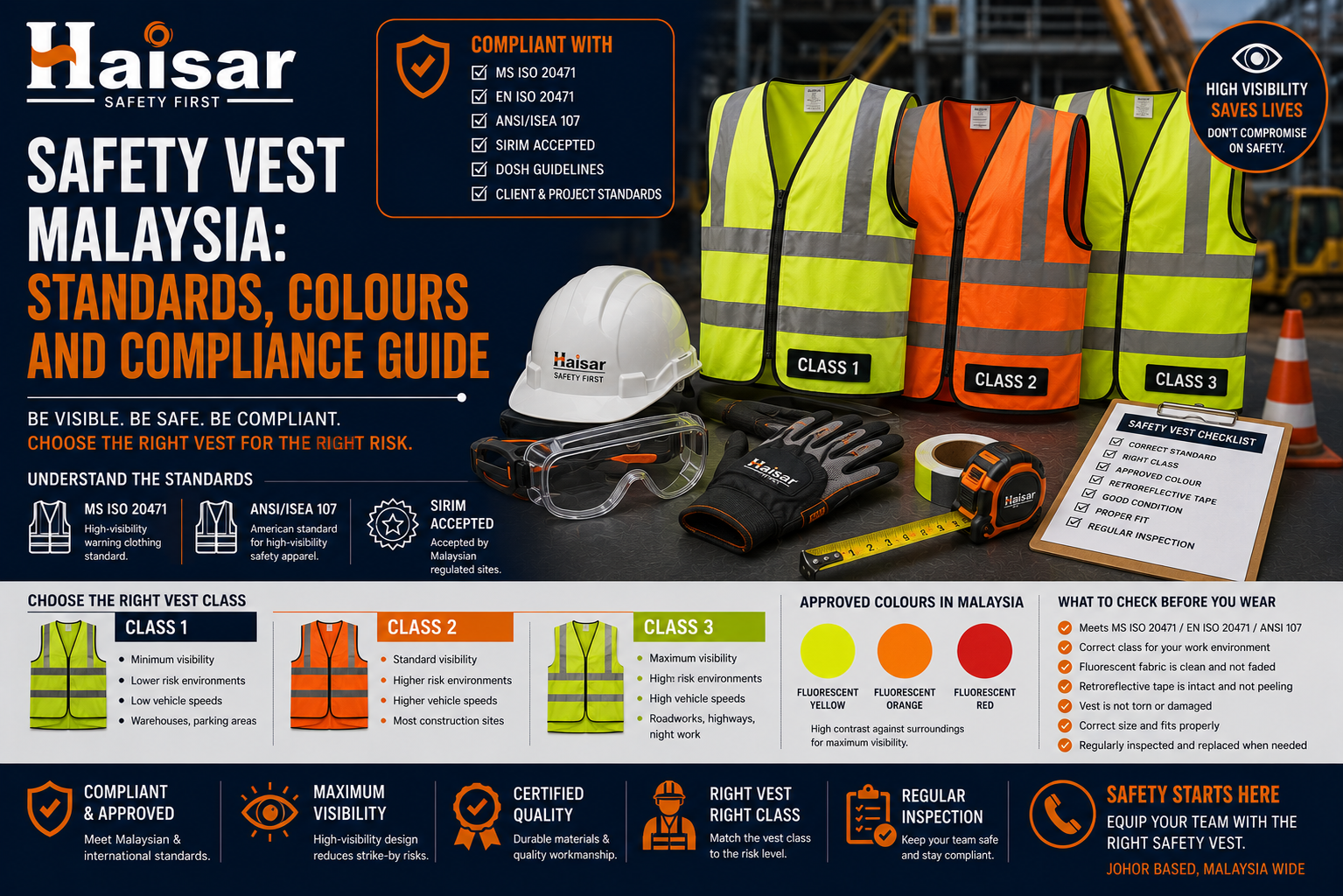
Safety vests used on Malaysian construction and industrial sites must comply with the applicable international or Malaysian standard. The primary standard referenced in Malaysia is MS ISO 20471, which is Malaysia's adoption of the international ISO 20471 standard for high-visibility clothing.
MS ISO 20471. This is the governing standard for high-visibility warning clothing in Malaysia. It defines three classes of high-visibility garment based on the minimum area of background fluorescent material and retroreflective tape that the garment must carry. Higher classes provide greater visibility and are required in higher-risk environments. The standard specifies minimum areas, placement requirements, and performance requirements for both the fluorescent background material and the retroreflective tape.
EN ISO 20471. The European version of the same standard, adopted identically by most international markets including Malaysia. Garments carrying EN ISO 20471 certification with the class marking are acceptable on Malaysian sites as equivalent to MS ISO 20471.
ANSI/ISEA 107. The American National Standard for high-visibility safety apparel. Widely referenced by international clients and contractors, particularly in the oil and gas sector. ANSI/ISEA 107 uses a similar class structure to ISO 20471 but with some differences in minimum area requirements and configuration. Many PETRONAS contractor specifications and international operator sites in Malaysia reference ANSI/ISEA 107 Class 2 or Class 3 alongside or instead of ISO 20471.
SIRIM acceptance. High-visibility garments carrying CE marking against EN ISO 20471 or ANSI/ISEA 107 certification are generally accepted on Malaysian regulated sites. SIRIM certification of safety vests is not universally required in the same way as for hard hats and certain other PPE categories, but certification documentation should be available for any garment used on a site where compliance documentation is inspected.
Understanding which standard applies to your site, your principal contractor's requirements, and your client's specifications before purchasing safety vests avoids the common situation of sourcing vests that do not meet the specific standard referenced in the site safety plan.
Safety Vest Classes: What Class 1, 2 and 3 Mean
The most important decision in safety vest procurement is selecting the correct class for the risk environment. Each class reflects a minimum level of visibility performance and is intended for use in specific risk environments.
Class 1 Safety Vests
Class 1 vests provide the minimum area of fluorescent background material and retroreflective tape under ISO 20471. They are designed for use in environments where workers are separated from vehicle and plant traffic, where vehicle speeds are low, and where the background environment provides adequate contrast for the vest to be seen.
Class 1 is appropriate for environments such as warehouses, parking areas, and off-road sites with very limited vehicle movement at low speeds where a small amount of high-visibility material provides adequate distinction from the background. It is not appropriate for road works, construction sites with active plant movement, or any environment where vehicle speeds exceed low walking pace.
In practice, Class 1 vests are rarely the appropriate specification for Malaysian construction and industrial sites. The risk environments on most active project sites require at minimum Class 2.
Class 2 Safety Vests
Class 2 vests provide a greater area of fluorescent background material and retroreflective tape than Class 1 and are the standard minimum specification for most Malaysian construction and industrial site environments. They are designed for environments with greater traffic hazard including sites with heavier plant movement, higher vehicle speeds, and lower contrast backgrounds where greater visibility is required.
Class 2 is the appropriate specification for the majority of Malaysian construction sites, industrial facility maintenance operations, and project sites where workers are in areas with mobile plant movement at typical site speeds. Most principal contractor and international client site safety standards in Malaysia specify Class 2 as the minimum requirement.
Class 2 vests under ISO 20471 must have a minimum of 0.50 square metres of fluorescent background material and a minimum of 0.13 square metres of retroreflective tape. The retroreflective tape must be placed in a configuration that provides 360-degree visibility from any angle of approach.
Class 3 Safety Vests and Garments
Class 3 provides the highest level of high-visibility protection and is required in the highest-risk environments including road works adjacent to live traffic, sites with vehicle movement at speeds above 60 km/h, and low-light conditions where maximum retroreflective area is required for visibility.
Class 3 garments under ISO 20471 must carry significantly greater areas of fluorescent material and retroreflective tape than Class 2, and must include sleeve coverage that is not required for Class 2. This is why Class 3 is typically achieved through a full jacket or coverall configuration rather than a vest alone. A Class 3 vest does not exist in the ISO 20471 framework. Class 3 requires arm and body coverage that a sleeveless vest cannot provide.
For road works, highway construction projects, and any operations adjacent to live public roads in Malaysia, Class 3 garments are the correct specification. Workers wearing Class 2 vests on road works sites alongside live traffic are not adequately protected.
Colour Requirements for Safety Vests in Malaysia
ISO 20471 specifies that the fluorescent background material of high-visibility garments must be one of three approved colours: fluorescent yellow-green, fluorescent orange-red, or fluorescent red. These colours are selected because their fluorescent properties provide maximum daytime visibility across the range of background environments encountered on typical work sites.
Fluorescent yellow-green is the most commonly used colour on Malaysian construction and industrial sites. It provides the highest contrast against the green and brown backgrounds typical of outdoor Malaysian work environments and is the colour most commonly associated with safety vests globally.
Fluorescent orange-red is commonly used for traffic management personnel and road works in Malaysia. It provides strong visibility against grey road surfaces and concrete backgrounds and is the colour traditionally associated with road safety workers.
Fluorescent red is less commonly used in Malaysia but is specified by some organisations and for some roles. It must meet the same fluorescent performance requirements as yellow and orange under ISO 20471.
Colour coding for site identification. Many principal contractors and project operators in Malaysia use colour-coded safety vests to differentiate workers by company, role, or access authorisation. A common colour coding system might use yellow for general workers, orange for supervisors, green for HSE officers, and red for emergency response personnel. These site-specific colour systems must be implemented using compliant vest specifications, not by substituting non-compliant coloured garments for the standard.
Retroreflective Tape: Performance and Maintenance
The retroreflective tape on a safety vest is what makes the garment effective in low-light conditions, including dawn, dusk, and night operations common on round-the-clock project sites in Malaysia. The fluorescent background material provides daytime visibility. The retroreflective tape provides visibility when a light source such as a vehicle headlight illuminates it.
Performance requirements. Under ISO 20471, retroreflective tape must meet minimum retroreflectivity values measured in candelas per lux per square metre. Tape that meets the standard when new but degrades rapidly due to washing, abrasion, or UV exposure does not maintain the required performance over the life of the garment. Quality retroreflective tape from reputable manufacturers maintains adequate performance across the claimed service life of the garment.
Tape degradation. The most common compliance failure with safety vests on Malaysian sites is not the initial specification but the continued use of vests with degraded retroreflective tape. Tape that is visibly faded, peeling, or discoloured from soiling does not provide the required retroreflectivity. Vests in this condition must be replaced. The common site practice of continuing to use vests until they are physically falling apart, regardless of tape condition, is not compliant and not safe.
Washing and care. Retroreflective tape degrades faster when vests are washed at temperatures above manufacturer recommendations or with detergents containing optical brighteners. The care instructions on certified safety vests must be followed. Industrial laundering at high temperatures is a common cause of premature tape degradation on Malaysian site vests.
Choosing the Right Safety Vest for Your Site in Malaysia
With the standards framework and class requirements understood, the following guidance helps match the vest specification to the common site environments in Johor and across Malaysia.
General construction and civil engineering sites. Class 2 fluorescent yellow-green vest as the minimum standard for all workers in areas with active plant and vehicle movement. Class 3 jacket or coverall for workers performing traffic management duties, working adjacent to live roads, or operating in any environment with vehicle speeds above typical site pace.
Oil and gas project sites. Class 2 minimum, with FR-rated hi-vis coveralls required for workers in process areas and classified zones where flash fire risk is present alongside the visibility requirement. The hi-vis vest must not be worn over FR coveralls in a way that covers the FR protection with a non-FR outer layer. FR-rated hi-vis garments that combine both requirements in a single compliant garment are the correct specification for this environment.
Solar farm and renewable energy sites. Class 2 minimum for all workers on active installation sites with plant movement. UV-protective lightweight fabric for outdoor workers in Malaysia's equatorial climate is a comfort and health consideration alongside the visibility standard.
Marine and port environments. Class 2 minimum for all workers in areas with vehicle and crane movement. Waterproof or water-resistant vest options for workers exposed to rain and marine spray. Consider Class 3 for workers involved in vessel loading and unloading operations with active heavy equipment movement.
Data centre construction and fit-out. Class 2 minimum for all workers on active construction sites. Reduced visibility requirement in completed data hall environments without active vehicle movement, though many major data centre operators maintain Class 2 as a site-wide standard regardless.
Road works and highway construction. Class 3 garments mandatory for all workers adjacent to live traffic. This is non-negotiable. Class 2 is not adequate for road works environments in Malaysia.
Inspection and Replacement of Safety Vests
Safety vests are consumable PPE that must be inspected regularly and replaced when they no longer meet the performance standard. The following inspection and replacement criteria apply.
Inspect the vest before each use for visible soiling that covers the fluorescent material, retroreflective tape that is peeling, cracked, or visibly faded, tears or damage to the fluorescent background material, and missing or non-functional fastening systems. Any vest failing this inspection must be removed from service and replaced.
Formally inspect and assess the full vest inventory at intervals defined in the site PPE programme, typically monthly for sites with high vest turnover and quarterly for lower-usage environments. Replace vests that cannot pass the pre-use inspection criteria.
For vests on sites with heavy soiling, high UV exposure, or frequent industrial washing, replacement cycles will be shorter than the manufacturer's stated service life. Budget for vest replacement as an ongoing operational cost rather than a one-time purchase.
Haisar Supply and Services: Safety Vest Supplier in Malaysia
Haisar Supply and Services supplies MS ISO 20471 and ANSI/ISEA 107 compliant safety vests and high-visibility garments for construction sites, industrial facilities, and project teams across Johor and peninsular Malaysia. Our range covers Class 2 and Class 3 configurations in standard and customised options, including mesh vests for hot-climate comfort, waterproof hi-vis jackets for wet season conditions, FR-rated hi-vis coveralls for oil and gas environments, and custom-branded vests with company or project identification.
We supply in bulk for project mobilisation and maintain stock of fast-moving vest specifications for rapid resupply when sites run low mid-project.
Browse Safety Vests and Hi-Vis Products at haisar.com
Contact our team for specifications, certification documentation, and pricing for your site's safety vest requirements.
Haisar Supply and Services Sdn Bhd (985158-T) | Kulai, Johor, Malaysia | www.haisar.com