Can't find what you're looking for? Get in touch!



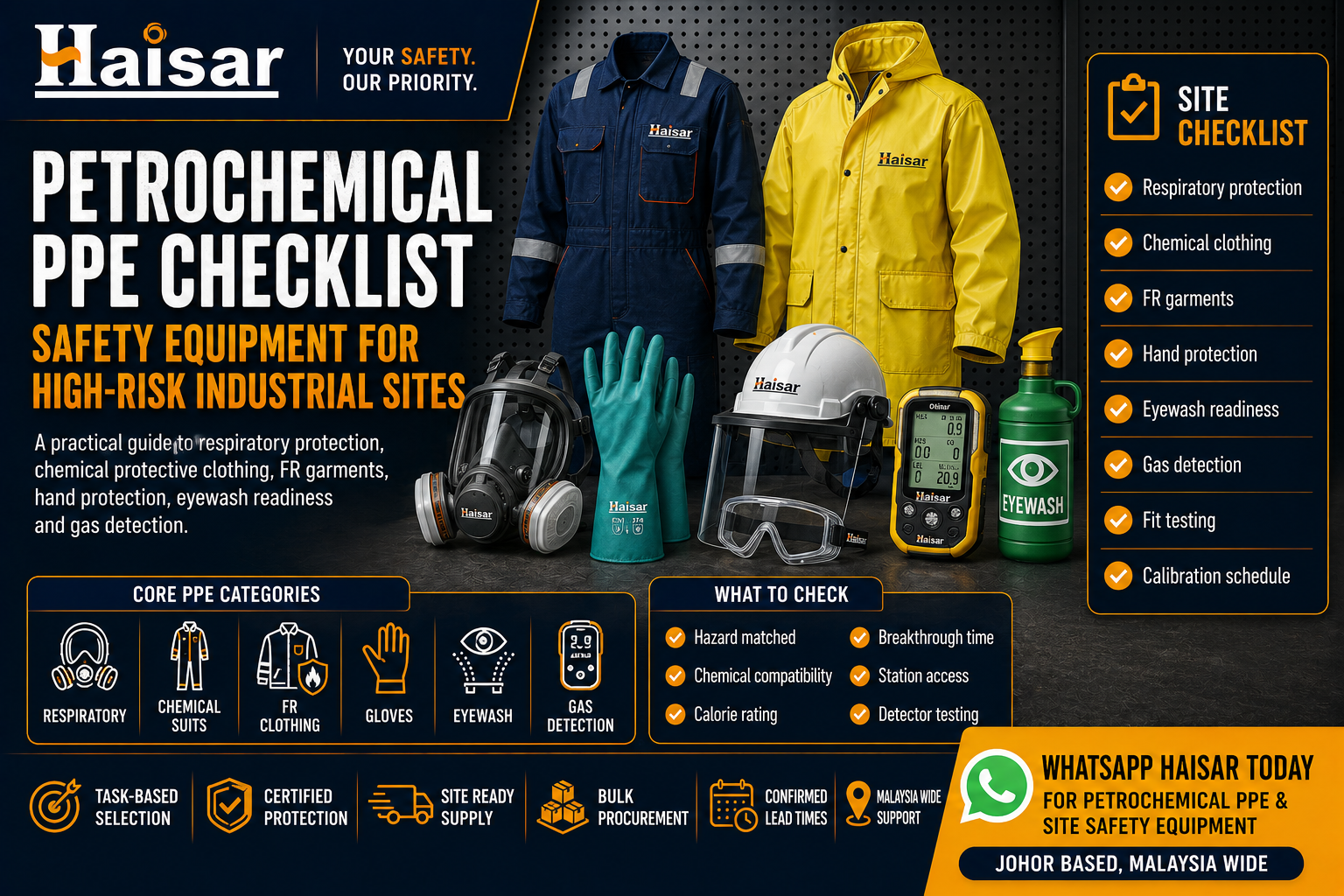
Petrochemical sites carry a hazard profile that most other industrial environments do not: flammable and toxic process streams, high-pressure systems, corrosive chemicals, and atmospheres that can become immediately dangerous to life with little warning. The personal protective equipment programme on a site like this is not a generic safety checklist borrowed from a standard factory. It is a set of equipment decisions built specifically around flash fire, chemical exposure, and atmospheric risk.
This guide sets out the core categories of PPE that a petrochemical, refinery, or chemical processing site needs to have in place, what to check before issuing each category of equipment, and a consolidated checklist your HSE and procurement teams can use when auditing current PPE provision or planning a new equipment order. It covers respiratory protection, chemical protective clothing, flame resistant garments, hand protection, eyewash and emergency equipment, and gas detection.
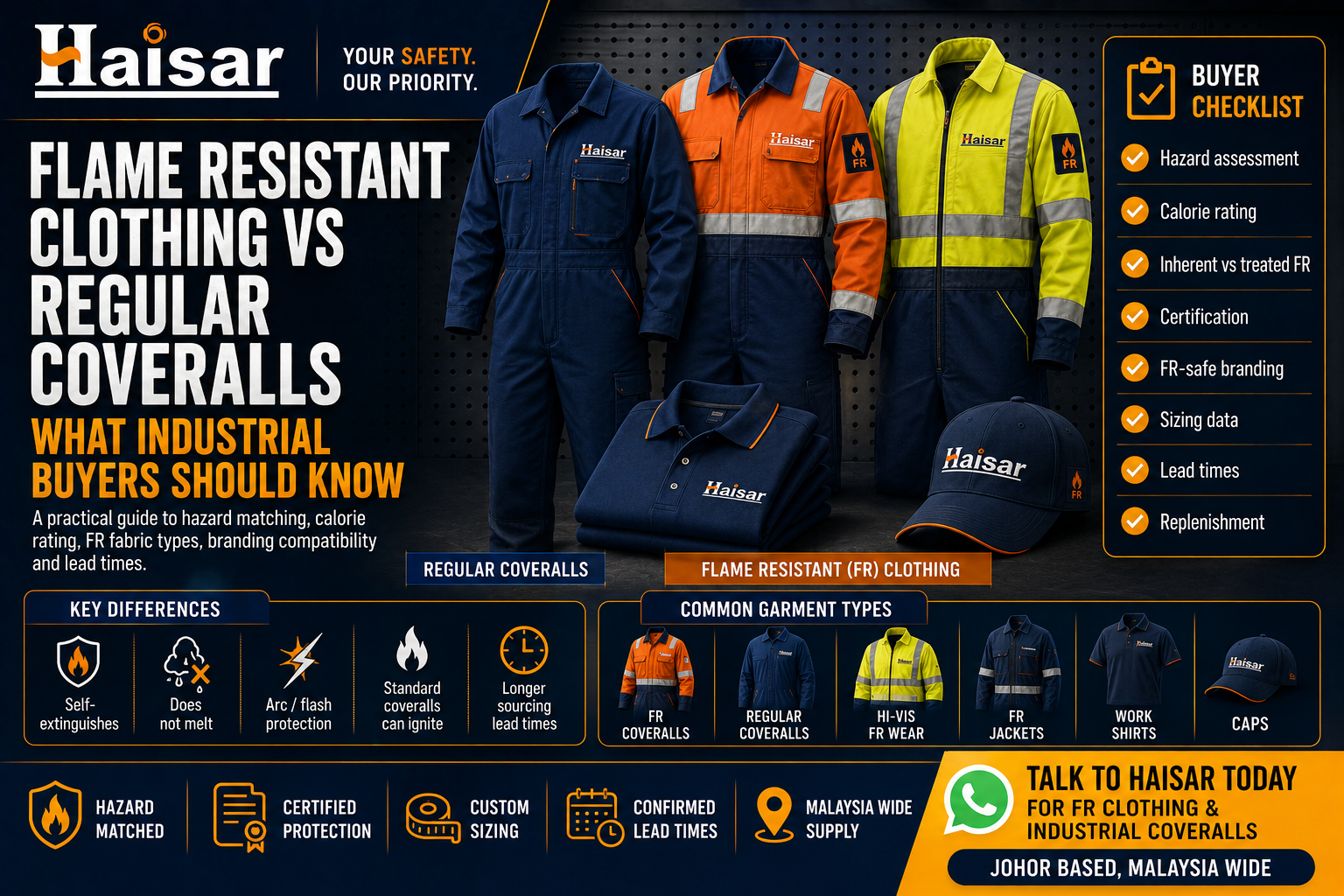
If your team works near flash fire, arc flash, or open flame hazards, the coveralls they wear are not a uniform decision. They are a protective equipment decision, and getting it wrong has consequences that go well beyond appearance. Regular polycotton or ripstop coveralls look similar to flame resistant (FR) garments on a rack, and on a casual inspection it can be difficult to tell them apart. The difference only becomes obvious in the moment it matters most: when the garment is exposed to fire.
For procurement teams and HSE managers in oil and gas, electrical work, welding, and plant maintenance across Malaysia, understanding exactly what separates FR clothing from regular workwear is essential before placing an order. This guide explains how FR fabric works, why regular coveralls fail in a flash fire, which roles genuinely require FR protection, and what to check before you buy.
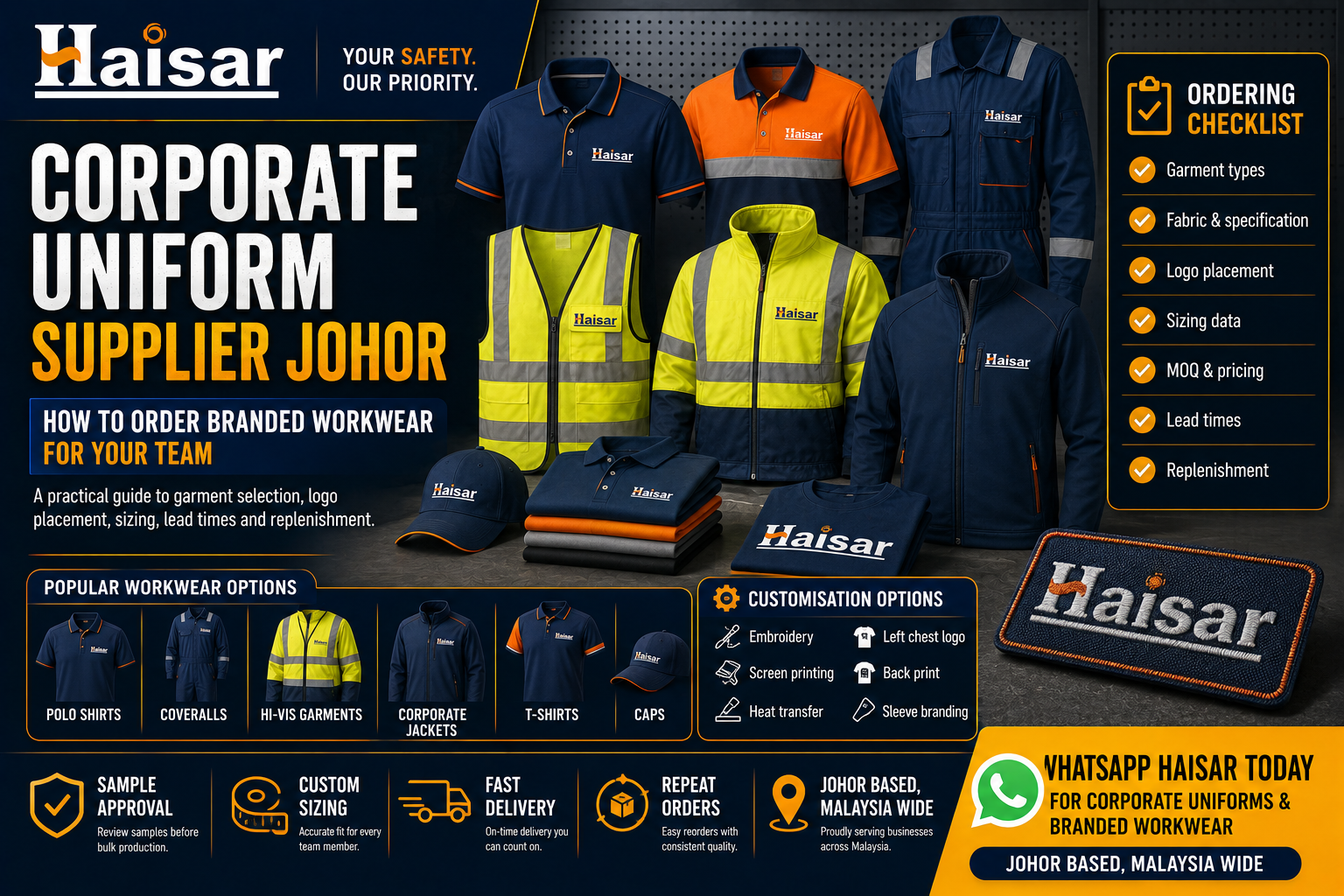
For businesses in Johor, branded workwear is one of the most visible investments you make in your company identity. Every technician who arrives at a client's premises, every supervisor on a construction site, every logistics driver making a delivery, and every front-of-house staff member greeting a customer is wearing your brand on their back. How that brand looks, and how consistently it is presented across your team, shapes the impression your business makes before a word is spoken.
Ordering corporate uniforms and branded workwear in Johor is straightforward when you know exactly what decisions you need to make and in what sequence. Get the sequence right and the result is a clean, professional uniform programme delivered on time and on budget. Get it wrong and you end up with garments in the wrong sizes, logos that do not match your brand, and delivery timelines that do not align with your team's mobilisation date.
This guide walks through the complete ordering process for corporate and branded workwear in Johor, covering garment selection, logo placement, fabric and specification choices, sizing, minimum order quantities, lead times, and what to expect from a quality workwear supplier. Whether you are ordering for ten staff or five hundred workers, the same decisions apply.
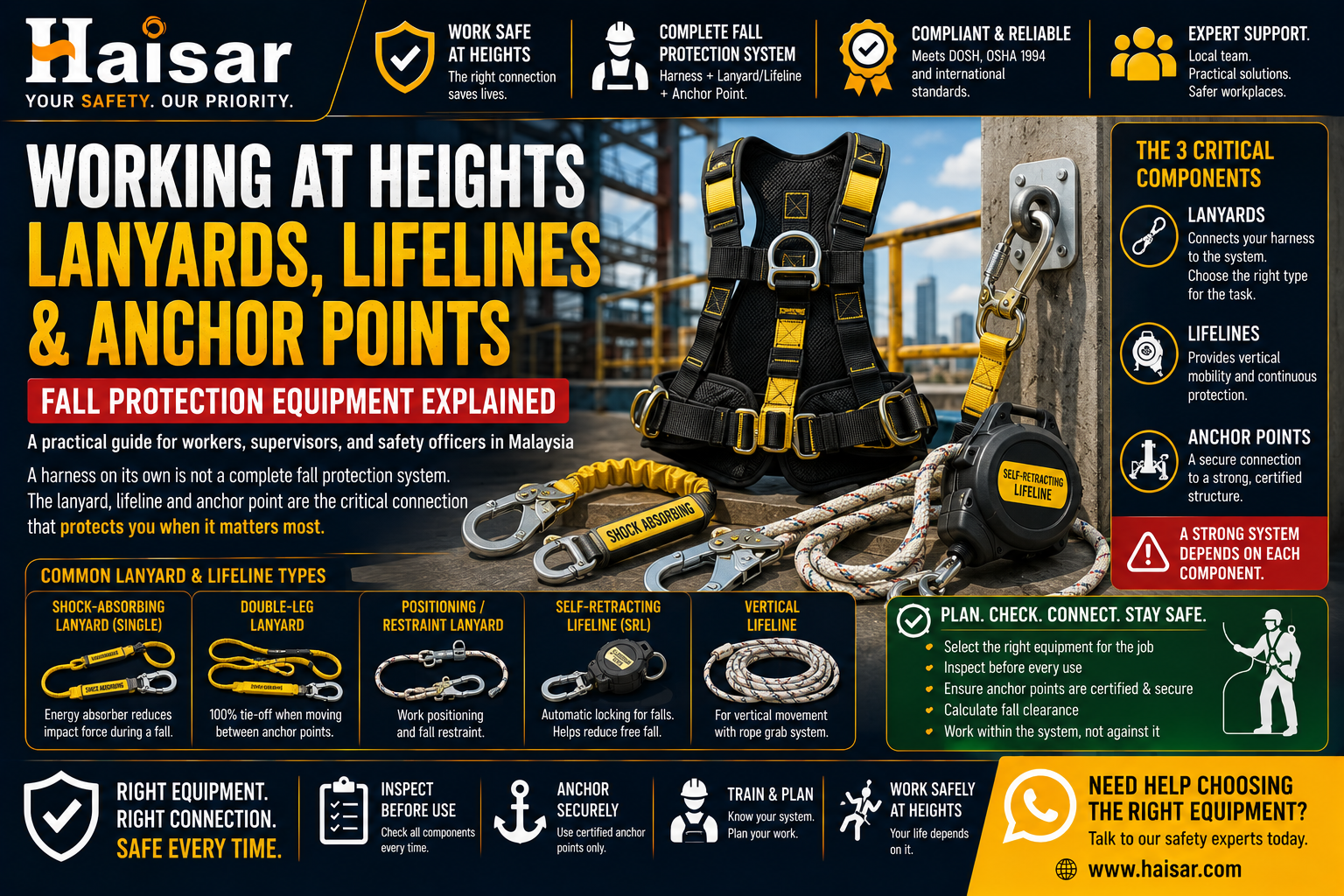
Fall Protection Equipment Explained
A practical guide for workers, supervisors, and safety officers in Malaysia
A safety harness keeps a worker attached to a fall protection system. But a harness on its own is not a complete fall protection system. The harness is only as effective as the components connecting it to a fixed structure - the lanyard, the lifeline, and the anchor point. This is where many working-at-heights programmes in Malaysia fall short. Teams invest in quality harnesses, tick the box on harness inspection, and then give insufficient attention to the connection between the worker and the structure. A worn snap hook, an incorrectly installed anchor, a shock-absorber pack that has already deployed, or a self-retracting lifeline used on the wrong type of fall - any one of these failures can result in a fall that the harness alone cannot prevent.
This guide explains lanyards, lifelines, and anchor points in plain language: what each component does, how the different types compare, how to select the right equipment for your work at height in Malaysia, and the inspection standards that apply to each. It is intended for workers, supervisors, safety officers, and procurement teams responsible for fall protection equipment across Malaysian construction sites, industrial facilities, and infrastructure projects.
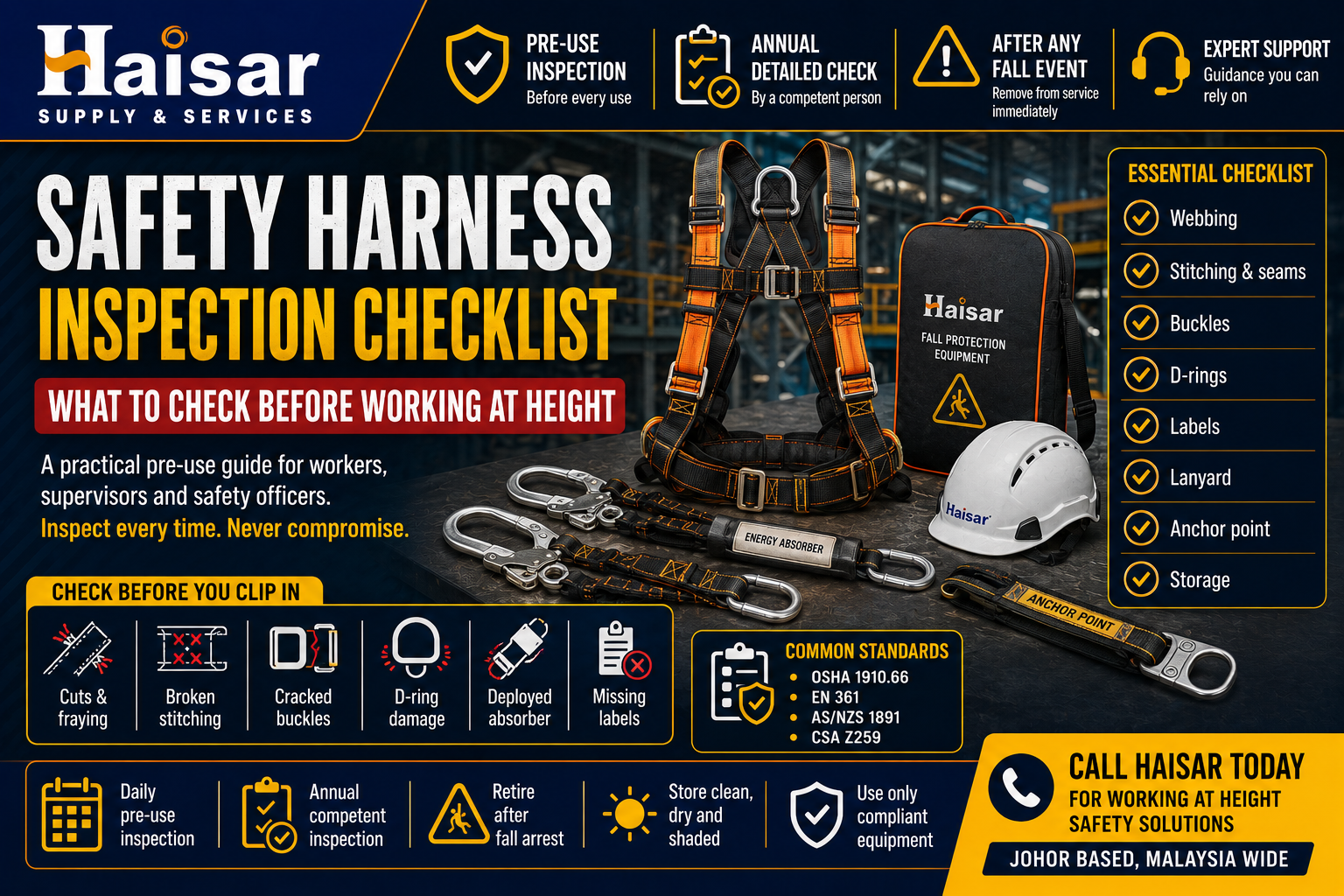
What to Check Before Working at Height ⚠
A comprehensive pre-use guide for workers, supervisors, and safety officers
Every year, falls from height remain one of the leading causes of serious workplace injuries and fatalities globally. Yet many of these accidents are preventable - often through one simple step that workers and supervisors overlook: a proper pre-use inspection of their personal fall protection equipment.
Your safety harness is your last line of defence when working at height. Whether you're working on a construction scaffold, a roof, a communications tower, or an elevated platform, the harness you clip into every morning must be in perfect working order. A single worn strap, a cracked buckle, or a missing label could mean the difference between walking away safely or not walking away at all.
This blog post provides a full, practical safety harness inspection checklist covering every component you need to check - including webbing, buckles, D-rings, labels, lanyards, anchor points, and storage conditions - along with clear guidance on what to look for and when to remove equipment from service.
Let's get started.
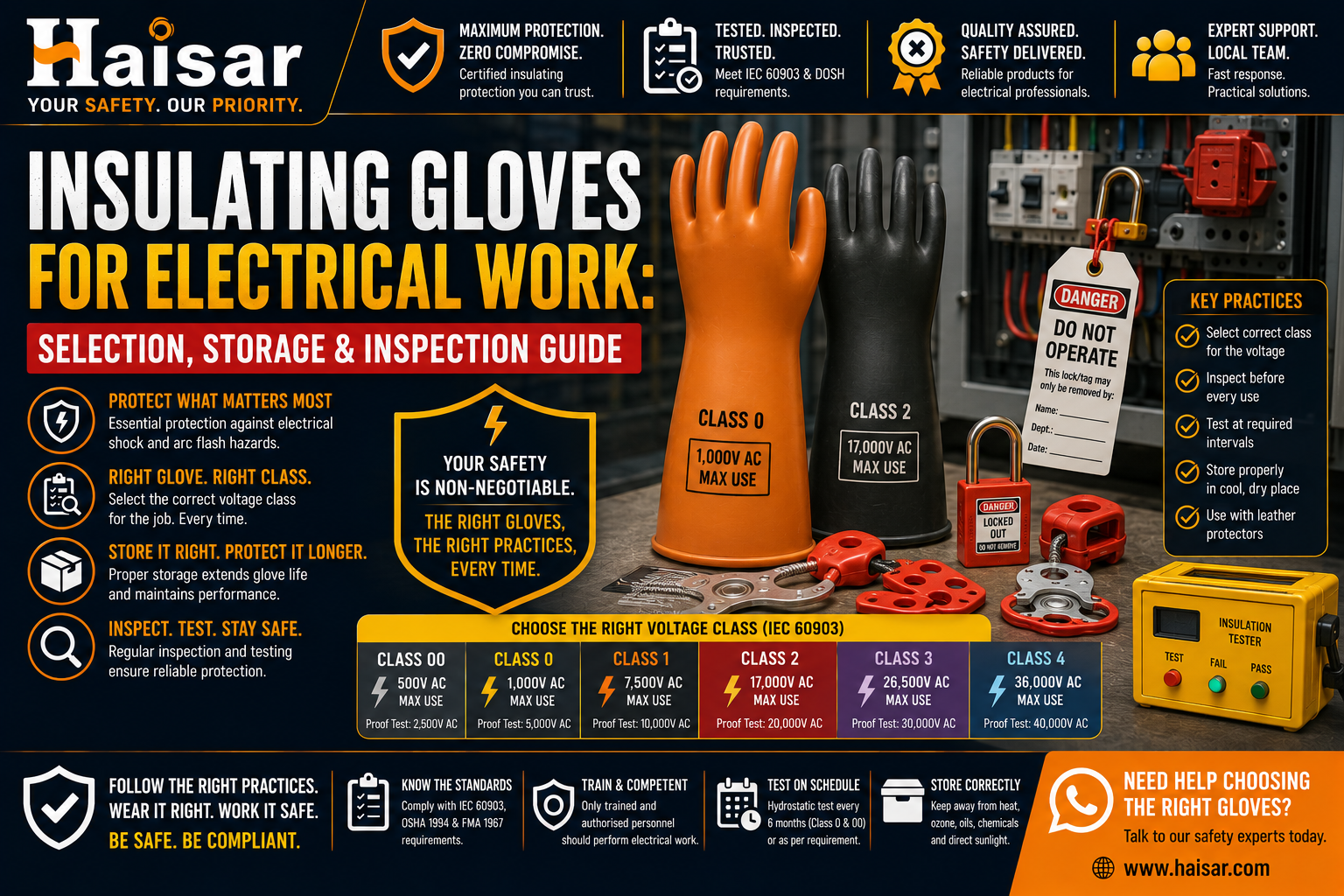
Insulating rubber gloves are the most safety-critical item of hand protection an electrical worker will ever wear. Unlike a cut-resistant glove that protects against a laceration, or a chemical glove that protects against a burn, an insulating glove protects against electrocution. A failure in the glove does not result in a minor injury that prompts a trip to the first aid room. It can result in a fatality.
This is why insulating rubber gloves are subject to a more rigorous selection, storage, and inspection regime than almost any other category of PPE. The glove that performed correctly during testing six months ago may not be safe today if it has developed an undetected pinhole defect, if it has been exposed to oils or solvents that degrade the rubber, or if it has simply exceeded the maximum interval since its last pressure test.
This guide covers everything electricians, electrical contractors, and HSE teams in Malaysia need to know about insulating rubber gloves: how to select the correct voltage class, how to store gloves correctly to preserve their dielectric integrity, and the inspection and testing regime that determines whether a glove can be trusted with a worker's life.
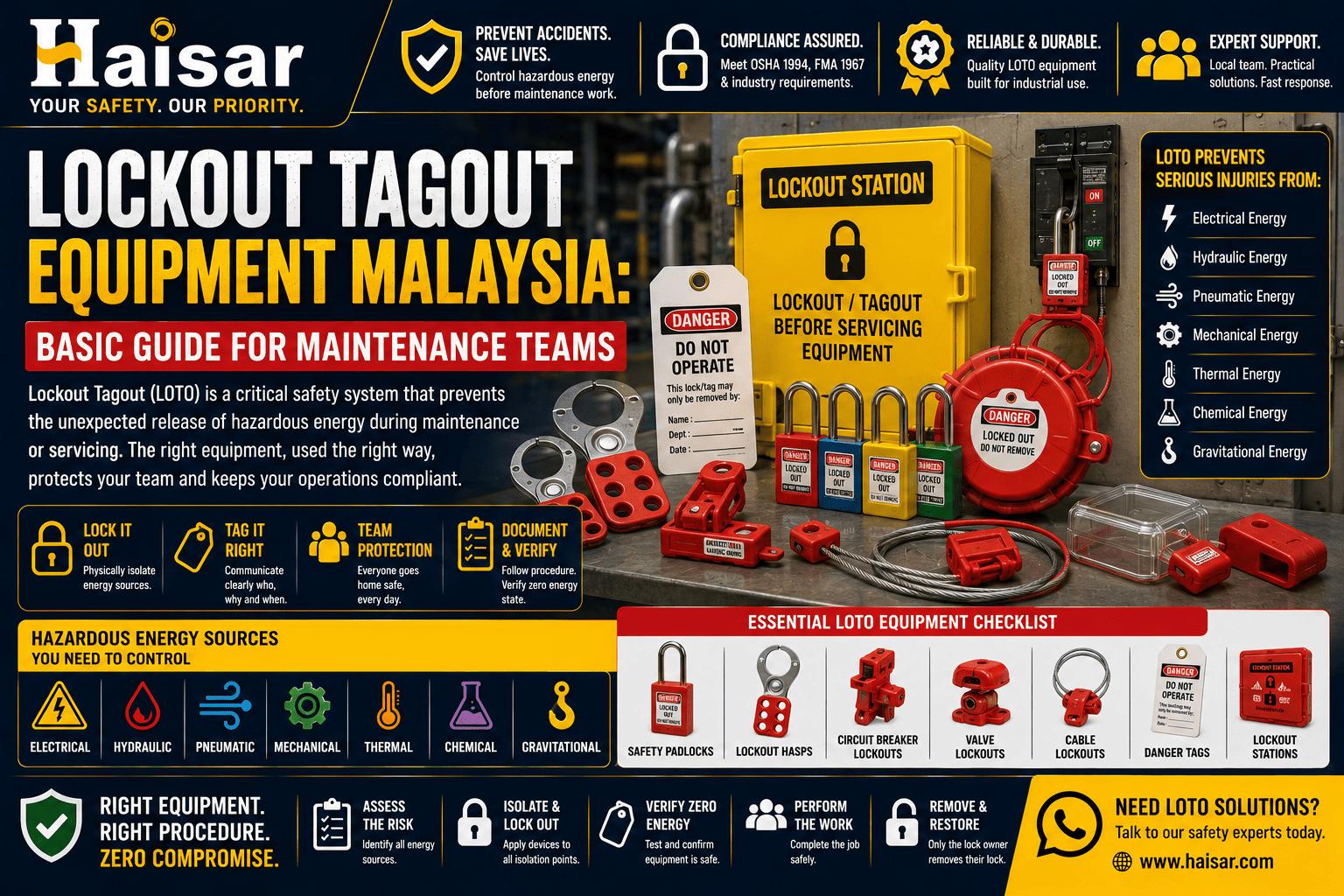
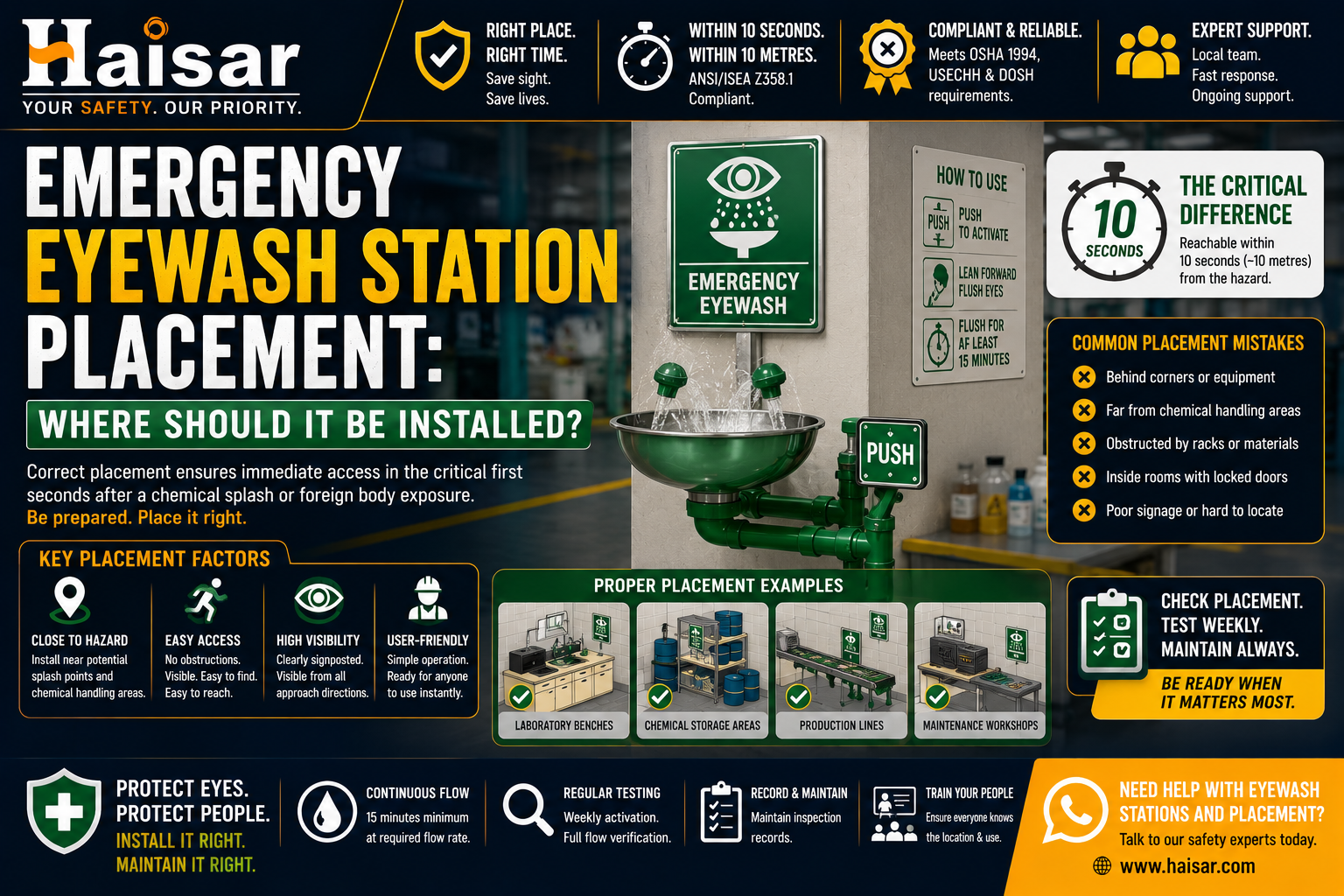
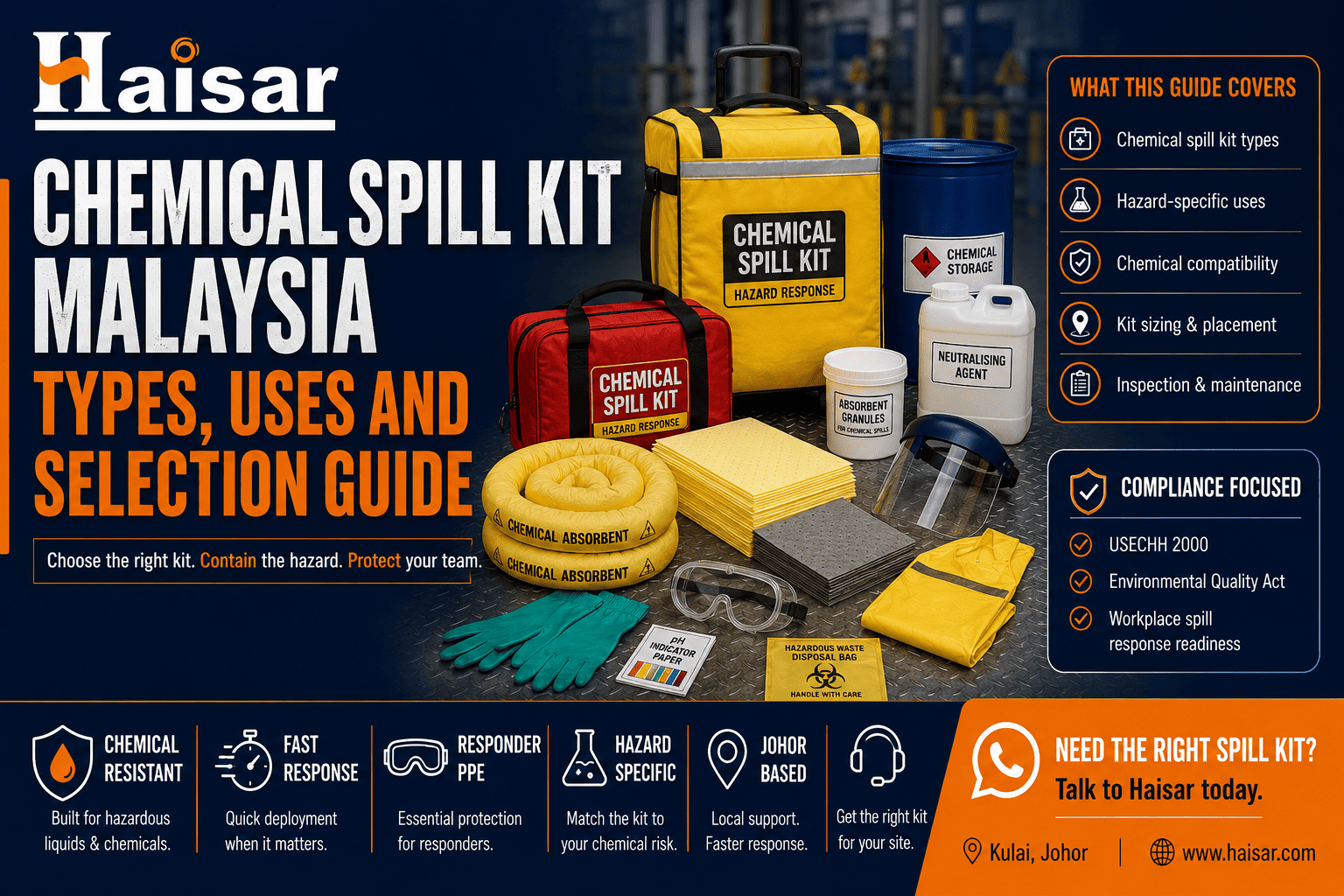
A chemical spill kit is not a generic product. It is a hazard-specific response tool whose effectiveness depends entirely on whether the absorbent materials it contains are the right materials for the specific chemical that has spilled. Use the wrong kit on the wrong chemical and one of two things happens. The absorbent degrades on contact, providing little or no containment. Or it absorbs the chemical while leaving a secondary contamination risk from the absorbed material that is just as hazardous as the original spill.
In Malaysian industrial workplaces, this selection error is more common than it should be. Procurement teams source a generic spill kit, place it in the chemical storage area, and consider the requirement met. DOSH and DOE inspectors think differently. And more importantly, the workers who have to respond to a chemical spill at two in the morning think very differently when the kit they open does not match the chemical in front of them.
This guide focuses specifically on chemical spill kits for hazardous chemical environments, how they differ from general-purpose spill kits, how to select the right kit for specific chemical hazards, and how to build a chemical spill response capability that is compliant with Malaysian regulatory requirements and operationally effective.
Chemical Spill Kits vs General Purpose Spill Kits: The Key Difference
The earlier Haisar spill kit guide covered the three main spill kit types including oil-only, chemical, and universal. This guide goes deeper into the chemical spill kit specifically because chemical spills in Malaysian industrial workplaces present hazards that a general-purpose kit is not designed to address.
The fundamental difference between a chemical spill kit and a general-purpose spill kit is chemical resistance of the absorbent materials.
Standard polypropylene absorbents used in universal and oil-only spill kits are made from synthetic polymers that perform well against water-based and petroleum-based fluids. When these absorbents are exposed to aggressive chemicals including concentrated acids, alkalis, and oxidising agents, the polypropylene fibres degrade. The absorbent may dissolve partially, lose its structural integrity, or react with the chemical in ways that produce heat, fumes, or secondary contamination.
Chemical spill kits use absorbent materials that are specifically manufactured to resist degradation by the chemical hazard categories they are designed to address. The most common chemical-resistant absorbent base materials are polypropylene that has been chemically treated or modified for greater resistance, mineral-based absorbents including natural minerals and synthetic mineral compounds that are inert to most aggressive chemicals, and clay-based granular absorbents for high-viscosity chemical spills and reactive chemical containment.
Beyond absorbent material compatibility, chemical spill kits for Malaysian industrial environments address a second requirement that general-purpose kits do not: the protection of the responder. A person responding to a concentrated hydrochloric acid spill faces a very different personal protection requirement from a person responding to a diesel fuel spill. Chemical spill kits designed for aggressive chemical environments include responder PPE as an integral kit component rather than expecting it to be sourced separately at the time of the incident.
The Regulatory Basis for Chemical Spill Response in Malaysia
USECHH Regulations 2000. The Occupational Safety and Health (Use and Standards of Exposure of Chemicals Hazardous to Health) Regulations 2000 require employers to implement control measures for chemicals hazardous to health that include provisions for spill containment and emergency response. The Chemical Health Risk Assessment (CHRA) for each workplace identifies the chemicals present, assesses the exposure risks, and specifies the controls required. Spill response equipment matched to the chemicals identified in the CHRA is a regulatory requirement, not a discretionary provision.
Environmental Quality Act 1974 (EQA) and Environmental Quality (Scheduled Wastes) Regulations 2005. Chemical spills involving scheduled waste chemicals that reach Malaysian waterways, drains, or soil are offences under the EQA. The Department of Environment (DOE) enforces these requirements and has authority to issue compound fines and prosecution notices for uncontained chemical releases. The key operational implication is that the response to a chemical spill must achieve containment before the spill reaches a floor drain, not after.
OSHA 1994 General Duty. The general duty to provide safe working conditions extends to providing the means for workers to respond safely to chemical spill incidents without themselves being exposed to the chemical hazard.
Hazardous goods storage and handling requirements. Where chemicals are stored in quantities above specified thresholds, the safety requirements for storage include secondary containment and spill response provisions that must be implemented before any chemical is received on site.
The practical compliance requirement from these overlapping frameworks is that every location in a Malaysian industrial workplace where a hazardous chemical could spill must have the appropriate spill response equipment immediately available, correctly specified for the chemicals present, maintained in a ready-to-use condition, and backed by trained personnel who know how to use it.
Chemical Hazard Categories and the Kit Types They Require
Chemical spill kit selection begins with the chemical hazard categories present at the work location. Not all chemical spills are the same and different chemical categories require different kit configurations.
Acids. Inorganic acids including hydrochloric acid, sulphuric acid, nitric acid, and phosphoric acid are among the most common chemicals handled in Malaysian manufacturing, metal processing, battery maintenance, and laboratory environments. They are corrosive to skin, eyes, and respiratory tract. They react with many common materials including metals, producing hydrogen gas, and with alkalis, producing heat and potentially toxic fumes.
For acid spills, the absorbent material must be chemically resistant to the acid and must not react exothermically with it. Clay-based and modified mineral absorbents are appropriate for most acid spill applications. The kit should include a neutralising agent, typically sodium bicarbonate or sodium carbonate, that can be applied after initial containment to neutralise the acid before the absorbed material is collected for disposal as chemical waste. pH indicator paper allows the responder to confirm that neutralisation is complete before handling the absorbed material.
Alkalis. Caustic soda (sodium hydroxide), ammonia solutions, potassium hydroxide, and calcium hydroxide are common alkali hazards in Malaysian food processing, water treatment, cleaning chemical, and chemical manufacturing environments. Alkalis are as corrosive as acids to skin, eyes, and respiratory tissue and are often underestimated by workers who associate the corrosive risk primarily with acids.
Alkali spill kits use similar chemical-resistant absorbents to acid kits but with a different neutralising agent, typically citric acid or a dilute acid solution, for the neutralisation step after containment. The kit configuration for acid and alkali applications is similar enough that a combined acid/alkali chemical spill kit covering both hazard classes is available and appropriate for workplaces handling both.
Organic solvents. Acetone, MEK (methyl ethyl ketone), IPA (isopropyl alcohol), xylene, toluene, and other organic solvents are widely used in Malaysian paint and coatings manufacturing, electronics assembly, laboratory operations, and industrial cleaning. Organic solvent spills present both a chemical exposure hazard and a fire and explosion hazard because most organic solvents are flammable.
For organic solvent spill kits, the absorbent must be non-sparking, the kit must not include materials that could generate static electricity during use, and the response procedure must eliminate ignition sources before approaching the spill. Where the solvent is particularly volatile, the spill response area must be ventilated to prevent vapour accumulation above the lower explosive limit. The kit for solvent spills typically includes activated clay or modified synthetic absorbents, anti-static collection bags, and non-sparking tools for collecting the absorbed material.
Oxidising chemicals. Hydrogen peroxide, sodium hypochlorite (bleach), nitric acid, and other oxidising agents are present in electronics manufacturing, water treatment, food processing, and chemical operations across Johor's industrial base. Oxidising agents react violently with organic materials including standard polypropylene absorbents, combustible materials, and in some cases with each other. Using a standard polypropylene absorbent on an oxidising chemical spill can initiate a fire or explosion.
For oxidising chemical spills, the absorbent must be verified as compatible with the specific oxidising agent involved. Vermiculite and similar inorganic mineral absorbents are appropriate for many oxidising chemical applications because they do not react with oxidising agents. Never use organic-fibre absorbents on oxidising chemical spills.
Toxic and acutely hazardous chemicals. For chemicals with very low exposure thresholds including certain pesticides, chlorinated solvents, heavy metal compounds, and process chemicals with high acute toxicity, the responder protection requirement takes precedence in kit design. Chemical spill kits for acutely hazardous chemicals include supplied air or SCBA capability alongside the absorbent materials, because the vapour or aerosol hazard from the spill may exceed what a cartridge respirator can address safely.
Multiple chemical environments. Many Malaysian industrial facilities handle several different chemical categories simultaneously. A chemical spill kit that addresses all the chemical classes present at the location eliminates the need to identify the correct single-chemical kit during the incident. Multi-hazard chemical spill kits using chemically inert mineral absorbents that are compatible with a broad range of aggressive chemicals provide a practical solution for mixed-chemical environments, provided the responder PPE in the kit covers the full hazard range.
What a Complete Chemical Spill Kit Contains
A well-specified chemical spill kit for Malaysian industrial use contains more than absorbent materials. The kit is a complete first-response package for the chemical incident.
Absorbent pads and pillows. For containment and surface absorption of the spilled liquid. Pads for surface absorption of the pooled liquid. Pillows for deploying in areas where the liquid has spread beneath equipment or into low-lying floor areas. Chemical-resistant construction appropriate for the chemical hazard class.
Absorbent socks and booms. For perimeter containment around the spill to prevent spreading. Deployed in a ring around the spill before the pads are applied to the main body of the liquid. Prevents the spill from reaching floor drains, kerbs, and adjacent areas while the main absorption is underway.
Loose granular absorbent. For high-viscosity liquids that do not absorb readily into pad materials, and for irregular surface spills where pads cannot achieve full contact. Also used as a covering layer over absorbed pads to minimise evaporation from solvent spills.
Neutralising agent. For acid and alkali spills, a neutralising agent appropriate for the specific hazard class. Sodium bicarbonate for acid spills. Citric acid or dilute acid solution for alkali spills. pH indicator paper to confirm neutralisation before handling.
Responder PPE. Chemical resistant gloves matched to the chemical hazard class. Chemical splash goggles or face shield. Chemical resistant disposable coverall or apron. Respiratory protection appropriate for the vapour hazard: P2 respirator for dust and low-vapour hazards, OV cartridge half-face respirator for solvent vapour, or supplied air for acutely hazardous high-vapour scenarios.
Waste disposal bags and ties. UN-rated chemical waste bags in heavy-gauge construction suitable for the chemical waste type. Colour-coded for chemical waste identification in compliance with Malaysian hazardous waste disposal regulations.
Instruction sheet. A step-by-step response procedure for the chemical hazard class the kit addresses. In an emergency, the responder may be unfamiliar with the specific kit. An instruction sheet removes ambiguity about the correct response sequence.
Hazard identification label. Identifying the chemical hazard class the kit is designed for, preventing kit misuse in an emergency when multiple kits for different chemicals may be stored in proximity.
Kit Sizing: Matching Capacity to the Spill Risk
Chemical spill kit capacity is expressed as the total volume of liquid the kit can absorb, typically between 20 and 200 litres for standard kits. Matching the kit capacity to the largest credible spill at the location is the correct approach.
For a workbench handling small quantities of laboratory reagents, a 20-litre kit at the bench addresses routine spill risk. For a drum dispensing area where 200-litre drums of process chemical are tapped and transferred, a 100 to 200-litre kit positioned at the dispensing station is the appropriate minimum. For bulk storage areas with IBC tanks or multiple drum storage, a large-capacity drum kit or wheelie bin kit with 200 litres or greater capacity is required.
The most common capacity error in Malaysian chemical workplaces is a small kit positioned next to large-volume chemical storage. A 20-litre kit cannot address a 200-litre drum failure. It provides the appearance of response capability without the substance.
For facilities with multiple chemical storage locations, the capacity calculation is done separately for each location rather than averaging across the facility. The response to a spill at the chemical store is only as fast as the equipment at that location. A large-capacity kit in a central store 100 metres away is not a response capability for a spill at the dispensing bench.
Placement, Inspection and Maintenance of Chemical Spill Kits
Placement. Chemical spill kits must be positioned at the hazard, not near the hazard. The kit must be immediately reachable by the responder from the spill location without crossing through the spill itself. For chemical handling workstations, this means the kit is within arm's reach of the handling area. For chemical storage rooms, the kit is positioned inside the room or immediately outside the door, not in a general supply store.
Kit locations must be clearly signed. A spill kit location sign visible from the approach to the area allows both regular workers and emergency responders who are unfamiliar with the layout to locate the kit without searching.
Inspection frequency. Chemical spill kits must be inspected regularly to verify that contents are complete, that the absorbent materials are dry and undamaged, that responder PPE items are in usable condition, and that the kit case or container is intact. Monthly inspection is the recommended minimum. For kits in chemical handling areas with frequent spill risk, more frequent inspection may be appropriate.
Replacement after use. A kit that has been partially or fully used in a spill response must be restocked immediately after the response is complete and the waste is disposed of. A depleted or partially used kit at a chemical handling location provides less protection than specified and must not be left in that condition between the incident and the resupply.
Waste disposal after spill response. Chemical waste including spent absorbents, contaminated PPE, and waste disposal bags from a chemical spill response are scheduled waste under Malaysian Environmental Quality (Scheduled Wastes) Regulations. They must be stored in labelled, sealed containers and disposed of through a licensed scheduled waste contractor. Disposing of chemical spill waste in general waste or through the municipal waste stream is an EQA offence.
Chemical Spill Kit Selection by Industry in Johor
Oil and gas and petrochemical facilities (Pasir Gudang). Hydrocarbon spill kits for petroleum product, process chemical, and fuel spills. Chemical spill kits for process chemicals and injection chemicals at PETRONAS contractor facilities. Acid/alkali kits for battery maintenance areas. Anti-static construction for classified hazardous area locations.
Manufacturing and industrial facilities. Chemical spill kits matched to the specific process chemicals used in each production area. Common requirements include acid kits for metal finishing and PCB manufacturing, solvent kits for paint and coatings production, and oxidiser-compatible kits for electronics and pharmaceutical manufacturing.
Construction sites. Acid kits for battery maintenance areas on large sites with significant generator and equipment batteries. Universal kits for fuel and lubricant spills from plant equipment. Chemical kits for concrete admixtures and chemical admixture products used in specialised concrete work.
Data centres. Acid kits for UPS battery rooms where sulphuric acid electrolyte is a spill risk. Coolant spill containment for glycol-based cooling system leaks. Non-sparking kit construction for areas with static-sensitive equipment.
Laboratory and research facilities. Multi-hazard chemical kits covering acids, alkalis, and solvents for general laboratory environments. Specialised kits matched to specific reagent classes for research environments with known and consistent chemical use.
Solar and renewable energy sites. Acid kits for battery energy storage systems associated with solar installations. Universal kits for hydraulic fluid and lubricant spills from equipment during installation.
Haisar Supply and Services: Chemical Spill Kit Supplier in Malaysia
Haisar Supply and Services supplies chemical spill kits for industrial, manufacturing, and project site environments across Johor and peninsular Malaysia. Our chemical spill kit range covers acid and alkali spill kits with neutralising agents and pH indicator paper, solvent and organic chemical spill kits with anti-static construction, multi-hazard chemical kits for mixed-chemical environments, oxidiser-compatible kits using inorganic mineral absorbents, and acutely hazardous chemical response kits including responder PPE.
We supply in kit sizes from 20 litres for workbench and laboratory applications through to 200-litre wheelie bin kits for bulk chemical storage areas. We also supply individual absorbent components and responder PPE for kit restocking after use.
Our team can advise on the correct kit type, absorbent material selection, and capacity for the specific chemicals at your facility. We provide the kit with chemical resistance compatibility information so your HSE team can verify the selection against the CHRA for your workplace.
WhatsApp us now to discuss your chemical spill kit requirements. Our team will respond promptly with product recommendations and pricing for your facility in Johor and across Malaysia.
Browse Chemical Safety and Emergency Response Products at haisar.com
Haisar Supply and Services Sdn Bhd (985158-T) | Kulai, Johor, Malaysia | www.haisar.com
