Can't find what you're looking for? Get in touch!



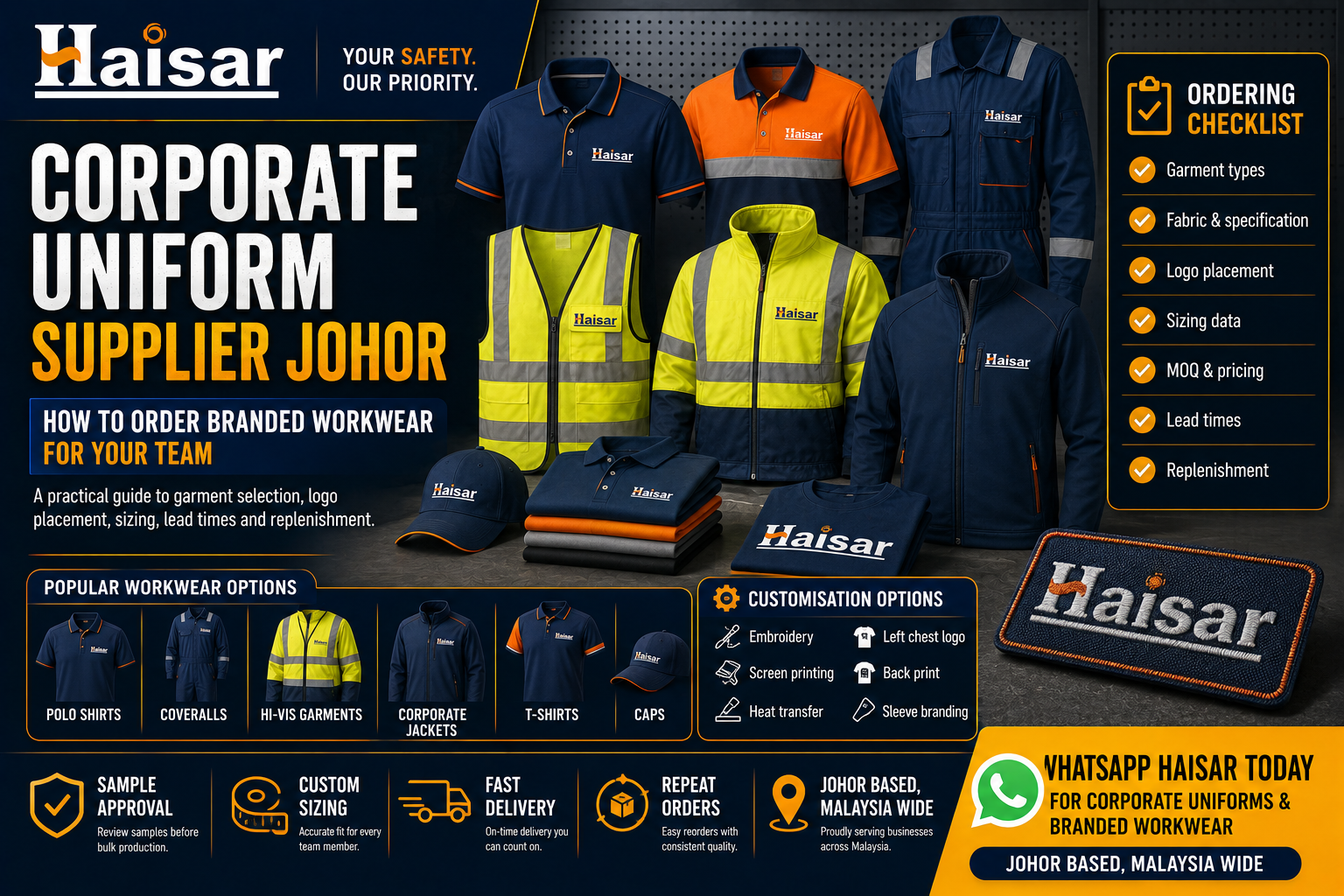
For businesses in Johor, branded workwear is one of the most visible investments you make in your company identity. Every technician who arrives at a client's premises, every supervisor on a construction site, every logistics driver making a delivery, and every front-of-house staff member greeting a customer is wearing your brand on their back. How that brand looks, and how consistently it is presented across your team, shapes the impression your business makes before a word is spoken.
Ordering corporate uniforms and branded workwear in Johor is straightforward when you know exactly what decisions you need to make and in what sequence. Get the sequence right and the result is a clean, professional uniform programme delivered on time and on budget. Get it wrong and you end up with garments in the wrong sizes, logos that do not match your brand, and delivery timelines that do not align with your team's mobilisation date.
This guide walks through the complete ordering process for corporate and branded workwear in Johor, covering garment selection, logo placement, fabric and specification choices, sizing, minimum order quantities, lead times, and what to expect from a quality workwear supplier. Whether you are ordering for ten staff or five hundred workers, the same decisions apply.
Step 1: Define Your Garment Types
The first decision in any corporate uniform order is which garment types you need. Different roles within the same organisation often require different garments, and combining them into a single coherent uniform programme creates a consistent brand appearance across the full team.
Polo shirts are the most versatile garment for corporate uniform programmes in Johor. Appropriate for customer-facing roles, supervisory staff, technical personnel, and management. In Malaysia's climate, a quality polo in moisture-wicking fabric provides a professional appearance with the comfort that extended wear in heat and humidity demands.
Coveralls and boilersuits for technical, maintenance, and industrial roles. Available in standard polycotton for general industrial use, ripstop for construction and outdoor environments, and flame-resistant (FR) fabric for oil and gas and petrochemical applications where flash fire protection is a site requirement.
Corporate T-shirts for events, casual environments, and team identification on project sites. Dry-fit and cotton-blend options for Malaysian climate conditions.
Hi-vis vests and jackets for teams working on construction sites, logistics operations, and any environment requiring MS ISO 20471 compliant visibility. Custom branding on hi-vis garments must be positioned and produced in a way that maintains the compliant reflective tape configuration and fluorescent material area requirements.
Jackets and outerwear for supervisory and management personnel in air-conditioned environments or outdoor work during cooler periods. Softshell and lightweight bomber jacket styles are popular for Johor's corporate uniform programmes.
For most organisations in Johor, the practical approach is to define one primary garment type for each staff category, with a consistent colour and branding specification across all types, rather than trying to accommodate individual preferences.
Step 2: Choose Your Fabric and Specification
Fabric selection determines how the garment looks, how long it lasts, and how comfortable it is to wear across a full shift in Malaysian conditions. The most common fabric choices for corporate workwear in Johor are as follows.
Polycotton (65/35 polyester/cotton blend) is the standard fabric for industrial coveralls and workwear across Johor's project and facility sectors. It is durable, relatively wrinkle-resistant, and holds colour well through repeated industrial laundering. The 65/35 blend is the balance point between the durability of polyester and the breathability and comfort of cotton.
100% polyester moisture-wicking fabric for polo shirts and active wear in Johor's tropical climate. Moisture-wicking construction draws sweat away from the skin and accelerates evaporation, keeping the wearer cooler and the garment drier during physical activity. Important for outdoor teams and roles with high physical demand.
Ripstop fabric for coveralls and workwear in high-abrasion environments. The reinforced weave prevents small tears from propagating, extending the service life of garments used in construction, fabrication, and outdoor project environments.
Flame-resistant (FR) fabric for oil and gas and petrochemical environments where flash fire risk is present. FR garments must be manufactured from inherently FR fabric, not fabric that has been chemically treated, because treatment-based FR performance degrades with washing. The calorie rating of the FR garment must match the flash fire hazard level at the specific facility.
For corporate uniform programmes that combine both office and field roles, specifying a consistent colour in different fabric weights for different roles, such as a moisture-wicking polo for office staff and a polycotton polo for site workers in the same colour and with the same logo, maintains visual consistency while matching the garment to the physical demands of each role.
Step 3: Decide on Logo Placement and Customisation
Logo placement and the customisation method used are the elements of corporate workwear that most directly reflect the quality of the finished product. Embroidery is the premium standard for branded workwear and the method Haisar recommends for most corporate uniform applications.
Embroidery stitches the logo directly into the fabric using coloured thread. It is durable, professional in appearance, and resistant to washing, heat, and abrasion. An embroidered logo on a quality garment will outlast the garment itself. Embroidery requires a one-time digitisation process that converts the logo artwork into an embroidery programme, after which the same file is used for all subsequent production runs.
Screen printing is appropriate for large graphic applications, particularly back prints on T-shirts and event garments. Good quality screen printing maintains colour accuracy and wash durability but is less permanent than embroidery for garments that are washed frequently.
Heat transfer printing allows photographic-quality image reproduction and is suitable for complex multi-colour logos. Modern heat-transfer materials maintain adhesion through repeated industrial laundering when correctly applied.
Standard logo placement positions:
- Left chest: Primary logo position for polos, T-shirts, coveralls, and jackets. The standard placement visible in all face-to-face interactions.
- Right chest: Secondary position for employee name, job title, or department identification.
- Left sleeve: Badge or project identification. Common on site coveralls and project uniforms.
- Back: Larger company name, website, or project identification. Standard for T-shirts and hi-vis garments.
- Cap or helmet brim: For branded headwear or hard hat branding using high-quality vinyl stickers.
Request a physical embroidered sample before approving full production. A digital proof confirms colour and layout. Only a physical sample confirms thread colour accuracy, stitch density, and the actual appearance of the logo on the specific fabric.
Step 4: Collect Sizing Data
Sizing is the element of corporate uniform procurement that generates the most post-delivery problems when it is not handled correctly. A sizing error on a large order means garments that cannot be worn, exchange logistics that consume time and cost, and delays in equipping the team.
For garments including coveralls, polo shirts, and jackets, collect individual measurements or size preferences from each team member before placing the order. Do not rely on a general size distribution estimate unless the workforce is not yet confirmed. The time saved by not collecting individual sizes is rarely worth the exchange process it generates.
Where the workforce is large and collecting individual measurements is not practical, a sizing session using sample garments from the supplier allows team members to try before the order is placed. Haisar can arrange sample garments for sizing sessions for larger uniform programme orders.
For a mixed Malaysian workforce, the size distribution typically skews toward medium and large, with smaller proportions at XS, XL, and XXL. However, individual project teams and workforce demographics vary significantly from this average and statistical assumptions should not replace individual data where it can be collected.
Include a provision for sizes outside the standard range in your order. Tall, petite, and extended size requirements are common across diverse workforces and leaving them unaddressed until after delivery creates problems at the point when the team needs to be equipped.
Step 5: Understand Minimum Order Quantities and Pricing
Corporate workwear pricing in Johor reflects three cost components: the garment itself, the one-time digitisation or artwork setup fee for the logo, and the per-garment customisation charge for embroidery, printing, or heat transfer.
Minimum order quantities (MOQ) for embroidered garments in Johor are typically twelve to twenty-four pieces for standard garments. Below the MOQ, the per-unit setup cost increases significantly because the digitisation and machine setup cost is spread across fewer pieces. Haisar works with small business orders below standard MOQ with adjusted pricing that reflects the smaller run.
Digitisation cost is a one-time charge for converting your logo artwork into an embroidery programme. Once digitised, the same file is used for all subsequent orders at no additional digitisation cost. This means the unit economics of a repeat order are more favourable than the initial order.
Volume pricing applies for larger orders. The per-unit embroidery charge reduces as order quantity increases. For organisations with ongoing uniform programmes, negotiating a programme rate that reflects full-year volume produces better unit economics than pricing each replenishment order individually.
Provide your logo in vector format (AI, EPS, or SVG) where possible. A high-resolution vector file allows accurate digitisation and ensures the logo can be scaled to different placement sizes without quality loss. Raster images (JPG or PNG) can be digitised but may require manual artwork reconstruction if the resolution is insufficient.
Step 6: Confirm Lead Times Before Placing Your Order
Lead time is the most common source of frustration in corporate workwear procurement because it is the variable most frequently underestimated at the planning stage. Branded workwear cannot be produced as fast as off-the-shelf items.
Standard embroidered polo shirts and T-shirts: two to three weeks from order confirmation and sample approval for standard in-stock garments with embroidered logo.
Custom colour garments and coveralls: three to four weeks from order confirmation, depending on garment availability in the specific colour and fabric specification.
FR fabric coveralls with embroidery: four to six weeks. FR fabric is a specialised material with longer sourcing lead times and the embroidery process must be confirmed as compatible with the FR specification of the garment.
Hi-vis garments with compliant branding: two to four weeks. Branding on hi-vis garments requires placement confirmation against the MS ISO 20471 reflective tape configuration to ensure the finished garment remains compliant.
Plan your order date by working backwards from the date you need the garments on hand. If your team mobilises on a specific date, the garments must be delivered and distributed before that date, not ordered on that date. For project mobilisations with firm start dates, place workwear orders a minimum of four to six weeks ahead for standard garments and six to eight weeks ahead for FR or custom-specification garments.
Step 7: Plan for Ongoing Replenishment
A corporate uniform programme is not a one-time purchase. Staff turnover, new joiners, garment wear and replacement, and expanding teams all generate ongoing replenishment requirements throughout the programme's life. Building replenishment planning into the programme from the start avoids the reactive scramble to equip new staff who are starting on short notice.
Haisar maintains the digitised logo file and order record from the initial programme order for all ongoing clients. Replenishment orders are processed against the established specification without re-digitising, re-sampling, or re-establishing the sizing and specification requirements. For high-turnover workforces, we can manage a standing stock arrangement where a buffer of the most common sizes is maintained for rapid issue to new joiners.
When placing your initial uniform order, communicate to your supplier that this is a programme order requiring ongoing replenishment, not a one-time purchase. This allows the supplier to structure the order in a way that facilitates replenishment, including maintaining the digitisation file, confirming the fabric and specification for consistent matching across repeat orders, and advising on the garment's likely continued availability from the manufacturer.
Why Choose Haisar as Your Corporate Uniform Supplier in Johor
Haisar Supply and Services Sdn Bhd, based in Kulai, Johor, supplies corporate uniforms, branded workwear, and customised garments for businesses across Johor and peninsular Malaysia. We serve SMEs ordering ten to thirty pieces for their first uniform programme and industrial operators ordering hundreds of branded coveralls and FR garments for project mobilisations and planned shutdowns.
Our corporate workwear supply covers:
- Polo shirts, T-shirts, corporate jackets, and outerwear in company colours with embroidered or printed logo
- Industrial coveralls in polycotton, ripstop, and FR fabric with company branding
- MS ISO 20471 compliant hi-vis vests and jackets with custom branding
- Custom colour and size specifications for large uniform programmes
- One-time logo digitisation with file retention for ongoing replenishment
- Physical sample approval before full production
- Sizing sessions for large workforce orders
- Delivery across Johor and peninsular Malaysia with transparent lead times
We give you a realistic lead time at the quotation stage and we meet it. We produce a sample for approval before full production. We retain your logo file and order specification for replenishment. And we respond promptly when you need to add new joiners or replace worn garments mid-programme.
WhatsApp Haisar to Start Your Corporate Uniform Order
Whether you are placing your first corporate uniform order for a new business in Johor, refreshing your existing workwear programme, or equipping a project workforce with branded safety garments, our team is ready to help.
WhatsApp us now for a fast response. Share your logo, tell us your garment type and quantity, and we will come back to you with options, a sample approval process, and a realistic delivery commitment.
Visit us at: www.haisar.com | Haisar Supply and Services Sdn Bhd (985158-T) | Kulai, Johor, Malaysia
