Can't find what you're looking for? Get in touch!



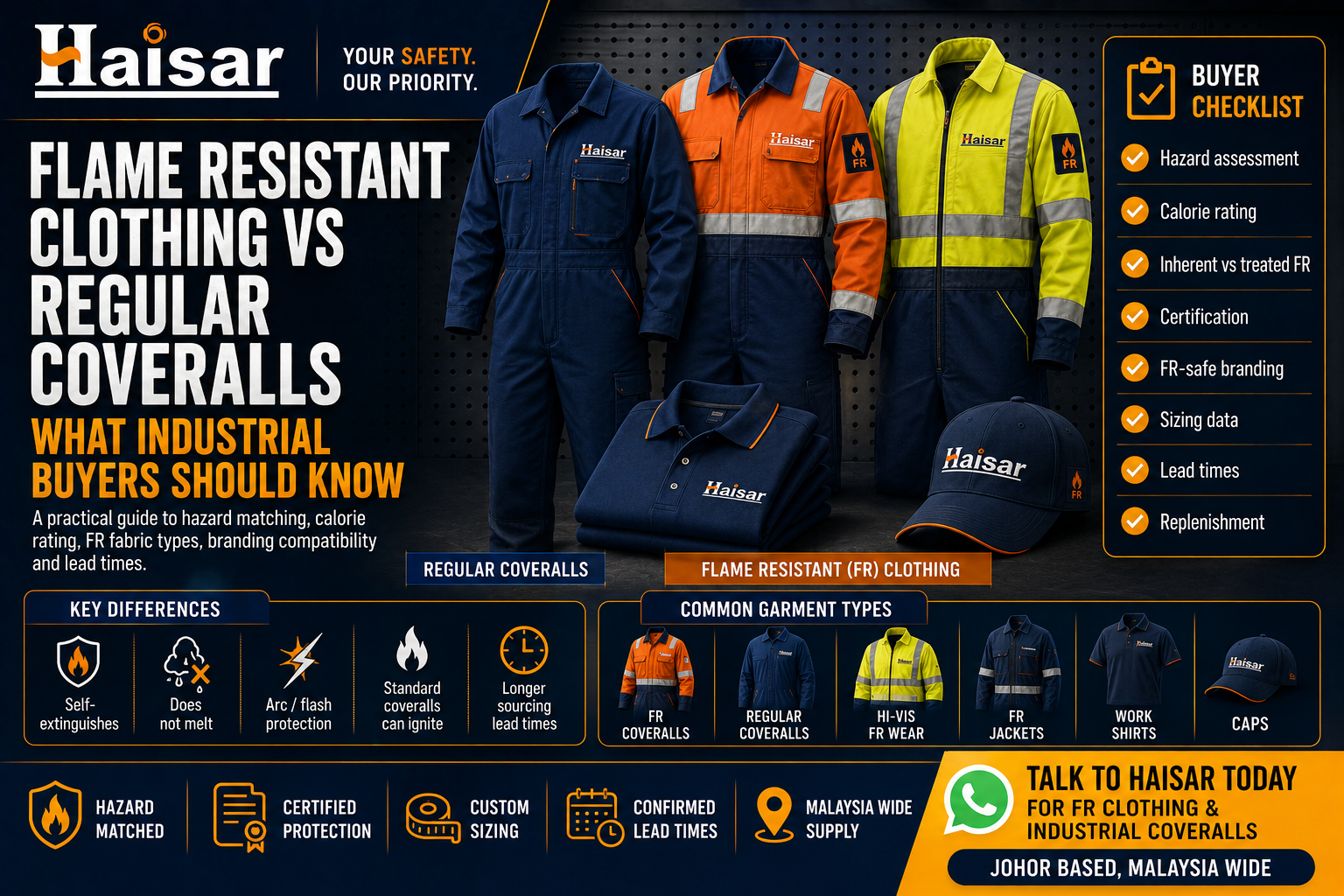
If your team works near flash fire, arc flash, or open flame hazards, the coveralls they wear are not a uniform decision. They are a protective equipment decision, and getting it wrong has consequences that go well beyond appearance. Regular polycotton or ripstop coveralls look similar to flame resistant (FR) garments on a rack, and on a casual inspection it can be difficult to tell them apart. The difference only becomes obvious in the moment it matters most: when the garment is exposed to fire.
For procurement teams and HSE managers in oil and gas, electrical work, welding, and plant maintenance across Malaysia, understanding exactly what separates FR clothing from regular workwear is essential before placing an order. This guide explains how FR fabric works, why regular coveralls fail in a flash fire, which roles genuinely require FR protection, and what to check before you buy.
What Makes a Garment Flame Resistant
Flame resistant clothing is made from fabric that either will not ignite when exposed to flame, or self-extinguishes immediately once the ignition source is removed. Critically, FR fabric does not continue to burn, melt, or drip onto the skin after exposure. This single property is what separates genuine FR protection from a garment that simply looks heavy-duty.
Inherent FR fabric is engineered at the fibre level, so the flame resistant property is built into the molecular structure of the fibre itself. Inherent FR fabric does not lose its protective performance over the life of the garment, regardless of how many times it is washed or how long it is worn.
Treated FR fabric starts as a standard fibre, typically cotton, which is then chemically treated to achieve flame resistance. Treated FR fabric can provide adequate protection when new, but the chemical treatment degrades with repeated industrial laundering, and protection can fall below the required standard well before the garment looks worn out.
For sites with an ongoing flash fire or arc flash hazard, this distinction matters more than almost any other specification on the order. A garment that has visually deteriorated is obviously due for replacement. A treated FR garment that has lost its chemical protection while still looking serviceable is a hazard that is invisible until tested.
Why Regular Coveralls Fail in a Flash Fire
Standard polycotton and ripstop coveralls are built for abrasion resistance, durability, and comfort. They are not built to resist ignition, and in a flash fire event they behave in ways that actively worsen the outcome for the wearer.
- Polyester content in standard fabric melts when exposed to flame and can fuse to the skin, turning the garment itself into a secondary injury source.
- Cotton content in untreated standard fabric ignites and continues burning after the original flame source is gone, extending the exposure time well beyond the initial flash.
- Standard coveralls offer no calorie rating, meaning there is no measured threshold of thermal energy the garment is rated to withstand before failure.
This is the core reason FR clothing exists as a separate category rather than simply being a more durable version of standard workwear. The failure mode of regular fabric in fire is the opposite of what protective clothing is meant to do: it adds to the injury instead of limiting it.
Who Actually Needs FR Clothing
Not every industrial role requires FR protection, and over-specifying FR garments for roles without a genuine flash fire or arc flash hazard adds unnecessary cost without a corresponding safety benefit. The roles where FR clothing is a genuine requirement, not a precaution, include the following.
Oil and gas operations across upstream, midstream, and downstream facilities where flammable hydrocarbons are present. Process areas, tank farms, and any zone with a flash fire risk assessment in place require FR coveralls as standard PPE.
Electrical work involving arc flash exposure, including switchgear operation, panel work, and live or potentially live electrical maintenance. Arc flash incidents generate intense, instantaneous thermal energy, and the FR garment's calorie rating must match the arc flash hazard category established for the specific task.
Welding and hot work where sparks, spatter, and radiant heat are a constant exposure during the task itself, not only in the event of an unplanned incident. FR coveralls for welding roles are worn as routine task protection.
Plant maintenance teams working in or near process areas, confined spaces with flammable atmospheres, or facilities undergoing turnaround and shutdown work, where the hazard profile of the area governs the PPE requirement rather than the specific task being performed.
For mixed workforces where some roles are exposed to flash fire or arc flash hazards and others are not, the practical approach is to map FR requirements to defined work zones and task types, rather than issuing FR garments uniformly across the entire team or, conversely, leaving the determination to individual discretion.
Calorie Rating and Matching FR Garments to Hazard Level
FR garments are rated by their arc rating or thermal protective performance, expressed as a calorie per square centimetre value. This number indicates the amount of thermal energy the garment can withstand before the risk of second-degree burn reaches the defined threshold. A higher calorie rating means greater protection, but also typically means a heavier, less breathable garment.
The correct calorie rating for a given role is determined by a flash fire or arc flash hazard assessment specific to the facility and task, not by a general industry assumption. A garment rated for a lower hazard category than the actual exposure provides a false sense of protection. A garment rated significantly higher than necessary adds heat stress and reduces wearer comfort without a safety benefit. Before placing an FR order, confirm the calorie rating required for each role with the facility's HSE documentation, and specify garments against that figure rather than a default.
Comparing FR Clothing and Regular Coveralls
The two garment categories diverge across several dimensions beyond fabric composition alone.
Fabric behaviour in fire: FR fabric self-extinguishes and does not melt onto the skin. Regular fabric continues burning or melts and adheres to the skin, extending injury.
Standards and certification: genuine FR garments are manufactured and tested against recognised flame resistance standards with a documented calorie rating. Regular coveralls carry no such rating because they are not designed against a flame hazard.
Cost: FR fabric and garment construction cost meaningfully more than standard polycotton or ripstop coveralls, reflecting the specialised fibre and testing involved.
Lifespan and laundering: inherent FR garments maintain protection for the working life of the garment. Treated FR garments require monitored laundering and a defined replacement schedule because chemical treatment degrades. Regular coveralls have no flame-related lifespan consideration at all.
Branding compatibility: company branding can be applied to FR garments, but the embroidery thread and any printed or transferred materials used must themselves be flame resistant and compatible with the FR fabric, which is not a consideration on standard workwear.
What to Check Before You Order FR Coveralls
A flash fire or arc flash hazard assessment confirming the required calorie rating for each role on site should sit at the centre of any FR procurement decision. Beyond that, the following checks protect against ordering garments that look correct but do not perform.
- Confirm whether inherent or treated FR fabric is specified, and if treated, confirm the laundering and replacement protocol that maintains protection over the garment's life.
- Request documentation showing the garment's calorie rating and the standard it is certified against, not just a manufacturer's general claim of FR performance.
- Confirm that any embroidery, printing, or branding material applied to the garment is itself flame resistant and will not compromise the FR performance of the base fabric.
- Check sizing across the full workforce before ordering, since exchanges on FR garments take longer to process than standard workwear due to the more limited fabric stock held by suppliers.
- Build lead time into your order date. FR fabric is a specialised material with longer sourcing lead times than standard polycotton or ripstop, typically four to six weeks from order confirmation, and longer for large or custom-colour orders.
Why Choose Haisar for FR Clothing and Industrial Coveralls in Malaysia
Haisar Supply and Services Sdn Bhd, based in Kulai, Johor, supplies flame resistant clothing, industrial coveralls, and customised workwear for oil and gas, electrical, welding, and plant maintenance teams across Malaysia.
Our FR and industrial workwear supply covers:
- FR coveralls in inherent and treated fabric, specified against the calorie rating required for your facility's hazard category
- Standard polycotton and ripstop coveralls for industrial roles outside flash fire or arc flash zones
- FR-compatible embroidery and branding that does not compromise the flame resistance of the garment
- Sizing support across large industrial workforces and project mobilisations
- Realistic, confirmed lead times for FR fabric sourcing, communicated at the quotation stage
- Delivery across Johor and peninsular Malaysia for planned shutdowns, turnarounds, and project starts
We help you specify the right garment for the actual hazard your team faces, rather than defaulting to the most expensive option or under-specifying to save cost. Where FR protection is required, we confirm the calorie rating against your hazard assessment before production. Where it is not, we recommend standard coveralls suited to the work.
Get a Quote for FR Clothing or Industrial Coveralls
If your team works in oil and gas, electrical maintenance, welding, or plant operations anywhere in Malaysia, talk to us before your next coverall order. We will help you confirm whether FR protection is required for each role, match the garment to the correct calorie rating, and give you a realistic lead time and quotation.
Get a quote today. Share your industry, the roles you need to equip, and your project timeline, and we will respond with garment options, certification details, and a delivery commitment you can plan around.
Visit us at: www.haisar.com | Haisar Supply and Services Sdn Bhd (985158-T) | Kulai, Johor, Malaysia
