Can't find what you're looking for? Get in touch!



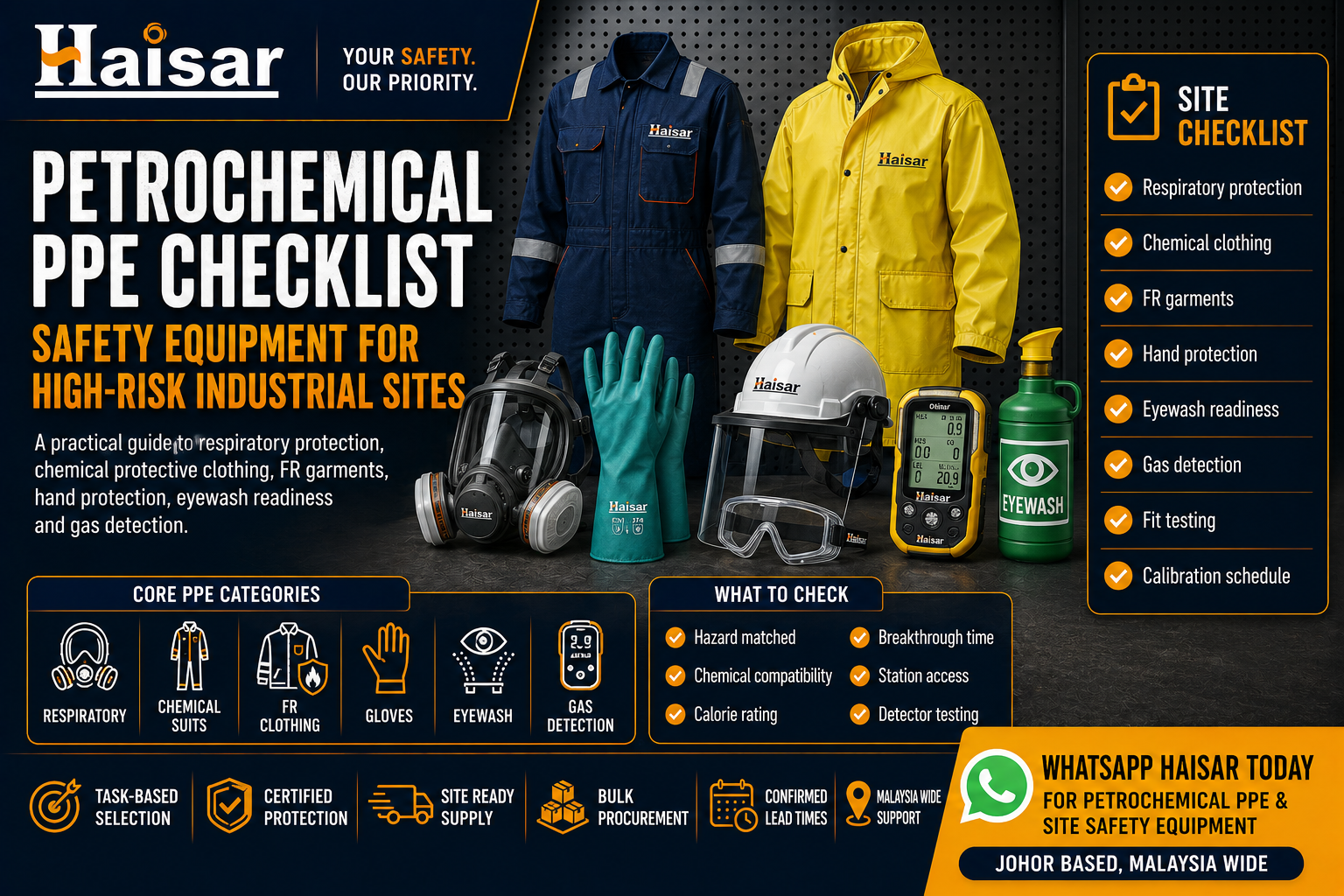
Petrochemical sites carry a hazard profile that most other industrial environments do not: flammable and toxic process streams, high-pressure systems, corrosive chemicals, and atmospheres that can become immediately dangerous to life with little warning. The personal protective equipment programme on a site like this is not a generic safety checklist borrowed from a standard factory. It is a set of equipment decisions built specifically around flash fire, chemical exposure, and atmospheric risk.
This guide sets out the core categories of PPE that a petrochemical, refinery, or chemical processing site needs to have in place, what to check before issuing each category of equipment, and a consolidated checklist your HSE and procurement teams can use when auditing current PPE provision or planning a new equipment order. It covers respiratory protection, chemical protective clothing, flame resistant garments, hand protection, eyewash and emergency equipment, and gas detection.
Why Petrochemical Sites Need a Different PPE Standard
Standard industrial PPE is built around mechanical hazards: cuts, impacts, falling objects, and general abrasion. Petrochemical PPE has to address those same mechanical hazards while also addressing flash fire, toxic and corrosive chemical exposure, and oxygen-deficient or flammable atmospheres, often in combination on the same task.
This compounding of hazards is what makes petrochemical PPE selection a specialist exercise rather than a standard purchasing decision. A glove rated for chemical resistance may not be rated for the specific chemical present on site. A coverall rated for flash fire may not provide chemical splash protection. Each category of equipment has to be selected against the actual hazard present at the specific task, not against a general assumption of what petrochemical work requires.
1. Respiratory Protection
Respiratory hazards on petrochemical sites range from routine nuisance dust and vapour exposure to immediately dangerous to life or health (IDLH) atmospheres during upset conditions, confined space entry, or process releases. The respiratory protection programme has to match the equipment to the actual exposure level, not default to a single solution across the entire site.
Filtering facepiece respirators (FFP) for low-level nuisance dust and particulate exposure in general site areas away from active process hazards. Not appropriate for vapour, gas, or oxygen-deficient atmospheres.
Half-face and full-face respirators with chemical cartridges for tasks with known, moderate vapour or gas exposure where the specific contaminant and concentration are understood and the cartridge is rated for that contaminant. Full-face respirators add eye protection against splash and vapour irritation.
Supplied-air respirators (SAR) for tasks in confined spaces, IDLH atmospheres, or any environment where the oxygen level or contaminant concentration is unknown or exceeds the protection factor of a cartridge respirator. Supplied air is mandatory wherever oxygen deficiency is a possibility, since cartridge respirators provide no protection against low oxygen.
Self-contained breathing apparatus (SCBA) for emergency response, firefighting, and rescue scenarios on site where mobility with an independent air supply is required and connection to a fixed air line is not practical.
Respirator selection has to be supported by a documented exposure assessment for each task, and fit testing has to be carried out for any tight-fitting respirator before it is issued to a worker. A respirator that has not been fit tested to the individual wearer cannot be relied upon to provide its rated protection factor, regardless of the equipment specification.
2. Chemical Protective Clothing
Chemical protective clothing protects against splash, spray, immersion, and vapour exposure to corrosive and hazardous chemicals. Selection depends on the specific chemical, the exposure type, and the duration of exposure expected during the task.
Type 3 and Type 4 chemical suits provide liquid-tight and spray-tight protection respectively, for tasks involving direct contact with corrosive liquids or pressurised chemical spray.
Type 5 and Type 6 chemical suits provide protection against airborne solid particulates and light liquid splash, appropriate for lower-exposure tasks such as general process area work where direct chemical contact is not expected but incidental exposure is possible.
Acid and caustic resistant aprons and sleeves for tasks involving direct handling of corrosive chemicals in fixed locations such as laboratory work, sampling points, and chemical transfer operations.
Chemical compatibility charts published by the suit manufacturer should be checked against the specific chemicals present at the facility before any chemical protective clothing is selected. A suit rated as chemical resistant in general terms may have a very short breakthrough time against a specific solvent or acid used on site, and breakthrough time, not just resistance, determines whether the garment is appropriate for the task duration.
3. Flame Resistant (FR) Clothing
Flash fire and arc flash hazards are present across most petrochemical process areas, and FR clothing is standard PPE for personnel working in or entering these zones. FR garments are made from fabric that self-extinguishes and does not melt onto the skin when exposed to flame, unlike standard polycotton or ripstop workwear.
Inherent FR fabric holds its flame resistant property for the working life of the garment regardless of laundering, making it the more reliable choice for long-term, high-frequency use.
Treated FR fabric achieves flame resistance through a chemical treatment applied to standard fibre, which can degrade with repeated industrial laundering and requires a managed inspection and replacement schedule.
Calorie rating is the measure of thermal energy an FR garment can withstand and must be matched to the flash fire or arc flash hazard category documented for the specific work area or task, not selected by default.
FR coveralls should be the base layer for any worker entering a designated flash fire zone, with additional chemical protective layers added on top where chemical exposure is also present at the same task. Where both hazards exist simultaneously, the combination of FR and chemical protective layers needs to be confirmed as compatible, since not every chemical suit is rated for use over FR fabric.
4. Hand Protection
Glove selection on petrochemical sites has to address chemical resistance, cut and abrasion resistance, and in some cases thermal protection, depending on the task. A single glove type rarely covers every hazard a worker encounters across a shift, and most petrochemical sites maintain several glove categories for different tasks.
Nitrile and neoprene chemical-resistant gloves for tasks involving direct handling of hydrocarbons, solvents, and many common process chemicals. Glove thickness and chemical compatibility should be checked against the specific substances handled.
Cut-resistant gloves for mechanical tasks involving sharp edges, metal fabrication, and general maintenance work where chemical exposure is not the primary hazard.
Heat and flame resistant gloves for tasks involving hot surfaces, steam systems, or proximity to flame, often used in combination with FR clothing for full-body protection during hot work.
Glove breakthrough time against the specific chemical in use should govern how frequently gloves are changed during a task, particularly for tasks involving prolonged or repeated contact with solvents and corrosive substances.
5. Eyewash and Emergency Equipment
Eyewash stations and emergency showers are required wherever workers handle corrosive or hazardous chemicals, and their placement, accessibility, and maintenance status directly affect the outcome of a chemical exposure incident. Equipment that is correctly specified but poorly located or out of service provides no real protection.
- Eyewash stations should be located within ten seconds' unobstructed walking distance of any task involving corrosive chemical handling, in line with recognised emergency equipment placement standards.
- Combination eyewash and emergency shower units are appropriate wherever full-body chemical exposure is a credible risk, not only facial or eye splash.
- Stations require regular flow testing and visible inspection tagging to confirm they are operational, since water supply issues and obstruction are common causes of eyewash station failure during an actual incident.
- Portable eyewash bottles supplement fixed stations for mobile and field tasks performed away from fixed station locations, but are not a substitute for fixed stations at primary chemical handling points.
6. Gas Detection
Gas detection is the category of PPE that gives workers and supervisors advance warning of an atmospheric hazard before exposure occurs, making it a critical layer of protection that operates alongside, rather than instead of, the personal protective equipment a worker is wearing.
Personal single-gas and multi-gas detectors worn by individual workers, providing continuous monitoring for oxygen level, flammable gas concentration, and common toxic gases such as hydrogen sulphide and carbon monoxide relevant to the specific process.
Area and fixed gas detection systems installed at process units and confined space entry points, providing facility-level monitoring and triggering alarms or shutdown systems independent of personal detectors.
Calibration and bump testing on a defined schedule for every personal and portable gas detector, since a detector that has drifted out of calibration provides a false sense of safety that is more dangerous than having no detector at all.
Gas detection equipment should be selected against the specific gases present at the facility, not a generic multi-gas configuration. A detector configured for the wrong gas profile will not alarm on the hazard actually present, regardless of how well-maintained the unit is.
Petrochemical PPE Checklist
Use this checklist to audit current PPE provision or to plan a new equipment order across a petrochemical or chemical processing site.
- Respiratory protection matched to a documented exposure assessment for each task, not a single default respirator across the site
- Fit testing completed and recorded for every worker issued a tight-fitting respirator
- Supplied-air respirators or SCBA available and assigned for confined space entry and IDLH atmosphere tasks
- Chemical protective clothing selected against manufacturer breakthrough time data for the specific chemicals on site
- FR clothing issued as base layer PPE for all personnel entering designated flash fire or arc flash zones
- FR garment calorie rating matched to the documented hazard category for each work area
- Inspection and replacement schedule in place for treated FR garments to track degradation from laundering
- Glove inventory covers chemical resistance, cut resistance, and heat resistance categories relevant to site tasks
- Glove change-out frequency set against chemical breakthrough time, not a general assumption
- Eyewash stations and emergency showers located within ten seconds of all corrosive chemical handling points
- Eyewash and shower stations on a current flow-testing and inspection tagging schedule
- Personal gas detectors configured for the specific gases present at the facility and assigned to relevant roles
- Gas detector calibration and bump testing carried out on a defined, recorded schedule
- PPE combinations, such as chemical suits worn over FR clothing, confirmed compatible for tasks where multiple hazards are present simultaneously
Why Choose Haisar for Petrochemical PPE in Malaysia
Haisar Supply and Services Sdn Bhd, based in Kulai, Johor, supplies PPE and protective workwear for oil and gas, petrochemical, and chemical processing sites across Malaysia, including FR clothing, chemical protective garments, and industrial coveralls specified against documented site hazard assessments.
Our petrochemical PPE supply covers:
- FR coveralls in inherent and treated fabric, matched to your facility's calorie rating requirements
- Chemical protective clothing selected against the specific substances handled on your site
- Hand protection across chemical-resistant, cut-resistant, and heat-resistant glove categories
- Custom branding compatible with FR and chemical protective fabric where required
- Sizing support and bulk procurement for project mobilisations, turnarounds, and planned shutdowns
- Realistic, confirmed lead times for specialised FR and chemical protective fabric sourcing
We work directly from your site's hazard assessment to recommend the correct PPE category and specification for each role, rather than supplying a generic petrochemical PPE package that may over- or under-protect specific tasks.
Download the Full Petrochemical PPE Checklist
Use the checklist above as a starting point for your next PPE audit or procurement cycle. For a printable, site-ready version you can circulate to your HSE and procurement teams, download the full checklist or get in touch with our team to discuss your facility's specific PPE requirements.
Download the checklist or send us your site's hazard assessment, and we will recommend the right respiratory, chemical, FR, hand protection, and gas detection equipment for your team, with a realistic quotation and delivery timeline.
Visit us at: www.haisar.com | Haisar Supply and Services Sdn Bhd (985158-T) | Kulai, Johor, Malaysia
