Can't find what you're looking for? Get in touch!



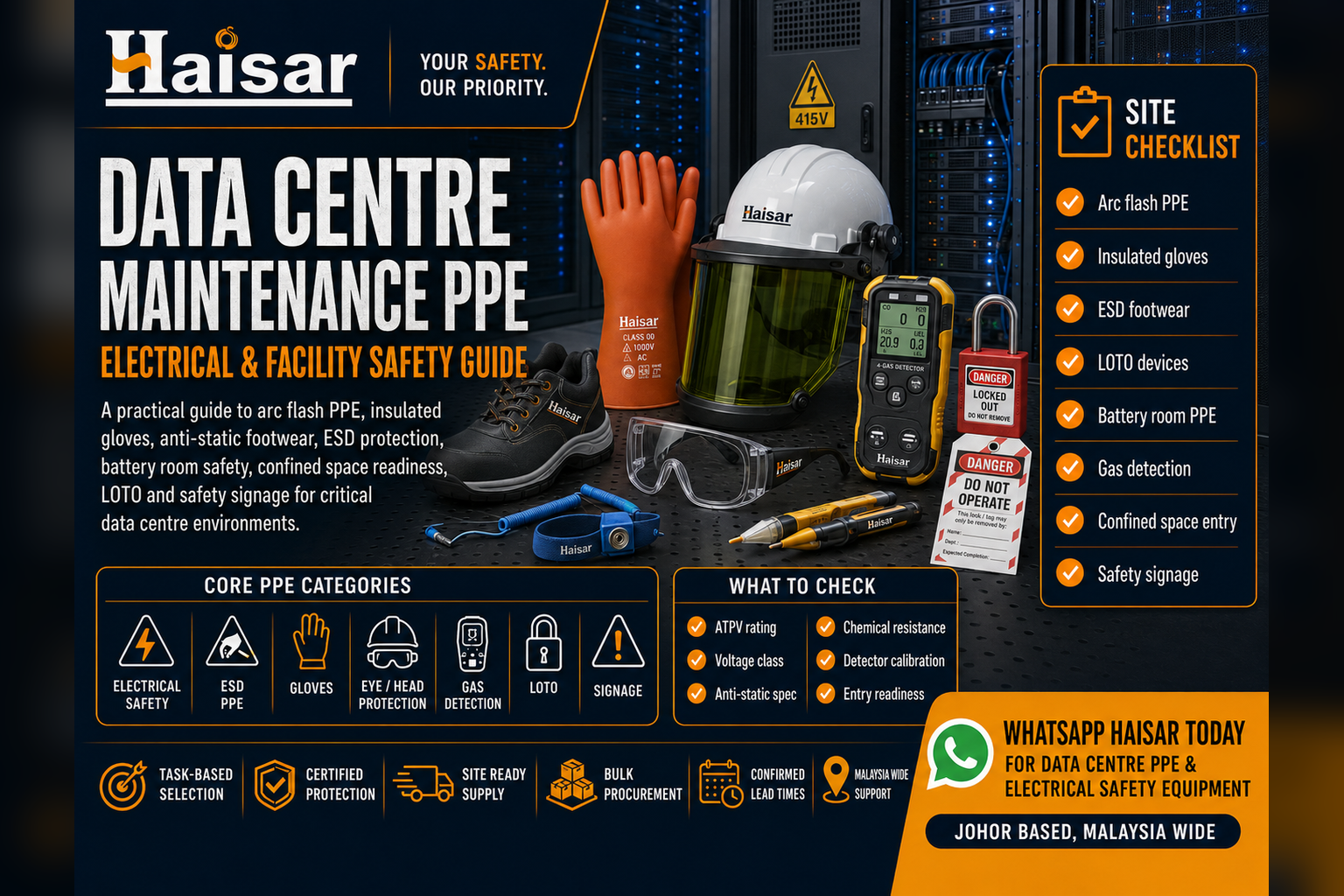
Malaysia's data centre sector is one of the fastest-growing in Southeast Asia. The hyperscale facilities being commissioned across Iskandar Puteri, Nusajaya, and Greater Johor Bahru are among the largest in the region, attracting global cloud and colocation operators who bring with them safety standards that exceed the Malaysian regulatory baseline. Behind the commissioning and operational headlines is a growing population of facility engineers, electrical maintenance technicians, mechanical and electrical contractors, and facilities management teams who work in these buildings every day.
Data centre maintenance is not like maintenance in a conventional commercial building. The electrical infrastructure density, the criticality of uptime, the mixture of high-voltage supply systems and sensitive low-voltage equipment, and the specific hazards of UPS battery rooms, mechanical plant areas, and above-ceiling cable management environments all create a PPE requirement that differs from both standard construction and standard industrial maintenance.
This guide covers the complete PPE and safety equipment specification for data centre maintenance operations in Malaysia, from the electrical safety equipment required for high-density power infrastructure through to the anti-static footwear and ESD gloves needed in live data halls, the confined space provisions for underfloor and ceiling void access, and the signage that keeps personnel safe in a complex multi-hazard environment.
The Data Centre Hazard Environment in Malaysia
Understanding why data centre maintenance requires specific PPE specification begins with the hazard profile of the environment. Several hazard categories in a data centre are significantly more severe or more specific than those encountered in typical commercial or light industrial maintenance.
High-density electrical infrastructure. Data centres concentrate electrical systems that in other building types would be spread across much larger floor areas. Main switchboards, UPS systems, power distribution units (PDUs), and bus bar systems all operate in close proximity. The fault current levels at main switchgear in a hyperscale data centre can be extremely high, producing arc flash incident energy values that significantly exceed those encountered in conventional commercial buildings. Electrical maintenance in this environment requires arc flash PPE specified against a site-specific arc flash risk assessment, not against a generic assumption.
Continuous operational pressure. Unlike a factory that can be stopped for maintenance, a live data centre operates continuously. Maintenance must be performed around energised systems. LOTO procedures apply where isolation is possible but some maintenance tasks must be performed near live systems under carefully managed conditions. This increases the baseline electrical hazard compared to environments where equipment can always be fully de-energised before work begins.
UPS battery systems. Battery backup systems ranging from conventional VRLA lead-acid batteries to modern lithium-ion installations present specific hazards. VRLA batteries off-gas hydrogen during charging and during thermal events. Lithium-ion systems present thermal runaway risk. Both involve sulphuric acid or other electrolytes with chemical splash and inhalation hazard during maintenance. Battery room PPE requirements differ from the general electrical maintenance specification.
Cooling and mechanical plant. Chillers, cooling towers, CRAC and CRAH units, and associated pipe systems involve refrigerants, cooling water treatment chemicals, high-pressure systems, and rotating machinery. Mechanical maintenance in these areas requires PPE appropriate to the specific mechanical, chemical, and pressure hazards of each system.
Underfloor and ceiling void confined spaces. Raised floor plenums in older data hall configurations and above-ceiling cable management spaces are classified confined spaces under DOSH's definition. Oxygen depletion from fire suppression system discharges is a real atmospheric hazard in some data centre confined space configurations.
ESD-sensitive environments. Live data halls contain active IT equipment worth millions of ringgit. Electrostatic discharge from improperly equipped personnel can damage or destroy IT equipment. Anti-static and ESD-rated PPE is not optional in live data hall environments.
Electrical Safety PPE for Data Centre Maintenance
Electrical safety is the primary safety discipline in data centre maintenance and the area where PPE specification requires the most technical precision.
Arc flash risk assessment first. No electrical maintenance PPE programme for a Malaysian data centre can be adequately specified without an arc flash risk assessment for the facility's electrical system. The arc flash study calculates the incident energy at every switchboard, UPS, PDU, and electrical panel in the building and determines the PPE category and ATPV rating required at each work location. Arc flash PPE selected without this site-specific data may be over-specified at some locations and fatally under-specified at others.
Arc flash rated face protection. Standard clear polycarbonate face shields provide impact protection only. They provide no arc flash protection. For any work within the arc flash boundary of live or partially live electrical equipment in a Malaysian data centre, arc flash rated face shields or switching hoods in cal/cm² matched to the calculated incident energy at the specific location are required. For main switchboards and primary UPS systems in hyperscale facilities, the incident energy can require switching hoods rather than face shields.
Arc flash rated garments. FR coveralls or arc flash rated two-piece garments with an ATPV equal to or exceeding the incident energy at the work location. All fabric layers worn under the arc flash garment must be inherently FR or 100% non-melting cotton. Polyester and synthetic base layers beneath an arc flash outer garment create a burn severity amplifier in an arc flash event.
Voltage-rated insulating rubber gloves. Class 0 for standard 230V and 415V LV work covering the majority of data centre electrical maintenance tasks. Class 2 or higher for any work involving medium voltage systems at the grid connection or primary distribution level. Pressure tested at six-monthly intervals with current test certificates. Worn with leather over-gloves at all times during use.
Voltage-rated insulating tools. All hand tools used for live or near-live electrical work must be voltage-rated to IEC 60900 for the system voltage being worked on. Non-voltage-rated tools are not to be used in live electrical work in data centre environments regardless of how brief the task appears.
Non-contact voltage detectors. Rated for the voltage range of the system being checked. Used to verify circuit status before any contact with terminals, conductors, or equipment. Circuit status must be confirmed de-energised before physical contact even when isolation has been applied through LOTO.
Insulating matting. At all switchboard, UPS, and PDU work locations where personnel stand during electrical maintenance. Rated for the system voltage at the location.
Lockout/Tagout (LOTO) equipment. For all electrical isolation during maintenance. Data centre LOTO programmes must address the specific challenge of maintaining system uptime. Some UPS and distribution systems cannot be fully isolated without impacting critical loads, requiring a managed live work procedure under hot work permit rather than full LOTO. Where full isolation is achievable, the LOTO equipment must be compatible with the specific circuit breaker, switch, and isolation device configurations in the facility. Data centre switchgear includes a range of racking-type, draw-out, and moulded case circuit breaker configurations requiring different lockout device types.
Anti-Static and ESD PPE for Data Hall Operations
Any work in an active data hall, whether electrical maintenance, equipment installation, cable management, or cleaning, requires anti-static PPE to prevent electrostatic discharge damage to IT equipment.
ESD or anti-static safety footwear. Standard steel-toe construction safety boots without anti-static specification are not appropriate in live data hall environments. Anti-static footwear dissipates static charge from the body to earth through a controlled resistance path in the outsole. For data centre maintenance in Johor's growing facility base, composite toe anti-static footwear is frequently the required specification because the facility also uses metal detector access control that steel-toe boots would trigger.
ESD wrist straps. For work on open IT equipment and cable terminations in active data halls, an ESD wrist strap grounding the technician to the equipment chassis provides continuous static dissipation during close-proximity work with active IT hardware.
Anti-static overalls or lab coats. For planned works in active data halls, anti-static certified overalls or lab coats over regular work clothing prevent the static generation that synthetic fabrics in regular workwear can cause in low-humidity data hall environments.
ESD-safe gloves. For handling active IT equipment, ESD-safe gloves that dissipate static while providing basic hand protection for handling equipment edges and components.
Grounding straps for equipment and tools. Carts, trolleys, and equipment racks moved into active data halls must be grounded to prevent static accumulation and discharge during movement.
Footwear Specification for Data Centre Maintenance
Different areas of a data centre require different footwear specifications and a single footwear type rarely covers all areas of a large facility.
Data hall operations. Anti-static or ESD rated composite toe safety shoes or boots. Composite toe to pass metal detectors. Slip-resistant outsole for raised floor tile surfaces. Anti-static certification to prevent ESD damage to IT equipment.
Mechanical plant rooms and generator areas. S3 rated steel-toe safety boots with oil and fuel-resistant outsole. Generator hall floors can be contaminated with diesel and lubricants. A fuel-oil resistant outsole that maintains grip on contaminated surfaces is the appropriate specification.
Battery rooms. Chemical-resistant safety footwear where sulphuric acid splash from VRLA battery maintenance is a risk. Standard rubber or PVC safety wellingtons provide adequate chemical protection for battery room maintenance operations alongside the general battery PPE requirements.
Outdoor yard and loading areas. Standard S3 rated safety boots with SRC slip-resistant outsoles for loading bay and external yard operations. Anti-static specification where vehicle refuelling operations occur adjacent to classified areas.
Gloves for Data Centre Maintenance Operations
The variety of tasks in data centre maintenance requires different glove specifications by work area and task type.
Electrical maintenance. Voltage-rated insulating rubber gloves as covered in the electrical PPE section. Class 0 as the minimum for all LV electrical work. Leather over-gloves worn over insulating gloves during all use.
IT equipment handling and cable work. ESD-safe gloves for active data hall cable termination, patch panel work, and IT equipment handling. Cut-resistant gloves at EN 388 TDM Level B to C for cable pulling and cable tray installation work where sharp cable tray edges and armoured cable create cut hazard.
Mechanical plant maintenance. Chemical resistant gloves for refrigerant handling, cooling water treatment chemical dosing, and lubricant application. Nitrile for general lubricant and coolant handling. Neoprene or butyl for more aggressive chemical contact. Heat-resistant gloves for work on hot pipe surfaces and pump housings.
Battery room maintenance. Chemical resistant gloves rated for sulphuric acid exposure for VRLA battery servicing. Acid-rated neoprene or natural rubber gloves confirmed by manufacturer for the battery electrolyte concentration involved. Face shield and acid-resistant apron in addition to gloves for electrolyte handling and battery watering operations.
General facility maintenance. General purpose cut-resistant work gloves for general maintenance tasks including installing equipment, handling materials, and facility fit-out work. EN 388 TDM Level B minimum for general mechanical handling.
Head and Eye Protection for Data Centre Maintenance
Head protection. Class B safety helmets, providing both impact and electrical insulation protection, for all areas of the facility during active construction, fit-out, and any overhead work. During operational maintenance in fitted-out data halls with completed overhead cable management, hard hat requirement varies by task. For tasks involving overhead work including above-ceiling access for cable work, Class B helmets are required. For floor-level rack work in active data halls, helmet use is task-dependent and should be specified in the facility's site safety plan.
Eye protection for electrical work. Arc flash rated face shields or switching hoods as the primary eye and face protection during arc flash risk activities. Safety glasses with impact-rated lenses as standard eye protection for all maintenance personnel when not engaged in tasks requiring arc flash face protection.
Eye protection for battery room work. Indirect-ventilated chemical splash goggles for all battery maintenance operations. The sealed enclosure of indirect-ventilated goggles prevents sulphuric acid splash from reaching the eyes from any approach angle. Standard safety glasses do not provide adequate protection for battery maintenance.
Eye protection for mechanical plant. Chemical splash goggles for refrigerant handling and cooling chemical dosing. Safety glasses for general mechanical maintenance without chemical splash risk.
Confined Space PPE for Underfloor and Ceiling Void Access
Data centres with raised floor configurations have underfloor plenums that are classified confined spaces where atmospheric testing is required before entry. Above-ceiling spaces used for cable routing also meet the confined space definition in many configurations.
Gas detection. A four-gas personal monitor covering O2, LEL, CO, and H2S as the minimum configuration for data centre confined space entry. For facilities with clean agent fire suppression systems installed in the confined space, confirm the suppression agent type and its atmospheric effects before entry. Clean agent discharge can displace oxygen. A personal gas monitor that detects oxygen deficiency provides the critical warning.
Ventilation. Forced air ventilation before and during confined space entry for underfloor plenum access. Electric fans used for ventilation must be suitable for the environment.
Tripod and retrieval system. For vertical entry points into deep underfloor plenums, a tripod and man-rated winch positioned at the entry point for the entry duration.
Full-body rescue harness with dorsal D-ring for all confined space entrants.
Standby person. A trained standby person must remain at the entry point for the full duration of every confined space entry operation in a data centre environment.
Safety Signage for Data Centre Environments
Data centres require specific signage appropriate to their mixed hazard environment and the range of personnel including maintenance staff, contractors, visitors, and IT operations teams who access the facility.
Mandatory PPE zone signs. Anti-static footwear required signs at all data hall entry points. ESD wrist strap required signs at active IT equipment work locations. Eye protection required signs at battery rooms and chemical handling areas. Arc flash warning labels at all switchboards, UPS systems, and PDUs specifying the incident energy, arc flash boundary, and required PPE.
Electrical hazard signs. High voltage warning at all MV and primary LV switchgear locations. Arc flash warning at all panels where arc flash risk assessment has been conducted, displaying the site-specific incident energy and boundary distance. Do not isolate and permit-to-work signs for systems subject to LOTO programmes.
Confined space signs. Confined space entry signs at all underfloor plenum access points and ceiling void access panels that meet the confined space definition. Permit required signs at each entry point.
Emergency information signs. Fire exit and evacuation route signs throughout the facility. AED location signs given the electrical hazard present in data centres. Emergency eye wash station location signs in battery rooms.
Access control signs. Data hall access restriction signs for unauthorised personnel. Clean room or ESD zone signs at active data hall entry points. Contractor access restriction signs for areas requiring specific authorisation.
Haisar Supply and Services: Data Centre PPE Supplier in Johor
Haisar Supply and Services Sdn Bhd, based in Kulai, Johor, supplies the complete range of PPE and safety equipment for data centre maintenance operations across Johor and peninsular Malaysia. Our data centre supply range is built around the specific hazard profile of the sector, from arc flash rated PPE in multiple ATPV ratings and voltage-rated insulating gloves with current test certificates, through to anti-static and ESD footwear, ESD gloves, LOTO equipment compatible with data centre electrical configurations, confined space gas detection and rescue systems, battery room chemical PPE, and safety signage covering all data centre hazard categories.
We work with facilities management teams, electrical maintenance contractors, and construction fit-out teams across Johor's expanding hyperscale and enterprise data centre base. We understand the electrical safety standards applied by international data centre operators and we supply with the product documentation that their contractor safety management requirements demand.
For data centre maintenance teams and contractors in Johor who need a local supplier with stock availability and rapid delivery for urgent maintenance PPE requirements, Haisar is ready to respond.
Get a Quote for Data Centre Maintenance PPE
Contact Haisar to discuss your data centre PPE requirements. Whether you are equipping a fit-out team, building an operational maintenance PPE programme, or sourcing specific items for a planned maintenance window, we respond promptly with product recommendations, ATPV specifications, and pricing.
Browse Electrical Safety and PPE Products at haisar.com
Haisar Supply and Services Sdn Bhd (985158-T) | Kulai, Johor, Malaysia | www.haisar.com
