Can't find what you're looking for? Get in touch!



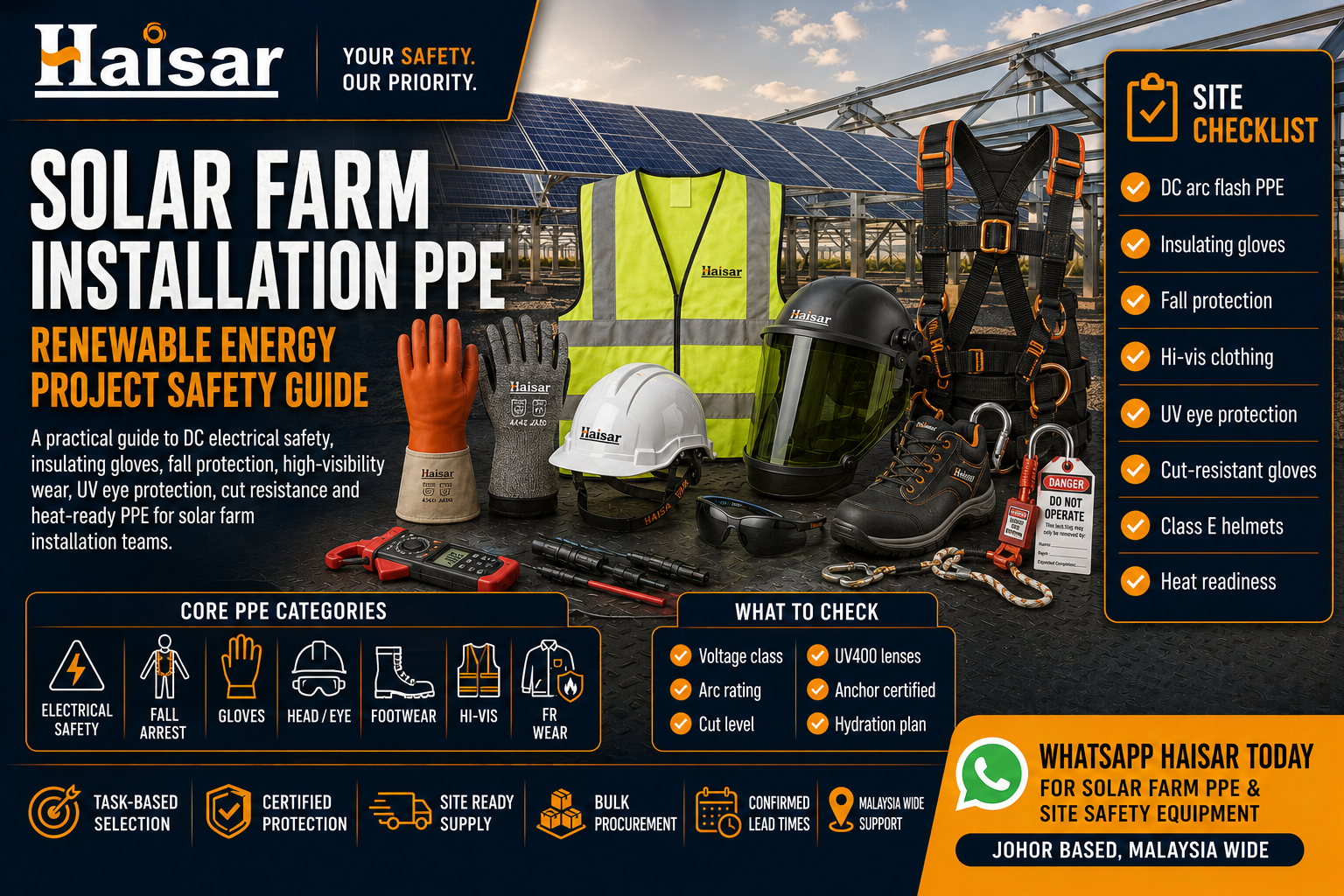
Malaysia's solar energy sector is expanding faster than its safety culture has kept up. Ground-mounted utility solar farms, rooftop commercial installations, and floating solar projects are being commissioned across Johor, Kedah, Perak, and Sabah at a pace that is pulling in EPC contractors, civil sub-contractors, and electrical teams who may have strong construction or electrical backgrounds but limited experience with the specific hazard combination that solar farm installation presents.
That combination is the problem. A solar farm installation site is not a standard construction site with an electrical component bolted on. It is a working electrical environment from the moment the first panel is connected, combined with sustained outdoor work at height, prolonged heat exposure in open terrain, and the particular hazard of DC electrical systems that behave differently from the AC systems that most Malaysian electrical workers have trained on. The PPE programme for a solar farm installation team must address all of these hazards simultaneously, and it must be implemented before the first panel goes on a racking structure, not after the first incident.
This guide covers the PPE requirements for solar farm EPC and installation teams in Malaysia, the hazard-specific reasoning behind each requirement, and the selection criteria that distinguish compliant, fit-for-purpose equipment from inadequate alternatives.
The Solar Farm Hazard Profile: Why Standard Site PPE Is Not Enough
Before specifying PPE, it is necessary to understand what makes a solar farm installation site different from a general civil or electrical construction site. The hazard profile has three characteristics that drive specific PPE requirements beyond what a standard site PPE pack provides.
Continuous DC electrical hazard from first panel connection. Photovoltaic panels generate DC electricity in any daylight condition, including overcast days. There is no equivalent of switching off the supply at a distribution board. Once panels are installed and connected in a string, the string is live. DC arc flash from a PV string is more sustained and harder to extinguish than an AC arc flash of equivalent voltage because DC arcs do not self-extinguish at zero-crossing points. Malaysian solar installations typically operate at string voltages between 600V and 1500V DC. At these voltages, the energy available in an arc flash event is substantial, and standard electrical PPE rated for AC low-voltage work is not necessarily adequate.
Working at height across the full duration of the installation. Panel installation on ground-mounted racking, rooftop installations, and floating solar structures all involve sustained work at elevated positions. On ground-mounted utility projects, workers are frequently working on racking structures at two to four metres, which is within the range where a fall can cause fatal or serious injury. The extended duration of this exposure — solar farm installations run for months — means that fatigue-related fall risk is a significant factor that short-duration elevated work does not present.
Thermal stress in open terrain. Utility solar farms are typically built on open land with minimal natural shade. Workers are exposed to full Malaysian solar radiation for the entire working day. Ground-mounted panel arrays focus and reflect heat downward onto the working surface beneath them. Wet Bulb Globe Temperature (WBGT) conditions on a Malaysian solar farm during peak hours can reach levels that impair judgment and physical coordination, creating secondary risk for both fall and electrical incidents.
Understanding these three hazard drivers makes the PPE specification process straightforward: the equipment programme must address electrical exposure including DC arc flash, fall arrest for sustained height work, and heat stress while maintaining all other protections.
Head Protection: Helmets for Electrical and Impact Risk
The helmet requirement on a solar farm installation site is not satisfied by any hard hat. It is satisfied by the correct hard hat for the electrical hazard class present on site.
Standard industrial hard hats are classified under MS EN 397 for mechanical protection. They provide impact and penetration protection but are not designed to provide electrical insulation. On a solar farm where workers are regularly in proximity to energised DC conductors, cable trays, and inverter connections, a helmet rated for electrical hazard is required.
Class E (Electrical) hard hats under ANSI Z89.1, or the equivalent type 2 classification under applicable standards, are rated for protection against electrical contact at up to 20,000 volts. For solar farm work at string voltages up to 1500V DC, a Class E rated hard hat provides the appropriate level of electrical insulation at the head.
In addition to electrical rating, the helmet for solar farm installation should include a full brim rather than a peak-only brim. A full-brim helmet provides shade to the face, ears, and back of the neck, reducing heat stress and solar radiation exposure over a full working day in open terrain. This is a meaningful ergonomic and health consideration on a Malaysian solar farm site where workers may spend six to eight hours daily in direct sunlight.
Sweatband and suspension systems in helmets used on solar farm sites should be inspected and replaced more frequently than on standard indoor industrial sites. Malaysian outdoor heat causes sweatband degradation and suspension system fatigue at a faster rate than manufacturer service intervals designed for temperate climate use.
Haisar's head protection range includes hard hats and helmets suitable for electrical site environments, including the MSA V-Gard helmet with Fas-Trac suspension.
Eye and Face Protection: UV, Glare, and Arc Flash
Solar farm installation presents two distinct eye hazard categories that require separate PPE selections and may require both to be worn simultaneously or interchangeably depending on the task.
UV and glare protection for general site work. Workers on open solar farm sites are exposed to high levels of UV radiation directly from sunlight and reflected from panel surfaces and light-coloured ground coverings. Standard clear safety glasses do not provide UV protection. Safety glasses for solar farm site work should be UV400-rated, meaning they block 100 percent of UV-A and UV-B radiation up to 400nm. Polarised lenses reduce glare from reflective panel surfaces and reduce eye fatigue over a full working day. The lens tint should be appropriate for the light conditions: grey or brown tints for bright outdoor conditions, clear for shaded or indoor inverter room work.
Arc flash face protection for electrical work on energised systems. Any task that involves working on or near energised DC conductors, junction boxes, combiner boxes, inverter terminals, or DC distribution equipment requires arc-rated face protection. The arc rating required depends on the incident energy calculation for the specific task and location. For combiner box and string junction work on standard utility PV installations, a minimum arc flash face shield rated to 4 cal/cm² is the entry level. For inverter and DC distribution board work at higher incident energy levels, a higher-rated arc flash face shield or arc flash hood is required.
Standard polycarbonate face shields are not arc-rated. An arc flash event behind a standard face shield can cause severe burns to the face and eyes. The arc rating must be verified against the incident energy for the task, not assumed based on the face shield's general construction.
Haisar's eye protection range includes safety glasses and goggles for outdoor UV environments, and face protection options including face shields appropriate for electrical site use. For arc flash rated face protection, refer to Haisar's electrical safety range.
Hand Protection: Three Glove Types for Three Hazard Categories
Hand protection on a solar farm installation site is not a single glove selection. The different tasks performed by installation teams present different hand hazards that require different glove types. A single general-purpose glove that compromises across all three categories provides partial protection in each area.
Insulating rubber gloves for electrical work on energised DC systems. Any task involving contact with or proximity to energised DC conductors, terminals, or equipment requires insulating rubber gloves rated for the voltage class present on site. For systems up to 1000V DC, Class 0 insulating rubber gloves rated to 1000V AC / 1500V DC are the minimum requirement. For systems between 1000V and 1500V DC, Class 1 insulating rubber gloves rated to 7500V AC are the appropriate selection.
Insulating rubber gloves must be worn over leather protector gloves that protect the rubber from physical damage during use. The leather protector does not contribute to electrical insulation; it prevents cuts, abrasion, and puncture of the rubber glove that would compromise its insulating properties. Before each use, insulating rubber gloves must be inspected for cuts, punctures, and ozone cracking, and inflated to verify that no air escapes through the glove body.
Haisar supplies the Novax insulating rubber gloves Class 00 for low-voltage electrical work.
Cut-resistant gloves for panel and racking installation. Panel frames, racking components, cable trays, and mounting hardware all present cut and laceration risks during handling and installation. Panels with damaged edge sealing have sharp glass edges. Cut-resistant gloves rated to EN 388 Level C or above, or ANSI A4 or above, are appropriate for panel handling and racking installation tasks. The glove must maintain sufficient dexterity for bolt fastening and cable management work.
Haisar's hand protection range includes the Stego cut protection range and mechanical and multi-purpose gloves suitable for racking and panel installation.
General-purpose work gloves for civil and cable work. Cable pulling, conduit installation, and civil groundwork tasks require durable general-purpose work gloves that provide grip, abrasion resistance, and basic cut protection without the specialised properties required for electrical or sharp-edge panel work. Leather work gloves or synthetic leather palm gloves are appropriate for these tasks.
The task-based glove selection must be embedded in the site's method statements so that workers are not defaulting to a single glove type across all tasks. Using insulating rubber gloves for panel handling is impractical and reduces dexterity unnecessarily; using general work gloves for energised DC work is a serious electrical safety failure.
Footwear: Dielectric Safety Boots for the Electrical Environment
Standard steel-toed safety boots provide impact and compression protection for the feet but conduct electricity. On a solar farm site where workers are regularly in proximity to energised DC systems, dielectric safety footwear that combines mechanical protection with electrical insulation is the correct selection.
Dielectric safety boots are constructed without metal components in the sole and toe cap. The toe cap is composite or reinforced plastic. The sole construction eliminates conductive pathways between the foot and ground. Dielectric boots for Malaysian solar farm use should carry both the safety footwear standard markings for impact and compression protection and a dielectric rating appropriate for the site voltage class.
For general site work away from energised electrical equipment, standard safety boots with steel toe caps are appropriate. The dielectric boot is the requirement for electrical workers, inverter installation teams, and anyone working in combiner rooms, inverter rooms, or on energised string wiring.
Haisar supplies dielectric safety boots for electrical work environments including solar farm electrical installations. The full feet protection range covers safety boots for civil, mechanical, and electrical site work.
High-Visibility Vests and Workwear: Site Safety and Heat Management
High-visibility vests are a baseline requirement on all Malaysian construction and EPC project sites. On a solar farm installation site, the hi-vis requirement intersects with the heat stress management requirement in a way that makes workwear selection more nuanced than simply handing out a yellow vest.
Hi-vis requirements. Solar farm sites involve the movement of vehicles, plant, and equipment across open terrain. Workers on foot in open areas where site traffic operates must be visible to plant operators and vehicle drivers at all times. ANSI/ISEA 107 Class 2 or equivalent hi-vis workwear with retroreflective striping is the baseline for workers in vehicle operating areas. At night or in low-visibility conditions, the retroreflective requirement becomes the primary safety function.
Heat management in workwear. Standard hi-vis polyester vests worn over heavy work clothing significantly increase thermal load on workers in Malaysian outdoor conditions. A workwear approach that manages heat stress while maintaining hi-vis compliance includes lightweight, moisture-wicking base layers that allow sweat evaporation, mesh-backed or ventilated hi-vis vests that allow airflow through the workwear system, and scheduling of heavy physical work outside peak WBGT hours where the site programme allows.
Arc-rated (FR) hi-vis workwear is required for electrical workers on energised systems. Standard hi-vis polyester is not arc-rated and will melt onto skin in an arc flash event, significantly worsening burn injuries. Arc-rated FR hi-vis clothing for solar farm electrical workers should carry an arc rating consistent with the incident energy calculations for the work tasks they perform.
Haisar's customised workwear range covers hi-vis vests and workwear for project and EPC site environments, including options for logo branding and site-specific colour coding.
Fall Protection: Harnesses, Lanyards, and Anchor Systems for Solar Racking Work
Falls from height are the leading cause of fatal injuries in Malaysian construction, and solar farm installation presents fall exposure that is sustained, repetitive, and conducted in environmental conditions that increase fall risk.
Ground-mounted utility solar farm racking places workers at between one and four metres above grade during panel installation. This height range is the most statistically dangerous for fall fatalities because it is above the threshold for serious injury but below the height where workers instinctively treat the fall risk with caution. Rooftop commercial solar installations place workers at heights where the consequences of an unprotected fall are clearly fatal.
Full-body harnesses. For rooftop solar installation work and for ground-mounted racking installation where the fall height exceeds two metres, a full-body safety harness connected to a compliant fall arrest system is required. The harness must be fitted correctly to the worker, inspected before each use, and connected to a rated anchor point through a compliant energy-absorbing lanyard or self-retracting lifeline.
Haisar supplies full-body harnesses for working at heights, including the Swelock K452 full-body harness, Colock full-body harness, and Picasaf full-body harness.
Lanyards and self-retracting lifelines (SRLs). Energy-absorbing lanyards for solar racking work must be sized for the fall clearance available at the work location. On low-clearance racking structures where the ground is close beneath the working position, standard 1.8-metre energy-absorbing lanyards may not provide adequate clearance to arrest a fall before ground contact. In these conditions, a short SRL that arrests falls within a shorter deployment distance is the appropriate selection.
Anchor points on racking structures. Temporary anchor points for fall arrest on solar racking structures must be rated for the fall arrest load and installed by a competent person. Standard racking components are not designed as fall arrest anchor points and must not be used as such without engineering verification of their load capacity and attachment geometry. Dedicated temporary anchor sockets or beam anchors designed for racking attachment provide compliant anchor points without compromising racking structural integrity.
Haisar's working at heights range covers harnesses, lanyards, anchor devices, and height safety equipment for solar installation and other construction applications.
Arc Flash PPE for DC Electrical Work on PV Systems
The arc flash hazard on a solar PV installation is qualitatively different from AC arc flash and is systematically underestimated by electrical workers who have trained and worked exclusively in AC environments.
DC arcs from PV string circuits and combiner boxes are sustained: the absence of zero-crossing means a DC arc, once established, continues as long as the source energy is available. String voltages at 1000V to 1500V DC with multiple parallel strings connected at combiner boxes can deliver substantial sustained arc energy. The burn hazard from a DC arc flash on a utility solar installation is significant.
Arc flash PPE for solar farm electrical work must be selected based on an arc flash hazard analysis specific to the DC system configuration, not on generic low-voltage electrical PPE assumptions. The analysis determines the incident energy in cal/cm² at each work location, and the PPE arc rating must exceed this value.
For combiner box work and string junction box commissioning on typical utility solar installations, the minimum arc flash PPE typically includes an arc-rated face shield or arc flash hood with a minimum rating of 4 cal/cm², arc-rated FR work clothing with a minimum arc rating of 8 cal/cm² (a single-layer AR/FR coverall or AR shirt and trousers), arc-rated rubber insulating gloves with leather protectors, and dielectric safety boots.
For inverter room work, DC distribution board commissioning, and fault investigation tasks on energised systems, a site-specific arc flash hazard analysis determining the exact incident energy is the correct basis for PPE selection. The arc flash suit and kit range from Haisar covers higher arc rating requirements for inverter and switchgear work on solar projects.
Respiratory Protection and Skin Protection for Outdoor Conditions
Two PPE requirements specific to Malaysian outdoor solar farm conditions are commonly omitted from site PPE programmes because they address hazards that are less visible than impact, electrical, or fall risk.
Respiratory protection for dusty terrain conditions. Ground-mounted solar farm construction involves extensive earthwork, grading, and civil preparation activities that generate significant airborne dust. During dry season conditions in Malaysian states where utility solar farms are being developed, respirable dust levels at active civil construction phases can exceed occupational exposure limits. Disposable P2 respirators for workers in active dust zones during civil preparation phases address this exposure. Once the site is grassed over or stabilised and panels are installed, the dust risk reduces significantly, but the civil preparation phase represents a meaningful respiratory exposure period.
Sun protection for prolonged outdoor exposure. While not a PPE item in the traditional sense, sun protection — high-SPF sunscreen applied to exposed skin, UV-protective neck covers under the helmet, and scheduling sun exposure management — is part of a complete occupational health programme for solar farm installation teams. Solar keratosis and skin cancer risks from prolonged, repeated UV exposure across a multi-month solar farm installation project are occupational health concerns that responsible EPC contractors address in their site health programme.
Building the Solar Farm PPE Programme: Implementation Considerations
Specifying the correct PPE for each hazard category is the first step. Ensuring that workers actually receive, wear, and correctly use that PPE across a multi-month installation programme on a remote site is the operational challenge.
Task-based PPE matrices. A solar farm PPE matrix maps each work task category to the specific PPE required for that task. Panel installation requires different PPE from string wiring commissioning, which requires different PPE from inverter room energisation. A site-level PPE matrix published in the site HSE plan, shared with all sub-contractors, and referenced in method statements ensures that the correct PPE selection is made at the task level rather than applied as a blanket minimum across all tasks.
Sub-contractor PPE alignment. Utility solar EPC projects in Malaysia typically involve multiple sub-contractors: civil groundwork contractors, mechanical racking installation contractors, panel installation sub-contractors, and electrical commissioning contractors. Each sub-contractor brings their own workforce and their own PPE practices. The principal EPC contractor is responsible for establishing a site-wide PPE standard that all sub-contractors comply with, and for verifying compliance through site induction, toolbox talks, and supervisory inspection.
PPE for commissioning and testing phases. The electrical hazard on a solar farm site increases significantly during the commissioning and testing phase, when DC strings are energised, inverters are powered up, and the AC grid connection is made. PPE requirements for commissioning personnel are more stringent than for installation personnel, and the transition from installation to commissioning phase must be accompanied by a formal change in the site PPE requirements communicated to all personnel on site.
Heat stress management as a PPE programme component. In Malaysian conditions, heat stress management is not a welfare consideration separate from the PPE programme. It is integral to it. Workers who are heat-stressed have impaired judgment and coordination. A worker who is approaching heat exhaustion is a fall risk on a racking structure and an electrical risk near energised equipment. The PPE programme for a solar farm must incorporate WBGT monitoring, work-rest schedules calibrated to ambient conditions, hydration provisions, and shaded rest areas as functional components of the safety programme, not as optional welfare additions.
Haisar Supply and Services: PPE Supplier for Solar Farm Projects in Malaysia
Haisar Supply and Services supplies PPE and safety equipment for solar EPC projects and renewable energy installation teams across Johor and peninsular Malaysia. We supply the full range of PPE required for solar farm installation work: hard hats including Class E rated helmets, UV and arc-rated eye and face protection, insulating rubber gloves and cut-resistant work gloves, dielectric and standard safety boots, hi-vis vests and FR workwear, and full-body harnesses with lanyards and anchor systems.
For electrical commissioning teams, we supply arc flash rated PPE including arc flash suits, arc flash hoods and face shields, and insulating rubber gloves for DC electrical work on PV systems.
For EPC contractors managing multi-site solar project rollouts across Malaysia, we can support bulk supply with consistent specifications across sites, staggered delivery to match project phase schedules, and replacement stock for consumable and single-use PPE items throughout the project duration.
Our PPE range, electrical safety equipment, working at heights equipment, and project supplies cover the complete safety equipment requirements for solar farm installation teams from site preparation through to commissioning and handover.
WhatsApp us now to discuss your solar farm PPE requirements. Our team will respond with product recommendations, specifications, and pricing for your project in Johor and across Malaysia.
Browse PPE and Safety Equipment for Solar Projects at haisar.com
Haisar Supply and Services Sdn Bhd (985158-T) | Kulai, Johor, Malaysia | www.haisar.com
