Can't find what you're looking for? Get in touch!



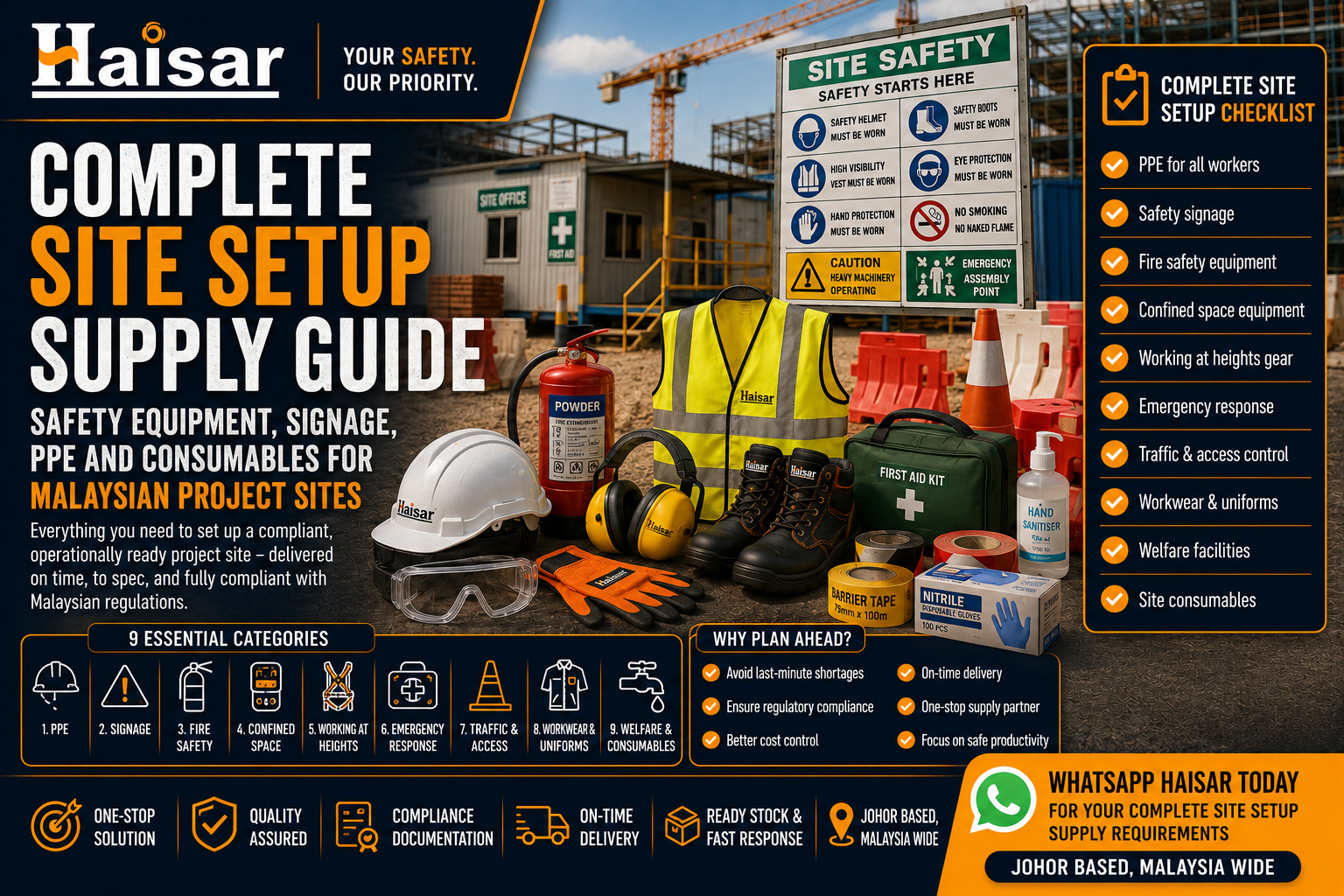
Setting up a project site in Malaysia is a procurement exercise that most project teams underestimate until they are standing on a half-ready site on day one of mobilisation, missing items from every category and making urgent phone calls to suppliers who cannot deliver before the end of the week.
A complete site setup requires safety equipment, personal protective equipment, signage, workwear, fire safety equipment, emergency response provisions, traffic and access management equipment, welfare facilities, and consumable supplies, all specified correctly for the site's hazard profile, all delivered before the workforce arrives, and all compliant with the regulatory requirements that apply to the project type and industry sector.
This pillar guide covers every category of equipment and supply required to set up a compliant, operationally ready project site in Malaysia. It is structured as a reference document that procurement managers, HSE officers, and project managers can use at the planning stage to build a comprehensive site setup supply list rather than discovering gaps after mobilisation has begun.
Before You Order: The Site Setup Planning Sequence
The most common site setup supply failure in Malaysia is not a product availability problem. It is a sequencing problem. Items are ordered in the wrong order, with the wrong lead times, against the wrong specifications, and without the compliance documentation that regulated project environments require.
The correct sequencing for site setup supply planning follows five steps.
Step 1: Identify the hazard environment. Before any product is specified, the hazard profile of the site must be established. What are the primary hazards? What is the industry classification? What regulatory frameworks apply, DOSH, BOMBA, PETRONAS, CIDB, or a combination? The hazard profile drives every specification decision downstream.
Step 2: Identify the regulatory requirements. Different project types carry different mandatory equipment requirements. A PETRONAS contractor site imposes FR garment and gas detection requirements that a general construction site does not. An offshore project imposes personal flotation and SOLAS requirements that an onshore facility does not. Map the regulatory requirements to the hazard environment before specifying equipment.
Step 3: Develop the site setup supply list by category. Using the structure in this guide, build a comprehensive supply list covering every category. For each item, specify the product standard required, the quantity, and the compliance documentation needed.
Step 4: Identify lead times and place orders in the correct sequence. Items with the longest lead times, custom FR workwear, embroidered garments, and specialist equipment requiring ordering from overseas, must be ordered first. Standard in-stock items can be ordered closer to the mobilisation date. Build a procurement calendar that works backwards from the site start date.
Step 5: Confirm documentation requirements and collect documentation at the point of order. For every item requiring compliance documentation, specify the documentation in the purchase order rather than requesting it after delivery. A missing SIRIM certificate or FR test certificate discovered on site inspection day is a problem that correct procurement sequencing prevents.
Category 1: Personal Protective Equipment
PPE is the largest and most category-diverse element of site setup supply. Every worker on the site needs a complete set of PPE appropriate to their role and work area before they can commence work.
Head protection. Class B safety helmets with electrical insulation for all active work areas. Class A for areas with no electrical overhead hazard. Bump caps for low-headroom maintenance environments. Chin straps for working at heights and marine environments. Quantity based on workforce size with a ten to fifteen percent buffer for replacements. Ensure a range of sizes is available where adjustable suspension systems do not cover all head sizes in the workforce.
Eye and face protection. Safety glasses with UV400 rating for all outdoor workers. Indirect-ventilated chemical splash goggles for any chemical handling operation. Face shields for grinding, cutting, and welding operations. Arc flash rated face shields or switching hoods for electrical maintenance work where arc flash risk assessment identifies the requirement.
Respiratory protection. Disposable FFP2 or N95 respirators for dusty construction activities including concrete cutting, earthworks, and demolition. Half-face respirators with OV/P100 combination cartridges for chemical handling and painting operations. Cartridge change-out schedule established and communicated at the time of issue. Supplied air or SCBA for any confined space entry into potentially oxygen-deficient atmospheres.
Hand protection. Cut-resistant gloves at EN 388 TDM Level C to D minimum for metal racking, structural steel, and fabrication work. General purpose work gloves for material handling and equipment operation. Chemical resistant gloves matched to the specific chemicals on site. Electrical insulating rubber gloves matched to system voltage for all electrical work. FR compatible gloves for workers in flash fire environments.
Foot protection. S3 rated safety boots with SRC slip-resistant outsoles as the standard for general construction and industrial work. Anti-static footwear for classified hazardous areas and electronics environments. Chemical resistant footwear for chemical handling locations. Maritime deck footwear for shipyard and wet steel deck environments.
Fall protection. Full-body harnesses with dorsal D-ring for all working at heights applications. Self-retracting lifelines for work locations where standard lanyard fall clearance is insufficient. Twin-leg energy-absorbing lanyards for movement between anchor points. Temporary anchor systems for structures without built-in anchorage. Rescue plan and rescue equipment in place before any working at heights activity commences.
Hearing protection. Pre-formed reusable earplugs or foam disposables for areas where measured noise levels exceed 85 dB(A). Helmet-mounted earmuffs for workers in hard hat zones with intermittent high-noise exposure. Noise level measurement conducted before designating hearing protection zones.
High-visibility garments. Class 2 hi-vis vests as the minimum for all workers in vehicle movement areas. Class 3 hi-vis jackets for loading dock areas, outdoor yard operations, and any work adjacent to live roads. All garments MS ISO 20471 compliant.
Category 2: Safety Signage
Site signage is a regulatory requirement under OSHA 1994, BOMBA, and the applicable industry standards, and is the first visible indicator to any DOSH inspector or client visitor of how seriously the project team takes safety management.
Mandatory PPE signs at every entry point to every area requiring specific PPE. Safety helmet required, safety boots required, high-visibility vest required, eye protection required, hearing protection required. Every entry point, not just the main gate.
Warning signs at every significant hazard location. Forklift operating signs at all pedestrian entry points to vehicle movement zones. Overhead loads warning at crane and hoist operating areas. High voltage signs at all electrical switchboards and distribution boards. Confined space entry signs at all confined space access points.
Prohibition signs at relevant locations. No entry, no smoking, no open flame, no unauthorised access. Posted at the point where the prohibited action could otherwise occur.
Emergency and evacuation signs. Emergency exit signs above all site welfare exit doors. Assembly point signs at the designated assembly point and at exits leading toward it. First aid location signs. Fire extinguisher location signs.
Site boundary and access control signs. Site entrance signs with site name, principal contractor, and safety requirements. Visitor reporting signs at the main entrance. Speed limit signs on all site roads.
Custom project signs. Site safety rules board at the main entrance. HSE notice board in the induction area. Toolbox talk station signage. Permit-to-work display boards at confined space entry points and hot work locations.
All signage must be in ISO 7010 compliant formats where applicable. For sites with a multilingual workforce, critical safety signs should include the relevant languages alongside the ISO symbol.
Category 3: Fire Safety Equipment
Every project site in Malaysia, from a small fit-out to a major infrastructure project, requires fire safety equipment compliant with BOMBA requirements. The type and quantity depends on the site size, the nature of the work, and whether the site includes temporary buildings and welfare facilities.
BOMBA-approved fire extinguishers of the correct class for the fire risks present. ABC dry powder for general site coverage. CO2 for electrical plant rooms and generator sets. Wet chemical for any cooking facilities on site. Positioned at the required spacing so no point on the site is more than 30 metres from the nearest appropriate extinguisher.
Fire blankets at all cooking areas in welfare facilities and at welding and hot work stations.
Fire detection and alarm for temporary buildings. Welfare blocks, site offices, and accommodation facilities must have fire detection appropriate for the occupancy. Battery-powered smoke detectors as a minimum for temporary buildings without a connection to a fire alarm system.
Emergency lighting in all temporary buildings and enclosed site structures.
Fire safety signage including fire action notices, extinguisher location signs, and assembly point markers at all site facilities.
Hot work permit system. A documented permit-to-work for all welding, grinding, and hot work activities. Fire watch equipment including a charged fire extinguisher and fire blanket at the point of hot work. Pre-work gas testing in areas where flammable materials or atmospheres may be present.
Fire assembly point. Clearly marked, at a safe distance from all site buildings and work areas, large enough for the full site workforce, and not in a position that would obstruct emergency vehicle access.
Category 4: Confined Space Equipment
Any project site that involves confined space entry, including tanks, vessels, manholes, sumps, cable tunnels, or enclosed structures, requires a complete confined space entry capability established before the first entry is permitted.
Gas detection. Four-gas personal monitors covering O2, LEL, CO, and H2S for every confined space entry operation. Bump tested before every entry shift with documented results. Pre-entry sampling pump for remote atmosphere testing before approach to the entry point. Calibration gas and docking station for fleet management.
Rescue systems. Tripod and man-rated winch at every vertical entry point for the duration of the entry. Full-body rescue harnesses with dorsal D-ring for all entrants. Retrieval lines connected to the winch and attached to each entrant.
Ventilation. Axial flow blowers and ducting for forced air supply before and during entry. Spark-free blowers for spaces where flammable atmosphere may be present.
Communication. Intrinsically safe two-way radios for classified area confined spaces. Wired communication as a backup for spaces with poor radio signal penetration.
Entry permit system. A documented confined space entry permit issued before every entry, signed by the authorised entry supervisor, with atmospheric test results recorded and the standby person identified. Entry permit display board at the access point.
Category 5: Working at Heights Equipment
For any project site with elevated work areas, the working at heights equipment programme must be established and equipment must be in place before any worker ascends above the ground level.
Scaffold systems. Erected by a competent scaffolder and inspected before first use, after any alteration, and at weekly intervals during use. Scaffold inspection tags in place on all completed scaffold access.
Edge protection and guardrails. At all open edges on elevated platforms, roof areas, and elevated floor openings. Minimum 910mm guardrail height with intermediate protection.
Personal fall protection. As covered in the PPE section. Full-body harnesses, SRLs, lanyards, and anchor systems sized for the workforce.
MEWPs (Mobile Elevated Work Platforms). Scissor lifts and boom lifts where scaffold is not appropriate. Operators trained and competent. Pre-use inspection before each shift. Ground conditions assessed for MEWP stability.
Ladder safety. Adequate length, correct angle, secured top and bottom, inspected before use. Not used as a working platform for tasks requiring two hands or sustained elevated work.
Fall protection rescue plan. Documented before any working at heights activity begins. Resources and trained personnel in place to rescue a suspended worker within the time window before suspension trauma becomes a risk.
Category 6: Emergency Response Equipment
Emergency response capability must be established on site before the workforce arrives, not assembled after the first incident occurs.
First aid kits. Stocked to the minimum contents of the Factories and Machinery (Safety, Health and Welfare) Regulations 1970. One kit per 50 workers. Positioned throughout the site, not only in the site office. Trained first aiders on every shift with current certificates.
AED units. For larger sites and sites with electrical hazards. Mounted in clearly signed, accessible locations throughout the site.
Eye wash stations. Within 10 seconds of travel from every chemical handling location. Plumbed or self-contained gravity-fed units, not squeeze bottle supplements.
Chemical spill kits. At every location where chemicals are stored or handled. Kit type matched to the chemicals present at each location.
Emergency evacuation plan. Documented and communicated to all workers at induction. Covers fire, chemical release, medical emergency, and any other credible emergency scenario for the site.
Emergency contact board. Prominently displayed at the site entrance and at welfare facilities. Includes BOMBA (994), ambulance (999), DOSH emergency contact, site emergency contacts, and nearest hospital.
Category 7: Site Traffic and Access Management
Vehicle and pedestrian management is a primary safety requirement on any active Malaysian project site with vehicle movement.
Traffic cones and delineators. For vehicle routing, work zone marking, and pedestrian protection. Size matched to the vehicle speeds on site.
Barriers and pedestrian separation. Water-filled plastic barriers for high-traffic separation. Crowd control barriers for pedestrian routing at entry points. Clear physical separation between vehicle and pedestrian zones throughout the site.
Road marking. Pedestrian walkway markings on internal site roads. Stop lines at site road junctions. Speed limit markings.
Site speed limit signs. 10 km/h in areas where pedestrians are present. Posted at site entry and at intervals on site roads.
Forklift and plant movement signs. At all pedestrian entry points to areas with active forklift and mobile plant movement.
Site access control. Boom barriers or gate systems at main site entrance. Visitor sign-in register. Contractor induction documentation at the gate. ID and access control for restricted areas.
Category 8: Workwear and Customised Garments
Branded workwear establishes workforce identification, communicates professionalism, and in multi-contractor environments provides a rapid visual means of identifying which company a worker belongs to and whether they are authorised to be in a specific area.
Company branded coveralls. Polycotton for general construction and industrial. Ripstop for high-abrasion outdoor environments. FR for oil and gas, electrical maintenance, and process plant environments. Embroidered logo and company identification.
Hi-vis vests with company branding. Class 2 minimum for all site workers in vehicle movement areas. Company logo and sub-contractor identification where required by the principal contractor.
Polo shirts for supervisory and management staff. Moisture-wicking fabric for Malaysian outdoor conditions. Embroidered company logo.
Safety helmets with company branding. High-quality vinyl stickers or pad-printed company logo on helmets, with role identification stickers where the principal contractor requires a colour or sticker identification system.
Lead times for custom workwear must be factored into the site setup procurement calendar. Standard embroidered garments require two to three weeks. FR fabric coveralls require four to six weeks. Orders must be placed before other site setup activities, not at the same time.
Category 9: Welfare Facilities and Site Consumables
A compliant and functional site requires welfare facilities and consumable supplies that are often overlooked in the main site setup supply list but that become urgent procurement requirements once the workforce is on site.
Welfare facilities. Adequate toilet and washing facilities for the workforce size per DOSH welfare requirements. Canteen or eating area separated from work areas. Drinking water supply. Rest areas with shade for outdoor workers.
PPE consumables. Disposable respirators, disposable gloves, barrier tape, and other consumable PPE items that will be consumed throughout the project. Establish consumption rate estimates and replenishment schedules before mobilisation.
Cleaning and hygiene supplies. Hand sanitiser, soap, and hygiene consumables for welfare facilities. Appropriate for the level of chemical contamination workers may bring from the work area.
Waste management. Designated waste collection areas for general waste, chemical waste, and construction debris. Appropriate waste containers for each waste type. Scheduled collection arrangements for chemical and hazardous waste.
Site lighting. For any work that extends into low-light periods or for covered work areas without adequate natural light. Temporary lighting appropriate for the work environment, intrinsically safe where classified hazardous areas are involved.
Site stationery and safety administration. Permit-to-work forms, toolbox talk records, visitor sign-in registers, induction checklists, and inspection records. These administrative supplies are as much a part of site setup as the physical equipment.
Building the Complete Site Setup Supply List
The categories above provide the framework for a complete site setup supply list. The specific items, quantities, and specifications within each category are determined by the project type, the workforce size, the hazard profile, and the regulatory requirements applicable to the project.
For procurement managers building a site setup supply list for a Malaysian project, the recommended approach is to work through each category systematically, identify the specific items required, confirm the regulatory standard for each, estimate the quantity based on the workforce size and the project duration, and identify whether the item requires ordering in advance due to lead time constraints.
For HSE officers reviewing a site setup supply list prepared by someone else, the review should confirm that every item is specified to the correct standard for the hazard environment, that quantities are adequate for the workforce size, and that compliance documentation requirements have been identified for every regulated product category.
Haisar Supply and Services provides a site setup supply consultation service for project teams in Johor and across Malaysia. Engage us at the planning stage and we will work through the site setup supply requirements with your team, confirm specifications, provide lead time commitments, and manage consolidated delivery of the full supply scope aligned to your mobilisation programme.
Haisar Supply and Services: Complete Site Setup Supplier in Malaysia
Haisar Supply and Services Sdn Bhd, based in Kulai, Johor, supplies the complete range of safety equipment, PPE, signage, fire safety equipment, workwear, emergency response products, and project consumables for site setup across Johor and peninsular Malaysia.
We cover every category in this guide from a single point of contact, eliminating the vendor fragmentation that makes multi-category site setup procurement complex and error-prone. We engage at the specification stage, confirm lead times before you commit, manage phased delivery aligned to your programme, and provide compliance documentation as a standard output of every supply.
For projects in Johor's active industrial and construction sectors including oil and gas, data centres, solar and renewable energy, power generation, marine, and infrastructure, we understand the sector-specific regulatory requirements and supply accordingly.
Get a Quote and Download the Haisar Site Setup Supply Catalog
Whether you are planning a new project mobilisation, reviewing your current site setup supply arrangements, or looking for a consolidated supply partner who can cover every category on your site setup list, contact Haisar today.
Download the Haisar Product Catalog
Browse All Products at haisar.com
Haisar Supply and Services Sdn Bhd (985158-T) | Kulai, Johor, Malaysia | www.haisar.com
