Can't find what you're looking for? Get in touch!



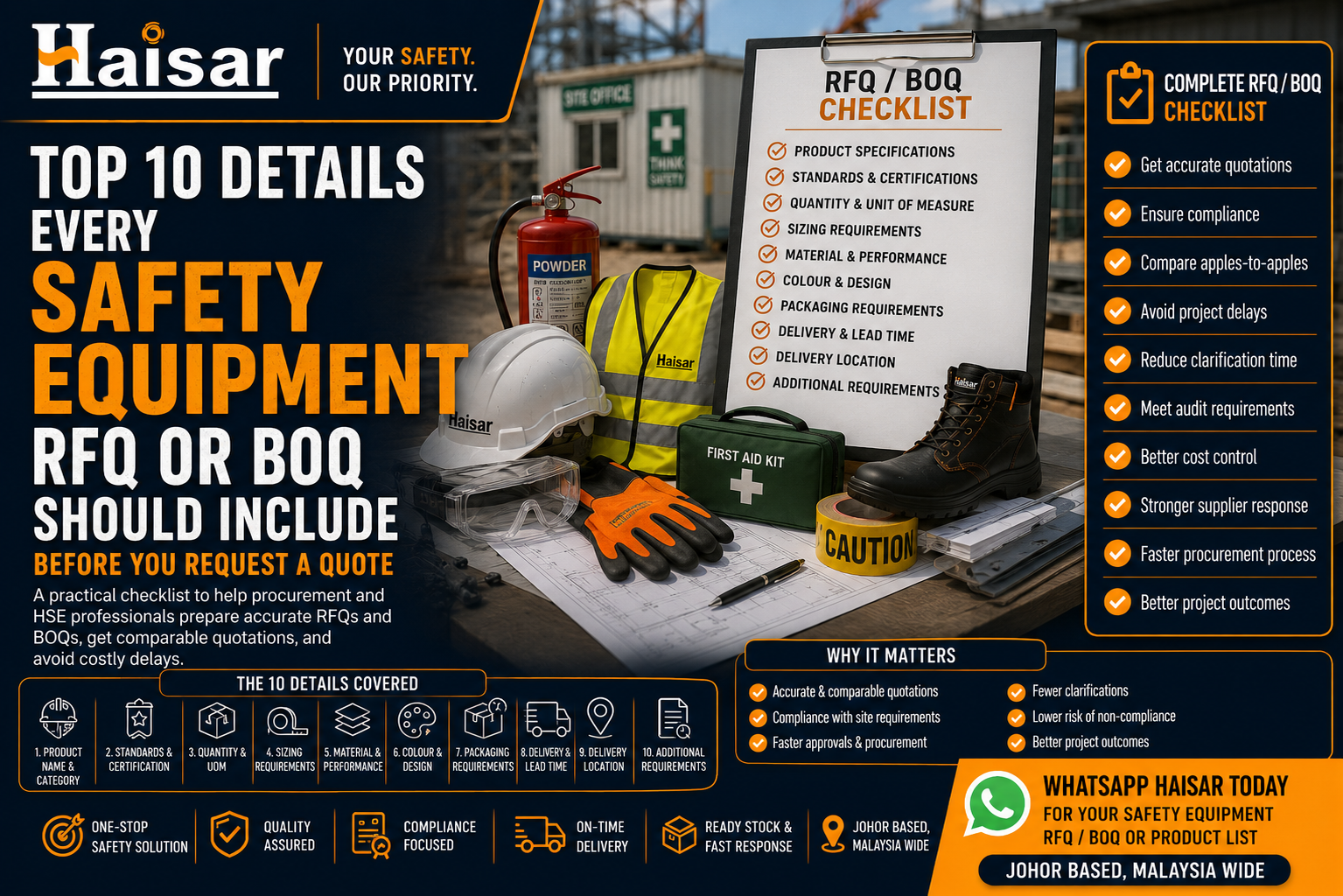
A poorly prepared RFQ or BOQ is one of the most common reasons safety equipment procurement stalls. Suppliers either return incomplete quotations, make wrong assumptions about product specifications, or come back with pricing that cannot be compared apple-to-apple. The fix is straightforward: before you send out a request for quotation or submit a bill of quantities, make sure ten specific details are in place.
This guide explains each one, adds the details that are easy to overlook (inspection requirements, sample approval), shows what happens to a quotation when a detail is missing, and gives you a ready-to-use checklist you can paste directly into your next RFQ.
|
Quick answer The ten details a complete safety equipment RFQ or BOQ needs are: product specification, applicable standard or certification, quantity and unit of measure, sizing, brand preference or approved alternatives, colour/customisation, delivery location and timeline, packaging and labelling, supporting documentation, and budget or commercial terms. |
WhatsApp us your RFQ, BOQ, or product list
What is an RFQ? What is a BOQ?
|
Quick definitions RFQ (Request for Quotation): a document sent to a supplier asking for pricing on specified products or services, used for straightforward purchase decisions. BOQ (Bill of Quantities): a structured, itemised list of all materials, equipment, and supplies required for a project, typically with quantities and specifications, most often used in construction and project procurement. |
Both documents live or die on the same thing: specification completeness. A BOQ is usually prepared by a project manager, quantity surveyor, or estimator and then passed to procurement for quotation, while an RFQ is more often issued directly by a procurement officer or HSE manager for a defined product list. The ten details in this guide apply equally to both - the format differs, but the information a supplier needs to quote accurately does not.
Why an incomplete RFQ costs you more than time
Suppliers who receive a vague request - "please quote for safety helmets, 50 units" - will either default to their most common specification (which may not match your site requirements), ask multiple clarifying questions that delay the process by days, or quote a range of products and leave the specification decision to the buyer. None of these outcomes serve a busy procurement officer or HSE manager.
A well-structured RFQ or BOQ eliminates ambiguity. It allows suppliers to return a quotation that is accurate, comparable, and procurement-ready - one that you can present to your finance team or project manager without having to go back to the supplier for clarification.
For projects involving PPE, customised workwear, fire safety equipment, or multi-category project supplies, the stakes of a poorly prepared RFQ are higher because the wrong product specification can mean a failed site audit, a non-compliance finding, or equipment that workers will not actually use.
The 10 details every safety equipment RFQ or BOQ should include
1. Product name, category and specification
State the exact product category rather than a generic description. "Safety helmet" covers PE helmets for site visitors, SIRIM-certified ABS helmets for general workers, climbing-style helmets with four-point chin straps for work at height, and electrically rated Class E helmets for electrical maintenance - all at different price points and specification levels.
Include the product name, category (PPE, fire safety, electrical safety, fall protection, customised workwear, project supplies), and any relevant sub-category, such as "full-face respirator" rather than just "respirator." Without this, the supplier quotes their standard product, and if your site requires a specific type, you will receive a quotation that cannot be approved without revision.
Related reading: Safety Helmet Guide: Types, Standards and Suppliers in Malaysia for the full breakdown of helmet types referenced above.
2. Applicable standard or certification requirement
For regulated workplaces in Malaysia, the standard your equipment must meet is a procurement-critical detail. Different standards apply to different product types, and some project clients - particularly in oil and gas, power generation, and data centre environments - specify exact certification requirements in their contractor HSE requirements.
Include the applicable standard or certification, for example MS 183 or MS 1869:2015 for helmets, MS ISO 20471 for high-visibility clothing, EN 374 for chemical-resistant gloves, or MS EN ISO 20345 for safety footwear. If your project principal has specified a particular standard, quote that reference exactly as stated. Suppliers may otherwise quote non-certified products, and using non-certified PPE on a site that requires certification is a compliance gap that DOSH inspections and client audits will identify.
Related reading: Electrical Safety PPE: Standards and Equipment Guide Malaysia and
Safety Shoes in Johor: A Complete Guide to Choosing the Right Protective Footwear cover the standards behind two of the most frequently misspecified categories.
|
Need help matching a standard? If you are unsure which standard applies to your product category, Haisar's team can assist with product matching against your site's compliance requirements. |
3. Quantity and unit of measure
This sounds straightforward, but it is regularly omitted or stated incorrectly. Safety equipment is priced and supplied in different units - individual pieces, pairs, sets, boxes, cartons, or rolls - and the unit of measure affects both pricing and delivery planning.
- Number of units required
- Unit of measure - e.g. "pairs" for gloves, "sets" for coveralls, "units" for helmets, "rolls" for barrier tape, "boxes" for disposable gloves
- Whether the quantity is a one-time purchase or a recurring requirement, relevant for pricing negotiation
Without this detail, suppliers may quote in different units, making comparison impossible. A quotation for "50 gloves" at a certain price may mean 50 individual gloves or 50 pairs - a cost difference of 100 percent.
4. Sizing requirements
PPE must fit the workers who use it. An RFQ that does not include sizing information forces suppliers to assume or quote one size only, which is rarely practical for bulk orders.
- Size range required (e.g. S, M, L, XL, XXL)
- Breakdown of quantities by size (e.g. 20 units M, 30 units L, 10 units XL)
- For customised workwear: individual measurement requirements or size chart
- For safety footwear: UK or EU sizing reference and quantity per size
Without this, suppliers cannot confirm stock availability accurately, and for customised workwear specifically, incorrect or missing size information is the most common cause of production delays. If you are managing customised workwear for a project team, Haisar provides size chart templates to simplify the sizing submission process.
5. Brand preference or approved alternatives
Many project sites and industrial facilities operate with an approved brand list for safety equipment, especially common on PETRONAS contractor projects, international joint venture sites, and facilities with documented procurement policies. Even where no formal approved list exists, buyers often have brand preferences based on past experience with product quality or after-sales support.
- Preferred brand or brands, if applicable
- Whether brand equivalents will be considered, and if so, the approval process required
- Whether brand approval documentation or technical data sheets are required for substitutes
Without this, suppliers will quote their available stock brand. If your site requires a specific brand and the supplier has quoted an equivalent, the quotation cannot be approved without revision and potentially a separate brand approval process.
Related reading: Top 10 Safety Equipment Brands Available in Johor for a full buyer's guide to the major brands supplied in Malaysia and how to choose between them.
6. Colour, marking, or customisation requirements
For high-visibility clothing, safety vests, helmets, coveralls, and workwear, colour is not a preference — it is often a site requirement or regulatory specification. Colour coding on site identifies roles, visitor status, and contractor teams. For customised workwear, additional details including logo placement, embroidery versus printing, and fabric type are needed before any quotation can be accurate.
- Required colour (e.g. fluorescent yellow-green, orange, or specific site colour coding)
- Reflective tape configuration if applicable
- For customised workwear: logo file (vector format preferred), placement, embroidery or heat transfer printing, fabric specification
- For helmets: whether slotted, vented, or accessory-compatible versions are required
Without this, suppliers quote standard configurations, and customised workwear that has not been specified correctly will require revision and can add two to four weeks to production lead times.
Related reading: Safety Vest Malaysia: Standards, Colours and Compliance Guide for a full explanation of colour requirements and what they signal on site.
7. Required delivery location and timeline
Procurement and supply chain are directly linked. A quotation without delivery requirements cannot include an accurate lead time, delivery cost, or logistics plan.
- Delivery address, including whether it is a project site, a central warehouse, or multiple locations
- Required delivery date or project mobilisation date
- Whether staged deliveries are required (e.g. 50% by Week 2, remainder by Week 4)
- Any site delivery restrictions, such as access times, vehicle size limits, or gate procedures
Without this, suppliers quote standard lead times that may not align with your project schedule. For customised items, production plus delivery lead time can range from two to six weeks, and this needs to be planned against your mobilisation date.
8. Packaging and labelling requirements
For large industrial projects, PPE is often required with specific packaging for ease of distribution, storage identification, or compliance documentation, particularly relevant for bulk orders going to multiple cost centres or site locations.
- Whether individual packaging or bulk packaging is acceptable
- Carton labelling requirements, e.g. cost centre code, project name, product description in a specific format
- Whether packing lists per carton are required
- Any special packaging for transport, such as for fragile or chemical-sensitive items
9. Supporting documentation required
Modern procurement — especially for industrial, oil and gas, and data centre projects — requires documentation alongside the product. This includes compliance certificates, test reports, and material safety data sheets. Including this requirement in your RFQ allows the supplier to confirm availability before the order is placed.
- SIRIM certificate or manufacturer's certificate of conformity
- Product datasheet or technical specification sheet
- Material Safety Data Sheet (MSDS/SDS) where applicable, particularly for chemical-handling PPE and consumables
- Batch-specific test reports if required by your HSE management system
- Manufacturer warranty documentation
Without this, you may receive the product without the supporting documentation your audit or compliance process requires, leading to delays in product acceptance or stock register updates.
|
Documentation support Haisar supports your compliance and procurement requirements by providing available product documentation with quotations for safety equipment, PPE, and project supplies. |
10. Budget indication or commercial terms (where applicable)
This is the detail most buyers omit because it feels counterintuitive to share a budget with a supplier before receiving a quotation. For complex or multi-category RFQs, however, indicating a budget range allows suppliers to optimise the product recommendation - suggesting a specification that delivers compliance and performance within your cost parameters rather than defaulting to the highest or lowest option.
- Target unit price range or total budget envelope for the RFQ
- Payment terms preference, e.g. 30-day credit, project milestone billing
- Whether the order will be subject to a purchase order process or direct invoice
- Preferred quotation validity period
Inspection requirements: what to specify in your RFQ
Inspection requirements are easy to leave out of an RFQ because they feel like a post-delivery concern rather than a quotation-stage detail. In practice, stating your inspection expectations upfront affects both pricing and lead time, and leaving it out is a common source of dispute after delivery.
- Pre-delivery inspection: state whether goods must be inspected and photographed before dispatch, and who conducts it - the supplier, a third-party inspection agency, or your own representative.
- Incoming goods inspection: confirm whether your site will conduct a formal incoming inspection against the RFQ specification, and what happens to non-conforming items - replacement, credit note, or return.
- Third-party inspection or certification bodies: if your project requires SGS, Bureau Veritas, TÜV, or another named inspection body, state this in the RFQ so the supplier can factor in cost and lead time.
- Acceptance criteria: define what constitutes a passed inspection - matching specification, correct labelling, no visible damage, and certification documents present.
Leaving inspection requirements out of the RFQ does not remove the need for inspection - it just means the terms get negotiated after delivery, when your leverage is weaker and your project timeline is already committed.
The sample approval process explained
For customised workwear, branded PPE, or any order where the exact product has not been supplied to you before, a sample approval step protects both sides from a costly bulk-order mistake. This is a standard part of the procurement cycle for larger orders and should be planned into your project timeline, not treated as an optional extra.
- Specification submitted: the RFQ is issued with full detail - product spec, standard, sizing, colour, and any customisation.
- Sample produced or pulled from stock: for customised items, a physical sample is produced; for standard stock items, a representative sample unit is provided.
- Sample review: the buyer inspects the sample against the RFQ specification, checking fit, colour match, logo placement, fabric, and labelling.
- Approval or revision: the sample is formally approved in writing, or specific revisions are requested and a second sample round is scheduled.
- Bulk production or bulk order release: only after written sample approval does the full order proceed to production or dispatch.
|
Build sample approval into your timeline For customised workwear, sample production and approval typically adds one to two weeks ahead of the two-to-six-week production and delivery window already discussed under delivery timelines. Factor this into your mobilisation planning, not as an afterthought once bulk production has already started. |
Comparison: incomplete vs. complete RFQ — what changes
|
Detail |
Incomplete RFQ |
Complete RFQ |
|
Product specification |
Supplier assumes standard type |
Supplier quotes the exact product required |
|
Certification |
May receive non-certified product |
Supplier confirms certification status upfront |
|
Quantity and sizing |
Supplier quotes one size |
Accurate breakdown by size reduces reorder risk |
|
Delivery |
Standard lead time quoted |
Lead time aligned to project mobilisation |
|
Inspection |
Terms negotiated after delivery |
Acceptance criteria agreed before order |
|
Sample approval |
Bulk order proceeds unverified |
Bulk order proceeds only after written sign-off |
|
Documentation |
Certificates requested after delivery |
Documentation confirmed as available before order |
|
Price comparability |
Quotations cannot be compared fairly |
Like-for-like comparison is possible |
|
Approval speed |
Revision rounds required |
Quotation can proceed directly to approval |
The ready-to-use RFQ / BOQ checklist
Use the table below when preparing your next RFQ or BOQ.
|
# |
Detail |
Confirmed |
Notes / Value |
|
1 |
Product name, category and specification |
☐ |
|
|
2 |
Applicable standard or certification requirement |
☐ |
|
|
3 |
Quantity and unit of measure |
☐ |
|
|
4 |
Sizing requirements, with breakdown by size |
☐ |
|
|
5 |
Brand preference or approved alternatives |
☐ |
|
|
6 |
Colour, marking, or customisation requirements |
☐ |
|
|
7 |
Required delivery location and timeline |
☐ |
|
|
8 |
Packaging and labelling requirements |
☐ |
|
|
9 |
Supporting documentation required |
☐ |
|
|
10 |
Budget indication or commercial terms, if applicable |
☐ |
|
|
11 |
Inspection requirements and acceptance criteria |
☐ |
|
|
12 |
Sample approval process, if applicable |
☐ |
|
Submit your completed RFQ to Haisar directly via the quotation page or
How Haisar handles RFQ and BOQ submissions
- Product matching: Haisar's team reviews your specification against available products, cross-referencing certification requirements and approved brand equivalents where relevant.
- Consolidated supply: where your RFQ spans multiple product categories - for example PPE, fire safety equipment, and customised workwear on a single project - Haisar consolidates the quotation into a single document, reducing the number of vendor relationships your procurement team needs to manage.
- Bulk order pricing: quantity thresholds are assessed and carton or contract pricing is applied where applicable, particularly useful for projects with phased delivery requirements.
- Delivery coordination: for project sites requiring specific delivery windows or staged deliveries, Haisar's team coordinates logistics to align with your project schedule.
Explore Haisar's full product range or submit your RFQ now via the quotation page.
Practical examples: what changes when the detail is right
Scenario 1 - Safety helmets for a construction project
Without detail: "50 helmets, yellow." Supplier quotes PE helmets at a low unit price. Site actually requires SIRIM-certified ABS helmets with ratchet adjustment. Order must be revised, causing a week's delay.
With detail: "50 SIRIM-certified ABS safety helmets, yellow, ratchet adjustment, MS 1869:2015, size 52–62cm." Supplier quotes accurately; quotation is approved first time.
Scenario 2 - Customised coveralls for a project team
Without detail: "30 coveralls with company logo." Supplier quotes standard navy coveralls with heat transfer print. Project actually requires hi-vis orange coveralls with reflective tape and embroidered logo per client site rule.
With detail: "30 hi-vis orange FR-rated coveralls, ANSI/ISEA 107 Class 2, embroidered logo front left chest, sizes per attached size chart, site colour code confirmed as orange." Supplier produces a compliant product without rework, and the sample is approved before bulk production starts.
Common RFQ and BOQ mistakes to avoid
- Sending a product name with no standard: "safety gloves" alone tells a supplier nothing about the hazard it needs to resist.
- Omitting size breakdown: a single total quantity with no size split forces the supplier to guess a distribution that rarely matches the actual workforce.
- Assuming "international standard" is specific enough: name the exact standard and edition - different standards address different hazards even within the same product category.
- Leaving delivery timeline vague: "as soon as possible" gives the supplier no basis for a realistic lead time quote or a fair price.
- Skipping the sample approval step on customised orders: proceeding straight to bulk production without a signed-off sample is one of the most expensive mistakes in workwear procurement.
- Not stating documentation needs upfront: requesting certificates after delivery often means waiting on the supplier's own admin cycle instead of having them ready at handover.
A note on regulatory context
Occupational safety procurement in Malaysia operates within the framework of the Occupational Safety and Health Act 1994 and the Occupational Safety and Health (Amendment) Act 2022, as enforced by the Department of Occupational Safety and Health (DOSH). Employers are responsible for ensuring that PPE provided to workers is suitable for the hazards present, maintained in good condition, and replaced when no longer effective.
Haisar supports your compliance and procurement requirements through product matching, documentation provision, and consolidated supply - but the selection of appropriate PPE for specific workplace hazards remains the responsibility of the employer and the competent person conducting the workplace risk assessment. For guidance on what constitutes suitable PPE for your industry, refer to DOSH's published guidelines and consult a qualified safety professional where required.
Related reading from Haisar
- Industrial Safety Equipment Johor: Complete Guide for Businesses and Factories
- Safety Helmet Guide: Types, Standards and Suppliers in Malaysia
- Safety Vest Malaysia: Standards, Colours and Compliance Guide
- The Complete Guide to Industrial Safety Gloves in Malaysia (2026)
- Safety Shoes in Johor: A Complete Guide to Choosing the Right Protective Footwear
- Electrical Safety PPE: Standards and Equipment Guide Malaysia
- BOMBA-Approved Fire Equipment: What Every Workplace in Malaysia Needs
- Safety Signage for Workplaces: Types Every Factory and Project Site Needs in Malaysia
- Top 10 Safety Equipment Brands Available in Johor
Submit your RFQ to Haisar today
Whether you are preparing a single-line quotation request or a multi-category project BOQ, Haisar's team is ready to assist with product matching, specification review, and competitive pricing for PPE, safety equipment, customised workwear, and project supplies across Johor and Malaysia.
Submit your RFQ online: Get a Quote
Send your product list on WhatsApp: +60 12-570 7015
Call: +607-595 5658
Frequently asked questions
What is the difference between an RFQ and a BOQ in safety equipment procurement?
An RFQ (Request for Quotation) is sent to a supplier asking for pricing on specified products. A BOQ (Bill of Quantities) is a structured, itemised list of all materials and equipment required for a project. Both benefit from the same level of product detail; the ten points in this article apply equally to each. A BOQ is often prepared by a project manager or estimator and then passed to procurement for quotation.
Do I need to include a HIRARC or risk assessment when submitting an RFQ for PPE?
Your RFQ does not need to include the full HIRARC documentation, but the hazard information from your risk assessment should inform the product specification you request. For example, if your HIRARC identifies chemical splash risk, the glove specification should reference the appropriate EN 374 protection type. Haisar can assist with product matching when you share a general description of the workplace hazard; the formal HIRARC remains an internal compliance document.
How quickly will I receive a quotation after submitting my RFQ to Haisar?
Response times depend on the complexity of the request. Straightforward single-category requests with complete specification details are typically quoted promptly. Multi-category project BOQs or requests requiring brand confirmation may take longer. Including all details from this checklist in your submission helps reduce the back-and-forth that extends quotation timelines.
Can Haisar supply both standard PPE and customised workwear on the same purchase order?
Yes. Haisar handles multi-category procurement including PPE, fire safety equipment, electrical safety equipment, project supplies, and customised workwear. Consolidating your requirements into a single submission reduces the number of vendor accounts your procurement team manages.
What should I do if I am not certain of the exact product specification required?
Include what you know — the product category, the work environment, the applicable hazard type, and any standard or certification your project requires. Haisar's team will assist with product matching based on the information provided. For complex or high-risk categories, consulting a qualified safety officer before specifying PPE is advisable.
Is there a minimum order quantity for safety equipment procurement through Haisar?
Haisar accepts requests ranging from single-product enquiries to full project BOQs. For bulk orders, carton pricing and contract rates may apply depending on product and quantity.
What is a sample approval process and when do I need one?
Sample approval is the step where a supplier produces or provides a representative unit for the buyer to check against the RFQ specification before bulk production or dispatch proceeds. It is most relevant for customised workwear, branded PPE, and any product not previously supplied to your site, and should be planned into your procurement timeline in advance.
Should I specify inspection requirements in the RFQ itself?
Yes. Stating whether a pre-delivery inspection, a named third-party inspection body, or a formal incoming-goods inspection is required lets the supplier factor cost and lead time into the quotation, rather than negotiating inspection terms after delivery when your leverage is weaker.
What happens if I don't specify a brand and my site only accepts an approved brand list?
The supplier will most likely quote their available stock brand, which may not match your site's approved vendor list. The quotation will then need to be revised, and depending on your client's process, a separate brand-approval submission may be required, adding time to the procurement cycle.
Can I request a downloadable version of the RFQ checklist?
Yes. Contact Haisar via the quotation page or WhatsApp and request the editable checklist, which can be filled in and submitted directly as part of your RFQ or BOQ.
