Can't find what you're looking for? Get in touch!



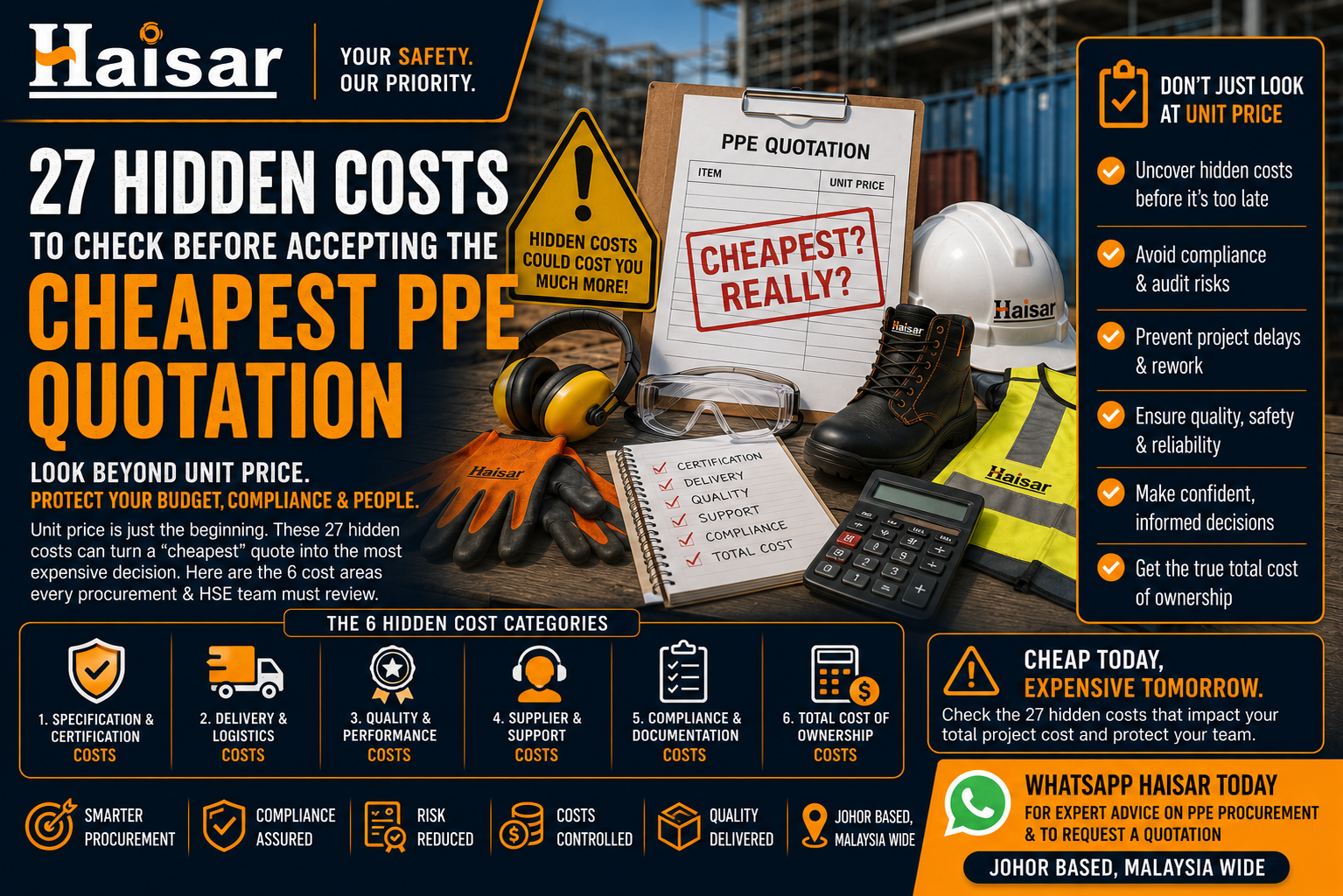
The cheapest PPE quotation on your desk is rarely the cheapest PPE you will actually receive - and almost never the lowest total cost of procurement. Unit price is only one line in the calculation. The remaining 27 factors covered in this article represent real costs that experienced procurement officers and HSE managers build into their supplier comparisons before a purchase order is raised. Miss them, and the savings you approved on paper become costs your project absorbs after the fact.
Why Unit Price Is the Wrong Starting Point for PPE Procurement
When procurement compares PPE quotations on unit price alone, it is comparing apples with unlabelled fruit. Two quotations for "safety helmets at 50 units" can differ in material grade, certification level, suspension system quality, shelf life remaining, and whether a SIRIM certificate or product datasheet is included. None of those differences appear in the unit price line.
The Occupational Safety and Health Act 1994 and the Occupational Safety and Health (Amendment) Act 2022, as enforced by the Department of Occupational Safety and Health (DOSH), place the obligation of suitable PPE selection on the employer - not the supplier. An employer who selects unsuitable PPE because it was cheapest has not met that obligation, regardless of what was written in the quotation. The hidden costs below are what bridges the gap between a low unit price and the total cost of a wrong procurement decision.
Selection Criteria for These 27 Items
The items below were selected based on three criteria: they are costs that do not appear on the face of a quotation, they occur with enough regularity in industrial PPE procurement in Malaysia to be considered structural rather than exceptional, and they are costs that a like-for-like quotation comparison - comparing the same specification across multiple suppliers - would help a buyer identify before committing. They are grouped into six categories for ease of reference.
Category A: Specification and Certification Costs (Items 1–6)
1. Cost of Non-Certified Product Replacement
A quotation that does not specify the certification standard may include non-certified or uncertified-equivalent products. If a DOSH inspection, client HSE audit, or principal contractor check identifies non-certified PPE on site, the product must be removed from service immediately and replaced. The cost of replacement — including the original purchase, urgent restocking, and any lost productivity during the gap — falls entirely on the buyer.
The relevant standard differs by product: MS 1869:2015 or MS 183 for safety helmets, MS ISO 20471 for high-visibility clothing, MS 1903 for safety footwear, and EN 374 or equivalent for chemical-resistant gloves, among others. Check these against SIRIM (www.sirim.my) and DOSH (www.dosh.gov.my) before accepting a quotation that does not state the certification.
2. Brand Substitution Without Prior Approval
Some suppliers quote a named brand to win the order, then substitute an equivalent at delivery. If your project principal contractor or client HSE system requires a specific approved brand, an unapproved substitute — however similar in specification - triggers a non-conformance. Getting a substitution approved retroactively, or replacing the product, both carry costs that the original price difference does not offset.
3. Wrong Protection Level for the Hazard
A quotation for chemical-resistant gloves that offers EN 374 Type C (light protection, tested against one chemical for ten minutes) may appear cheaper than a quotation for Type A (tested against six chemicals for at least thirty minutes each). The unit price difference between Type C and Type A is real. The cost of a chemical permeation incident caused by underspecified gloves is orders of magnitude larger - and falls on the employer under the OSH Act.
4. Expired or Near-Expiry Stock
PPE has a manufacturer-defined shelf life. Helmets, disposable respirators, chemical-resistant gloves, and some harness webbing are all time-limited materials. A quotation that does not specify batch date or minimum remaining shelf life may include stock that is months from expiry. If the PPE is issued to workers and expires before the project ends, replacement is required. The unit price saving on the original purchase is entirely consumed by the unplanned reorder.
5. Counterfeit or Grey-Market Products
At price points significantly below market average for a named brand, the risk of counterfeit or grey-market products rises. These products often carry printed markings that superficially resemble genuine certification marks but have not been tested. When a product fails under impact, pressure, or chemical exposure in service, the legal and human cost is not recoverable. Buyers should request batch-specific test reports and manufacturer certificates of conformity, not just product datasheets, for any quotation where pricing is substantially below the market range.
6. Missing Documentation for Audit Readiness
Many industrial clients and principal contractors require documentation alongside delivered PPE: SIRIM certificates, manufacturer certificates of conformity, product datasheets, and in some cases batch-specific test reports. A quotation that does not include or confirm the availability of this documentation creates a procurement gap that procurement officers only discover when documentation is requested for an audit — often under time pressure. Chasing documentation after delivery costs time; requesting it upfront as a quotation condition costs nothing.
Category B: Delivery and Logistics Costs (Items 7–12)
7. Delivery Charges Not Included in Quoted Price
A low unit price that excludes delivery is not directly comparable with a higher unit price that includes delivery to site. For project sites in Johor - Pengerang, Pasir Gudang, Kota Tinggi, or remote industrial zones - delivery costs on small or ungrouped orders can be significant. Always confirm whether the quoted price is ex-warehouse (buyer arranges transport) or delivered to your specified address.
8. Minimum Order Quantities That Force Over-Procurement
Some suppliers apply minimum order quantities (MOQs) that require buyers to purchase more units than the project needs. If you require 35 units of a particular respirator cartridge and the supplier's MOQ is 50, you are paying for 15 units you do not immediately need. The cost of excess stock - storage, potential expiry, and tied-up capital - is not visible in the unit price but is real. Compare the total order cost, not the unit price.
9. Lead Time Penalties and Project Delays
A supplier who quotes a low price but cannot commit to your project mobilisation timeline transfers the cost of the delay to your project. If workers cannot begin a task because PPE has not arrived, the cost of that downtime - labour standing, equipment idle time, and potential contractual penalties - is typically far larger than any unit price saving on the PPE itself. Always request a firm delivery commitment as part of the quotation evaluation, not as an afterthought.
10. Partial Delivery Costs
A supplier who is unable to fulfil the full order in a single delivery may ship in batches. Each partial delivery adds administrative processing time (delivery orders, goods receiving checks, invoice matching) and, where delivery charges apply per shipment, direct cost. A supplier who can confirm full stock and single-delivery execution is worth a price premium if it eliminates partial delivery costs.
11. Return and Exchange Logistics
If the delivered product does not match the specification in the quotation, or if sizing is incorrect for customised workwear, the cost of returning goods and arranging replacement falls on the buyer in terms of time and, where a supplier's return policy does not cover inbound logistics, direct cost. A supplier with a clear return and exchange policy and local stock reduces this risk.
12. Emergency Restocking Premium
When a project runs short of PPE mid-execution - because the initial quantity was underestimated, because product was consumed faster than planned, or because PPE was withdrawn from service following damage - the reorder is typically an urgent one. Urgent orders attract premium pricing from most suppliers. A buyer who selected the cheapest supplier without confirming ongoing stock availability may find themselves paying a significant premium on the emergency reorder, eliminating the original saving.
Haisar supports consolidated supply and bulk ordering for PPE, safety equipment, and project supplies across Johor and Malaysia. For a like-for-like quotation comparison, submit your requirement here or WhatsApp +60 12-570 7015.
Category C: Compliance and Liability Costs (Items 13–17)
13. DOSH Stop-Work Order and Rectification Costs
A stop-work order issued by DOSH due to non-compliant or unsuitable PPE halts site operations until the rectification is completed and reinspected. The cost of a stop-work order includes lost production, contractor standby time, rectification materials, and the administrative cost of managing the order. All of this traces back to a PPE procurement decision that prioritised price over verified compliance.
14. Employer Liability Under OSH Act 2022
Under the Occupational Safety and Health (Amendment) Act 2022, the maximum penalty for failing to provide suitable PPE has increased to RM500,000. Directors and senior managers can be held personally liable where it is shown that due diligence was not exercised. The purchase of PPE at the lowest unit price, without verification of suitability for the specific hazard, does not constitute due diligence. The cost of this exposure is not quantifiable in advance but is bounded by the legislation.
15. Insurance Claim Implications
PPE-related workplace accidents can affect workers' compensation insurance claims and premiums. Where an investigation determines that unsuitable or non-certified PPE contributed to an injury, the employer's liability position is weakened. Some insurance policies contain exclusion clauses for injuries occurring when non-certified PPE was in use. The insurance cost implications of a PPE-related claim are not visible at the point of procurement but are a real downstream cost of the initial purchasing decision.
16. Client Penalty and Contract Rectification Costs
Project clients and principal contractors in oil and gas, power generation, and data centre construction in Malaysia routinely conduct HSE audits and site inspections. A non-conformance finding related to PPE - wrong type, non-certified, or unapproved brand - can result in a contractual penalty notice, a formal corrective action request, or in repeated instances, damage to the contractor's prequalification standing with that client. These costs are reputational and contractual, not listed on any PPE invoice.
17. Incident Investigation and Reporting Costs
Under the Occupational Safety and Health (Notification of Accident, Dangerous Occurrence, Occupational Poisoning and Occupational Disease) Regulations 2004 (commonly known as NADOPOD), workplace injuries must be reported to DOSH within prescribed timelines. An incident investigation following a PPE-related injury requires management time, legal advice in some cases, and may result in enforcement action. These administrative and legal costs are downstream of the procurement decision but causally linked to it.
Category D: Product Performance and Replacement Rate Costs (Items 18–22)
18. Shorter Service Life Requiring More Frequent Replacement
A PE safety helmet priced at RM10 that degrades under UV exposure and requires replacement every 12 months costs more over a three-year project than an ABS helmet priced at RM28 that lasts 30–36 months of active service. This is the total cost of ownership calculation that sophisticated procurement applies to all consumable safety equipment. Unit price comparisons that do not account for replacement frequency systematically underestimate the true cost of lower-quality products.
19. Higher Damage and Write-Off Rates
Lower-quality PPE typically has lower impact resistance, lower abrasion resistance, and lower resistance to the chemical and UV conditions of Malaysian industrial environments. Higher damage rates mean more units written off per year per worker, which increases the effective unit cost over the period of use. Tracking write-off rates by product and supplier is a practice that experienced HSE managers use to identify the actual cost of PPE procurement decisions.
20. Worker Non-Compliance Due to Discomfort
PPE that workers find uncomfortable - too heavy, poorly fitting, too hot, or restrictive - is PPE that workers find reasons not to wear. Non-compliance with PPE requirements is a safety failure and a compliance failure, and it falls on the employer regardless of whether the PPE was provided. The cost of a non-compliance finding, an injury occurring while PPE was not being worn, or repeated retraining programmes to drive compliance, is not recoverable from the PPE supplier. Comfort and fit are legitimate procurement criteria, not preferences.
21. Increased Consumable Usage Due to Product Failure Rate
Disposable PPE - nitrile gloves, dust masks, disposable coveralls - has a usage rate that is partly driven by product quality. Lower-quality nitrile gloves with thinner gauge or lower puncture resistance are more likely to tear during use, requiring more frequent changes per shift. If a worker uses three pairs of RM0.40 gloves per shift instead of one pair of RM1.20 gloves, the cost per shift is the same but the waste volume, disposal cost, and administrative burden of restocking is higher.
22. Heat Stress Incidents from Inappropriate Workwear Specification
In Malaysia's climate, PPE that does not allow adequate moisture management or ventilation can contribute to heat stress incidents among workers, particularly for those in full-body protection or chemical-resistant suits. A heat stress incident carries medical costs, lost working time, and potential DOSH reportable incident classification. Specifying workwear that meets the task's protection requirements while managing thermal load is a safety and cost consideration that unit price comparisons do not capture.
Category E: Administrative and Process Costs (Items 23–25)
23. Multiple Purchase Orders and Vendor Management Overhead
Accepting the cheapest quotation from a different supplier for each PPE category - helmets from one, gloves from another, coveralls from a third - reduces unit prices but increases the number of vendor relationships, purchase orders, delivery orders, invoices, and goods-receiving processes that procurement must manage. The administrative cost per purchase order in a structured procurement environment is real. Consolidating PPE supply through a single supplier that can quote across all categories typically reduces this overhead even when individual unit prices are not the lowest available.
24. Requalification and Re-Approval Process Costs
Where a PPE supplier change occurs mid-project, some clients and principal contractors require the new supplier to go through a supplier qualification or approval process before their products are accepted on site. This process takes time, requires documentation, and may delay PPE availability. The cost of this requalification - including the project time lost while it is ongoing - is a hidden cost of selecting the lowest-price supplier without evaluating their prequalification status with your client.
25. Internal Rework Costs When Quotation Errors Are Discovered Late
When a quotation is accepted and a purchase order raised before the specification mismatch is discovered - usually at goods receiving or during a site audit - the cost of unwinding the order includes processing a return, raising a corrective purchase order, and in some cases paying a restocking fee. This administrative rework is a direct cost of the initial quotation evaluation not being thorough enough to catch the specification gap before commitment.
Category F: Customised Workwear-Specific Costs (Items 26–27)
26. Production Rework for Incorrect Customisation
For customised workwear - hi-vis coveralls, branded safety jackets, embroidered vests - a quotation accepted without confirming all customisation details (logo file, placement, embroidery versus heat transfer, fabric specification, colour, sizing breakdown) will almost certainly result in rework. Rework on a 50-piece embroidered coverall order takes two to four weeks and costs at least partial re-production. The unit price saving on the initial quotation is absorbed entirely by this outcome.
27. Fabric Specification That Fails Client or Regulatory Requirements
Some project clients specify minimum fabric weights, FR (flame-resistant) ratings, or antistatic properties for workwear used on their sites. A customised workwear quotation accepted at the lowest price may use a lighter or non-FR fabric that fails the client specification. The cost of reproducing the order in the correct fabric, at project urgency pricing, typically exceeds the original cost of specifying the fabric correctly from the outset.
The Quotation Comparison Scorecard
Use this scorecard when evaluating competing PPE quotations. Score each supplier 1 (does not meet), 2 (partially meets), or 3 (fully meets) for each criterion. Total score gives a like-for-like basis for comparison beyond unit price.
| # | Evaluation Criterion | Weight | Supplier A | Supplier B | Supplier C |
|---|---|---|---|---|---|
| 1 | Certification standard confirmed and matching spec | High | |||
| 2 | Brand matches approved list or equivalent confirmed | High | |||
| 3 | Protection level appropriate for stated hazard | High | |||
| 4 | Minimum shelf life remaining confirmed | Medium | |||
| 5 | Manufacturer COC or SIRIM cert available | High | |||
| 6 | Product datasheet provided with quotation | Medium | |||
| 7 | Delivery cost included or clearly stated | Medium | |||
| 8 | Full quantity available from single delivery | Medium | |||
| 9 | Firm delivery date aligns with project timeline | High | |||
| 10 | MOQ does not force significant over-procurement | Low | |||
| 11 | Return/exchange policy confirmed | Low | |||
| 12 | Ongoing stock availability confirmed | Medium | |||
| 13 | Quotation references applicable Malaysian standard | High | |||
| 14 | Supplier is established and referenceable | Medium | |||
| 15 | Sizing breakdown confirmed (where applicable) | Medium | |||
| 16 | Customisation details fully confirmed (where applicable) | High | |||
| 17 | Unit price is competitive on a like-for-like basis | Medium | |||
| Total Score | /51 | /51 | /51 |
A supplier scoring high on criteria 1, 3, 5, 9, and 13 but lower on unit price will almost always deliver a lower total cost of procurement than a supplier with the lowest unit price but gaps in those five criteria.
What a Like-for-Like Quotation Comparison Looks Like in Practice
To illustrate how these hidden costs materialise, consider a simplified comparison for 100 units of SIRIM-certified ABS safety helmets for a construction project:
| Factor | Quotation A (Lowest Unit Price) | Quotation B | Quotation C |
|---|---|---|---|
| Unit price | RM12.00 | RM18.00 | RM22.00 |
| Total unit cost (100 pcs) | RM1,200 | RM1,800 | RM2,200 |
| Certification | Not stated | MS 1869:2015 confirmed | MS 1869:2015 + SIRIM cert included |
| Material | PE (unconfirmed) | ABS confirmed | ABS confirmed |
| Estimated service life | 12 months | 30 months | 36 months |
| Delivery included | No (RM80 est.) | Yes | Yes |
| Documentation | Not offered | COC available | COC + batch test report |
| Effective 3-year cost (incl. replacements + delivery) | ~RM3,680 | ~RM2,160 | ~RM2,420 |
Quotation A, the cheapest on unit price, becomes the most expensive over the project lifecycle once like-for-like service life, delivery, and documentation are factored in. The numbers above are illustrative; the actual calculation for your specific product and project will differ, but the methodology applies.
How to Request a Like-for-Like Quotation from Haisar
Haisar supports procurement officers, HSE managers, and project teams in preparing like-for-like quotation comparisons for PPE, safety equipment, customised workwear, and project supplies. To get a comparison based on brand, certification, availability, and delivery requirements:
- State the product specification including required standard or certification
- Confirm the quantity and sizing breakdown
- Indicate your required delivery date and location
- Note any brand preferences or approved brand list requirements
- Attach your existing quotation(s) for comparison if available
Haisar's team will return a quotation that addresses all of these criteria on a like-for-like basis, so you can evaluate the full picture - not just the unit price.
📋 Submit your comparison request online → 💬 WhatsApp your requirement → 📞 Call: +607-595 5658
Related Reading from Haisar
- Top 10 Details Every Safety Equipment RFQ or BOQ Should Include Before You Request a Quote (new article — link once published)
- Industrial Safety Equipment Johor: Complete Guide for Businesses and Factories
- How to Choose the Right Safety Equipment for Your Business in Malaysia
- Top 10 Safety Equipment Brands Available in Johor
- Safety Vest Malaysia: Standards, Colours and Compliance Guide
Frequently Asked Questions
Does a lower unit price always mean lower quality PPE? Not necessarily. A lower unit price may reflect efficient procurement, lower overheads, or a different distribution model rather than lower product quality. The issue is not that low-price PPE is always poor — it is that unit price alone gives you no information about the factors that determine total cost. A lower price on a certified, documented, correctly specified product from a reliable supplier may genuinely be the best procurement decision. The 27 items in this article are the questions you need answered before you can determine whether the lower price is a real saving or a deferred cost.
Are there legal requirements specifying how I should evaluate PPE quotations in Malaysia? The Occupational Safety and Health Act 1994 and the OSH (Amendment) Act 2022 require employers to provide PPE that is suitable for the hazard. The Act does not prescribe a procurement process, but it does place the burden of demonstrating suitability on the employer. In practice, a documented quotation evaluation process that considers specification, certification, and fitness for purpose is stronger evidence of due diligence than a purchase decision based on price alone.
How do I handle a situation where my purchasing policy requires me to accept the lowest quotation? Many organisations have policies requiring acceptance of the lowest quotation for equivalent products. The key phrase is "equivalent products." A quotation evaluation that establishes like-for-like equivalence — confirming that all quotations meet the same specification, certification, and delivery criteria — satisfies both the policy requirement and the need for due diligence. If a lower-priced quotation does not meet the specification, it is not equivalent and should not be the comparator. Documenting this assessment protects both the procurement officer and the organisation.
What is a reasonable minimum shelf life to require on PPE at time of delivery? This depends on the product and the duration of your project. As a general starting point, requiring a minimum of 12 months remaining shelf life at delivery for helmets and disposable respirators, and six months for disposable gloves, gives a reasonable working buffer for a standard project. For longer projects, request confirmation of batch manufacture date and calculate against the manufacturer's stated shelf life. The manufacturer's instructions and technical documentation are the authoritative reference, not general guidelines.
Can Haisar match an existing quotation on price while providing full certification documentation? Submit your existing quotation to Haisar via the quotation page or WhatsApp. Haisar's team will review the specification and provide a like-for-like comparison including confirmation of certification, availability, and delivery terms. Where the specification in an existing quotation is incomplete or ambiguous, Haisar will flag this as part of the comparison response, which itself has value for the procurement decision.
Is it worth paying more for a single consolidated supplier versus sourcing each PPE category from the cheapest available supplier? The administrative cost of managing multiple vendors — separate purchase orders, delivery schedules, invoices, goods receiving processes, and supplier qualification records — is a real cost that procurement teams in larger organisations have begun to quantify. For projects or facilities where PPE spans multiple categories (helmets, gloves, footwear, workwear, fire safety, fall protection), the administrative saving from consolidating supply with a single capable supplier frequently offsets the unit price difference on individual items. The break-even point depends on the volume and frequency of your procurement activity.
Sources and regulatory references (for human verification before publishing):
- Occupational Safety and Health Act 1994 (Malaysia): www.dosh.gov.my
- Occupational Safety and Health (Amendment) Act 2022: www.dosh.gov.my
- NADOPOD Regulations 2004: www.dosh.gov.my
- MS 1869:2015, MS 183, MS ISO 20471, MS 1903 — SIRIM Malaysian Standards: www.sirim.my
- EN 374 (chemical glove standard) — European Committee for Standardization
- Note: RM500,000 maximum penalty figure is cited in enforcement communications from DOSH following the 2022 Amendment Act. Verify current enforcement position at www.dosh.gov.my before publishing.
- The illustrative cost table in the article uses hypothetical numbers to demonstrate methodology only. Do not publish as market pricing data.
