Can't find what you're looking for? Get in touch!



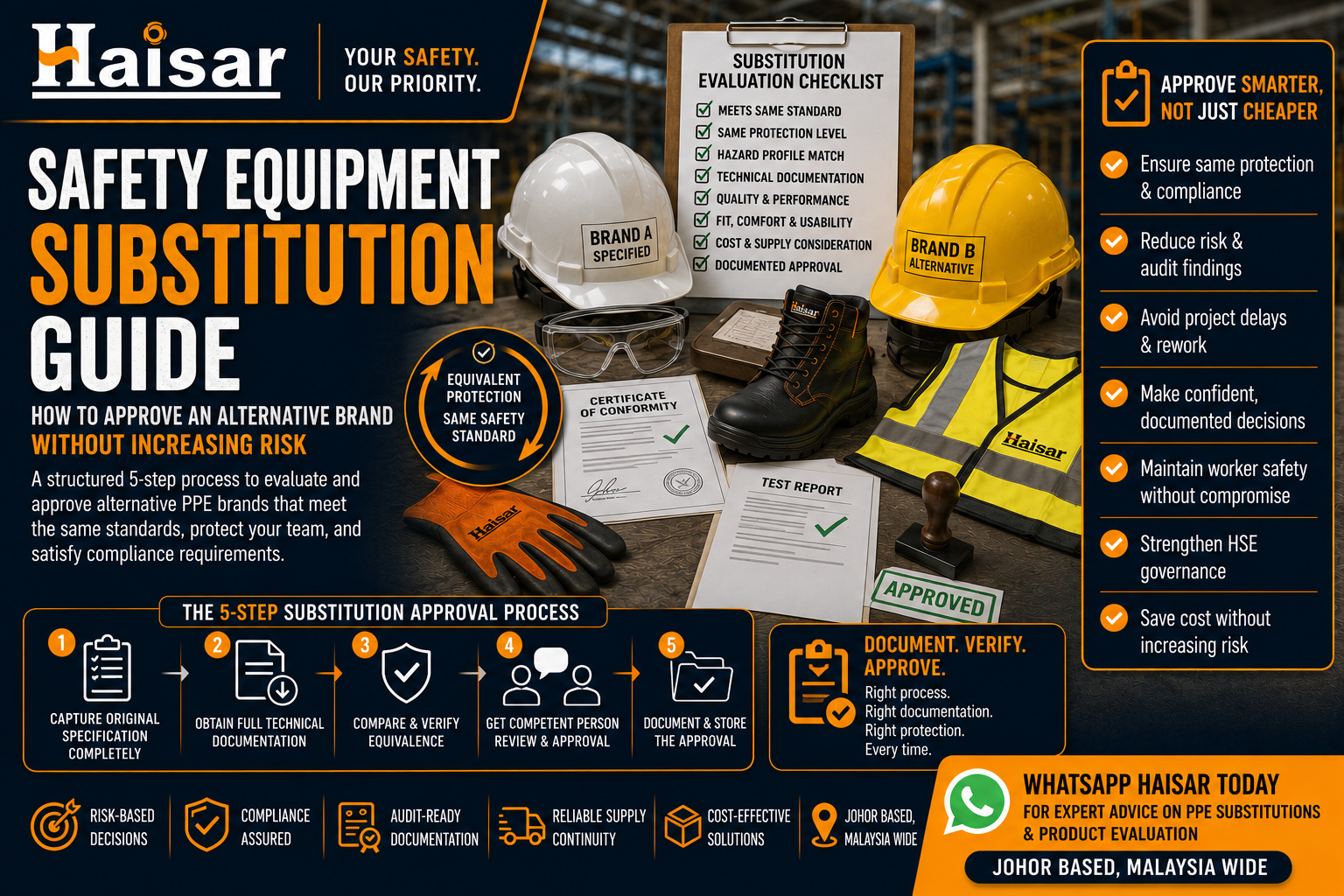
When your specified brand is unavailable, over budget, or discontinued mid-project, the question is never simply "what else can we use?" The question is whether the alternative meets the same protection standard, fits the same hazard profile, and can be demonstrated - on paper - to be equivalent to what was originally specified. Get that demonstration right and a brand substitution is a routine procurement decision. Get it wrong and you have introduced unquantified risk into your PPE programme while believing you have managed it.
This guide gives procurement officers, HSE managers, and project teams a structured process for evaluating and approving alternative PPE brands - one that protects the worker, satisfies your compliance obligations under Malaysian occupational safety law, and holds up to a client or DOSH audit.
Why Brand Substitutions Go Wrong
Most PPE brand substitution problems are not caused by bad products. They are caused by incomplete evaluation - a comparison that stops at the product name and misses the details that actually determine whether one product can do the job of another.
The three most common failure points are these.
Certification level is assumed rather than verified. Two helmets can both carry the EN 397 mark but differ in optional test criteria - electrical insulation, lateral deformation resistance, or very high temperature performance. If your specification requires those optional criteria and the substitute was not tested for them, the mark is the same but the protection is not.
The substitution is accepted verbally rather than documented. Where a principal contractor, client HSE team, or the employer's own safety management system requires an approved brand list, an undocumented substitution creates a compliance gap that a site audit will find. The product may be perfectly adequate. But without documentation, it is unapproved - and that is a non-conformance.
The hazard profile of the task was not revisited. Equipment is specified for a reason. When a substitution is considered, the hazard that drove the original specification needs to be re-examined against the alternative product. If the alternative product meets the same standard to the same level for that specific hazard, the substitution is supportable. If it meets a different standard, or the same standard to a lower performance level, it needs to be evaluated by a competent person - not waved through on the basis that it looks similar.
The Legal and Compliance Context in Malaysia
Under the Occupational Safety and Health Act 1994 and the Occupational Safety and Health (Amendment) Act 2022, the employer's duty is to provide PPE that is suitable for the hazard - not PPE that matches a specific brand. The obligation is hazard-driven, not brand-driven.
This is actually useful for procurement. It means that a properly evaluated and documented alternative brand is legally equivalent to the originally specified product, provided it meets the same protection standard for the same hazard. DOSH does not mandate specific brands. What DOSH expects, and what any audit will look for, is evidence that the PPE provided was suitable - which means documented evidence that the selection was considered and the standard was verified.
The practical implication: a substitution that is evaluated, documented, and signed off by a competent person is in a stronger compliance position than an original specification that was selected without documented rationale. Process matters as much as product.
For sites where principal contractors or clients maintain their own approved product lists, the approval process for substitutions is set by those clients, not solely by DOSH. In those cases, the steps below inform your internal evaluation - the formal approval still goes through the client's process.
The Five-Step Substitution Approval Process
Step 1: Capture the Original Specification Completely
Before you can evaluate an alternative, you need a complete picture of what the original product was actually required to do. A model number and a brand name are not enough.
Document the following for the original specified product:
- Product category and type (e.g., full-face respirator, not just "respirator")
- Applicable standard and edition (e.g., MS EN 136:2002 for full-face respirators, or EN 397:2012+A1:2012 for industrial safety helmets)
- Any optional test criteria within that standard that apply to the task (e.g., electrical insulation, high temperature, lateral deformation)
- Protection level where the standard has multiple levels (e.g., EN 374 Type A/B/C for chemical gloves, or FFP1/FFP2/FFP3 for filtering facepieces)
- Any client or principal contractor additional requirements beyond the standard
- Service environment factors: chemical exposure, UV exposure, temperature, abrasion, electrical hazard
If this information is not already captured in your risk assessment or PPE specification record, collect it now. You cannot evaluate an alternative against a specification you have not defined.
Step 2: Identify the Alternative and Obtain Full Technical Documentation
Once you have the original specification documented, request the following from the supplier proposing the alternative:
Product datasheet - confirming material, construction, and rated performance. Not a marketing brochure. A technical datasheet that states the standard tested against, the test results achieved, and any limitations.
Certificate of Conformity (COC) - from the manufacturer, confirming the product meets the stated standard. The COC should identify the certification body, the standard and edition, and the scope of testing.
SIRIM certificate where applicable - for product categories regulated under Malaysian mandatory certification (safety helmets, safety footwear, and selected other categories), the SIRIM certificate confirms local market compliance. Verify the current list of SIRIM-mandated product categories at www.sirim.my before assuming whether a SIRIM cert is required for your specific product.
Manufacturer's declaration of equivalence - some manufacturers produce a formal document confirming that a proposed product is equivalent to a specified competitor product. Not all suppliers can or will provide this, but it is worth requesting for complex substitutions.
Batch-specific test reports - for high-risk applications, batch test reports from an accredited laboratory provide stronger assurance than a general COC. These are most commonly required in chemical process, pharmaceutical, and offshore environments.
Do not accept verbal assurances of equivalence. Do not accept a product datasheet as a substitute for a COC. Documentation that you can place in front of a DOSH inspector or a client auditor is the objective.
Step 3: Conduct a Like-for-Like Equivalence Assessment
With both sets of documentation in hand, compare the original and the alternative across these five dimensions:
Standard and edition. The alternative must be tested against the same standard, or a standard that is formally recognised as equivalent. An EN-certified product is generally acceptable on Malaysian sites where the specific MS standard adopts the EN standard by reference - but verify this for the specific standard in question. A product certified only to a national standard from a jurisdiction with lower testing requirements than the applicable Malaysian or EN standard is not automatically equivalent.
Protection level within the standard. Where a standard has multiple performance levels, the alternative must meet or exceed the level required for the task. Substituting a lower protection level, even within the same standard, is not an equivalent substitution - it is a downgrade.
Optional test criteria. Some standards include mandatory base tests plus optional tests that apply to specific use conditions. Electrical insulation in EN 397 is one example. Chemical resistance in EN 374 is defined across different chemical classes. Verify whether the optional criteria that apply to your specific hazard were tested and passed by the alternative product.
Physical compatibility. For PPE systems - particularly fall protection, respiratory protection, and head protection with accessories - the alternative product must be physically compatible with the rest of the system. A harness that connects to a different lanyard connector standard, or a hard hat that does not accept the same visor mounting system as the original, is not a drop-in equivalent even if it carries the same certification.
Service life and maintenance requirements. If the original product has a manufacturer-defined service life of three years and the alternative has a service life of eighteen months, the substitution changes your replacement programme, inspection schedule, and total cost of ownership. This is not a reason to reject the substitution but it must be factored in and communicated to whoever manages the PPE inventory.
This assessment should be completed in writing, not retained only in someone's memory. A one-page comparison document is sufficient for most substitutions.
Step 4: Route the Assessment for Approval
Who approves a PPE brand substitution depends on your organisation's safety management system and the context of the project:
Internal approval. For most substitutions on sites without a mandatory client approved brand list, the competent person responsible for PPE selection - typically the HSE Manager or a qualified safety officer - signs off the like-for-like assessment. The assessment is then filed with the PPE specification record or the project HSE plan.
Client or principal contractor approval. Where the project client or principal contractor maintains an approved product list, their HSE or procurement team must review and formally accept the substitute before it goes on site. Submit the like-for-like assessment, the COC, and the product datasheet as a package. Request written confirmation. Do not assume verbal acceptance is sufficient.
Regulatory notification. DOSH does not require notification for routine PPE brand substitutions. However, if the PPE substitution affects a system subject to a DOSH permit or approval - for instance, respiratory protection in a confined space entry procedure or fall protection on a work at height permit - ensure the updated equipment reference is reflected in the relevant permit documentation.
For any substitution involving PPE that protects against life-threatening hazards - confined space, work at height, chemical process, electrical live work - the assessment should be reviewed by a competent person with relevant technical knowledge before approval, not processed as a routine procurement decision.
Step 5: Document, Communicate, and Update the PPE Register
Once the substitution is approved, three things need to happen before the alternative product reaches the worker.
Update the PPE specification record. The original specification document, approved brand list, or PPE matrix should be updated to reflect the approved alternative. Record the model, brand, standard, COC reference, and the date and name of the person who approved the substitution.
Communicate the change to workers and supervisors. Workers who have been issued the original product and are familiar with its fit, adjustment, and inspection criteria need to know that a different product has been issued, what the differences are in fit and adjustment, and whether any change to the inspection or replacement criteria applies.
Update inventory and replacement schedules. If the alternative product has a different service life, different inspection intervals, or different replacement triggers, the PPE register and replacement schedule must reflect that. A substitution that is approved but not operationally integrated is a compliance gap waiting to become an incident.
Substitution Scenarios and How to Handle Them
Scenario: The specified hard hat brand is out of stock nationally and the project mobilises in two weeks. This is the most common driver of substitution requests and the one most likely to be rushed. The pressure of the mobilisation date does not reduce the need for a proper assessment. It increases the risk of accepting a product that looks equivalent but is not. Priority actions: obtain the COC and datasheet for the proposed alternative on day one, complete the equivalence assessment before the first delivery is accepted, and do not issue the alternative to workers until the assessment is signed off. If the approval process is faster than two weeks, it fits. If it is not, the timeline needs to be revised or an interim product needs to be sourced from a supplier with current stock of the specified product.
Scenario: The principal contractor's client requires MSA V-GARD helmets but MSA is quoting a 6-week lead time. Contact the client HSE team immediately and present the situation transparently. A client who is informed early and given a documented alternative for review is far more cooperative than a client who discovers an unapproved substitution during a site walk. Request a formal substitution approval in writing, following whatever process the client's HSE management system prescribes. Haisar can assist with product matching and documentation preparation for this type of client submission.
Scenario: A cheaper alternative is proposed by the site manager to reduce PPE costs. Cost is a legitimate procurement consideration. An alternative that meets the same standard at a lower price is a valid outcome of a proper substitution process. But the process cannot be reversed starting with the conclusion (the cheaper product) and working backwards to justify it. The equivalence assessment must be run against the specification, not against the price target. If the cheaper product passes the assessment, it is a good procurement decision. If it does not, it is a cost saving that creates a risk exposure.
Scenario: A worker's glove size is not available in the specified brand. Sizing availability is a legitimate reason to introduce an equivalent product for specific workers. The substitution assessment in this case focuses on whether the alternative product in the required size meets the same protection standard. Document the specific reason for the substitution (sizing unavailability) alongside the technical assessment.
What "Equivalent" Actually Means in Practice
The word equivalent is used loosely in procurement. In PPE terms it has a specific meaning: equivalent protection for the same hazard, at the same or higher performance level, under the same use conditions, with documented evidence of testing.
Equivalent does not mean:
- Similar-looking
- Same price bracket
- The same general product category
- "We've used it before without problems"
- "The supplier says it's equivalent"
Equivalent means: tested and certified to the same standard, at the same or higher protection level, for the same hazard, with documentation you can show to a competent person, a client auditor, or a DOSH inspector.
If any of those conditions is uncertain, the substitution needs a more thorough assessment, not a faster approval.
How Haisar Supports the Substitution Process
When you send Haisar the original model number and the applicable standard, the team reviews available stock against your specification and identifies alternatives that meet the documented criteria - with COC and product datasheet included in the quotation response. This is not a generic "we have something similar" response. It is a like-for-like product review based on the technical details of your requirement.
For projects where the principal contractor or client requires a formal substitution submission, Haisar can support the documentation package - confirming the standard, the certification body, the test scope, and any relevant product performance data for the proposed alternative.
Send your original model and required standard for an equivalent-product review → WhatsApp your specification to +60 12-570 7015 →
The Alternative Product Approval Checklist
Use this checklist as part of your substitution approval process. File the completed checklist with your PPE specification record.
Original product documentation
- [ ] Product category, type, and model recorded
- [ ] Applicable standard and edition confirmed
- [ ] Optional test criteria relevant to the hazard identified
- [ ] Protection level within the standard confirmed
- [ ] Client or principal contractor additional requirements recorded
Alternative product documentation
- [ ] Product datasheet obtained and reviewed
- [ ] Certificate of Conformity obtained from manufacturer
- [ ] SIRIM certificate confirmed (where applicable)
- [ ] Batch test reports obtained (for high-risk applications)
Equivalence assessment
- [ ] Same standard and edition confirmed
- [ ] Same or higher protection level confirmed
- [ ] Applicable optional test criteria met
- [ ] Physical compatibility with existing PPE system confirmed
- [ ] Service life and maintenance requirements compared and noted
Approval and communication
- [ ] Assessment signed off by competent person
- [ ] Client or principal contractor approval obtained (where required)
- [ ] PPE specification record updated
- [ ] Workers and supervisors informed
- [ ] Inventory and replacement schedules updated
Related Reading from Haisar
- 27 Hidden Costs to Check Before Accepting the Cheapest PPE Quotation
- Top 10 Details Every Safety Equipment RFQ or BOQ Should Include Before You Request a Quote
- Top 10 Safety Equipment Brands Available in Johor
- Safety Helmet Guide: Types, Standards and Suppliers in Malaysia
- Industrial Safety Equipment Johor: Complete Guide for Businesses and Factories
Frequently Asked Questions
Does DOSH require a specific brand of PPE for any product category? DOSH does not mandate specific brands. The obligation under the Occupational Safety and Health Act 1994 and the OSH (Amendment) Act 2022 is to provide PPE that is suitable for the hazard. Suitability is determined by standard, protection level, and fitness for the specific work environment — not by brand. Some product categories do require mandatory certification under SIRIM (currently including safety helmets and safety footwear, among others) which means the product must carry the relevant SIRIM certification mark, but any brand that holds that certification is acceptable from a regulatory standpoint. Refer to www.sirim.my and www.dosh.gov.my for the current list of mandatory certification categories.
Can we accept an alternative brand on a project site where the client specifies approved brands? Only with the client's written approval. Where a principal contractor or project client maintains an approved brand list, any substitution must go through their formal approval process before the product goes on site. Using an unapproved product — even an equivalent one — is a non-conformance against the client's HSE requirements and may result in a corrective action, removal of the product from site, or reputational consequences for the contractor. Always route substitutions through the client's process and obtain written confirmation.
What is the difference between a Certificate of Conformity and a product datasheet? A product datasheet is a document produced by the manufacturer describing the product's features, materials, and claimed performance. It is a marketing and technical reference document and does not constitute certification evidence. A Certificate of Conformity (COC) is a document — issued by the manufacturer or an accredited certification body — confirming that the product has been tested and meets a specific standard. For PPE evaluation purposes, the COC is the document that matters. The datasheet supports it but does not substitute for it.
If an alternative product carries the same EN or MS standard mark as the original, is it automatically equivalent? Not always. Certification marks confirm that the product was tested to the base requirements of the standard. Many standards contain optional test criteria for specific use conditions — electrical insulation under EN 397, specific chemical classes under EN 374, and so on. If the original specification required those optional criteria and the alternative was not tested for them, the mark is the same but the protection is not. Always check the scope of testing against the scope of the hazard.
How long should a substitution approval record be kept? As a minimum, retain the substitution documentation for the period of use of the product plus the applicable statute of limitations for workplace injury claims, which in Malaysia is generally three years from the date of knowledge of injury under the Limitation Act 1953. For industrial diseases with long latency periods — such as occupational respiratory disease from long-term exposure — longer retention may be advisable. Consult your legal adviser for guidance specific to your industry and risk profile. In practice, many HSE management systems retain PPE records for the life of the project plus five years as a standard policy.
We have a large ongoing PPE programme. At what point does substitution management become a system rather than a one-off process? When substitutions happen regularly — due to supply chain variability, project-to-project brand availability differences, or a large multi-site operation — managing them one at a time is inefficient and creates inconsistency. A structured PPE matrix that lists approved primary products and pre-approved equivalent alternatives for each category, maintained and reviewed at least annually, converts the substitution approval process from a reactive exercise into a proactive procurement tool. Building the "alternative brand accepted?" question into your RFQ template and quotation process — asking suppliers to quote primary and equivalent alternatives simultaneously — reduces substitution lead time when availability issues arise.
Regulatory references:
- Occupational Safety and Health Act 1994 (Malaysia): www.dosh.gov.my
- Occupational Safety and Health (Amendment) Act 2022: www.dosh.gov.my
- Limitation Act 1953 (Malaysia)
- SIRIM mandatory certification product categories: www.sirim.my
- EN 397:2012+A1:2012 (industrial safety helmets), EN 374 (chemical gloves), MS EN 136 (full-face respirators)
