Can't find what you're looking for? Get in touch!



Most project procurement problems are not procurement problems at all. They are planning problems that only become visible at the procurement stage, usually when it is too late to fix them cleanly. The customised coveralls that needed a logo are in production somewhere, the gas detectors that need calibration are sitting in a supplier's warehouse two weeks from your mobilisation date, and the site office supplies that everyone assumed someone had ordered have not been ordered by anyone.
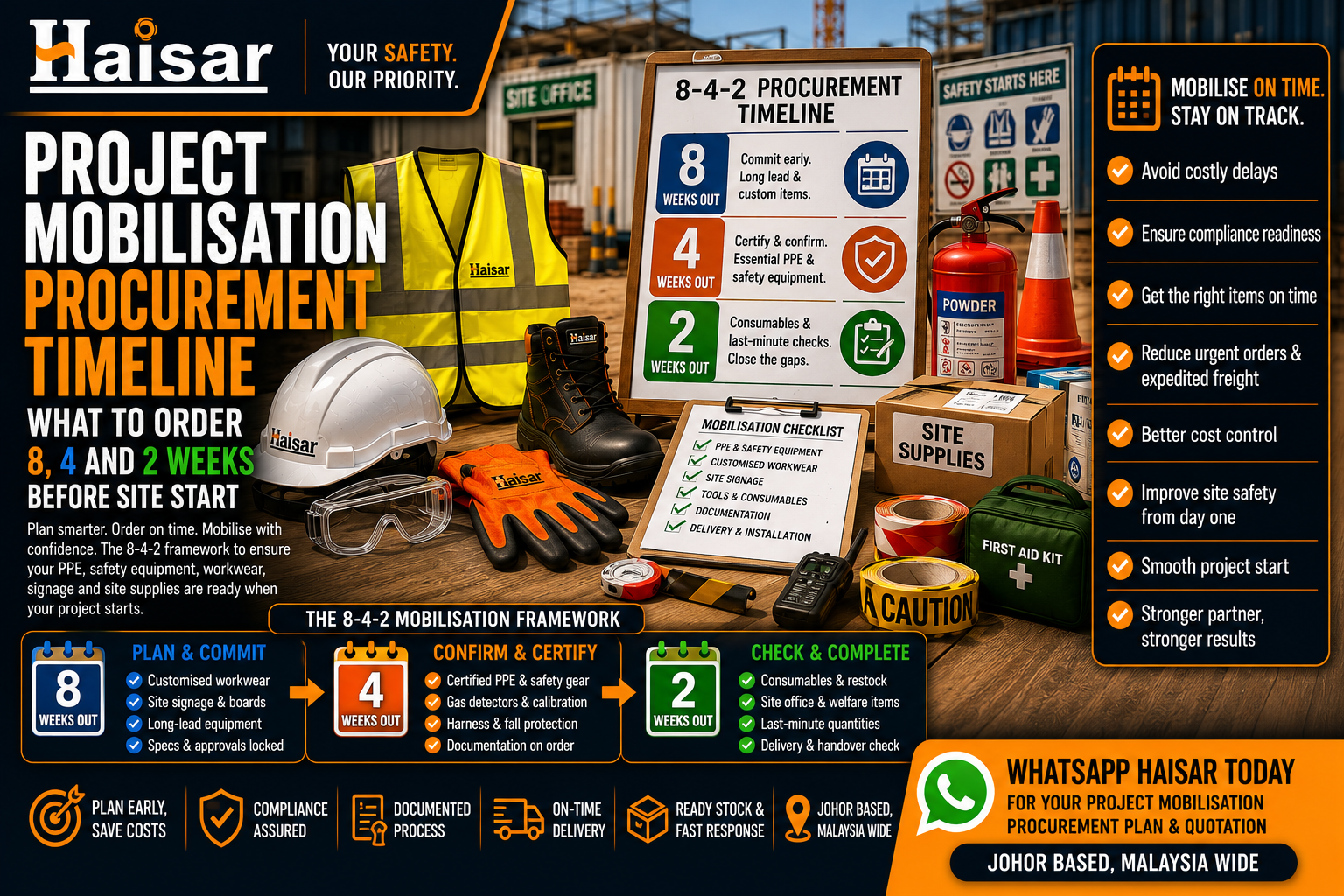
The 8-4-2 framework is the answer to this pattern. It works by reverse-engineering your mobilisation date into three procurement windows, each with a distinct category of items and a distinct purpose. Eight weeks out is when you commit to anything that has a production or lead time. Four weeks out is when certified and documented equipment needs to be confirmed on order. Two weeks out is when consumables, last-minute quantities, and administrative checks close out. Miss any window and the cost is either an expedited freight charge, a substitution you did not want, or workers standing on site without the equipment they need to begin.
What follows is a practical procurement timeline built around how PPE, safety equipment, customised workwear, and project supplies actually move through the supply chain in Malaysia - not how they are supposed to move in theory.
Eight Weeks Out: Commit to Everything That Cannot Be Rushed
The eight-week mark is the most important and the most neglected of the three windows. It is important because it is the only point in the timeline where you still have enough runway to recover from a supplier problem without it affecting the mobilisation date. It is neglected because, eight weeks out, the urgency does not feel real yet, and competing demands on the project team's attention tend to crowd it out.
The items that belong in this window share a common characteristic: their lead time is set by someone other than your supplier. Customised workwear is the clearest example. A bulk order of branded coveralls or embroidered safety vests requires fabric sourcing, cutting, production, embroidery or printing, quality checking, and packaging before it reaches you. From the point of confirmed order with a confirmed artwork file, a typical run of fifty to two hundred units of customised workwear takes two to four weeks in production, more for larger quantities or complex embroidery. Add shipping, goods receiving, and distribution preparation and you are consuming six to seven weeks of your eight-week window. There is no shortcut here that does not involve a premium price for priority production — and even then, artwork revisions or size chart corrections can absorb the buffer you thought you had bought.
Project signage belongs in the same window. Site entrance boards, hazard warning signs, DOSH-mandated safety notices, emergency contact boards, and directional signage for large sites are all fabricated items with their own production timelines. A site that opens without compliant safety signage in place is a site that fails its first client or DOSH inspection before a single day of productive work has occurred. The signage list for a medium-sized project site in Johor — construction, industrial plant, or data centre fitout — typically runs to forty to eighty individual items. Getting that list specified and ordered at eight weeks means the signs arrive with time to review, correct any fabrication errors, and install before the site opens.
Specialised or long-lead safety equipment also goes in at this stage. Gas detection equipment from international brands typically carries two to six weeks lead time depending on model and local stock levels. Fall protection systems for specific anchor configurations, confined space tripods and retrieval systems, and electrical safety equipment for live work environments all have lead times that make eight weeks a realistic but not comfortable procurement window. If any item in this category requires calibration, certification, or proof testing before deployment — personal gas monitors need calibration gas and a calibrated reference, and new harness systems need proof testing documentation — that process needs to be planned within the eight-week window, not after the equipment arrives.
The administrative work that supports these orders also begins here. Your HSE plan or project safety plan, in whatever form your client or principal contractor requires, will specify approved products or standards for key equipment categories. Getting those specifications confirmed and communicated to your supplier at eight weeks — rather than at four weeks — is what prevents the scenario where your supplier's available product does not match your client's requirement and you discover this with three weeks to go.
If you are using Haisar for your project procurement, this is the point to send through your full mobilisation supply list, even in draft form. A staged quotation that confirms pricing and lead times across all categories — with customised items quoted separately from stock items — lets you plan your purchase order schedule and budget against the actual procurement reality rather than against an assumption.
Four Weeks Out: Certify, Confirm and Close the Long Tail
By the four-week mark, your customised items should be in production and your long-lead equipment should be on order. The focus now shifts to the category of items that require documented certification, the fast-moving PPE that you need in high volume, and anything that appeared on the supply list but has not yet been converted into a confirmed order.
Certified personal protective equipment is the core of this window. Safety helmets, safety footwear, harnesses, and respiratory protection all require certification documentation — SIRIM certificates, manufacturer certificates of conformity, and product datasheets — that you need to have in hand before the equipment reaches your workers. Ordering at four weeks gives your supplier time to prepare and include that documentation with the delivery, rather than chasing it after the fact. It also gives you time to review the documentation against your project HSE plan requirements before the equipment is issued and discover any gaps while there is still time to act on them.
Bulk PPE orders — gloves, safety vests, eye protection, hearing protection, disposable respirators — should be confirmed at this stage rather than left to the two-week window. These items are typically available from stock, which can create a false sense that they can be ordered at any point. The risk is that "available from stock" is a snapshot, not a guarantee. A large project site mobilising in the same period as yours can clear the local stock of a fast-moving product category. Ordering at four weeks does not usually mean you receive the goods at four weeks; most suppliers will hold for a closer delivery date if requested. But it confirms your allocation and prevents the scenario of arriving at two weeks out and finding your specified product on backorder for three weeks.
Fire safety equipment for your site offices, welfare facilities, and any temporary structures needs to be on order at this point with installation and commissioning timing confirmed. BOMBA-compliant fire extinguishers, fire hose reels for temporary buildings meeting the relevant size thresholds, and fire blankets for canteen and cooking areas are regulatory requirements, not optional additions. A site that opens welfare facilities without the required fire safety equipment in place is technically in breach of the relevant fire safety regulations from day one — and a BOMBA or DOSH inspection in the first two weeks will find it.
First aid provision is in the same category. The Occupational Safety and Health (First Aid) Regulations 2004 and the Factories and Machinery (Safety, Health and Welfare) Regulations 1970 both impose specific requirements on first aid kit contents and the number of kits required based on workforce size. Ordering compliant kits at four weeks and confirming that a trained first aider will be present at mobilisation closes two compliance requirements simultaneously. Ordering at two weeks and discovering that the kit contents do not match the regulatory specification under those two acts leaves you with an active compliance gap on a site that is already open.
Four weeks is also the checkpoint for your site consumables — cable ties, lockout/tagout padlocks and hasps, barrier tape, safety signs, personal issue items — that do not have long lead times but benefit from being ordered together with certified equipment to consolidate your delivery schedule and reduce the number of inbound shipments your site team has to manage. A single consolidated delivery at three to three and a half weeks out, covering certified PPE and fast-moving consumables together, is far easier to receive and manage than four separate deliveries across the week before mobilisation.
Two Weeks Out: Top Up, Verify and Fill the Gaps
The two-week window is not where major procurement decisions belong. If something significant is arriving in this window that was not already confirmed at four weeks, the reason is either a late change to the project scope, a stockout that forced a substitution, or a planning gap that needs to be understood and prevented next time. What belongs in this window is verification, top-up quantities, and the small-format consumables that are genuinely appropriate for late procurement.
Verification means walking through your original supply list against what has been received, checked in, and confirmed compliant. Not what has been ordered, not what is in transit — what is physically in your possession and confirmed against specification. This review typically reveals a small number of gaps: a size that was underrepresented in the original workwear order, a product that arrived with an incorrect certification mark that needs to be returned, or an item that was on the list but fell off the purchase order somewhere in the process. Two weeks is still enough time to resolve these gaps with a stock supplier. Four days is not.
Top-up quantities for consumables — disposable gloves, FFP2 or FFP3 respirators, disposable coveralls for chemical or dusty tasks, hand sanitiser and welfare supplies for site offices — go in at this stage. These are items where the quantity ordered at four weeks was an estimate based on the projected workforce, and the actual workforce at mobilisation is now better known. Ordering the shortfall at two weeks from a supplier with local stock is a normal and appropriate use of this window.
The two-week mark is also when site administrative documentation should be closing out. Your CHRA (Chemical Health Risk Assessment) if required for the site's work activities, your noise assessment if the site environment requires it, your confined space entry procedures if relevant, and your work at height permit templates — all of these reference specific PPE by model or standard. The equipment arriving on site should match the references in those documents. If there have been any product substitutions during the procurement process, this is the final checkpoint to confirm the substituted products have been updated in the relevant documentation before the permits go live.
A supplier like Haisar who handles consolidated procurement across PPE, fire safety, project supplies, and customised workwear can make this two-week window significantly cleaner. A single purchase order to close out the remaining quantities, a single delivery run, and a single delivery order to receive against — rather than chasing three suppliers for separate shipments — reduces the administrative load on a project team that has a hundred other things demanding attention two weeks before they open a site.
Why the Sequence Matters More Than the Individual Items
Reading the framework above as three separate shopping lists misses the point. The value of the 8-4-2 structure is in the sequencing — the discipline of putting long-lead and production items first, certified and documented items second, and consumable top-ups last. That sequencing exists because the lead time of an item is not in your control, but the timing of your decision to order is. Deciding at week eight to order customised workwear does not change the production time — it ensures that the production time fits inside the procurement window rather than running past it.
The sequencing also creates a natural audit trail. When your HSE manager needs to present the site's PPE compliance documentation at the principal contractor's pre-mobilisation meeting, a procurement process that followed the 8-4-2 framework means the documentation has been building up for eight weeks, not assembled in a rush in the last three days. Certificates of conformity are on file, SIRIM certificates have been received and checked, the approved brand list has been cross-referenced against what was actually ordered, and the first aid and fire safety provisions are confirmed compliant. That is a very different meeting from one where procurement was handled reactively.
For projects in Johor's major industrial zones — Pengerang, Pasir Gudang, Tanjung Langsat, Senai, and the Iskandar development corridor — the sequence also reflects the practical reality of supply chain geography. Some specialised products, particularly in gas detection, rope access, and FR workwear, have limited local stock in Malaysia and rely on regional or international replenishment. An eight-week window for those categories is not a luxury — it is the minimum that allows you to source from a credible supplier rather than accepting whatever happens to be immediately available.
Sending Your Mobilisation List to Haisar
The most practical way to use this framework is to send Haisar your mobilisation date and your supply list — even a draft list — at the eight-week mark. Haisar's team will identify which items fall into which procurement window based on actual lead times, flag any products that require longer than standard lead time, and return a staged delivery quotation that maps your purchase orders to the 8-4-2 structure rather than treating everything as a single bulk order.
For projects involving customised workwear, consolidated multi-category supply, or equipment that requires certification documentation, the earlier the list arrives, the more options the team has to ensure you mobilise with everything in place.
Send your mobilisation date and supply list to Haisar → WhatsApp your list directly to +60 12-570 7015 →
Related Reading from Haisar
- Top 10 Details Every Safety Equipment RFQ or BOQ Should Include Before You Request a Quote
- 27 Hidden Costs to Check Before Accepting the Cheapest PPE Quotation
- Safety Equipment Brand Substitution: How to Approve an Alternative Without Increasing Risk
- First Aid Kit Requirements for Malaysian Workplaces
- Fire Hose Reel and Fire Blanket Guide for Malaysian Workplaces
- Industrial Safety Equipment Johor: Complete Guide for Businesses and Factories
Frequently Asked Questions
What if our mobilisation date changes after we have already placed orders in the eight-week window? A mobilisation date shift is one of the most common disruptions in project procurement, and the answer depends on how the shift moves. A push-out — a later mobilisation — is the easier direction. Stock items ordered for delivery can usually be delayed with a supplier who has good communication and reasonable terms; the main concern is products that have already entered production, where a production hold is sometimes possible but not always. A pull-forward — an earlier mobilisation — is far more difficult to manage if customised items are still in production. The answer is to flag the change to your supplier immediately when it becomes known, not when the new date is confirmed. Every day of notice is procurement optionality that disappears the moment you wait.
Our project scope is not fully defined at eight weeks — how do we start procurement without a complete specification? Split your supply list into confirmed and provisional categories and start procurement on the confirmed items only. In practice, most projects have a stable core of PPE requirements — head protection, foot protection, hand protection, hi-vis — that are defined by the site type and the principal contractor's requirements, even before the full project scope is finalised. Customised workwear, which has the longest lead time, is typically defined by workforce size and company branding, both of which are usually confirmed well before eight weeks. The categories that are more scope-dependent — specialised chemical PPE, confined space equipment, specific gas detection configurations — are also typically the categories with longer individual lead times, which creates the risk. For those items, a provisional purchase order or a letter of intent to a supplier who can hold stock allocation reduces the risk of being caught without supply when the specification is confirmed.
Is it realistic to get a staged delivery quotation from a supplier rather than one bulk quote? Yes, and it is the format that project procurement officers and HSE managers find most useful in practice. A staged quotation separates items by procurement window, confirms the lead time and expected delivery date for each category, and allows you to plan purchase orders and budget drawdown against the actual procurement schedule. Haisar provides staged delivery quotations for project mobilisations where the supply scope covers multiple categories or includes customised items. The input required is your mobilisation date and your supply list, in as much detail as you have at the time.
Which PPE categories consistently catch project teams by surprise in terms of lead time? In the Malaysian market, four categories consistently generate mobilisation problems when left too late. Customised workwear, for the production reasons described above. FR-rated workwear in non-standard sizes, which is typically held in limited stock locally. Calibrated gas detection equipment from international brands, which often requires pre-delivery calibration against certified reference gas. And fall protection systems configured for specific anchor types, particularly where the project engineer has specified a non-standard anchor configuration that requires a custom or semi-custom assembly. None of these categories should be in a two-week procurement window.
Does the 8-4-2 framework apply to ongoing replenishment as well as initial mobilisation? The framework is designed for mobilisation, where there is a fixed start date and a hard deadline. For ongoing replenishment — maintaining stock levels across a running project — the equivalent discipline is a minimum stock level and reorder trigger for each fast-moving consumable category, reviewed monthly by the site HSE coordinator or procurement officer. The principle is the same: the decision to reorder needs to happen well before the stock runs out, not when the last box is opened. Haisar supports ongoing replenishment arrangements for project sites, with a consolidated supply approach that reduces the number of reorder events and purchase orders the site team needs to manage across the duration of a project.
Regulatory references:
- Occupational Safety and Health (First Aid) Regulations 2004: www.dosh.gov.my
- Factories and Machinery (Safety, Health and Welfare) Regulations 1970: www.dosh.gov.my
- BOMBA fire safety requirements for temporary site facilities: www.bomba.gov.my
- Chemical Health Risk Assessment (CHRA) requirements under the Occupational Safety and Health (Use and Standards of Exposure of Chemicals Hazardous to Health) Regulations 2000: www.dosh.gov.my
- No specific product pricing, delivery times, or stock availability is stated as a guarantee in this article. All lead time references are illustrative ranges based on typical market conditions, not Haisar commitments.
