Can't find what you're looking for? Get in touch!



Last reviewed: July 2026
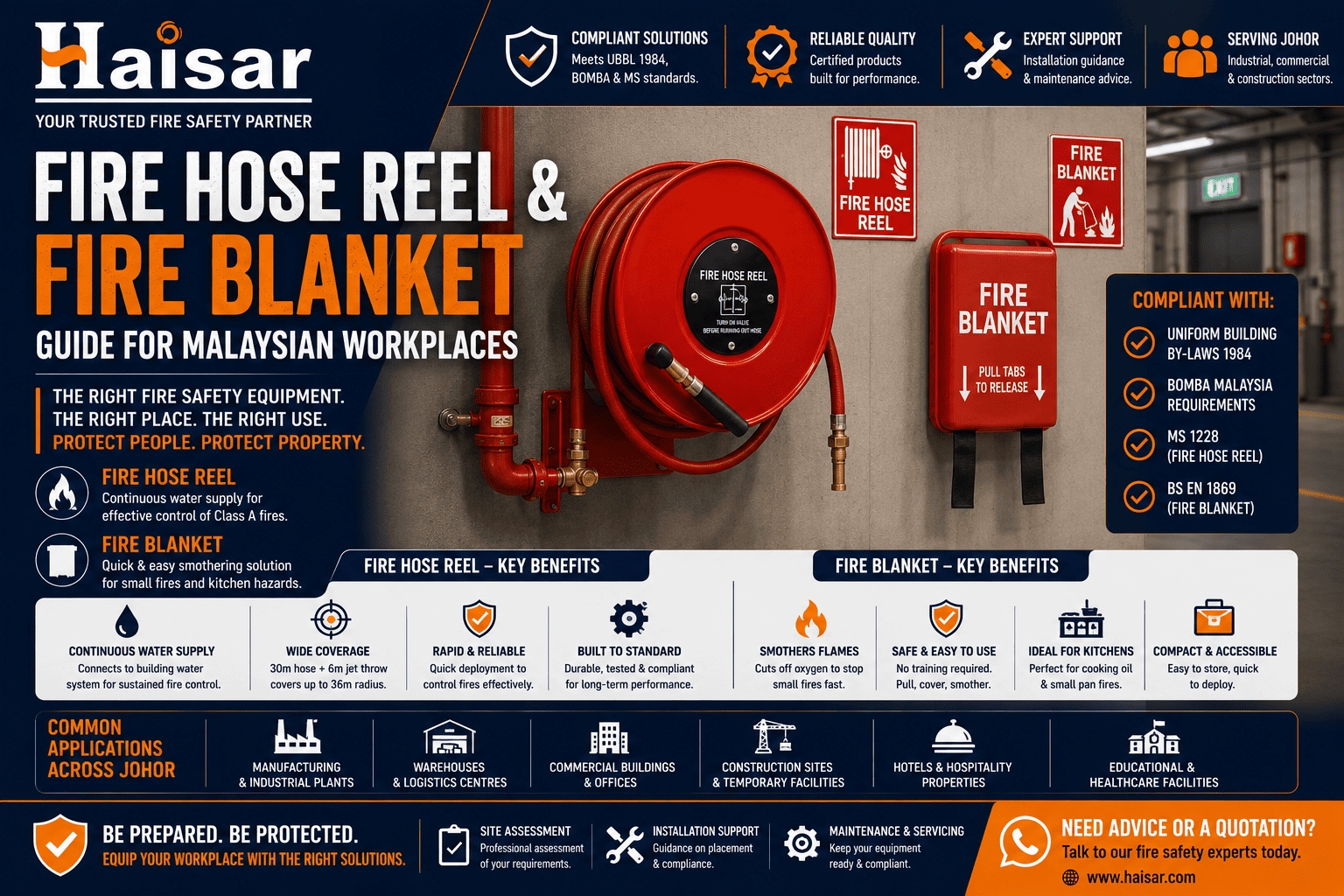
Fire hose reels and fire blankets serve very different purposes. A hose reel provides a continuous water supply for suitable fires involving ordinary combustible solids. A fire blanket is a single-user device designed to smother a small, containable fire by excluding oxygen. Neither product is suitable for every workplace, and neither should be purchased as a generic “BOMBA compliance” item without checking the building’s approved fire-safety requirements and actual hazards.
For Malaysian employers, building owners, facility managers and project teams, the correct approach is to verify what the approved plans and applicable fire-safety requirements call for, choose equipment that meets the relevant standards, maintain it through properly registered providers where required, and train occupants to prioritise alarm, evacuation and personal safety.
|
Need a quotation for fire hose reels, blankets or related equipment? Share your premises type, quantity, required standard, documentation needs and delivery location. Haisar can support equipment sourcing and procurement coordination across Johor and peninsular Malaysia. |
Quick Answer: Which Fire-Fighting Tool Is Intended for Which Situation?
|
Equipment |
Primary purpose |
Suitable examples |
Do not use when |
|
Fire hose reel |
Continuous water application to a suitable early-stage fire |
Paper, timber, textiles, packaging and other ordinary combustible solids |
Live electrical equipment, flammable liquids, cooking oils, reactive metals, unsafe smoke conditions or where the escape route is threatened |
|
Fire blanket |
Smothering a small fire that can be completely covered |
Small cooking-vessel fire; small contained fire within the blanket’s certified scope; clothing fire only where product instructions and trained response support it |
Fire has spread, flames are too large to approach, large commercial fryer, live equipment risk, unknown chemical or metal fire |
|
Portable extinguisher |
Rapid first-aid fire-fighting using an agent matched to the hazard |
ABC powder, CO2, foam, water or wet chemical according to the fire risk and rating |
Agent does not match the fire; fire is beyond incipient stage; smoke, heat or escape conditions are unsafe |
The first action is not to collect equipment. Raise the alarm, call emergency services, help people evacuate and use first-aid fire-fighting equipment only if you have been trained, the fire is still small, the correct equipment is available and a clear escape route remains behind you.
Related Haisar guide: Emergency Evacuation Plan Malaysia
Malaysian Regulatory and Standards Framework
Fire hose reels are fixed fire-safety installations. Their requirement and layout are normally determined through the Uniform Building By-Laws, relevant state or local implementation, approved building plans, the premises fire strategy and JBPM requirements. A buyer should not assume that every office, warehouse, hotel or temporary site facility requires the same system.
JBPM’s ePREMIS standards directory lists MS 1489-1:2023, Fire extinguishing installations and equipment - Part 1: Hose reels and foam inlets. JBPM’s public FAQ also explains that hose-reel positions are planned based on overall coverage and refers to MS 1489-1. The approved design and current standard should therefore be checked instead of applying a simple radius calculation from an article or catalogue.
Malaysia’s Fire Services (Amendment) Act 2025 and regulations that came into operation in February 2026 strengthened the framework for prescribed fire-fighting equipment, fire-safety installations, competent persons and registered fire-safety contractors. Installation, testing, servicing, repair or modification should be assigned only to providers whose current registration and scope cover the work.
Fire blankets are portable products rather than fixed hose systems. Where a blanket is specified, ask for evidence that the product is tested to a recognised current standard for fire blankets, such as EN 1869:2019, and verify the exact model, size, instructions and certificate. A claim that the fabric is “fire resistant” is not the same as evidence that the complete packaged product has been tested as a fire blanket.
|
Important “BOMBA approved” is not one universal certificate that automatically covers every hose reel, blanket, installation and premises. Confirm the product or installation status, referenced standard, material-certification documents, approved plans and the registration status of the provider performing regulated work. |
Related Haisar guide: BOMBA-Approved Fire Equipment in Malaysia
Fire Hose Reels: Purpose and Limitations
A fire hose reel is a fixed installation connected to a water supply. It typically includes a reel or drum, hose, shut-off or control valve, nozzle, pipework and supporting water-supply components. Depending on the approved system, pumps and dedicated storage may also form part of the installation.
The hose reel is intended to provide a controllable water stream for suitable Class A combustible-solid fires. It may support trained occupants in controlling a small fire before it grows, but it does not replace the alarm system, evacuation procedure or fire-service response.
Suitable fire types
- Paper, cardboard and packaging materials
- Timber and many ordinary wood products
- Textiles and similar combustible solids
- Some ordinary solid furnishings and non-reactive general materials, subject to the premises fire plan
When a hose reel must not be used
- Live electrical equipment or any situation where electrical isolation has not been confirmed
- Petrol, solvents, paint, fuel or other flammable-liquid fires
- Cooking oil or fat fires
- Combustible metal or water-reactive chemical fires
- Gas fires unless the fuel supply has been isolated and the emergency procedure specifically permits action
- Any fire producing heat, smoke or rapid growth that makes approach unsafe
- Any situation where using the reel would place the user between the fire and the exit
|
Life-safety rule If there is uncertainty about the fire type, the water supply, smoke conditions or your escape route, do not use the hose reel. Evacuate, close doors where safe and call 999. |
Where Are Fire Hose Reels Required?
The requirement is premises-specific. It may depend on the building purpose group, floor area, height, occupancy, compartment layout, fire load and approved fire-safety design. Similar-looking buildings may have different systems because their approved plans, use or risk profile differ.
Common premises where approved designs may include hose-reel systems include industrial buildings, warehouses, commercial buildings, hotels, educational or healthcare premises and mixed-use developments. This should not be read as a statement that every building in those categories automatically requires the same quantity or layout.
Before purchasing or relocating a reel, review:
- Approved architectural and fire-safety plans
- Applicable UBBL requirements and local-authority conditions
- JBPM comments, Fire Certificate conditions or inspection records where applicable
- Current MS 1489-1 requirements
- Hydraulic design, pump and water-supply information
- Changes to partitions, storage layout, processes or occupancy
Coverage, Location and Access
Do not calculate hose-reel coverage by adding a nominal hose length to an assumed jet throw and drawing a simple circle. Real coverage is affected by partitions, doors, racking, corners, obstructions, hose routing, pressure and the approved design.
JBPM’s published FAQ notes that hose-reel layout is planned based on overall coverage and references MS 1489-1. It also records a 50 m hose-reel-to-hose-reel planning distance in the cited context. The exact number and location for a premises must still follow the approved plans and competent design.
A hose reel should be:
- Readily visible or clearly identified with appropriate signage
- Accessible without moving stock, furniture, pallets or equipment
- Positioned so the hose can be deployed without being trapped by doors or sharp edges
- Protected from impact, corrosion and unauthorised alteration
- Connected to the designed water supply with valves in the correct operating position
- Kept within the configuration shown in the approved fire-safety design
Related Haisar guide: Safety Signage for Workplaces
How to Use a Fire Hose Reel Safely
Site procedures and training must follow the specific reel design and instructions. A typical response sequence is:
- Raise the alarm and ensure the emergency call and evacuation procedures have started.
- Confirm that the fire involves a suitable ordinary combustible material and that water will not create an electrical, chemical or liquid-fire hazard.
- Keep a clear escape route behind you. Do not proceed into smoke or toward a fire that is growing rapidly.
- Open the supply or control valve as required by the system.
- Pull out enough hose to reach the area without tight bends, snags or obstruction.
- Test the nozzle from a safe position and direct the water at the burning material, not at people or electrical equipment.
- Withdraw immediately if heat or smoke increases, the fire spreads, the water supply is inadequate or the escape route becomes unsafe.
A hose reel should be used only by someone who understands its limitations. Untrained occupants should prioritise evacuation and should not delay leaving a building to attempt fire-fighting.
Inspection, Testing and Maintenance of Fire Hose Reels
The maintenance programme should follow the approved system, MS 1489-1, manufacturer instructions, Fire Certificate conditions where applicable and the requirements of the registered provider. Do not rely only on an annual sticker while ignoring access, leakage, valve position or visible damage between services.
|
Check |
What to verify |
Suggested responsibility |
|
Routine visual check |
Unobstructed access; sign visible; cabinet and reel undamaged; no obvious leaks; valve and nozzle accessible; no unauthorised use |
Named facilities or fire-safety representative |
|
Functional inspection |
Hose deployment, reel movement, valve and nozzle operation, water flow and pressure, pump or supply response where applicable |
Appropriately registered competent person or contractor |
|
Hose condition |
Cuts, cracking, blistering, abrasion, flattening, contamination, coupling condition and signs of ageing |
Registered service provider during planned maintenance |
|
System records |
Inspection date, findings, defects, corrective action, replacement components and provider registration details |
Facilities or fire-safety management |
|
After use or alteration |
System restored, hose correctly rewound, valves reset, damage assessed, supply confirmed and incident recorded |
Registered provider and premises responsible person |
The exact formal testing interval should be taken from the applicable standard, approved maintenance programme and provider scope. If the building use, layout, racking or compartmentation changes, obtain a competent review rather than assuming the original hose-reel coverage remains valid.
Related Haisar guide: Workplace Fire Safety Compliance Malaysia
Common Fire Hose Reel Failures
- Reel blocked by pallets, furniture, cabinets or temporary displays
- Valve closed, isolated or inaccessible
- Hose damaged, kinked, flattened or incorrectly wound
- Nozzle missing, seized or replaced with an incompatible part
- Corrosion or leakage at the drum, coupling, pipework or valve
- Insufficient water pressure or an unavailable pump
- Unapproved relocation following renovations or racking changes
- Missing inspection records or work completed by a provider without the correct registration scope
- Employees taught to use the reel without being taught when to evacuate instead
Fire Blankets: What They Are and What They Can Do
A fire blanket is a flexible sheet intended to smother a small fire by excluding oxygen. It is normally stored in a quick-release pouch or rigid container and deployed by one person. EN 1869:2019 specifies requirements for non-reusable fire blankets intended for small fires and includes performance, construction, marking, packaging and preservation requirements.
The blanket must be large enough to fully cover the burning container or small fire. If flames extend beyond the blanket, the user cannot approach safely or the fire involves a large fryer or spread cooking oil, the blanket is not the correct primary control.
Suitable applications
- A small cooking-oil or fat fire in a pan or small vessel that the blanket can fully cover
- Another small, contained fire where the product instructions specifically permit use
- A clothing fire where the blanket is sufficiently large and trained responders follow the product and emergency instructions
Situations where a blanket is not appropriate
- Fire has spread to cabinets, extraction systems, walls or surrounding materials
- Large deep-fat fryer or commercial cooking system beyond the blanket’s tested scope
- Uncontrolled flammable-liquid spill fire
- Reactive chemical, compressed-gas or combustible-metal fire
- Live electrical equipment where power cannot be isolated and safe use is uncertain
- Blanket is too small to completely cover the fire
- User would have to pass through smoke or flames to reach the fire
- Using the blanket as a shield to walk through a fire or smoke-filled escape route
|
Do not confuse products A welding blanket or spark curtain is designed to control sparks, spatter or radiant heat during hot work. It is not automatically a certified EN 1869 fire blanket for smothering a small cooking-oil fire. Specify the correct product for the intended use. |
Fire Blankets in Commercial Kitchens
Fire blankets are commonly provided in commercial kitchens, canteens and food-service areas, but they must be part of a complete kitchen fire strategy. A blanket alone is not adequate protection for every cooking risk.
For a small pan fire, a correctly certified blanket may be suitable when the fire can be fully covered and the user can safely switch off the heat source. Larger fryers may require a suitable wet-chemical extinguisher and, depending on the approved design and risk, a fixed kitchen suppression system. Check the premises fire-risk assessment, approved plans, equipment ratings and JBPM requirements.
Mount the blanket:
- Near enough to the cooking area for quick access, but not directly above or behind the most likely fire source
- Where a user can reach it while keeping an exit route available
- At a practical height with pull tabs clearly visible
- Away from storage, locked cupboards and locations requiring tools to access
- With the manufacturer’s instructions and markings legible
Related Haisar guide: Fire Extinguisher Types in Malaysia
How to Use a Fire Blanket
Follow the instructions printed on the specific product. A common small-pan response is:
- Raise the alarm and ask someone to call emergency services if necessary.
- If it is safe, switch off the heat source. Do not move the pan or carry it outside.
- Pull the release tabs and allow the blanket to unfold.
- Protect your hands behind the blanket edges as directed by the manufacturer.
- Approach only if the fire is small, smoke is limited and your exit remains clear.
- Place the blanket over the entire container from the near side to the far side without throwing it into the oil.
- Leave the blanket in place and allow the container to cool. Do not lift it to check whether the fire is out.
- Evacuate immediately if the blanket does not fully contain the fire or conditions worsen.
Never pour water onto burning cooking oil. The rapid production of steam can eject burning oil and cause a violent fire spread.
Using a Blanket for Clothing Fires
EN 1869 notes that blankets large enough may be suitable for smothering clothing fires. However, the response must not delay immediate action such as stop, drop and roll, emergency shower use where available, calling for help and prompt burn first aid.
Do not wrap a casualty in a way that traps heat or obstructs breathing. After the flames are extinguished, begin appropriate first aid, cool thermal burns with clean cool running water where suitable, avoid removing material stuck to the skin and obtain urgent medical assistance.
Fire Blanket Inspection and Replacement
|
Inspection point |
What to check |
Action |
|
Container or pouch |
Mounted securely, clean, undamaged and not blocked |
Repair mounting or replace damaged container |
|
Release tabs |
Visible, accessible and not tied, taped or trapped |
Restore immediate release access |
|
Instructions and label |
Legible product identity, standard, size and deployment instructions |
Replace if essential information is missing or illegible |
|
Blanket condition |
No evidence of contamination, moisture, damage or partial deployment |
Remove from service and replace if condition is uncertain |
|
After any use |
Blankets certified to EN 1869 are non-reusable |
Replace immediately and record the incident |
|
Suitability |
Size and certified scope match the fire risk |
Upgrade or add wet-chemical/fixed suppression where the risk exceeds blanket capability |
Fire Hose Reel vs Extinguisher vs Fire Blanket
|
Scenario |
Preferred first-aid equipment |
Important limitation |
|
Paper or cardboard fire in a safe, reachable area |
Correct water extinguisher or hose reel, depending on approved provision and fire size |
Do not proceed if smoke, heat or escape conditions are unsafe |
|
Live electrical cabinet |
Usually a suitable rated CO2 or other approved non-conductive agent after following electrical emergency procedures |
Never apply hose-reel water to live equipment |
|
Small pan of burning cooking oil |
Certified fire blanket or suitable wet-chemical extinguisher |
Never use water; blanket must completely cover the pan |
|
Large commercial fryer |
Wet-chemical extinguisher and/or approved fixed kitchen suppression system |
A small blanket may be inadequate |
|
Petrol, solvent or paint fire |
Suitable foam, dry powder or other agent selected for the hazard |
Do not use hose-reel water |
|
Clothing fire |
Stop, drop and roll; emergency shower if available; sufficiently large blanket only as trained |
Call for medical help and start burn first aid |
|
Fire beyond incipient stage |
Evacuation and fire-service response |
Do not attempt first-aid fire-fighting |
Workplace Application Guide
|
Workplace area |
Likely consideration |
What to verify |
|
Warehouse or factory |
Approved hose-reel coverage, extinguisher types, alarm and evacuation arrangements |
Fire load, racking changes, electrical and chemical hazards, unobstructed deployment path |
|
Office or retail building |
System required by approved plans; portable equipment and clear access |
Floor layout, partitions, Fire Certificate conditions where applicable |
|
Commercial kitchen or canteen |
Fire blanket, wet-chemical extinguisher and possibly fixed suppression |
Pan and fryer size, extraction system, gas isolation, approved design |
|
Laboratory |
Blanket may be suitable only for defined small fires; extinguisher agent must match chemicals |
Chemical incompatibilities, live equipment and emergency shutdown procedure |
|
Welding or fabrication area |
Hot-work blanket or curtain for spark and spatter control |
Do not substitute ordinary fire blanket; verify temperature and hot-work rating |
|
Construction site facilities |
Portable extinguishers and other systems according to temporary-building risk and approvals |
Do not assume a hose reel is required without water supply and approved design |
|
Electrical or server room |
Appropriate clean or non-conductive extinguishing agent; isolation procedure |
Hose reel must not be used on energised equipment |
Procurement Checklist for Fire Hose Reels and Fire Blankets
Fire hose reel RFQ information
- Building and area where the system will be installed
- Approved drawing, equipment schedule or consultant specification
- Required standard, including current MS 1489-1 reference
- Reel type, hose type, hose length, nozzle and valve specification
- Cabinet, signage, pipework and corrosion-resistance requirements
- Water pressure, pump and storage information from the system designer
- Material-certification or registration documents required
- Installation, testing and commissioning scope
- Required registration scope of the competent person or fire-safety contractor
- Delivery location, quantity and project programme
Fire blanket RFQ information
- Intended use: small kitchen fire, clothing-fire response or another specific small-fire application
- Required standard and certificate, such as EN 1869:2019
- Blanket dimensions and container type
- Product model, manufacturer and traceability details
- Instruction language and labelling requirements
- Mounting location and quantity
- Confirmation that the product is single-use
- Separate specification where a welding or hot-work blanket is required
|
Buying advice Do not approve a product only because the quotation says “BOMBA approved,” “fireproof” or “SIRIM.” Ask for the exact product model, referenced standard, certificate or registration evidence, supplier scope and compatibility with the approved premises design. |
Frequently Asked Questions
Does every Malaysian workplace need a fire hose reel?
No. The requirement depends on the applicable building regulations, approved plans, building use, size, height, occupancy and fire strategy. Confirm the requirements for the specific premises.
Can a fire hose reel be used on an electrical fire?
No, not while equipment is energised or electrical isolation is uncertain. Water creates a serious shock and arc hazard. Follow the electrical emergency procedure and use the appropriate approved extinguishing agent.
How far can a fire hose reel cover?
Coverage must be assessed from the approved design and current MS 1489-1 requirements. Walls, doors, racking and hose routing affect reach. Do not rely only on a catalogue hose length plus an assumed jet distance.
Is a fire blanket mandatory in every commercial kitchen?
Not as a universal statement. A blanket is commonly specified for small cooking-oil risks, but the complete provision depends on approved plans, the kitchen risk, fryer size and authority requirements. Larger risks may require wet-chemical extinguishers or fixed suppression systems.
Can a fire blanket be reused?
A blanket complying with EN 1869 is intended to be non-reusable. Replace it after any deployment or use, and replace it sooner if the packaging, label or blanket condition is damaged or uncertain.
Can a welding blanket be used as a kitchen fire blanket?
Not unless the exact product is also certified and instructed for that purpose. Welding blankets and fire blankets have different intended uses and performance requirements.
Who should service or modify a hose-reel system?
Use a provider whose current JBPM registration and scope cover the prescribed installation or work. Malaysia’s 2026 regulations strengthened registration controls for competent persons and fire-safety contractors.
Source Fire Safety Equipment Through Haisar
Haisar Supply & Services supports contractors, facility managers, HSE departments and procurement teams with fire-safety, rescue and emergency-response equipment across Johor and peninsular Malaysia.
Relevant supply categories include fire hose reels and associated components, certified fire blankets, portable fire extinguishers, fire-safety signs, emergency-response products and related workplace safety equipment. Haisar can assist with product matching, quotations, documentation requests and multi-category procurement coordination.
Fixed-system design, hydraulic calculations, installation, formal testing, official certification and regulated servicing must be performed or approved by appropriately registered professionals and contractors.
Related Haisar guide: Emergency Response Equipment Checklist
Browse Haisar Fire Safety & Rescue products
WhatsApp Haisar at +60 12-570 7015
Haisar Supply & Services Sdn Bhd (985158-T) | Kulai, Johor, Malaysia | www.haisar.com
|
Disclaimer This article provides general information and does not replace approved building plans, a premises-specific fire-risk assessment, manufacturer instructions, advice from a registered fire-safety professional or requirements issued by JBPM and other relevant authorities. |
Official and Technical References
- Fire Services Act 1988 (Act 341)
- Fire Services (Amendment) Act 2025
- Fire Services (Fire-fighting Equipment or Fire Safety Installation) Regulations 2026
- Fire Services (Competent Person and Fire Safety Contractor) Regulations 2026
- JBPM ePREMIS Malaysian Standards Directory - includes MS 1489-1:2023
- JBPM Frequently Asked Questions - hose-reel coverage and MS 1489-1
- JBPM Material Certification Certificate information
- BSI overview of BS EN 1869:2019 Fire Blankets
