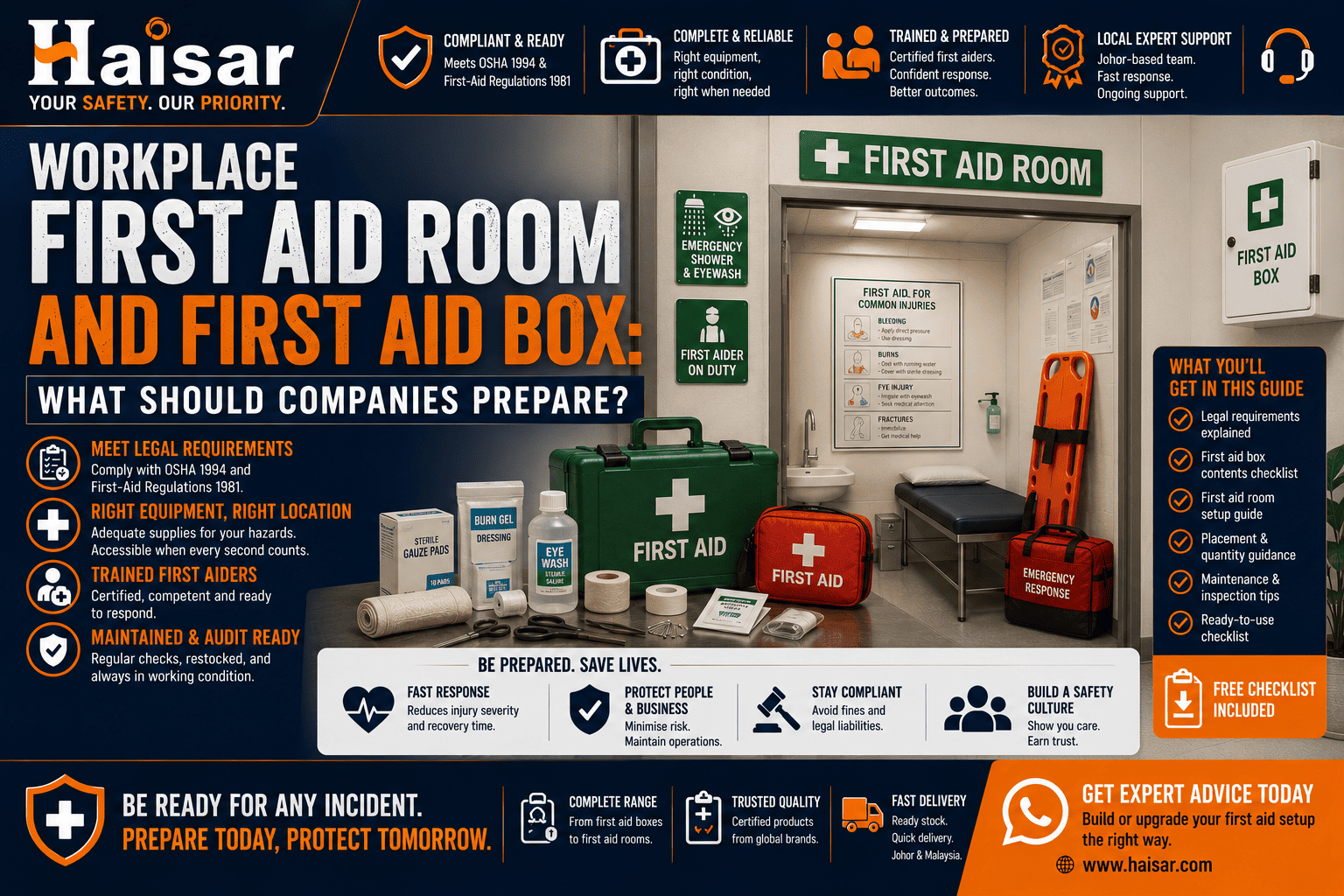
Ask most companies in Malaysia where their first aid box is and they will give you a room or a wall location. Ask them when it was last restocked, whether the contents match the hazard profile of the work, or whether the first aider assigned to that box is still on the same shift - and the confidence drops sharply.

First aid provision is one of the most universally required workplace safety obligations in Malaysia, and one of the most commonly maintained at a level that satisfies a casual glance but fails at the point of use. A first aid box with three plasters, a bottle of antiseptic with an expired date, and an eye pad that was used two months ago is not first aid provision. It is a compliance record that has not been updated to reflect the actual condition of the equipment.

This guide covers what Malaysian companies are required to provide under the Occupational Safety and Health Act 1994, what a properly stocked first aid box and first aid room actually contain, how to calibrate the provision to the specific hazards present in your workplace, and how to maintain first aid equipment so it works at the moment it is needed.

 WhatsApp us for a quick quote 

The Legal Obligation: What Malaysian Law Requires

The obligation to provide first aid in the workplace in Malaysia sits under the Occupational Safety and Health Act 1994 and the First-Aid Regulations 1981. The First-Aid Regulations set out the minimum requirements for first aid provision based on the number of workers employed, the nature of the work, and the distance from the nearest medical facility.

The key requirements that most employers need to meet are as follows.

  • First aid boxes. At least one first aid box must be provided for every 150 workers or fraction thereof in a workplace. The box must be marked with a white cross on a green background, kept in a suitable location, and maintained in a clean and serviceable condition. The contents must be restocked promptly after use and checked regularly to ensure nothing has expired.
  • First aiders. Every workplace with 50 or more workers must have at least one certified first aider. For workplaces with more than 500 workers, additional first aiders are required based on a defined ratio. The first aider must hold a valid certificate from an approved training body recognised under the Regulations. The certificate is valid for three years and must be renewed.
  • First aid rooms. Workplaces with more than 500 workers, or with specific hazardous activities, must provide a dedicated first aid room that meets minimum requirements for equipment, accessibility, and hygiene. The room must have a sink with running water, adequate lighting, a stretcher or examination couch, and the required equipment for the hazard profile of the facility.
  • First aid incidents must be recorded in a register maintained at the workplace. For notifiable accidents under the OSHA, the employer must submit the relevant notification to DOSH within the required timeframe using DOSH Form 8.

The Regulations define the minimum. But a company whose workforce includes chemical handling, machinery operation, working at heights, or other specific hazards has obligations that go beyond the minimum first aid box content. The first aid provision must be adequate for the foreseeable injuries that could occur in that specific workplace. A warehouse with a forklift fleet needs trauma capability that a standard Regulations-compliant first aid box does not automatically include.

First Aid Box Contents: The Minimum Standard and Beyond

The First-Aid Regulations specify a minimum list of items that a first aid box must contain. This list is the regulatory floor, not the recommended setup. For most industrial and commercial workplaces in Malaysia, the minimum list should be supplemented based on the specific hazard profile of the work.

Standard first aid box contents (minimum per First-Aid Regulations)

Adhesive plasters — assorted sizes

Safety pins

Sterile wound dressings — various sizes

Scissors — blunt-ended

Roller bandages — various widths

Tweezers / splinter forceps

Triangular bandages (x2)

First aid guidance card

Sterile eye pads with bandage (x2)

Adhesive tape

Disposable gloves — latex-free

Antiseptic wipes (individually sealed)

Adhesive wound closure strips

Sterile saline eyewash (sealed bottle)

Resuscitation face shield / mask

Accident / incident record book

For workplaces with specific hazard profiles, the following supplementary items should be added to the standard contents or held at the first aid room for first aider use.

Supplementary items by workplace hazard

Haemostatic gauze - hand and laceration risk

Glucose gel sachets - diabetic workers on-site

Chemical burns dressing - chemical handling

AED (defibrillator) - large workforce / remote location

Burn gel dressing - heat and welding risk

Spine board - fall and height injury risk

Tourniquet - high-severity laceration risk

Traction splint - lower-limb fracture risk

Mylar emergency blanket - exposure / shock risk

Irrigation syringe (60 ml) - wound cleaning

Hypothermia blanket - cold environment work

Sealed saline eyewash station - chemical / dust exposure


Important: expiry dates on first aid box contents

Every sealed item in a first aid box - dressings, eyewash bottles, antiseptic wipes, resuscitation masks - has an expiry date. An expired dressing used on an open wound creates infection risk. An expired eyewash bottle may have compromised sterility. Quarterly expiry checks are the minimum standard. High-turnover workplaces with frequent first aid incidents require more frequent review.

First Aid Box Placement: Where and How Many

Quantity and placement are two different questions and both matter. Placing all of a company’s first aid boxes in one central location satisfies a quantity count but fails the accessibility requirement. The Regulations require that first aid be accessible - which in a large facility means distributed across work areas, not centralised for administrative convenience.

  • One box per 150 workers is the quantity reference. For a 300-worker factory, this means a minimum of two first aid boxes. For a 450-worker facility, at least three. But a factory with three separate production buildings, each housing 100 workers, needs a box in each building regardless of the count - because accessibility across buildings during a time-critical incident cannot depend on running between structures.
  • Travel time is the real placement standard. A worker who has sustained a laceration, a chemical splash, or a dust contamination incident needs to reach a first aid box quickly. The practical standard is that a first aid box should be reachable from any work area within ninety seconds of normal walking pace. Map your floor plan, identify the furthest points from your current first aid box locations, and add boxes where the travel time exceeds this.
  • Hazard proximity matters. A first aid box should be positioned near the highest-risk activities in each area. The workshop with angle grinders and cutting equipment needs a box closer than the packaging line next to it. The chemical dispensing area needs a box within reach of the operator, not across the room. Placement by hazard proximity, not by wall space availability, is the correct logic.
  • Signage must be visible. Every first aid box location must be marked with appropriate signage that is visible from the approach direction, not obstructed by equipment or storage, and at a height that is readable from a normal standing position. The sign must remain in place even when the box is temporarily removed for restocking.

For construction sites and project environments

First aid box placement on a construction site must follow the activity, not the site office location. As work fronts move, the first aid box closest to the active work area must move with it. A first aid box in the site office fifty metres from the active work area satisfies a static location record but fails the accessibility standard in practice. Include first aid box repositioning in the weekly site safety walkthrough.

The First Aid Room: What It Must Contain

For workplaces that require a first aid room - those with 500 or more workers, or specific hazardous operations — the room provides the primary medical response capability for serious incidents until emergency services arrive. The first aid room is not a storage room with a stretcher in it. It is a functional treatment space.

Minimum first aid room requirements include:

  • A sink with hot and cold running water and liquid soap.
  • Adequate lighting, including a focused examination light or ceiling-mounted examination lamp.
  • A stretcher, examination couch, or treatment bed with pillow and clean linen.
  • A chair for seated treatment of minor injuries.
  • A first aid cabinet or cupboard stocked to the required standard and secured against unauthorised access.
  • A waste bin with a foot pedal and clinical waste disposal bags.
  • A means of calling for assistance - telephone, intercom, or call point.
  • Clearly displayed emergency contact numbers including BOMBA (994), the nearest hospital emergency department, and the site emergency coordinator.
  • A first aid register or incident recording book.
  • A notice indicating the name and location of the responsible first aider on the current shift.

First aid rooms for facilities with specific hazard profiles require additional equipment beyond this base. Chemical handling facilities should have a dedicated decontamination shower and eyewash within or adjacent to the first aid room. High-voltage electrical environments should have specific electrical injury response guidance and non-conductive first aid equipment. Facilities with confined space permit-to-work should have oxygen therapy equipment available if the confined space atmosphere risk warrants it.

The first aid room must be accessible to an injured person who may have limited mobility. The door must be wide enough for a stretcher. The approach corridor must be clear. The room must not be used for storage, meetings, or any purpose that reduces its availability or cleanliness as a treatment space.

Calibrating First Aid Provision to Your Workplace Hazard Profile

The most common error in workplace first aid provision in Malaysia is treating the Regulations as a specification rather than a minimum. A garment factory, a chemical processing plant, a construction project, and an office building all have different hazard profiles and therefore different first aid requirements. The same box contents and the same first aider-to-worker ratio do not produce the same level of appropriate provision across all four.

The correct approach is to start from the hazard profile of the specific workplace and work forward to the first aid provision required. Consider the following dimensions.

  • Nature and severity of foreseeable injuries. A metal fabrication workshop has a high probability of lacerations, eye injuries from grinding, and burns. The first aid provision needs wound management capability - haemostatic dressings, irrigation equipment, burn gel - that a standard box does not automatically include. A data entry office has a different foreseeable injury profile that does not require the same provision.
  • Chemical hazards. Any workplace where workers handle or are exposed to chemicals needs first aid provision that addresses chemical burns, eye contamination, and inhalation events. This means sealed saline eyewash, chemical burns dressings, and a first aider trained in chemical exposure first response. The COSHH assessment for the facility should drive the first aid provision specification for chemical hazards.
  • Working at height and fall risk. Facilities with working at height activities have a foreseeable risk of falls resulting in spinal injury, head injury, and multiple trauma. The first aid provision needs spinal immobilisation capability — a spine board and cervical collar - and a first aider trained in trauma first response, not just basic wound management.
  • Distance from emergency services. A facility located more than fifteen minutes from the nearest hospital emergency department or ambulance station needs a higher level of first aid provision because the time to definitive medical care is extended. This may mean additional first aiders, a more comprehensive first aid room, and an AED where cardiac event risk exists.
  • Shift and weekend coverage. First aid provision must be available during every hour that workers are on site. This means a certified first aider on every shift, not just the day shift. For 24-hour operations, this means three separate first aider deployments across the three shifts. The logistics of first aider coverage by shift must be planned as part of the first aid provision, not assumed.

First Aid Maintenance: Keeping Equipment Ready to Use

First aid equipment that has not been maintained is first aid equipment that cannot be relied on when it is needed. The maintenance obligation is not a separate compliance requirement from the provision obligation. A first aid box that fails at the point of use because it has not been maintained is a first aid provision failure, regardless of how long it has been on the wall.

Task

Frequency

Who is responsible

Inspect first aid box contents

Monthly

Named first aider or safety officer

Restock used or expired items

After each use

Named first aider

Check expiry dates on all items

Quarterly

Safety officer

Flush eyewash bottles (if present)

Weekly

Named first aider

Inspect first aid room facilities

Monthly

Safety officer

Review first aider coverage by shift

At roster change

HSE manager

Update emergency contact card

When details change

HSE manager

Record all first aid incidents

Immediately after each incident

First aider on duty

Submit DOSH Form 8 (if notifiable)

Within 7 days of incident

Employer or HSE manager

The inspection and maintenance record is the evidence that the obligation has been met. DOSH inspectors, client HSE auditors, and post-incident investigators will ask to see the maintenance log for first aid equipment. A box that was fully stocked twelve months ago with no inspection record since does not demonstrate ongoing compliance. The log must show regular inspection, prompt restocking, and first aider coverage continuity.

Assign by name, not by department

A maintenance schedule that assigns responsibility to “the safety team” or “HSE” creates shared responsibility that defaults to no responsibility. Every first aid box inspection must be assigned to a named individual with a defined inspection date and a countersignature requirement. When that individual is absent, a named deputy must be assigned. The schedule must follow the person, not the role.

First Aider Training and Certification in Malaysia

A first aid box without a certified first aider is an incomplete provision. A first aid room without a trained operator on every shift is a compliance gap that cannot be addressed with equipment alone. First aider training and certification is the human element of first aid provision and must be managed with the same discipline as the physical equipment.

  • Approved training providers. First aider certification in Malaysia must be obtained from a training provider approved under the First-Aid Regulations. The certificate is valid for three years. Companies should maintain a register of first aider names, certificate numbers, issue dates, and expiry dates so that approaching expiry is managed proactively rather than discovered when the certificate has lapsed.
  • Coverage by shift. The certification register must be mapped to the shift roster. Every shift must have at least one certified first aider present. If a certified first aider is absent through leave, illness, or roster change, a replacement with a valid certificate must be rostered for that shift. The absence of a first aider on a shift is a compliance failure under the Regulations.
  • Industry-specific training. Basic first aider certification covers general first response. For workplaces with specific hazard profiles, additional training should be provided to the designated first aiders. Chemical incident first response, trauma and spinal injury management, confined space rescue first aid, and electrical injury response are examples of supplementary training that goes beyond the basic certification scope.
  • First aid as part of induction. All workers should receive basic first aid awareness training as part of their induction — not certification, but awareness of the location of first aid boxes, the identity of the first aider on their shift, the procedure for reporting an incident, and the emergency contact numbers for the facility. This ensures that anyone present at an incident knows the first response steps, even when the certified first aider is not immediately on the scene.

Haisar Supply and Services: First Aid Equipment for Malaysian Workplaces

Haisar Supply and Services Sdn Bhd supplies first aid equipment, first aid cabinets, first aid room fixtures, and supplementary first aid consumables to industrial and commercial workplaces across Johor and peninsular Malaysia. Our first aid range covers standard Regulations-compliant first aid boxes and refill kits, workplace and industrial first aid cabinets, eyewash bottles and eyewash stations, burn dressings and chemical burns kits, trauma and spinal immobilisation equipment, AED units and AED cabinets, and ancillary first aid consumables for restocking and maintenance.

For companies working through a first aid provision review — whether establishing provision for a new facility, upgrading an existing setup to meet a new hazard profile, or preparing for a DOSH inspection — Haisar can advise on the correct provision for your workforce size and hazard categories, supply the full range from a single supplier, and provide the product documentation your compliance records require.

Our team understands the first aid requirements of PETRONAS contractor sites, EPC and construction project environments, chemical and manufacturing facilities, and commercial workplaces across Johor’s active sectors.

Get the Right First Aid Provision for Your Workplace

Whether you are equipping a new workplace, restocking an existing first aid programme, or working through a compliance review ahead of a DOSH inspection, contact Haisar to discuss your first aid equipment requirements. We will advise on the correct box contents and quantity for your workforce and hazard profile, supply compliant and certified products, and help you establish a maintenance framework that keeps your provision ready at the point of use.

→  View Our First Aid and Emergency Response Equipment Range

→  Request a First Aid Equipment Quote

→  See What We Do at Haisar


Haisar Supply and Services Sdn Bhd (985158-T)  •  Kulai, Johor, Malaysia  •  www.haisar.com