Walk into any warehouse, office, laboratory, or construction site in Malaysia and you will find at least one fire extinguisher on the wall. Most people can locate one. Far fewer people can tell you whether it is the right type for the hazard in that specific room, why the one in the server room is a different colour from the one in the kitchen, or what would actually happen if someone grabbed the wrong extinguisher and used it on the wrong class of fire.
This is not a trivial gap. Using a water-based extinguisher on an electrical fire can kill the person holding it. Using a dry powder extinguisher in an enclosed server room can destroy equipment worth hundreds of thousands of ringgit and leave the room uninhabitable for hours. The difference between the right extinguisher and the wrong one is not a technicality. It is a safety-critical decision that gets made in the first ten seconds of an incident, usually by someone who has not thought about it since their last fire safety briefing.
This guide explains the main fire extinguisher types available in Malaysia, what each one is designed to do, where each one belongs, and how to match the right extinguisher to the hazard profile of your specific workplace.
Why Fire Class Matters Before Extinguisher Type
Every fire extinguisher is designed to suppress a specific class of fire. Before selecting an extinguisher type, you need to understand which fire class or classes are present in the area you are protecting.
Malaysia follows the fire classification framework aligned with the international standard. The classes you will encounter in most commercial and industrial settings are as follows.
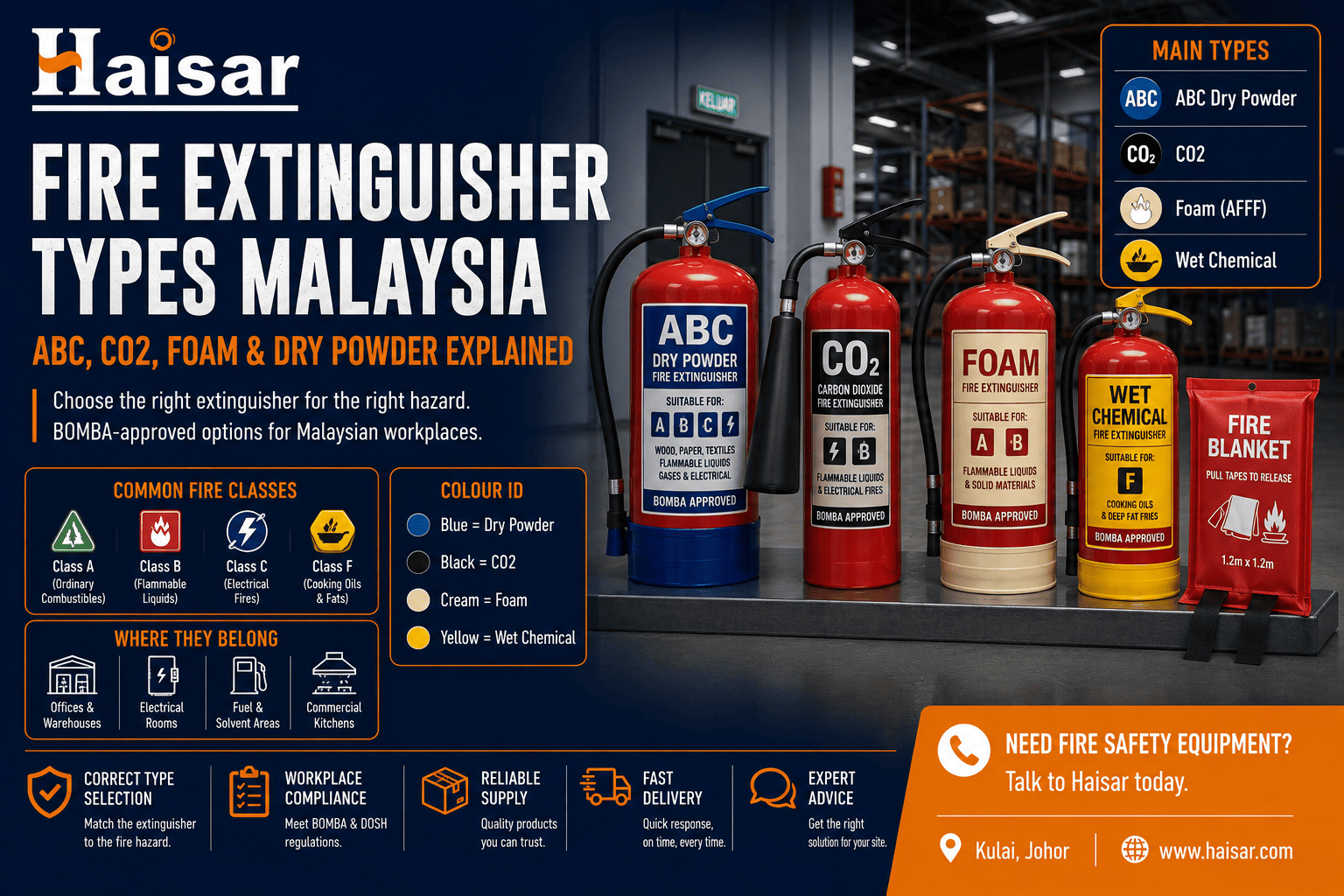
Class A fires involve ordinary solid combustibles — wood, paper, cardboard, fabric, rubber, and most plastics. These are the most common fires in offices, storage areas, and general workspaces.
Class B fires involve flammable liquids and gases — petrol, diesel, solvents, paint, cooking oil, and liquefied petroleum gas. These are the dominant fire risk in workshops, fuel storage areas, kitchens, and chemical handling areas.
Class C fires involve energised electrical equipment — switchboards, control panels, servers, motors, and distribution boards. The electrical current makes these fires uniquely dangerous to fight with conductive agents.
Class F fires involve cooking oils and fats at high temperatures — specifically deep-fryer oil and commercial cooking equipment. This class requires a suppression mechanism that manages the saponification reaction that ordinary agents cannot control.
Some extinguisher types cover multiple fire classes. Some cover only one. Placing an extinguisher rated only for Class A in front of a Class B hazard is not compliance — it is a liability.
Dry Powder (ABC) Extinguishers
Dry powder extinguishers — often called ABC extinguishers because they are rated for Class A, B, and C fires — are the most commonly deployed fire extinguisher type in Malaysia. The agent inside is monoammonium phosphate, a fine chemical powder that works by interrupting the chemical chain reaction of combustion and smothering the fire's oxygen supply.
The ABC rating makes dry powder extinguishers the closest thing to a general-purpose fire extinguisher available, which explains their prevalence on construction sites, in factories, in vehicle workshops, and in general commercial premises where the fire risk is mixed and a single extinguisher type needs to cover multiple hazard classes.
Where dry powder extinguishers belong. Industrial facilities and factories with mixed combustible and flammable liquid risks. Construction sites where the hazard profile includes solid combustibles, fuel storage, and plant equipment. Vehicle workshops and automotive service bays. Warehouses storing mixed goods. Outdoor areas where wind resistance during discharge is needed.
Where dry powder extinguishers do not belong. Enclosed offices, server rooms, clean rooms, laboratories, and food preparation areas. The powder contaminates everything it contacts. After a dry powder discharge in an office, the room requires full cleaning of all surfaces, equipment, and ventilation systems before it can be used. In a server room, a dry powder discharge means the loss of every piece of equipment in the room even if the fire itself was small. In a food preparation area, the contamination renders the space unusable until professional decontamination is complete.
Maintenance consideration. Dry powder extinguishers require regular inspection to ensure the powder has not compacted inside the cylinder, which reduces discharge effectiveness. Annual shaking and testing per BOMBA requirements is the minimum standard.
Carbon Dioxide (CO2) Extinguishers
CO2 extinguishers discharge pressurised carbon dioxide gas, which suppresses fire by displacing the oxygen the fire needs to sustain combustion. CO2 leaves no residue, which makes it the correct choice for any area where post-fire contamination of equipment or surfaces would create its own serious problem.
The electrical non-conductivity of CO2 makes it the standard choice for electrical hazard areas. Unlike water or foam, CO2 does not conduct electricity back to the person using the extinguisher. For Class C fires involving energised electrical equipment, CO2 is the correct extinguisher type.
Where CO2 extinguishers belong. Server rooms and data centres. Electrical switchrooms and distribution boards. Laboratory equipment areas. Office environments where computers and electronic equipment dominate the fire risk. Marine and shipyard applications with electrical hazards. Any space where leaving a residue would cause damage exceeding the fire damage.
Where CO2 extinguishers do not belong. Enclosed spaces with people present where the oxygen displacement creates a suffocation risk. Outdoor areas where the gas disperses before reaching effective concentration. Class A fires involving deep-seated solid combustibles where CO2 provides no cooling effect and re-ignition risk is high.
Practical handling note. The discharge horn of a CO2 extinguisher gets extremely cold during discharge. Touching the horn directly causes cold burns. Operators must hold the handle, not the horn. This is a training point that matters in live incident conditions when the instinct is to grab whatever part of the extinguisher is closest.
Foam (AFFF) Extinguishers
Foam extinguishers use aqueous film-forming foam — AFFF — to suppress Class A and Class B fires. The foam blanket works in two ways: it seals the fuel surface from oxygen, preventing ignition from continuing, and it cools the burning material below the temperature required to sustain combustion.
The foam's ability to flow across a liquid surface and form a continuous seal makes it significantly more effective on flammable liquid fires than dry powder, because dry powder can be easily disrupted once discharged, allowing re-ignition. A foam blanket, once established, is more stable.
Where foam extinguishers belong. Fuel storage and transfer areas. Vehicle refuelling points. Paint stores and solvent handling areas. Marine vessel engine rooms and fuel compartments. Loading bays and logistics facilities where flammable liquid risks coexist with ordinary combustible risks. Car parks.
Where foam extinguishers do not belong. Electrical hazard areas — AFFF conducts electricity and must never be used on energised electrical equipment. Class F cooking oil fires, where the high temperature of burning cooking oil causes a violent steam explosion if water-based foam contacts it directly.
Environmental consideration. Traditional AFFF foam concentrate contains PFAS compounds that are subject to increasing environmental regulation globally. Fluorine-free foam alternatives are available and are becoming the standard specification for new installations and replacement orders. When sourcing foam extinguishers for Malaysian facilities, confirming whether the concentrate is PFAS-free is increasingly relevant for compliance with the environmental management obligations of project principals.
Water and Water Mist Extinguishers
Water extinguishers are the oldest fire suppression technology and remain the most effective agent for deep-seated Class A fires involving solid combustibles. Water works by cooling the burning material below its ignition temperature and absorbing the heat that sustains combustion. The limitation is that water provides no barrier against re-ignition from a remaining fuel source and is actively dangerous on electrical and flammable liquid fires.
Water mist extinguishers are a development of the water extinguisher that addresses some of the traditional limitations. The mist nozzle breaks the water into fine droplets that increase the surface area in contact with the fire, improving the cooling effect, and the mist creates a partial barrier between the fire and the operator. Some water mist extinguishers carry a Class C rating because the fine mist does not conduct electricity in the same way a solid stream does, though this rating should be confirmed on the specific product before relying on it for electrical hazard protection.
Where water extinguishers belong. Paper stores, libraries, and record storage areas. Textile warehouses. Timber yards and wood processing areas. General office Class A hazard areas where no electrical or flammable liquid risk is present.
Where water mist extinguishers belong. Hospital and healthcare environments where cleanliness is critical and CO2's oxygen displacement creates patient safety risks. Commercial kitchens with Class F risks where specific water mist products carry the appropriate rating. Data centre environments where specialist water mist systems are used as fixed suppression.
Where neither belongs. Any area with energised electrical equipment if using conventional water. Any area with flammable liquid storage. Any cooking environment unless the product specifically carries a Class F rating.
Wet Chemical Extinguishers
Wet chemical extinguishers are engineered specifically for Class F fires — high-temperature cooking oil fires in commercial kitchen environments. The agent is a potassium-based alkaline solution that reacts with burning cooking oil through a saponification process, converting the surface of the oil into a thick, soapy, non-flammable layer that seals the fuel from oxygen and prevents re-ignition.
The distinction between a wet chemical extinguisher and other types matters critically in commercial kitchen settings. Using a water extinguisher on a cooking oil fire at frying temperature causes a violent explosion of superheated steam that can project burning oil across the kitchen and onto the operator. Using a CO2 extinguisher on a deep fryer fire can achieve initial suppression but the oil remains at ignition temperature and re-ignites once the CO2 disperses. Only a wet chemical extinguisher creates the stable saponified layer that prevents re-ignition.
Where wet chemical extinguishers belong. Commercial kitchens in hotels, restaurants, canteens, and institutional food service operations. Any facility operating commercial deep fryers or high-temperature cooking equipment. Staff canteens in factories and industrial facilities where commercial cooking equipment is in use.
Where wet chemical extinguishers do not belong. Areas without a Class F risk. The wet chemical agent offers no advantage over other types for Class A, B, or C fires and should not be relied upon as a general-purpose extinguisher.
Matching Extinguisher Type to Workplace: A Practical Guide
Understanding the individual extinguisher types is the first step. The second step is knowing which combination belongs in each specific workplace environment. Most Malaysian workplaces contain more than one fire class risk and require more than one extinguisher type placed in the right locations for the right hazards.
General office. The dominant risk is Class A from paper, furniture, and fitout. Class C electrical risk is present from computers, printers, and distribution boards. Recommended: CO2 extinguishers at electrical equipment locations; dry powder ABC or water mist for general Class A coverage. Avoid: dry powder near workstations and electronics if CO2 can cover the electrical risk.
Factory and industrial floor. Mixed Class A and B risks are typical — solid combustibles from packaging and raw materials, flammable liquids from lubricants and cleaning agents, electrical risk from machinery and control panels. Recommended: ABC dry powder for general coverage; CO2 at electrical panel and control room locations; foam extinguishers near fuel and solvent storage.
Chemical and hazardous materials handling. The specific extinguisher type depends on the chemical hazards present. Solvent-based risks are Class B. Reactive chemical risks may require specialist suppression agents. Electrical hazards at control panels require CO2. The COSHH assessment and fire risk assessment for the facility should define the extinguisher specification.
Server room and data centre. The primary risk is Class C from electrical equipment. CO2 is the standard choice. Some facilities use fixed CO2 or inert gas suppression systems supplemented by portable CO2 extinguishers. Dry powder must never be placed in a server room.
Commercial kitchen. A wet chemical extinguisher is mandatory at every cooking station with high-temperature equipment. A CO2 or ABC extinguisher for Class A and C coverage elsewhere in the kitchen is appropriate. The wet chemical extinguisher must be positioned where the operator can reach it without crossing the cooking area.
Construction site. Mixed hazards across a large area with variable activities. ABC dry powder provides the broadest general coverage. CO2 at the site office, electrical distribution board, and generator. Foam at the fuel storage and vehicle refuelling point. The fire extinguisher placement plan should be reviewed as the site activities and layout change through the project phases.
Petrol station and fuel retail. Class B is the dominant hazard. Foam extinguishers at the pump islands and fuel storage. ABC dry powder as backup. CO2 at the shop's electrical distribution board.
Marine vessel and shipyard. A wide range of hazards across confined spaces, fuel systems, electrical installations, and hot work activities. CO2 for engine rooms and electrical spaces. Foam for fuel and machinery spaces. Dry powder for general deck coverage and hot work proximity. The vessel's fire plan defines the specific placement and type requirements for each compartment.
BOMBA Requirements and DOSH Compliance in Malaysia
Fire extinguisher selection, placement, and maintenance in Malaysia is governed by the requirements of the Fire and Rescue Department of Malaysia (BOMBA) under the Fire Services Act 1988, and by DOSH requirements under the Occupational Safety and Health Act 1994 where workplace safety obligations are applicable.
BOMBA's Uniform Building By-Laws specify the minimum fire extinguisher requirements for different building classes, including the minimum number of extinguishers per floor area, the maximum travel distance to an extinguisher, and the minimum fire rating required for the extinguishers installed.
For most commercial and industrial occupancies in Malaysia, the practical compliance requirements include: fire extinguishers inspected and maintained at minimum twelve-monthly intervals by an authorised service provider; BOMBA-approved extinguishers installed (products not carrying BOMBA approval should not be used to satisfy compliance); a fire safety log maintained on site recording inspection dates, maintenance records, and extinguisher locations; and extinguisher locations marked with appropriate signage at the correct height.
For facilities undergoing BOMBA inspection or renewing their Certificate of Fitness, extinguisher type and placement compliance is among the items inspected. The type must match the hazard class present in each area. Placing an extinguisher of the wrong type at a location to satisfy a quantity requirement without matching it to the hazard is a compliance failure, not a compliance solution.
The DOSH requirement for workplace fire safety under the OSHA framework places an obligation on employers to ensure workers are trained in the correct use of available extinguishers. An extinguisher of the right type in the right location that no worker knows how to use correctly is a partial solution. Fire extinguisher selection and training belong together as a single programme, not as separate compliance tick-boxes.
Extinguisher Colour Coding in Malaysia
Malaysia follows the British Standard colour coding system for fire extinguisher identification, which assigns a panel colour on the extinguisher body to indicate the agent type. The cylinder body is uniformly red across all types. The colour coding appears as a coloured panel near the top of the cylinder.
Red panel indicates a water or water mist extinguisher. Cream or ivory panel indicates a foam extinguisher. Black panel indicates a CO2 extinguisher. Blue panel indicates a dry powder extinguisher. Yellow or canary yellow panel indicates a wet chemical extinguisher.
This colour coding system is the basis for the trained visual identification that fire wardens and workers use to select the correct extinguisher in an emergency. Training should always include colour identification as a practical element, not just the theoretical extinguisher type descriptions.
Sizing: What Capacity Do You Need?
Fire extinguisher capacity is rated in kilograms for dry powder, CO2, and wet chemical types, and in litres for water and foam types. A larger capacity extinguisher discharges more agent for a longer period, which matters for larger fire areas and for ensuring the fire is fully suppressed rather than temporarily knocked back.
For most Malaysian commercial premises, the standard deployments are: 6 kg ABC dry powder for general coverage; 5 kg or 6.8 kg CO2 for electrical hazard areas; 6 litre or 9 litre foam for flammable liquid risk areas; 2 litre or 6 litre wet chemical for commercial kitchens.
BOMBA's fire rating requirements specify the minimum fire rating — expressed as a numerical prefix such as 13A or 34B — that extinguishers in each location must achieve. A higher number indicates a larger fire the extinguisher is rated to suppress. The fire risk assessment for your facility determines whether the standard capacity extinguisher meets the required fire rating for each location, or whether a larger capacity unit is needed.
For large industrial facilities, high-rack warehouses, and facilities with significant flammable liquid volumes, the fire risk assessment may specify trolley-mounted or wheeled extinguishers with significantly larger capacities than the portable units described here.
Haisar Supply and Services: Fire Safety Equipment for Malaysian Workplaces
Haisar Supply and Services Sdn Bhd supplies fire extinguishers, fire safety equipment, and full fire safety compliance packages to industrial and commercial clients across Johor and peninsular Malaysia. Our fire safety range includes ABC dry powder, CO2, foam, wet chemical, and water mist extinguishers from BOMBA-approved sources, alongside fire safety signage, fire blankets, fire hose reels, and ancillary fire safety equipment.
For project buyers and facilities managers working through a fire safety compliance review, Haisar can assess your site's fire hazard profile against the extinguisher types and quantities required, provide a consolidated supply quotation covering your full extinguisher specification, and coordinate delivery to your site against your compliance timeline.
Our team is familiar with BOMBA inspection requirements, DOSH workplace fire safety obligations, and the specific fire safety specifications of PETRONAS contractor sites, EPC project environments, and industrial facility operators across Johor's active sectors.
Talk to Haisar About Your Fire Safety Requirements
Whether you are equipping a new facility, replacing an expired extinguisher inventory, or working through a BOMBA compliance review, contact our team to discuss your fire safety equipment requirements. We will confirm the correct extinguisher types for your hazard profile, advise on quantity and placement against your floor plan, and supply BOMBA-approved products with the documentation your compliance record requires.
View Our Fire Safety and Rescue Equipment Range
Request a Fire Safety Equipment Quote
Haisar Supply and Services Sdn Bhd (985158-T) | Kulai, Johor, Malaysia | www.haisar.com