Most factories and industrial sites in Malaysia have some emergency response equipment on site. A first aid box in the supervisor's office. A fire extinguisher by the main door. An eyewash station installed during the original fit-out that nobody has checked since commissioning.

What most sites do not have is a complete, systematically organised emergency response setup that covers every plausible incident category, with equipment in the right location, maintained to the correct standard, and known to the people who would need to use it in the first two minutes of an incident.

That gap matters most at the moment it matters most - when the incident has already happened and someone is standing in front of a chemical splash, an unconscious colleague, or a spill spreading toward a drain, trying to remember where the relevant equipment is and whether it is in working condition.

This guide gives HSE managers, safety officers, and procurement managers at Malaysian factories and industrial facilities a complete reference for emergency response equipment selection and placement, organised by incident category. At the end is a downloadable checklist that covers every category in this guide, ready for use as an audit tool, a procurement reference, or an onboarding document for new site safety personnel.

 WhatsApp us for a quick quote 

Why a Systematic Approach to Emergency Response Equipment Matters

DOSH's requirements under the Occupational Safety and Health Act 1994 and its subsidiary regulations place clear obligations on employers to provide adequate emergency response capability for the hazards present on their sites. BOMBA requirements under the Fire Services Act 1988 address fire-specific emergency equipment. The requirements of PETRONAS contractor management systems, international client HSE specifications, and third-party audit frameworks add further layers of obligation for many Malaysian industrial facilities.

But compliance with the minimum regulatory requirement is not the same as adequate emergency response capability. The regulatory minimum defines the floor. The hazard profile of your specific facility defines the appropriate ceiling. A factory handling corrosive chemicals needs a more sophisticated emergency eyewash and decontamination setup than the regulatory minimum specifies. A facility operating in a confined space environment needs rescue equipment that a standard DOSH audit checklist may not specifically itemise.

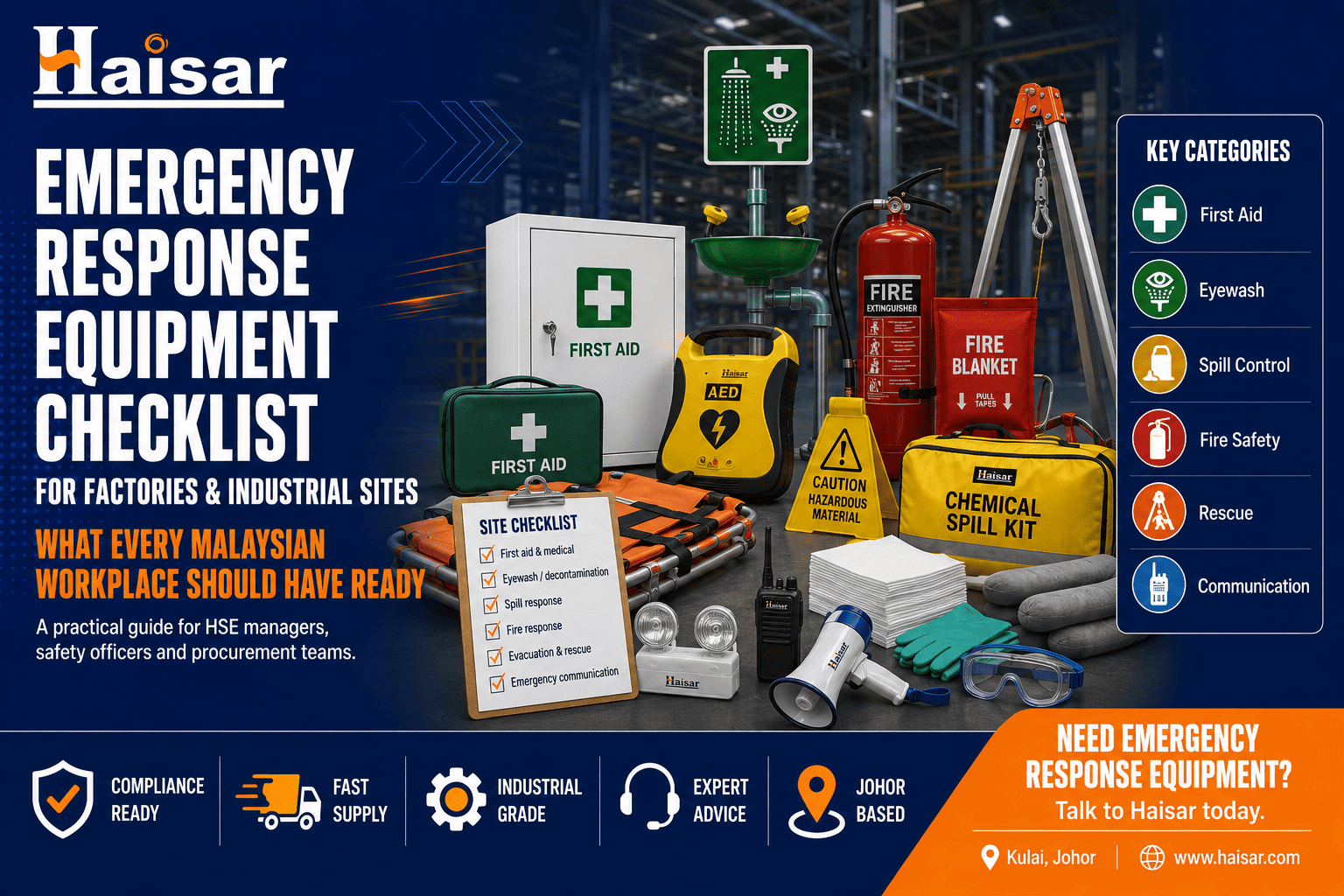
The systematic approach in this guide works through six incident categories that cover the emergency response spectrum for most Malaysian factories and industrial sites: first aid and medical response, eyewash and emergency decontamination, spill response and chemical containment, fire response and suppression, evacuation and rescue, and emergency communication and coordination. Each category has its own equipment requirements, placement logic, and maintenance obligations.

No two facilities have identical requirements. Use this guide and the accompanying checklist as the starting framework, then apply your site's specific hazard profile to identify any category where your site's risk level requires going beyond the general specification.

Category 1: First Aid and Medical Response Equipment

First aid equipment is the most universally required emergency response category. Every factory and industrial site in Malaysia must maintain first aid facilities adequate for the workforce size and the hazard profile of the work.

First aid boxes and kits. The minimum content of a first aid box for a Malaysian industrial workplace is defined under the First-Aid Regulations under the OSHA. For most industrial workplaces, the contents include adhesive plasters in multiple sizes, sterile wound dressings, bandages, triangular bandages, sterile eye pads, disposable gloves, scissors, adhesive tape, resuscitation face shield, and a first aid guidance card. A standard first aid box is not sufficient for all hazard profiles. Facilities with hand and laceration risks should supplement with haemostatic gauze. Chemical handling areas require dedicated chemical burns first aid materials. High-risk electrical environments need specific guidance cards for electrical injury response.

First aid box placement. One first aid box for every 150 workers or fraction thereof is the standard reference, but placement logic matters as much as quantity. First aid boxes must be within reasonable travel distance of every work area, which on a large factory floor may mean multiple boxes distributed across the production area rather than a single central location. Each box must be clearly marked, regularly inspected, and restocked promptly when items are used.

Stretcher and patient movement equipment. A stretcher or carry sheet is required equipment for facilities where a worker could become unconscious or immobile and cannot self-evacuate. Foldable stretchers, spine boards for suspected spinal injury incidents, and evacuation chairs for multi-storey facilities all belong in this category. The stretcher must be accessible in the area where the highest risk of a fall or serious injury exists, not stored in a distant first aid room.

Automated External Defibrillators (AEDs). AEDs are not yet universally mandated for Malaysian industrial workplaces, but they are standard equipment in any facility serious about cardiac event survival rates. The window for effective defibrillation is narrow — survival rates drop sharply with each minute after cardiac arrest. For facilities with large workforces, significant distances from the nearest ambulance response, or workforce demographics that increase cardiac risk, AED deployment is a practical risk management decision independent of the regulatory requirement.

First aider certification and coverage. Equipment without trained operators is incomplete emergency response. Malaysia's First-Aider requirements under OSHA mandate a minimum number of certified first aiders per workforce size. For most industrial workplaces, this means at least one certified first aider available on every shift, not just during day hours. The first aid equipment plan should map trained first aiders to shifts and work areas as part of the overall emergency response plan.

Category 2: Eyewash and Emergency Decontamination

Eyewash stations and emergency showers are mandatory for any facility where workers handle chemicals, solvents, acids, alkalis, or any other substance that can cause eye or skin injury on contact. The value of this equipment is entirely dependent on reaching it within ten to fifteen seconds of exposure — the window before significant tissue damage occurs.

Plumbed eyewash stations. A plumbed eyewash station delivers a continuous flow of tempered potable water for a minimum of fifteen minutes. This is the standard for any fixed chemical handling workstation where the risk of eye splash is routine. The station must be within ten seconds of travel from the hazard — approximately ten metres — with no obstructions, no doors to open, and no delay between activation and flow. Plumbed stations require weekly activation to flush stagnant water from the supply line and prevent microbial contamination, which is one of the most commonly overlooked maintenance requirements on Malaysian industrial sites.

Portable eyewash stations. Portable gravity-fed eyewash stations are appropriate for temporary work areas, remote site locations, or supplementary coverage where plumbing is not available. They must be inspected and refilled according to the manufacturer's schedule. Sealed saline eyewash bottles provide the minimum portable eye irrigation capability for first aid boxes and tool pouches. Each bottle provides approximately fifteen minutes of single-eye irrigation and has a defined shelf life that must be managed.

Emergency safety showers. Where the risk involves full-body chemical contact — spray from pressurised chemical systems, immersion incidents, or large-volume splash from bulk chemical handling — a combined safety shower and eyewash station is required. The shower must deliver a minimum of 75 litres per minute and the activation must be immediate, operable by an injured person without fine motor coordination. The shower head height and coverage area must conform to ANSI Z358.1 or equivalent standard.

Decontamination areas. For facilities handling highly hazardous chemical substances — corrosives at concentration, cytotoxic materials, or persistent skin-absorbing compounds — a dedicated decontamination area with a shower, drain containment, neutralisation materials, and secondary PPE for the responders conducting the decontamination provides a level of response capability beyond a standard safety shower. The decontamination area should be positioned at the exit of the chemical handling zone, not inside it.

Category 3: Spill Response and Chemical Containment

Chemical and hazardous material spills are among the most common industrial incidents in Malaysian facilities. The first ten minutes of a spill response determine whether an incident remains contained or becomes an environmental, safety, and regulatory event.

Spill kits — general purpose. A general-purpose spill kit contains absorbent pads, socks, pillows, disposal bags, and gloves sufficient to contain and absorb a defined volume of spilled liquid. Kits are rated by absorbent capacity in litres. For most factory floor locations without specific chemical hazards, a general-purpose kit rated for 30 to 50 litres provides adequate primary response capability. Kits must be placed at every fuelling point, lubricant storage area, and process chemical dispensing location.

Spill kits — chemical specific. For acid spills, the correct absorbent is an acid-specific neutralising material that reacts with the acid during absorption, reducing the risk to the responder and the concentration of the recovered material. For alkali spills, an alkali-specific neutralising absorbent applies the same principle. Using a general-purpose cellulose absorbent on an acid spill does not neutralise the hazard — it transfers it. The chemical inventory at your facility should map directly to the spill kit specification at each chemical storage and handling location.

Hazchem spill kits. For facilities storing scheduled chemicals under Malaysia's Environmental Quality Act or handling chemicals with aquatic toxicity, a hazchem spill kit with drain sealing plugs, bund extenders, and additional containment equipment provides the response capability to prevent a spill from reaching drainage infrastructure. The Environmental Quality (Scheduled Wastes) Regulations 2005 and DOSH's Process Safety Management requirements both create obligations for facilities that go beyond basic absorbent management.

Drain sealing and bunding equipment. A drain seal — a rubber or foam plug sized to standard drain apertures — is basic emergency containment equipment that can prevent a spill from becoming a waterway contamination incident. Every facility with outdoor drains in proximity to chemical storage should have drain seals readily accessible. Inflatable drain blockers and drain seal bags provide a higher-capability option for large-diameter drains and culverts.

Spill response PPE. Responding to a spill without appropriate PPE converts the responder into the second casualty. Chemical-resistant gloves, protective apron or chemical splash suit, face shield, and chemical-resistant boots must be stocked as part of the spill response kit for any hazardous chemical handling area. The PPE specification must match the chemicals present — nitrile gloves adequate for one chemical may be inadequate for another.

Category 4: Fire Response and Suppression Equipment

Fire response equipment at the portable and first-response level forms the critical gap between the automatic detection system alarming and the fire brigade arriving. Correct equipment in the right hands in the first ninety seconds of a fire incident can prevent a manageable incident from becoming a structural fire.

Fire extinguishers by type and location. The correct fire extinguisher type must match the fire class risk at each location. ABC dry powder extinguishers provide the broadest general coverage for mixed Class A and B risks on the factory floor. CO2 extinguishers belong at every electrical panel, server room, and control room. Foam extinguishers belong at fuel storage, chemical stores, and flammable liquid handling areas. Wet chemical extinguishers are mandatory at commercial cooking equipment. Placing the wrong extinguisher type at a location because a quantity is needed is not compliance — it is a liability. For a detailed breakdown of extinguisher types and placement logic, refer to our fire extinguisher types guide.

Fire hose reels and hydrant equipment. Fixed fire hose reels provide a higher-volume water supply than portable extinguishers for Class A fire situations involving larger material volumes. Hose reel placement and coverage radius must be confirmed against the floor plan. Hose reel cabinets must remain accessible — a hose reel with pallets stacked in front of it does not exist for response purposes.

Fire blankets. Fire blankets are standard equipment for commercial kitchen environments and for any area where clothing-on-fire and small contained fire risks are present. A fire blanket at every cooking station and at the first aid station provides a basic tool that workers can use without training to smother a small fire or protect an injured person from flame exposure.

Thermal imaging and detection. For facilities with the budget and risk profile to justify it, portable thermal imaging cameras available to the emergency response team allow identification of hotspots before they become fires and detection of fire spread behind barriers during an incident response. This is not standard equipment for all facilities but is relevant for large chemical stores, high-rack warehouses, and facilities with significant thermal process equipment.

Category 5: Evacuation and Rescue Equipment

Evacuation and rescue equipment covers the tools and systems needed to move people out of a hazardous area safely, and to retrieve personnel who cannot self-evacuate due to injury, incapacitation, or work location.

Emergency evacuation signage and lighting. Emergency exit signs and evacuation route markers must be illuminated, unobstructed, and visible from any point along the evacuation route. Emergency lighting — lighting that activates on mains power failure — must cover all evacuation routes, stairways, and assembly areas. BOMBA's inspection requirements include signage and emergency lighting as standard checklist items. Signage that is covered by storage, blocked by new equipment, or missing from a route extended during a facility expansion is a compliance failure and a real evacuation risk.

High-visibility evacuation vests for wardens. Floor wardens and emergency response team members need to be immediately identifiable during an evacuation. High-visibility vests marked with the warden's role — Floor Warden, First Aider, Incident Commander — allow the workforce to identify who to follow and who to report to during an emergency without confusion. The number of vests required is determined by the warden coverage ratio for the facility's workforce and floor plan.

Confined space rescue equipment. For any facility with permit-to-work confined spaces — tanks, vessels, manholes, pits, or enclosed process areas — dedicated confined space rescue equipment is not optional. A confined space rescue kit includes a tripod or davit arm, a winch or fall arrest/retrieval device rated for rescue loads, a rescue harness suitable for the casualty's retrieval position, and attendant PPE including supplied air respiratory protection where the atmosphere of the space cannot be verified. The equipment must be positioned at the confined space entry point during every entry, not stored in a central location and retrieved if needed.

Working at height rescue equipment. For facilities with work at height activities — rooftop plant maintenance, rack installation, scaffolding operations — a height rescue kit or rescue descent device provides the capability to lower an incapacitated worker from a height before the fire brigade's aerial equipment arrives. The ten to fifteen minute response time of emergency services means that a worker hanging unconscious in a harness at ten metres needs to be retrieved by the site's own team.

Evacuation chairs. Multi-storey facilities must provide for the evacuation of workers who cannot use stairs — due to physical disability, injury, or incapacitation during the incident. Evacuation chairs, stair descent devices, and refuge area provision address this requirement. The evacuation plan must account for this population explicitly, not treat it as an exception to be managed on the day.

Rope and rescue lines. Basic rescue lines — throw bags, guide lines, and safety ropes — belong at any facility with a water body, open drainage channel, or process vessel that creates an immersion risk. A worker who falls into a bunded tank or drainage channel may be unable to climb out without assistance, and a guide line thrown by a bystander is a faster initial response than waiting for lifting equipment to arrive.

Category 6: Emergency Communication and Coordination Equipment

Emergency response equipment without a functioning communication system to activate it, coordinate it, and call for external assistance is an incomplete system. Communication and coordination equipment is the connective tissue of the emergency response plan.

Emergency alarm and PA system. The factory alarm system must be audible across every area of the facility, including areas with high ambient noise levels. For facilities with multiple buildings or outdoor work areas, a combination of audible alarm and visual strobe ensures all workers receive the emergency signal regardless of noise conditions. The alarm must have a tested backup power supply. An alarm system that fails during a mains power disruption is the situation most likely to coincide with a process emergency.

Emergency contact boards and information. A clearly displayed emergency contact board at the facility entrance, security post, and first aid room lists: the internal emergency extension number, BOMBA's emergency number (994), DOSH incident reporting contact, the nearest hospital with emergency department, the hospital's phone number, and the names and direct numbers of the site emergency coordinator and backup. In an incident, the person making the first call may not be the HSE manager. They need the information in front of them without searching.

Two-way radios for emergency response team. The site's emergency response team requires reliable communication independent of the facility's phone system. Two-way radios dedicated to the emergency response team — charged, tested weekly, and stored at a known location — ensure that the incident commander, floor wardens, first aiders, and the site entrance security point can communicate throughout an incident, including during an evacuation when mobile phones may be inadequate due to network congestion.

Emergency muster board or accountability system. A muster board or electronic roll-call system provides the incident commander with a definitive account of which workers are present, which are accounted for at the assembly point, and which may remain in the building. Paper-based visitor registers must be taken to the assembly point during an evacuation. Facilities with large workforces, contractor movements, and visitor flows benefit from an electronic access control system that generates a real-time attendance report accessible from outside the building during an incident.

First aid room and incident reporting materials. The first aid room or designated first aid area should stock incident report forms, body fluid exposure reporting forms, and the DOSH Form 8 (Accident Notification) for completion following a notifiable incident. These are administrative items, not emergency response tools, but they belong in the emergency response system because the window for accurate reporting is immediately after the incident, before memory degrades and witnesses disperse.

Maintenance, Inspection, and Compliance Records

Emergency response equipment that is not maintained is emergency response equipment that does not work when it matters. The maintenance obligation for each equipment category is as binding as the installation obligation.

First aid boxes must be inspected monthly and restocked immediately after use. Fire extinguishers must be inspected annually by an authorised service provider with maintenance records retained. Eyewash stations must be flushed weekly and their water quality checked. Spill kits must be inspected and restocked after any use, and checked on a regular schedule to ensure absorbents have not degraded. Emergency lighting must be tested monthly for function and annually for duration. Confined space rescue equipment must be inspected before every confined space entry and formally inspected annually.

The inspection and maintenance record for each item is as important as the item itself during a DOSH inspection, a BOMBA audit, or a post-incident investigation. A fire extinguisher that was never serviced has the same regulatory standing as a fire extinguisher that was never installed. The record is the evidence that the obligation was met.

Assign inspection responsibilities to named roles, not just departments. A maintenance checklist that belongs to "safety" gets done when someone in safety does it. A checklist with a named inspector and a countersignature requirement gets done on schedule.

Emergency Response Equipment Checklist: Section Summary

The downloadable checklist at the end of this guide covers all six categories above in a format ready for use as a site audit, a procurement reference, or an onboarding document. Each section lists the equipment items, the minimum standard or specification reference, the recommended placement, and columns for recording the quantity on site, the condition, the last inspection date, and any action required.

Section 1 — First Aid and Medical Response: First aid boxes by location, stretcher and patient movement equipment, AED, first aider shift coverage register.

Section 2 — Eyewash and Emergency Decontamination: Plumbed eyewash stations, portable eyewash units, emergency safety showers, decontamination area equipment, maintenance log.

Section 3 — Spill Response and Chemical Containment: General purpose spill kits by location and capacity, chemical-specific spill kits matched to chemical inventory, drain seals, spill response PPE by hazard zone.

Section 4 — Fire Response and Suppression: Extinguishers by type and location, hose reels, fire blankets, fire detection and alarm system status.

Section 5 — Evacuation and Rescue: Signage and emergency lighting, warden vests and role assignments, confined space rescue kit per entry point, height rescue equipment, evacuation chairs for multi-storey areas.

Section 6 — Emergency Communication and Coordination: Alarm system test record, emergency contact board locations, two-way radios and charge status, muster system, incident reporting forms.

Haisar Supply and Services: Emergency Response Equipment for Malaysian Industrial Sites

Haisar Supply and Services Sdn Bhd supplies the full range of emergency response equipment for factories and industrial facilities across Johor and peninsular Malaysia. Our emergency response range covers first aid equipment and cabinets, eyewash stations and safety showers, chemical spill kits and containment equipment, fire extinguishers and fire safety equipment, confined space and working at height rescue equipment, evacuation equipment, and emergency response PPE for first responders and emergency teams.

For HSE managers and procurement teams working through an emergency response equipment review, Haisar can assess your facility's hazard profile, identify gaps in your current emergency response equipment inventory against the categories in this guide, and provide a consolidated supply quotation covering your full requirements. We supply to DOSH and BOMBA compliance standards and can provide the product documentation your compliance records require.

Our team is familiar with the emergency response requirements of PETRONAS contractor sites, EPC and construction project environments, chemical and process facilities, marine and shipyard operations, and manufacturing facilities across Johor's active industrial sectors.

Download the Emergency Response Equipment Checklist

The complete Emergency Response Equipment Checklist covering all six categories in this guide is available for download. Use it as your site audit tool, procurement reference, or new-site commissioning checklist. Every item in this guide appears in the checklist with its placement recommendation, minimum specification, and inspection frequency.

Download the Emergency Response Equipment Checklist

Or contact our team directly to discuss your facility's emergency response equipment requirements. We will work through the checklist with you, identify your gaps, and provide a complete supply solution from a single supplier relationship.

View Our Emergency Response and Fire Safety Equipment Range

See What We Do at Haisar

Haisar Supply and Services Sdn Bhd (985158-T) | Kulai, Johor, Malaysia | www.haisar.com