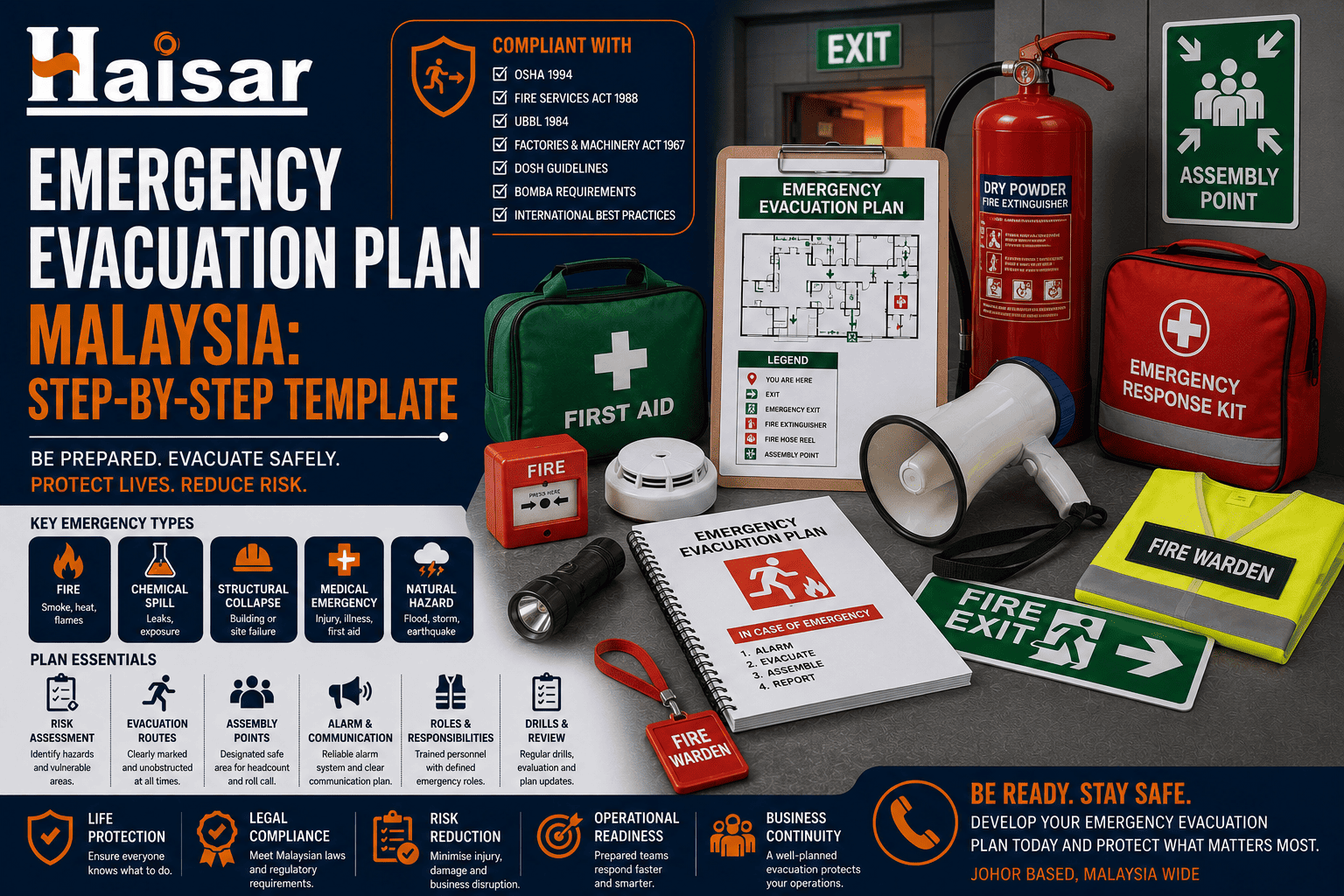
An emergency evacuation plan is not a document that lives in a filing cabinet. It is an operational system that must work under pressure, in the dark, with noise and confusion, and with workers who may never have rehearsed what to do. When an emergency occurs at a workplace in Malaysia, whether it is a fire, a chemical release, a structural collapse, or a medical emergency, the evacuation plan is what stands between a controlled response and a chaotic one.

Malaysian law is clear on the obligation. OSHA 1994, the Fire Services Act 1988, BOMBA requirements for certificate of fitness premises, and the Factories and Machinery Act all impose obligations on employers to have documented emergency procedures, to communicate them to workers, and to test them through regular drills. Despite this, emergency evacuation plans in Malaysian workplaces range from genuinely effective operational documents to paper compliance exercises that would not survive first contact with a real emergency.

This guide explains what a legally compliant and operationally effective emergency evacuation plan in Malaysia must contain, walks through a step-by-step template you can adapt for your workplace or project site, and covers the equipment and signage required to support plan implementation.

At the end of this guide, a downloadable template is available. Use it as the starting point for your site-specific plan, not as a finished document. Every effective emergency evacuation plan is specific to the facility, the workforce, and the hazards it addresses.

 WhatsApp us for a quick quote 

The Regulatory Basis for Emergency Evacuation Planning in Malaysia

Understanding the legal obligations underpinning emergency evacuation planning helps prioritise what the plan must contain and what level of detail DOSH and BOMBA expect to see.

OSHA 1994, Section 15. The general duty requires employers to provide and maintain safe systems of work and to provide such information, instruction, training, and supervision as is necessary to ensure the safety and health at work of employees. Emergency procedures and evacuation training are explicitly part of this obligation.

Occupational Safety and Health (Employer's Safety and Health General Policy Statements) (Exception) Regulations 1995. Employers above the specified threshold must have a written safety and health policy that includes emergency procedures. The policy must be communicated to all employees.

Fire Services Act 1988 and Fire Services (Means of Escape) Regulations. These regulations govern the provision of adequate means of escape from fire in buildings and the maintenance of escape routes in a usable condition at all times. BOMBA enforces these requirements through the certificate of fitness process and through periodic inspection of premises.

Uniform Building By-Laws 1984. The UBBLs set specific requirements for fire exits, exit widths, exit signage, emergency lighting, and fire assembly points that must be reflected in the evacuation plan.

Factories and Machinery Act 1967. For factory premises, the Act and subsidiary regulations require documented emergency procedures including fire safety and chemical spill response.

Industry-Specific Requirements. Oil and gas operations under PETRONAS and PCSB requirements, offshore operations under the Petroleum Safety Measures Act, construction projects under CIDB guidelines, and international client specifications all impose additional emergency planning obligations beyond the OSHA baseline. An emergency evacuation plan that meets the OSHA minimum may not meet the requirements of an international client or a PETRONAS principal contractor.

What Makes an Evacuation Plan Effective

Before moving to the template, it is worth distinguishing between a plan that satisfies compliance documentation requirements and one that actually works in an emergency.

A compliant evacuation plan contains the required elements and is available for inspection. An effective evacuation plan does everything a compliant plan does and also results in all workers reaching the assembly point safely when an alarm sounds. The gap between these two outcomes is usually explained by three things.

Workers do not know the plan. The plan exists but has not been communicated to all workers, has not been communicated in languages the workforce can understand, or has been communicated once at induction and never reinforced.

The plan does not match the site. The plan was written at project start and the site has changed significantly since then. Temporary structures have altered escape routes. New work areas have been created without corresponding evacuation provisions. Contractors have come and gone and the current workforce composition is not reflected in the plan.

The plan has not been tested. A plan that has never been rehearsed in a drill is a plan whose weaknesses have not been found. Drills identify blocked exit routes, broken emergency lighting, confused assembly point locations, workers who did not hear the alarm, and supervisors who do not know their fire warden responsibilities. These are problems that must be found in a drill, not in a real emergency.

The template below is designed to produce a plan that is communicable, maintained, and testable, not just documentable.

Emergency Evacuation Plan Template: Step-by-Step

Section 1: Facility and Plan Information

This section establishes the basic facts about the premises and the document itself. Every evacuation plan must be specific to a location.

Facility name and address. The full physical address of the premises including GPS coordinates for large sites or remote locations where emergency services may have difficulty locating the site from the address alone.

Plan version and date. Evacuation plans must be reviewed and updated whenever the facility changes, whenever the plan is tested and weaknesses are identified, and at least annually. Version control ensures that the current plan can be identified and that outdated versions are not being followed.

Plan owner. The named individual responsible for maintaining the plan, coordinating drills, and ensuring that the plan is communicated to all workers. This is typically the Safety and Health Officer (SHO) or HSE Manager for the facility.

Emergency contact numbers. A complete list including BOMBA (994), police (999 or 112), ambulance (999 or 112), the nearest hospital emergency department, DOSH emergency contact, and facility management emergency contacts. These must be current and must be displayed prominently at key locations throughout the facility, not only in the plan document.

Scope of the plan. The specific areas, buildings, and operations covered by the plan. For multi-tenanted buildings or multi-contractor project sites, the scope defines which areas are covered by this plan and how it interfaces with evacuation plans for other occupants or contractors.

Section 2: Emergency Scenarios Covered

An effective evacuation plan addresses the specific emergency types credible at the facility, not a generic list. The scenarios covered must be informed by the hazard profile of the premises.

Fire. The primary evacuation scenario for most Malaysian workplaces. Must address fire alarm activation, evacuation routes for each area of the facility, assembly points, and fire warden responsibilities.

Chemical release or spill. For workplaces handling chemicals hazardous to health, a chemical release or spill may require evacuation of the affected area or of the entire facility depending on the nature and quantity of the release. The plan must address how a chemical release is communicated to all workers and how the evacuation is initiated and coordinated.

Structural failure or explosion. For construction sites and industrial facilities, partial structural collapse or an explosion incident may result in blocked evacuation routes that require alternative exit paths. The plan must identify secondary and tertiary evacuation routes for each area.

Medical emergency. Serious injuries and sudden illness require a response that may involve partial evacuation or creating a clear path for emergency services access. The plan must identify first aid resources, AED locations, and the procedure for calling and directing emergency services to the casualty location.

Gas leak. For facilities handling or connected to gas supply systems, a gas leak scenario requires rapid evacuation before an ignition source triggers a fire or explosion. The gas isolation procedure must be documented alongside the evacuation procedure.

Natural disaster. For sites in areas with flood risk, the plan must include a flood evacuation procedure. Malaysia's monsoon seasons produce flooding events that can develop rapidly on low-lying industrial sites in Johor and across the peninsula.

Section 3: Evacuation Routes and Assembly Points

This is the operational core of the plan and the section that must be most precisely tailored to the specific facility.

Floor plans and evacuation route maps. Clear, legible floor plans for each level of the facility showing all exit doors, evacuation routes, fire extinguisher locations, first aid equipment locations, AED locations, fire alarm call points, and assembly points. Floor plans must be posted at key locations throughout the facility and must reflect the current layout.

Primary evacuation routes. For each area of the facility, the primary evacuation route describes the path from that area to the nearest safe exit. Routes must be clear of obstructions at all times. Blocked or obstructed evacuation routes are one of the most common BOMBA inspection findings.

Secondary evacuation routes. For each area, an alternative route must be identified for use when the primary route is blocked by fire, smoke, structural damage, or another hazard. Workers must know both their primary and secondary routes.

Assembly points. One or more designated assembly points must be identified at a safe distance from the building. Assembly points must be clearly signposted, must be large enough to accommodate the full workforce, and must be located so that they do not impede access for emergency service vehicles. Multiple assembly points may be needed for large sites to allow workers from different areas to assemble without crossing through hazardous areas.

Personnel accountability procedure. At the assembly point, the fire warden for each work area must carry out a headcount and confirm to the Assembly Point Warden that all personnel from their area are accounted for. The accountability procedure must identify who is responsible for accounting for visitors, contractors, and workers in remote areas of the site. Missing persons must be reported immediately to the Assembly Point Warden and communicated to BOMBA on their arrival.

Section 4: Fire Warden Structure and Responsibilities

The human system that executes the evacuation plan is as important as the physical plan document. Every area of the facility must have a designated Fire Warden with a trained deputy.

Fire Warden appointment. Fire Wardens must be appointed in writing, must be trained in fire warden responsibilities, and their appointment must be reviewed when they change roles or leave the organisation. A list of current Fire Wardens must be maintained and must be available for BOMBA inspection.

Fire Warden responsibilities on alarm activation. Direct workers in their area to evacuate via the designated primary or secondary route. Conduct a sweep of their area to check for workers who may not have heard the alarm, including toilet facilities, storage rooms, and plant rooms. Confirm that all workers from their area have evacuated. Proceed to the assembly point and carry out a headcount. Report to the Assembly Point Warden.

Assembly Point Warden responsibilities. The Assembly Point Warden coordinates the accountability process at the assembly point, receives headcount reports from Fire Wardens, reports missing persons to BOMBA, and acts as the primary point of contact for emergency services on arrival. The Assembly Point Warden must know the total number of persons on site at the time of evacuation.

Responsibilities for workers with mobility impairment. Workers who cannot self-evacuate using the designated routes must have a Personal Emergency Evacuation Plan (PEEP) that identifies a safe refuge location and the person responsible for their assisted evacuation. PEEP requirements must be assessed at induction for all workers and updated when the worker's mobility status changes.

Section 5: Communication and Alarm Systems

Alarm activation. Describe the fire alarm system in the facility, how it is activated (automatic detection, manual call point), and what workers should do on hearing the alarm. The response to the alarm must be unambiguous: evacuate immediately via the designated route. The alarm must not be silenced or ignored pending investigation.

All-clear procedure. Define who has the authority to declare the all-clear and allow workers to return to the facility. All-clear must only be given by the Assembly Point Warden after confirmation from BOMBA or facility management that the premises are safe. Workers must not re-enter the building on their own initiative before the all-clear is given.

Communication with workers in remote areas. For large sites, workers in remote areas including plant rooms, storage areas, and areas with high ambient noise may not hear the main alarm. Secondary alert methods including radio communication, buddy systems, and zone-specific alarm sounders must be documented.

Communication with emergency services. The procedure for calling BOMBA, police, or ambulance must be documented. The person calling must be prepared to provide the facility address, the nature of the emergency, the number of people on site, and any specific hazards that emergency services should be aware of including chemical storage, gas systems, and confined space locations.

Section 6: Special Considerations

Shift workers and night operations. The number and location of Fire Wardens must be adequate for all operational shifts, not just the day shift. Night shift operations with reduced staffing must have sufficient trained Fire Wardens to cover the evacuation procedure.

Contractors and visitors. All contractors and visitors must be inducted in the evacuation procedure before starting work or entering the facility. The induction must include the alarm sound, the evacuation routes for the areas they will access, the assembly point location, and the accountability procedure.

Multilingual workforce. On project sites and in facilities with a diverse workforce, the evacuation plan and the induction materials must be available in the languages spoken by the workforce. A worker who cannot read or understand the plan cannot follow it effectively.

Persons working alone. Lone workers require specific provisions including a check-in system that would trigger an emergency response if they fail to check in at the required interval.

Contractor interfaces. For multi-contractor project sites, the evacuation plan must define how the accountability process works across contractor boundaries, who has overall responsibility for the assembly point, and how the overall all-clear is communicated.

Section 7: Emergency Equipment Inventory

The plan must document the location, type, and maintenance status of all emergency equipment on site.

Fire extinguishers. Type, rating, location, and service status. All extinguishers must be BOMBA-approved and serviced annually by a BOMBA-registered contractor.

Fire hose reels. Location and maintenance status.

Emergency lighting. Locations and monthly test records.

Exit signage. Locations and condition. Signs must be illuminated and must be visible from the approach to each exit.

First aid kits. Locations, contents, and last inspection date.

AED units. Locations, battery status, and pad expiry dates.

Eye wash stations. Locations and last flush date.

Chemical spill kits. Locations, kit type, and contents check date.

Emergency contact display boards. Locations of posted emergency contact information throughout the facility.

Section 8: Drill Programme and Plan Review

Drill frequency. Fire evacuation drills must be conducted at minimum annually for most Malaysian workplaces. Higher-risk facilities and those with high contractor turnover benefit from more frequent drills. The first drill on a new project site should be conducted as soon as a sufficient workforce is on site, not at the end of the project.

Drill report. Each drill must be documented with the date, time, number of participants, time to full assembly, issues identified, and corrective actions. The drill report is a DOSH and BOMBA document and must be available for inspection.

Plan review triggers. The evacuation plan must be reviewed and updated after every drill, after any change to the facility layout or evacuation routes, after any emergency incident, after significant changes to the workforce composition or contractor base, and at least annually regardless of whether any of the above have occurred.

Emergency Equipment Your Plan Depends On

An evacuation plan without the supporting equipment is a document, not a system. The equipment required to implement an effective evacuation plan in a Malaysian workplace includes the following.

Emergency exit and evacuation route signage in compliance with MS ISO 7010, covering exit direction arrows, exit door signs, and assembly point identification. Emergency lighting providing minimum 3-hour backup illumination along all escape routes. BOMBA-approved fire extinguishers of the correct type and rating for the hazards present. Fire alarm systems including manual call points and automatic detection appropriate to the occupancy. First aid kits stocked per the Factories and Machinery (Safety, Health and Welfare) Regulations. AED units in facilities with electrical hazards or a workforce size that warrants them. Eye wash stations within 10 seconds of chemical handling locations. Chemical spill kits matched to the chemicals present on site.

Haisar Supply and Services supplies the full range of emergency response and evacuation support equipment for workplaces and project sites across Johor and Malaysia. Our emergency products range covers evacuation signage, first aid kits, AED units, eye wash stations, fire extinguishers, spill kits, and associated emergency response equipment for the full range of scenarios covered in this guide.

Download the Haisar Emergency Evacuation Plan Template

The step-by-step template in this guide is available as a downloadable document. Use it as the starting framework for your site-specific emergency evacuation plan. Adapt every section to your specific facility, workforce, and hazard profile before using it as your operational plan.

Download the Emergency Evacuation Plan Template

Or contact our team to discuss emergency response equipment requirements for your site. We supply across Johor and peninsular Malaysia with fast quotation turnaround.

Haisar Supply and Services Sdn Bhd (985158-T) | Kulai, Johor, Malaysia | www.haisar.com