Can't find what you're looking for? Get in touch!



Walk onto any active industrial site in Johor and you will see PPE being worn - but not always the right PPE for the right person doing the right task. The general worker in a standard hard hat running cable in an electrical switchroom. The site visitor in a borrowed vest and a helmet that is two sizes too large. The welder with eye protection rated for grinding, not arc flash. None of these are deliberate failures. They are almost always the product of a PPE programme that was built around categories of equipment rather than categories of worker.
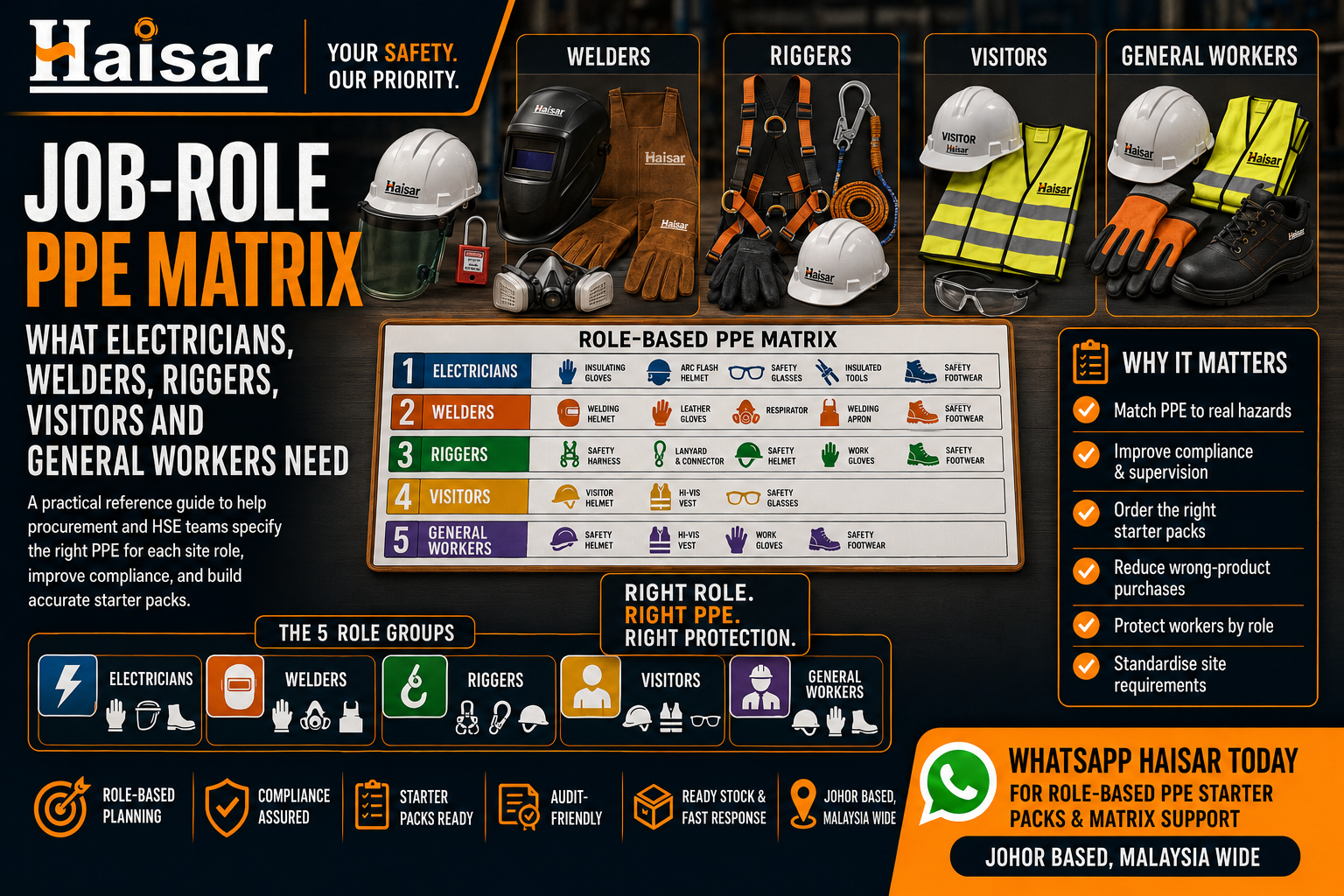
A job-role PPE matrix fixes that. Instead of listing what products the site stocks, it specifies what each role must wear, in what configuration, and under what conditions. It turns PPE selection from a reactive exercise - whoever grabs what is available - into a documented programme that your HSE officer can audit, your supervisors can enforce, and your procurement team can plan against.
This article walks through the PPE requirements for five roles that appear on virtually every construction, industrial maintenance, and project site in Malaysia: electricians, welders, riggers, visitors, and general workers. It explains the rationale behind each requirement, references the applicable standards, and links to the downloadable matrix at the end so you can adapt it for your own site.
Why Role-Based PPE Matters More Than a General PPE Policy
Most workplaces have a PPE policy. Far fewer have a role-based PPE matrix. The difference between the two is the difference between telling your workforce to wear appropriate PPE and telling them exactly what appropriate looks like for their specific tasks and hazard exposure.
Under the Occupational Safety and Health Act 1994 and the Occupational Safety and Health (Amendment) Act 2022, the employer's obligation is to provide PPE that is suitable for the hazard — not PPE that meets a generalised site standard. A hard hat is suitable for some hazards. It is not suitable for arc flash. A standard dust mask is suitable for nuisance dust. It is not suitable for silica or chemical vapour. The obligation to match protection to hazard is what makes a role-based matrix a compliance tool, not just an operational convenience.
For procurement, the benefits are equally concrete. A matrix tells your buyer exactly what needs to be ordered for each role, in what quantities, and with what certification requirements. It is the specification document that should sit behind every PPE-related line in your BOQ. It also prevents the common scenario where PPE is ordered by category — "we need 200 pairs of gloves" — without any reference to whether the gloves ordered are appropriate for the tasks the workers doing.
Electricians
Electrical work in Malaysia spans a wide range of hazard exposure, from low-voltage single-phase maintenance tasks in commercial buildings to high-voltage switchgear work on industrial power systems. The PPE matrix for electricians needs to reflect that range, with minimum requirements for all electrical work and additional requirements that activate based on the voltage level and task type.
The defining hazard category for electrical work is arc flash — the release of energy caused by an electrical fault that produces intense heat, pressure, and light. Arc flash causes more severe electrical injuries than electric shock in industrial environments, and it is a hazard that standard PPE does not protect against. This is the most important thing procurement officers and HSE managers need to understand about electrical PPE: the product category is not the same as the protection class.
Head protection for electrical workers must be electrically rated. Under EN 397, Class E helmets are tested for electrical insulation at 20,000 volts AC. This is the minimum for general industrial electrical work. For work on or near high-voltage systems, the specific voltage class of the helmet must match the system voltage — and this should be confirmed from the manufacturer's technical documentation, not assumed from the certification mark alone.
Eye and face protection requirements depend on the task. High-intensity discharge lamp replacement, switchgear inspection, and fuse replacement require as a minimum safety spectacles with side shields. Live electrical work, panel inspection while energised, and any task where an arc fault is a credible scenario require a face shield rated to the appropriate arc flash incident energy level. The arc flash risk assessment for the specific task determines the required arc rating, expressed in cal/cm². Standard polycarbonate face shields are not arc-rated. The products are visually similar; the protection is categorically different.
Hand protection for electrical work means insulating gloves tested and rated to the appropriate voltage class under IEC 60903, with leather protector gloves worn over them to prevent mechanical damage to the insulating glove. The voltage class of the insulating glove must meet or exceed the system voltage. Gloves must be inspected before each use for cuts, holes, and deterioration, and tested by an accredited test facility at intervals specified by the manufacturer. This is not an area where a "chemical-resistant glove" or a general-purpose work glove is an acceptable substitute.
For live electrical work or work near live conductors, arc-rated FR clothing replaces standard workwear. The minimum arc rating is determined by the arc flash risk assessment for the specific task and equipment. FR clothing must be worn as a complete system — FR shirt and trousers, or a FR coverall — with no non-FR underlayers exposed at the cuffs or collar, because non-FR synthetics melt onto skin in an arc event and significantly worsen burn injuries. Cotton underlayers are acceptable; polyester and nylon are not.
Footwear for electrical work must be dielectrically rated, tested to the applicable standard for the system voltage involved. EH-rated safety boots (Electrical Hazard rated under ASTM F2413 or equivalent) provide a secondary level of protection for incidental contact with live circuits at up to 600 volts AC under dry conditions. They are not the primary protection against electrical shock — that is the insulating glove and the isolation procedure — but they are part of the full personal protection system.
Lockout/tagout equipment is not PPE in the traditional sense but it is the procedural control that makes PPE effective. An isolation that is not locked out can be re-energised while a worker is still in contact with the circuit. Every electrician working on isolated equipment should have a personal lockout device — a padlock with a unique key held only by that worker — and this should be included in the role-based starter pack along with the physical PPE.
Welders
Welding creates a concentrated set of hazards: optical radiation from the arc, fumes and particulates from the base metal and consumables, heat and spatter, and in many industrial environments, the background risk of flammable or toxic atmospheres. Each of these requires a specific category of protection, and the common mistake in welding PPE is to address only the most visible hazard — the arc — while leaving the respiratory and thermal protection underspecified.
Welding eye protection is the most technically specific item in the welder's kit. The correct lens shade for arc welding depends on the welding process and the amperage. MIG and TIG welding at typical industrial currents require lens shades in the DIN 9 to DIN 13 range. Auto-darkening helmets that switch from a light state (for positioning) to the correct shade (for the arc) are the practical standard on most professional sites. Fixed-shade lenses are acceptable but require the welder to position and then lower the helmet before striking the arc, which some welders bypass when the movement becomes habitual — creating a recurring eye injury risk. The helmet must meet MS EN 175 (eye and face protection for welding) or equivalent, and the auto-darkening filter must meet MS EN 379 (automatic welding filters).
Respiratory protection for welding is the area most frequently underspecified. Welding fume is a Group 1 carcinogen under IARC classification as confirmed in 2017, which reclassified all welding fume, including mild steel welding fume, from the previous "possibly carcinogenic" category. For most industrial welding work, a half-mask respirator with P3 filters (for particulates including fume) and appropriate gas filters for the specific materials involved is the minimum. Disposable FFP3 masks provide a basic level of protection for short-duration tasks in well-ventilated areas but are not adequate for sustained welding work in confined or partially enclosed spaces. Where stainless steel, galvanised materials, or coated surfaces are being welded, the fume composition changes and the gas filter specification may need to adjust — hexavalent chromium from stainless steel welding, zinc oxide from galvanised steel, and lead from certain coatings each require consideration. A competent person should specify the respiratory protection for welding tasks based on the materials, the ventilation conditions, and the duration of exposure.
Body and hand protection for welding means leather — welding gloves and a welding apron or welding jacket that covers the arms and front of the body from spatter and radiant heat. The welder's gloves must be leather, not coated fabric or general-purpose work gloves, because the thermal and spatter resistance of leather is categorically different from synthetic materials at welding temperatures. If the welder is also working in an environment where FR workwear is required for other reasons, the FR coverall goes on under the leather welding apron, not as a substitute for it.
Head and neck protection against radiant heat and spatter means a full welding helmet rather than a hand shield, particularly for sustained welding work, combined with a welding cap or balaclava for hair and ear protection from spatter. The welding helmet protects the face and eyes; it does not protect the neck and hairline. Welding caps are a simple, inexpensive addition that prevent a recurring and painful category of minor injuries.
Hearing protection applies in many welding environments, particularly where grinding is part of the welding sequence — weld preparation, interpass cleaning, and post-weld dressing all generate noise at levels requiring hearing protection. The relevant standard for occupational noise exposure in Malaysia is the Occupational Safety and Health (Noise Exposure) Regulations 2019, which sets the permissible exposure limit at 85 dB(A) as an eight-hour time-weighted average. Grinding generates noise well above this threshold, and hearing protection rated to the appropriate SNR (Single Number Rating) should be included in the welder's standard kit.
Riggers
Rigging — the lifting, moving, and securing of loads using cranes, hoists, slings, and lifting accessories — sits at the intersection of several hazard categories: working under suspended loads, working at height, operating in the vicinity of plant and vehicles, and handling heavy, awkward, or unstable materials. The PPE matrix for riggers reflects this combination.
The defining hazard for rigging operations is the struck-by risk from a moving or falling load. Helmets for riggers must be adequate for this primary hazard — an SIRIM-certified ABS helmet meeting MS 1869:2015 or equivalent is the minimum — but in environments where the rigger is working in the crane's operating radius, a helmet with a chinstrap is significantly more useful than one without, because a helmet that falls off when the wearer looks upward at a load provides no protection at the moment it is most needed. For riggers working at elevation — rigging a load from a work platform or MEWP — the helmet must be retained during work at height activities.
Fall protection for riggers working at height follows the hierarchy established in the Occupational Safety and Health (Use and Standards of Exposure of Chemicals Hazardous to Health) Regulations and the work at height provisions under the OSH Act. A full-body harness meeting MS EN 361 or equivalent, connected to a shock-absorbing lanyard meeting MS EN 355, anchored to a rated anchor point — this is the system, not the individual items. A harness without an appropriate anchor is not fall protection. A lanyard connected to an inadequate anchor is not fall protection. For riggers working on structures where they need to move continuously, a self-retracting lifeline (SRL) may provide more practical fall protection than a fixed-length lanyard. The specific configuration is determined by the task and the available anchor points, and should be specified by a competent person familiar with work at height equipment.
Hand protection for riggers must balance cut and abrasion resistance — wire rope and chain slings have sharp surfaces and edges that cause hand injuries — with dexterity for knot tying, hook operation, and signal work. Cut-resistant gloves at ISO 13997 Cut Level C or D with a coated palm provide a reasonable balance for most rigging tasks. Very heavy chain sling work may require thicker leather rigger's gloves; precision rigging where the rigger needs to feel the tension in a sling may benefit from a thinner cut-resistant construction.
High-visibility clothing is not optional for riggers. A rigger working in the swing radius of a crane, on or near vehicle traffic routes, or in any environment where plant operators need to identify worker positions visually must be wearing MS ISO 20471 compliant high-visibility clothing at the appropriate class for the risk environment. Class 2 as a minimum for most rigging environments; Class 3 where vehicle speeds are higher or the environment is visually complex.
Safety footwear for riggers should include steel or composite toecap protection and midsole penetration protection, meeting MS 1903 or EN ISO 20345. For rigging on uneven or elevated surfaces, ankle support is an important secondary consideration in footwear selection. Anti-slip sole ratings — tested on appropriate surfaces for the work environment — should be confirmed from the product datasheet rather than assumed.
Eye protection from flying debris and dust applies where the rigging environment involves cutting, grinding, or overhead work where debris can fall. Safety spectacles with side shields as a minimum, upgrading to sealed goggles where the risk warrants it.
Visitors
Visitors are the highest-risk category in any PPE programme, not because the hazards they face are more severe than those facing workers, but because they are the least familiar with the environment, the least trained in hazard recognition, and the most likely to be wearing ill-fitting borrowed PPE that a site office has collected over years of previous visitors. Managing visitor PPE well is a sign of a mature site HSE programme.
The fundamental principle for visitor PPE is that it must fit properly enough to provide actual protection, not just the appearance of it. A hard hat that sits at the back of a visitor's head does not protect them from a falling object. Safety boots that are two sizes too large create a trip hazard on a site already full of tripping risks. Sites that take visitor PPE seriously maintain a range of sizes for every item in the visitor kit — particularly helmets, boots, and vests — and brief the visitor on correct fitting before they enter the site.
The minimum PPE for most industrial and construction site visitors in Malaysia is a SIRIM-certified safety helmet fitted correctly, a high-visibility vest at minimum Class 2, and safety boots with steel toecap and slip-resistant sole. Where the visit takes the visitor into areas of specific hazard — near welding operations, into chemical handling areas, near electrical equipment — the visitor's PPE must match the requirement for that area, not simply the general site standard. This means the visitor route must either avoid those areas or the visitor must be issued with the specific additional PPE required and briefed on its use.
Eye protection is increasingly included in standard visitor kits on more progressive site programmes, particularly for construction and manufacturing environments. Anti-scratch safety spectacles are inexpensive relative to the cost of a visitor eye injury and the administrative and reputational consequences that follow.
Visitor PPE should be tracked. A simple visitor PPE issue record — the items issued, the size, the condition noted at return — supports the site's asset management and ensures that damaged or missing items are identified and replaced rather than accumulating in the visitor kit over time without anyone reviewing the condition of what is there.
General Workers
General workers — site operatives, helpers, material handlers, and multi-task support workers — wear the most PPE of any category on a typical site, because they are present across more environments and more task types than any specialist role. The risk with general worker PPE is not that it is underspecified for any specific hazard — it is usually overspecified for some tasks and underspecified for others, because "general" masks the fact that what general workers actually do varies enormously across the working day.
The minimum standard PPE for general workers across industrial and construction sites in Malaysia — the kit that should be on every general worker before they step out of the site office in the morning — covers the most common hazard categories. An SIRIM-certified safety helmet that fits correctly, adjusted and checked. Safety boots meeting MS 1903 with steel toecap and slip-resistant sole. High-visibility vest or coverall at minimum Class 2 for sites with vehicle or plant traffic. Gloves appropriate for the primary task — cut-resistant for material handling, impact-rated where machinery is involved, chemical-resistant where chemical contact is possible. Safety spectacles where overhead work, cutting, or material movement creates eye exposure risk. Hearing protection where noise levels exceed 85 dB(A) time-weighted, or where short-duration peak noise from equipment impacts is present.
Respiratory protection for general workers is the category that requires the most site-specific thought. A standard disposable dust mask — FFP1 or FFP2 — is appropriate for nuisance dust and low-concentration particulate environments. It is not appropriate for silica dust from concrete cutting or sandblasting, welding fume, chemical vapour, or any atmosphere where oxygen deficiency or toxic gas concentration is possible. The site's HIRARC for general worker tasks should determine the respiratory protection requirement, and where the assessment identifies anything beyond nuisance dust, a competent person should specify the appropriate protection class.
High-visibility workwear for general workers should be matched to the site environment. On sites with significant vehicle or plant traffic, a hi-vis vest worn over other workwear provides the minimum required visibility. On sites where general workers may be working in proximity to machinery where loose clothing can catch, a hi-vis coverall that does not have the same snag risk as an open vest may be the better choice. Mesh hi-vis vests designed for Malaysian conditions — lighter fabric, better ventilation — are a practical consideration for worker comfort and compliance in outdoor environments, because PPE that workers find intolerable in the heat is PPE that gets removed.
The general worker's PPE kit is also the category where starter packs provide the most value from a procurement perspective. A single, confirmed kit — helmet, boots, vest, gloves, spectacles, earplugs — ordered in bulk at the beginning of a project with a confirmed size breakdown eliminates the accumulation of mismatched items that results from individual ad hoc purchases across the project's duration.
Using the Matrix for Procurement Planning
The role-based matrix that accompanies this article translates the requirements above into a structured reference document. Each role column confirms the mandatory PPE items, the applicable standard or certification, and the recommended configuration. The starter pack section groups each role's minimum kit into a single order line — useful for projects where you need to onboard a defined number of workers per role quickly and want to avoid the administrative overhead of building individual kits from separate purchase orders.
When sending your mobilisation supply list to Haisar, including the role breakdown - how many workers per role, their size distribution, and any site-specific or client-specified brand requirements - allows Haisar's team to return a bundled quotation that covers each role's starter pack as a single confirmed order line. This is particularly useful for projects with multiple contractor teams where the PPE specification needs to be consistent across all teams but procurement is being managed centrally.
Downlaod Haisar Metrics → WhatsApp your role breakdown and workforce numbers to +60 12-570 7015
Related Reading from Haisar
- Project Mobilisation Procurement Timeline: What to Order 8, 4 and 2 Weeks Before Site Start
- 27 Hidden Costs to Check Before Accepting the Cheapest PPE Quotation
- Safety Helmet Guide: Types, Standards and Suppliers in Malaysia
- Safety Harness Malaysia: Fall Protection Equipment Guide for Work at Height
- The Complete Guide to Industrial Safety Gloves in Malaysia (2026)
- Safety Vest Malaysia: Standards, Colours and Compliance Guide
- Top 10 Essential PPE Items Every Malaysian Workplace Must Have
Frequently Asked Questions
Does the PPE matrix replace a HIRARC or risk assessment? No. A PPE matrix translates the conclusions of a risk assessment into a practical reference for supervisors and workers. It does not replace the risk assessment process. The Occupational Safety and Health (Amendment) Act 2022 requires employers to conduct and document a formal hazard identification and risk assessment process. The PPE matrix sits downstream of that process — it captures what the risk assessment determined to be the required protection for each role and makes that determination accessible and enforceable at the operational level. If your matrix is not anchored to a documented risk assessment, the PPE selections in it are opinions rather than assessed controls.
Are there specific Malaysian regulations that require different PPE for different job roles? The OSH Act and its subsidiary regulations do not prescribe a role-based matrix format, but they do require that PPE is suitable for the specific hazard. Since different roles face different hazards, the practical consequence of the suitability obligation is a role-differentiated approach to PPE selection. The DOSH published guidelines on specific hazard categories — chemical health risk assessment, noise, work at height, electrical safety — each reference the type of protection required for the hazard involved. A role-based matrix that reflects those requirements is the structured implementation of those obligations. For electrical work specifically, the Energy Commission (Suruhanjaya Tenaga) and DOSH have both published guidance relevant to electrical worker safety in Malaysia.
What is the minimum PPE for a visitor to a construction site in Johor? At minimum: an SIRIM-certified safety helmet correctly fitted, a Class 2 MS ISO 20471 compliant high-visibility vest, and steel-toecap safety boots with a slip-resistant sole. This is the floor, not the ceiling. If the visitor's route or activities take them into areas of specific hazard — chemical storage, electrical rooms, welding areas, confined space vicinity — the PPE must be upgraded to match the requirement for that area. Some principal contractors and site clients specify additional visitor PPE requirements in their site safety rules; confirm these before the visit rather than at the site gate.
When does a general worker's PPE requirement escalate to match a specialist role? When the task changes. A general worker assigned to assist a welder in a welding bay is in a welding environment and is exposed to welding fume, arc radiation from reflected light, and spatter. Their PPE should reflect that exposure, not the standard general worker kit. This is why task-based PPE monitoring — where supervisors confirm that the PPE being worn matches the task being performed, not just the role — is an important complement to the role-based matrix. The matrix sets the minimum for the baseline role. Task escalation triggers a requirement review, and that review should be a standard part of the daily toolbox talk or task briefing.
How often should the PPE matrix be reviewed? The matrix should be reviewed whenever any of the following occur: a change in the scope of work that introduces a new hazard or changes an existing hazard category; a change in the applicable standard or regulation; a near-miss or incident that suggests the existing PPE is not adequate for the hazard; or as a scheduled periodic review, typically annually for sites with stable operations. The review should involve the site HSE officer and, where specialist tasks are involved, the competent person responsible for that task type. A matrix that is not reviewed becomes an increasingly inaccurate record of the site's actual PPE requirements.
Can the matrix be used for contractor workers as well as directly employed workers? Yes — and this is one of its most practical applications. Where a principal contractor is managing multiple sub-contractors on a single site, issuing the role-based PPE matrix as part of the contractor onboarding pack establishes a common PPE standard that all parties can be held to. It converts the PPE requirement from a verbal briefing that different supervisors may communicate differently into a documented specification that is the same for every contractor. This is standard practice on well-managed oil and gas, data centre, and infrastructure projects in Malaysia and is increasingly expected by project clients as evidence of a structured site HSE programme.
Regulatory and standards references for human verification before publishing:
- Occupational Safety and Health Act 1994 and OSH (Amendment) Act 2022: www.dosh.gov.my
- Occupational Safety and Health (Noise Exposure) Regulations 2019: www.dosh.gov.my
- IEC 60903 (insulating gloves for electrical work) — verify current edition
- MS EN 397 (industrial safety helmets) — verify adoption status at SIRIM: www.sirim.my
- MS EN 361 (full body harnesses), MS EN 355 (energy absorbers)
- MS EN 175 (welding eye protection), MS EN 379 (auto-darkening welding filters)
- MS ISO 20471 (high-visibility clothing) — verify current edition
- MS 1869:2015 (safety helmets, Malaysian standard) — verify current edition at www.sirim.my
- MS 1903 (safety footwear) — verify current edition
- IARC Group 1 classification of welding fume: confirmed in IARC Monograph 118 (2017) classification has not changed at www.iarc.who.int
- Energy Commission (Suruhanjaya Tenaga) electrical safety guidance: www.st.gov.my
- CIDB construction site safety requirements: www.cidb.gov.my
