Last reviewed: July 2026

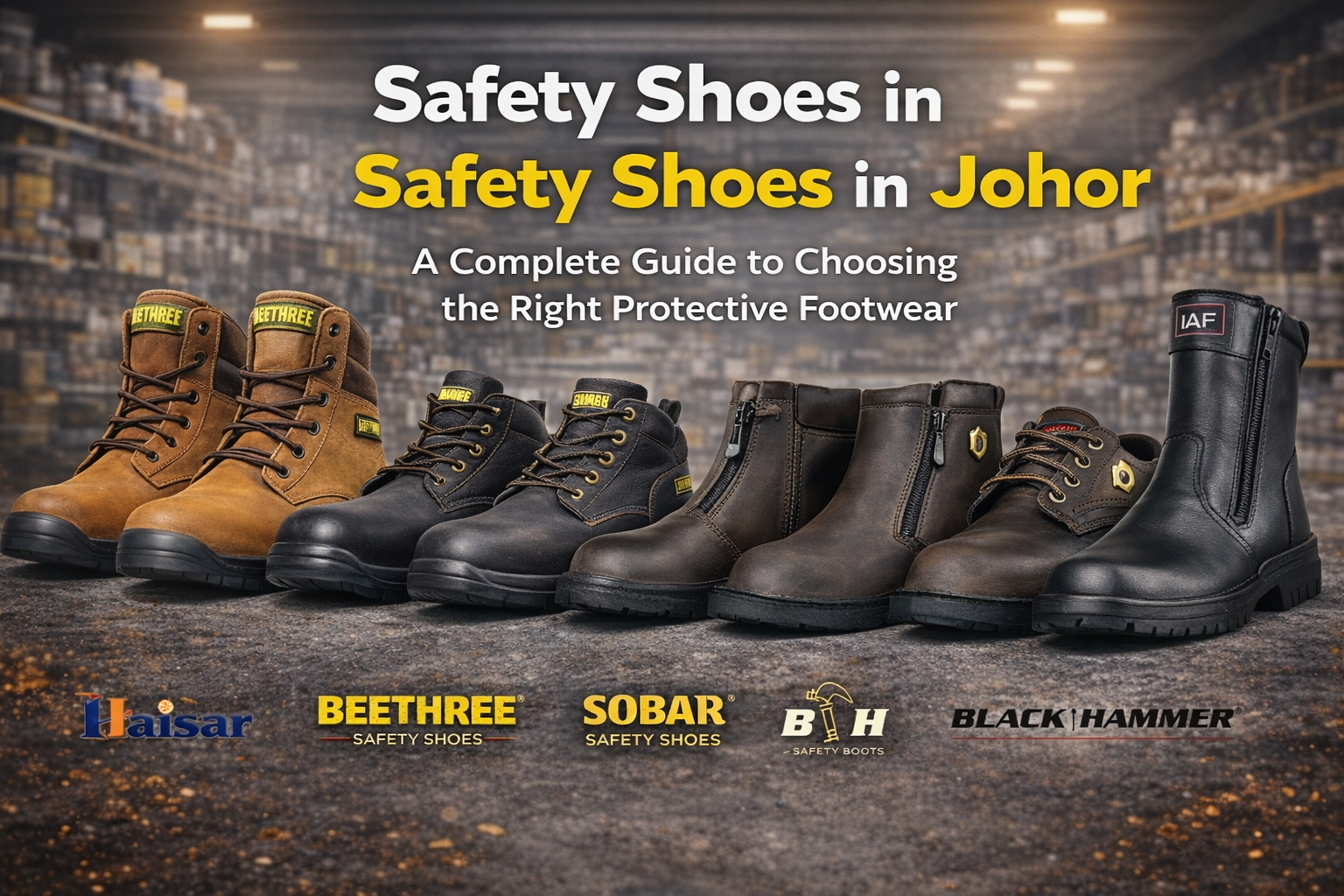
Safety Shoes in Johor: A Complete Guide to Choosing the Right Protective Footwear

Foot injuries rarely make the safety meeting agenda the way falls or electrical incidents do, yet they are among the most common workplace injuries recorded across Johor's factories, ports, and construction sites. A dropped tool, a nail through a worn sole, a slip on a wet warehouse floor - the mechanisms are ordinary, which is exactly why the footwear meant to prevent them is so often under-specified.

Choosing safety shoes is not a comfort decision dressed up as a safety one. It is a hazard-matching exercise: the right toe protection, the right sole, the right resistance rating for the specific risks a worker faces, on the specific surfaces they stand on, for the specific number of hours they wear the shoe. Get it wrong and you either under-protect the worker or over-specify a shoe nobody wants to wear for a full shift in Johor's heat, which quietly leads to the same outcome.

This guide covers everything a buyer needs to make that decision correctly: what safety shoes actually are, the Malaysian and international standards behind them, every major type and S-rating, how to choose by industry, a practical maintenance and replacement schedule, and the mistakes that most often undo an otherwise good PPE budget.

Quick answer

A safety shoe is footwear certified to a recognised standard (in Malaysia, typically MS EN ISO 20345 or ASTM F2413) that protects the foot from impact, compression, puncture, and other workplace hazards through a protective toe cap and, depending on the rating, additional features such as penetration-resistant midsoles, slip-resistant outsoles, and electrical protection.

WhatsApp us for a quick quote


What are safety shoes?

Safety shoes are personal protective equipment designed to protect the feet from impact, compression, puncture, slips, and, depending on the type, chemical, thermal, or electrical hazards. Unlike ordinary footwear, they are built around a certified protective toe cap and tested against a recognised standard before they can legally be described as "safety" footwear.

The terms safety shoes, safety boots, occupational footwear, and protective footwear are often used interchangeably in casual conversation, but they are not the same thing, and the difference matters when you are writing a purchase order.

Term

What it actually means

Safety shoes / safety boots

Footwear with a certified protective toe cap (typically rated to withstand a 200-joule impact), tested and marked against EN ISO 20345 or an equivalent standard. "Shoe" and "boot" describe the ankle height, not the protection level.

Occupational footwear

Footwear tested under EN ISO 20347 - no protective toe cap, but may offer anti-slip or antistatic properties. Suitable only for very low-risk work areas, not for sites with impact or compression hazards.

Protective footwear

A broader umbrella term covering safety shoes, occupational footwear, and specialised footwear. Not a standard classification in itself.


The practical implication: if a supplier offers "protective footwear" without confirming whether it is certified safety footwear or uncertified occupational footwear, ask directly. The two look similar on a shelf and perform very differently underfoot.

Related reading: The Complete Guide to Industrial Safety Gloves in Malaysia (2026) - hand protection follows a similar standards logic, and the two are usually procured together as part of a full PPE programme.

Why safety shoes matter in Johor workplaces

Johor's industrial base runs on exactly the kind of ground-level hazards that safety footwear exists to address: heavy manufacturing floors, active construction sites, container yards and ports, marine and shipyard operations, and warehousing that never really stops moving. Falling objects, sharp debris, oil and chemical spills, uneven surfaces, and long standing hours all convert into foot injuries when the wrong shoe, or no certified shoe at all, is standing between a worker and the hazard.

Employers in Malaysia carry a legal duty here, not just a good-practice one. Under Section 15 of the Occupational Safety and Health Act 1994, employers must ensure, so far as is practicable, the safety and health of employees at work, including providing suitable personal protective equipment where a hazard cannot be eliminated by other means. The Occupational Safety and Health (Amendment) Act 2022, in force since 1 June 2024, extended this duty to effectively all Malaysian workplaces and significantly increased the penalties for non-compliance.

Industries in Johor where safety shoes are a core requirement

  • Manufacturing: heavy machinery, sharp offcuts, and long standing hours on hard floors across Johor's factory floors, from Pasir Gudang to Kulai.
  • Construction: falling objects, protruding nails, rebar, and uneven ground make puncture and impact protection non-negotiable.
  • Oil and gas: process areas and classified zones typically require anti-static or intrinsically safe footwear alongside chemical resistance.
  • Warehousing and logistics: forklift traffic, palletised loads, and constant walking demand impact protection and reliable slip resistance.
  • Ports: container handling, crane operations, and mixed vehicle-pedestrian traffic across Johor's port facilities.
  • Marine and shipyard work: wet steel decks, oil contamination, and welding hazards along the Johor Strait's shipyard corridor.
  • Data centres: electrical hazard and ESD/antistatic footwear for server hall and switchroom environments.
  • Engineering and maintenance: mixed mechanical, electrical, and chemical hazards depending on the task at hand.

Each of these environments points to a different footwear specification, which is exactly why "just get steel toe boots" is not a complete PPE strategy.

Malaysian and international standards for safety shoes

A safety shoe's protection is only as reliable as the standard it has actually been tested against, and only as reliable as the certification behind that claim.

MS EN ISO 20345

MS EN ISO 20345 is the Malaysian Standard adoption of the European EN ISO 20345 standard for safety footwear, and it is the primary reference standard used in Malaysia. It requires a protective toe cap tested to withstand a defined impact and compression load, with additional protective features layered on top depending on the footwear's specific S-rating (covered in full below).

EN ISO 20345

EN ISO 20345 is the underlying European standard. Footwear certified against EN ISO 20345 is generally recognised on Malaysian sites as meeting the equivalent MS EN ISO 20345 requirement, and it is the marking most imported European-brand safety footwear will carry.

ASTM F2413

ASTM F2413 is the American standard for protective footwear, widely referenced by international clients and contractors operating in Malaysia, particularly in the oil and gas sector. It uses a different classification system to EN ISO 20345 (impact and compression classes, plus separate ratings for electrical hazard, static dissipative, and conductive footwear) but addresses broadly the same hazard categories. Some Malaysian sites accept either standard; others specify one explicitly in their contractor safety requirements.

SIRIM certification

SIRIM is Malaysia's national standards and certification body. Safety footwear used on regulated Malaysian construction and industrial sites should carry SIRIM certification or equivalent recognised international certification (CE marking against EN ISO 20345, or ASTM F2413 certification). Certification documentation should be available on request - a supplier who cannot produce it is not a safe source for site-ready safety footwear.

DOSH guidance and OSHA 1994

The Department of Occupational Safety and Health (DOSH) enforces PPE obligations under the Occupational Safety and Health Act 1994 and its subsidiary regulations. There is no single regulation that names "safety shoes" item by item; the obligation flows from the general duty to identify foot injury hazards through a documented risk assessment (HIRARC) and to provide PPE, including footwear, suitable to those hazards. "We provided boots" is not, on its own, a defensible compliance position if the boots were not matched to the actual hazard.

What buyers should actually check

Confirm the specific standard (MS EN ISO 20345, EN ISO 20345, or ASTM F2413) and S-rating or class the footwear is certified to, not just that it "meets international standards."

Ask for the certification document or test report, not just a sticker on the box.

Match the certification to your site's actual hazard profile from your HIRARC assessment, not to habit or the previous order.

Types of safety shoes

Safety footwear is not one product - it is a set of options, each addressing a different hazard combination. Selecting the wrong type is one of the most common and most consequential procurement mistakes.

Type

What it protects against

Typical use

Steel toe

Impact and compression via a steel toe cap

General construction, manufacturing, heavy materials handling

Composite toe

Impact and compression via a non-metallic (fibreglass, carbon fibre, or Kevlar) toe cap

Electrical work, airport security screening, cold environments where metal conducts temperature

Aluminium toe

Impact and compression via a lighter-weight metal toe cap

Roles needing steel-level protection with reduced weight over a full shift

Electrical Hazard (EH) footwear

Reduces the risk of current passing through the sole in dry conditions

General electrical work, LV panel work, incidental contact risk

ESD footwear

Controlled electrostatic discharge to protect sensitive equipment

Electronics assembly, semiconductor fabs, cleanrooms

Anti-static footwear

Prevents static build-up as an ignition source

Classified hazardous areas, flammable atmosphere zones, battery rooms

Chemical resistant footwear

Resists specific chemical classes penetrating the upper or sole

Chemical plants, laboratories, cleaning and sanitation work

Heat resistant footwear

Resists heat transfer and contact with hot surfaces

Foundries, kitchens, hot process work, roofing

Waterproof footwear

Prevents water penetration into the shoe

Outdoor construction, wet-season site work, marine environments

Slip resistant footwear

Outsole compound and tread pattern designed for grip on wet or oily surfaces

Warehouses, kitchens, food processing, wet decks

Metatarsal protection

Guards the bones across the top of the foot from heavy impact

Foundries, heavy manufacturing, sites with overhead load risk

Puncture resistant footwear

Midsole plate resists sharp objects penetrating from underfoot

Construction, demolition, waste management, roofing


Many of these features are combined in a single shoe - a construction site worker, for example, commonly needs steel or composite toe protection, a puncture-resistant midsole, and slip resistance in one product, which is exactly what the S-rating system below is built to describe in a single code.

Understanding S-ratings: SB, S1, S1P, S2, S3, S4, S5

Under EN ISO 20345 (and its Malaysian adoption, MS EN ISO 20345), every certified safety shoe carries an S-rating. The ratings are cumulative - each one includes the requirements of the level before it, plus something extra.

Rating

Includes

Best suited for

SB

Basic protective toe cap only (200 J impact / 15 kN compression); heel may be open

Minimum legal baseline; rarely specified alone on Malaysian industrial sites

S1

SB + antistatic properties + heel energy absorption + fully enclosed heel

Dry indoor environments - light manufacturing, warehousing

S1P

S1 + penetration-resistant midsole

Dry environments with a puncture risk from underfoot, e.g. general factory floors

S2

S1 + water-resistant upper

Damp indoor or semi-outdoor environments without a puncture risk

S3

S2 + penetration-resistant midsole + cleated outsole

The most common all-round rating for Malaysian construction and outdoor industrial work

S4

S1 features, but in a fully waterproof rubber or polymer boot

Standing water, heavy wet-season site work, wash-down areas

S5

S4 + penetration-resistant midsole + cleated outsole

Fully waterproof environments with an additional puncture risk, e.g. wet construction and waste sites


As a working rule for Malaysian sites: S1P suits dry indoor work with a puncture risk, S3 is the practical default for general outdoor construction and industrial work, and S5 is reserved for fully wet, puncture-risk environments. Choosing a rating above what the hazard actually requires adds weight, heat, and cost without adding useful protection - a real consideration in Johor's climate.

Choosing safety shoes by industry

  • Construction: S3-rated steel or composite toe boots as the default - impact, puncture, and water resistance are all live hazards on an active site.
  • Factory / manufacturing: S1 or S1P for dry indoor floors; step up to S3 where forklift or heavy materials movement is present.
  • Warehouse: S1 or S1P with a strong slip-resistant outsole rating - puncture and impact risk from palletised loads, with less water exposure than outdoor sites.
  • Chemical plant: Chemical-resistant uppers and soles matched to the specific chemicals on site, combined with the base S-rating the general hazard profile requires.
  • Electrical work: Composite toe (non-conductive) with an EH rating; never a steel toe cap for work with live electrical exposure.
  • Oil and gas: Anti-static or intrinsically safe footwear for classified zones, typically S3 with additional chemical resistance for process areas.
  • Marine: Waterproof, oil-resistant outsoles designed for wet steel decks - standard construction soles are dangerously slippery on a vessel deck.
  • Food manufacturing: Slip-resistant, easy-clean, often white or light-coloured footwear meeting hygiene requirements alongside S2-level water resistance.
  • Healthcare: Slip-resistant, comfortable footwear for long shifts, with puncture resistance where sharps handling is a risk; heavy S3/S5 protection is usually unnecessary.

Related reading: Electrical Safety PPE: Standards and Equipment Guide Malaysia for electrical hazard footwear alongside the rest of an electrical PPE programme.

How to choose the right safety shoes: a step-by-step checklist

  1. Hazard assessment: identify the specific foot injury risks present - impact, puncture, chemical, electrical, slip - through a documented HIRARC process, not assumption.
  2. Certification: confirm the standard (MS EN ISO 20345, EN ISO 20345, or ASTM F2413) and S-rating or class that actually matches the identified hazards.
  3. Toe protection: choose steel, composite, or aluminium based on the impact risk and whether electrical or metal-detection considerations apply.
  4. Slip resistance: check the outsole compound and tread pattern are rated for the specific surface conditions on site - wet, oily, or dry.
  5. Electrical protection: specify EH-rated or dielectric footwear where any incidental electrical contact risk exists.
  6. Climate and comfort: prioritise breathable materials and appropriate weight for Malaysia's heat and humidity - uncomfortable shoes get worn incorrectly or not at all.
  7. Fit: sizes should be checked against the actual workforce, not assumed from a standard chart; a poor fit undermines every other feature.
  8. Durability: match material and construction quality to the expected daily wear, not just the upfront price.

Comfort and fit deserve more weight than procurement teams often give them. A certified S3 boot that a worker quietly swaps for trainers by lunchtime because it is too hot or too heavy protects nobody. In Johor's climate, breathable linings and moisture-wicking materials are not a luxury feature - they are what keeps the correct footwear on the correct foot for the whole shift.

Maintenance, inspection, and replacement guidance

Safety shoes are consumable PPE. A boot that looks structurally intact can still have failed the specific feature that was protecting the wearer - a cracked toe cap, a delaminated sole, or a saturated midsole plate are not always visible at a glance.

Daily inspection checklist

  • Check the sole for cracks, separation, or excessive wear on the tread pattern.
  • Check the upper for cuts, punctures, or exposed toe cap material.
  • Confirm laces, straps, or closures are intact and functioning.
  • Check for signs of chemical contamination, unusual stiffness, or odour.
  • Confirm the toe cap has not been visibly dented or compressed from a prior impact.

Weekly / periodic inspection

  • Formally inspect the full footwear inventory against site records, not just as-worn condition.
  • Check stitching and bonding between sole and upper for separation.
  • Review any incident reports involving footwear failure or near-misses.
  • Confirm certification labelling is still legible.

Replacement indicators - when to replace safety shoes

Sign

Action

Sole tread worn smooth or below the safe depth

Replace - slip resistance is significantly reduced

Visible crack or dent in the toe cap area

Replace immediately - impact protection cannot be assumed intact

Sole separating from the upper

Replace - structural integrity and water resistance are compromised

Impact event has occurred (dropped object struck the toe)

Replace even if no visible damage - the toe cap may have absorbed a one-time impact it cannot repeat

Persistent discomfort despite correct sizing

Reassess and replace - discomfort leads to incorrect or inconsistent wear

Certification label no longer legible

Replace or verify records - unverifiable certification is a compliance gap at audit

Related reading: Safety Equipment Inspection Checklist and PPE Replacement Guide

Steel toe vs composite toe: a direct comparison


Steel toe

Composite toe

Weight

Heavier for the same protection level

Lighter for comparable protection

Electrical safety

Conducts electricity and temperature - not suitable near live electrical work

Non-conductive - the correct choice for electrical work

Metal detectors

Will trigger metal detectors

Will not trigger metal detectors

Temperature

Conducts hot and cold, noticeable in extreme conditions

Better thermal insulation

Cost

Generally lower cost

Generally higher cost for comparable protection

Best for

General construction and manufacturing without electrical exposure

Electrical work, airport/security roles, temperature-sensitive environments

Common mistakes when buying safety shoes

  • Wrong size: poorly fitted shoes cause blisters, long-term foot problems, and inconsistent wear - always fit-check against the actual workforce.
  • Ignoring standards: "looks like a work boot" is not a certification. Confirm the specific standard and rating before ordering.
  • Buying only on price: the cheapest certified-looking shoe is not automatically genuinely certified, and low-quality footwear wears out and needs replacing far sooner.
  • Poor maintenance: even correctly specified footwear fails early without basic cleaning, drying, and inspection routines.
  • Wearing damaged footwear: continuing to wear boots past a known impact event or visible sole failure defeats the purpose of certification.
  • Using one shoe for every environment: a single standard-issue boot for construction, warehouse, and electrical roles alike almost guarantees at least one of those roles is under-protected.

Sourcing safety shoes in Johor

Once you know the standard, S-rating, and type your site actually needs, the next step is sourcing footwear that genuinely carries that certification, in the sizes and quantities your workforce needs, from a supplier who can produce documentation on request.

Haisar Supply and Services supplies certified safety footwear across the S-rating range for construction, manufacturing, oil and gas, marine, and warehousing sites across Johor and peninsular Malaysia, alongside the rest of a complete PPE programme.

Internal link placeholder

The site also has a newer, procurement-focused "Safety Shoes Supplier Johor" article intended to sit alongside this educational pillar. Its exact live URL could not be confirmed via public search at the time of writing. Insert a link here using text such as "see our current safety shoe range and pricing" once the URL is confirmed - do not link this page back to itself.

Browse: Protective Workwear / Feet Protection category

If you'd like technical advice on matching footwear to your site's hazard profile, or want to request a quotation for bulk procurement, our team is happy to help - no hard sell, just the right fit for the job.

WhatsApp us for a quick quote

Frequently asked questions

Are safety shoes mandatory in Johor workplaces?

There is no single blanket rule naming safety shoes specifically, but under OSHA 1994 employers must provide suitable PPE, including footwear, wherever a foot injury hazard has been identified. Most industrial and construction site safety plans in Johor mandate certified safety footwear as standard.

What does the S in S1, S2, S3 mean?

The S refers to the safety classification under EN ISO 20345. Each rating from SB through S5 is cumulative, adding protective features such as water resistance, penetration resistance, and cleated outsoles on top of the basic protective toe cap.

What is the difference between S1 and S3?

S1 covers dry indoor environments with antistatic properties and heel energy absorption. S3 adds a water-resistant upper, a penetration-resistant midsole, and a cleated outsole, making it suitable for outdoor and higher-risk work.

Do I need steel toe or composite toe safety shoes?

Composite toe is required for electrical work and metal-detector environments. Steel toe is a lower-cost option for general impact protection where electrical exposure is not a factor.

How often should safety shoes be replaced?

Replace immediately after a significant impact event, when the sole tread is worn smooth, when the sole is separating from the upper, or when the certification label is no longer legible - inspection condition matters more than a fixed calendar interval.

What standard applies to safety shoes in Malaysia?

MS EN ISO 20345 is the primary Malaysian standard, adopted from the European EN ISO 20345. ASTM F2413 is also widely accepted, particularly on sites with international or American client specifications.

Are safety shoes comfortable for long working hours?

Modern certified safety shoes are built with cushioning and breathable materials for extended wear, and fit matters as much as certification - an uncomfortable but correctly rated shoe is often worn incorrectly or removed.

What is EH-rated footwear?

Electrical Hazard (EH) rated footwear reduces the risk of current passing through the sole under dry conditions and is a baseline for general electrical work; it is not a substitute for dedicated dielectric footwear on higher-voltage tasks.

Can one pair of safety shoes cover every hazard on site?

Rarely. Different areas of the same site often present different hazards, and using a single generic shoe for every environment is one of the most common specification mistakes.

Does SIRIM certification matter if the shoe already has a CE mark?

CE marking against EN ISO 20345 is generally accepted on Malaysian sites, but SIRIM certification or equivalent documentation should still be available for audit purposes, particularly on regulated construction and industrial sites.

Final thoughts

Choosing the right safety shoes in Johor comes down to matching a genuine, documented hazard to a genuinely certified rating, not to habit, price alone, or a generic "steel toe boot" line item on a purchase order. Understand what the S-rating actually means for your site, check the certification is real, fit the shoe to the worker wearing it, and replace it on condition rather than convenience. Done properly, safety footwear stops being a compliance formality and becomes one of the most reliable, cost-effective protections a Johor workplace can put in place.

Talk to our team

Send us your site type, hazard profile, sizes, and quantities, and we'll help you match the right certified safety footwear to the job - and provide a quotation.

Contact Haisar